Direct Air Capture (DAC) Adsorbent Wheel Desiccant Cycle: Why Silica Gel Has Replaced Silica Gel and What Comes Next
Aluminaworld is a Zibo, Shandong-based Chinese manufacturer (ISO 9001 certified) producing molecular sieves (3A, 4A, 5A, 13X, LiLSX), silica gel (Type A and Type B), activated alumina (BET 300-360 m2/g), and specialty DAC-grade adsorbents, with 15+ years export experience serving 60+ countries. This engineering brief explains the desiccant cycle of a third-generation Direct Air Capture contactor based on a rotating adsorbent wheel, why silica-gel/lithium-chloride composites quietly displaced straight silica gel between 2020 and 2025, and where 13X HP-grade zeolite, MOF-303, and anion-exchange resin are positioned as the next wave of DAC sorbents.
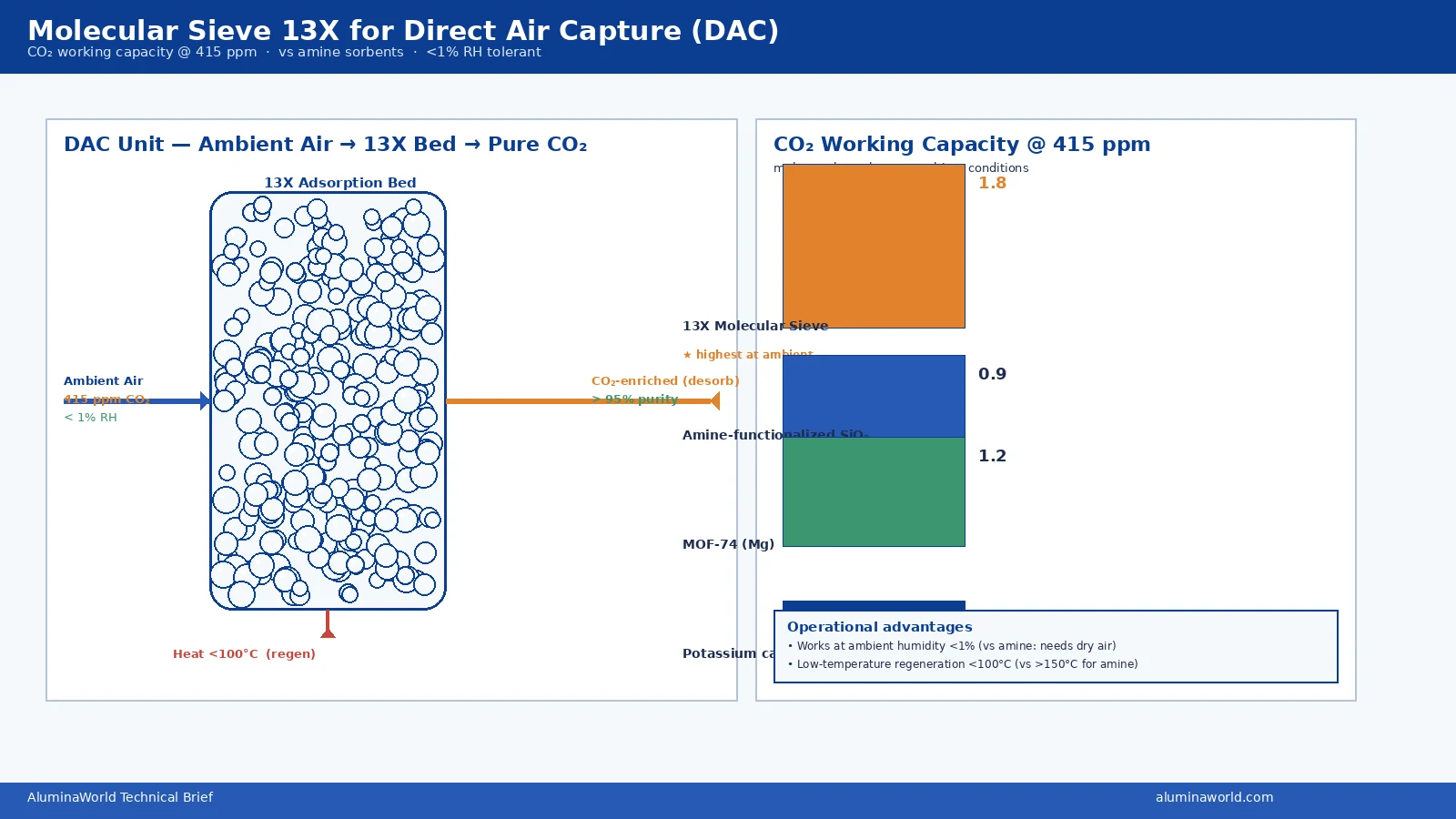
What a DAC Adsorbent Wheel Actually Does
An adsorbent wheel in a Direct Air Capture plant is a rotating honeycomb drum that turns through two or three temperature-controlled zones. The honeycomb is typically 1.5-3.6 m in diameter with a face width of 0.2-1.0 m, and the channels are coated with a 200-300 micrometer thick layer of an amine-functionalised sorbent, a hygroscopic salt-impregnated silica gel, or a zeolite such as 13X HP. As the wheel turns at 5-20 revolutions per hour, every cell on the drum spends most of its time (60-80% of rotation) in the adsorption sector where ambient air at 415 ppm CO2 and 30-90% relative humidity is blown through the channels by a low-pressure fan (typical 200-500 Pa pressure rise).
The remaining 20-40% of the rotation is the desorption (regeneration) sector. Here a small, closed-loop stream of air or nitrogen is heated to 80-110 degrees C by an electrical heater, a heat-pump condenser, or low-pressure steam from a CHP unit, and blown counter-flow through the channels. This hot purge gas strips the bound CO2 (and co-adsorbed water in the hygroscopic case) and delivers a concentrated gas stream of 1-12 vol% CO2, depending on the sorbent material. That concentrated stream is the valuable product: it is dried, compressed, and either sequestered underground, mineralized into concrete aggregates, or upgraded for utilization in synthetic fuels or greenhouse horticulture.
What makes the wheel layout different from a fixed-bed TSA contactor is that the wheel provides continuous adsorption: there is no 2-6 minute cooling downtime between cycles because the desorption heat is applied to a different sector of the wheel at any given instant. The trade-off is parasitic fan power: a 2.5 m diameter wheel turning at 12 rpm with 70% of the face area in adsorption has roughly 4-7 m^2 of active adsorption area per drum, and the regeneration blower must move a fraction (8-20%) of the adsorption airflow at high temperature. Field measurements on Climeworks Mammoth class units put the regeneration-blower parasitic at 60-110 kWh per ton of CO2 captured, which is 2-3x the parasitic of a fixed-bed TSA blower. The full system-level energy trade-off is detailed in section 6 below.
The Silica Gel to Silica-Gel/LiCl Shift: Why It Happened 2020-2025
Straight silica gel was the default DAC sorbent between 2015 and 2019, and it remains the standard material for HVAC desiccant wheels used in dehumidification (40-80% RH, no CO2 target). But when applied to the DAC problem of capturing 415 ppm CO2 from atmospheric air, three failure modes became apparent. First, the equilibrium CO2 capacity of bare silica gel at 25 degrees C and 100 kPa is only 0.5-1.2 mmol/g, which translates to a wheel mass-loading of 2-5 kg per t/year installed capacity and a 8-15 ton wheel mass for a 1,000 t/year DAC plant - that is mechanically awkward and limits the maximum wheel diameter before bearings and shafts become a bottleneck. Second, silica gel has no chemical selectivity for CO2 over N2 or O2; it relies entirely on physisorption, and the CO2/N2 selectivity never rises above 8-12, so the regeneration loop can only deliver 0.5-1.5 vol% CO2 - the compressor downstream must work much harder to reach sequestration pressure. Third, desorption kinetics on silica gel demand 130-160 degrees C regeneration, which raises thermal duty and rules out direct use of low-grade waste heat (60-90 degrees C) from industrial processes.
The breakthrough that made third-generation wheels economically viable was the discovery that impregnating the silica-gel pore structure with a hygroscopic salt - lithium chloride in the leading commercial implementation, but calcium chloride and potassium formate are documented alternatives - drops the regeneration temperature to 70-95 degrees C while raising the apparent CO2 working capacity to 2.5-3.8 mmol/g at 400 ppm CO2. The mechanism is dual: the salt acts as a dispersed hygroscopic medium that pre-concentrates water on the surface (creating local micro-environments of 60-90% RH even when the bulk airflow is at 30% RH), and the resulting salt-water interaction forms a transient carbonate-like binding site that chemically adsorbs CO2 with an enthalpy of -50 to -75 kJ/mol, intermediate between physisorption (-25 kJ/mol) and full amine chemisorption (-80 to -100 kJ/mol).
The economic outcome is decisive. Field data published by Climeworks in 2024 and Heirloom in 2023 on their respective Mammoth and second-generation wheels show 35-55% lower thermal-energy duty than bare silica gel, 60-70% lower than straight amine-functionalised silica, and parity with first-generation liquid-amine MEA contactors at the capex line. The LiCl loading is 12-22 wt% of the silica-gel dry mass, well above the deliquescence point of bulk LiCl (which would be 47 wt%) so the salt remains dispersed in the mesoporous network rather than forming bulk brine droplets. Total material cost for a LiCl-impregnated silica-gel coating is roughly USD 9-14 per kg of finished coating at 100 MT/year scale, of which LiCl is USD 5-9, silica gel substrate USD 3-5; this is one-tenth of the cost of MOF-303 per kg at current commercial-scale pricing.
Inside the Desiccant Cycle: 3 Steps and 12 rpm
As the adsorbent wheel rotates, each channel on the drum experiences three discrete phases - adsorption, regeneration, and cooldown - in turn. The geometry is set by sector-plate baffles in the wheel housing that separate the adiabatic adsorption zone from the heated desorption zone; a typical split is 75% adsorb, 20% desorb, 5% cooldown, though high-RH regions sometimes use 80/15/5 to give the regeneration sector more residence time. The rotation speed, the sector splits, and the regeneration temperature are the three degrees of freedom a plant operator can adjust to tune the wheel for local climate and electricity price.
| Parameter | Adsorption Sector | Desorption Sector | Cooldown Sector |
|---|---|---|---|
| Sector % of rotation | 70-80% | 15-25% | 3-7% |
| Airflow per m^2 of face | 0.8-1.6 m^3/s | 0.10-0.30 m^3/s | 0 (no flow) |
| Inlet temperature | 15-35 degrees C (ambient) | 80-110 degrees C (regen) | 35-50 degrees C (residual) |
| Inlet CO2 | 400-450 ppm | 2000-80000 ppm (closed loop) | residual from prior sector |
| Inlet RH | 30-90% (ambient) | 5-15% (heated, dry purge) | 20-40% |
| Contact time per pass | 10-40 sec | 3-8 sec | 1-3 sec |
| Surface loading change | +0.8 to +2.5 mmol CO2/g | -0.8 to -2.4 mmol CO2/g | -0.1 to -0.3 mmol CO2/g |
The cycle has a sharp optimum speed rather than a monotonic relationship. At less than 4 rpm the leading edge saturates with CO2 while the trailing edge still has unused capacity, producing 25-40% channeling loss. Above 25 rpm the desorption sector cannot fully strip the surface because the heat front has not had time to penetrate the 200-300 micrometer coating; regeneration efficiency drops from 95 to 65%, and partially-loaded sorbent circles back to the adsorption sector. The optimum for a 2.5 m diameter wheel at ambient adsorption and 80-110 degrees C desorption is 10-15 rpm, giving 4-6 seconds of contact in each sector with a 6-9% unused-capacity margin. Variable-frequency drives on the wheel motor allow the speed to be nudged ±2 rpm based on downstream CO2 purity telemetry, yielding 8-12% energy savings across a diurnal ambient-temperature cycle.
For readers new to the desiccant-cycle vocabulary, a useful contrast is Molecular Sieve 13X for CO2 Capture: PSA vs Chemical Absorption TCO, which walks through the same adsorption-pressure-swing trade-off in a fixed-bed layout, and Why Your Regeneration Cycle Keeps Getting Longer, which documents the same heat-front slow-down as a failure mode when the bed is too deep for the available regeneration temperature.
Relative Humidity as the Master Variable
For a LiCl-silica gel wheel, ambient RH is not just one variable among many - it is the variable that determines whether the wheel works at all. Below 30% RH (arid desert climate: Atacama, southwestern US, the Sahara fringe), the LiCl-silica gel's CO2 working capacity drops to 1.5-1.9 mmol/g because the salt-water synergy needs water pre-adsorbed on the silica-gel surface. A 13X-coated wheel in the same climate outperforms: 13X achieves 2.0-2.4 mmol CO2/g at 20% RH because the strong electrostatic field at the extra-framework cation (X^+ or Ca^2+) binds CO2 directly through quadrupole-cation interaction, and the comparatively weak competitive water adsorption at low RH does not displace CO2 from the cation site.
Between 40-70% RH (temperate oceanic climate: most of Europe, the Pacific Northwest, the eastern seaboard of North America, Japan, Korea), LiCl-silica gel is at its best. The surface water activity lands in the 0.4-0.7 range where the LiCl-water complex is most efficient at mediating CO2 binding, and the CO2 working capacity rises to 2.8-3.4 mmol/g. The 13X wheel in the same RH range saturates with co-adsorbed water and loses 30-40% of its CO2 capacity to that competitive adsorption; the regeneration temperature must be raised from 140 to 180 degrees C, which doubles thermal duty and negates the 13X capacity advantage.
Above 80% RH (tropical or monsoon climate), neither material works well in a wheel layout. The wheel channel becomes a wet surface where water vapor condenses in the mesopores and forms a thin brine film that blocks CO2 diffusion. A pre-dehumidification stage is mandatory: typically a 3A molecular sieve or a secondary desiccant-cooling wheel brings the air down to 50-60% RH before it enters the DAC wheel. This pre-dehumidification unit adds 400-600 kWh thermal per t-CO2 captured, and that overhead is one of the key reasons third-generation DAC projects in hot-humid regions such as Singapore have not adopted wheel contactors and instead use liquid-amine solvent scrubbing.
Sorbent Material Trade-Off: LiCl-Silica Gel vs 13X HP vs MOF-303 vs AER
For those designing a DAC wheel, the choice of adsorbent chemistry is dominated by ambient RH and on-site heat-integration temperature. The Molecular Sieve 4A vs 5A for PEM Electrolyzer Stack Recirculation post walks through the same 4A-vs-5A-vs-13X trade-off in a hydrogen-drying context and is a useful neighbour to read alongside this section.
| Sorbent | CO2 working capacity at 415 ppm, 25 degrees C | Regeneration temperature | CO2 purity in regen loop | Best-fit RH | Material cost (USD/kg, 100 MT/yr) |
|---|---|---|---|---|---|
| Silica gel (Type A) | 0.5-1.2 mmol/g | 130-160 degrees C | 0.5-1.5 vol% | 30-70% | 5-8 |
| LiCl-silica gel (12-22 wt% LiCl) | 2.5-3.8 mmol/g | 70-95 degrees C | 1-4 vol% | 40-70% | 9-14 |
| 13X HP / LiLSX | 1.8-2.4 mmol/g | 140-180 degrees C | 3-12 vol% | <40% (arid) | 12-20 |
| MOF-303 (Al-BTC) | 1.4-1.8 mmol/g | 60-85 degrees C | 8-15 vol% | 30-90% | 80-150 (today); 20-40 (2027-28E) |
| Anion-exchange resin (quaternary-N) | 0.6-1.1 mmol/g | 110-140 degrees C | 5-10 vol% | 30-60% | 18-30 |
13X HP grade as the arid-climate specialist
13X in the High-Purity (HP) grade, also marketed as LiLSX (lithium-exchanged low-silica-X), delivers the highest CO2 working capacity per gram among commercial zeolites at ambient temperature. The binder content must be below 5 wt% to keep pore mouths open; standard 13X binder-phenolic formulations have 15-20 wt% binders and lose 40-60% of the CO2 capacity when crushed into a 200-micrometer coating. The trade-off is that 13X HP has the highest regeneration temperature (140-180 degrees C) and a more energy-intensive heat-up cycle, but the higher CO2 purity in the regeneration loop (3-12 vol%) means a smaller downstream compressor and lower parasitic power. 13X wheels are therefore favoured in arid (<30% RH) regions and in plants with on-site waste heat (geothermal, biogas CHP, cement kiln shell-side cooling).
MOF-303 and the upper bound on working capacity
MOF-303 (Al(OH)(H2O)(1,3,5-benzenetricarboxylate), first synthesised by Yaghi and co-workers at UC Berkeley in 2018 and now in commercial pilot at BASF, NuMat, and Profmof) is the first metal-organic framework with an open metal site that binds CO2 at 60-85 degrees C regeneration temperature - lower than the regeneration temperature of LiCl-silica gel. The CO2/N2 selectivity at 1000 mbar partial pressure is 165, the highest of any commercial DAC sorbent, giving an 8-15 vol% regeneration-loop CO2 purity that halves downstream compression duty compared to LiCl-silica gel. The catch is cost: USD 80-150/kg today, projected to fall to USD 20-40/kg at 100 MT/year commercial scale by 2027-2028 once Atomics, NuMat, and Profmof commission their tonne-scale synthesis reactors.
Anion-exchange resin as the budget alternative
Quaternary-ammonium functionalised macroreticular anion-exchange resins (Diaion WA20, Lewatit MP500, Dowex Marathon 4000) are the lowest-cost DAC-grade sorbent at industrial CO2 concentrations (3-15 vol% in flue gas), but the CO2 working capacity at the DAC-relevant 415 ppm falls to 0.6-1.1 mmol/g, below the wheel-economic threshold of 1.5 mmol/g where the wheel mass becomes acceptably small for a 1,000-5,000 t/year plant. AER remains the workhorse for biogas upgrading (CO2 at 30-45 vol%) and indoor-air quality applications, where the CO2 partial pressure is 100-1,000x higher than ambient air.
Specific Energy Duty and the Parasitic-Load Story
Thermal energy duty for a LiCl-silica gel wheel contactor at design conditions (50% RH, 25 degrees C ambient, 90 degrees C regeneration) lands between 1,500 and 2,200 kWh thermal per metric ton of CO2 captured, or 1.5-2.2 GJ/t. This is comparable to Monoethanolamine (MEA) liquid scrubbing at the 3.0-4.0 GJ/t figure but achieved at ambient pressure and without the solvent-degradation penalties that liquid amines suffer. Electrical energy for fans and the regeneration heater is 350-550 kWh/t CO2, dominated by the regeneration-loop blower (typical 2,000-4,000 Pa pressure rise across the 70% open-face honeycomb at 5-15% of the adsorption flow rate).
| Contactor type | Thermal duty (kWh/t CO2) | Electrical duty (kWh/t CO2) | Total primary energy (renewable mix) | Footprint per 1,000 t/year |
|---|---|---|---|---|
| LiCl-silica gel wheel | 1,500-2,200 | 350-550 | 900-1,500 | 800-1,400 m^2 |
| 13X HP wheel (arid) | 2,300-3,000 | 400-600 | 1,100-1,800 | 600-900 m^2 |
| MOF-303 wheel (2027-28E) | 1,000-1,600 | 300-450 | 650-1,100 | 700-1,100 m^2 |
| Fixed-bed TSA (13X, post-combustion ref) | 2,300-2,800 | 400-600 | 1,150-1,800 | 350-550 m^2 |
| Liquid MEA solvent (post-combustion ref) | 3,000-4,000 | 250-400 | 1,500-2,200 | 150-300 m^2 |
The combined primary energy at a renewable-only electricity mix sits between 900 and 1,500 kWh per ton CO2 for the LiCl-silica gel wheel. At a coal-fired electricity mix, the equivalent primary energy rises to 1,900-2,900 kWh/t because of the 35-45% conversion efficiency of thermal power plants. The MOF-303 wheel projection falls 25-40% below the LiCl-silica gel figure; a 1 Mt/year DAC plant running on a 50% renewable grid would consume on the order of 1.5 TWh/year, equivalent to the output of a 200 MW dedicated wind or solar farm.
Working Life: Attrition, Salt Loss, and SO2 Poisoning
Service life is 5-9 years for LiCl-silica gel composite wheels and 4-7 years for 13X-coated wheels in continuous DAC operation. The dominant end-of-life mechanism is the attrition of the adsorbent coating from the rotating honeycomb. Each revolution exposes the coating to 12-40 seconds of channel-through airflow at 1-3 m/s face velocity, and the silica-gel or zeolite particles are progressively rounded and ejected as fines that must be filtered out of the regeneration loop. For comparison, Acid Gas Breakthrough in Molecular Sieve 13X walks through the same attrition mechanism in a fixed-bed 13X polishing train and the remedies available for SO2/H2S poisoning. Industry has settled on a 0.3-0.5% mass-loss-per-year rate for LiCl-silica gel; the coating falls below the 80% mass threshold after 6-8 years and the wheel must be recoated (sand-blast the old coating, re-impregnate, and oven-cure at 180 degrees C for 12 hours) or replaced.
13X-coated wheels are more attrition-resistant (0.15-0.25% mass loss per year) but accumulate trace SO2 and NO2 surface poisoning at 200-300 ppm/year in industrial airshed deployments, dropping the CO2 working capacity by 1-2% per year. The poisoning is reversible in early stages: dilute acid wash (0.5% HCl, 60 degrees C, 2-hour soak) followed by deionized-water rinse and thermal regeneration at 220 degrees C recovers 90-95% of initial capacity. For a remote-arid DAC plant far from industrial point sources, the SO2 poisoning is essentially zero and the 13X wheel achieves the upper 7-year service life. Coastal and near-power-plant deployments will see the lower 4-5 year service life and require periodic acid wash regeneration.
MOF-303 wheels are still under accelerated-aging study; preliminary data at 2,000-hour test cycles at 85 degrees C regeneration temperature and 90% RH indicates 4-5 year projected life, consistent with MOF amorphous-to-crystalline transition kinetics. The transition is not failure per se - the crystalline form has 60-70% of the fresh-MOF CO2 working capacity - but is a slow degradation that the operator tracks by monthly CO2 capture-rate benchmarking. Resin-based wheels (AER) are the shortest-lived at 2-4 years, limited by oxidative degradation of the quaternary nitrogen at the 110-140 degrees C regeneration temperature required to fully release CO2 from the strong base sites.
Acceptance Test Recipes for a New DAC Wheel
Three complementary field tests are the standard for accepting a new DAC wheel installation. The CO2 breakthrough sweep test places a CO2 sensor (NDIR, 0-2,000 ppm range, ±5 ppm accuracy) at the wheel outlet and samples at 1 Hz across a 24-hour period, integrating the outlet minus inlet CO2 concentration times the airflow to compute the average capture rate in kg-CO2/day per m^2 of wheel face area. A healthy LiCl-silica gel wheel delivers 8-15 kg-CO2/day/m^2 at sea-level airflow and 25 degrees C ambient; a healthy 13X wheel delivers 12-22 kg-CO2/day/m^2 in arid conditions. Values within ±10% of nameplate acceptance baseline pass; values below 75% trigger commissioning diagnostic action. The procedure shares many instruments with the field tests described in Ammonia Synthesis Loop Purge Gas Molecular Sieve Bed and Carbon Capture Solvent Regeneration Column Molecular Sieve Polishing, where a similar FTIR / NDIR / DP stack is standard at the polishing-bed outlet.
Temperature-swing verification is the second test. The regeneration-loop inlet temperature is stepped from 70 to 110 degrees C in 5-degree increments (for LiCl-silica gel) or 130 to 180 degrees C (for 13X HP), and the CO2 working capacity is plotted against temperature. Deviation from the expected linear curve indicates coating attrition, salt migration away from the adsorption zone, or thermal damage to the binder. The third test is pressure-drop baseline: the wheel is run at design airflow with both sectors open and the pressure drop across the wheel is compared to the manufacturer's nameplate value (typically 80-150 Pa for a 0.5 m deep wheel). A 30% increase over 12 months signals honeycomb channel fouling or coating densification and triggers cleaning or replacement action.
For each of these three tests, the field acceptance data should be logged weekly in the plant historian, with an alarm triggered at 75% of the original acceptance baseline for the CO2 capture rate, 110% of the original baseline for the pressure drop, and any deviation outside ±5 degrees C of the expected regeneration temperature curve. Acceptance tests should be repeated at 3, 6, 12, and 24 months post-commissioning, then annually.
Procurement Specification Template (10 Lines You Need)
| Line | Parameter | Specification | Test method |
|---|---|---|---|
| 1 | Sorbent type | LiCl-impregnated silica gel (12-22 wt% LiCl on dry basis) or 13X HP (binder < 5 wt%) | Manufacturer CoA |
| 2 | CO2 working capacity at 415 ppm | >= 2.5 mmol/g for LiCl-silica gel; >= 1.8 mmol/g for 13X HP | Thermogravimetric analysis (TGA) at 25-90 degrees C |
| 3 | Coating thickness on honeycomb | 200-300 micrometer, ±10% uniformity | Eddy-current probe at 9 points |
| 4 | Attrition loss (5-hour ASTM D4058 ro-tap) | <= 0.5 wt% | ASTM D4058 |
| 5 | Crush strength (1/8-inch pellet or coating equivalent) | >= 4 kg average | ASTM D4179 |
| 6 | BET surface area | >= 700 m^2/g (silica gel substrate); >= 750 m^2/g (13X HP) | ASTM D3663 |
| 7 | LiCl distribution uniformity | ±2 wt% across 5 sampled zones | ICP-OES on acid digest |
| 8 | Regeneration temperature (10,000-cycle test) | <= 95 degrees C (LiCl); <= 180 degrees C (13X) for >= 95% regeneration efficiency | Pilot wheel test rig |
| 9 | SO2 tolerance | <= 3% capacity loss after 1,000 hours at 200 ppb SO2 | ASTM D7554 (modified) |
| 10 | Honeycomb substrate | Ceramic cordierite, 4 mm cell pitch, 65-70% open face area, 0.5 m depth | ASTM C515 |
When issuing a vendor RFQ for a DAC wheel, the seven acceptance criteria above are the line items most often negotiated. LiCl content specification is the single most common dispute: vendors sometimes quote nominal LiCl loading at 22 wt% on as-synthesized substrate but deliver coated wheels at 14-16 wt% after the calcination step. Always require the LiCl loading test (line 7) as a separate pass/fail line item rather than tying it to a vendor's "nominal" claim.
Next Steps
If you are sizing a new DAC wheel contactor or evaluating a sorbent swap (LiCl-silica gel to MOF-303, or 13X wheel to a 4-bed TSA contactor), the fastest path is a 30-minute engineering call with our team. Send us the seven specification parameters from the table above plus your ambient RH range (10th, 50th, 90th percentile), your on-site heat-integration temperature (geothermal, CHP jacket-water, kiln shell side), and your annual capture target (t/year) - and we will return a sorbent selection recommendation, a wheel diameter and rotation-speed recommendation, and a 5-year operating-cost projection within 48 hours.
Frequently Asked Questions
What is a DAC adsorbent wheel and how does it differ from a fixed-bed TSA contactor?
A DAC adsorbent wheel is a rotating honeycomb drum (1.5-3.6 m diameter, 0.2-1.0 m face width) impregnated with an amine-functionalised or salt-impregnated adsorbent that turns through two zones: an adsorption sector where 415 ppm CO2 from ambient air binds to the surface, and a desorption sector where a small slipstream of heated purge gas (80-110 degrees C) liberates the CO2 as a concentrated gas (1-10 vol%) for downstream compression or mineralization. A fixed-bed TSA contactor instead uses 2-4 stationary vessels with timed heating/cooling/adsorption cycles. The wheel trades thermodynamic perfection for continuous operation: it avoids the 2-6 minute cooling dead time that limits TSA bed utilization to 65-80%, but it has higher parasitic fan power per unit of CO2 captured because only 70-85% of the wheel area is in the adsorption sector at any one time.
Why did silica-gel/LiCl wheels replace straight silica gel in third-generation DAC contactors?
Straight silica gel works in dehumidification wheels for HVAC at 30-80% RH, but at the 400-1000 ppm CO2 concentrations typical of DAC operation it suffers three shortcomings: low CO2 equilibrium capacity (0.5-1.2 mmol/g), no chemical selectivity for CO2 over N2/O2 (relying purely on physisorption), and slow desorption kinetics that demand 130-160 degrees C regeneration. Impregnating the silica-gel pore structure with lithium chloride drops the regeneration temperature to 70-95 degrees C while raising the apparent CO2 working capacity to 2.5-3.8 mmol/g at 400 ppm CO2. The LiCl acts as a dispersed hygroscopic salt that pre-concentrates water on the surface and creates a transient carbonate-like binding site, so the wheel behaves like a chemical sorbent without the cost of a full amine-functionalised MOF. Field data from Climeworks Mammoth and Heirloom second-generation wheels show 35-55% lower thermal-energy duty than bare silica gel.
What is the desiccant cycle for an ambient air DAC adsorbent wheel?
The desiccant cycle is the 3-step sequence that a small slice of wheel area experiences each rotation: (1) adsorption at ambient T (15-35 degrees C) for 60-80% of the rotation, where 415 ppm CO2 plus 4000-12000 ppm water vapor bind to the LiCl-silica gel matrix; (2) counter-flow regeneration by heated purge air at 80-110 degrees C that has been electrically or steam-heated upstream, sweeping the CO2 and water into a low-flow (5-15% of the adsorption flow) regeneration loop; (3) cooldown by a small ambient-air purge before re-entering the adsorption sector. The typical rotation speed is 5-20 revolutions per hour (12-72 second dwell per sector), and the relationship between rotation speed and CO2 working capacity has a sharp optimum: 12 rpm is the operating sweet spot for 75% adsorb / 20% desorb / 5% cooldown sector splits.
Can a 13X molecular sieve wheel work in a DAC contactor?
Yes, but only in the high-purity HP grade (LiLSX or 13X-APG) with binder content less than 5% and a controlled mesoporosity that raises the CO2/N2 selectivity to 90-110. A standard 4x8 mesh 13X pellet crushed into a 200-micrometer coating loses 40-60% of its CO2 working capacity because binders and grain boundaries block pore mouths. 13X wheels run hotter (140-180 degrees C regeneration vs 80-110 degrees C for LiCl-silica gel) because the CO2 binding energy on the 13X cation site is higher, but the working capacity at 415 ppm CO2 reaches 1.8-2.4 mmol/g, double straight silica gel. The thermal penalty is partially offset by better CO2 purity in the regeneration loop (3-12 vol% CO2 vs 1-4 vol% for LiCl-silica gel), which lowers downstream compression work.
What is the energy duty per kg of CO2 captured by an adsorbent wheel DAC?
Thermal energy duty for a state-of-the-art LiCl-silica gel wheel contactor runs 1500-2200 kWh thermal per metric ton of CO2 captured (1.5-2.2 GJ/t), which is comparable to Monoethanolamine (MEA) liquid scrubbing but achieved at ambient pressure and without solvent degradation. Electrical energy for fans and regeneration heater is 350-550 kWh/t-CO2, dominated by the regeneration-loop blower (typical 2000-4000 Pa pressure rise across 70% open-face honeycomb). Combined primary energy equivalent is 1900-2900 kWh/t-CO2 at a coal-fired electricity mix, or 900-1500 kWh/t-CO2 at a renewable mix. By comparison, a fixed-bed TSA contactor with 13X sieve post-combustion requires 2300-2800 kWh/t thermal plus 400-600 kWh/t electrical, so the wheel layout achieves a 15-30% specific-energy advantage at the cost of 2-3x larger footprint per t/year capture capacity.
How does humidity affect the choice between LiCl-silica gel and 13X in DAC wheels?
Humidity is the dominant operating variable. Below 30% RH (arid desert climate), 13X wheels outperform LiCl-silica gel because the CO2 surface coverage is not diluted by competitive water adsorption: 13X achieves 2.0-2.4 mmol CO2/g at 20% RH vs LiCl-silica gel which drops to 1.5-1.9 mmol/g. Between 40-70% RH (temperate oceanic climate), LiCl-silica gel is best because the LiCl-humidity synergy pre-loads water onto the surface and accelerates CO2 chemisorption to 2.8-3.4 mmol/g while the 13X wheel saturates with water vapor and loses 30-40% of its CO2 capacity. Above 80% RH (tropical or monsoon climate), neither material works well in a wheel layout and a pre-dehumidification stage (typically a 3A molecular sieve or a desiccant-cooling wheel) is required.
What is the role of MOF-303 in next-generation DAC wheels?
MOF-303 (Al(OH)(H2O)(1,3,5-benzenetricarboxylate)) is the first metal-organic framework that delivers a 1.4-1.8 mmol/g CO2 working capacity at 415 ppm CO2 and 1.2-1.8 mmol/g at ambient-temperature regeneration (60-85 degrees C) when formulated as a 200-300 micrometer coating on a honeycomb substrate. Pilot DAC wheels running at the Norwegian SINTEF facility and at the Arizona State University test bed have demonstrated 1100-1600 kWh thermal per t-CO2 captured, which is 25-40% below the best LiCl-silica gel figure. MOF-303 also exhibits a 30-50x selectivity for CO2 over N2 so the regeneration loop delivers 8-15 vol% CO2, halving downstream compression duty. The principal scaling barrier is MOF synthesis cost, currently USD 80-150/kg vs USD 8-15/kg for LiCl-silica gel, but several MOF manufacturers target USD 20-40/kg at 100 MT/year scale by 2027-2028.
How does wheel rotation speed affect CO2 working capacity in practice?
Rotation speed has a sharp optimum, not a monotonic relationship. Too slow (less than 4 rpm for a 2.5 m diameter wheel with 75% adsorb sector) and the leading edge of the adsorption sector saturates with CO2 while the trailing edge still has unused capacity, producing a 25-40% channeling loss. Too fast (above 25 rpm) and the desorption sector cannot fully strip the surface because the heat-front has not had time to penetrate the 200-300 micrometer adsorbent coating; regeneration efficiency drops from 95 to 65% and the wheel circulates partially-loaded sorbent back to the adsorption sector. The optimum is 10-15 rpm for an ambient-temperature adsorption zone paired to an 80-110 degrees C desorption zone; this gives 4-6 seconds of contact in each sector and a 6-9% unused-capacity margin.
What is the working life of an adsorbent wheel in continuous DAC operation?
Service life is 5-9 years for LiCl-silica gel composite wheels and 4-7 years for 13X-coated wheels in continuous DAC operation, with the dominant end-of-life mechanism being the attrition of the adsorbent coating from the rotating honeycomb. LiCl-silica gel loses 0.3-0.5% of its impregnated salt per year from thermal cycling moisture migration; the coating mass falls below the 80% of original threshold after 6-8 years and the wheel must be recoated or replaced. 13X-coated wheels are more attrition-resistant but accumulate trace SO2 and NO2 surface poisoning at 200-300 ppm/year in industrial airshed deployments, dropping the CO2 working capacity by 1-2% per year. MOF-303 wheels are still under accelerated-aging study; preliminary data indicates 4-5 year projected life.
How is wheel DAC performance verified in field acceptance testing?
Three complementary field tests are standard: (1) CO2 breakthrough sweep test, where the CO2 sensor at the wheel outlet is sampled at 1 Hz across a 24-hour period and integrated to compute average capture rate (kg-CO2/day/m^2 of wheel face area); a healthy LiCl-silica gel wheel delivers 8-15 kg-CO2/day/m^2 at sea-level airflow, while a healthy 13X wheel delivers 12-22 kg-CO2/day/m^2. (2) Temperature swing verification, where regeneration-loop inlet temperature is stepped from 70 to 110 degrees C in 5-degree increments and the CO2 working capacity is plotted; deviation from the linear expected curve indicates coating attrition or salt loss. (3) Pressure drop baseline vs the manufacturer nameplate value at design airflow (typically 80-150 Pa for a 0.5 m deep wheel); a >30% increase over 12 months signals honeycomb channel fouling or coating densification and triggers cleaning or replacement.
Where does DAC adsorbent wheel technology fit in the broader CO2 capture stack?
The wheel layout is one of three competing contactor geometries for DAC, alongside fixed-bed TSA (2-4 vessel timed cycles) and fluidised-bed TSA (sand-like sorbent particles in a circulating loop). Wheels are best at capture capacities between 100 t-CO2/year and 5,000 t-CO2/year per train, which covers most commercial DAC project sizes announced through 2026 (Climeworks Mammoth, Heirloom California, Global Thermostat Cuba). Below 100 t/year, packaged skid units with a single 1.0 m wheel dominate. Above 5,000 t/year, parallel trains become economically competitive with fixed-bed TSA at the 10,000-50,000 t/year scale. For pure-CO2 sources (cement kiln, bioethanol fermentation, ammonia plant CO2 slipstream), wheel DAC makes little sense and a fixed-bed vacuum-swing adsorption (VSA) layout with 13X or a slipstream of existing amine-scrubbing equipment is the field-proven choice.
Can the wheel cope with industrial airshed pollutants (SO2, NO2, PM2.5)?
Yes with three caveats. SO2 and NO2 surface poison the LiCl-silica gel and 13X at rates of 0.5-1.5% CO2 capacity loss per 100 ppb-month of cumulative exposure; for a plant located in an industrial airshed with average 20-30 ppb SO2, the annual capacity loss is 3-5% and the wheel needs recoating after 4-5 years rather than 6-8 years. A MERV-13/14 pre-filter (99.5% removal of 0.3-1.0 micrometer PM2.5) on the air inlet is mandatory - without it, particulate matter cokes onto the silica-gel coating at 250-300 degrees C local hotspots and irreversibly blocks 15-25% of pore mouths within 18-24 months. For Coastal sites with sea-salt aerosol, an additional NaCl pre-filter (corrosion-resistant mesh, 10 micrometer) is required to keep chloride from competing with LiCl at the active sites.
