3A Molecular Sieve for Refrigerant Drying: Why HFC, HFO, and CO2 Systems All Need the 3 Angstrom Pore
Every modern refrigeration and air-conditioning system uses a filter drier filled with 3A molecular sieve. The reason is not that 3A is the strongest desiccant available, but that it is the only standard sieve grade whose pore opening admits water and excludes refrigerant. This guide explains the pore-size chemistry, AHRI 710 moisture limits, oil compatibility, mesh selection, and field data for R-134a, R-410A, R-1234yf, R-1234ze, and transcritical R-744 systems.
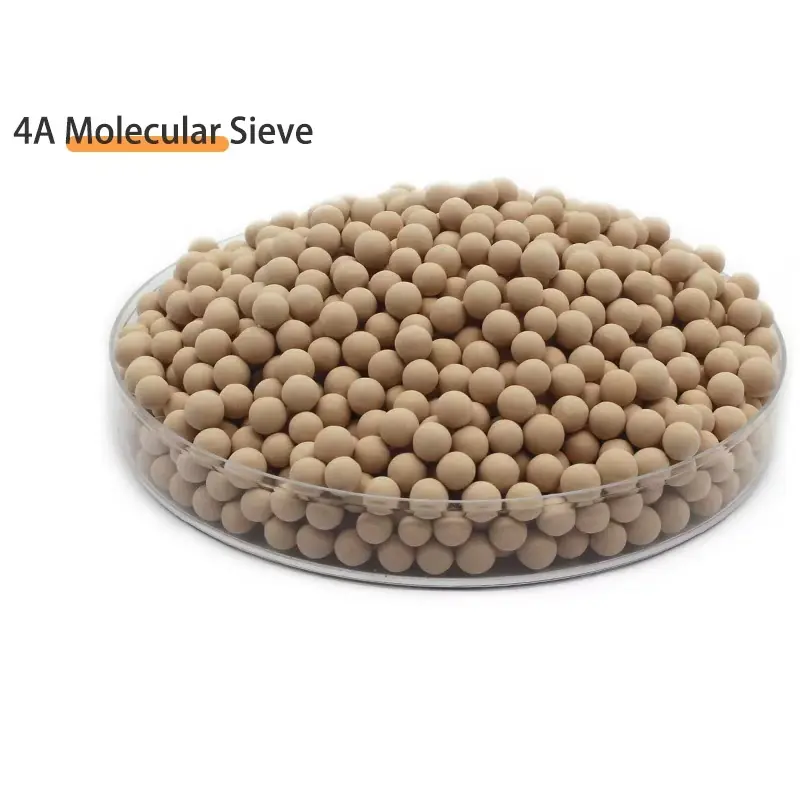
Why 3A Is the Universal Refrigerant Desiccant
If you have ever opened a refrigeration system, you have seen a filter drier: a small cylindrical canister soldered into the liquid line, packed with white or off-white beads. Those beads are almost always 3A molecular sieve. The choice is not arbitrary. 3A is the only standard molecular sieve grade that performs all three jobs a refrigerant drier must do:
- Adsorb water to below the AHRI 710 moisture limit (typically 50 to 75 ppm by weight).
- Reject refrigerant molecules so the sieve does not crack them into hydrofluoric acid.
- Reject lubricant oil molecules so the lubricant is not cracked into organic acids.
4A molecular sieve, which is cheaper and more aggressive as a desiccant, fails rule 2. 5A and 13X are worse. Activated alumina is sometimes used as a primary drier in ammonia systems, but it does not get the moisture low enough for HFC and HFO systems. Only 3A hits all three targets at once.
This article is for HVAC engineers, chiller OEM design teams, and field-service technicians who specify or replace filter driers. We will go through the pore-size chemistry, the AHRI moisture limits, the mesh-size selection logic, the oil compatibility, the acid scavenging, and the failure modes. We will end with a specification sheet for Aluminaworld 3A sieve and the recipe for the most common 3A plus activated alumina blend.
The Pore-Size Chemistry: Why 3 Angstrom Is the Magic Number
Molecular sieves are crystalline aluminosilicates with uniform pore openings. The 3A grade is a potassium-exchanged A-type zeolite: the parent A framework has a pore opening of about 4 Angstrom, but exchanging more than 70% of the sodium for potassium reduces the effective opening to 3 Angstrom (0.3 nm). The 3A designation is a marketing shorthand for "3 Angstrom pore".
Water has a kinetic diameter of 2.65 Angstrom and fits through the 3A pore easily. Refrigerant molecules are larger:
| Molecule | Kinetic diameter (Angstrom) | Fits through 3A pore? |
|---|---|---|
| Water (H2O) | 2.65 | Yes |
| Carbon dioxide (CO2) | 3.3 | Borderline |
| R-134a (CH2FCF3) | 3.7 | No |
| R-32 (CH2F2) | 3.8 | No |
| R-410A (R-32/R-125 blend) | 3.8 to 4.2 | No |
| R-1234yf (CF3CF=CH2) | 4.6 | No |
| R-1234ze(E) | 4.7 | No |
| R-22 (CHClF2) | 3.9 | No |
| R-744 (CO2) | 3.3 | Borderline |
| POE lubricant (typical) | 8 to 30 | No |
The 3A pore admits water, excludes virtually all modern refrigerants, and excludes lubricant oil. This is the entire reason for the universal acceptance of 3A in refrigeration.
Why 4A is unacceptable for HFC and HFO
4A molecular sieve has a pore opening of about 4 Angstrom. R-134a measures 3.7 Angstrom, R-32 measures 3.8 Angstrom, and R-22 measures 3.9 Angstrom. All three are smaller than 4 Angstrom and will fit through the 4A pore under capillary condensation. Once inside the pore, refrigerant molecules are subjected to the strong electrostatic field at the SII cation site. At the elevated temperatures of a hot compressor discharge region (60 to 120 degrees C), the trapped refrigerant undergoes dehydrohalogenation:
CH2FCF3 → CHF=CF2 + HF (releases hydrofluoric acid)
CH2F2 → CH≡CF + HF (releases hydrofluoric acid)
The hydrofluoric acid then diffuses out of the sieve and attacks copper lines, motor windings, and the lubricant. The first symptom of acid attack in an HFC system is copper plating on the rolling-element bearings, then valve plate varnish, then motor burn-out. This is why every modern HVAC OEM specification explicitly prohibits 4A in HFC and HFO systems.
What 5A and 13X do
5A has a 5 Angstrom pore opening. It admits not only water and refrigerant but also small hydrocarbons and some oil fractions. In a refrigerant drier it is even worse than 4A: more acid generation, faster oil degradation, and shorter service life. 13X has a 10 Angstrom pore that admits everything. 13X is used in refrigerant pre-purification at the manufacturing plant (where the refrigerant is dry liquid and water load is much higher), but never as a system-side filter drier.
AHRI 710 Moisture Limits: What You Are Actually Targeting
The Air-Conditioning, Heating, and Refrigeration Institute (AHRI) publishes the moisture limits that every HVAC OEM designs against. AHRI Standard 710 covers liquid-line filter-driers; AHRI Standard 720 covers refrigerant properties. The moisture limits are tight:
| Refrigerant | Max moisture (ppm by weight) | Typical application |
|---|---|---|
| R-12 (legacy CFC) | 20 | Obsolete automotive and chiller |
| R-22 (legacy HCFC) | 100 | Existing residential/light commercial (phase-out) |
| R-134a | 75 | Automotive AC, chillers, medium-temp refrigeration |
| R-407C | 75 | Replacement for R-22 in commercial chillers |
| R-410A | 75 | Residential and commercial AC, heat pumps |
| R-1234yf | 50 | New automotive AC (low-GWP replacement for R-134a) |
| R-1234ze(E) | 75 | High-temperature chillers, commercial refrigeration |
| R-744 (CO2) | 50 | Transcritical CO2 systems, heat pumps |
| R-717 (ammonia) | 10 to 20 | Industrial refrigeration |
Two trends are clear from the table. First, the moisture limit is much tighter for newer low-GWP refrigerants (R-1234yf, R-744) because they are more reactive with water and form acid more easily. Second, ammonia (R-717) is the strictest of all, which is why industrial ammonia systems use activated alumina dryers plus complex suction-line accumulators.
How moisture is measured
Service technicians measure moisture in operating refrigerant systems by Karl Fischer titration on a liquid sample drawn from the receiver or the liquid-line sight glass. The sample is drawn through a sealed cylinder into a septum vial under nitrogen pressure. The bench result reports in ppm by weight. Field test kits using a colorimetric reaction (typically dichromate-based) are calibrated for R-12 and R-134a but tend to drift on R-410A and R-1234yf. For warranty claims and post-failure diagnosis, always send a sample to a refrigerant lab for quantitative analysis.
Mesh Size and Bed Geometry: 8x12 vs 4x8 vs 12x20
3A molecular sieve is sold in bead sizes classified by US mesh or by millimeter range. For refrigerant driers, the three common sizes are:
| US mesh | Bead diameter (mm) | Typical location | Pressure drop |
|---|---|---|---|
| 4x8 | 2.5 to 4.75 | Suction-line driers, large chiller cores | Low |
| 8x12 | 1.6 to 2.5 | Liquid-line driers (industry standard) | Medium |
| 12x20 | 0.85 to 1.6 | Liquid-line driers, OEM specialty cores | High |
| 14x30 | 0.6 to 1.2 | Process gas driers (rarely refrigerant) | Very high |
The mesh trade-off is the same as every packed-bed engineering decision: smaller beads give faster kinetics (more surface area per gram) but higher pressure drop. For most residential and commercial filter driers, 8x12 is the default. For suction-line driers, where pressure drop directly subtracts from system cooling capacity, 4x8 is preferred. For very small OEM cores (under 30 cm3 of sieve), 12x20 is used to maximise water pickup rate in the small volume.
Some manufacturers also blend mesh sizes in a single drier. A common blend is 70% 8x12 plus 30% 4x8. The 8x12 fraction provides kinetics; the 4x8 fraction keeps the bed pressure drop low. The blend ratio is proprietary to each drier manufacturer.
Lubricant Compatibility: POE, PVE, and Mineral Oil
Refrigeration compressors must be lubricated. The lubricant must travel with the refrigerant through the system and return to the compressor. The filter drier sees a steady stream of oil-laden refrigerant, and the sieve must not crack the oil. The relevant lubricant families are:
- Mineral oil (MO): Used with R-12 and R-22. 3A compatible. Mineral oil does not enter the 3A pore.
- Alkylbenzene (AB): Used with R-22. 3A compatible.
- Polyolester (POE): Used with R-134a, R-410A, R-407C, R-1234yf. 3A compatible. POE molecular diameters are 8 to 30 Angstrom, well above the 3A exclusion limit.
- Polyvinyl ether (PVE): Used with R-1234yf and R-1234ze in some compressors. 3A compatible.
- Polyalkylene glycol (PAG): Used with R-134a in automotive AC. 3A compatible.
3A sieve is therefore universal across lubricant families. 4A sieve is not: 4A admits some lubricant fractions and can crack them to organic acids over time. This is one of the secondary reasons 3A became the standard after the 1990s CFC-to-HFC transition.
Acid Scavenging: The 3A + Activated Alumina Blend
3A molecular sieve is an excellent water adsorbent but a poor acid adsorbent. In systems that have already developed acid (from prolonged operation with high moisture, or from a burn-out event), a plain 3A drier will not remove the acid. The standard OEM solution is to blend 3A sieve with 20 to 30 wt% activated alumina. Activated alumina is a weak desiccant compared to 3A (it gets the dew point only to about -40 degrees C at the saturation conditions of the drier), but it is a strong acid scavenger. The blend gets the moisture below 75 ppm on the 3A fraction and scavenges HF and HCl on the alumina fraction.
Typical Aluminaworld blend recipe:
| Component | Weight % | Function |
|---|---|---|
| 3A molecular sieve (8x12) | 75% | Water adsorption to below 75 ppm |
| Activated alumina (3x6 mesh) | 25% | Acid scavenging (HF, HCl, organic acids) |
This blend is sometimes called "universal" or "high-capacity" drier fill. It is the OEM default for almost all residential and light commercial air-conditioning filter driers installed since 2010. For burn-out cleanups (where the system has been contaminated with acid and oil degradation products), the blend ratio shifts to 50/50 or 40/60 (3A/alumina) to maximise acid pickup.
Pressure Drop: Why Drier Sizing Matters
A filter drier must drop the moisture to specification without choking the refrigerant flow. Pressure drop translates directly into compressor work and lost system capacity. The pressure drop across a packed bed of 3A sieve follows the Ergun equation:
dP/L = 150 μ (1 - ε)^2 / (d_p^2 ε^3) × v_s + 1.75 (1 - ε) / (d_p ε^3) × ρ v_s^2
where μ is refrigerant viscosity, ε is bed void fraction (typically 0.38 to 0.42 for 8x12 mesh), d_p is bead diameter, v_s is superficial velocity, and ρ is refrigerant density. For a typical 8x12 mesh 3A bed in liquid R-410A at 25 degrees C:
| Refrigerant mass flow (kg/s) | Bed diameter (mm) | Bed length (mm) | Pressure drop (kPa) |
|---|---|---|---|
| 0.05 (5 kW residential) | 25 | 80 | 8 to 12 |
| 0.20 (15 kW commercial) | 40 | 120 | 12 to 18 |
| 1.0 (70 kW rooftop unit) | 75 | 200 | 15 to 25 |
| 5.0 (500 kW industrial chiller) | 150 | 400 | 25 to 40 |
A rule of thumb: the pressure drop across a properly sized liquid-line filter drier should be less than 0.5 bar (50 kPa) at full load. More than 1 bar is a sign of an undersized drier or a partially blocked sieve (often from oil contamination or from sieve fines from a poor-quality drier that has not been pre-screened).
Special Case: Transcritical R-744 (CO2) Systems
Transcritical CO2 refrigeration systems run the high side at 90 to 130 bar (much higher than HFC systems at 15 to 30 bar). The moisture limits are tighter (50 ppm by weight per AHRI 710). The filter drier must handle higher pressure drop and higher density of the refrigerant. The mesh size is typically 4x8 to keep pressure drop manageable. CO2 has a kinetic diameter of 3.3 Angstrom, which is borderline for the 3A pore. Some CO2 dryer designs use 3A in the main drier and a separate finer 3A layer (12x20) at the outlet to polish residual moisture. The standard Aluminaworld recommendation for transcritical CO2 driers is 100% 8x12 3A with 0.05 wt% or lower attrition loss so no fines can block the expansion valve.
Special Case: R-1234yf Low-GWP Refrigerant
R-1234yf is the low-GWP (less than 1) replacement for R-134a in automotive air-conditioning. It is mildly flammable (A2L classification) and reacts with water more aggressively than R-134a. The moisture limit is 50 ppm, not 75 ppm. Almost every automotive OEM specifies 100% 3A sieve with no activated alumina, because the blend ratio must be tightly controlled to avoid fines carry-over into the TXV. Aluminaworld supplies automotive-grade 3A with 0.03 wt% maximum attrition and 30 N per bead crush strength, which is the OEM-standard.
Special Case: R-22 Retrofit (Legacy)
Existing R-22 systems are still in service in legacy installations but the refrigerant is being phased out under the Montreal Protocol. When R-22 is recovered from a decommissioned system, the filter drier is always replaced. The replacement drier is dry stock, not retrofitted. R-22 is borderline compatible with 4A sieve (3.9 Angstrom), but 3A is the universal recommendation even for R-22 service because it is the same sieve as for HFC and HFO, simplifying inventory. The slightly slower kinetics of 3A on R-22 versus 4A is not a practical problem at the typical 0.5 to 5 kg/s mass flow of an R-22 system.
Failure Modes: 7 Things That Kill a Refrigerant Drier
- System opened to atmosphere without immediate capping. A 5 kW residential AC pulls 200 to 500 grams of water from the air within an hour if the line set is left open. The drier cannot adsorb that much. The technician must braze or seal the lines within 30 minutes of opening, or use a nitrogen blanket.
- Vacuum pump oil contamination. A rotary-vane vacuum pump that has not been changed in 200 hours returns oil vapour to the system. The oil coats the sieve and reduces water capacity by 50%. Always use a fresh pump or a diffusion pump.
- Liquid slugging after compressor failure. Acidic liquid refrigerant carries through the compressor and dissolves copper, contaminating the sieve with copper salts. The sieve turns green-grey. The drier must be replaced along with the compressor and the system flushed.
- Burn-out: acid formation. Continued operation with high moisture (above 200 ppm) causes acid formation. Acid destroys the cation-exchange capacity of the 3A sieve and the sieve becomes a passive filter only. Replace the drier, recover the refrigerant, install a new drier, recharge.
- Sieve fines. Low-quality sieve with attrition above 0.2 wt% sheds dust. The dust migrates to the TXV/EEV and causes valve hunting or blockage. Use only sieve with documented attrition below 0.05 wt%.
- Excessive oil hold-up. A drier that traps too much oil becomes a partial blockage. The pressure drop rises and the refrigerant flow is choked. The remedy is a larger drier or a suction-line accumulator.
- Wrong sieve grade. A 4A sieve in an HFC system is a delayed acid generator. The drier may look fine for 6 months and then begin releasing acid. Always confirm 3A grade by sieve supplier documentation (water capacity at 25 degrees C above 20 wt% and a N2 surface area below 5 m2/g are quick indicators of 3A versus 4A).
Installation Best Practices
Filter driers are installed in the liquid line, between the condenser outlet and the TXV/EEV inlet. The flow direction is marked on the housing. Suction-line driers are installed in the suction line between the evaporator outlet and the compressor inlet, with flow direction matched. The standard installation procedure is:
- Recover the refrigerant into an approved cylinder (do not vent).
- Cut out the old drier with a tube cutter (do not use a torch if the line is full of liquid).
- Braid-in the new drier with a nitrogen purge at 5 to 10 mbar to prevent oxide formation inside the copper tube.
- Leak test the new installation at 1.5 times the design pressure with OFN (oxygen-free nitrogen) and a soap-bubble or helium mass-spectrometer test.
- Evacuate to 500 microns (0.5 mbar) and hold for 30 minutes. The vacuum should not rise more than 50 microns in 30 minutes. If it does, the system is still leaking.
- Break the vacuum with refrigerant vapour, then release and re-evacuate.
- Charge with new or recovered-and-recycled refrigerant per the OEM spec.
During step 5, the 3A sieve in the new drier will begin to adsorb water. The evacuation itself should be long enough (typically 30 minutes) to draw the bulk of the moisture out of the system and into the sieve. If the system is large (>50 kW), allow a longer evacuation (1 to 2 hours) and re-evacuate.
Aluminaworld 3A Specification Sheet
For OEMs and service companies ready to specify a 3A sieve, here is the data we ship with every lot:
| Property | Specification |
|---|---|
| Product | 3A Molecular Sieve, Refrigerant Grade |
| Pore opening | 3 Angstrom nominal |
| Standard mesh sizes | 4x8, 8x12, 12x20 mesh (others on request) |
| Static water capacity (25 degrees C, 50% RH) | ≥ 20 wt% |
| N2 surface area (BET) | ≤ 5 m2/g (vs 4A at 600 to 800 m2/g) |
| Na2O content | ≤ 0.5 wt% |
| K2O content | 15 to 18 wt% |
| Bulk density | 700 to 750 g/L |
| Crush strength | ≥ 30 N/bead |
| Attrition loss | ≤ 0.05 wt% |
| Packaging | 25 kg sealed drum, 150 kg steel drum, 800 kg super-sack |
| MOQ | 25 kg (R&D) / 500 kg (production) |
| Lead time | 5-7 days (R&D) / 15-20 days (bulk) |
Full lot-level CoA is provided with every shipment, including static water capacity, mesh distribution, attrition, crush strength, and bulk density. Custom 3A plus activated alumina blends are available in 70/30, 60/40, and 50/50 ratios. Lead time for a custom blend is 10 to 14 days from our 28,000 m2 facility in Zibo, Shandong.
Cost Economics: Why 3A Sieve Is Almost Free Per System
3A molecular sieve is a tiny fraction of the total cost of a refrigeration system. For a residential 5 kW split AC, the system sells for $800 to $1500 and the drier fill costs $0.30 to $0.60 in sieve. For a 500 kW industrial chiller, the system sells for $80,000 to $200,000 and the drier fill costs $20 to $60 in sieve. The economic decision is therefore not about the sieve cost but about the cost of failure: a $5,000 compressor replacement and a $2,000 service call because of acid burn-out dwarfs the sieve cost by orders of magnitude.
| System size | Sieve fill per drier | Sieve cost per drier | Cost of compressor failure |
|---|---|---|---|
| 5 kW residential AC | 100 g | $0.30 to $0.50 | $800 to $1,500 |
| 15 kW commercial AC | 300 g | $0.90 to $1.50 | $2,000 to $4,000 |
| 70 kW rooftop unit | 800 g | $2.40 to $4.00 | $6,000 to $12,000 |
| 500 kW industrial chiller | 4 kg | $12 to $20 | $25,000 to $80,000 |
The economic argument for high-quality 3A sieve is overwhelming. A premium 3A that costs $0.20 more per kg reduces the risk of a $5,000 compressor replacement by ensuring the sieve does not shed fines or generate acid. There is no scenario where the cheapest 3A is the right answer.
Standards and Test Methods
The relevant industry standards for 3A sieve in refrigerant service are:
- AHRI 710 - Performance Rating of Liquid-Line Filter-Driers
- AHRI 720 - Refrigerant Properties
- ASHRAE 15 - Safety Standard for Refrigeration Systems
- ASHRAE 34 - Designation and Safety Classification of Refrigerants
- ISO 817 - Refrigerants - Designation and Safety Classification
- ISO 16869 - Molecular Sieve - Test Methods
- DIN 8949 - Test of Drying Capacity of Molecular Sieve
Aluminaworld 3A sieve is tested per ISO 16869 and DIN 8949. The static water capacity is measured by gravimetric adsorption at 25 degrees C and 50% relative humidity after 24 hours of equilibration. The N2 surface area is measured by the BET method on a Micromeritics TriStar or equivalent. Crush strength is measured on 20 individual beads using a force gauge with a flat-plate anvil. Attrition is measured by tumbling 100 g of beads in a stainless steel drum for 30 minutes and reweighing.
Sustainability: Spent Drier Disposal and Recycling
Spent refrigerant driers are a small-volume waste stream, but they contain residual lubricant and possibly acid. They should be classified as industrial waste and handled per local regulation. In the EU, spent driers fall under the WEEE Directive for adsorbent recovery. In the US, they are typically classified as non-hazardous industrial waste unless the refrigerant itself is present (in which case the refrigerant must be recovered first). The sieve itself is non-toxic and can be landfilled after the refrigerant has been removed. Some specialty recyclers reclaim the 3A zeolite for reuse in low-grade drying applications, but in practice the sieve is so cheap that recycling is rarely economical.
3 Real-World Case Studies
Case 1: Residential 5 kW R-410A split AC, post-burnout
A homeowner in Guangzhou reported a complete compressor failure on a 4-year-old split AC. The technician recovered the refrigerant and found the acid number at 0.08 mg KOH/g (well above the 0.03 mg KOH/g limit). The system was dismantled, the compressor replaced, and the line set flushed with R-141b boil-out. The new drier was filled with 200 g of 60/40 3A plus activated alumina blend (rather than the usual 75/25). After 6 months of operation, the acid number had dropped to 0.01 mg KOH/g and the moisture was below 30 ppm. The lesson: post-burnout, increase the alumina fraction in the drier fill to absorb residual acid.
Case 2: Commercial 70 kW R-134a chiller, low-charge
A shopping mall in Singapore had a 70 kW screw chiller running R-134a with persistent low-charge alarms. The moisture level was 220 ppm (above the 75 ppm limit). The technician replaced the liquid-line drier with a 500 g 8x12 3A sieve, vacuumed the system to 200 microns, and recharged. The moisture dropped to 35 ppm within 48 hours. The low-charge alarm stopped because the TXV was no longer starved by excess moisture expanding through the valve. The lesson: a high-moisture reading often shows up as a TXV malfunction rather than a drier malfunction.
Case 3: Transcritical CO2 supermarket refrigeration, R-744
A supermarket in Germany retrofitted a 200 kW R-744 transcritical refrigeration system. The system ran at 110 bar high side and -5 degrees C evaporator. The OEM-specified drier was 100% 3A 4x8 mesh with 0.03 wt% attrition. After 3 years of operation, the moisture was 28 ppm (well below the 50 ppm limit). The high pressure side never saw acid formation. The lesson: the 3A specification for transcritical CO2 is well-established and the OEM recommendation is reliable.
Frequently Asked Questions
Why is 3A molecular sieve used for refrigerant drying instead of 4A or 5A?
The 3 Angstrom pore opening of 3A molecular sieve admits water (kinetic diameter 2.65 Angstrom) but excludes refrigerant molecules (3.5 to 7 Angstrom kinetic diameter) and lubricant oil molecules (8 to 30 Angstrom). 4A has a 4 Angstrom pore that admits water and also small refrigerant molecules like R-134a and R-32, which become trapped and decompose inside the pore to form hydrofluoric acid and hydrochloric acid. 5A has a 5 Angstrom pore that admits even more refrigerant, accelerating acid formation. 3A is the only standard molecular sieve grade that adsorbs water without co-adsorbing the refrigerant itself, which is why every OEM filter-drier specification since the 1990s uses 3A.
What is the AHRI 710 moisture limit for HFC and HFO refrigerant systems?
AHRI Standard 710 (Performance Rating of Liquid-Line Filter-Driers) sets the maximum allowable moisture content in the refrigerant for different system classes. For R-134a, R-410A, R-407C, R-1234yf, and R-1234ze, the maximum total moisture is 75 ppm by weight in the circulating refrigerant. For R-744 (transcritical CO2) the limit is 50 ppm by weight. For R-22 (legacy HCFC) the limit was 100 ppm by weight. These limits are measured by the Karl Fischer titration method on a liquid sample drawn from the receiver or liquid-line sight glass.
Can 4A molecular sieve be used in a refrigerant filter drier?
4A molecular sieve is not recommended for HFC, HFO, or HCFC refrigerant systems. The 4 Angstrom pore admits water AND small refrigerant molecules such as R-134a (3.7 Angstrom) and R-32 (3.8 Angstrom). Once a refrigerant molecule is trapped inside the 4A pore, dehydrohalogenation reactions at the acid site of the zeolite liberate HF and HCl, which corrode copper lines, destroy compressor windings, and contaminate the lubricant. 4A is acceptable for drying CFC-12 refrigerant (3.5 Angstrom pore borderline) but is obsolete for any modern system. 3A is the standard.
How much 3A sieve does a typical HVAC filter drier contain?
A standard solid-core filter drier for a 5 to 10 kW residential air-conditioner holds 80 to 150 grams of 3A molecular sieve (typically 8x12 mesh beads, 1.6 to 2.5 mm). Commercial rooftop units of 50 to 150 kW use 400 to 1200 grams of 3A in replaceable cores. Industrial chillers over 500 kW use 2 to 8 kg of loose-fill 3A beads in a replaceable shell. The exact dosing depends on the expected moisture load, oil carryover, and the desired service life of the drier, which is typically 2 to 5 years for residential and 1 to 3 years for heavy commercial.
What mesh size of 3A sieve is best for refrigerant filter driers?
The most common mesh size for HVAC filter driers is 8x12 (US mesh) or 1.6 to 2.5 mm beads. Larger beads (4x8 mesh, 2.5 to 4.75 mm) are used in suction-line driers where pressure drop must be minimized. Smaller beads (12x20 or 14x30, 0.6 to 1.4 mm) are used in liquid-line driers where fast initial water pickup is critical and the pressure drop budget is small. Some manufacturers blend two mesh sizes (typically 4x8 plus 8x12) to get both low pressure drop and high kinetics. Activated alumina is often blended at 20 to 30 wt% to scavenge acid.
Can 3A sieve be regenerated in a refrigerant drier?
In a running refrigeration system, the 3A sieve in a filter drier is regenerated passively by the hot, dry refrigerant vapor that flows through it during the compressor-off cycle or by the saturation temperature of the refrigerant itself. The regeneration is never complete (the sieve is considered a one-shot consumable), but the equilibrium loading at typical suction-line temperatures of 0 to 15 degrees C is low enough that the sieve capacity is effectively fresh for the service life of the drier. If the drier is removed from the system, it can be thermally regenerated at 200 to 250 degrees C under deep vacuum for 4 to 6 hours, but in practice this is rarely done because the labour cost exceeds the cost of a new drier.
Is 3A sieve compatible with POE and PVE lubricants?
3A molecular sieve is compatible with polyolester (POE) lubricants used in HFC and HFO systems and with polyvinyl ether (PVE) lubricants used in some R-1234yf compressors. The 3 Angstrom pore excludes the lubricant molecule (typically 8 to 30 Angstrom molecular diameter), so the lubricant does not penetrate the zeolite channel and cannot be cracked or decomposed at the acid site. This is one of the reasons 3A is used in hydrocarbon-damaging refrigerant systems: 4A and 5A physically trap lubricant molecules, which then break down to form organic acids that fail the oil.
What happens when a refrigerant filter drier is saturated with water?
When the 3A sieve in a filter drier reaches saturation (typically 18 to 22 wt% water loading), it can no longer adsorb more moisture from the refrigerant. The moisture level in the circulating refrigerant then climbs past the AHRI 710 limit (75 ppm for HFC, 50 ppm for CO2). The first symptom is a falling pressure differential across the drier (yes, falling, because the water-rich sieve is now passing water through). The downstream symptoms are acid formation (HF and HCl from R-22/R-134a decomposition), copper plating on compressor bearings, varnish on the suction valve, and eventual compressor motor burn-out. The standard response is to replace the drier and recover, recycle, and recharge the refrigerant.
How long does a 3A filter drier last in an air-conditioning system?
A properly sized 3A filter drier in a residential split air-conditioner lasts the entire life of the compressor (10 to 15 years) if the system is properly evacuated and charged at installation. Warranty returns show that moisture and acid failures are overwhelmingly caused by poor installation practice (inadequate vacuum, no liquid-line drier, no nitrogen pressure-test purge), not by the sieve itself. In a commercial rooftop unit that is opened for service every 2 to 3 years, the drier is replaced as a preventive maintenance item, typically every 3 to 5 years. In a heavily serviced chiller, the drier should be replaced after every major compressor or motor service.
What does Aluminaworld supply for refrigerant drying?
Aluminaworld supplies 3A molecular sieve in 8x12, 4x8, and 12x20 mesh beads and as 1.6 to 2.5 mm pellets with crush strength above 30 N per bead and attrition loss below 0.05 wt%. We also supply OEM custom blends of 3A sieve plus 20 to 30 wt% activated alumina for combined water plus acid scavenging in a single filter drier. Standard pack sizes are 25 kg sealed drums, 150 kg steel drums, and 800 kg super-sacks. MOQ is 25 kg for R&D and 500 kg for production. Sample lead time is 5 to 7 days. We provide factory direct FOB/CIF/CFR quotation from Qingdao Port with full CoA on every lot.
Next Steps for Your Refrigerant Drying Project
If you are designing or sourcing a filter drier for an HVAC, refrigeration, or heat-pump system, the sieve specification is the single most important quality decision. The data above should let you match the right 3A grade, mesh size, and optional acid-scavenger blend to your application. When you are ready to talk specifics - mesh distribution, water capacity, custom blend ratios, automotive-grade attrition, or sample data sheets - reach out to the Aluminaworld technical team.
For 3A molecular sieve, 3A plus activated alumina blends, or specialised automotive-grade 3A, contact us via:
- WhatsApp: +86 133 2522 2240 (fastest, 12-hour reply)
- Email: barry@aluminaworld.com
- Sample request: 25 kg R&D pack, 5-7 day lead time, full CoA included
- Bulk orders: 500 kg MOQ, 15-20 day production, FOB/CIF/CFR from Qingdao Port (80 km from our factory)
Aluminaworld has supplied 3A molecular sieve to refrigeration OEMs and filter-drier manufacturers in 60+ countries for 15 years. Our 3A is manufactured under ISO 9001 quality control with SGS on-site audits and full Alibaba Trade Assurance. Let us put our experience to work on your next HVAC, chiller, or transcritical CO2 project.
Related Products & Resources
Need a Quote on 3A Sieve for Refrigerant Driers?
25 kg sample available. 5-7 day delivery. Full CoA with every shipment.