Activated Alumina Ball Attrition in Pneumatic Conveying Lines: How to Specify Mechanical Strength, Velocity, and Dust Limits
A bead can meet its adsorption certificate and still arrive at the vessel as dust. This guide shows buyer-engineers how to connect material strength, conveying velocity, bend geometry, sampling, commissioning, and lifecycle economics into one defensible specification.
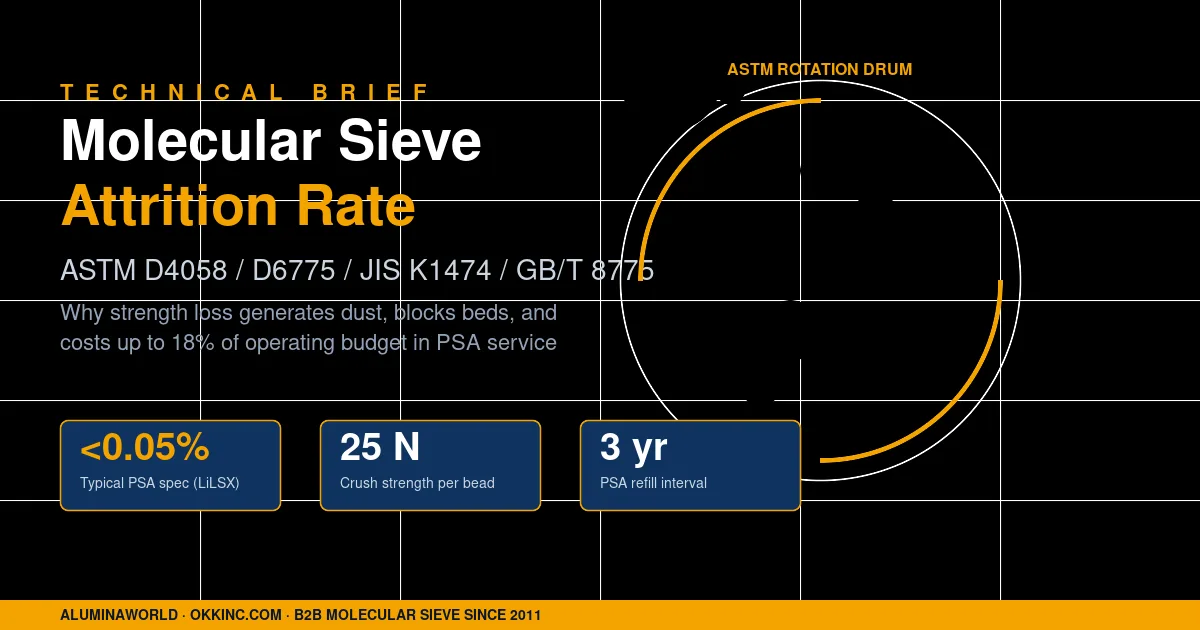
Quick Answer
Do not write “high mechanical strength” as the only requirement. Define bead size, test method, conditioning, sample count, statistical result, maximum initial fines, maximum net generated fines after a representative transfer, route geometry, operating velocity window, and acceptance sampling. A project screen such as 5 N/mm may be used only when both parties agree exactly how it is measured. For many clean one-pass transfers, a net fines target around 0.5 wt% can be a useful starting point, but it is an engineering target rather than a universal standard.
Industry-Typical Preliminary Design Ranges
| Parameter | Typical preliminary range | Procurement note |
|---|---|---|
| Activated alumina bead size | 2-5 mm or 3-5 mm | Confirm full sieve distribution and undersize limit |
| Bulk density | 0.65-0.80 kg/L | Typical only; use lot CoA for loading mass |
| Static water adsorption | 15-20 wt% under supplier test conditions | Do not compare values measured at different RH/temperature |
| Dilute-phase gas velocity | About 12-22 m/s | Use lowest stable value; solids velocity is lower |
| Dense-phase solids velocity | About 3-8 m/s | Depends strongly on system type and product permeability |
| Long-radius elbow | R/D commonly 5-10 | Verify space, wear liner, and pressure loss |
| Indicative net new fines target | ≤0.5 wt% after one representative pass | Project-defined, not a universal standard |
Important: These ranges are industry-typical values for front-end engineering. They are not guaranteed Aluminaworld specifications and should not replace the agreed data sheet or route trial.
1. Executive Decision: Treat Attrition as a System Property
For a buyer-engineer, the critical lesson is that attrition is not captured by one certificate number. The useful question is not whether a catalog calls the product high strength. The useful question is whether a defined lot, conditioned in a defined way, survives a defined route and still meets the adsorber's particle-size and dust limits. That formulation turns a vague complaint into a measurable engineering requirement. Follow the evidence from incoming lot to source hopper, through pickup and bends, into the receiver, and finally into the operating bed. Use mass balance, trend data, photographs, retained samples, and method-controlled laboratory tests. This chain of custody prevents a supplier-quality dispute from becoming guesswork and prevents a conveying-design fault from being hidden by changing media.
From a design-review standpoint, the team should document how attrition is not captured by one certificate number. Convert the statement into a checkable item: identify the owner, measurement location, instrument or laboratory method, acceptance band, recording frequency, and action if the value falls outside that band. A requirement that cannot be sampled or audited will not protect the plant during commissioning or a later quality dispute.
In practical plants, procurement should separate guaranteed properties from industry-typical engineering ranges. Small uncertainties compound: a slightly weak tail in the bead-strength distribution meets a slightly high conveying velocity at a short-radius elbow, and the receiver then converts chips into dust through repeated collision. No single factor looks unacceptable by itself, yet the combined system misses its performance target. Follow the evidence from incoming lot to source hopper, through pickup and bends, into the receiver, and finally into the operating bed. Use mass balance, trend data, photographs, retained samples, and method-controlled laboratory tests. This chain of custody prevents a supplier-quality dispute from becoming guesswork and prevents a conveying-design fault from being hidden by changing media.
From a design-review standpoint, the team should document how procurement should separate guaranteed properties from industry-typical engineering ranges. Convert the statement into a checkable item: identify the owner, measurement location, instrument or laboratory method, acceptance band, recording frequency, and action if the value falls outside that band. A requirement that cannot be sampled or audited will not protect the plant during commissioning or a later quality dispute.
The specification should therefore address a route trial is the highest-value step before approving a bulk order. Values quoted below are industry-typical ranges for preliminary engineering, not universal guarantees. Final limits must be confirmed against actual product data, the exact transfer route, applicable site standards, and a witnessed trial whenever the consequence of failure is material. Follow the evidence from incoming lot to source hopper, through pickup and bends, into the receiver, and finally into the operating bed. Use mass balance, trend data, photographs, retained samples, and method-controlled laboratory tests. This chain of custody prevents a supplier-quality dispute from becoming guesswork and prevents a conveying-design fault from being hidden by changing media.
From a design-review standpoint, the team should document how a route trial is the highest-value step before approving a bulk order. Convert the statement into a checkable item: identify the owner, measurement location, instrument or laboratory method, acceptance band, recording frequency, and action if the value falls outside that band. A requirement that cannot be sampled or audited will not protect the plant during commissioning or a later quality dispute.
A disciplined review begins with this article uses typical ranges where no universal standard limit exists. Record the assumptions explicitly. When a vendor, EPC contractor, and plant operator use different definitions for fines, velocity, or crush strength, their numbers may appear to agree while describing different physical tests. Method alignment is more important than an impressive isolated value. Follow the evidence from incoming lot to source hopper, through pickup and bends, into the receiver, and finally into the operating bed. Use mass balance, trend data, photographs, retained samples, and method-controlled laboratory tests. This chain of custody prevents a supplier-quality dispute from becoming guesswork and prevents a conveying-design fault from being hidden by changing media.
From a design-review standpoint, the team should document how this article uses typical ranges where no universal standard limit exists. Convert the statement into a checkable item: identify the owner, measurement location, instrument or laboratory method, acceptance band, recording frequency, and action if the value falls outside that band. A requirement that cannot be sampled or audited will not protect the plant during commissioning or a later quality dispute.
2. What Attrition Means and Why Fines Are Expensive
In practical plants, define fracture, chipping, abrasion, dust and pre-existing fines. Small uncertainties compound: a slightly weak tail in the bead-strength distribution meets a slightly high conveying velocity at a short-radius elbow, and the receiver then converts chips into dust through repeated collision. No single factor looks unacceptable by itself, yet the combined system misses its performance target. Follow the evidence from incoming lot to source hopper, through pickup and bends, into the receiver, and finally into the operating bed. Use mass balance, trend data, photographs, retained samples, and method-controlled laboratory tests. This chain of custody prevents a supplier-quality dispute from becoming guesswork and prevents a conveying-design fault from being hidden by changing media.
From a design-review standpoint, the team should document how define fracture, chipping, abrasion, dust and pre-existing fines. Convert the statement into a checkable item: identify the owner, measurement location, instrument or laboratory method, acceptance band, recording frequency, and action if the value falls outside that band. A requirement that cannot be sampled or audited will not protect the plant during commissioning or a later quality dispute.
The specification should therefore address explain lost working capacity, maldistribution and downstream filter loading. Values quoted below are industry-typical ranges for preliminary engineering, not universal guarantees. Final limits must be confirmed against actual product data, the exact transfer route, applicable site standards, and a witnessed trial whenever the consequence of failure is material. Follow the evidence from incoming lot to source hopper, through pickup and bends, into the receiver, and finally into the operating bed. Use mass balance, trend data, photographs, retained samples, and method-controlled laboratory tests. This chain of custody prevents a supplier-quality dispute from becoming guesswork and prevents a conveying-design fault from being hidden by changing media.
From a design-review standpoint, the team should document how explain lost working capacity, maldistribution and downstream filter loading. Convert the statement into a checkable item: identify the owner, measurement location, instrument or laboratory method, acceptance band, recording frequency, and action if the value falls outside that band. A requirement that cannot be sampled or audited will not protect the plant during commissioning or a later quality dispute.
A disciplined review begins with connect fines to pressure drop, dust exposure and housekeeping. Record the assumptions explicitly. When a vendor, EPC contractor, and plant operator use different definitions for fines, velocity, or crush strength, their numbers may appear to agree while describing different physical tests. Method alignment is more important than an impressive isolated value. Follow the evidence from incoming lot to source hopper, through pickup and bends, into the receiver, and finally into the operating bed. Use mass balance, trend data, photographs, retained samples, and method-controlled laboratory tests. This chain of custody prevents a supplier-quality dispute from becoming guesswork and prevents a conveying-design fault from being hidden by changing media.
From a design-review standpoint, the team should document how connect fines to pressure drop, dust exposure and housekeeping. Convert the statement into a checkable item: identify the owner, measurement location, instrument or laboratory method, acceptance band, recording frequency, and action if the value falls outside that band. A requirement that cannot be sampled or audited will not protect the plant during commissioning or a later quality dispute.
For a buyer-engineer, the critical lesson is that distinguish one-pass damage from multi-pass recirculation. The useful question is not whether a catalog calls the product high strength. The useful question is whether a defined lot, conditioned in a defined way, survives a defined route and still meets the adsorber's particle-size and dust limits. That formulation turns a vague complaint into a measurable engineering requirement. Follow the evidence from incoming lot to source hopper, through pickup and bends, into the receiver, and finally into the operating bed. Use mass balance, trend data, photographs, retained samples, and method-controlled laboratory tests. This chain of custody prevents a supplier-quality dispute from becoming guesswork and prevents a conveying-design fault from being hidden by changing media.
From a design-review standpoint, the team should document how distinguish one-pass damage from multi-pass recirculation. Convert the statement into a checkable item: identify the owner, measurement location, instrument or laboratory method, acceptance band, recording frequency, and action if the value falls outside that band. A requirement that cannot be sampled or audited will not protect the plant during commissioning or a later quality dispute.
3. Activated Alumina Microstructure and Mechanical Failure
The specification should therefore address describe gamma-alumina pore structure, binder bridges and calcination. Values quoted below are industry-typical ranges for preliminary engineering, not universal guarantees. Final limits must be confirmed against actual product data, the exact transfer route, applicable site standards, and a witnessed trial whenever the consequence of failure is material. Follow the evidence from incoming lot to source hopper, through pickup and bends, into the receiver, and finally into the operating bed. Use mass balance, trend data, photographs, retained samples, and method-controlled laboratory tests. This chain of custody prevents a supplier-quality dispute from becoming guesswork and prevents a conveying-design fault from being hidden by changing media.
From a design-review standpoint, the team should document how describe gamma-alumina pore structure, binder bridges and calcination. Convert the statement into a checkable item: identify the owner, measurement location, instrument or laboratory method, acceptance band, recording frequency, and action if the value falls outside that band. A requirement that cannot be sampled or audited will not protect the plant during commissioning or a later quality dispute.
A disciplined review begins with explain surface flaws, internal cracks and moisture conditioning. Record the assumptions explicitly. When a vendor, EPC contractor, and plant operator use different definitions for fines, velocity, or crush strength, their numbers may appear to agree while describing different physical tests. Method alignment is more important than an impressive isolated value. Follow the evidence from incoming lot to source hopper, through pickup and bends, into the receiver, and finally into the operating bed. Use mass balance, trend data, photographs, retained samples, and method-controlled laboratory tests. This chain of custody prevents a supplier-quality dispute from becoming guesswork and prevents a conveying-design fault from being hidden by changing media.
From a design-review standpoint, the team should document how explain surface flaws, internal cracks and moisture conditioning. Convert the statement into a checkable item: identify the owner, measurement location, instrument or laboratory method, acceptance band, recording frequency, and action if the value falls outside that band. A requirement that cannot be sampled or audited will not protect the plant during commissioning or a later quality dispute.
For a buyer-engineer, the critical lesson is that show why adsorption capacity and mechanical toughness can conflict. The useful question is not whether a catalog calls the product high strength. The useful question is whether a defined lot, conditioned in a defined way, survives a defined route and still meets the adsorber's particle-size and dust limits. That formulation turns a vague complaint into a measurable engineering requirement. Follow the evidence from incoming lot to source hopper, through pickup and bends, into the receiver, and finally into the operating bed. Use mass balance, trend data, photographs, retained samples, and method-controlled laboratory tests. This chain of custody prevents a supplier-quality dispute from becoming guesswork and prevents a conveying-design fault from being hidden by changing media.
From a design-review standpoint, the team should document how show why adsorption capacity and mechanical toughness can conflict. Convert the statement into a checkable item: identify the owner, measurement location, instrument or laboratory method, acceptance band, recording frequency, and action if the value falls outside that band. A requirement that cannot be sampled or audited will not protect the plant during commissioning or a later quality dispute.
In practical plants, compare 2-5 mm beads, larger balls and ceramic support media. Small uncertainties compound: a slightly weak tail in the bead-strength distribution meets a slightly high conveying velocity at a short-radius elbow, and the receiver then converts chips into dust through repeated collision. No single factor looks unacceptable by itself, yet the combined system misses its performance target. Follow the evidence from incoming lot to source hopper, through pickup and bends, into the receiver, and finally into the operating bed. Use mass balance, trend data, photographs, retained samples, and method-controlled laboratory tests. This chain of custody prevents a supplier-quality dispute from becoming guesswork and prevents a conveying-design fault from being hidden by changing media.
From a design-review standpoint, the team should document how compare 2-5 mm beads, larger balls and ceramic support media. Convert the statement into a checkable item: identify the owner, measurement location, instrument or laboratory method, acceptance band, recording frequency, and action if the value falls outside that band. A requirement that cannot be sampled or audited will not protect the plant during commissioning or a later quality dispute.
4. Conveying Regimes: Dilute Phase, Dense Phase and Vacuum Transfer
A disciplined review begins with describe saltation, pickup velocity and solids loading ratio. Record the assumptions explicitly. When a vendor, EPC contractor, and plant operator use different definitions for fines, velocity, or crush strength, their numbers may appear to agree while describing different physical tests. Method alignment is more important than an impressive isolated value. Follow the evidence from incoming lot to source hopper, through pickup and bends, into the receiver, and finally into the operating bed. Use mass balance, trend data, photographs, retained samples, and method-controlled laboratory tests. This chain of custody prevents a supplier-quality dispute from becoming guesswork and prevents a conveying-design fault from being hidden by changing media.
From a design-review standpoint, the team should document how describe saltation, pickup velocity and solids loading ratio. Convert the statement into a checkable item: identify the owner, measurement location, instrument or laboratory method, acceptance band, recording frequency, and action if the value falls outside that band. A requirement that cannot be sampled or audited will not protect the plant during commissioning or a later quality dispute.
For a buyer-engineer, the critical lesson is that compare high-speed dilute phase with plug or strand dense phase. The useful question is not whether a catalog calls the product high strength. The useful question is whether a defined lot, conditioned in a defined way, survives a defined route and still meets the adsorber's particle-size and dust limits. That formulation turns a vague complaint into a measurable engineering requirement. Follow the evidence from incoming lot to source hopper, through pickup and bends, into the receiver, and finally into the operating bed. Use mass balance, trend data, photographs, retained samples, and method-controlled laboratory tests. This chain of custody prevents a supplier-quality dispute from becoming guesswork and prevents a conveying-design fault from being hidden by changing media.
From a design-review standpoint, the team should document how compare high-speed dilute phase with plug or strand dense phase. Convert the statement into a checkable item: identify the owner, measurement location, instrument or laboratory method, acceptance band, recording frequency, and action if the value falls outside that band. A requirement that cannot be sampled or audited will not protect the plant during commissioning or a later quality dispute.
In practical plants, explain when vacuum loaders are convenient but damaging. Small uncertainties compound: a slightly weak tail in the bead-strength distribution meets a slightly high conveying velocity at a short-radius elbow, and the receiver then converts chips into dust through repeated collision. No single factor looks unacceptable by itself, yet the combined system misses its performance target. Follow the evidence from incoming lot to source hopper, through pickup and bends, into the receiver, and finally into the operating bed. Use mass balance, trend data, photographs, retained samples, and method-controlled laboratory tests. This chain of custody prevents a supplier-quality dispute from becoming guesswork and prevents a conveying-design fault from being hidden by changing media.
From a design-review standpoint, the team should document how explain when vacuum loaders are convenient but damaging. Convert the statement into a checkable item: identify the owner, measurement location, instrument or laboratory method, acceptance band, recording frequency, and action if the value falls outside that band. A requirement that cannot be sampled or audited will not protect the plant during commissioning or a later quality dispute.
The specification should therefore address state why lowest stable velocity is the design objective. Values quoted below are industry-typical ranges for preliminary engineering, not universal guarantees. Final limits must be confirmed against actual product data, the exact transfer route, applicable site standards, and a witnessed trial whenever the consequence of failure is material. Follow the evidence from incoming lot to source hopper, through pickup and bends, into the receiver, and finally into the operating bed. Use mass balance, trend data, photographs, retained samples, and method-controlled laboratory tests. This chain of custody prevents a supplier-quality dispute from becoming guesswork and prevents a conveying-design fault from being hidden by changing media.
From a design-review standpoint, the team should document how state why lowest stable velocity is the design objective. Convert the statement into a checkable item: identify the owner, measurement location, instrument or laboratory method, acceptance band, recording frequency, and action if the value falls outside that band. A requirement that cannot be sampled or audited will not protect the plant during commissioning or a later quality dispute.
5. Velocity, Momentum and the Elbow Damage Multiplier
For a buyer-engineer, the critical lesson is that use particle kinetic energy proportional to velocity squared. The useful question is not whether a catalog calls the product high strength. The useful question is whether a defined lot, conditioned in a defined way, survives a defined route and still meets the adsorber's particle-size and dust limits. That formulation turns a vague complaint into a measurable engineering requirement. Follow the evidence from incoming lot to source hopper, through pickup and bends, into the receiver, and finally into the operating bed. Use mass balance, trend data, photographs, retained samples, and method-controlled laboratory tests. This chain of custody prevents a supplier-quality dispute from becoming guesswork and prevents a conveying-design fault from being hidden by changing media.
From a design-review standpoint, the team should document how use particle kinetic energy proportional to velocity squared. Convert the statement into a checkable item: identify the owner, measurement location, instrument or laboratory method, acceptance band, recording frequency, and action if the value falls outside that band. A requirement that cannot be sampled or audited will not protect the plant during commissioning or a later quality dispute.
In practical plants, explain outer-radius impact, angle of incidence and bend-to-pipe ratio. Small uncertainties compound: a slightly weak tail in the bead-strength distribution meets a slightly high conveying velocity at a short-radius elbow, and the receiver then converts chips into dust through repeated collision. No single factor looks unacceptable by itself, yet the combined system misses its performance target. Follow the evidence from incoming lot to source hopper, through pickup and bends, into the receiver, and finally into the operating bed. Use mass balance, trend data, photographs, retained samples, and method-controlled laboratory tests. This chain of custody prevents a supplier-quality dispute from becoming guesswork and prevents a conveying-design fault from being hidden by changing media.
From a design-review standpoint, the team should document how explain outer-radius impact, angle of incidence and bend-to-pipe ratio. Convert the statement into a checkable item: identify the owner, measurement location, instrument or laboratory method, acceptance band, recording frequency, and action if the value falls outside that band. A requirement that cannot be sampled or audited will not protect the plant during commissioning or a later quality dispute.
The specification should therefore address discuss blind tees, target boxes and de-energizing receivers. Values quoted below are industry-typical ranges for preliminary engineering, not universal guarantees. Final limits must be confirmed against actual product data, the exact transfer route, applicable site standards, and a witnessed trial whenever the consequence of failure is material. Follow the evidence from incoming lot to source hopper, through pickup and bends, into the receiver, and finally into the operating bed. Use mass balance, trend data, photographs, retained samples, and method-controlled laboratory tests. This chain of custody prevents a supplier-quality dispute from becoming guesswork and prevents a conveying-design fault from being hidden by changing media.
From a design-review standpoint, the team should document how discuss blind tees, target boxes and de-energizing receivers. Convert the statement into a checkable item: identify the owner, measurement location, instrument or laboratory method, acceptance band, recording frequency, and action if the value falls outside that band. A requirement that cannot be sampled or audited will not protect the plant during commissioning or a later quality dispute.
A disciplined review begins with cover flexible hose, reducers, valves and sudden expansions. Record the assumptions explicitly. When a vendor, EPC contractor, and plant operator use different definitions for fines, velocity, or crush strength, their numbers may appear to agree while describing different physical tests. Method alignment is more important than an impressive isolated value. Follow the evidence from incoming lot to source hopper, through pickup and bends, into the receiver, and finally into the operating bed. Use mass balance, trend data, photographs, retained samples, and method-controlled laboratory tests. This chain of custody prevents a supplier-quality dispute from becoming guesswork and prevents a conveying-design fault from being hidden by changing media.
From a design-review standpoint, the team should document how cover flexible hose, reducers, valves and sudden expansions. Convert the statement into a checkable item: identify the owner, measurement location, instrument or laboratory method, acceptance band, recording frequency, and action if the value falls outside that band. A requirement that cannot be sampled or audited will not protect the plant during commissioning or a later quality dispute.
6. How to Specify Mechanical Strength Without Misusing N/mm
In practical plants, separate single-particle force in N from normalized load in N/mm. Small uncertainties compound: a slightly weak tail in the bead-strength distribution meets a slightly high conveying velocity at a short-radius elbow, and the receiver then converts chips into dust through repeated collision. No single factor looks unacceptable by itself, yet the combined system misses its performance target. Follow the evidence from incoming lot to source hopper, through pickup and bends, into the receiver, and finally into the operating bed. Use mass balance, trend data, photographs, retained samples, and method-controlled laboratory tests. This chain of custody prevents a supplier-quality dispute from becoming guesswork and prevents a conveying-design fault from being hidden by changing media.
From a design-review standpoint, the team should document how separate single-particle force in N from normalized load in N/mm. Convert the statement into a checkable item: identify the owner, measurement location, instrument or laboratory method, acceptance band, recording frequency, and action if the value falls outside that band. A requirement that cannot be sampled or audited will not protect the plant during commissioning or a later quality dispute.
The specification should therefore address require diameter, loading rate, platens, conditioning and sample count. Values quoted below are industry-typical ranges for preliminary engineering, not universal guarantees. Final limits must be confirmed against actual product data, the exact transfer route, applicable site standards, and a witnessed trial whenever the consequence of failure is material. Follow the evidence from incoming lot to source hopper, through pickup and bends, into the receiver, and finally into the operating bed. Use mass balance, trend data, photographs, retained samples, and method-controlled laboratory tests. This chain of custody prevents a supplier-quality dispute from becoming guesswork and prevents a conveying-design fault from being hidden by changing media.
From a design-review standpoint, the team should document how require diameter, loading rate, platens, conditioning and sample count. Convert the statement into a checkable item: identify the owner, measurement location, instrument or laboratory method, acceptance band, recording frequency, and action if the value falls outside that band. A requirement that cannot be sampled or audited will not protect the plant during commissioning or a later quality dispute.
A disciplined review begins with request median, tenth percentile, standard deviation and broken fraction. Record the assumptions explicitly. When a vendor, EPC contractor, and plant operator use different definitions for fines, velocity, or crush strength, their numbers may appear to agree while describing different physical tests. Method alignment is more important than an impressive isolated value. Follow the evidence from incoming lot to source hopper, through pickup and bends, into the receiver, and finally into the operating bed. Use mass balance, trend data, photographs, retained samples, and method-controlled laboratory tests. This chain of custody prevents a supplier-quality dispute from becoming guesswork and prevents a conveying-design fault from being hidden by changing media.
From a design-review standpoint, the team should document how request median, tenth percentile, standard deviation and broken fraction. Convert the statement into a checkable item: identify the owner, measurement location, instrument or laboratory method, acceptance band, recording frequency, and action if the value falls outside that band. A requirement that cannot be sampled or audited will not protect the plant during commissioning or a later quality dispute.
For a buyer-engineer, the critical lesson is that explain why an average alone can hide a weak tail. The useful question is not whether a catalog calls the product high strength. The useful question is whether a defined lot, conditioned in a defined way, survives a defined route and still meets the adsorber's particle-size and dust limits. That formulation turns a vague complaint into a measurable engineering requirement. Follow the evidence from incoming lot to source hopper, through pickup and bends, into the receiver, and finally into the operating bed. Use mass balance, trend data, photographs, retained samples, and method-controlled laboratory tests. This chain of custody prevents a supplier-quality dispute from becoming guesswork and prevents a conveying-design fault from being hidden by changing media.
From a design-review standpoint, the team should document how explain why an average alone can hide a weak tail. Convert the statement into a checkable item: identify the owner, measurement location, instrument or laboratory method, acceptance band, recording frequency, and action if the value falls outside that band. A requirement that cannot be sampled or audited will not protect the plant during commissioning or a later quality dispute.
7. Attrition and Abrasion Test Methods
The specification should therefore address reference ASTM D4058 as a catalyst-carrier method that may be adapted. Values quoted below are industry-typical ranges for preliminary engineering, not universal guarantees. Final limits must be confirmed against actual product data, the exact transfer route, applicable site standards, and a witnessed trial whenever the consequence of failure is material. Follow the evidence from incoming lot to source hopper, through pickup and bends, into the receiver, and finally into the operating bed. Use mass balance, trend data, photographs, retained samples, and method-controlled laboratory tests. This chain of custody prevents a supplier-quality dispute from becoming guesswork and prevents a conveying-design fault from being hidden by changing media.
From a design-review standpoint, the team should document how reference ASTM D4058 as a catalyst-carrier method that may be adapted. Convert the statement into a checkable item: identify the owner, measurement location, instrument or laboratory method, acceptance band, recording frequency, and action if the value falls outside that band. A requirement that cannot be sampled or audited will not protect the plant during commissioning or a later quality dispute.
A disciplined review begins with discuss rotating drum, air-jet and pneumatic-loop tests. Record the assumptions explicitly. When a vendor, EPC contractor, and plant operator use different definitions for fines, velocity, or crush strength, their numbers may appear to agree while describing different physical tests. Method alignment is more important than an impressive isolated value. Follow the evidence from incoming lot to source hopper, through pickup and bends, into the receiver, and finally into the operating bed. Use mass balance, trend data, photographs, retained samples, and method-controlled laboratory tests. This chain of custody prevents a supplier-quality dispute from becoming guesswork and prevents a conveying-design fault from being hidden by changing media.
From a design-review standpoint, the team should document how discuss rotating drum, air-jet and pneumatic-loop tests. Convert the statement into a checkable item: identify the owner, measurement location, instrument or laboratory method, acceptance band, recording frequency, and action if the value falls outside that band. A requirement that cannot be sampled or audited will not protect the plant during commissioning or a later quality dispute.
For a buyer-engineer, the critical lesson is that require exact sieve cut, duration, sample mass and calculation. The useful question is not whether a catalog calls the product high strength. The useful question is whether a defined lot, conditioned in a defined way, survives a defined route and still meets the adsorber's particle-size and dust limits. That formulation turns a vague complaint into a measurable engineering requirement. Follow the evidence from incoming lot to source hopper, through pickup and bends, into the receiver, and finally into the operating bed. Use mass balance, trend data, photographs, retained samples, and method-controlled laboratory tests. This chain of custody prevents a supplier-quality dispute from becoming guesswork and prevents a conveying-design fault from being hidden by changing media.
From a design-review standpoint, the team should document how require exact sieve cut, duration, sample mass and calculation. Convert the statement into a checkable item: identify the owner, measurement location, instrument or laboratory method, acceptance band, recording frequency, and action if the value falls outside that band. A requirement that cannot be sampled or audited will not protect the plant during commissioning or a later quality dispute.
In practical plants, avoid claiming ISO 9001 proves product strength. Small uncertainties compound: a slightly weak tail in the bead-strength distribution meets a slightly high conveying velocity at a short-radius elbow, and the receiver then converts chips into dust through repeated collision. No single factor looks unacceptable by itself, yet the combined system misses its performance target. Follow the evidence from incoming lot to source hopper, through pickup and bends, into the receiver, and finally into the operating bed. Use mass balance, trend data, photographs, retained samples, and method-controlled laboratory tests. This chain of custody prevents a supplier-quality dispute from becoming guesswork and prevents a conveying-design fault from being hidden by changing media.
From a design-review standpoint, the team should document how avoid claiming ISO 9001 proves product strength. Convert the statement into a checkable item: identify the owner, measurement location, instrument or laboratory method, acceptance band, recording frequency, and action if the value falls outside that band. A requirement that cannot be sampled or audited will not protect the plant during commissioning or a later quality dispute.
8. Representative Sampling and Fines Mass Balance
A disciplined review begins with sample source, intermediate points and receiver. Record the assumptions explicitly. When a vendor, EPC contractor, and plant operator use different definitions for fines, velocity, or crush strength, their numbers may appear to agree while describing different physical tests. Method alignment is more important than an impressive isolated value. Follow the evidence from incoming lot to source hopper, through pickup and bends, into the receiver, and finally into the operating bed. Use mass balance, trend data, photographs, retained samples, and method-controlled laboratory tests. This chain of custody prevents a supplier-quality dispute from becoming guesswork and prevents a conveying-design fault from being hidden by changing media.
From a design-review standpoint, the team should document how sample source, intermediate points and receiver. Convert the statement into a checkable item: identify the owner, measurement location, instrument or laboratory method, acceptance band, recording frequency, and action if the value falls outside that band. A requirement that cannot be sampled or audited will not protect the plant during commissioning or a later quality dispute.
For a buyer-engineer, the critical lesson is that use composite increments rather than a handful from the top. The useful question is not whether a catalog calls the product high strength. The useful question is whether a defined lot, conditioned in a defined way, survives a defined route and still meets the adsorber's particle-size and dust limits. That formulation turns a vague complaint into a measurable engineering requirement. Follow the evidence from incoming lot to source hopper, through pickup and bends, into the receiver, and finally into the operating bed. Use mass balance, trend data, photographs, retained samples, and method-controlled laboratory tests. This chain of custody prevents a supplier-quality dispute from becoming guesswork and prevents a conveying-design fault from being hidden by changing media.
From a design-review standpoint, the team should document how use composite increments rather than a handful from the top. Convert the statement into a checkable item: identify the owner, measurement location, instrument or laboratory method, acceptance band, recording frequency, and action if the value falls outside that band. A requirement that cannot be sampled or audited will not protect the plant during commissioning or a later quality dispute.
In practical plants, control moisture and electrostatic dust losses. Small uncertainties compound: a slightly weak tail in the bead-strength distribution meets a slightly high conveying velocity at a short-radius elbow, and the receiver then converts chips into dust through repeated collision. No single factor looks unacceptable by itself, yet the combined system misses its performance target. Follow the evidence from incoming lot to source hopper, through pickup and bends, into the receiver, and finally into the operating bed. Use mass balance, trend data, photographs, retained samples, and method-controlled laboratory tests. This chain of custody prevents a supplier-quality dispute from becoming guesswork and prevents a conveying-design fault from being hidden by changing media.
From a design-review standpoint, the team should document how control moisture and electrostatic dust losses. Convert the statement into a checkable item: identify the owner, measurement location, instrument or laboratory method, acceptance band, recording frequency, and action if the value falls outside that band. A requirement that cannot be sampled or audited will not protect the plant during commissioning or a later quality dispute.
The specification should therefore address calculate initial, final and net generated fines. Values quoted below are industry-typical ranges for preliminary engineering, not universal guarantees. Final limits must be confirmed against actual product data, the exact transfer route, applicable site standards, and a witnessed trial whenever the consequence of failure is material. Follow the evidence from incoming lot to source hopper, through pickup and bends, into the receiver, and finally into the operating bed. Use mass balance, trend data, photographs, retained samples, and method-controlled laboratory tests. This chain of custody prevents a supplier-quality dispute from becoming guesswork and prevents a conveying-design fault from being hidden by changing media.
From a design-review standpoint, the team should document how calculate initial, final and net generated fines. Convert the statement into a checkable item: identify the owner, measurement location, instrument or laboratory method, acceptance band, recording frequency, and action if the value falls outside that band. A requirement that cannot be sampled or audited will not protect the plant during commissioning or a later quality dispute.
9. Route Design Checklist for New Installations
For a buyer-engineer, the critical lesson is that cover line diameter, horizontal length, elevation and number of bends. The useful question is not whether a catalog calls the product high strength. The useful question is whether a defined lot, conditioned in a defined way, survives a defined route and still meets the adsorber's particle-size and dust limits. That formulation turns a vague complaint into a measurable engineering requirement. Follow the evidence from incoming lot to source hopper, through pickup and bends, into the receiver, and finally into the operating bed. Use mass balance, trend data, photographs, retained samples, and method-controlled laboratory tests. This chain of custody prevents a supplier-quality dispute from becoming guesswork and prevents a conveying-design fault from being hidden by changing media.
From a design-review standpoint, the team should document how cover line diameter, horizontal length, elevation and number of bends. Convert the statement into a checkable item: identify the owner, measurement location, instrument or laboratory method, acceptance band, recording frequency, and action if the value falls outside that band. A requirement that cannot be sampled or audited will not protect the plant during commissioning or a later quality dispute.
In practical plants, locate acceleration zones and high-energy impacts. Small uncertainties compound: a slightly weak tail in the bead-strength distribution meets a slightly high conveying velocity at a short-radius elbow, and the receiver then converts chips into dust through repeated collision. No single factor looks unacceptable by itself, yet the combined system misses its performance target. Follow the evidence from incoming lot to source hopper, through pickup and bends, into the receiver, and finally into the operating bed. Use mass balance, trend data, photographs, retained samples, and method-controlled laboratory tests. This chain of custody prevents a supplier-quality dispute from becoming guesswork and prevents a conveying-design fault from being hidden by changing media.
From a design-review standpoint, the team should document how locate acceleration zones and high-energy impacts. Convert the statement into a checkable item: identify the owner, measurement location, instrument or laboratory method, acceptance band, recording frequency, and action if the value falls outside that band. A requirement that cannot be sampled or audited will not protect the plant during commissioning or a later quality dispute.
The specification should therefore address size receiver disengagement area and vent filtration. Values quoted below are industry-typical ranges for preliminary engineering, not universal guarantees. Final limits must be confirmed against actual product data, the exact transfer route, applicable site standards, and a witnessed trial whenever the consequence of failure is material. Follow the evidence from incoming lot to source hopper, through pickup and bends, into the receiver, and finally into the operating bed. Use mass balance, trend data, photographs, retained samples, and method-controlled laboratory tests. This chain of custody prevents a supplier-quality dispute from becoming guesswork and prevents a conveying-design fault from being hidden by changing media.
From a design-review standpoint, the team should document how size receiver disengagement area and vent filtration. Convert the statement into a checkable item: identify the owner, measurement location, instrument or laboratory method, acceptance band, recording frequency, and action if the value falls outside that band. A requirement that cannot be sampled or audited will not protect the plant during commissioning or a later quality dispute.
A disciplined review begins with provide access points for sampling and inspection. Record the assumptions explicitly. When a vendor, EPC contractor, and plant operator use different definitions for fines, velocity, or crush strength, their numbers may appear to agree while describing different physical tests. Method alignment is more important than an impressive isolated value. Follow the evidence from incoming lot to source hopper, through pickup and bends, into the receiver, and finally into the operating bed. Use mass balance, trend data, photographs, retained samples, and method-controlled laboratory tests. This chain of custody prevents a supplier-quality dispute from becoming guesswork and prevents a conveying-design fault from being hidden by changing media.
From a design-review standpoint, the team should document how provide access points for sampling and inspection. Convert the statement into a checkable item: identify the owner, measurement location, instrument or laboratory method, acceptance band, recording frequency, and action if the value falls outside that band. A requirement that cannot be sampled or audited will not protect the plant during commissioning or a later quality dispute.
10. Operating Window and Control Philosophy
In practical plants, start at low airflow and increase only until transfer stabilizes. Small uncertainties compound: a slightly weak tail in the bead-strength distribution meets a slightly high conveying velocity at a short-radius elbow, and the receiver then converts chips into dust through repeated collision. No single factor looks unacceptable by itself, yet the combined system misses its performance target. Follow the evidence from incoming lot to source hopper, through pickup and bends, into the receiver, and finally into the operating bed. Use mass balance, trend data, photographs, retained samples, and method-controlled laboratory tests. This chain of custody prevents a supplier-quality dispute from becoming guesswork and prevents a conveying-design fault from being hidden by changing media.
From a design-review standpoint, the team should document how start at low airflow and increase only until transfer stabilizes. Convert the statement into a checkable item: identify the owner, measurement location, instrument or laboratory method, acceptance band, recording frequency, and action if the value falls outside that band. A requirement that cannot be sampled or audited will not protect the plant during commissioning or a later quality dispute.
The specification should therefore address avoid empty-line high-speed acceleration and surging feeders. Values quoted below are industry-typical ranges for preliminary engineering, not universal guarantees. Final limits must be confirmed against actual product data, the exact transfer route, applicable site standards, and a witnessed trial whenever the consequence of failure is material. Follow the evidence from incoming lot to source hopper, through pickup and bends, into the receiver, and finally into the operating bed. Use mass balance, trend data, photographs, retained samples, and method-controlled laboratory tests. This chain of custody prevents a supplier-quality dispute from becoming guesswork and prevents a conveying-design fault from being hidden by changing media.
From a design-review standpoint, the team should document how avoid empty-line high-speed acceleration and surging feeders. Convert the statement into a checkable item: identify the owner, measurement location, instrument or laboratory method, acceptance band, recording frequency, and action if the value falls outside that band. A requirement that cannot be sampled or audited will not protect the plant during commissioning or a later quality dispute.
A disciplined review begins with trend transfer time, differential pressure and batch fines. Record the assumptions explicitly. When a vendor, EPC contractor, and plant operator use different definitions for fines, velocity, or crush strength, their numbers may appear to agree while describing different physical tests. Method alignment is more important than an impressive isolated value. Follow the evidence from incoming lot to source hopper, through pickup and bends, into the receiver, and finally into the operating bed. Use mass balance, trend data, photographs, retained samples, and method-controlled laboratory tests. This chain of custody prevents a supplier-quality dispute from becoming guesswork and prevents a conveying-design fault from being hidden by changing media.
From a design-review standpoint, the team should document how trend transfer time, differential pressure and batch fines. Convert the statement into a checkable item: identify the owner, measurement location, instrument or laboratory method, acceptance band, recording frequency, and action if the value falls outside that band. A requirement that cannot be sampled or audited will not protect the plant during commissioning or a later quality dispute.
For a buyer-engineer, the critical lesson is that interlock on high pressure, blocked filter and receiver high level. The useful question is not whether a catalog calls the product high strength. The useful question is whether a defined lot, conditioned in a defined way, survives a defined route and still meets the adsorber's particle-size and dust limits. That formulation turns a vague complaint into a measurable engineering requirement. Follow the evidence from incoming lot to source hopper, through pickup and bends, into the receiver, and finally into the operating bed. Use mass balance, trend data, photographs, retained samples, and method-controlled laboratory tests. This chain of custody prevents a supplier-quality dispute from becoming guesswork and prevents a conveying-design fault from being hidden by changing media.
From a design-review standpoint, the team should document how interlock on high pressure, blocked filter and receiver high level. Convert the statement into a checkable item: identify the owner, measurement location, instrument or laboratory method, acceptance band, recording frequency, and action if the value falls outside that band. A requirement that cannot be sampled or audited will not protect the plant during commissioning or a later quality dispute.
11. Loading an Adsorber Without Destroying the Bed
The specification should therefore address compare gravity loading, socks, dense phase and vacuum loading. Values quoted below are industry-typical ranges for preliminary engineering, not universal guarantees. Final limits must be confirmed against actual product data, the exact transfer route, applicable site standards, and a witnessed trial whenever the consequence of failure is material. Follow the evidence from incoming lot to source hopper, through pickup and bends, into the receiver, and finally into the operating bed. Use mass balance, trend data, photographs, retained samples, and method-controlled laboratory tests. This chain of custody prevents a supplier-quality dispute from becoming guesswork and prevents a conveying-design fault from being hidden by changing media.
From a design-review standpoint, the team should document how compare gravity loading, socks, dense phase and vacuum loading. Convert the statement into a checkable item: identify the owner, measurement location, instrument or laboratory method, acceptance band, recording frequency, and action if the value falls outside that band. A requirement that cannot be sampled or audited will not protect the plant during commissioning or a later quality dispute.
A disciplined review begins with keep drop height low and distribute beads evenly. Record the assumptions explicitly. When a vendor, EPC contractor, and plant operator use different definitions for fines, velocity, or crush strength, their numbers may appear to agree while describing different physical tests. Method alignment is more important than an impressive isolated value. Follow the evidence from incoming lot to source hopper, through pickup and bends, into the receiver, and finally into the operating bed. Use mass balance, trend data, photographs, retained samples, and method-controlled laboratory tests. This chain of custody prevents a supplier-quality dispute from becoming guesswork and prevents a conveying-design fault from being hidden by changing media.
From a design-review standpoint, the team should document how keep drop height low and distribute beads evenly. Convert the statement into a checkable item: identify the owner, measurement location, instrument or laboratory method, acceptance band, recording frequency, and action if the value falls outside that band. A requirement that cannot be sampled or audited will not protect the plant during commissioning or a later quality dispute.
For a buyer-engineer, the critical lesson is that avoid walking on the bed and uncontrolled toppling. The useful question is not whether a catalog calls the product high strength. The useful question is whether a defined lot, conditioned in a defined way, survives a defined route and still meets the adsorber's particle-size and dust limits. That formulation turns a vague complaint into a measurable engineering requirement. Follow the evidence from incoming lot to source hopper, through pickup and bends, into the receiver, and finally into the operating bed. Use mass balance, trend data, photographs, retained samples, and method-controlled laboratory tests. This chain of custody prevents a supplier-quality dispute from becoming guesswork and prevents a conveying-design fault from being hidden by changing media.
From a design-review standpoint, the team should document how avoid walking on the bed and uncontrolled toppling. Convert the statement into a checkable item: identify the owner, measurement location, instrument or laboratory method, acceptance band, recording frequency, and action if the value falls outside that band. A requirement that cannot be sampled or audited will not protect the plant during commissioning or a later quality dispute.
In practical plants, install support screens, hold-down layers and final dust filters correctly. Small uncertainties compound: a slightly weak tail in the bead-strength distribution meets a slightly high conveying velocity at a short-radius elbow, and the receiver then converts chips into dust through repeated collision. No single factor looks unacceptable by itself, yet the combined system misses its performance target. Follow the evidence from incoming lot to source hopper, through pickup and bends, into the receiver, and finally into the operating bed. Use mass balance, trend data, photographs, retained samples, and method-controlled laboratory tests. This chain of custody prevents a supplier-quality dispute from becoming guesswork and prevents a conveying-design fault from being hidden by changing media.
From a design-review standpoint, the team should document how install support screens, hold-down layers and final dust filters correctly. Convert the statement into a checkable item: identify the owner, measurement location, instrument or laboratory method, acceptance band, recording frequency, and action if the value falls outside that band. A requirement that cannot be sampled or audited will not protect the plant during commissioning or a later quality dispute.
12. Commissioning Trial Protocol
A disciplined review begins with define baseline material sample and retained reference. Record the assumptions explicitly. When a vendor, EPC contractor, and plant operator use different definitions for fines, velocity, or crush strength, their numbers may appear to agree while describing different physical tests. Method alignment is more important than an impressive isolated value. Follow the evidence from incoming lot to source hopper, through pickup and bends, into the receiver, and finally into the operating bed. Use mass balance, trend data, photographs, retained samples, and method-controlled laboratory tests. This chain of custody prevents a supplier-quality dispute from becoming guesswork and prevents a conveying-design fault from being hidden by changing media.
From a design-review standpoint, the team should document how define baseline material sample and retained reference. Convert the statement into a checkable item: identify the owner, measurement location, instrument or laboratory method, acceptance band, recording frequency, and action if the value falls outside that band. A requirement that cannot be sampled or audited will not protect the plant during commissioning or a later quality dispute.
For a buyer-engineer, the critical lesson is that run a representative mass through the actual route. The useful question is not whether a catalog calls the product high strength. The useful question is whether a defined lot, conditioned in a defined way, survives a defined route and still meets the adsorber's particle-size and dust limits. That formulation turns a vague complaint into a measurable engineering requirement. Follow the evidence from incoming lot to source hopper, through pickup and bends, into the receiver, and finally into the operating bed. Use mass balance, trend data, photographs, retained samples, and method-controlled laboratory tests. This chain of custody prevents a supplier-quality dispute from becoming guesswork and prevents a conveying-design fault from being hidden by changing media.
From a design-review standpoint, the team should document how run a representative mass through the actual route. Convert the statement into a checkable item: identify the owner, measurement location, instrument or laboratory method, acceptance band, recording frequency, and action if the value falls outside that band. A requirement that cannot be sampled or audited will not protect the plant during commissioning or a later quality dispute.
In practical plants, record air pressure, velocity proxy, cycle time and dust collector data. Small uncertainties compound: a slightly weak tail in the bead-strength distribution meets a slightly high conveying velocity at a short-radius elbow, and the receiver then converts chips into dust through repeated collision. No single factor looks unacceptable by itself, yet the combined system misses its performance target. Follow the evidence from incoming lot to source hopper, through pickup and bends, into the receiver, and finally into the operating bed. Use mass balance, trend data, photographs, retained samples, and method-controlled laboratory tests. This chain of custody prevents a supplier-quality dispute from becoming guesswork and prevents a conveying-design fault from being hidden by changing media.
From a design-review standpoint, the team should document how record air pressure, velocity proxy, cycle time and dust collector data. Convert the statement into a checkable item: identify the owner, measurement location, instrument or laboratory method, acceptance band, recording frequency, and action if the value falls outside that band. A requirement that cannot be sampled or audited will not protect the plant during commissioning or a later quality dispute.
The specification should therefore address inspect bends and calculate acceptance against agreed net fines. Values quoted below are industry-typical ranges for preliminary engineering, not universal guarantees. Final limits must be confirmed against actual product data, the exact transfer route, applicable site standards, and a witnessed trial whenever the consequence of failure is material. Follow the evidence from incoming lot to source hopper, through pickup and bends, into the receiver, and finally into the operating bed. Use mass balance, trend data, photographs, retained samples, and method-controlled laboratory tests. This chain of custody prevents a supplier-quality dispute from becoming guesswork and prevents a conveying-design fault from being hidden by changing media.
From a design-review standpoint, the team should document how inspect bends and calculate acceptance against agreed net fines. Convert the statement into a checkable item: identify the owner, measurement location, instrument or laboratory method, acceptance band, recording frequency, and action if the value falls outside that band. A requirement that cannot be sampled or audited will not protect the plant during commissioning or a later quality dispute.
13. Troubleshooting Excessive Dust Generation
For a buyer-engineer, the critical lesson is that separate material weakness from excessive system energy. The useful question is not whether a catalog calls the product high strength. The useful question is whether a defined lot, conditioned in a defined way, survives a defined route and still meets the adsorber's particle-size and dust limits. That formulation turns a vague complaint into a measurable engineering requirement. Follow the evidence from incoming lot to source hopper, through pickup and bends, into the receiver, and finally into the operating bed. Use mass balance, trend data, photographs, retained samples, and method-controlled laboratory tests. This chain of custody prevents a supplier-quality dispute from becoming guesswork and prevents a conveying-design fault from being hidden by changing media.
From a design-review standpoint, the team should document how separate material weakness from excessive system energy. Convert the statement into a checkable item: identify the owner, measurement location, instrument or laboratory method, acceptance band, recording frequency, and action if the value falls outside that band. A requirement that cannot be sampled or audited will not protect the plant during commissioning or a later quality dispute.
In practical plants, inspect first elbow, pickup point, valve and receiver inlet. Small uncertainties compound: a slightly weak tail in the bead-strength distribution meets a slightly high conveying velocity at a short-radius elbow, and the receiver then converts chips into dust through repeated collision. No single factor looks unacceptable by itself, yet the combined system misses its performance target. Follow the evidence from incoming lot to source hopper, through pickup and bends, into the receiver, and finally into the operating bed. Use mass balance, trend data, photographs, retained samples, and method-controlled laboratory tests. This chain of custody prevents a supplier-quality dispute from becoming guesswork and prevents a conveying-design fault from being hidden by changing media.
From a design-review standpoint, the team should document how inspect first elbow, pickup point, valve and receiver inlet. Convert the statement into a checkable item: identify the owner, measurement location, instrument or laboratory method, acceptance band, recording frequency, and action if the value falls outside that band. A requirement that cannot be sampled or audited will not protect the plant during commissioning or a later quality dispute.
The specification should therefore address check moisture exposure, bead age and repeated recycling. Values quoted below are industry-typical ranges for preliminary engineering, not universal guarantees. Final limits must be confirmed against actual product data, the exact transfer route, applicable site standards, and a witnessed trial whenever the consequence of failure is material. Follow the evidence from incoming lot to source hopper, through pickup and bends, into the receiver, and finally into the operating bed. Use mass balance, trend data, photographs, retained samples, and method-controlled laboratory tests. This chain of custody prevents a supplier-quality dispute from becoming guesswork and prevents a conveying-design fault from being hidden by changing media.
From a design-review standpoint, the team should document how check moisture exposure, bead age and repeated recycling. Convert the statement into a checkable item: identify the owner, measurement location, instrument or laboratory method, acceptance band, recording frequency, and action if the value falls outside that band. A requirement that cannot be sampled or audited will not protect the plant during commissioning or a later quality dispute.
A disciplined review begins with use a controlled split test to isolate route versus batch. Record the assumptions explicitly. When a vendor, EPC contractor, and plant operator use different definitions for fines, velocity, or crush strength, their numbers may appear to agree while describing different physical tests. Method alignment is more important than an impressive isolated value. Follow the evidence from incoming lot to source hopper, through pickup and bends, into the receiver, and finally into the operating bed. Use mass balance, trend data, photographs, retained samples, and method-controlled laboratory tests. This chain of custody prevents a supplier-quality dispute from becoming guesswork and prevents a conveying-design fault from being hidden by changing media.
From a design-review standpoint, the team should document how use a controlled split test to isolate route versus batch. Convert the statement into a checkable item: identify the owner, measurement location, instrument or laboratory method, acceptance band, recording frequency, and action if the value falls outside that band. A requirement that cannot be sampled or audited will not protect the plant during commissioning or a later quality dispute.
14. Quality Documentation and Purchase Specification
In practical plants, list data sheet, CoA, particle size, bulk density and adsorption. Small uncertainties compound: a slightly weak tail in the bead-strength distribution meets a slightly high conveying velocity at a short-radius elbow, and the receiver then converts chips into dust through repeated collision. No single factor looks unacceptable by itself, yet the combined system misses its performance target. Follow the evidence from incoming lot to source hopper, through pickup and bends, into the receiver, and finally into the operating bed. Use mass balance, trend data, photographs, retained samples, and method-controlled laboratory tests. This chain of custody prevents a supplier-quality dispute from becoming guesswork and prevents a conveying-design fault from being hidden by changing media.
From a design-review standpoint, the team should document how list data sheet, CoA, particle size, bulk density and adsorption. Convert the statement into a checkable item: identify the owner, measurement location, instrument or laboratory method, acceptance band, recording frequency, and action if the value falls outside that band. A requirement that cannot be sampled or audited will not protect the plant during commissioning or a later quality dispute.
The specification should therefore address request test method details and lot traceability. Values quoted below are industry-typical ranges for preliminary engineering, not universal guarantees. Final limits must be confirmed against actual product data, the exact transfer route, applicable site standards, and a witnessed trial whenever the consequence of failure is material. Follow the evidence from incoming lot to source hopper, through pickup and bends, into the receiver, and finally into the operating bed. Use mass balance, trend data, photographs, retained samples, and method-controlled laboratory tests. This chain of custody prevents a supplier-quality dispute from becoming guesswork and prevents a conveying-design fault from being hidden by changing media.
From a design-review standpoint, the team should document how request test method details and lot traceability. Convert the statement into a checkable item: identify the owner, measurement location, instrument or laboratory method, acceptance band, recording frequency, and action if the value falls outside that band. A requirement that cannot be sampled or audited will not protect the plant during commissioning or a later quality dispute.
A disciplined review begins with define packaging, handling and retained sample requirements. Record the assumptions explicitly. When a vendor, EPC contractor, and plant operator use different definitions for fines, velocity, or crush strength, their numbers may appear to agree while describing different physical tests. Method alignment is more important than an impressive isolated value. Follow the evidence from incoming lot to source hopper, through pickup and bends, into the receiver, and finally into the operating bed. Use mass balance, trend data, photographs, retained samples, and method-controlled laboratory tests. This chain of custody prevents a supplier-quality dispute from becoming guesswork and prevents a conveying-design fault from being hidden by changing media.
From a design-review standpoint, the team should document how define packaging, handling and retained sample requirements. Convert the statement into a checkable item: identify the owner, measurement location, instrument or laboratory method, acceptance band, recording frequency, and action if the value falls outside that band. A requirement that cannot be sampled or audited will not protect the plant during commissioning or a later quality dispute.
For a buyer-engineer, the critical lesson is that write acceptance, rejection and dispute-testing clauses. The useful question is not whether a catalog calls the product high strength. The useful question is whether a defined lot, conditioned in a defined way, survives a defined route and still meets the adsorber's particle-size and dust limits. That formulation turns a vague complaint into a measurable engineering requirement. Follow the evidence from incoming lot to source hopper, through pickup and bends, into the receiver, and finally into the operating bed. Use mass balance, trend data, photographs, retained samples, and method-controlled laboratory tests. This chain of custody prevents a supplier-quality dispute from becoming guesswork and prevents a conveying-design fault from being hidden by changing media.
From a design-review standpoint, the team should document how write acceptance, rejection and dispute-testing clauses. Convert the statement into a checkable item: identify the owner, measurement location, instrument or laboratory method, acceptance band, recording frequency, and action if the value falls outside that band. A requirement that cannot be sampled or audited will not protect the plant during commissioning or a later quality dispute.
15. Seven-Year TCO: Why the Cheapest Bead Can Cost More
The specification should therefore address include media loss, labor, filters, downtime and waste disposal. Values quoted below are industry-typical ranges for preliminary engineering, not universal guarantees. Final limits must be confirmed against actual product data, the exact transfer route, applicable site standards, and a witnessed trial whenever the consequence of failure is material. Follow the evidence from incoming lot to source hopper, through pickup and bends, into the receiver, and finally into the operating bed. Use mass balance, trend data, photographs, retained samples, and method-controlled laboratory tests. This chain of custody prevents a supplier-quality dispute from becoming guesswork and prevents a conveying-design fault from being hidden by changing media.
From a design-review standpoint, the team should document how include media loss, labor, filters, downtime and waste disposal. Convert the statement into a checkable item: identify the owner, measurement location, instrument or laboratory method, acceptance band, recording frequency, and action if the value falls outside that band. A requirement that cannot be sampled or audited will not protect the plant during commissioning or a later quality dispute.
A disciplined review begins with model quality yield rather than price per tonne only. Record the assumptions explicitly. When a vendor, EPC contractor, and plant operator use different definitions for fines, velocity, or crush strength, their numbers may appear to agree while describing different physical tests. Method alignment is more important than an impressive isolated value. Follow the evidence from incoming lot to source hopper, through pickup and bends, into the receiver, and finally into the operating bed. Use mass balance, trend data, photographs, retained samples, and method-controlled laboratory tests. This chain of custody prevents a supplier-quality dispute from becoming guesswork and prevents a conveying-design fault from being hidden by changing media.
From a design-review standpoint, the team should document how model quality yield rather than price per tonne only. Convert the statement into a checkable item: identify the owner, measurement location, instrument or laboratory method, acceptance band, recording frequency, and action if the value falls outside that band. A requirement that cannot be sampled or audited will not protect the plant during commissioning or a later quality dispute.
For a buyer-engineer, the critical lesson is that show how one unplanned shutdown dominates small purchase savings. The useful question is not whether a catalog calls the product high strength. The useful question is whether a defined lot, conditioned in a defined way, survives a defined route and still meets the adsorber's particle-size and dust limits. That formulation turns a vague complaint into a measurable engineering requirement. Follow the evidence from incoming lot to source hopper, through pickup and bends, into the receiver, and finally into the operating bed. Use mass balance, trend data, photographs, retained samples, and method-controlled laboratory tests. This chain of custody prevents a supplier-quality dispute from becoming guesswork and prevents a conveying-design fault from being hidden by changing media.
From a design-review standpoint, the team should document how show how one unplanned shutdown dominates small purchase savings. Convert the statement into a checkable item: identify the owner, measurement location, instrument or laboratory method, acceptance band, recording frequency, and action if the value falls outside that band. A requirement that cannot be sampled or audited will not protect the plant during commissioning or a later quality dispute.
In practical plants, include trial and inspection cost as risk reduction. Small uncertainties compound: a slightly weak tail in the bead-strength distribution meets a slightly high conveying velocity at a short-radius elbow, and the receiver then converts chips into dust through repeated collision. No single factor looks unacceptable by itself, yet the combined system misses its performance target. Follow the evidence from incoming lot to source hopper, through pickup and bends, into the receiver, and finally into the operating bed. Use mass balance, trend data, photographs, retained samples, and method-controlled laboratory tests. This chain of custody prevents a supplier-quality dispute from becoming guesswork and prevents a conveying-design fault from being hidden by changing media.
From a design-review standpoint, the team should document how include trial and inspection cost as risk reduction. Convert the statement into a checkable item: identify the owner, measurement location, instrument or laboratory method, acceptance band, recording frequency, and action if the value falls outside that band. A requirement that cannot be sampled or audited will not protect the plant during commissioning or a later quality dispute.
16. Safety, Dust Control and Environmental Management
A disciplined review begins with address nuisance dust, eye protection and respiratory assessment. Record the assumptions explicitly. When a vendor, EPC contractor, and plant operator use different definitions for fines, velocity, or crush strength, their numbers may appear to agree while describing different physical tests. Method alignment is more important than an impressive isolated value. Follow the evidence from incoming lot to source hopper, through pickup and bends, into the receiver, and finally into the operating bed. Use mass balance, trend data, photographs, retained samples, and method-controlled laboratory tests. This chain of custody prevents a supplier-quality dispute from becoming guesswork and prevents a conveying-design fault from being hidden by changing media.
From a design-review standpoint, the team should document how address nuisance dust, eye protection and respiratory assessment. Convert the statement into a checkable item: identify the owner, measurement location, instrument or laboratory method, acceptance band, recording frequency, and action if the value falls outside that band. A requirement that cannot be sampled or audited will not protect the plant during commissioning or a later quality dispute.
For a buyer-engineer, the critical lesson is that ground conductive equipment and evaluate static hazards for the process. The useful question is not whether a catalog calls the product high strength. The useful question is whether a defined lot, conditioned in a defined way, survives a defined route and still meets the adsorber's particle-size and dust limits. That formulation turns a vague complaint into a measurable engineering requirement. Follow the evidence from incoming lot to source hopper, through pickup and bends, into the receiver, and finally into the operating bed. Use mass balance, trend data, photographs, retained samples, and method-controlled laboratory tests. This chain of custody prevents a supplier-quality dispute from becoming guesswork and prevents a conveying-design fault from being hidden by changing media.
From a design-review standpoint, the team should document how ground conductive equipment and evaluate static hazards for the process. Convert the statement into a checkable item: identify the owner, measurement location, instrument or laboratory method, acceptance band, recording frequency, and action if the value falls outside that band. A requirement that cannot be sampled or audited will not protect the plant during commissioning or a later quality dispute.
In practical plants, use local exhaust and sealed collection rather than compressed-air cleaning. Small uncertainties compound: a slightly weak tail in the bead-strength distribution meets a slightly high conveying velocity at a short-radius elbow, and the receiver then converts chips into dust through repeated collision. No single factor looks unacceptable by itself, yet the combined system misses its performance target. Follow the evidence from incoming lot to source hopper, through pickup and bends, into the receiver, and finally into the operating bed. Use mass balance, trend data, photographs, retained samples, and method-controlled laboratory tests. This chain of custody prevents a supplier-quality dispute from becoming guesswork and prevents a conveying-design fault from being hidden by changing media.
From a design-review standpoint, the team should document how use local exhaust and sealed collection rather than compressed-air cleaning. Convert the statement into a checkable item: identify the owner, measurement location, instrument or laboratory method, acceptance band, recording frequency, and action if the value falls outside that band. A requirement that cannot be sampled or audited will not protect the plant during commissioning or a later quality dispute.
The specification should therefore address dispose or reuse spent alumina according to contamination history. Values quoted below are industry-typical ranges for preliminary engineering, not universal guarantees. Final limits must be confirmed against actual product data, the exact transfer route, applicable site standards, and a witnessed trial whenever the consequence of failure is material. Follow the evidence from incoming lot to source hopper, through pickup and bends, into the receiver, and finally into the operating bed. Use mass balance, trend data, photographs, retained samples, and method-controlled laboratory tests. This chain of custody prevents a supplier-quality dispute from becoming guesswork and prevents a conveying-design fault from being hidden by changing media.
From a design-review standpoint, the team should document how dispose or reuse spent alumina according to contamination history. Convert the statement into a checkable item: identify the owner, measurement location, instrument or laboratory method, acceptance band, recording frequency, and action if the value falls outside that band. A requirement that cannot be sampled or audited will not protect the plant during commissioning or a later quality dispute.
17. Worked Example: 20-Tonne Transfer to a Twin-Tower Dryer
For a buyer-engineer, the critical lesson is that set transparent typical assumptions, not supplier guarantees. The useful question is not whether a catalog calls the product high strength. The useful question is whether a defined lot, conditioned in a defined way, survives a defined route and still meets the adsorber's particle-size and dust limits. That formulation turns a vague complaint into a measurable engineering requirement. Follow the evidence from incoming lot to source hopper, through pickup and bends, into the receiver, and finally into the operating bed. Use mass balance, trend data, photographs, retained samples, and method-controlled laboratory tests. This chain of custody prevents a supplier-quality dispute from becoming guesswork and prevents a conveying-design fault from being hidden by changing media.
From a design-review standpoint, the team should document how set transparent typical assumptions, not supplier guarantees. Convert the statement into a checkable item: identify the owner, measurement location, instrument or laboratory method, acceptance band, recording frequency, and action if the value falls outside that band. A requirement that cannot be sampled or audited will not protect the plant during commissioning or a later quality dispute.
In practical plants, compare an uncontrolled dilute-phase route with optimized transfer. Small uncertainties compound: a slightly weak tail in the bead-strength distribution meets a slightly high conveying velocity at a short-radius elbow, and the receiver then converts chips into dust through repeated collision. No single factor looks unacceptable by itself, yet the combined system misses its performance target. Follow the evidence from incoming lot to source hopper, through pickup and bends, into the receiver, and finally into the operating bed. Use mass balance, trend data, photographs, retained samples, and method-controlled laboratory tests. This chain of custody prevents a supplier-quality dispute from becoming guesswork and prevents a conveying-design fault from being hidden by changing media.
From a design-review standpoint, the team should document how compare an uncontrolled dilute-phase route with optimized transfer. Convert the statement into a checkable item: identify the owner, measurement location, instrument or laboratory method, acceptance band, recording frequency, and action if the value falls outside that band. A requirement that cannot be sampled or audited will not protect the plant during commissioning or a later quality dispute.
The specification should therefore address calculate indicative fines, replacement and downtime impacts. Values quoted below are industry-typical ranges for preliminary engineering, not universal guarantees. Final limits must be confirmed against actual product data, the exact transfer route, applicable site standards, and a witnessed trial whenever the consequence of failure is material. Follow the evidence from incoming lot to source hopper, through pickup and bends, into the receiver, and finally into the operating bed. Use mass balance, trend data, photographs, retained samples, and method-controlled laboratory tests. This chain of custody prevents a supplier-quality dispute from becoming guesswork and prevents a conveying-design fault from being hidden by changing media.
From a design-review standpoint, the team should document how calculate indicative fines, replacement and downtime impacts. Convert the statement into a checkable item: identify the owner, measurement location, instrument or laboratory method, acceptance band, recording frequency, and action if the value falls outside that band. A requirement that cannot be sampled or audited will not protect the plant during commissioning or a later quality dispute.
A disciplined review begins with show the decision gate for full-scale approval. Record the assumptions explicitly. When a vendor, EPC contractor, and plant operator use different definitions for fines, velocity, or crush strength, their numbers may appear to agree while describing different physical tests. Method alignment is more important than an impressive isolated value. Follow the evidence from incoming lot to source hopper, through pickup and bends, into the receiver, and finally into the operating bed. Use mass balance, trend data, photographs, retained samples, and method-controlled laboratory tests. This chain of custody prevents a supplier-quality dispute from becoming guesswork and prevents a conveying-design fault from being hidden by changing media.
From a design-review standpoint, the team should document how show the decision gate for full-scale approval. Convert the statement into a checkable item: identify the owner, measurement location, instrument or laboratory method, acceptance band, recording frequency, and action if the value falls outside that band. A requirement that cannot be sampled or audited will not protect the plant during commissioning or a later quality dispute.
18. Procurement Scorecard for Buyer-Engineers
In practical plants, weight mechanical evidence, adsorption quality, consistency and service. Small uncertainties compound: a slightly weak tail in the bead-strength distribution meets a slightly high conveying velocity at a short-radius elbow, and the receiver then converts chips into dust through repeated collision. No single factor looks unacceptable by itself, yet the combined system misses its performance target. Follow the evidence from incoming lot to source hopper, through pickup and bends, into the receiver, and finally into the operating bed. Use mass balance, trend data, photographs, retained samples, and method-controlled laboratory tests. This chain of custody prevents a supplier-quality dispute from becoming guesswork and prevents a conveying-design fault from being hidden by changing media.
From a design-review standpoint, the team should document how weight mechanical evidence, adsorption quality, consistency and service. Convert the statement into a checkable item: identify the owner, measurement location, instrument or laboratory method, acceptance band, recording frequency, and action if the value falls outside that band. A requirement that cannot be sampled or audited will not protect the plant during commissioning or a later quality dispute.
The specification should therefore address score trial performance separately from certificate claims. Values quoted below are industry-typical ranges for preliminary engineering, not universal guarantees. Final limits must be confirmed against actual product data, the exact transfer route, applicable site standards, and a witnessed trial whenever the consequence of failure is material. Follow the evidence from incoming lot to source hopper, through pickup and bends, into the receiver, and finally into the operating bed. Use mass balance, trend data, photographs, retained samples, and method-controlled laboratory tests. This chain of custody prevents a supplier-quality dispute from becoming guesswork and prevents a conveying-design fault from being hidden by changing media.
From a design-review standpoint, the team should document how score trial performance separately from certificate claims. Convert the statement into a checkable item: identify the owner, measurement location, instrument or laboratory method, acceptance band, recording frequency, and action if the value falls outside that band. A requirement that cannot be sampled or audited will not protect the plant during commissioning or a later quality dispute.
A disciplined review begins with include packaging and logistics because transport can pre-damage beads. Record the assumptions explicitly. When a vendor, EPC contractor, and plant operator use different definitions for fines, velocity, or crush strength, their numbers may appear to agree while describing different physical tests. Method alignment is more important than an impressive isolated value. Follow the evidence from incoming lot to source hopper, through pickup and bends, into the receiver, and finally into the operating bed. Use mass balance, trend data, photographs, retained samples, and method-controlled laboratory tests. This chain of custody prevents a supplier-quality dispute from becoming guesswork and prevents a conveying-design fault from being hidden by changing media.
From a design-review standpoint, the team should document how include packaging and logistics because transport can pre-damage beads. Convert the statement into a checkable item: identify the owner, measurement location, instrument or laboratory method, acceptance band, recording frequency, and action if the value falls outside that band. A requirement that cannot be sampled or audited will not protect the plant during commissioning or a later quality dispute.
For a buyer-engineer, the critical lesson is that define red flags and conditional approval. The useful question is not whether a catalog calls the product high strength. The useful question is whether a defined lot, conditioned in a defined way, survives a defined route and still meets the adsorber's particle-size and dust limits. That formulation turns a vague complaint into a measurable engineering requirement. Follow the evidence from incoming lot to source hopper, through pickup and bends, into the receiver, and finally into the operating bed. Use mass balance, trend data, photographs, retained samples, and method-controlled laboratory tests. This chain of custody prevents a supplier-quality dispute from becoming guesswork and prevents a conveying-design fault from being hidden by changing media.
From a design-review standpoint, the team should document how define red flags and conditional approval. Convert the statement into a checkable item: identify the owner, measurement location, instrument or laboratory method, acceptance band, recording frequency, and action if the value falls outside that band. A requirement that cannot be sampled or audited will not protect the plant during commissioning or a later quality dispute.
19. Next Steps
The specification should therefore address send route geometry and target transfer rate to the supplier. Values quoted below are industry-typical ranges for preliminary engineering, not universal guarantees. Final limits must be confirmed against actual product data, the exact transfer route, applicable site standards, and a witnessed trial whenever the consequence of failure is material. Follow the evidence from incoming lot to source hopper, through pickup and bends, into the receiver, and finally into the operating bed. Use mass balance, trend data, photographs, retained samples, and method-controlled laboratory tests. This chain of custody prevents a supplier-quality dispute from becoming guesswork and prevents a conveying-design fault from being hidden by changing media.
From a design-review standpoint, the team should document how send route geometry and target transfer rate to the supplier. Convert the statement into a checkable item: identify the owner, measurement location, instrument or laboratory method, acceptance band, recording frequency, and action if the value falls outside that band. A requirement that cannot be sampled or audited will not protect the plant during commissioning or a later quality dispute.
A disciplined review begins with request method-aligned strength and attrition data. Record the assumptions explicitly. When a vendor, EPC contractor, and plant operator use different definitions for fines, velocity, or crush strength, their numbers may appear to agree while describing different physical tests. Method alignment is more important than an impressive isolated value. Follow the evidence from incoming lot to source hopper, through pickup and bends, into the receiver, and finally into the operating bed. Use mass balance, trend data, photographs, retained samples, and method-controlled laboratory tests. This chain of custody prevents a supplier-quality dispute from becoming guesswork and prevents a conveying-design fault from being hidden by changing media.
From a design-review standpoint, the team should document how request method-aligned strength and attrition data. Convert the statement into a checkable item: identify the owner, measurement location, instrument or laboratory method, acceptance band, recording frequency, and action if the value falls outside that band. A requirement that cannot be sampled or audited will not protect the plant during commissioning or a later quality dispute.
For a buyer-engineer, the critical lesson is that run a representative trial before full vessel loading. The useful question is not whether a catalog calls the product high strength. The useful question is whether a defined lot, conditioned in a defined way, survives a defined route and still meets the adsorber's particle-size and dust limits. That formulation turns a vague complaint into a measurable engineering requirement. Follow the evidence from incoming lot to source hopper, through pickup and bends, into the receiver, and finally into the operating bed. Use mass balance, trend data, photographs, retained samples, and method-controlled laboratory tests. This chain of custody prevents a supplier-quality dispute from becoming guesswork and prevents a conveying-design fault from being hidden by changing media.
From a design-review standpoint, the team should document how run a representative trial before full vessel loading. Convert the statement into a checkable item: identify the owner, measurement location, instrument or laboratory method, acceptance band, recording frequency, and action if the value falls outside that band. A requirement that cannot be sampled or audited will not protect the plant during commissioning or a later quality dispute.
In practical plants, contact Aluminaworld for sample and engineering review. Small uncertainties compound: a slightly weak tail in the bead-strength distribution meets a slightly high conveying velocity at a short-radius elbow, and the receiver then converts chips into dust through repeated collision. No single factor looks unacceptable by itself, yet the combined system misses its performance target. Follow the evidence from incoming lot to source hopper, through pickup and bends, into the receiver, and finally into the operating bed. Use mass balance, trend data, photographs, retained samples, and method-controlled laboratory tests. This chain of custody prevents a supplier-quality dispute from becoming guesswork and prevents a conveying-design fault from being hidden by changing media.
From a design-review standpoint, the team should document how contact Aluminaworld for sample and engineering review. Convert the statement into a checkable item: identify the owner, measurement location, instrument or laboratory method, acceptance band, recording frequency, and action if the value falls outside that band. A requirement that cannot be sampled or audited will not protect the plant during commissioning or a later quality dispute.
Conveying Method Comparison
| Method | Damage tendency | Control priority | Best fit |
|---|---|---|---|
| Gravity through loading sock | Low when drop height is controlled | Distribution, segregation, worker exposure | Direct vessel loading with overhead access |
| Dense-phase pressure conveying | Low to moderate | Stable plugs, low velocity, valve sequencing | Long routes and valuable fragile media |
| Dilute-phase pressure conveying | Moderate to high | Minimum stable air velocity, bend design | Simple high-throughput transfers after trial |
| Vacuum conveying | Moderate; can be high at pickup and receiver | Air leaks, pickup control, receiver de-energizing | Contained short transfers and retrofit layouts |
| Manual bags with uncontrolled drop | Variable | Drop height, dust, ergonomics, contamination | Small emergency loads only |
Illustrative TCO Comparison for a 20-Tonne Charge
| Cost element | Low-damage transfer | High-damage transfer | Basis |
|---|---|---|---|
| Net generated fines | 0.3% = 60 kg | 2.0% = 400 kg | Illustrative project scenario |
| Media value lost at USD 1,600/t | USD 96 | USD 640 | Typical assumed price, not a quotation |
| Filter and cleanup | USD 300 | USD 2,000 | Site-dependent allowance |
| Unplanned outage exposure | Low | Potentially USD 10,000+ | Dominant but plant-specific cost |
| Seven-year risk-adjusted impact | Controlled | Can exceed purchase-price saving many times | Include repeated transfer and bed pressure drop |
The table is a decision model, not a supplier quote. Replace the assumed media price, labor rate, outage cost, and transfer frequency with site values. Its purpose is to show why procurement based only on price per tonne can select the more expensive operating outcome.
Incoming-Lot Inspection Checklist
1. Identity And Lot Traceability
For a buyer-engineer, the critical lesson is that the checklist must capture identity and lot traceability. The useful question is not whether a catalog calls the product high strength. The useful question is whether a defined lot, conditioned in a defined way, survives a defined route and still meets the adsorber's particle-size and dust limits. That formulation turns a vague complaint into a measurable engineering requirement. Follow the evidence from incoming lot to source hopper, through pickup and bends, into the receiver, and finally into the operating bed. Use mass balance, trend data, photographs, retained samples, and method-controlled laboratory tests. This chain of custody prevents a supplier-quality dispute from becoming guesswork and prevents a conveying-design fault from being hidden by changing media.
Write the result in the project file with units, test date, responsible person, and reference to the applicable drawing or method. For incoming-lot inspection checklist, this prevents the common failure in which the team records a pass/fail statement but cannot reconstruct the test conditions several months later.
2. Representative Sampling
In practical plants, the checklist must capture representative sampling. Small uncertainties compound: a slightly weak tail in the bead-strength distribution meets a slightly high conveying velocity at a short-radius elbow, and the receiver then converts chips into dust through repeated collision. No single factor looks unacceptable by itself, yet the combined system misses its performance target. Follow the evidence from incoming lot to source hopper, through pickup and bends, into the receiver, and finally into the operating bed. Use mass balance, trend data, photographs, retained samples, and method-controlled laboratory tests. This chain of custody prevents a supplier-quality dispute from becoming guesswork and prevents a conveying-design fault from being hidden by changing media.
Write the result in the project file with units, test date, responsible person, and reference to the applicable drawing or method. For incoming-lot inspection checklist, this prevents the common failure in which the team records a pass/fail statement but cannot reconstruct the test conditions several months later.
3. Particle-Size Distribution
The specification should therefore address the checklist must capture particle-size distribution. Values quoted below are industry-typical ranges for preliminary engineering, not universal guarantees. Final limits must be confirmed against actual product data, the exact transfer route, applicable site standards, and a witnessed trial whenever the consequence of failure is material. Follow the evidence from incoming lot to source hopper, through pickup and bends, into the receiver, and finally into the operating bed. Use mass balance, trend data, photographs, retained samples, and method-controlled laboratory tests. This chain of custody prevents a supplier-quality dispute from becoming guesswork and prevents a conveying-design fault from being hidden by changing media.
Write the result in the project file with units, test date, responsible person, and reference to the applicable drawing or method. For incoming-lot inspection checklist, this prevents the common failure in which the team records a pass/fail statement but cannot reconstruct the test conditions several months later.
4. Initial Fines Mass
A disciplined review begins with the checklist must capture initial fines mass. Record the assumptions explicitly. When a vendor, EPC contractor, and plant operator use different definitions for fines, velocity, or crush strength, their numbers may appear to agree while describing different physical tests. Method alignment is more important than an impressive isolated value. Follow the evidence from incoming lot to source hopper, through pickup and bends, into the receiver, and finally into the operating bed. Use mass balance, trend data, photographs, retained samples, and method-controlled laboratory tests. This chain of custody prevents a supplier-quality dispute from becoming guesswork and prevents a conveying-design fault from being hidden by changing media.
Write the result in the project file with units, test date, responsible person, and reference to the applicable drawing or method. For incoming-lot inspection checklist, this prevents the common failure in which the team records a pass/fail statement but cannot reconstruct the test conditions several months later.
5. Strength-Method Details
For a buyer-engineer, the critical lesson is that the checklist must capture strength-method details. The useful question is not whether a catalog calls the product high strength. The useful question is whether a defined lot, conditioned in a defined way, survives a defined route and still meets the adsorber's particle-size and dust limits. That formulation turns a vague complaint into a measurable engineering requirement. Follow the evidence from incoming lot to source hopper, through pickup and bends, into the receiver, and finally into the operating bed. Use mass balance, trend data, photographs, retained samples, and method-controlled laboratory tests. This chain of custody prevents a supplier-quality dispute from becoming guesswork and prevents a conveying-design fault from being hidden by changing media.
Write the result in the project file with units, test date, responsible person, and reference to the applicable drawing or method. For incoming-lot inspection checklist, this prevents the common failure in which the team records a pass/fail statement but cannot reconstruct the test conditions several months later.
6. Route Operating Data
In practical plants, the checklist must capture route operating data. Small uncertainties compound: a slightly weak tail in the bead-strength distribution meets a slightly high conveying velocity at a short-radius elbow, and the receiver then converts chips into dust through repeated collision. No single factor looks unacceptable by itself, yet the combined system misses its performance target. Follow the evidence from incoming lot to source hopper, through pickup and bends, into the receiver, and finally into the operating bed. Use mass balance, trend data, photographs, retained samples, and method-controlled laboratory tests. This chain of custody prevents a supplier-quality dispute from becoming guesswork and prevents a conveying-design fault from being hidden by changing media.
Write the result in the project file with units, test date, responsible person, and reference to the applicable drawing or method. For incoming-lot inspection checklist, this prevents the common failure in which the team records a pass/fail statement but cannot reconstruct the test conditions several months later.
7. Photographic Evidence
The specification should therefore address the checklist must capture photographic evidence. Values quoted below are industry-typical ranges for preliminary engineering, not universal guarantees. Final limits must be confirmed against actual product data, the exact transfer route, applicable site standards, and a witnessed trial whenever the consequence of failure is material. Follow the evidence from incoming lot to source hopper, through pickup and bends, into the receiver, and finally into the operating bed. Use mass balance, trend data, photographs, retained samples, and method-controlled laboratory tests. This chain of custody prevents a supplier-quality dispute from becoming guesswork and prevents a conveying-design fault from being hidden by changing media.
Write the result in the project file with units, test date, responsible person, and reference to the applicable drawing or method. For incoming-lot inspection checklist, this prevents the common failure in which the team records a pass/fail statement but cannot reconstruct the test conditions several months later.
8. Acceptance And Corrective Action
A disciplined review begins with the checklist must capture acceptance and corrective action. Record the assumptions explicitly. When a vendor, EPC contractor, and plant operator use different definitions for fines, velocity, or crush strength, their numbers may appear to agree while describing different physical tests. Method alignment is more important than an impressive isolated value. Follow the evidence from incoming lot to source hopper, through pickup and bends, into the receiver, and finally into the operating bed. Use mass balance, trend data, photographs, retained samples, and method-controlled laboratory tests. This chain of custody prevents a supplier-quality dispute from becoming guesswork and prevents a conveying-design fault from being hidden by changing media.
Write the result in the project file with units, test date, responsible person, and reference to the applicable drawing or method. For incoming-lot inspection checklist, this prevents the common failure in which the team records a pass/fail statement but cannot reconstruct the test conditions several months later.
Pneumatic-Line Design Review Checklist
1. Identity And Lot Traceability
In practical plants, the checklist must capture identity and lot traceability. Small uncertainties compound: a slightly weak tail in the bead-strength distribution meets a slightly high conveying velocity at a short-radius elbow, and the receiver then converts chips into dust through repeated collision. No single factor looks unacceptable by itself, yet the combined system misses its performance target. Follow the evidence from incoming lot to source hopper, through pickup and bends, into the receiver, and finally into the operating bed. Use mass balance, trend data, photographs, retained samples, and method-controlled laboratory tests. This chain of custody prevents a supplier-quality dispute from becoming guesswork and prevents a conveying-design fault from being hidden by changing media.
Write the result in the project file with units, test date, responsible person, and reference to the applicable drawing or method. For pneumatic-line design review checklist, this prevents the common failure in which the team records a pass/fail statement but cannot reconstruct the test conditions several months later.
2. Representative Sampling
The specification should therefore address the checklist must capture representative sampling. Values quoted below are industry-typical ranges for preliminary engineering, not universal guarantees. Final limits must be confirmed against actual product data, the exact transfer route, applicable site standards, and a witnessed trial whenever the consequence of failure is material. Follow the evidence from incoming lot to source hopper, through pickup and bends, into the receiver, and finally into the operating bed. Use mass balance, trend data, photographs, retained samples, and method-controlled laboratory tests. This chain of custody prevents a supplier-quality dispute from becoming guesswork and prevents a conveying-design fault from being hidden by changing media.
Write the result in the project file with units, test date, responsible person, and reference to the applicable drawing or method. For pneumatic-line design review checklist, this prevents the common failure in which the team records a pass/fail statement but cannot reconstruct the test conditions several months later.
3. Particle-Size Distribution
A disciplined review begins with the checklist must capture particle-size distribution. Record the assumptions explicitly. When a vendor, EPC contractor, and plant operator use different definitions for fines, velocity, or crush strength, their numbers may appear to agree while describing different physical tests. Method alignment is more important than an impressive isolated value. Follow the evidence from incoming lot to source hopper, through pickup and bends, into the receiver, and finally into the operating bed. Use mass balance, trend data, photographs, retained samples, and method-controlled laboratory tests. This chain of custody prevents a supplier-quality dispute from becoming guesswork and prevents a conveying-design fault from being hidden by changing media.
Write the result in the project file with units, test date, responsible person, and reference to the applicable drawing or method. For pneumatic-line design review checklist, this prevents the common failure in which the team records a pass/fail statement but cannot reconstruct the test conditions several months later.
4. Initial Fines Mass
For a buyer-engineer, the critical lesson is that the checklist must capture initial fines mass. The useful question is not whether a catalog calls the product high strength. The useful question is whether a defined lot, conditioned in a defined way, survives a defined route and still meets the adsorber's particle-size and dust limits. That formulation turns a vague complaint into a measurable engineering requirement. Follow the evidence from incoming lot to source hopper, through pickup and bends, into the receiver, and finally into the operating bed. Use mass balance, trend data, photographs, retained samples, and method-controlled laboratory tests. This chain of custody prevents a supplier-quality dispute from becoming guesswork and prevents a conveying-design fault from being hidden by changing media.
Write the result in the project file with units, test date, responsible person, and reference to the applicable drawing or method. For pneumatic-line design review checklist, this prevents the common failure in which the team records a pass/fail statement but cannot reconstruct the test conditions several months later.
5. Strength-Method Details
In practical plants, the checklist must capture strength-method details. Small uncertainties compound: a slightly weak tail in the bead-strength distribution meets a slightly high conveying velocity at a short-radius elbow, and the receiver then converts chips into dust through repeated collision. No single factor looks unacceptable by itself, yet the combined system misses its performance target. Follow the evidence from incoming lot to source hopper, through pickup and bends, into the receiver, and finally into the operating bed. Use mass balance, trend data, photographs, retained samples, and method-controlled laboratory tests. This chain of custody prevents a supplier-quality dispute from becoming guesswork and prevents a conveying-design fault from being hidden by changing media.
Write the result in the project file with units, test date, responsible person, and reference to the applicable drawing or method. For pneumatic-line design review checklist, this prevents the common failure in which the team records a pass/fail statement but cannot reconstruct the test conditions several months later.
6. Route Operating Data
The specification should therefore address the checklist must capture route operating data. Values quoted below are industry-typical ranges for preliminary engineering, not universal guarantees. Final limits must be confirmed against actual product data, the exact transfer route, applicable site standards, and a witnessed trial whenever the consequence of failure is material. Follow the evidence from incoming lot to source hopper, through pickup and bends, into the receiver, and finally into the operating bed. Use mass balance, trend data, photographs, retained samples, and method-controlled laboratory tests. This chain of custody prevents a supplier-quality dispute from becoming guesswork and prevents a conveying-design fault from being hidden by changing media.
Write the result in the project file with units, test date, responsible person, and reference to the applicable drawing or method. For pneumatic-line design review checklist, this prevents the common failure in which the team records a pass/fail statement but cannot reconstruct the test conditions several months later.
7. Photographic Evidence
A disciplined review begins with the checklist must capture photographic evidence. Record the assumptions explicitly. When a vendor, EPC contractor, and plant operator use different definitions for fines, velocity, or crush strength, their numbers may appear to agree while describing different physical tests. Method alignment is more important than an impressive isolated value. Follow the evidence from incoming lot to source hopper, through pickup and bends, into the receiver, and finally into the operating bed. Use mass balance, trend data, photographs, retained samples, and method-controlled laboratory tests. This chain of custody prevents a supplier-quality dispute from becoming guesswork and prevents a conveying-design fault from being hidden by changing media.
Write the result in the project file with units, test date, responsible person, and reference to the applicable drawing or method. For pneumatic-line design review checklist, this prevents the common failure in which the team records a pass/fail statement but cannot reconstruct the test conditions several months later.
8. Acceptance And Corrective Action
For a buyer-engineer, the critical lesson is that the checklist must capture acceptance and corrective action. The useful question is not whether a catalog calls the product high strength. The useful question is whether a defined lot, conditioned in a defined way, survives a defined route and still meets the adsorber's particle-size and dust limits. That formulation turns a vague complaint into a measurable engineering requirement. Follow the evidence from incoming lot to source hopper, through pickup and bends, into the receiver, and finally into the operating bed. Use mass balance, trend data, photographs, retained samples, and method-controlled laboratory tests. This chain of custody prevents a supplier-quality dispute from becoming guesswork and prevents a conveying-design fault from being hidden by changing media.
Write the result in the project file with units, test date, responsible person, and reference to the applicable drawing or method. For pneumatic-line design review checklist, this prevents the common failure in which the team records a pass/fail statement but cannot reconstruct the test conditions several months later.
Witnessed Trial Data Sheet
1. Identity And Lot Traceability
The specification should therefore address the checklist must capture identity and lot traceability. Values quoted below are industry-typical ranges for preliminary engineering, not universal guarantees. Final limits must be confirmed against actual product data, the exact transfer route, applicable site standards, and a witnessed trial whenever the consequence of failure is material. Follow the evidence from incoming lot to source hopper, through pickup and bends, into the receiver, and finally into the operating bed. Use mass balance, trend data, photographs, retained samples, and method-controlled laboratory tests. This chain of custody prevents a supplier-quality dispute from becoming guesswork and prevents a conveying-design fault from being hidden by changing media.
Write the result in the project file with units, test date, responsible person, and reference to the applicable drawing or method. For witnessed trial data sheet, this prevents the common failure in which the team records a pass/fail statement but cannot reconstruct the test conditions several months later.
2. Representative Sampling
A disciplined review begins with the checklist must capture representative sampling. Record the assumptions explicitly. When a vendor, EPC contractor, and plant operator use different definitions for fines, velocity, or crush strength, their numbers may appear to agree while describing different physical tests. Method alignment is more important than an impressive isolated value. Follow the evidence from incoming lot to source hopper, through pickup and bends, into the receiver, and finally into the operating bed. Use mass balance, trend data, photographs, retained samples, and method-controlled laboratory tests. This chain of custody prevents a supplier-quality dispute from becoming guesswork and prevents a conveying-design fault from being hidden by changing media.
Write the result in the project file with units, test date, responsible person, and reference to the applicable drawing or method. For witnessed trial data sheet, this prevents the common failure in which the team records a pass/fail statement but cannot reconstruct the test conditions several months later.
3. Particle-Size Distribution
For a buyer-engineer, the critical lesson is that the checklist must capture particle-size distribution. The useful question is not whether a catalog calls the product high strength. The useful question is whether a defined lot, conditioned in a defined way, survives a defined route and still meets the adsorber's particle-size and dust limits. That formulation turns a vague complaint into a measurable engineering requirement. Follow the evidence from incoming lot to source hopper, through pickup and bends, into the receiver, and finally into the operating bed. Use mass balance, trend data, photographs, retained samples, and method-controlled laboratory tests. This chain of custody prevents a supplier-quality dispute from becoming guesswork and prevents a conveying-design fault from being hidden by changing media.
Write the result in the project file with units, test date, responsible person, and reference to the applicable drawing or method. For witnessed trial data sheet, this prevents the common failure in which the team records a pass/fail statement but cannot reconstruct the test conditions several months later.
4. Initial Fines Mass
In practical plants, the checklist must capture initial fines mass. Small uncertainties compound: a slightly weak tail in the bead-strength distribution meets a slightly high conveying velocity at a short-radius elbow, and the receiver then converts chips into dust through repeated collision. No single factor looks unacceptable by itself, yet the combined system misses its performance target. Follow the evidence from incoming lot to source hopper, through pickup and bends, into the receiver, and finally into the operating bed. Use mass balance, trend data, photographs, retained samples, and method-controlled laboratory tests. This chain of custody prevents a supplier-quality dispute from becoming guesswork and prevents a conveying-design fault from being hidden by changing media.
Write the result in the project file with units, test date, responsible person, and reference to the applicable drawing or method. For witnessed trial data sheet, this prevents the common failure in which the team records a pass/fail statement but cannot reconstruct the test conditions several months later.
5. Strength-Method Details
The specification should therefore address the checklist must capture strength-method details. Values quoted below are industry-typical ranges for preliminary engineering, not universal guarantees. Final limits must be confirmed against actual product data, the exact transfer route, applicable site standards, and a witnessed trial whenever the consequence of failure is material. Follow the evidence from incoming lot to source hopper, through pickup and bends, into the receiver, and finally into the operating bed. Use mass balance, trend data, photographs, retained samples, and method-controlled laboratory tests. This chain of custody prevents a supplier-quality dispute from becoming guesswork and prevents a conveying-design fault from being hidden by changing media.
Write the result in the project file with units, test date, responsible person, and reference to the applicable drawing or method. For witnessed trial data sheet, this prevents the common failure in which the team records a pass/fail statement but cannot reconstruct the test conditions several months later.
6. Route Operating Data
A disciplined review begins with the checklist must capture route operating data. Record the assumptions explicitly. When a vendor, EPC contractor, and plant operator use different definitions for fines, velocity, or crush strength, their numbers may appear to agree while describing different physical tests. Method alignment is more important than an impressive isolated value. Follow the evidence from incoming lot to source hopper, through pickup and bends, into the receiver, and finally into the operating bed. Use mass balance, trend data, photographs, retained samples, and method-controlled laboratory tests. This chain of custody prevents a supplier-quality dispute from becoming guesswork and prevents a conveying-design fault from being hidden by changing media.
Write the result in the project file with units, test date, responsible person, and reference to the applicable drawing or method. For witnessed trial data sheet, this prevents the common failure in which the team records a pass/fail statement but cannot reconstruct the test conditions several months later.
7. Photographic Evidence
For a buyer-engineer, the critical lesson is that the checklist must capture photographic evidence. The useful question is not whether a catalog calls the product high strength. The useful question is whether a defined lot, conditioned in a defined way, survives a defined route and still meets the adsorber's particle-size and dust limits. That formulation turns a vague complaint into a measurable engineering requirement. Follow the evidence from incoming lot to source hopper, through pickup and bends, into the receiver, and finally into the operating bed. Use mass balance, trend data, photographs, retained samples, and method-controlled laboratory tests. This chain of custody prevents a supplier-quality dispute from becoming guesswork and prevents a conveying-design fault from being hidden by changing media.
Write the result in the project file with units, test date, responsible person, and reference to the applicable drawing or method. For witnessed trial data sheet, this prevents the common failure in which the team records a pass/fail statement but cannot reconstruct the test conditions several months later.
8. Acceptance And Corrective Action
In practical plants, the checklist must capture acceptance and corrective action. Small uncertainties compound: a slightly weak tail in the bead-strength distribution meets a slightly high conveying velocity at a short-radius elbow, and the receiver then converts chips into dust through repeated collision. No single factor looks unacceptable by itself, yet the combined system misses its performance target. Follow the evidence from incoming lot to source hopper, through pickup and bends, into the receiver, and finally into the operating bed. Use mass balance, trend data, photographs, retained samples, and method-controlled laboratory tests. This chain of custody prevents a supplier-quality dispute from becoming guesswork and prevents a conveying-design fault from being hidden by changing media.
Write the result in the project file with units, test date, responsible person, and reference to the applicable drawing or method. For witnessed trial data sheet, this prevents the common failure in which the team records a pass/fail statement but cannot reconstruct the test conditions several months later.
Adsorber Loading Checklist
1. Identity And Lot Traceability
A disciplined review begins with the checklist must capture identity and lot traceability. Record the assumptions explicitly. When a vendor, EPC contractor, and plant operator use different definitions for fines, velocity, or crush strength, their numbers may appear to agree while describing different physical tests. Method alignment is more important than an impressive isolated value. Follow the evidence from incoming lot to source hopper, through pickup and bends, into the receiver, and finally into the operating bed. Use mass balance, trend data, photographs, retained samples, and method-controlled laboratory tests. This chain of custody prevents a supplier-quality dispute from becoming guesswork and prevents a conveying-design fault from being hidden by changing media.
Write the result in the project file with units, test date, responsible person, and reference to the applicable drawing or method. For adsorber loading checklist, this prevents the common failure in which the team records a pass/fail statement but cannot reconstruct the test conditions several months later.
2. Representative Sampling
For a buyer-engineer, the critical lesson is that the checklist must capture representative sampling. The useful question is not whether a catalog calls the product high strength. The useful question is whether a defined lot, conditioned in a defined way, survives a defined route and still meets the adsorber's particle-size and dust limits. That formulation turns a vague complaint into a measurable engineering requirement. Follow the evidence from incoming lot to source hopper, through pickup and bends, into the receiver, and finally into the operating bed. Use mass balance, trend data, photographs, retained samples, and method-controlled laboratory tests. This chain of custody prevents a supplier-quality dispute from becoming guesswork and prevents a conveying-design fault from being hidden by changing media.
Write the result in the project file with units, test date, responsible person, and reference to the applicable drawing or method. For adsorber loading checklist, this prevents the common failure in which the team records a pass/fail statement but cannot reconstruct the test conditions several months later.
3. Particle-Size Distribution
In practical plants, the checklist must capture particle-size distribution. Small uncertainties compound: a slightly weak tail in the bead-strength distribution meets a slightly high conveying velocity at a short-radius elbow, and the receiver then converts chips into dust through repeated collision. No single factor looks unacceptable by itself, yet the combined system misses its performance target. Follow the evidence from incoming lot to source hopper, through pickup and bends, into the receiver, and finally into the operating bed. Use mass balance, trend data, photographs, retained samples, and method-controlled laboratory tests. This chain of custody prevents a supplier-quality dispute from becoming guesswork and prevents a conveying-design fault from being hidden by changing media.
Write the result in the project file with units, test date, responsible person, and reference to the applicable drawing or method. For adsorber loading checklist, this prevents the common failure in which the team records a pass/fail statement but cannot reconstruct the test conditions several months later.
4. Initial Fines Mass
The specification should therefore address the checklist must capture initial fines mass. Values quoted below are industry-typical ranges for preliminary engineering, not universal guarantees. Final limits must be confirmed against actual product data, the exact transfer route, applicable site standards, and a witnessed trial whenever the consequence of failure is material. Follow the evidence from incoming lot to source hopper, through pickup and bends, into the receiver, and finally into the operating bed. Use mass balance, trend data, photographs, retained samples, and method-controlled laboratory tests. This chain of custody prevents a supplier-quality dispute from becoming guesswork and prevents a conveying-design fault from being hidden by changing media.
Write the result in the project file with units, test date, responsible person, and reference to the applicable drawing or method. For adsorber loading checklist, this prevents the common failure in which the team records a pass/fail statement but cannot reconstruct the test conditions several months later.
5. Strength-Method Details
A disciplined review begins with the checklist must capture strength-method details. Record the assumptions explicitly. When a vendor, EPC contractor, and plant operator use different definitions for fines, velocity, or crush strength, their numbers may appear to agree while describing different physical tests. Method alignment is more important than an impressive isolated value. Follow the evidence from incoming lot to source hopper, through pickup and bends, into the receiver, and finally into the operating bed. Use mass balance, trend data, photographs, retained samples, and method-controlled laboratory tests. This chain of custody prevents a supplier-quality dispute from becoming guesswork and prevents a conveying-design fault from being hidden by changing media.
Write the result in the project file with units, test date, responsible person, and reference to the applicable drawing or method. For adsorber loading checklist, this prevents the common failure in which the team records a pass/fail statement but cannot reconstruct the test conditions several months later.
6. Route Operating Data
For a buyer-engineer, the critical lesson is that the checklist must capture route operating data. The useful question is not whether a catalog calls the product high strength. The useful question is whether a defined lot, conditioned in a defined way, survives a defined route and still meets the adsorber's particle-size and dust limits. That formulation turns a vague complaint into a measurable engineering requirement. Follow the evidence from incoming lot to source hopper, through pickup and bends, into the receiver, and finally into the operating bed. Use mass balance, trend data, photographs, retained samples, and method-controlled laboratory tests. This chain of custody prevents a supplier-quality dispute from becoming guesswork and prevents a conveying-design fault from being hidden by changing media.
Write the result in the project file with units, test date, responsible person, and reference to the applicable drawing or method. For adsorber loading checklist, this prevents the common failure in which the team records a pass/fail statement but cannot reconstruct the test conditions several months later.
7. Photographic Evidence
In practical plants, the checklist must capture photographic evidence. Small uncertainties compound: a slightly weak tail in the bead-strength distribution meets a slightly high conveying velocity at a short-radius elbow, and the receiver then converts chips into dust through repeated collision. No single factor looks unacceptable by itself, yet the combined system misses its performance target. Follow the evidence from incoming lot to source hopper, through pickup and bends, into the receiver, and finally into the operating bed. Use mass balance, trend data, photographs, retained samples, and method-controlled laboratory tests. This chain of custody prevents a supplier-quality dispute from becoming guesswork and prevents a conveying-design fault from being hidden by changing media.
Write the result in the project file with units, test date, responsible person, and reference to the applicable drawing or method. For adsorber loading checklist, this prevents the common failure in which the team records a pass/fail statement but cannot reconstruct the test conditions several months later.
8. Acceptance And Corrective Action
The specification should therefore address the checklist must capture acceptance and corrective action. Values quoted below are industry-typical ranges for preliminary engineering, not universal guarantees. Final limits must be confirmed against actual product data, the exact transfer route, applicable site standards, and a witnessed trial whenever the consequence of failure is material. Follow the evidence from incoming lot to source hopper, through pickup and bends, into the receiver, and finally into the operating bed. Use mass balance, trend data, photographs, retained samples, and method-controlled laboratory tests. This chain of custody prevents a supplier-quality dispute from becoming guesswork and prevents a conveying-design fault from being hidden by changing media.
Write the result in the project file with units, test date, responsible person, and reference to the applicable drawing or method. For adsorber loading checklist, this prevents the common failure in which the team records a pass/fail statement but cannot reconstruct the test conditions several months later.
Root-Cause Evidence Package
1. Identity And Lot Traceability
For a buyer-engineer, the critical lesson is that the checklist must capture identity and lot traceability. The useful question is not whether a catalog calls the product high strength. The useful question is whether a defined lot, conditioned in a defined way, survives a defined route and still meets the adsorber's particle-size and dust limits. That formulation turns a vague complaint into a measurable engineering requirement. Follow the evidence from incoming lot to source hopper, through pickup and bends, into the receiver, and finally into the operating bed. Use mass balance, trend data, photographs, retained samples, and method-controlled laboratory tests. This chain of custody prevents a supplier-quality dispute from becoming guesswork and prevents a conveying-design fault from being hidden by changing media.
Write the result in the project file with units, test date, responsible person, and reference to the applicable drawing or method. For root-cause evidence package, this prevents the common failure in which the team records a pass/fail statement but cannot reconstruct the test conditions several months later.
2. Representative Sampling
In practical plants, the checklist must capture representative sampling. Small uncertainties compound: a slightly weak tail in the bead-strength distribution meets a slightly high conveying velocity at a short-radius elbow, and the receiver then converts chips into dust through repeated collision. No single factor looks unacceptable by itself, yet the combined system misses its performance target. Follow the evidence from incoming lot to source hopper, through pickup and bends, into the receiver, and finally into the operating bed. Use mass balance, trend data, photographs, retained samples, and method-controlled laboratory tests. This chain of custody prevents a supplier-quality dispute from becoming guesswork and prevents a conveying-design fault from being hidden by changing media.
Write the result in the project file with units, test date, responsible person, and reference to the applicable drawing or method. For root-cause evidence package, this prevents the common failure in which the team records a pass/fail statement but cannot reconstruct the test conditions several months later.
3. Particle-Size Distribution
The specification should therefore address the checklist must capture particle-size distribution. Values quoted below are industry-typical ranges for preliminary engineering, not universal guarantees. Final limits must be confirmed against actual product data, the exact transfer route, applicable site standards, and a witnessed trial whenever the consequence of failure is material. Follow the evidence from incoming lot to source hopper, through pickup and bends, into the receiver, and finally into the operating bed. Use mass balance, trend data, photographs, retained samples, and method-controlled laboratory tests. This chain of custody prevents a supplier-quality dispute from becoming guesswork and prevents a conveying-design fault from being hidden by changing media.
Write the result in the project file with units, test date, responsible person, and reference to the applicable drawing or method. For root-cause evidence package, this prevents the common failure in which the team records a pass/fail statement but cannot reconstruct the test conditions several months later.
4. Initial Fines Mass
A disciplined review begins with the checklist must capture initial fines mass. Record the assumptions explicitly. When a vendor, EPC contractor, and plant operator use different definitions for fines, velocity, or crush strength, their numbers may appear to agree while describing different physical tests. Method alignment is more important than an impressive isolated value. Follow the evidence from incoming lot to source hopper, through pickup and bends, into the receiver, and finally into the operating bed. Use mass balance, trend data, photographs, retained samples, and method-controlled laboratory tests. This chain of custody prevents a supplier-quality dispute from becoming guesswork and prevents a conveying-design fault from being hidden by changing media.
Write the result in the project file with units, test date, responsible person, and reference to the applicable drawing or method. For root-cause evidence package, this prevents the common failure in which the team records a pass/fail statement but cannot reconstruct the test conditions several months later.
5. Strength-Method Details
For a buyer-engineer, the critical lesson is that the checklist must capture strength-method details. The useful question is not whether a catalog calls the product high strength. The useful question is whether a defined lot, conditioned in a defined way, survives a defined route and still meets the adsorber's particle-size and dust limits. That formulation turns a vague complaint into a measurable engineering requirement. Follow the evidence from incoming lot to source hopper, through pickup and bends, into the receiver, and finally into the operating bed. Use mass balance, trend data, photographs, retained samples, and method-controlled laboratory tests. This chain of custody prevents a supplier-quality dispute from becoming guesswork and prevents a conveying-design fault from being hidden by changing media.
Write the result in the project file with units, test date, responsible person, and reference to the applicable drawing or method. For root-cause evidence package, this prevents the common failure in which the team records a pass/fail statement but cannot reconstruct the test conditions several months later.
6. Route Operating Data
In practical plants, the checklist must capture route operating data. Small uncertainties compound: a slightly weak tail in the bead-strength distribution meets a slightly high conveying velocity at a short-radius elbow, and the receiver then converts chips into dust through repeated collision. No single factor looks unacceptable by itself, yet the combined system misses its performance target. Follow the evidence from incoming lot to source hopper, through pickup and bends, into the receiver, and finally into the operating bed. Use mass balance, trend data, photographs, retained samples, and method-controlled laboratory tests. This chain of custody prevents a supplier-quality dispute from becoming guesswork and prevents a conveying-design fault from being hidden by changing media.
Write the result in the project file with units, test date, responsible person, and reference to the applicable drawing or method. For root-cause evidence package, this prevents the common failure in which the team records a pass/fail statement but cannot reconstruct the test conditions several months later.
7. Photographic Evidence
The specification should therefore address the checklist must capture photographic evidence. Values quoted below are industry-typical ranges for preliminary engineering, not universal guarantees. Final limits must be confirmed against actual product data, the exact transfer route, applicable site standards, and a witnessed trial whenever the consequence of failure is material. Follow the evidence from incoming lot to source hopper, through pickup and bends, into the receiver, and finally into the operating bed. Use mass balance, trend data, photographs, retained samples, and method-controlled laboratory tests. This chain of custody prevents a supplier-quality dispute from becoming guesswork and prevents a conveying-design fault from being hidden by changing media.
Write the result in the project file with units, test date, responsible person, and reference to the applicable drawing or method. For root-cause evidence package, this prevents the common failure in which the team records a pass/fail statement but cannot reconstruct the test conditions several months later.
8. Acceptance And Corrective Action
A disciplined review begins with the checklist must capture acceptance and corrective action. Record the assumptions explicitly. When a vendor, EPC contractor, and plant operator use different definitions for fines, velocity, or crush strength, their numbers may appear to agree while describing different physical tests. Method alignment is more important than an impressive isolated value. Follow the evidence from incoming lot to source hopper, through pickup and bends, into the receiver, and finally into the operating bed. Use mass balance, trend data, photographs, retained samples, and method-controlled laboratory tests. This chain of custody prevents a supplier-quality dispute from becoming guesswork and prevents a conveying-design fault from being hidden by changing media.
Write the result in the project file with units, test date, responsible person, and reference to the applicable drawing or method. For root-cause evidence package, this prevents the common failure in which the team records a pass/fail statement but cannot reconstruct the test conditions several months later.
Related Alumina and Adsorbent Products
- Activated Alumina — review the current product page and request a lot-specific technical data sheet.
- Activated Alumina Desiccant — review the current product page and request a lot-specific technical data sheet.
- Alumina Ceramic Ball — review the current product page and request a lot-specific technical data sheet.
- Inert Alumina Ceramic Ball — review the current product page and request a lot-specific technical data sheet.
- 4A Molecular Sieve — review the current product page and request a lot-specific technical data sheet.
- 13X Molecular Sieve — review the current product page and request a lot-specific technical data sheet.
Frequently Asked Questions
1. What is a practical attrition limit for activated alumina delivered by pneumatic conveying?
For a clean, well-designed transfer, many industrial buyers set a project acceptance target of no more than 0.5 wt% newly generated minus-0.5 mm fines after one representative conveying pass. Severe routes or repeated recirculation may justify a different limit. The value is not universal: define the sieve, sample location, number of passes, moisture condition, and test mass in the purchase specification.
2. Is 5 N/mm a universal minimum crush strength for activated alumina balls?
No. A linear-load value such as 5 N/mm is a useful project screen only when the test geometry, bead diameter, loading rate, conditioning, and statistical reporting are fixed. Many suppliers report force per bead in newtons rather than N/mm. Never compare unlike methods. State the method and request median, lower percentile, and breakage distribution, not only an average.
3. Why do beads break mainly at elbows?
Elbows change particle momentum. Beads strike the outer radius at a velocity-dependent angle, producing impact fracture, chipping, and wall wear. The damage increases rapidly with gas velocity and long-radius bends normally reduce it. Blind tees, target boxes, low-velocity receivers, and properly selected flexible hose can further dissipate energy.
4. What conveying velocity should be used?
There is no single safe velocity. Dense-phase systems often operate near 3 to 8 m/s solids velocity, while dilute-phase air velocity can be roughly 12 to 22 m/s depending on line size, solids loading, and pickup requirements. Use the lowest stable velocity that avoids saltation and plugging, confirm it with a trial, and treat these values as industry-typical ranges rather than guaranteed design limits.
5. Can I use ASTM D4058 to qualify activated alumina beads?
ASTM D4058 is an attrition and abrasion method for catalysts and catalyst carriers and can inform an internal test, but activated alumina desiccant suppliers and users employ several methods. A purchase contract should identify the exact edition, apparatus, sample preparation, result calculation, and any deviations. ISO 9001 certification does not replace product-specific mechanical testing.
6. How should fines be measured before and after transfer?
Take representative composite samples according to a documented solids-sampling plan, condition them consistently, and sieve them on the same stack for the same duration. Report initial fines, final fines, and net generated fines. Sample both the source and receiver; otherwise pre-existing warehouse dust can be incorrectly blamed on the conveying system.
7. Does higher bulk density mean lower attrition?
Not necessarily. Bulk density reflects particle packing, pore volume, and size distribution. A dense bead can still contain manufacturing cracks, while a lower-density bead can be tough if its binder and calcination are optimized. Use bulk density as a mass-balance and vessel-loading parameter, not a substitute for crush and attrition tests.
8. Should activated alumina be vacuum-loaded into an adsorber?
Vacuum transfer can be acceptable for short, gentle routes with controlled velocity and a soft receiver. However, direct high-velocity vacuum loading through tight elbows can generate fines. For critical dryer beds, gravity loading from a hopper, controlled dense phase, or a low-velocity vacuum system with a de-energizing receiver is usually preferable.
9. What operational signs indicate attrition is occurring?
Rising dust-collector differential pressure, visible dust at vents, increasing receiver fines, unstable transfer time, higher adsorber pressure drop, downstream filter loading, and a decline in usable bed depth are common indicators. Trend these values by batch or transfer campaign rather than relying on one visual inspection.
10. What documents should a buyer request from the supplier?
Request the product data sheet, certificate of analysis, particle-size distribution, bulk density, loss on ignition, static water adsorption, crush-strength method and distribution, attrition method and result, retained sample policy, ISO 9001 certificate, packaging details, and a written statement of typical versus guaranteed properties. For a new route, also request enough trial material for a full-scale conveying test.
Next Steps
Send Aluminaworld your bead size, annual quantity, line diameter, horizontal and vertical distance, bend count, transfer-rate target, and acceptable fines limit. We can prepare a product-specific data package and sample plan. Final mechanical and conveying limits should be confirmed by a representative route trial.