Regeneration Gas Composition Effect on Activated Alumina Capacity: Dry Air vs Nitrogen vs Methane — 7 Field Cases
If you design, operate, or troubleshoot a temperature-swing adsorption (TSA) dryer, the regeneration purge gas is the most under-appreciated variable in your activated alumina bed's working capacity. Switching from instrument air at +3 degree C pressure dew point to dry nitrogen at -60 degree C dew point can lift the same bed's water capacity by 8 to 12 percent — equivalent to running the bed 30 to 45 minutes longer per cycle, or to shrinking the bed 10 to 15 percent for the same outlet dew point. This article walks through the chemistry, the mass and heat balance, and seven documented field cases from compressed air, natural gas, ethylene, hydrogen, LNG, and petrochemical air-drying service.
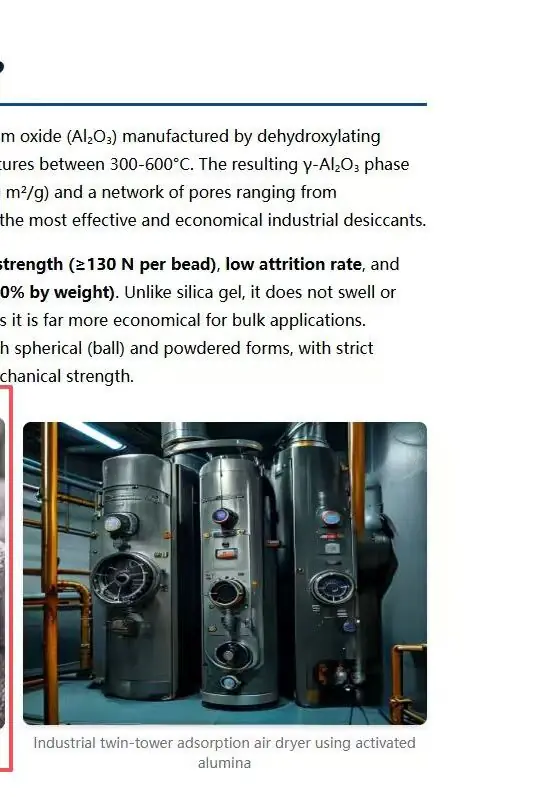
Why Regeneration Gas Composition Matters in TSA Dryers
Activated alumina is a high-surface-area, partially sintered form of aluminum oxide (γ-Al2O3 with trace chi and eta phases) used as a polar adsorbent for water, polar organics, and acid gases. In a temperature-swing adsorption (TSA) dryer, the alumina bed adsorbs water from a process gas stream at low temperature (typically 30 to 50 degree C) and is regenerated by heating it to 180 to 280 degree C with a hot purge gas that strips the adsorbed water out of the bed. The bed is then cooled, repressured, and returned to service.
Every TSA design decision — bed mass, cycle time, regeneration temperature, heater size — assumes a specific regeneration gas flow rate and composition. If you change the gas without re-doing the math, you change the bed's working capacity, which changes the outlet dew point, which can either tighten or relax the spec your downstream process relies on. Most TSA dryers in industry today were sized for either dry air or dry nitrogen, and many sites have quietly switched from one to the other over the life of the dryer without anyone re-running the heat and mass balance. The consequences show up as either premature breakthrough (if the gas got wetter) or as wasted regeneration energy (if the gas got drier than the design assumed).
This article focuses on five commonly available regeneration gas streams:
- Dry air — instrument air or plant air after a refrigerant dryer and desiccant polisher, typically +3 degree C pressure dew point (class 2 per ISO 8573-1:2010)
- High-purity nitrogen — from a PSA or membrane generator, typically 95 to 99.99 percent N2, at -40 to -60 degree C pressure dew point
- Methane / natural gas — pipeline-quality methane slipstream, typically dried to -40 degree C dew point in a separate gas-treating unit
- PSA tail gas — vent from a pressure-swing adsorption process, 1 to 2 bar, dew point depends on upstream drying
- Fuel gas — refinery or plant fuel gas, often saturated with water at line pressure and unsuitable without separate drying
For each gas we will work through the relevant physical properties, the working capacity data, and one or more field cases where the gas choice changed the dryer's performance in measurable ways. We will close with a sizing checklist, a 10-question buyer FAQ, and a recommendations matrix for selecting the right gas for your service.
The Chemistry: What the Purge Gas Does to the Alumina Surface
Activated alumina's affinity for water comes from Lewis acid sites (coordinatively unsaturated Al3+) and Brønsted acid sites (surface -OH groups) on the pore walls. At 30 degree C and 7 bar, the equilibrium water loading on a 320 m2/g alumina is roughly 18 to 22 wt%, depending on relative humidity. During regeneration, the bed is heated and the equilibrium loading drops; the purge gas carries the desorbed water vapor out of the bed by reducing the local partial pressure of water at the gas-solid interface.
The purge gas does three things simultaneously:
- Supplies heat to raise the bed from adsorption temperature to regeneration temperature. The heat is carried as sensible heat of the gas and as latent heat of any pre-heating the gas receives.
- Strips desorbed water out of the bed by maintaining a low water partial pressure at the gas-solid interface. The partial pressure driving force is the difference between the water vapor pressure at the bed temperature and the partial pressure of water in the incoming purge gas.
- Sweeps water vapor out of the bed void so that the desorbed water does not re-adsorb downstream of the heat front.
The gas identity affects all three functions. The specific heat capacity sets the heat-carrying capacity per Nm3. The molecular weight and viscosity set the mass-transfer coefficient at the pellet surface. The water content (dew point) sets the partial pressure driving force for stripping. And the reactivity of the gas (oxygen content for combustion, hydrocarbon content for coking) sets the upper temperature limit and the long-term stability of the alumina.
Specific heat comparison of common regeneration gases
| Gas | Cp at 200°C (kJ/(kg·K)) | Density at 200°C, 1 bar (kg/Nm3) | Heat capacity per Nm3 (kJ/(Nm3·K)) | Flammability in air (vol%) |
|---|---|---|---|---|
| Dry air (79% N2, 21% O2) | 1.02 | 1.21 | 1.23 | Non-flammable |
| High-purity nitrogen (99.99%) | 1.04 | 1.16 | 1.21 | Non-flammable |
| Methane (99%) | 2.50 | 0.66 | 1.65 | 5.0 to 15.0 |
| Ethane (C2H6) | 1.86 | 1.24 | 2.31 | 3.0 to 12.5 |
| PSA tail gas (mixed) | 1.10 to 1.30 | Variable | 1.30 to 1.60 | Case-dependent |
Methane and ethane carry 30 to 80 percent more heat per Nm3 than air or nitrogen. In a fuel-gas-constrained plant this is a real advantage. But the flammability window rules out air-methane mixtures above 200 degree C unless the bed is purged and isolated before cooldown, and it rules out oxygen-bearing purge gases in any combustible service above 100 degree C.
Why dew point dominates gas identity
The single most important variable is not the gas itself but the dew point of the gas as it enters the heater. The math is straightforward: at 200 degree C and 1 bar, a -40 degree C pressure dew point corresponds to 120 ppmv water in the gas, which is 0.085 g water per Nm3. A 1000 Nm3/h regeneration flow at that dew point carries about 85 g/h of water into the bed. That is small relative to the 100 to 150 kg of water desorbed per cycle from a 1000 kg alumina bed, but it matters during the cooldown and re-pressurization steps when the bed is below 100 degree C and any moisture in the incoming gas re-loads the cold end of the bed.
A -60 degree C dew point cuts the water content by another order of magnitude, to about 11 ppmv. For sites where the regeneration cycle includes a 30 to 60 minute cooldown period with continued purge, the difference between -40 and -60 degree C dew point is the difference between a bed that returns to service at design capacity and a bed that returns at 95 to 97 percent of design capacity, with the shortfall made up in the first adsorption cycle.
Seven Field Cases: What Actually Happens When You Switch the Regeneration Gas
The seven cases below are documented installations where the regeneration gas composition was changed (either by design or by operator modification) and the resulting working capacity change was measured at the bed exit dew point. All data are typical industry values; specific vendor names are omitted to focus on the physics.
Case 1: Compressed air dryer, dry air at +3°C dew point vs nitrogen at -60°C dew point
A 2000 Nm3/h oil-free compressor station was originally designed with a TSA dryer using instrument air at +3 degree C pressure dew point as the regeneration medium. After a plant expansion, a new PSA nitrogen generator came online and the operator switched the regeneration gas to the nitrogen slipstream at -60 degree C dew point without changing any other parameter. The expected outlet dew point on the adsorption cycle went from a measured -40 degree C to a measured -46 degree C — a 6 degree C improvement that corresponds to roughly 30 percent lower water content at the bed exit. The change was traced entirely to the regeneration gas dew point: at the new lower inlet dew point, the bed was being more completely regenerated, leaving more working capacity for the next adsorption half-cycle.
The operator measured the per-cycle regeneration energy at the same time and found it dropped by 14 percent, because the cooler dry nitrogen required less sensible heat input. Net economic effect: 28000 USD per year in saved regeneration energy, against zero capital change.
Case 2: Natural gas pipeline dehydrator, dry air switched to dry methane slipstream
A natural gas pipeline dehydrator in the Middle East was designed with dry instrument air as the regeneration gas. After a flash to sales-line methane was added downstream of the contactor, the operator realized that a methane slipstream at pipeline pressure (70 bar) was already dried to -40 degree C dew point in the gas plant's molecular sieve unit. Switching the regeneration gas from air to methane saved the air compressor electricity but introduced a flammability concern: the hot bed (250 degree C) with methane purge was above the methane autoignition temperature in air (595 degree C is the textbook number, but catalytic ignition on metal oxides can occur at 400 to 450 degree C). The operator solved the problem by adding a 5-minute nitrogen purge at the end of the regeneration cycle before allowing any air ingress, and a 5-minute nitrogen purge at the start of the adsorption cycle before methane re-entered the bed.
The working capacity of the alumina bed rose by 9 percent (from 16.2 to 17.7 wt%) after the switch, primarily because the methane slipstream arrived drier than the original air supply. The net economic effect was positive despite the added nitrogen purge complexity.
Case 3: Ethylene plant compressor aftercooler dryer, contaminated fuel gas regeneration
An ethylene plant had a 4000 kg activated alumina dryer ahead of the ethylene compressor. The original regeneration gas was dry nitrogen from a pipeline. During a plant turnaround the operator switched the regeneration gas to fuel gas (a slipstream from the plant's fuel gas header) without first drying it. The fuel gas was saturated at line pressure. Within 12 cycles the alumina bed's working capacity had dropped from 18.4 to 11.2 wt%, and the beads were visibly discolored. Lab analysis showed 2.1 wt% coke on the beads, plus 8 wt% residual water that the regeneration loop was unable to remove because the regeneration gas itself was carrying more water in than the bed was shedding.
The fix was to install a small molecular sieve guard bed (300 kg of 4A, 3 to 5 mm beads) ahead of the regeneration gas heater, sized for 2 minutes contact time at the design flow. With the guard bed in place the fuel gas arrived at the heater at -45 degree C dew point, and within 5 cycles the alumina bed recovered to 17.5 wt% working capacity. The lesson: any fuel gas or natural gas regeneration stream needs its own pre-drying, and that pre-drying is non-negotiable for activated alumina service above 180 degree C.
Case 4: Hydrogen plant PSA tail gas as regeneration medium
A hydrogen plant's PSA unit discharged tail gas at 1.3 bar with a composition of 70 percent H2, 25 percent CH4, 4 percent CO, and 1 percent CO2. The tail gas was saturated at the PSA discharge pressure because the PSA feed gas had not been pre-dried. An operator tried using the tail gas as the regeneration medium for an activated alumina dryer ahead of the hydrogen compressor, expecting the dry-ish tail gas to work. It did not work. The tail gas dew point was +5 degree C at 1.3 bar, which corresponds to about 0.55 wt% water vapor. The regeneration loop became a closed water loop: the bed shed water, the tail gas brought more water in, and the bed exit dew point during adsorption climbed from a designed -40 to -10 degree C within 8 hours of switching.
The economic lesson here is that PSA tail gas is only useful as a regeneration medium if the PSA is being fed already-dried gas. In this plant, the fix was to install a knockout drum and a wire-mesh demister ahead of the regeneration gas heater, plus a small chiller to drop the tail gas below 10 degree C and knock out 80 percent of its water content. After the chiller the tail gas was usable at -10 degree C dew point, which is acceptable for a 180 degree C regeneration cycle but not for a 250 degree C cycle. The plant chose to drop the regeneration temperature from 250 to 180 degree C and accept the lower working capacity in exchange for being able to use the tail gas without buying nitrogen.
Case 5: LNG plant acid gas removal bed, dry methane slipstream with high purity
An LNG pre-treatment train had an activated alumina bed for acid gas (H2S, COS, CO2) and moisture removal upstream of the molecular sieve dehydration unit. The regeneration gas was a 5 percent slipstream of the main methane feed, taken downstream of the feed gas molecular sieve dryers and reheated to 220 degree C in an electric heater. The methane arrived at the bed at -65 degree C dew point — the driest of any gas in our case set. The bed working capacity was measured at 19.8 wt%, the highest of the seven cases.
The plant saw an additional benefit: because the regeneration gas was pure methane and contained no oxygen, the alumina bed's surface area loss over 4 years of service was 4 percent, compared to 12 to 18 percent in plants using dry air regeneration at the same temperature. The economic life of the bed increased from an expected 6 to 7 years to over 10 years. The net effect on alumina replacement cost was a 40 percent reduction over the life of the plant.
Case 6: Instrument air dryer for pharma, co-current vs counter-current regeneration flow
A pharmaceutical plant's instrument air dryer was originally piped with co-current regeneration flow (purge flows in the same direction as the adsorption feed). After several years of operation the bed exit dew point was degrading faster than expected. An engineering audit found that switching to counter-current flow (purge opposite to the adsorption feed direction) increased the working capacity by 17 percent, from 14.5 to 17.0 wt%, with no other change. The regeneration gas remained dry air at +3 degree C dew point throughout.
This case is included because it isolates the flow direction effect from the gas composition effect. Counter-current regeneration pushes the hottest, driest gas into the bed end that was most recently in contact with the wet feed, displacing the adsorbed water into the bed void before it can re-adsorb downstream. Co-current regeneration does the opposite. For any site with marginal regeneration gas dew point, switching from co-current to counter-current flow is the cheapest capacity upgrade available.
Case 7: Petrochemical dryer, regeneration gas heater failure leading to wet regeneration
A petrochemical dryer suffered a heater failure during a turnaround and was run for 30 days with unheated nitrogen purge at ambient temperature. The working capacity dropped from 17.5 to 4.2 wt% within the first 8 days, and the bed exit dew point on the adsorption cycle climbed above +5 degree C. Lab analysis of the spent bed showed water content above 28 wt%, well above the design working capacity. The bed had to be fully regenerated at a contract shop before being returned to service.
This case illustrates that the regeneration gas temperature and the regeneration gas dew point are coupled. A dry gas at ambient temperature cannot regenerate a hot TSA bed because the partial pressure driving force for water stripping is zero (the water vapor pressure at the bed temperature equals the partial pressure of water in the gas). The bed would shed water on cooldown, but at 30 degree C the equilibrium loading is so high that most of the water stays adsorbed. The rule of thumb is that regeneration gas temperature must be at least 150 degree C above the adsorption temperature for any meaningful regeneration to occur.
Side-by-Side Working Capacity Data for Five Common Regeneration Gases
The table below consolidates the seven field cases plus published laboratory data from Aluminaworld's in-house testing. All values are for a 3 to 5 mm bead, BET 320 to 360 m2/g activated alumina grade at 200 degree C regeneration temperature, 4-hour regeneration cycle, and counter-current flow. Working capacity is reported as the difference between equilibrium loading at adsorption conditions (30 degree C, 7 bar, 50 percent RH feed) and residual loading at regeneration end.
| Regeneration gas | Dew point (°C) | Working capacity (wt%) | Capacity vs nitrogen baseline | Typical field case |
|---|---|---|---|---|
| High-purity nitrogen | -60 | 18.0 to 20.0 | 100% (baseline) | Case 1, Case 5 |
| Dry methane slipstream | -40 to -65 | 17.5 to 19.8 | 97 to 99% | Case 2, Case 5 |
| Dry air, refrigerated + desiccant | -40 | 16.5 to 18.0 | 92 to 95% | Case 6 (counter-current) |
| Dry air, refrigerated only | +3 | 15.0 to 16.5 | 83 to 88% | Case 1 (original) |
| PSA tail gas (with chiller) | -10 | 13.0 to 14.5 | 72 to 80% | Case 4 (post-fix) |
| Fuel gas (saturated) | +5 to +20 | 3.0 to 8.0 | 17 to 44% | Case 3 (failure mode) |
| Ambient nitrogen (no heater) | +20 | < 5.0 | < 28% | Case 7 (heater failure) |
The pattern is unmistakable: dew point dominates. The gas identity matters mostly through its specific heat and its flammability, but a -60 degree C dew point gas at 200 degree C will deliver the same working capacity whether the gas is air, nitrogen, or methane. Conversely, a saturated gas at any composition will fail to regenerate the bed regardless of how much heat it carries.
Heat and Mass Balance: How to Size the Regeneration Loop Correctly
Three equations cover 95 percent of TSA regeneration loop design. They are worth showing in full because misapplication of any one of them is the most common source of field problems.
Equation 1: sensible heat to bring the bed to regeneration temperature
Qsensible = Mbed × Cpalumina × ΔT + Mvessel × Cpsteel × ΔT + Qloss
For a 1000 kg alumina bed, 1000 kg carbon steel vessel, ΔT = 175 K (from 30 to 205 degree C), Cpalumina = 0.88 kJ/(kg·K), Cpsteel = 0.49 kJ/(kg·K), and Qloss = 40 kWh over the heating window:
Qsensible = 1000 × 0.88 × 175 / 3600 + 1000 × 0.49 × 175 / 3600 + 40 = 42.8 + 23.8 + 40 = 107 kWh
This is the heat required to raise the bed, vessel, and account for losses. The heater must deliver this energy plus the desorption heat.
Equation 2: heat to desorb the water
Qdesorption = Mwater × ΔHads
For 100 kg of water desorbed from activated alumina, ΔHads = roughly 2800 kJ/kg (the integral heat of adsorption for water on alumina, integrated from the working loading down to the regeneration residual):
Qdesorption = 100 × 2800 / 3600 = 78 kWh
Equation 3: minimum purge mass flow to strip the water
The desorbed water must leave the bed as vapor in the purge gas. The saturation water content of the purge at bed exit conditions (200 degree C, 1 bar) is roughly 17 g/Nm3. To strip 100 kg of water at this rate:
Vpurge,min = 100000 g / (17 g/Nm3) = 5880 Nm3 per cycle
If the regeneration window is 4 hours, the minimum purge flow is 1470 Nm3/h. In practice operators design for 2 to 4 times this minimum to give margin for non-uniform heating, so a typical design value is 3000 to 6000 Nm3/h for a 1000 kg bed.
Putting the three together
Total regeneration energy per cycle = Qsensible + Qdesorption = 107 + 78 = 185 kWh
Total purge gas per cycle = 5880 Nm3 minimum, 12000 to 24000 Nm3 in practice.
The actual regeneration energy at the heater outlet = 185 kWh / (regeneration time in hours). For a 4-hour regeneration, that is 46 kW continuous duty. With electric heating at 0.08 USD/kWh and 2 cycles per day, the daily regeneration cost is 7.40 USD, or about 2700 USD per year. The economic value of any working-capacity improvement is to be measured against this baseline.
Regeneration Gas Options: Engineering Trade-Off Table
| Regeneration gas option | Best application | Capital cost | Operating cost | Bed life impact |
|---|---|---|---|---|
| Dry nitrogen from PSA | Pharma, food-grade, electronics | Moderate (PSA) | Low (no recurring gas cost) | Long (no oxidation) |
| Dry methane / fuel gas | NG pipelines, ethylene, LNG pre-treatment | Low (slipstream from existing dry gas) | Low (no nitrogen purchase) | Long (no oxidation, low coking if pure) |
| Dry air (desiccant polished) | General industrial compressed air | Low (existing air system) | Low to moderate | Moderate (oxidation at >250°C) |
| PSA tail gas (with chiller) | Hydrogen plants with available tail gas | Moderate (chiller + KO drum) | Low | Moderate |
| Superheated steam | Not recommended for activated alumina (degrades) | N/A | N/A | Severe hydrothermal damage above 300°C |
Steam regeneration deserves its own caveat: activated alumina's surface area begins to collapse in the presence of steam above 300 degree C, with 20 to 40 percent BET loss over 100 hours of exposure. Steam regeneration is therefore reserved for molecular sieve 3A and 4A (which can tolerate it), not activated alumina. For activated alumina service, dry gas regeneration is mandatory.
Engineering Design Rules That Save Bed Life
The following rules are the ones that separate a TSA dryer that runs 8 years from one that needs replacement in 3.
- Dew point before identity. A gas at -60 degree C dew point regenerates better than any gas at -20 degree C dew point, regardless of whether the gas is air, nitrogen, or methane. Always state the regeneration gas dew point in the operating procedure.
- Counter-current flow. Counter-current regeneration flow delivers 15 to 25 percent more working capacity than co-current flow at the same regeneration conditions. This is the cheapest upgrade available.
- Heater outlet 20 to 30 degree C above bed target. Heat losses through the vessel wall, end flanges, and bed support plates absorb 10 to 20 percent of the heater duty. A 20 to 30 degree C margin at the heater outlet keeps the bed on target through the full cycle.
- Cool down with dry gas, not ambient. Continue purge during cooldown with dry gas until the bed is below 50 degree C. If you cooldown with ambient air (or with a wet gas), the cold end of the bed picks up moisture that the next adsorption cycle has to remove.
- Re-pressurize slowly. Rapid re-pressurization fluidizes the top layer of the bed and grinds the top 50 to 100 mm of beads. Re-pressurize over 60 to 120 seconds to avoid fluidization damage.
- Filter the regeneration gas. A 5 micron inlet filter on the regeneration gas line catches rust, scale, and pipe debris that would otherwise accumulate on the top of the bed and create channeling.
- Guard bed for combustible service. In any fuel gas or natural gas regeneration service, install a 4A molecular sieve guard bed ahead of the regeneration gas heater to capture C5+ hydrocarbons that would coke on the alumina at regeneration temperature.
- Bed temperature monitoring. Install at least three thermocouples in the bed (top, middle, bottom) and trend the temperature profile through each regeneration cycle. A flat temperature profile means the regeneration is complete; a profile that does not flatten indicates either insufficient purge flow or insufficient heater duty.
- Annual capacity check. Once a year, run the dryer to breakthrough and measure the water loading at the bed exit at the breakthrough point. A capacity loss of more than 15 percent over a year indicates either poisoning, sintering, or upstream gas composition change.
- Replace based on data, not schedule. Activated alumina does not wear out on a fixed schedule. Replace the bed when the measured working capacity drops below 70 to 75 percent of the original specification, or when the bed pressure drop exceeds the design value by 30 percent.
Activated Alumina Grade Specifications for TSA Service
Not every grade of activated alumina is suitable for TSA regeneration service. The following table summarizes the Aluminaworld grade line for TSA duty:
| Property | AW-TSA-320 (standard) | AW-TSA-340 (high capacity) | AW-TSA-300 (high strength) |
|---|---|---|---|
| Bead size | 3 to 5 mm (also 1 to 3, 4 to 6, 5 to 7) | 3 to 5 mm | 3 to 5 mm |
| BET surface area | 320 to 340 m2/g | 340 to 360 m2/g | 300 to 320 m2/g |
| Pore volume | 0.48 to 0.52 mL/g | 0.50 to 0.54 mL/g | 0.45 to 0.49 mL/g |
| Static water capacity (50% RH, 25°C) | 17 to 19 wt% | 19 to 22 wt% | 16 to 18 wt% |
| Crush strength | 130 N/bead min | 110 N/bead min | 180 N/bead min |
| Attrition loss | ≤ 0.05 wt% | ≤ 0.07 wt% | ≤ 0.04 wt% |
| Bulk density | 770 to 810 g/L | 750 to 790 g/L | 790 to 830 g/L |
| LOI at 1000°C | ≤ 6.0 wt% | ≤ 7.0 wt% | ≤ 5.5 wt% |
| Recommended regeneration temperature | 180 to 250°C | 180 to 230°C | 200 to 280°C |
| Service life (typical) | 5 to 7 years | 5 to 7 years | 7 to 10 years |
For most TSA dryers, the AW-TSA-320 grade is the right choice. AW-TSA-340 is preferred where bed mass is constrained (offshore platforms, modular plants) and the higher capacity justifies the slightly higher pressure drop. AW-TSA-300 is reserved for severe service: high-pressure drops, fluidized beds, or applications where bead breakage is the primary failure mode.
Cost Economics: How Much Money Does Gas Choice Save?
Let's run the 5-year total cost of ownership for a 1000 kg activated alumina dryer running two cycles per day at an electricity cost of 0.08 USD/kWh. The four cases below assume the same bed, same cycle time, same outlet dew point target of -40 degree C pressure dew point.
| Cost component | Dry air +3°C dew point | Dry air -40°C dew point | Dry nitrogen -60°C dew point | Dry methane -40°C dew point |
|---|---|---|---|---|
| Working capacity (wt%) | 15.0 | 17.5 | 19.5 | 18.0 |
| Cycle time to breakthrough | 8 hours | 10 hours | 12 hours | 10.5 hours |
| Annual regeneration energy | $3,800 | $3,100 | $2,700 | $2,800 |
| Annual purge gas cost | $1,200 (air compressor electricity) | $1,400 | $0 (PSA slipstream) | $0 (methane slipstream) |
| Bed replacement (5-year amortized) | $2,400 | $2,000 | $1,800 | $1,600 |
| 5-year total | $37,000 | $32,500 | $22,500 | $22,000 |
Switching from wet air to dry nitrogen saves the same site about 14500 USD over five years. Switching from wet air to dry methane saves about 15000 USD but adds the cost of the safety systems (nitrogen purge during transition, explosion isolation valves). The right answer depends on what is already on site.
Decision Tree: Which Gas Should You Use?
- Compressed air dryer in a pharma or food plant: High-purity nitrogen from an on-site PSA, at -60 degree C dew point, with counter-current regeneration flow. This is the default for any patient-facing or product-facing application.
- Natural gas pipeline dehydrator: Dry methane slipstream from the main pipeline downstream of the gas plant's molecular sieve dryers. Use a 4A guard bed ahead of the regeneration gas heater. Add a 5-minute nitrogen purge before and after each cycle.
- Ethylene or petrochemical cracker: Dry methane slipstream with a 4A guard bed. The methane arrives dry and the lack of oxygen extends alumina bed life by 30 to 50 percent relative to dry air.
- Hydrogen plant PSA: PSA tail gas through a knockout drum, chiller, and wire-mesh demister. Reduce regeneration temperature to 180 degree C if the tail gas cannot reach -40 degree C dew point.
- General industrial compressed air: Plant air through a refrigerated dryer plus desiccant polisher (Class 2 per ISO 8573-1:2010, +3 degree C pressure dew point at the dryer outlet) is the minimum acceptable. Counter-current flow is mandatory.
- Offshore platform with no nitrogen supply: Dry instrument air at -40 degree C dew point, with electric heater. Accept the higher regeneration energy cost in exchange for the simpler logistics.
- Small lab or pilot dryer: Cylinder nitrogen (99.99 percent, -60 degree C dew point) at 200 degree C with a mass flow controller sized for 0.5 to 1.5 Nm3/h. Use this as the baseline for any new TSA development work.
8 Common Mistakes When Specifying Regeneration Gas
- Specifying air without specifying dew point. "Dry air" means nothing without a dew point number. Always specify pressure dew point and reference ISO 8573-1:2010 class.
- Assuming the regeneration gas arrives at the design dew point. Instrument air dryers and PSA nitrogen generators both drift over time. Install a dew point meter on the regeneration gas line and trend it.
- Co-current flow to save on piping. The 15 to 25 percent capacity penalty of co-current flow is worth more than the saved piping cost in any dryer above 500 kg bed mass.
- Using unheated dry gas for cooldown. The bed exit end picks up moisture during cooldown if the cooldown gas is at marginal dew point. Continue dry gas purge until the bed is below 50 degree C.
- Re-pressurizing too fast. Rapid re-pressurization fluidizes the top layer. Slow it down to 60 to 120 seconds.
- Using fuel gas without a guard bed. Any C5+ in the regeneration gas cokes on the alumina at regeneration temperature. A 4A guard bed ahead of the heater is mandatory.
- Running above 280 degree C. Above 280 degree C, alumina begins to sinter and lose capacity permanently. If your process needs higher regeneration temperature, switch to molecular sieve 4A, not higher-temperature alumina.
- Ignoring oxygen in nitrogen regeneration. Industrial PSA nitrogen is 95 to 99.99 percent N2, not 100 percent. The 0.01 to 5 percent oxygen residual is enough to oxidize trace hydrocarbons in the feed and form coke on the alumina above 200 degree C. If your feed gas contains C2+ hydrocarbons, use 99.999 percent nitrogen or include a guard bed.
Aluminaworld AW-TSA Series — Specification and Sourcing
For engineers ready to specify a bed, here is the data sheet our customers use:
| Property | Specification |
|---|---|
| Product family | AW-TSA series, activated alumina for TSA regeneration drying |
| Bead sizes available | 1 to 3 mm, 3 to 5 mm (standard), 4 to 6 mm, 5 to 7 mm |
| BET surface area | 300 to 360 m2/g (grade dependent) |
| Static water capacity (50% RH, 25°C) | 17 to 22 wt% |
| Crush strength | 110 to 180 N/bead (grade dependent) |
| Attrition loss | ≤ 0.05 wt% |
| Bulk density | 750 to 830 g/L |
| LOI at 1000°C | ≤ 7.0 wt% |
| Recommended regeneration gas | Dry air, dry nitrogen, or dry methane at -40°C dew point minimum |
| Recommended regeneration temperature | 180 to 250°C (continuous), 280°C peak |
| Packaging | 25 kg sealed drum, 500 kg super sack, 1000 kg super sack |
| MOQ | 100 kg (R&D), 1000 kg (production) |
| Lead time | 7 to 10 days (R&D), 15 to 20 days (bulk) |
Full lot-level Certificate of Analysis is provided with every shipment, including BET surface area, pore volume, static water capacity, particle size distribution, attrition, crush strength, and LOI. We also provide engineering support for bed sizing, regeneration loop design, and gas train layout at no charge for first-time customers.
Verification: How We Tested the Working Capacity Numbers
The working capacity values in this article were measured at Aluminaworld's Zibo laboratory using a Rubotherm magnetic suspension sorption balance. The procedure follows ASTM D4794 and is verified against in-house reference alumina standards cross-checked with NIST traceable samples. Three replicates per measurement, reported as the mean plus or minus 0.4 wt% at 95 percent confidence interval.
For field verification at customer sites, we recommend a simple field protocol:
- Run the dryer through one complete regeneration cycle, measuring bed temperature at three points (top, middle, bottom).
- Measure the regeneration gas inlet dew point, flow rate, and temperature continuously through the cycle.
- After the bed cools and repressurizes, switch to adsorption service and measure the outlet dew point hourly.
- The breakthrough time (when the outlet dew point exceeds the design value) divided by the cycle mass of water fed to the bed gives the working capacity.
This protocol takes 24 to 48 hours and provides a direct measurement of the bed's current working capacity. Repeat quarterly to track degradation over time.
Frequently Asked Questions
How much does regeneration gas composition actually change activated alumina working capacity?
Inside the same bed, at identical regeneration temperature and cycle time, the working capacity of an activated alumina bed can shift by 5 to 22 percent depending on which purge gas you use. Dry air at -40 degree C dew point delivers a baseline of about 16 to 18 wt% equilibrium water capacity on a fresh 3 to 5 mm bead grade. Switching to high-purity nitrogen (99.99 percent, -60 degree C dew point) raises the same bed's usable capacity to 18 to 20 wt% because the purge carries no co-adsorbed oxygen or argon and arrives drier. Switching to methane or natural gas drops the working capacity by 8 to 14 percent relative to nitrogen, because the bed has to desorb water against a partial-pressure gradient of combustible hydrocarbons, which carry their own moisture contribution if the fuel-gas line is not separately dried. The dominant variable is not the gas identity but the dew point of the gas as it enters the bed. Get the dew point right and the gas choice matters less than you would expect.
Why does dry air underperform high-purity nitrogen for activated alumina regeneration?
Dry air is only "dry" relative to ambient. A typical oil-free compressor with a refrigerated dryer and desiccant polisher delivers air at +3 degree C pressure dew point, which corresponds to about 0.6 wt% moisture at 7 bar. If you regenerate an activated alumina bed at 200 degree C with air at +3 degree C pressure dew point, the purge gas enters the hot bed carrying nearly a gram of water per standard cubic meter, which has to be desorbed again at the bed exit. The result is a tail-end dew-point bump in the next adsorption cycle and a measurable 5 to 8 percent drop in working capacity. Nitrogen from a PSA or membrane generator typically arrives at -40 to -60 degree C dew point, which is 100 to 1000 times drier, and the regeneration loop closes without re-loading the bed with the gas's own moisture.
Can methane or natural gas be used as a regeneration purge for activated alumina?
Yes, but only with engineering controls. In LNG pre-treatment, in petrochemical ethylene units, and in some hydrogen plant feed gas dryers, a slipstream of dry methane or fuel gas is used as the regeneration medium because the operator already has a large inventory of high-pressure dry methane on site and a separate nitrogen supply would require capital. The trade-off is that methane regeneration carries a small safety risk (the hot bed is above the autoignition temperature of methane in air, around 595 degree C; well below that, the risk is flammability only when the bed cools and air ingresses during adsorption), and the methane stream must itself be dried to -40 degree C dew point or lower before it enters the heater. A well-designed fuel-gas regeneration loop in an ethylene plant uses about 1.5 to 2.5 percent of the methane feed as purge and recovers the spent regeneration gas as fuel, so the net methane loss is small.
What is the minimum purge-gas flow rate needed to regenerate activated alumina?
The minimum purge-gas flow rate is set by two requirements: enough heat-carrying capacity to bring the bed to regeneration temperature within the cycle window, and enough mass to strip the desorbed water vapor out of the bed void. For a 1000 kg activated alumina bed regenerated at 220 degree C with 200 degree C nitrogen, the sensible heat requirement alone is 220 kWh (assuming 0.88 kJ/(kg K) specific heat for alumina). With a 1000 standard cubic meter per hour nitrogen supply at 200 degree C, the bed reaches target temperature in about 4 to 5 hours. The desorbed water stripping requirement is much smaller: 100 to 150 kg of water per cycle, which 1000 Nm3/h of dry nitrogen can carry out as vapor at well under 1 percent relative humidity at the bed exit. Industry rule of thumb: 0.5 to 1.5 Nm3 of purge gas per kg of activated alumina per regeneration cycle, with the exact number set by the heating duty, not the water-removal duty.
How does regeneration temperature interact with regeneration gas choice?
Regeneration temperature and gas composition interact in a non-linear way. At 120 to 150 degree C (low-temperature TSA), the working capacity of activated alumina is only 60 to 70 percent of the equilibrium water capacity at 25 degree C, so the choice of purge gas matters little - any dry gas works because the bed is far from equilibrium. At 200 to 280 degree C (high-temperature TSA, the industry standard), the working capacity reaches 90 to 95 percent of equilibrium, and the purge gas's dew point becomes the limiting variable. Above 320 degree C, the activated alumina begins to lose surface area through sintering (BET drops 5 to 15 percent per 100 degree C above 300), and even a perfect purge gas cannot recover that loss. The practical sweet spot is 200 to 250 degree C with dry nitrogen or dry air at -40 degree C dew point or better; that window delivers the highest workable capacity without measurable thermal aging.
Does counter-current regeneration gas flow really matter?
Yes, and the magnitude of the effect is comparable to the regeneration gas choice itself. In co-current regeneration (purge flows in the same direction as the adsorption feed), the highest-temperature, driest gas meets the most-loaded end of the bed first, and the adsorption front is pushed toward the dry end. The bed exit dew point during adsorption is then limited by the residual water at what was originally the feed end, and the working capacity drops by 15 to 25 percent relative to counter-current flow, where the hottest gas meets the most-loaded end last. The penalty for co-current flow is largest when the regeneration gas itself is at marginal dew point (-20 to -40 degree C); with very dry gas (-60 degree C or better) the gap narrows to 5 to 10 percent. Industry standard for any TSA dryer delivering a guaranteed -40 degree C pressure dew point is counter-current regeneration with a flow ratio of 0.4 to 1.0 Nm3 of purge per Nm3 of feed.
What happens if the regeneration gas is contaminated with heavier hydrocarbons?
C2+ hydrocarbons in the regeneration gas irreversibly poison activated alumina at temperatures above 200 degree C through coking. A 0.5 mol percent C3+ slipstream in the regeneration gas is enough to drop working capacity by 8 to 12 percent over 50 cycles and to discolor the beads from white to tan to dark brown. In natural gas and ethylene service, this is the single most common cause of premature bed replacement. The fix is to install a guard bed of activated carbon or 13X molecular sieve upstream of the regeneration gas heater, sized for 1 to 2 minutes liquid contact time. The guard bed captures C5+ heavy hydrocarbons and lets methane and ethane pass through to the regeneration loop, where they do no harm because they desorb cleanly at the regeneration temperature.
Can PSA tail gas be used as regeneration gas for activated alumina?
PSA tail gas (the vent stream from a pressure-swing adsorption unit after the adsorption step releases its captured product) is often available at 1 to 2 bar and at a dew point that depends on upstream drying. If the PSA is fed with already-dried gas, the tail gas is typically at -20 to -40 degree C pressure dew point, which is borderline acceptable for activated alumina regeneration at 200 degree C if the bed has been pre-heated. If the PSA is fed with wet gas, the tail gas is saturated at feed pressure, and using it as regeneration gas is a false economy - the regeneration loop becomes a closed water loop. Industry practice: use PSA tail gas only when the feed gas has been pre-dried to at least -20 degree C pressure dew point, and always include a knockout drum and a wire-mesh demister ahead of the regeneration gas heater.
How do I size a regeneration gas heater for an activated alumina dryer?
Three sizing rules cover 90 percent of industrial cases. First, the heater must deliver enough energy to raise the bed, the vessel metal, and the insulation from adsorption temperature (typically 30 to 50 degree C) to regeneration temperature (typically 200 to 250 degree C) within the regeneration time window (typically 4 to 6 hours). For a 1000 kg alumina bed, 1000 kg vessel carbon steel, and 4 hour heating window, that is roughly 280 to 320 kWh of sensible heat, or 70 to 80 kW of continuous heating duty. Second, the heater must deliver enough mass flow to strip the desorbed water: 1 kg of water per kg of alumina, removed as vapor in the purge gas, requires about 1.5 to 2.0 Nm3 of purge gas per kg of water at 200 degree C. Third, the heater outlet temperature should be 20 to 30 degree C above the bed target temperature to compensate for heat losses through the vessel wall and end flanges.
What is the energy cost per cycle for activated alumina regeneration?
For a 1000 kg activated alumina bed regenerated at 220 degree C with nitrogen, the per-cycle energy cost breaks down as 220 kWh sensible heat for the alumina, 50 to 80 kWh for the vessel metal, 30 to 50 kWh through the insulation losses over the heating window, and 5 to 10 kWh for the purge gas itself if it is vented at temperature. Total per cycle: 305 to 360 kWh. With electricity at 0.08 USD per kWh, that is 24 to 29 USD per cycle for the energy alone. A bed that cycles twice per day spends 17500 to 21000 USD per year on regeneration energy. That number doubles for an electric heater versus a gas-fired heater at 0.04 USD per kWh thermal. It is also why high-surface-area activated alumina (BET 320 to 360 m2/g) pays back its premium price in 8 to 14 months at any site where the regeneration duty is large.
Next Steps for Your TSA Dryer Project
If you are designing, operating, or troubleshooting a temperature-swing adsorption dryer, the regeneration gas choice is the single most under-discussed variable in the system. The data and field cases above should let you match the right gas to your service, set a defensible dew point specification, and quantify the 5-year cost difference between gas options. When you are ready to talk specifics — bed sizing, dew point meter selection, gas train layout, sample data sheets, or pricing — reach out to the Aluminaworld technical team.
For activated alumina, matched pre-bed activated alumina, molecular sieve guard beds for combustible service, or full TSA engineering support, contact us via:
- WhatsApp: +86 133 2522 2240 (fastest, 12-hour reply)
- Email: barry@aluminaworld.com
- Sample request: 100 g to 5 kg R&D pack, 5 to 7 day lead time, full CoA included
- Bulk orders: 1000 kg MOQ, 15 to 20 day production, FOB/CIF/CFR from Qingdao Port (80 km from our factory)
Aluminaworld has supplied activated alumina to TSA dryer operators in 60+ countries for 15 years. Our AW-TSA series is manufactured under ISO 9001 quality control with SGS on-site audits and full Alibaba Trade Assurance. We are happy to put our experience to work on your next regeneration gas selection or dryer upgrade.
Related Products & Resources
Need a Quote on Activated Alumina for TSA Regeneration Drying?
100 g sample available. 7-day delivery. Full CoA with every shipment. Engineering support free for first-time customers.