
Activated Alumina Storage: Shelf Life and Receiving Checks
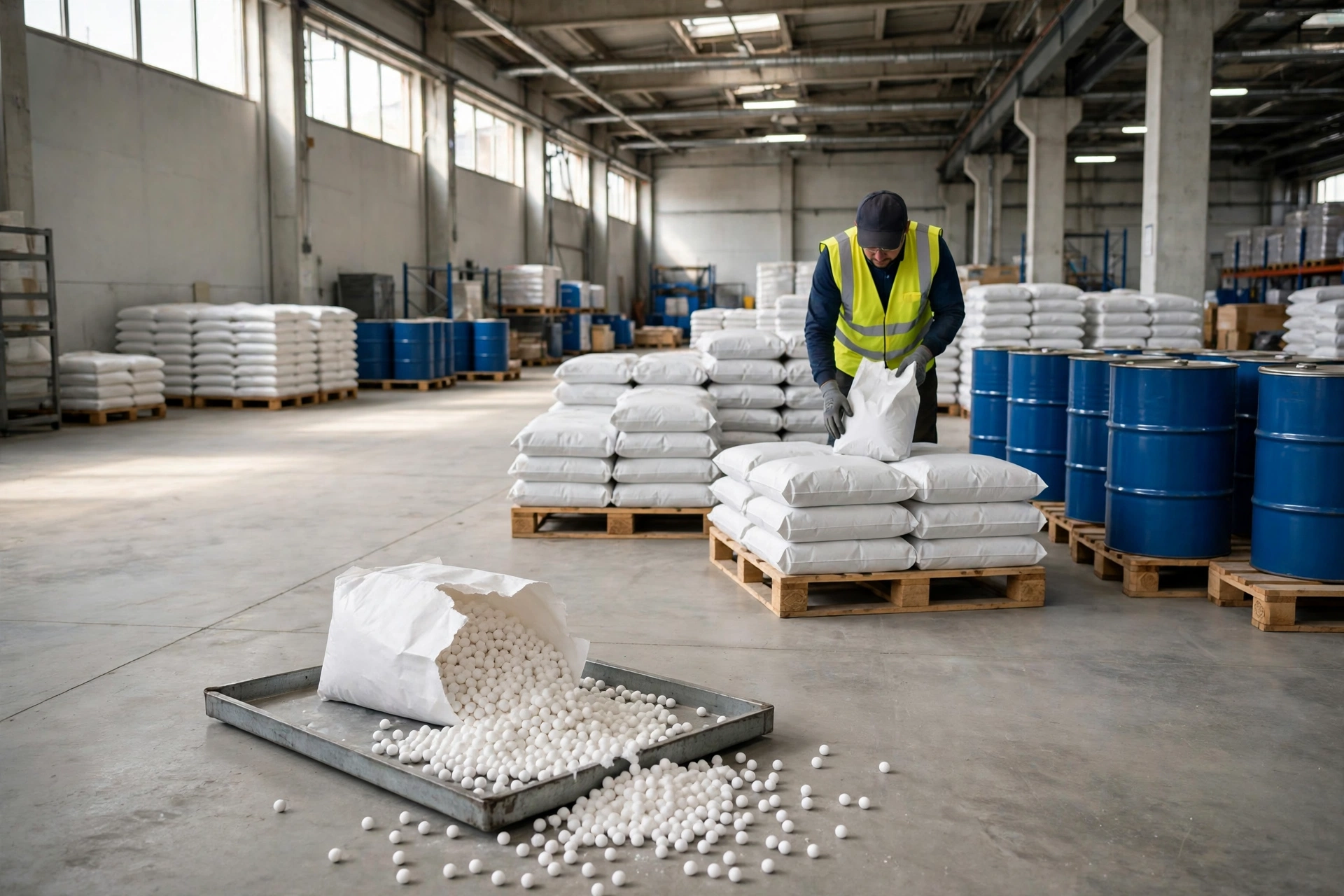
A dryer that underperforms is often blamed on the wrong thing: the grade, the bed size, the regeneration cycle. Often the real cause sits in the warehouse — activated alumina that picked up moisture in storage, or a delivery never checked on arrival. The beads leave the factory dry; what happens between the factory gate and the dryer decides how much drying capacity is left.
This guide is for plant engineers and buyers: why activated alumina absorbs moisture in storage, which packaging protects it, how long it keeps, and the five receiving checks that stop a wet lot reaching your dryer.
Why Activated Alumina Absorbs Moisture in Storage
Activated alumina is a desiccant even when nobody asks it to be — an open bag in a humid warehouse starts drying the room air on day one.
Activated alumina is a porous, spherical aluminium oxide with a very high internal surface area — 300–360 m²/g BET and 0.38–0.48 cm³/g pore volume on the Aluminaworld datasheet, at Al₂O₃ ≥ 93%. That surface is what makes it a desiccant, and what makes it vulnerable in storage: adsorption is physical and reversible, so moisture taken up in the warehouse is moisture the dryer would otherwise have removed from the air. Capacity spent drying the warehouse is capacity the dryer no longer has. The packaging is the only barrier: sealed bags and drums stay dry as packed. Once opened, a bag should go into the dryer in the same shift, and any remainder must be resealed airtight and dated.
Packaging Formats and What Each One Protects
Packaging is not a shipping detail: it is the first layer of moisture protection, and the right format depends on how fast the material is used.
| Format | Best for | Handling note | Main risk |
|---|---|---|---|
| 25 kg bags | Small dryers, top-ups, trial lots | Easy to carry and reseal | Torn or open bags left on the line |
| 150 kg steel drums | Medium users, longer storage | Rigid, resealable; the best moisture barrier | Damaged lid seal; drums stored outdoors |
| 800/1000 kg bulk bags | Large dryers, full-bed change-outs | Plan the whole bag into one job | Once opened, the whole tonne is exposed |
Choose by consumption rate, not unit price: a bulk bag left open for a month loses more capacity than it ever saved on packaging. Small users should stay with bags or drums; bulk bags suit a full-bed change-out, loaded in one job.
Storage Rules That Keep Capacity Intact
Five rules cover almost every storage failure we see — and none of them needs new equipment.
- Store indoors, in a dry room — never outdoors or against a wall where condensation forms.
- Keep pallets off the floor and away from steam lines, wash-down areas and roof leaks.
- Keep the original packaging sealed until the day of use — a cut bag is an open bag.
- First in, first out: use the oldest lot first and keep lot labels visible.
- Use an opened bag in the same shift; if impossible, fold the liner tight, tape it shut and date the bag.
Normal warehouse temperatures are fine — humidity and water contact are the enemies, not heat.
Shelf Life: There Is No Fixed Expiry Date
Activated alumina has no expiry date printed on the bag — and a sealed bag does not go stale on a calendar.
Activated alumina is a stable ceramic oxide, not a chemical that degrades: its capacity is unchanged as long as it stays dry, so what ages is the packaging and the storage conditions, not the beads. Judge a stored lot by its condition, not its date — sealed, dry, undamaged packaging and a batch COA showing low package moisture mean the lot is good; a torn bag in a damp corner is suspect whatever the date. A damp lot is not waste: reactivation at 170–250 °C, the regeneration range on the datasheet, drives the adsorbed water off and restores capacity.
Receiving Inspection: Five Checks Before the Lot Reaches the Dryer
Ten minutes at the goods-in dock saves a dryer bed. Run these five checks on every delivery.
1. COA against the purchase order
Match the batch certificate to the order: bead size (1–3, 2–4, 3–5, 4–6 or 5–8 mm spherical beads), BET 300–360 m²/g, crush strength (≥ 130, ≥ 180 or ≥ 210 N/particle by size), attrition ≤ 0.1 wt%, package moisture. Any value outside the datasheet is a hold.
2. Packaging integrity
No tears, no wet patches, drum lids sealed, pallet wrapping intact — a wet patch outside a bag usually means a wet patch on the beads inside.
3. Weight and count
Weigh a sample of bags or drums and count the lot — short weight is the fastest sign of trouble in transit.
4. Visual check
Uniform white spherical beads, no dust cloud when poured, no broken beads, no discolouration. Dust points to rough handling; a grey or stained lot points to contamination.
5. The delta-T spot test
Add a fixed amount of water to a weighed sample and watch the temperature rise: fresh beads warm sharply, saturated beads stay flat. No laboratory is needed, and the test settles the most common argument at goods-in — whether the lot is dry enough to load.
Hold a failed lot, segregate it, photograph the damage and tell the supplier the same day, with the COA and test result in the message. A hold costs a phone call; a wet bed costs a regeneration cycle and a week of high dew points.
What to Do With a Damp or Damaged Lot
A damp lot is a recoverable lot — but only if it never reaches the dryer untested.
Reactivate first: heat the beads to 170–250 °C with a dry purge gas, then re-test with the delta-T spot test. If only the packaging is damaged but the beads test fresh, re-bag into sealed containers and use that lot first. If the lot still tests flat, reject it with the evidence — COA, photographs and test result. Never load wet beads expecting the dryer's regeneration to fix them: the first cycle will be spent drying the desiccant instead of the air.
For the numbers behind these checks, see the activated alumina product page, the six lab methods for testing activated alumina quality and the regeneration temperature guide.
Frequently Asked Questions
How long can activated alumina be stored?
In sealed, dry packaging, indefinitely — capacity is a function of condition, not age. Check the COA and the packaging, not the calendar.
Can damp activated alumina be dried and reused?
Yes — reactivate at 170–250 °C with a dry purge gas, then re-test with the delta-T spot test before loading. If it still tests flat, reject the lot.
How do I test an activated alumina delivery on arrival?
Check the COA against the order, inspect the packaging, weigh a sample, look at the beads, and run a delta-T spot test. Hold the lot if any check fails.
Which packaging should I order — bags, drums or bulk bags?
25 kg bags for top-ups and small dryers, 150 kg steel drums for longer storage, 800/1000 kg bulk bags for full-bed change-outs. Never leave a bulk bag open between jobs.
If a delivery arrived damp, or a stored lot may no longer be dry, send us the grade, bead size and COA package moisture — our engineers will confirm whether to load, reactivate or reject it: barry@okkinc.com.
Get a Quote
Tell us the product, grade and quantity. We reply within 12 hours with EXW pricing and lead time.
- ✓ COA and technical datasheet with every shipment
- ✓ EXW pricing — freight calculated per order
- ✓ Engineering consultation on grade selection and loading
Prefer to talk now?
WhatsApp +86 133 2522 2240
or email barry@okkinc.com