What "blue hydrogen" actually delivers at the battery limits of a steam-methane reformer
Blue hydrogen is hydrogen produced from fossil feedstock (most often natural gas, sometimes refinery off-gas or naphtha) where the CO2 co-product is captured rather than vented. The dominant production route is steam-methane reforming (SMR) followed by a water-gas shift (WGS) train and a pressure-swing adsorption (PSA) unit, which together produce a 99.99% pure H2 stream at the PSA outlet and a separate concentrated CO2 stream that is dried, compressed, and sent for sequestration or enhanced-oil-recovery injection. In an autothermal reformer (ATR) layout, the SMR and partial-oxidation steps are combined in a single refractory-lined vessel, but the downstream WGS + PSA + CO2-capture flow scheme is identical from a polishing-stage perspective.
The critical point for this article: the H2 stream leaving the PSA tail gas is not the final product. That stream still contains trace contaminants — primarily residual NH3 from the cracking of any amines used upstream, residual CO/CO2 to the low ppm range, and trace sulfur compounds (H2S, COS) if the upstream desulfurization is incomplete. For most merchant hydrogen applications (refinery hydroprocessing, ammonia synthesis feed, fuel-cell-grade H2), these contaminants must be reduced to low-ppm or low-ppb levels before the gas can be sent to the end user. The activated alumina polishing stage is the workhorse technology for the NH3 component of this cleanup.
Typical inlet and outlet targets for a blue hydrogen polishing train are:
| Contaminant | Typical inlet (post-PSA) | Polishing outlet target | Standard reference |
|---|---|---|---|
| NH3 | 50-300 ppm (typical), up to 1000 ppm spike | <10 ppm (process), <1 ppm (fuel-cell) | EIGA IGC 121/14, SAE J2719 |
| CO + CO2 (combined) | 10-100 ppm | <10 ppm (process), <2 ppm (fuel cell) | ISO 14687, SAE J2719 |
| H2S | 1-50 ppb (if upstream ZnO guard) | <4 ppb (fuel cell) | ISO 14687 Grade D |
| CH4 + N2 + Ar (inerts) | 1000-5000 ppm | <100 ppm (process) | Process spec |
The activated alumina polishing stage addresses the first row of that table. The other contaminants are addressed by separate technologies (CO/CO2 by methanation or further PSA, H2S by upstream ZnO or activated carbon, inerts by cryogenic or membrane polishing). If you are specifying a polishing train, you must treat NH3 removal as a stand-alone sub-system and not assume any of the other stages will incidentally remove it. They will not.
Why NH3 is the hardest contaminant to remove at the polishing stage
Of the four contaminants listed above, NH3 is the most insidious for three reasons:
1. NH3 slips past the upstream amine scrubber in real operating conditions. The monoethanolamine (MEA) or methyldiethanolamine (MDEA) contactor upstream of the reformer is designed to remove CO2 from the shifted syngas, but it has weak affinity for NH3 in the temperature window where it operates (40-60 deg C). NH3 has a Henry's-law constant that is roughly 20 times lower than CO2 in water at 40 deg C, meaning it tends to flash out of the lean solvent stream into the gas phase before the syngas reaches the reformer tubes. The result: residual NH3 in the reformer feed at 20-100 ppm, which is partially converted to N2 and H2 in the reformer catalyst bed but still leaves 50-200 ppm slip downstream of the PSA.
2. NH3 poisons downstream catalysts irreversibly. The reformer tubes themselves are filled with nickel-on-alumina or nickel-on-calcined-alumina reforming catalyst. NH3 does not harm this catalyst directly, but NH3 that slips through the reformer unchanged will accumulate on the methanation catalyst (Ni-Ru on alumina) downstream of the polishing stage and on the fuel-cell Pt anode catalyst if the H2 is destined for PEM electrolysis or fuel-cell use. PEM fuel-cell anodes are particularly sensitive: 1 ppm NH3 in the feed H2 causes a measurable 5-10% power-density loss within 100 hours of operation, and 10 ppm causes permanent performance decay within 200 hours. Reversible at first, irreversible beyond a threshold.
3. NH3 detection at low ppm is operationally expensive. A fourier-transform infrared (FTIR) spectrometer can resolve NH3 down to 0.5 ppm in a H2 matrix but costs roughly USD 40-60k for a process-grade unit plus USD 8-12k/year in calibration gas and consumables. Electrochemical sensors are cheaper (USD 1-3k) but drift by 5-15% per month and require weekly calibration, which is operationally painful in a remote SMR plant. Many blue H2 plants therefore operate their polishing stage blind — they know the bed is loaded to roughly 60-80% of design capacity based on hours-since-regeneration, but they do not have direct measurement of the NH3 breakthrough curve. This makes the bed design itself much more conservative than it would be for a fully-instrumented application.
The activated alumina NH3 adsorption chemistry, in three reactions
The activated alumina polishing stage relies on the chemisorption of NH3 onto the Lewis-acid sites (coordinatively unsaturated Al3+ cations) and Brønsted-acid sites (surface -OH groups) on the gamma-alumina surface. Three reactions matter:
Reaction 1 (dominant at 30-150 deg C, the polishing-stage operating window):
Al-OH(s) + NH3(g) -> Al-NH4(s) DeltaH_ads approx -75 to -95 kJ/mol
This is a Brønsted-acid proton transfer. The surface hydroxyl protonates the NH3 to form a coordinated NH4+ on the alumina surface. The heat of adsorption is in the 75-95 kJ/mol range, which is high enough that the adsorbed NH3 is stable at polishing-stage temperatures up to about 180 deg C — well above the typical 50-80 deg C operating temperature of the polishing bed.
Reaction 2 (secondary, occurs at low coverage):
Al3+(s) + NH3(g) -> Al-NH3(s) DeltaH_ads approx -45 to -60 kJ/mol
This is a Lewis-acid coordination. The coordinatively unsaturated surface Al3+ acts as an electron-pair acceptor and forms a dative bond with the lone pair on NH3. Lower heat of adsorption than the Brønsted reaction, but it extends the working capacity of the bed by roughly 10-15% at the expense of easier thermal desorption during regeneration.
Reaction 3 (irreversible, occurs at high coverage and elevated temperature):
2 Al-OH(s) + NH3(g) -> Al-O-NH2-Al(s) + H2O(g) DeltaH_rxn approx -25 kJ/mol, occurs above 250 deg C
This is the deactivation reaction. At regeneration temperatures above 250 deg C in the presence of high NH3 surface coverage, two adjacent surface hydroxyls can condense with NH3 to form a bridging -O-NH2- surface species. This species is not regenerated by the standard 280-320 deg C regeneration sweep and accumulates over successive cycles, slowly reducing the working capacity of the bed by 1-3% per 100 cycles. After 1500-2000 regeneration cycles the bed needs replacement — typically 3-5 years of continuous service in a blue H2 polishing train.
The practical implication: regeneration temperature is the single most important operating parameter of the polishing bed. Operate at 280-310 deg C and the bed lasts 3-5 years. Push to 330-360 deg C to recover more working capacity per cycle and you halve the bed life.
Bed design: a 7-step worked example for 50,000 Nm^3/h H2 polishing
To make the design concrete, here is a 7-step worked example for the polishing train on a 50,000 Nm^3/h blue hydrogen plant with 150 ppm NH3 slip from the PSA (typical for an SMR without an upstream NH3-specific removal stage) and a target outlet of <10 ppm NH3 to the end user (typical refinery hydrocracker feed spec).
Step 1: Inlet NH3 mass flow.
Q_in = 50,000 Nm^3/h x (150 / 1,000,000) x (17 g/mol / 22.4 L/mol) = 50,000 x 150e-6 x 0.759 = 5.69 kg/h NH3
Step 2: Working capacity of activated alumina at polishing conditions. For a typical gamma-alumina with 320 m^2/g BET surface area and 0.4-0.8 mm pellet size at 50 deg C and 20 bar(g), the NH3 equilibrium working capacity at breakthrough (10 ppm outlet) is 4.5-6.0 wt% on a dry-bed basis. Use 5.0 wt% as the design point.
Step 3: Cycle time design target. 24 hours between regenerations is industry-standard for a blue H2 polishing train. Shorter cycles (8-12 hours) are operationally painful; longer cycles (48-72 hours) require very large beds that are uneconomic.
Step 4: Required bed mass.
m_bed = 5.69 kg/h x 24 h / 0.05 = 2,731 kg activated alumina per bed
Step 5: Bed geometry. For a 2-bed configuration (one adsorbing, one regenerating, swing every 12 hours), each bed holds 1,365 kg alumina. With a 1.0 m internal-diameter vessel, the packed bed depth at 700 kg/m^3 bulk density is:
L_bed = 1,365 kg / (pi/4 x 1.0^2 x 700) = 2.48 m
A 2.5 m packed depth in a 1.0 m vessel is workable — bed aspect ratio L/D = 2.5, which is within the 3:1 to 5:1 sweet spot that prevents channeling at the top of the bed (see Blog #114 for the aspect-ratio derivation). If you need to drop below 2.5 m bed depth to keep L/D closer to 1.5-2.0, increase the vessel diameter to 1.2 m.
Step 6: Pressure drop across the bed. Using the Ergun equation at 20 bar(g) and 50 deg C with H2 viscosity 8.8 μPa·s and 0.4-0.8 mm pellet size, the bed pressure drop is roughly 0.4-0.6 bar across 2.5 m depth. Acceptable for a polishing stage where the upstream pressure is 20-25 bar and the downstream process train has 1-2 bar of allowable pressure drop budget.
Step 7: Regeneration energy. The regeneration heat duty at 300 deg C in dry nitrogen is dominated by the sensible heat of the bed plus the desorption enthalpy. For 1,365 kg alumina with a Cp of 0.9 kJ/(kg·K), heating from 50 deg C to 300 deg C requires 307,000 kJ of sensible heat, plus roughly 80,000 kJ to desorb the loaded NH3 (at -85 kJ/mol × 5 wt% × 13.65 kmol / bed). Total: 387,000 kJ per regeneration, or 32,200 kJ per hour of operation on a 12-hour cycle. This is small relative to the reformer duty but is a real parasitic load that operators must plan for.
The polishing train: where activated alumina sits in the flow scheme
The activated alumina polishing stage is rarely the only NH3-removal step. In most blue hydrogen flow schemes it sits downstream of one or more upstream NH3-mitigation steps, and the design of the upstream stages determines what residual NH3 load the polishing bed sees. The most common train configurations:
| Train configuration | NH3 load at polishing inlet | Activated alumina bed life | Comments |
|---|---|---|---|
| No upstream NH3 removal | 100-300 ppm | 2-3 years | Cheapest, but bed replaces fast and outlet spec hard to hit reliably |
| Reformer tube-side NH3 cracking (high steam:carbon 4-5) | 30-80 ppm | 3-4 years | Standard design, balanced approach |
| Water-wash contactor upstream of CO2 absorber | 10-30 ppm | 5-7 years | Adds water management cost, but cuts polishing-stage load 5x |
| PSA with NH3-selective zeolite 5A top layer | 5-20 ppm | 5-7 years | Most expensive, used only for fuel-cell-grade H2 |
If your polishing train sits downstream of a reformer that has been operated at steam:carbon ratio of 4-5 (the design point for most SMR-based blue H2 plants), the polishing bed sees a manageable 30-80 ppm inlet NH3 load and the activated alumina can deliver 3-4 years of service before replacement. If your reformer has been operated at lower steam:carbon (3.0-3.5, sometimes seen in plants that have been debottlenecked for throughput), the polishing bed can see 150-300 ppm NH3 inlets and the bed life drops to 18-24 months.
The operational lesson: the polishing bed is a buffer, not a fix. If your reformer is mis-operated, the polishing bed will silently saturate faster and start slipping NH3 before the scheduled regeneration cycle. Monitor the reformer steam:carbon ratio as carefully as you monitor the polishing bed outlet.
Regeneration: temperature, sweep gas, and the 4 failure modes
Regeneration of the polishing bed is straightforward in principle and operationally tricky in practice. The four failure modes that operators hit most often:
Failure mode 1: Regeneration temperature too low (200-260 deg C). Below about 260 deg C, the NH3 desorption is incomplete. Residual NH3 accumulates on the bed with each cycle, gradually reducing working capacity. After 20-30 such under-temperature regenerations, the bed can lose 30-50% of its design working capacity and start slipping NH3 mid-cycle. Symptom: polishing outlet NH3 rises steadily over weeks, eventually exceeding the 10 ppm spec.
Failure mode 2: Regeneration sweep gas too wet. The regeneration sweep must be dry — typically dry N2 at -40 deg C dew point or drier, or dried reformer-side PSA tail gas. If the sweep gas is wet (>-20 deg C dew point), the water co-adsorbs on the alumina during the cool-down phase of regeneration and occupies capacity that should be available for NH3 in the next adsorption cycle. Symptom: bed capacity drops 15-25% with no change in operating temperature.
Failure mode 3: Regeneration cooling too fast (uncontrolled cool-down). If the bed is cooled from 300 deg C to 50 deg C in less than 4-6 hours, the thermal gradient can fracture the alumina pellets — particularly for the larger 3-5 mm spheres used in high-pressure polishing service. Fractured pellets generate fines that migrate to the bottom of the bed, increase pressure drop, and eventually block the outlet screen. Symptom: rising bed pressure drop with stable NH3 outlet, eventually leading to a forced bed replacement.
Failure mode 4: Regeneration gas flow too low. The regeneration sweep flow must be sufficient to carry the desorbed NH3 out of the bed before it re-adsorbs downstream in the cooler portions of the vessel. Typical design sweep is 0.3-0.5 Nm^3/h per kg of alumina, which for the 1,365 kg bed in our worked example is 400-680 Nm^3/h. If the actual sweep is below 0.2 Nm^3/h per kg, the regeneration is effectively incomplete because the desorbed NH3 just re-adsorbs a few bed-diameters downstream. Symptom: bed reaches temperature setpoint but capacity does not recover.
Specifying activated alumina for the polishing bed
If you are procuring activated alumina for a blue H2 polishing stage, the COA should specify at minimum the following parameters. These are industry-typical ranges; the precise values should be matched to the reformer operating window and polishing outlet spec, not copied from a generic data sheet:
| Parameter | Typical range | Test method | Why it matters for NH3 polishing |
|---|---|---|---|
| BET surface area | 280-360 m^2/g | ISO 9277 | Directly proportional to NH3 working capacity |
| Pellet size | 2-5 mm (spheres) or 3-5 mm (cylinders) | ASTM E11 / ISO 3310 | Smaller pellets = more capacity but higher pressure drop; trade-off |
| Attrition index | <0.5 wt% (ASTM D4058) | ASTM D4058 | Higher attrition = more fines = pressure drop rise in service |
| Bulk density | 700-850 kg/m^3 | ASTM D6683 | Defines vessel sizing |
| Crush strength | 70-130 N per pellet (3 mm) | ASTM D4179 | Resists breakage under bed weight + thermal cycling |
| LOI at 1000 deg C | 4-7 wt% | ASTM D7582 | Indicates residual hydroxyl density; affects NH3 capacity at low coverage |
| Na2O content | <0.4 wt% | XRF / ICP-OES | High Na2O catalyzes NH3 cracking to N2 at high temp, reduces capacity |
The three parameters that most often cause procurement problems: (a) attrition index — suppliers sometimes report a value that was measured on a different lot than the one shipped, so always require the test report to reference the production batch number; (b) Na2O — high-Na2O material is cheaper but reduces NH3 capacity by 10-15% in service; (c) crush strength — sub-spec crush strength is the single most common cause of premature pressure drop rise in service. Always require batch-specific COA on these three parameters.
Why this matters in 2026: the blue H2 project pipeline
Blue hydrogen project announcements accelerated sharply through 2024-2025 as the IRA (US Inflation Reduction Act) and EU Innovation Fund programs matured their hydrogen production tax credit frameworks. As of mid-2026, the global pipeline of blue H2 projects in advanced development (FID taken or pre-FID) is approximately 25-30 million tonnes per annum of nameplate H2 capacity, of which roughly 60% is SMR-based blue and 40% is ATR or partial-oxidation blue. Almost every one of these projects requires an activated alumina polishing stage downstream of the PSA — the question is not whether, but how many beds, what regeneration scheme, and what batch-specific COA spec.
For procurement engineers, this means two things. First, the activated alumina supply market for blue H2 polishing is consolidating around 3-4 major Western suppliers and 6-8 Asian suppliers (including Aluminaworld as the Chinese-source option); specifying a brand is no longer necessary if you specify the COA correctly. Second, batch-specific COA is becoming a contractual standard rather than a luxury — the difference between a generic 5 wt% NH3 capacity and a batch-verified 5.2 wt% NH3 capacity is the difference between 3 years of bed life and 5 years of bed life, which over the life of the plant is the difference between USD 200k and USD 800k of operating cost.
The takeaway: if you are in the engineering phase of a blue H2 project now, do not skip the polishing-stage bed design. It is the smallest capital line item in the flow scheme (typically <2% of the reformer + PSA capital cost) and the largest operating cost line item on a per-tonne-H2 basis. Get it right and it disappears into the background. Get it wrong and you will be the operator who explains to management why the polishing bed is being replaced in year 2 instead of year 5.
Frequently asked questions
1. What is the typical NH3 working capacity of activated alumina in blue H2 polishing service?
At typical polishing conditions (50 deg C, 20 bar(g), 50-300 ppm inlet NH3, 10 ppm outlet spec), activated alumina delivers 4.5-6.0 wt% equilibrium working capacity on a dry-bed basis, with 5.0 wt% as the design point. Capacity drops to 3.0-3.5 wt% if the bed is operated at 150 deg C instead of 50 deg C, which is why the polishing bed is located downstream of the final cooler, not upstream of it.
2. Can activated alumina remove both NH3 and water in the same bed?
Yes, and this is in fact the standard configuration for a blue H2 polishing train — the activated alumina bed at 50 deg C is loaded with both NH3 (chemisorbed on Lewis + Brønsted sites) and water (physisorbed on the surface). The water capacity is roughly 12-18 wt% under the same conditions, an order of magnitude higher than the NH3 capacity. The design trade-off is that regeneration heat duty is dominated by the water desorption, not the NH3 desorption, so the regeneration cycle for a combined H2O + NH3 polishing bed is longer (typically 18-24 hours) than for an NH3-only bed (12 hours).
3. How often should the polishing bed be replaced?
Industry-typical replacement interval is 3-5 years for a polishing bed operated at 280-310 deg C regeneration temperature with a dry N2 sweep. Replacement is driven by either (a) declining working capacity — when the bed can no longer hold 24 hours of NH3 between regenerations — or (b) rising pressure drop — when fines accumulation pushes the bed pressure drop above the process allowable (typically 1-2 bar for a polishing stage). At lower regeneration temperatures (260-280 deg C) replacement can extend to 5-7 years; at higher temperatures (330-360 deg C) it shortens to 18-24 months.
4. Can molecular sieve 13X replace activated alumina for NH3 polishing?
Technically yes — 13X has a slightly higher NH3 working capacity (6-8 wt% vs 5-6 wt% for activated alumina). But 13X is much more expensive (3-5x per kg), requires higher regeneration temperature (280-320 deg C vs 280-300 deg C), and is far more sensitive to water co-adsorption. If the polishing train is already removing water upstream of the NH3 stage, 13X is overkill; if it is not, the 13X will be saturated with water and the NH3 capacity will be lost. Use activated alumina unless you have a specific reason to upgrade.
5. What happens if the polishing bed misses a regeneration cycle?
A single missed cycle (e.g., 36 hours since last regen instead of 24) is not catastrophic — the bed has roughly 20-30% residual capacity beyond the design point, so it will continue to deliver <10 ppm NH3 outlet for the extra 8-12 hours. After 48 hours, the outlet will start rising and may exceed 10 ppm by hour 60-72. The bed is not damaged by a single extended cycle, but a pattern of extended cycles (e.g., operator keeps deferring regeneration to maintain throughput) will accelerate the deactivation Reaction 3 and shorten bed life.
6. How do I verify the polishing bed is actually delivering <10 ppm NH3 at the outlet?
Install an FTIR or tunable-diode-laser (TDL) NH3 analyzer at the polishing bed outlet. FTIR is the industry standard at USD 40-60k capital cost plus USD 8-12k/year consumables; TDL is more expensive (USD 80-120k capital) but has lower drift and faster response. Electrochemical sensors are acceptable as a backup but not as the primary measurement. Without an outlet analyzer, you are running the polishing bed blind, which is acceptable for the first 6-12 months of operation but becomes risky as the bed ages and capacity declines.
7. Is it possible to use the polishing bed as a primary NH3 removal stage, without an upstream reformer-side NH3 cracking step?
Technically yes for small plants (under 5,000 Nm^3/h H2), but for a 50,000 Nm^3/h plant the polishing bed would need to handle the full 200-500 ppm NH3 slip from the reformer, which triples the bed mass and shortens the cycle to 8 hours. This is operationally painful and economically unjustified. Always operate the reformer at steam:carbon ratio of 4-5 to crack as much of the NH3 as possible in the reformer tubes themselves, and let the polishing bed handle only the residual slip.
8. What is the impact of pressure on NH3 working capacity?
NH3 working capacity on activated alumina increases with pressure at low-to-moderate coverage because the higher partial pressure of NH3 drives more adsorption. At 1 bar the working capacity at 50 deg C is 3.5-4.5 wt%; at 20 bar it is 4.5-6.0 wt%; at 50 bar it plateaus at 5.0-6.5 wt%. Beyond 50 bar there is little additional benefit. For a blue H2 plant operated at 20-30 bar (standard SMR pressure), the bed design should use the 20 bar working capacity and add a 10-15% margin for the inevitable capacity loss over the bed life.
9. What is the lifetime cost per kg of NH3 removed for the activated alumina polishing bed?
For a 1,365 kg bed handling 5.69 kg/h NH3 at 24-hour cycles over a 4-year bed life, the lifetime cost per kg NH3 removed is roughly USD 0.40-0.60 per kg NH3, comprising (a) alumina media replacement at USD 4-6 per kg × 1,365 kg / (5.69 kg/h × 24 h × 365 × 4) ≈ USD 0.18 per kg NH3; (b) regeneration energy at USD 8-12 per MWh × 387 MJ per regen × 365 regen/year / (5.69 kg/h × 24 × 365 × 4) ≈ USD 0.16 per kg NH3; (c) vessel depreciation and maintenance ≈ USD 0.10 per kg NH3. This is well below the cost of letting NH3 slip to the downstream process (one ppm of NH3 slip into a PEM fuel cell costs roughly USD 50-100 per hour in degraded performance).
10. Can I use a 5A or 13X molecular sieve in place of activated alumina if the polishing bed has to deliver <1 ppm NH3 for fuel-cell grade H2?
For fuel-cell-grade H2 (ISO 14687 Grade D, <0.1 ppm NH3), activated alumina alone cannot reliably deliver the spec. The standard train for fuel-cell-grade H2 is activated alumina for the bulk removal (down to 1-5 ppm) followed by a smaller 5A or 13X polishing bed for the deep cut (down to <0.1 ppm). The 5A/13X bed operates at higher regeneration temperature (320-350 deg C) and is roughly 5-10% of the size of the activated alumina bed. The combined train costs 30-50% more than activated alumina alone but is necessary for the fuel-cell-grade spec.
Next steps
If you are specifying an activated alumina polishing bed for a new blue hydrogen plant, the three parameters to lock in first are: (1) expected NH3 inlet load from the PSA (request this from the reformer licensor with a sensitivity range, not a single number); (2) regeneration sweep gas source (dry N2 from a PSA, or dry reformer-side tail gas, not instrument air); (3) outlet NH3 spec — be honest about whether you are targeting <10 ppm process grade or <1 ppm fuel-cell grade, because the bed sizing and regeneration scheme differ by a factor of 3 between these two cases. Get these three numbers right and the bed will deliver 3-5 years of service without intervention. Get any of them wrong and you will be replacing the bed in 18-24 months.
For a deeper look at how activated alumina compares with molecular sieve 13X for combined NH3 + water polishing at cryogenic inlet conditions (the LH2 use case), see our guide on LH2 zeolite pre-drying with 13X. For the bed-aspect-ratio and pressure-drop design constraints that govern the polishing vessel geometry, see adsorber bed aspect ratio engineering. For the regeneration-cycle degradation mechanisms that govern bed-life forecasting, see why regeneration cycles get longer. For the broader ammonia-as-hydrogen-carrier upstream context that determines what slip the polishing bed must handle, see activated alumina in ammonia cracking service. For the procurement-side checklist that flags which COA parameters matter for NH3 polishing, see retrofitting an existing dryer to a new adsorbent.
Specifying an activated alumina polishing bed for a blue H2 plant?
Send us your reformer NH3 slip estimate, target outlet spec, and operating pressure. We will return a 1-page bed sizing + regeneration scheme within 24 hours.
WhatsApp: +86 133 2522 2240 → Email: barry@aluminaworld.com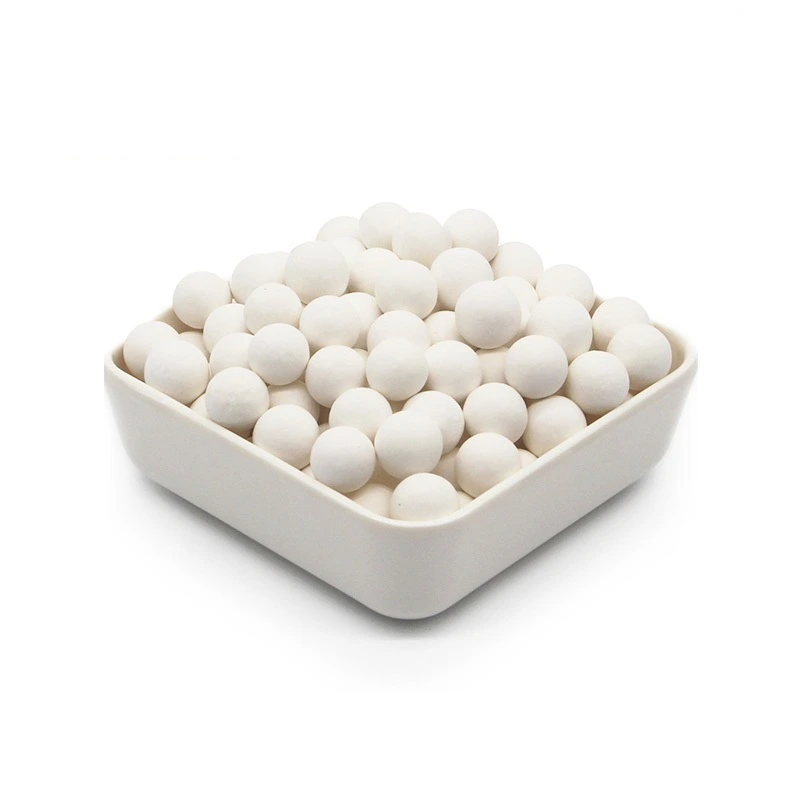
Activated Alumina — NH3 Polishing Grade
Gamma-alumina spheres (320 m^2/g BET, 2-5 mm), attrition index <0.5 wt%, Na2O <0.4 wt%, batch-specific COA, 4-6 wt% NH3 working capacity at 50 deg C / 20 bar polishing conditions.
View Product Details →