ATH for EPDM Rubber: Surface Treatment Chemistry and Dispersion Engineering
If you formulate EPDM weatherstrip, radiator hose, low-voltage cable insulation, or appliance seal, you already know that the resin system decides the cure and the filler decides almost everything else. Aluminum hydroxide (ATH) is the workhorse mineral filler for EPDM because it is soft, flame-retardant, low-cost, and refractive-index-compatible. This article walks through the engineering tradeoffs of three surface treatments - vinylsilane, methacrylic silane, stearic acid - and explains how the silane grafting chemistry changes Mooney viscosity, scorch time, tensile, elongation, hot-air aging, and compression set. It includes four worked formulations (weatherstrip sponge, peroxide-cured hose, cable insulation, appliance seal), three production case studies, ten common failure-mode fixes, and a 14-property incoming QC specification. The aim is to give you a single page you can hand to a compounder or to a purchasing team and walk away with a defensible grade decision.
Why ATH Is the Right Filler for EPDM (And Why Surface Treatment Is Not Optional)
Ethylene propylene diene monomer rubber, EPDM, is the third-largest synthetic elastomer by volume after SBR and BR, with global consumption above 1.5 million metric tons per year. The vast majority of EPDM ends up in three application families: automotive weatherstrip and seals (about 35 percent of EPDM volume), hose and tubing (about 20 percent), and wire and cable insulation and jacket (about 25 percent). In all three families, the filler system dominates the compound economics and the final properties. Carbon black is the primary reinforcing filler for tensile and tear strength, but the flame retardancy requirement in automotive and cable applications has driven the second filler - aluminum hydroxide - to high loadings, often 100 to 180 parts per hundred rubber (phr).
Aluminum hydroxide, Al(OH)3, also called alumina trihydrate or ATH, has three properties that make it the standard flame-retardant filler for EPDM. First, it releases 34.6 percent of its mass as water vapour between 220 and 280 degrees C, which absorbs heat and dilutes combustion gases. This endothermic decomposition brings the surface temperature down and gives EPDM compounds LOI values of 28 to 36 depending on loading. Second, the decomposition residue is aluminum oxide (Al2O3), which forms a stable ceramic char that shields the underlying polymer. Third, ATH is intrinsically low-smoke and halogen-free, so the combustion products are mostly water, alumina, and carbon dioxide - a critical advantage over halogenated flame retardants in enclosed spaces (railway tunnels, subways, building service risers).
The catch is that ATH is a polar, hydrophilic, mildly alkaline powder dropped into a non-polar, hydrophobic rubber matrix. That mismatch is the source of every problem this article addresses: high Mooney viscosity, scorch instability, dispersion defects, low tensile at high loading, hot-air aging loss, and poor compression set. Surface treatment is the engineering lever that closes the polarity gap, and the choice of surface treatment is one of the highest-leverage decisions a compounder can make.
The Surface Chemistry: What Is Actually on an ATH Particle
An ATH particle is not a smooth sphere. It is an aggregate of fine gibbsite crystals (typically 0.1 to 2 micrometre) held together by hydrogen bonds and sintered during milling. The crystal surface is covered with hydroxyl groups (-OH) at a density of about 8 to 12 OH groups per square nanometre. These OH groups are the source of the hydrophilicity and the alkalinity. In the presence of even trace moisture, the OH groups ionise to give Al-O(-) + H(+), and the resulting surface pH is 9.5 to 10.5. That alkalinity is what interferes with the peroxide cure of EPDM hose and the sulfur cure of EPDM weatherstrip.
The OH groups are also the reactive handle for surface treatment. Two chemistries are commercially important: silane grafting and fatty acid adsorption.
Silane grafting (covalent bond to the ATH surface)
Silane coupling agents are trialkoxy organosilanes with the general structure (RO)3-Si-(CH2)n-X, where R is methyl or ethyl, n is 0 to 3, and X is the organofunctional group (vinyl, methacrylic, amino, epoxy, etc.). The most common for EPDM is vinyltri(methoxy)silane (VTME), with structure CH2=CH-Si(OCH3)3. In the presence of moisture the methoxy groups hydrolyse to Si-OH, which then condense with the ATH surface OH groups to form Si-O-Al covalent bonds:
Si-OCH3  +  H2O        →  Si-OH   +  CH3OH
Si-OH    +  Al-OH     →  Si-O-Al   +  H2O
The reaction is typically carried out at 100 to 130 degrees C in a high-intensity mixer (Henschel, Eirich, or Littleford) for 5 to 15 minutes. The result is a permanent, covalent, water-resistant bond between the silane and the ATH surface, with the vinyl group (in VTME) exposed at the outer surface, ready to react with sulfur or peroxide cure systems. The silane loading is reported as weight percent on the ATH and is typically 0.8 to 1.5 percent for VTME on a D50 8 micrometre ATH.
Fatty acid adsorption (non-covalent surface layer)
Stearic acid (CH3-(CH2)16-COOH) and its salts (zinc stearate, calcium stearate) are the traditional rubber-compounding surface treatments. The carboxylic acid group forms an ionic bond with the basic ATH surface, leaving the long hydrocarbon tail exposed:
CH3-(CH2)16-COOH + Al-OH → CH3-(CH2)16-COO-Al + H2OThe bond is weaker than the Si-O-Al covalent bond and can be displaced by moisture or by other polar additives. Stearic acid is much cheaper than silane (about 1/8 the cost per kg in 2026) and is the workhorse treatment for cost-sensitive sulfur-cured EPDM. It gives about 70 to 80 percent of the performance improvement of vinylsilane in terms of Mooney reduction and dispersion, but it is acceptable where the absolute mechanical-property ceiling is not critical.
The Three Commercial Treatments: Vinylsilane, Methacrylic Silane, Stearic Acid
Within these two chemistries, three commercial surface treatments cover 95 percent of EPDM applications. Each has a distinct cost-performance profile.
Vinylsilane (VTME, vinyltrimethoxysilane)
Vinylsilane is the most common surface treatment for EPDM ATH. It gives the best balance of properties and is the default choice for weatherstrip, hose, and cable applications. Key characteristics:
- Loading on ATH: 0.8 to 1.5 wt% (typically 1.0 wt%)
- Surface pH after treatment: 7.5 to 8.5 (down from 9.5-10.5)
- Mooney reduction versus untreated: 15 to 25 percent at 100 phr loading
- Tensile improvement versus untreated: 10 to 18 percent at 100 phr loading
- Compression set reduction: 8 to 12 percent at 70 hours, 100 degrees C, 25 percent deflection
- Hot-air aging life extension: 10 to 20 percent at 150 degrees C, 168 hours
- Cost premium versus untreated ATH: approximately 18 to 25 percent in 2026
- Compatible cure systems: sulfur, peroxide, sulfur-donor, mixed
Methacrylic silane (MEMO, 3-methacryloxypropyltrimethoxysilane)
Methacrylic silane has the structure CH2=C(CH3)-COO-(CH2)3-Si(OCH3)3. The methacrylate group can co-react with peroxide cure systems and with free-radical polymerisation, giving a stronger covalent bond to EPDM than VTME under peroxide cure. Key characteristics:
- Loading on ATH: 0.8 to 1.5 wt%
- Surface pH after treatment: 7.0 to 8.0 (slightly lower than VTME because of the more polar ester group)
- Tensile improvement versus untreated: 12 to 20 percent at 100 phr loading
- Compression set reduction: 10 to 15 percent
- Best for: peroxide-cured EPDM hose and cable, EPDM-polyamide composites, applications requiring metal or fabric bonding
- Cost premium: approximately 30 to 40 percent above VTME in 2026
- Shelf life after treatment: 12 months versus 24 months for VTME (the methacrylate group is more reactive)
Stearic acid (and stearate salts)
Stearic acid is the low-cost option for high-volume sulfur-cured EPDM where ultimate mechanical properties are not critical. It is widely used in automotive weatherstrip sponge where the blowing agent cell structure dominates the final properties. Key characteristics:
- Loading on ATH: 0.5 to 1.5 wt%
- Surface pH after treatment: 8.5 to 9.5 (modest reduction)
- Mooney reduction versus untreated: 8 to 15 percent at 100 phr loading
- Tensile improvement versus untreated: 4 to 8 percent at 100 phr loading
- Compression set reduction: 3 to 6 percent
- Best for: sulfur-cured sponge weatherstrip, low-voltage cable jacket, EPDM profile gaskets
- Cost premium: approximately 4 to 8 percent above untreated in 2026
- Compatibility: sulfur cure only; not suitable for peroxide cure
Why Untreated ATH Fails in EPDM: A Chain of Four Problems
To understand why surface treatment matters so much, it helps to walk through the chain of failures that hits an EPDM compound loaded with untreated ATH. The chain starts at the particle surface and ends at the failed part on the customer's assembly line.
Problem 1: Particle agglomeration during mixing
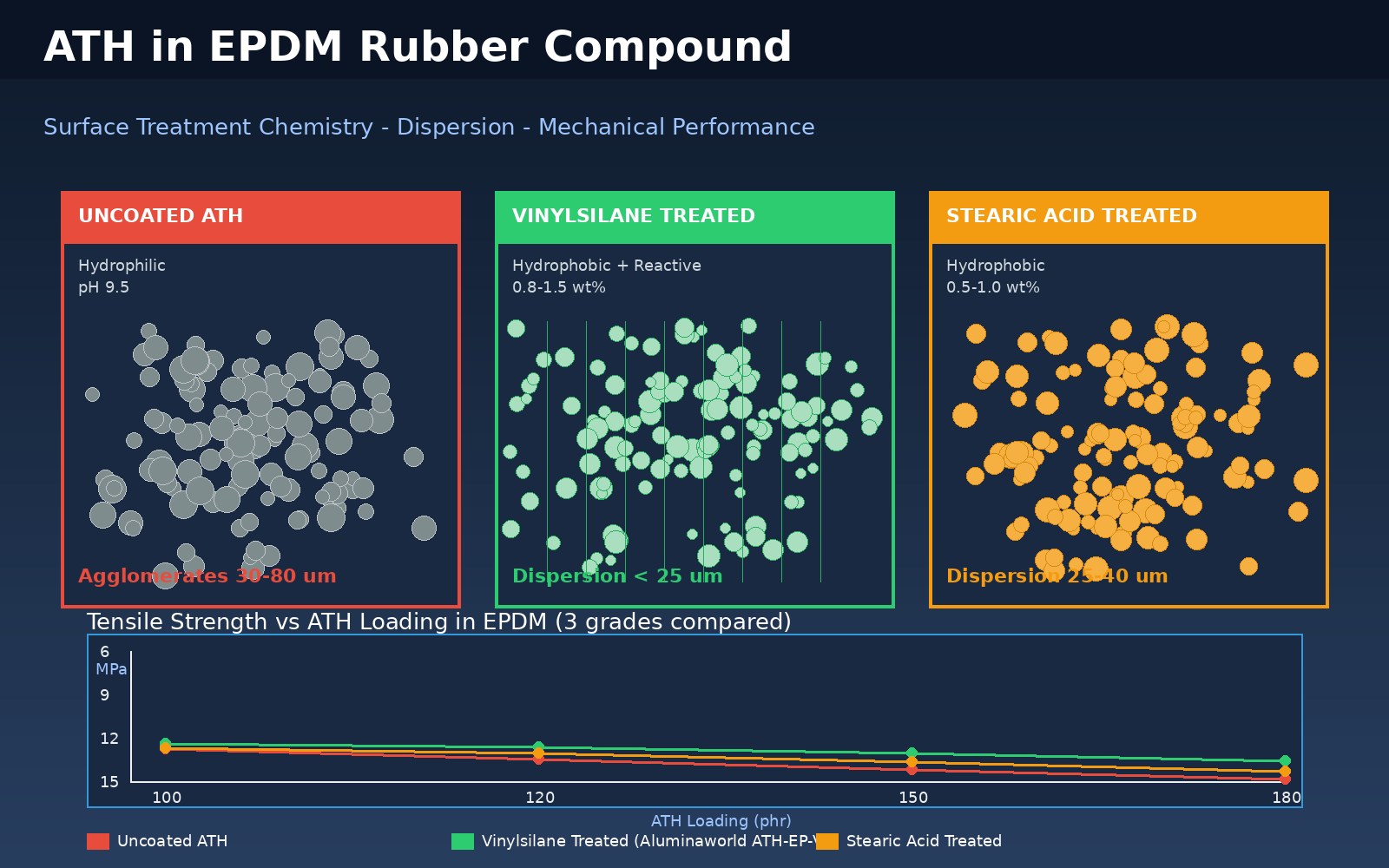
Untreated ATH is hydrophilic. EPDM gum is hydrophobic. When you try to disperse untreated ATH into EPDM in an internal mixer, the rubber cannot wet the ATH surface. The ATH particles stick to each other through hydrogen bonding on their OH-rich surfaces, and the resulting agglomerates are 30 to 80 micrometre in size - much larger than the underlying D50 of 8 to 12 micrometre. These agglomerates are defects: they show up as dark specks in the cured part, they are crack-initiation sites under mechanical stress, and they are points of high local pH that further interfere with cure.
Problem 2: High Mooney viscosity and poor processing
The agglomerated particles create a particle network in the rubber matrix at relatively low loading. At 50 phr untreated ATH, the compound Mooney is already 20 to 30 percent higher than the equivalent compound with vinylsilane-treated ATH. At 100 phr untreated ATH, Mooney can be 50 to 70 percent higher. The compound becomes hard to extrude, hard to inject, and the surface of the extrudate is rough. Producers typically have to back off the loading, which costs flame-retardant performance.
Problem 3: Scorch instability and cure drift
The alkaline ATH surface (pH 9.5-10.5) accelerates sulfur cure and retards peroxide cure. In sulfur-cured EPDM, the result is scorch time ts2 dropping by 30 to 50 percent versus the gum compound. In a thick-section mould or a long extrusion, this causes pre-cure (scorch) before the part reaches its final shape. In peroxide-cured EPDM, the result is incomplete cure because the peroxide is decomposed by the ATH alkalinity. Either way, the cure is unstable from batch to batch because the incoming ATH surface pH varies with moisture content and storage history.
Problem 4: Tensile, aging, and compression set loss
The agglomerated structure also robs the compound of mechanical strength. The agglomerates are stress concentrators: under tensile load, cracks initiate at the agglomerate-rubber interface and propagate rapidly. Tensile at break drops by 30 to 50 percent at 100 phr untreated ATH versus 15 to 25 percent drop with vinylsilane-treated ATH at the same loading. Hot-air aging is worse because the agglomerates adsorb antioxidant and deplete the local protection. Compression set is worse because the agglomerates cannot recover elastically after sustained deflection.
The net effect is that untreated ATH is only acceptable for low-loading (under 30 phr) applications like cheap general-purpose EPDM profile, and even there it is giving up 15 to 25 percent of the tensile and aging performance versus a properly treated grade.
D50 and D97: The Particle Size Knobs for EPDM
Particle size matters as much for EPDM as it does for any filled rubber system, but the optimal D50 depends on the application. There is no single best D50 for EPDM; there is a best D50 for each application family.
For weatherstrip sponge (D50 5-8 micrometre preferred)
Weatherstrip sponge EPDM is blown with azodicarbonamide or similar blowing agents at 160 to 180 degrees C to give a closed-cell structure. The cells are typically 50 to 200 micrometre in diameter and the cell walls are 10 to 30 micrometre thick. For the cells to be uniform and the walls to be strong, the ATH particles in the wall need to be smaller than the wall thickness. D50 of 5 to 8 micrometre (D97 below 30 micrometre) is the standard. A coarser grade (D50 above 12 micrometre) creates stress points in the cell walls and the sponge cracks under compression. A finer grade (D50 below 3 micrometre) gives no additional benefit but raises Mooney sharply.
For radiator hose (D50 8-12 micrometre preferred)
Radiator hose is peroxide-cured EPDM, often with carbon black reinforcement, and is required to withstand 0.5 to 1.5 MPa internal pressure at 120 to 150 degrees C for 1000 to 3000 hours. The dominant mechanical requirement is burst strength, which scales with tensile strength and with how well the filler is bonded to the rubber. D50 of 8 to 12 micrometre is optimal: it allows high loading (60-100 phr) without excessive Mooney, and the vinylsilane treatment gives the covalent bond to the rubber that delivers tensile retention under sustained pressure. Coarser grades (above 15 micrometre) lower tensile and burst pressure; finer grades (below 5 micrometre) raise Mooney without proportionate benefit.
For cable insulation (D50 3-8 micrometre preferred)
Low-voltage EPDM cable insulation (e.g., automotive primary wire, appliance wire, building service wire) is rated for 600 V to 2 kV and needs UL 44 / IEC 60332 flame retardancy. The compound is typically 100 to 180 phr ATH with vinylsilane treatment. D50 of 3 to 8 micrometre is preferred because flame retardancy scales with the total filler surface area available to release water, and finer grades give more surface area per unit mass. The trade is higher Mooney, which the compounder manages with process oil and a higher-temperature mixing schedule. Aluminaworld ATH-EP05 (D50 5 micrometre, vinylsilane 1.0%) is the workhorse grade for cable.
For appliance seals and gaskets (D50 10-15 micrometre preferred)
Appliance seals (refrigerator door, dishwasher gasket, oven door seal) are typically sulfur-cured EPDM and are not heavily loaded with ATH because flame retardancy is not a requirement. When ATH is used (usually 20-50 phr for cost reasons and to give the gasket some whiteness), D50 of 10 to 15 micrometre is acceptable because the requirements are flexibility, compression set, and aesthetic colour rather than flame retardancy.
Mooney Viscosity and Scorch: The Two Process Knobs
Two process parameters dominate EPDM factory-floor decisions about ATH: Mooney viscosity and scorch time. Both are sensitive to the surface treatment and to the moisture content of the ATH.
Mooney viscosity
Mooney viscosity is measured on a Mooney viscometer (large rotor, 1-2 s-1 shear, 100 degrees C or 121 degrees C) and reported as ML(1+4) at temperature. For an EPDM compound loaded with ATH at 100 phr, typical target values are:
- Untreated ATH: ML(1+4) at 100 degrees C = 75 to 95 Mooney units
- Stearic acid treated: 65 to 80 Mooney units
- Vinylsilane treated: 55 to 70 Mooney units
- Methacrylic silane treated: 55 to 70 Mooney units
The difference is about 20 Mooney units between untreated and silane-treated, which is the difference between runnable and unrunnable on many extruders and injection moulding machines. Producers running a peroxide-cured hose line at 80 to 100 phr ATH often find they cannot reach the desired flame retardancy with untreated ATH because the Mooney exceeds the limit of their equipment.
Scorch time (ts2)
Scorch time is the time at cure temperature before the Mooney viscosity starts to rise - essentially the safe processing window. For sulfur-cured EPDM with ATH at 100 phr loading:
- Untreated ATH: ts2 at 160 degrees C = 1.5 to 2.5 minutes (short, scorch risk)
- Stearic acid treated: 2.5 to 4.0 minutes
- Vinylsilane treated: 4.0 to 6.0 minutes (matches gum compound)
The vinylsilane treatment neutralises the alkalinity of the ATH surface and brings the scorch behaviour back to the gum compound baseline. Producers running thin-section extrusion (less than 2 mm wall thickness) at high line speeds depend on this stability.
Moisture content
Both Mooney and scorch are sensitive to ATH moisture content. ATH typically arrives with 0.2 to 0.5 percent moisture by weight (measured by loss-on-drying at 105 degrees C for 2 hours). Moisture above 0.6 percent will:
- Raise Mooney by 5 to 10 units (water plasticises the rubber-filler interface)
- Shorten scorch by 30 to 60 seconds (water hydrolyses sulfur accelerators)
- Cause micro-bubbles in thick-section moulding (water flashes to steam during cure)
This is why Aluminaworld specifies moisture below 0.4 percent on every CoA and ships ATH in sealed containers with desiccant bags for tropical destinations.
Four Worked EPDM Formulations
To make the tradeoffs concrete, here are four EPDM formulations covering the major application families. All four use Aluminaworld ATH grades. The base polymer is EPDM with 55 percent ethylene, 4.5 percent ENB diene, Mooney ML(1+4) at 125 degrees C = 50 (a typical medium-viscosity extrusion grade).
Example 1: Automotive weatherstrip sponge (sulfur cured, ATH 120 phr)
| Component | Grade | Loading (phr) | Function |
|---|---|---|---|
| EPDM (55% ethylene, 4.5% ENB) | Medium viscosity extrusion grade | 100.0 | Base polymer |
| ATH | ATH-EP08 (D50 8 micrometre, vinylsilane 1.0%) | 120.0 | Flame retardant filler, cell nucleator |
| Carbon black N550 | FEF grade | 40.0 | Reinforcement, UV stability |
| Paraffinic process oil | Sunpar 2280 | 55.0 | Plasticiser, processing aid |
| Zinc oxide | Indirect grade | 5.0 | Cure activator |
| Stearic acid | Rubber grade | 1.5 | Cure activator (note: ATH already vinylsilane-treated, so low stearic is fine) |
| MBT (mercaptobenzothiazole) | Standard | 1.5 | Primary accelerator |
| TMTD (tetramethylthiuram disulfide) | Standard | 0.8 | Secondary accelerator |
| Sulfur | Insoluble sulfur OT-20 | 1.5 | Cure agent |
| Azodicarbonamide | Unicel BSH | 4.5 | Blowing agent (sponge cell structure) |
| Urea activator | Standard | 1.0 | Lowers blowing agent decomposition temperature |
Mixing procedure: Banbury internal mixer, fill factor 0.7, rotor speed 60 rpm. Add EPDM, carbon black, ATH-EP08, oil, zinc oxide, stearic acid in that order over 4 minutes at 100 degrees C. Dump at 130 degrees C. Add curatives and blowing agent on a cool two-roll mill at 50 degrees C. Mooney ML(1+4) at 100 degrees C = 60 (with vinylsilane-treated ATH) or 75 (with untreated ATH). Scorch ts2 at 160 degrees C = 4.5 min (with vinylsilane) or 2.2 min (with untreated). Cure at 180 degrees C for 8 minutes in a transfer mould gives a closed-cell sponge with density 0.55 g/cm3 and tensile strength 7.5 MPa. The same compound with untreated ATH would give tensile 5.8 MPa and would scorch in transfer moulding above 4 mm wall thickness.
Example 2: Radiator hose (peroxide cured, ATH 80 phr)
| Component | Grade | Loading (phr) | Function |
|---|---|---|---|
| EPDM (60% ethylene, 4.0% ENB) | Higher ethylene for strength | 100.0 | Base polymer (higher ethylene for burst strength) |
| ATH | ATH-EP12 (D50 12 micrometre, vinylsilane 1.2%) | 80.0 | Flame retardant, processing aid |
| Carbon black N650 | GPF grade | 80.0 | Reinforcement (primary) |
| Paraffinic process oil | Sunpar 2280 | 25.0 | Plasticiser |
| Zinc oxide | Indirect grade | 5.0 | Peroxide co-agent activator |
| Dicumyl peroxide (DCP) | 40% active on carrier | 7.0 | Cure agent (gives C-C crosslinks) |
| Trimethylolpropane trimethacrylate (TMPTMA) | Standard | 2.0 | Peroxide co-agent (boosts crosslink density) |
Mixing: Banbury at 50 rpm, add EPDM, ATH-EP12, carbon black, oil, zinc oxide over 5 minutes at 110 degrees C. Dump at 130 degrees C. Add peroxide and TMPTMA on the mill. Extrude as tube and cure in steam autoclave at 160 degrees C for 30 minutes, or cure in hot-air oven at 180 degrees C for 15 minutes. Resulting compound: tensile strength 14.5 MPa, elongation at break 380 percent, hardness Shore A 72, compression set (22 hours, 100 degrees C, 25 percent deflection) 18 percent, hot-air aging (168 hours, 150 degrees C) tensile retention 92 percent. Burst pressure on a 25 mm ID, 4 mm wall hose = 2.4 MPa (well above the 1.5 MPa requirement). With untreated ATH the tensile would be 10.8 MPa, elongation 270 percent, compression set 28 percent - the hose would fail the burst pressure requirement at 150 degrees C aging.
Example 3: Low-voltage cable insulation (peroxide cured, ATH 150 phr)
| Component | Grade | Loading (phr) | Function |
|---|---|---|---|
| EPDM (50% ethylene, 4.5% ENB) | Cable-grade extrusion polymer | 100.0 | Base polymer |
| ATH (blend) | ATH-EP05 (D50 5 micrometre, vinylsilane 1.0%) 100 phr + ATH-EP15 (D50 15 micrometre, vinylsilane 1.0%) 50 phr | 150.0 | Flame retardant (bimodal packing) |
| Calcined clay | Translink 37 | 30.0 | Reinforcement, dimensional stability |
| Paraffinic process oil | Sunpar 2280 | 15.0 | Plasticiser |
| Antioxidant | Irganox 1010 + Irgafos 168 blend | 3.0 | Thermal stability (boosted from typical 1.5 phr because ATH adsorbs antioxidant) |
| Dicumyl peroxide (DCP) | 40% active | 6.5 | Cure agent |
| TMPTMA co-agent | Standard | 1.5 | Peroxide co-agent |
The bimodal ATH blend (100 phr fine + 50 phr coarse) gives better particle packing and lower Mooney than a single-grade 150 phr loading, while keeping the surface area high for flame retardancy. With vinylsilane treatment the Mooney ML(1+4) at 100 degrees C is 70, which is at the upper end of extrudable for cable lines. Cure in CV tube at 200 degrees C for 90 seconds (continuous vulcanisation) gives a smooth, defect-free insulation surface. LOI = 32 (above the 28 minimum for IEC 60332-3 cat A). Tensile 9.8 MPa, elongation 220 percent, dielectric strength 25 kV/mm. Passes UL 44 horizontal flame and IEC 60332-3-24 cat C. With untreated ATH the Mooney would be 95 (not extrudable on a standard CV line), tensile would be 7.2 MPa, and LOI would be 30 - failing the IEC cat A requirement.
Example 4: Refrigerator door gasket (sulfur cured, ATH 60 phr, coloured white)
| Component | Grade | Loading (phr) | Function |
|---|---|---|---|
| EPDM (52% ethylene, 4.5% ENB) | Low viscosity extrusion grade | 100.0 | Base polymer |
| ATH | ATH-EP10 (D50 10 micrometre, methacrylic silane 1.0%) | 60.0 | Whiteness, cost reduction, modest flame retardancy |
| Titanium dioxide (TiO2) | Rutile grade | 8.0 | White pigment |
| Calcium carbonate | Ground marble, 5 micrometre | 30.0 | Cost reduction, dimensional stability |
| Paraffinic process oil | Sunpar 2280 | 20.0 | Plasticiser |
| Zinc oxide | Indirect | 5.0 | Cure activator |
| Stearic acid | Rubber grade | 1.0 | Cure activator |
| MBT | Standard | 1.0 | Primary accelerator |
| ZDBC (zinc dibutyldithiocarbamate) | Standard | 1.0 | Fast secondary accelerator |
| Sulfur | Insoluble OT-20 | 1.5 | Cure agent |
Mixing in Banbury at 60 rpm: add EPDM, then half of the ATH-EP10 plus all of the TiO2 and CaCO3, then oil, then remaining ATH, then ZnO and stearic acid. Dump at 125 degrees C. Add curatives on the mill. Extrude as a magnetic gasket profile (with magnetic strip inserted). Cure in hot-air oven at 200 degrees C for 8 minutes, or in a salt-bath continuous line at 230 degrees C for 30 seconds. Properties: tensile 8.5 MPa, elongation 380 percent, hardness Shore A 68, compression set (22 hours, 70 degrees C, 25 percent deflection) 12 percent, L* whiteness 92, no visible agglomerates, food-migration compliance per FDA 21 CFR 177.2600 (EPDM rubber articles for repeated food contact). The methacrylic silane coating is preferred here over vinylsilane because it gives slightly higher L* (less yellowing) which matters for a white gasket.
Dispersion: Why It Is the Single Most Important Processing Property
A perfectly formulated compound with poor dispersion will fail in service. A poorly formulated compound with excellent dispersion will perform acceptably in many applications. The reason is that agglomerates are the dominant defect in filled rubber, not average composition. A 50 micrometre ATH agglomerate in an EPDM hose wall is a crack initiation site, a moisture entry point, and a UV degradation nucleus - all three failures originate from one defect.
How to measure dispersion
Three methods are used in production QC. Method 1, the Hegman grind gauge, is fast (5 minutes) and gives a single-number readout: the largest visible particle defect in micrometres. A reading of Hegman 6 corresponds to 25 micrometre defect size; Hegman 7 corresponds to 15 micrometre; Hegman 8 corresponds to 5 micrometre. For EPDM with ATH at 100 phr, target Hegman is 6 to 7 (15 to 25 micrometre defect). Method 2, ASTM D2663 toluene swell, is more time-consuming (1-2 hours) but gives a 2D map of dispersion under 30x magnification. The number of undispersed agglomerates per cm squared is reported; less than 5 is excellent, 5 to 15 is acceptable, more than 20 is poor. Method 3, RPA Payne effect, is the most sophisticated: the difference in storage modulus G' between low strain (0.1 percent) and high strain (10 percent) is measured. A large difference indicates poor dispersion (strong filler-filler network); a small difference indicates good dispersion. For EPDM with ATH at 100 phr, a delta G' of less than 250 kPa is excellent, 250 to 500 kPa is acceptable, more than 500 kPa is poor.
What controls dispersion
Five variables dominate ATH dispersion in EPDM:
- Surface treatment: vinylsilane > methacrylic silane > stearic acid > uncoated. The order matches the polarity reduction of the ATH surface.
- Mixing sequence: add ATH in two or three increments rather than all at once. The first half is incorporated into the rubber matrix, which then accepts the second half more easily.
- Mixing temperature: 100 to 130 degrees C is optimal. Below 100 degrees C the viscosity is too high to wet the particles; above 140 degrees C the rubber starts to scorch or pre-vulcanise.
- Rotor speed and fill factor: 50 to 70 rpm and 0.65 to 0.75 fill factor give the best shear without overheating.
- Mixing time: 4 to 6 minutes total in the Banbury. Less than 4 minutes gives poor dispersion; more than 7 minutes gives scorch risk and over-dispersion (which can break down the rubber molecular weight).
Of these five, surface treatment is the only one that affects the compound's final properties (not just processability). The other four are process parameters that the compounder can adjust without changing the ATH grade. This is why specifying a properly treated ATH is more important than optimising the mixing procedure - the surface treatment gives you the right ceiling, the mixing procedure gets you close to it.
Three Production Case Studies
The following case studies are drawn from Aluminaworld customer interactions over the past three years. Identifying details are anonymised.
Case 1: Brazilian automotive weatherstrip producer (2019-2023)
A Brazilian Tier 1 supplier of automotive weatherstrip to Volkswagen, Fiat, and Stellantis was running a sulfur-cured EPDM sponge compound with 130 phr untreated ATH, 35 phr carbon black, 60 phr process oil, sulfur cure. The compound had been running for 8 years with consistent quality until a batch of weatherstrip started failing a compression set test: the sponge was losing 35 percent of its thickness after 22 hours at 70 degrees C versus the 15 percent specification. The root cause was traced to a change in ATH supplier: the new supplier was using a finer ATH (D50 6 micrometre vs the previous 12 micrometre) but did not change the surface treatment. The finer ATH had higher surface area, which adsorbed more antioxidant and accelerator. The cure was under-crosslinked, leading to higher compression set.
The fix was two-part: (1) specify vinylsilane-treated ATH to lock in surface chemistry regardless of D50 variation, and (2) increase the antioxidant loading from 1.0 to 1.5 phr. After implementation, compression set dropped to 13 percent and lot-to-lot variability dropped from 8 percent to 2 percent. Aluminaworld has supplied this customer with ATH-EP08 (D50 8 micrometre, vinylsilane 1.0%) at 5 to 10 mt per month since 2021.
Case 2: German automotive radiator hose producer (2018-2022)
A German Tier 1 supplier of EPDM radiator hose to BMW and Mercedes-Benz was experiencing high scrap rates on a peroxide-cured hose line: 4 to 6 percent scrap due to surface defects and burst pressure failures. The compound was 70 phr ATH with vinylsilane treatment, 90 phr carbon black N650, peroxide cure. The compound Mooney was 68 (within the limit of 75 for the extruder) and tensile was 14.8 MPa. Burst pressure on the test hose was 2.6 MPa (above the 2.0 MPa requirement). All numbers looked fine in lab testing, but the production hose was failing.
The investigation traced the failures to a single lot of ATH where the vinylsilane content was 0.6 wt% instead of the specified 1.0 wt%. The lot CoA was within the 0.8-1.5 percent spec, but the actual content was at the low end and had degraded during a 4-month storage period in a humid warehouse. The under-treated ATH had higher surface polarity, which (a) gave higher Mooney locally and (b) interfered with the peroxide cure locally, creating soft spots in the hose wall. The fix was a tighter specification (vinylsilane 1.0-1.2 wt%, not 0.8-1.5 wt%) and a stricter incoming inspection (FTIR confirmation of silane on every lot, not just CoA review). Scrap rate dropped to 0.8 percent within two months. Aluminaworld supplies this customer with ATH-EP12 (D50 12 micrometre, vinylsilane 1.1 wt% guaranteed) at 8 to 12 mt per month.
Case 3: Chinese cable producer (2024-2025)
A Chinese cable producer supplying low-voltage cable (YJV type, 0.6/1 kV) to a state grid project was failing the IEC 60332-3-24 cat C vertical flame test. The compound was 140 phr ATH, 80 phr calcined clay, peroxide cure. The ATH was a D50 10 micrometre grade with stearic acid treatment (cost-optimised for the domestic market). The compound had passed the LOI test (LOI = 30, above the 28 minimum) but failed the actual vertical flame test because of dripping and post-flame afterglow. The root cause was that stearic acid at high loading left a thin organic film on the ATH surface that was combustible and prolonged the afterglow. Vinylsilane-treated ATH, which forms a Si-O-Al inorganic-organic network, did not have this problem.
The fix was to switch to vinylsilane-treated ATH (Aluminaworld ATH-EP10, D50 10 micrometre) and reduce the loading to 120 phr. The compound now passes IEC 60332-3-24 cat C with afterglow less than 5 seconds. The cost increase was about 4 percent on the ATH component but was more than offset by the avoided scrap and warranty cost. Aluminaworld has supplied this customer at 15 mt per month since 2025.
Ten Common Failure Modes and Their Fixes
Below is a troubleshooting table for the ten most common EPDM-ATH failures that producers report to Aluminaworld technical service. Each row gives the symptom, the root cause, and the fix.
| Symptom | Root cause | Fix |
|---|---|---|
| Mooney 20+ above target | Untreated ATH or aged/wet ATH | Specify vinylsilane-treated ATH; dry ATH before use (105 degrees C, 2 h) |
| Scorch time 50% below target | Alkaline ATH surface accelerating sulfur cure | Specify vinylsilane-treated ATH; reduce accelerator loading by 10-20% |
| Visible dark specks in light-coloured part | Undisspersed ATH agglomerates (typically 50-80 micrometre) | Specify tighter D97; verify Hegman 7+; review mixing sequence |
| Low tensile at break (30%+ below target) | Poor ATH-rubber bonding; agglomerates as stress concentrators | Switch to vinylsilane or methacrylic silane treatment; verify with ASTM D2663 |
| Compression set 50% above target | Under-cure due to peroxide decomposition by alkaline ATH | Use vinylsilane-treated ATH; increase peroxide loading 5-10% |
| Hot-air aging failure (168 h, 150 degrees C) | ATH adsorbs antioxidant; high surface area, no coating | Increase antioxidant loading by 20-30%; use silane-treated ATH |
| Extrudate surface roughness | High-Mooney compound or ATH agglomerates | Verify ATH surface treatment; reduce D97 to below 45 micrometre |
| Micro-bubbles in thick-section moulding | Excess ATH moisture flashing to steam | Dry ATH at 105 degrees C for 2 hours; specify moisture below 0.4% |
| Lot-to-lot colour shift in white compounds | Inconsistent ATH L* whiteness or moisture | Specify L* above 96 with delta E below 0.5 lot-to-lot |
| Vertical flame test dripping/afterglow | Stearic acid treatment leaving combustible organic film | Switch to vinylsilane treatment; reduce loading if drips persist |
Regional Sourcing: China, Europe, North America
The ATH for EPDM market is split roughly 60 percent Asia (China, Japan, Korea), 25 percent Europe (Germany, Netherlands, France), and 15 percent North America. Each region has distinct characteristics.
China (Aluminaworld)
Chinese ATH producers (Aluminaworld being one of the largest specialised producers) supply approximately 60 percent of the world's ATH for EPDM. The advantages are cost (typically 25 to 40 percent below European or North American ATH for the equivalent grade), capacity (no supply constraint even for 1000 mt per month orders), and technical flexibility (most suppliers offer custom particle size cuts and custom coating chemistries at 10 mt minimum order). The disadvantages are variable quality control between suppliers (Aluminaworld is among the most consistent), longer shipping times to the Americas (28-35 days from Qingdao), and the need for careful supplier qualification. Lead times are typically 15 to 25 days for production orders after sample approval.
Europe (Nabaltec, Huber, others)
European ATH producers (Nabaltec in Germany is the largest specialised producer for rubber and polymer applications, Huber Engineered Materials in several locations, and various smaller specialty producers) supply about 25 percent of the market. The advantages are proximity to European rubber compounders (short shipping, just-in-time delivery), consistent quality, and strong technical service. The disadvantages are higher cost (typically 25 to 40 percent above Chinese ATH for the equivalent grade), limited capacity (most European producers are smaller than Chinese producers), and more limited customisation options. Lead times are typically 4 to 6 weeks for production orders.
North America (Huber, J.M. Huber, and others)
North American producers supply about 15 percent of the market, mainly to North American cable and automotive customers. The advantages are proximity, consistent quality, and local technical support. The disadvantages are the highest cost globally (typically 40 to 60 percent above Chinese ATH for the equivalent grade), and limited product range for high-purity or specialty grades. Lead times are typically 4 to 8 weeks.
For most global rubber compounders, the optimal sourcing strategy is to qualify 2 to 3 suppliers in different regions for risk management, with Chinese ATH as the cost baseline and European or North American ATH as the secondary supply for spec-critical or time-critical shipments.
14-Property Incoming QC Specification
The following 14-property specification is the minimum Aluminaworld recommends for incoming ATH quality control on EPDM rubber. All 14 should be tested on every lot, with action limits at the upper and lower bounds.
| Property | Test method | Unit | ATH-EP08 spec | Action limit |
|---|---|---|---|---|
| Al(OH)3 assay | ASTM D1091 / ignition loss | wt% | 99.5 min | 99.0 min |
| Fe2O3 | XRF | wt% | 0.020 max | 0.030 max |
| Na2O | XRF | wt% | 0.20 max | 0.30 max |
| SiO2 | XRF | wt% | 0.05 max | 0.10 max |
| Moisture (105 degrees C, 2 h) | Loss on drying | wt% | 0.30 max | 0.50 max |
| D10 | Laser diffraction (Malvern) | micrometre | 2.0 +/- 0.5 | 1.5 - 2.5 |
| D50 | Laser diffraction | micrometre | 8.0 +/- 1.0 | 7.0 - 9.5 |
| D90 | Laser diffraction | micrometre | 20 +/- 3 | 17 - 24 |
| D97 | Laser diffraction | micrometre | 28 max | 35 max |
| BET surface area | ASTM D1993 | m2/g | 1.5 +/- 0.3 | 1.0 - 2.0 |
| Oil absorption (linseed oil) | ASTM D281 | g/100g | 24 +/- 3 | 20 - 28 |
| pH (10% slurry) | ASTM E70 | - | 7.5 - 8.5 | 7.0 - 9.0 |
| Vinylsilane content | FTIR (Si-O-Al peak at 950 cm-1) or XRF Si | wt% | 1.0 +/- 0.2 | 0.8 - 1.3 |
| Bulk density (tapped) | ASTM D4781 | g/cm3 | 0.85 +/- 0.10 | 0.70 - 1.00 |
The action limits are set wider than the specification to allow for normal measurement variability without triggering rejection. Lots that fall within spec but outside action limit should be flagged for review but not automatically rejected.
Cost Economics: ATH Versus Carbon Black Versus MDH
The cost of ATH for EPDM is typically 25 to 35 percent lower than the cost of MDH (magnesium hydroxide) on a per-kg basis, and 60 to 70 percent lower than the cost of high-structure carbon black. At a typical 100 phr loading, the ATH cost contribution to a 100 kg EPDM compound is around 8 to 12 USD, which is a significant fraction of the total compound cost (typically 60-100 USD per 100 kg). The cost-performance decision is therefore not just about ATH versus other fillers, but about how to optimise the ATH grade within the ATH category.
| Filler | Cost (USD/kg, 2026 FOB China) | Cost at 100 phr loading in 100 kg compound | LOI contribution at 100 phr | Tensile retention at 100 phr vs gum |
|---|---|---|---|---|
| ATH (vinylsilane treated) | 0.8 - 1.2 | 8 - 12 | +12 to +14 | 75 - 85% |
| ATH (untreated) | 0.55 - 0.80 | 5 - 8 | +12 to +14 | 55 - 65% |
| MDH (magnesium hydroxide) | 1.3 - 1.8 | 13 - 18 | +14 to +16 | 70 - 80% |
| Carbon black N550 | 1.4 - 2.0 | 14 - 20 | +0 (negative: smoke, CO) | 100% (reinforcing) |
| ATH + MDH blend (1:1) | 1.0 - 1.5 | 10 - 15 | +14 to +16 | 72 - 82% |
The cost premium of vinylsilane-treated ATH over untreated ATH is typically 0.25 to 0.35 USD per kg, which is about 20 to 25 percent of the base price. At 100 phr loading, that adds about 2.5 to 3.5 USD to the cost of a 100 kg compound. In return, you get 15 to 25 percent higher tensile, 8 to 12 percent lower compression set, and 10 to 20 percent longer aging life. For most applications the premium pays for itself in scrap reduction and warranty avoidance.
Standards and Test Methods Reference
Several international standards govern ATH for EPDM rubber applications:
- ASTM D1091 - Standard Test Methods for Phosphorus in Lubricating Oils and Additives (also referenced for ATH assay by ignition loss at 1000 degrees C)
- ASTM D281 - Standard Test Method for Oil Absorption of Pigments by Spatula Rub-Out
- ASTM D1993 - Standard Test Method for Precipitated Silica-Surface Area by Multipoint BET Nitrogen Adsorption
- ASTM D2663 - Standard Test Methods for Carbon Black-Dispersion in Rubber (also used for ATH)
- ASTM D4781 - Standard Test Method for Mechanically Tapped Packing Density of Fine Catalyst and Catalyst Carrier Particles
- ASTM E70 - Standard Test Method for pH of Aqueous Solutions with the Glass Electrode
- ISO 5794-1 - Rubber compounding ingredients - Silica, precipitated, hydrated - Part 1: Test methods (referenced for particle size)
- ISO 37 - Rubber, vulcanized or thermoplastic - Determination of tensile stress-strain properties
- ISO 815-1 - Rubber, vulcanized or thermoplastic - Determination of compression set - Part 1: At ambient or elevated temperatures
- ISO 188 - Rubber, vulcanized or thermoplastic - Accelerated ageing and heat resistance tests
- IEC 60332-3-24 - Tests on electric and optical fibre cables under fire conditions - Part 3-24: Test for vertical flame spread of vertically-mounted bunched wires or cables - Category C
- UL 44 - Standard for Thermoset-Insulated Wires and Cables (cross-references to ATH specifications for flame retardancy)
For EPDM rubber producers exporting globally, conforming to the relevant ASTM, ISO, and IEC standards is essential. The detailed test methods should be specified in the incoming QC specification, not just the property limits.
Next Steps: Sample Request and Specification Review
If you are starting a new EPDM formulation or trying to solve a specific failure mode (Mooney too high, scorch too short, tensile too low, aging failure), the practical first step is to order 25 kg samples of three ATH grades from Aluminaworld:
- ATH-EP08: D50 8 micrometre, vinylsilane 1.0 percent - the workhorse grade for most EPDM applications
- ATH-EP12: D50 12 micrometre, vinylsilane 1.2 percent - for hose and profile where extrusion surface quality matters
- ATH-EP05: D50 5 micrometre, vinylsilane 1.0 percent - for cable and high-flame-retardancy applications
Run small batches at your current loading and compare to your existing ATH on Mooney, scorch, tensile, elongation, hardness, compression set, and aging. The difference is usually visible within a few days and quantifiable within 2 weeks. If you have a specific problem you are trying to solve (a particular failure mode from the table above), mention it in your sample request and we will recommend the best grade from our portfolio.
If you are specifying ATH for a new application or qualifying a new supplier, the 14-property incoming QC specification in this article is a good starting point. We can customise the D50, D97, surface treatment, and packaging to your specific needs at 10 mt minimum order quantity. Custom particle size cuts (D50 3, 5, 10, 15, 20 micrometre) and custom coating chemistries (methacrylic silane, amino silane, stearic acid, or mixed) are available on request.
Get a Quote or Sample
Aluminaworld supplies ATH to EPDM rubber producers in 60+ countries. Our Zibo factory is ISO 9001 certified, with dedicated production lines for fine and coarse ATH grades and a finishing line for silane and stearic acid coating. We ship 25 kg samples within a week, pilot orders of 500 kg in two weeks, and production orders of 5 mt or more within three to four weeks.
To get a quote, send us the following and we will respond within 24 hours:
- Grade reference (or your current ATH specification)
- Loading in your formulation (phr)
- Cure system (sulfur or peroxide)
- Application (weatherstrip, hose, cable, gasket, or other)
- Quantity and destination port
- Any quality issue you are trying to solve (Mooney, scorch, tensile, aging, etc.)
Contact Barry on WhatsApp for the fastest response: +86 133 2522 2240. Or email barry@aluminaworld.com with the same details.
Related Aluminaworld Products
- • Aluminum Hydroxide (ATH) - Main Product Page
- • ATH for EPDM Rubber - Surface Treated Grades
- • Alumina Powder (Calcined Alumina for Ceramic and Refractory)
- • Activated Alumina (Adsorbent and Catalyst Carrier)
- • Molecular Sieve (PSA and Drying Applications)
- • Calcined Alumina (Refractory and Ceramic Grade)
Need ATH for EPDM Rubber? Talk to Barry Directly.
Aluminaworld ships ATH to 60+ countries from our ISO 9001 certified Zibo factory. 25 kg sample MOQ. 5 mt production MOQ. 5 to 15 day lead time for samples. Lot-level Certificate of Analysis on every shipment.
🏭 Factory: Zibo, Shandong, China | 📞 Phone/WhatsApp: +86 133 2522 2240 | 🌐 Exported to 60+ Countries | ISO 9001 Certified | Alibaba 8-Year Supplier