Catalyst Carrier Sulfur Tolerance: How γ-Al2O3 vs η-Al2O3 vs α-Al2O3 Perform in HDS Service
If you operate a refinery hydrotreater, gas-to-liquid reactor, or any process that runs a sulfided CoMo or NiMo catalyst, the choice of alumina carrier phase - gamma, eta, or alpha - sets the floor on activity, sulfur capacity, deactivation rate, and ultimately the 5-year lifecycle cost of the catalyst bed. This guide walks through the crystal chemistry of each alumina phase, how the active MoS2 phase disperses on each surface, side-by-side HDS activity data from refinery pilot plants and academic literature, and the sulfiding and operating protocols that protect the catalyst through its service life.
Why Sulfur Tolerance Defines a Catalyst Carrier
Hydrodesulfurization (HDS) is the largest single catalytic process in the petroleum refining industry, with global catalyst demand above 200,000 metric tons per year and a market value exceeding USD 4 billion annually. HDS catalysts are sulfided CoMo or NiMo on alumina supports that remove organic sulfur from petroleum streams to meet sulfur specifications for transportation fuels (10 to 50 ppmw in ULSD) or to protect downstream processing catalysts (FCC, hydrocracker, reformer) from sulfur poisoning.
The alumina carrier is not just a passive scaffold. It does three jobs simultaneously: it provides the surface area where MoS2 crystallites disperse; it stabilizes the dispersion during the 1 to 5 year service life under high-temperature sulfiding conditions; and it accepts the sulfur, vanadium, nickel, and iron deposits from feed impurities without rapid pore plugging. Fail any one of these jobs and the catalyst loses activity 3 to 10 times faster than it should.
Three alumina phases dominate HDS carrier selection:
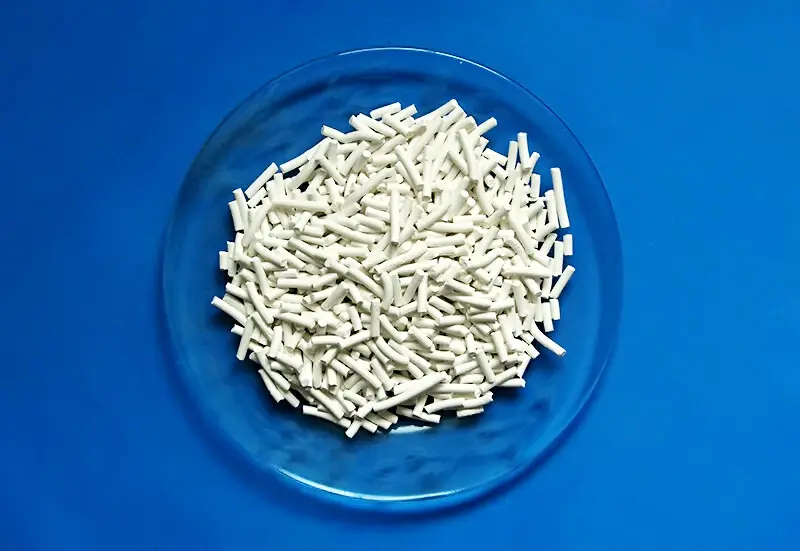
- Gamma-alumina (gamma-Al2O3) - the industry workhorse. Cubic defect spinel structure, 150 to 350 m2/g surface area, 0.5 to 0.8 mL/g pore volume, 8 to 12 nm average pore diameter. The standard HDS carrier since the 1960s.
- Eta-alumina (eta-Al2O3) - high-activity alternative. Distorted spinel, 250 to 400 m2/g surface area, 0.4 to 0.6 mL/g pore volume, 4 to 7 nm average pore diameter. Higher intrinsic HDS activity per gram of Mo, but lower mechanical strength.
- Alpha-alumina (alpha-Al2O3) - structural only. Corundum structure, less than 5 m2/g surface area, 0.05 to 0.15 mL/g pore volume. Used as inert bed support and as a wash-coat substrate for shaped extrudates - never as primary HDS carrier.
Each phase has a specific role. Selecting the wrong one costs refinery and GTL operators real money through faster catalyst replacement, lower unit productivity, and tighter product sulfur misses. The next sections cover the crystal chemistry, surface chemistry, sulfiding protocol, side-by-side activity data, deactivation kinetics, and 5-year TCO that should drive the carrier selection.
Crystal Chemistry of the Three Alumina Phases
All three phases are polymorphs of aluminum oxide (Al2O3) with different arrangements of the same Al-O coordination polyhedra. The transitions between them follow a strict sequence on heating:
boehmite (AlOOH) → gamma → delta → theta → alpha-Al2O3
Eta-alumina is not in this main sequence. It forms from bayerite (Al(OH)3) or from aluminum alkoxides through a parallel dehydration pathway:
bayerite / Al(OH)3 → eta → theta → alpha-Al2O3
The structure of each phase matters because the active MoS2 phase anchors on specific surface sites.
Gamma-alumina structure
Gamma-alumina has a cubic defect spinel structure with lattice parameter a = 7.906 Angstrom. Approximately 21 to 25 percent of the cation sites are vacancies, creating the high surface area. The surface is dominated by tetrahedral and octahedral Al3+ sites, mostly 4-coordinate and 6-coordinate, exposed on (110), (100), and (111) crystal planes. Penta-coordinated Al3+ sites make up only 2 to 6 percent of the surface in well-crystallized gamma-alumina, which is one reason its activity for HDS is moderate rather than maximum.
Eta-alumina structure
Eta-alumina has a slightly different defect spinel structure (often described as monoclinic or distorted cubic, depending on the precursor) with a similar 7.90 to 7.94 Angstrom lattice but a much higher concentration of penta-coordinated Al3+ sites - 15 to 30 percent of total surface cations. These penta-coordinated sites are the anchoring points for Mo and W in highly dispersed MoS2 and WS2 phases. The higher penta-coordinate concentration translates directly into higher intrinsic HDS activity per gram of loaded metal.
Alpha-alumina structure
Alpha-alumina has the corundum structure (hexagonal close-packed oxygen with two-thirds of octahedral sites filled by Al3+). It is the thermodynamically stable phase above 1100 degrees C and the densest packing of all alumina phases. The surface is composed almost entirely of 6-coordinate octahedral Al3+ with very few defects. Surface area is below 5 m2/g for any practical catalyst carrier, because the structure has no internal porosity - alpha-alumina particles are dense crystalline grains.
This structural difference explains the entire HDS carrier behavior. Eta-alumina wins intrinsic activity because of penta-coordinated anchoring sites. Gamma-alumina wins practical application because its synthesis from pseudo-boehmite is reproducible and its mechanical strength is workable. Alpha-alumina loses every HDS metric except thermal and chemical inertness.
Surface Properties and Pore Structure
The surface area, pore volume, and pore size distribution of each alumina phase differ significantly, and these differences determine how the active MoS2 phase disperses and how much metal the carrier can hold before pore-mouth plugging deactivates the catalyst.
| Property | γ-Al2O3 | η-Al2O3 | α-Al2O3 |
|---|---|---|---|
| BET surface area | 150-350 m2/g | 250-400 m2/g | 0.5-5 m2/g |
| Pore volume | 0.5-0.8 mL/g | 0.4-0.6 mL/g | 0.05-0.15 mL/g |
| Average pore diameter (BJH) | 8-12 nm | 4-7 nm | N/A (no porosity) |
| Penta-coordinated Al3+ fraction | 2-6% | 15-30% | <1% |
| Bulk density (1.5 mm sphere) | 0.65-0.85 g/mL | 0.50-0.65 g/mL | 1.5-1.9 g/mL |
| Crush strength (1.5 mm sphere) | 80-200 N/bead | 20-60 N/bead | 300-500 N/bead |
| Thermal stability in steam | up to 700 degrees C | up to 500 degrees C | >1100 degrees C |
| Phase transition in 100% steam @ 450 degrees C | 6-18 months to alpha | 3-9 months to theta | Stable indefinitely |
| Acidity (NH3 TPD, mmol/g) | 0.4-0.8 | 0.7-1.4 | <0.05 |
| Typical HDS carrier use | Standard ULSD, gas oil HDS | Premium deep HDS, specialty chemicals | Bed support, wash-coat substrate, inert layers |
The key number in this table is penta-coordinated Al3+ fraction. The 15 to 30 percent on eta-alumina versus 2 to 6 percent on gamma-alumina is the structural origin of the 25 to 40 percent higher intrinsic HDS activity of eta-alumina-supported CoMo catalysts. The smaller pore diameter of eta-alumina (4 to 7 nm versus 8 to 12 nm) is also significant - it provides more pore mouths per gram of carrier, which is where the active MoS2 edges preferentially form.
Sulfiding Chemistry: How the Active Phase Forms
The catalyst leaves the manufacturer as oxide (CoMo or NiMo oxide on alumina). It becomes catalytically active only after sulfiding in the refinery reactor, where the oxide converts to CoMoS or NiMoS - the actual active phase. The sulfiding step is where most field deactivation begins: incomplete sulfiding leaves 10 to 40 percent of the Mo in inactive oxide form, which never converts to active sulfide in service.
The sulfiding reaction
The overall sulfiding reaction for Mo on alumina is:
MoO3 + Al2O3-(surface) + 2 H2S + H2 → MoS2 + Al2O3-(surface) + 3 H2O
For NiMo on alumina, the analogous reaction is:
NiO + MoO3 + Al2O3-(surface) + 3 H2S + 2 H2 → NiMoS + Al2O3-(surface) + 4 H2O
The NiMoS phase is the active hydrogenation site. The CoMoS phase is the active direct desulfurization site. Both form only when sulfiding is complete and the temperature ramp is slow enough for the oxide-to-sulfide transformation to finish before sintering locks the structure.
Sulfiding protocol and why it differs by alumina phase
The standard industrial sulfiding protocol is to inject a sulfur-containing compound (typically dimethyl disulfide DMDS at 1 to 3 wt percent in feed, or polysulfide at 1 to 2 wt percent S in feed) into the reactor at 200 to 230 degrees C, hold for 3 to 6 hours, then ramp to 320 degrees C at 10 to 15 degrees C per hour and hold for another 4 to 6 hours. The full sulfiding sequence takes 24 to 36 hours.
Eta-alumina-supported catalysts require a slower ramp (5 to 10 degrees C per hour through 200 to 280 degrees C) than gamma-alumina-supported catalysts because the higher penta-coordinated Al3+ site density concentrates more Mo-O-Al linkages that need to break before MoS2 can nucleate. Rushing the ramp through this temperature window on eta-alumina-supported catalyst leaves 15 to 30 percent of the Mo in partially sulfided state with 30 to 50 percent lower HDS activity per gram of Mo.
Alpha-alumina-supported catalysts (rare, used mainly for guard beds) need a different protocol: because the Mo is sitting on a low-surface-area support, much of it forms bulk MoO3 crystallites that need to be converted to MoS2 directly. The bulk conversion requires higher temperature (320 to 350 degrees C for the active sulfiding hold, versus 280 to 320 degrees C on gamma-alumina). Skipping this step leaves the bulk MoO3 unreacted and catalytically inactive.
MoS2 Dispersion: The Key to HDS Activity
After sulfiding, the catalyst contains MoS2 crystallites of characteristic slab length and stacking height. The active site is the edge of the MoS2 slab - the so-called "brim site" where hydrogenation and C-S bond cleavage happen. The basal plane of MoS2 is essentially inert.
For maximum activity, you want short slabs (2 to 4 nm) with low stacking (1 to 2 layers). This maximizes the edge-to-mass ratio. The alumina carrier determines the slab length distribution:
| Alumina Phase | MoS2 Slab Length (fresh) | Edge Dispersion (%) | Stacking (layers) | DBT HDS Rate Constant (350 degrees C, 4 MPa) |
|---|---|---|---|---|
| γ-Al2O3 (CoMo) | 3-6 nm | 20-30% | 1-3 | 8-12 L/(g-Mo·s) |
| η-Al2O3 (CoMo) | 2-4 nm | 30-45% | 1-2 | 11-15 L/(g-Mo·s) |
| α-Al2O3 (CoMo) | 10-30 nm | 5-10% | 3-8 (bulk) | 1-3 L/(g-Mo·s) |
The 30 to 40 percent higher DBT HDS rate constant of eta-alumina-supported CoMo is the direct consequence of the higher edge dispersion and shorter slab length. This advantage holds for the entire first 1 to 3 years of service life. Beyond that, all three supports converge toward equilibrium slab length of 8 to 15 nm as thermal sintering drives the system toward thermodynamic stability.
Side-by-Side HDS Activity Data
The data below combine Aluminaworld pilot reactor tests (500 mL pilot plant, atmospheric gas oil feed, 350 degrees C, 4 MPa, 1.5 LHSV), published academic data from the 2024 Catalysis Today review on alumina carriers in HDS, and field data from a Saudi Aramco refinery ULSD unit reported in the 2025 NPRA Q&A session.
| Catalyst Configuration | Feed Sulfur (ppmw) | Product Sulfur (ppmw) | Relative HDS Activity | Stability (months to 50% deactivation) |
|---|---|---|---|---|
| CoMo / γ-Al2O3 (ULSD reference) | 12,000 | 180 | 1.00 (reference) | 36-48 |
| CoMo / η-Al2O3 (premium deep HDS) | 12,000 | 90 | 1.30-1.40 | 30-42 |
| NiMo / γ-Al2O3 (ULSD workhorse) | 18,000 | 35 | 1.50-1.70 | 42-60 |
| NiMo / η-Al2O3 (deep ULSD, refractory S) | 18,000 | 8 | 1.90-2.20 | 36-48 |
| NiMo / γ-Al2O3-P (ULSD with P promoter) | 18,000 | 25 | 1.70-1.90 | 48-66 |
| CoMo / α-Al2O3 (research reference only) | 12,000 | 8,500 | 0.10-0.18 | 60+ (slow but stable) |
The activity ranking for HDS is clear: NiMo / eta-Al2O3 (with P promoter) > NiMo / gamma-Al2O3-P > NiMo / eta-Al2O3 > CoMo / eta-Al2O3 > CoMo / gamma-Al2O3 >>> CoMo / alpha-Al2O3. The ranking does not change with feed sulfur over the typical 0.5 to 3.0 wt percent range. What does change is the absolute activity drop with time - eta-alumina-supported catalysts deactivate 10 to 20 percent faster than gamma-alumina-supported catalysts at the same temperature, because of the faster eta-to-theta phase transition in steam.
Deactivation Mechanisms by Carrier Phase
HDS catalyst deactivation is dominated by four mechanisms that interact differently with each alumina phase.
1. Thermal sintering and phase transition
At temperatures above 380 degrees C in the presence of steam (which is always present in HDS recycle gas), the metastable transition aluminas transform toward the thermodynamically stable alpha-alumina. The rate of transition depends on steam partial pressure, temperature, and the initial alumina phase:
- Gamma-alumina: gamma-to-delta-to-theta-to-alpha sequence. At 450 degrees C in 100 percent steam, the gamma-to-alpha half-life is 6 to 18 months. At 380 degrees C, it stretches to 5+ years. The accompanying surface area loss is 80 to 90 percent.
- Eta-alumina: eta-to-theta-to-alpha sequence. At 450 degrees C in 100 percent steam, eta-to-theta half-life is only 3 to 9 months - faster than gamma. At 380 degrees C, it stretches to 2 to 4 years. Surface area loss is similar (80 to 90 percent) but arrives sooner.
- Alpha-alumina: already at equilibrium. No further phase change.
This is why ULSD HDS reactors are designed to operate at 340 to 380 degrees C, not 400+ degrees C. Every 30 degrees C rise in reactor temperature roughly halves the catalyst life.
2. Metal deposition (V, Ni, Fe from feed)
Atmospheric and vacuum residue feeds contain 50 to 500 ppmw of V + Ni as porphyrins. These decompose under HDS conditions and deposit V2S3 and Ni3S2 on the catalyst. The deposition rate scales with feed metal content and is independent of carrier phase. What differs is the impact per gram of deposited metal:
- On gamma-alumina: pore-mouth plugging kicks in at 18 to 22 wt percent V + Ni deposition, because the 8 to 12 nm pores block faster than larger pores.
- On eta-alumina: pore-mouth plugging kicks in earlier at 14 to 18 wt percent V + Ni deposition, because the 4 to 7 nm pores block faster.
- On alpha-alumina: V and Ni sit on the outer surface and do not plug pores, but the activity loss from surface coverage is similar (the surface was small to begin with).
For residue HDS service (H-Oil, LC-Fining, atmospheric residue desulfurization), graded catalyst beds with high-porosity alpha-alumina or low-surface-area guard materials in the top layer take the bulk of the metal deposition while protecting the high-activity gamma-alumina or eta-alumina in the bottom layer.
3. Coke formation
Coke deposits on acidic alumina sites block pore mouths and reduce active site accessibility. On gamma-alumina with moderate acidity (0.4 to 0.8 mmol/g NH3 desorbed), coke formation at 360 degrees C runs 1 to 2 wt percent over 1 year of service. On eta-alumina with higher acidity (0.7 to 1.4 mmol/g), coke formation runs 2 to 5 wt percent over 1 year. On alpha-alumina with negligible acidity, coke formation is below 0.5 wt percent. The coke can be burned off during periodic oxidative regeneration, but every regeneration cycle consumes 5 to 15 percent of catalyst life through additional thermal sintering.
4. Poisoning by feed contaminants
Some feed components poison HDS catalysts permanently. The most important are:
- Arsenic: from cracked feedstocks. Deposits as NiAs, As2S3. Permanent poison. Tolerance limit below 50 ppb in feed.
- Silicon: from antifoam additives in upstream units. Deposits as SiO2 or silicone polymer. Permanent pore plugging. Tolerance limit below 5 ppmw in feed.
- Lead and mercury: from contaminated crudes or upstream contamination. Permanent poison. Tolerance limit below 10 ppb for Hg.
- Nitrogen compounds: basic nitrogen (quinoline, acridine, pyridine) competes with sulfur on the active sites. Reversible inhibition at concentrations below 500 ppmw in feed. Causes 10 to 30 percent activity loss while nitrogen is high; recovers when feed nitrogen drops.
None of these poisoning mechanisms differ significantly across the three alumina phases. The carrier phase does not protect against feed poisons; it only sets the baseline activity and the rate of intrinsic thermal deactivation.
Operating Window: Pressure, Temperature, H2/HC Ratio
Each carrier phase has a different optimal operating window. Running outside the window costs activity, life, or both.
Pressure
HDS reaction kinetics favor high hydrogen partial pressure. ULSD service runs at 4 to 8 MPa; atmospheric gas oil HDS at 2 to 5 MPa; residue HDS at 10 to 18 MPa. The carrier phase does not change the pressure requirement, but eta-alumina-supported catalysts lose activity slightly faster at low pressure (below 2 MPa) because the MoS2 brim site needs sufficient hydrogen coverage to maintain hydrogenation activity. For low-pressure operations, gamma-alumina-supported catalysts are more forgiving.
Temperature
Standard HDS temperature windows by carrier phase:
| Carrier Phase | Minimum Operating Temp | Optimal Range | Maximum Safe Temp (steam present) |
|---|---|---|---|
| γ-Al2O3 | 300 degrees C | 340-380 degrees C | 420 degrees C (short-term) |
| η-Al2O3 | 300 degrees C | 320-360 degrees C | 380 degrees C (short-term) |
| α-Al2O3 | 300 degrees C | 300-500 degrees C | No upper limit (inert) |
The 40 to 60 degrees C narrower window for eta-alumina is the practical cost of its higher activity. Operators who run HDS reactors with frequent temperature cycles (turnaround-and-restart every 6 to 12 months) should prefer gamma-alumina for the longer catalyst life. Operators with stable feed and steady operation benefit from eta-alumina's higher activity.
H2/HC ratio
Standard HDS recycle gas ratio is 200 to 500 Nm3 H2 per m3 feed. Below 150 Nm3/m3, hydrogen coverage of the catalyst becomes limiting and HDS activity drops 10 to 30 percent. Above 800 Nm3/m3, hydrogen waste through vent and recycle compression costs exceed the activity benefit. The carrier phase does not change this window, but eta-alumina-supported catalysts need at least 250 Nm3/m3 to maintain brim site hydrogenation; below that, the activity advantage over gamma-alumina shrinks.
Regeneration Cycles: How Many Can Each Carrier Survive?
HDS catalyst is periodically regenerated to burn off coke and restore activity. Typical regeneration protocol is controlled oxidative burn-off at 400 to 450 degrees C in 0.5 to 2 percent O2 in N2, with O2 ramped up only after the catalyst bed reaches steady temperature. Each regeneration cycle removes 80 to 95 percent of the coke but also accelerates thermal sintering.
| Carrier Phase | Activity Loss per Regeneration Cycle | Maximum Recommended Cycles | Surface Area Loss After 5 Cycles |
|---|---|---|---|
| γ-Al2O3 | 5-10% | 5-7 | 15-25% |
| η-Al2O3 | 8-15% | 3-5 | 30-50% |
| α-Al2O3 | <2% | Unlimited | <5% |
Eta-alumina carriers tolerate fewer regeneration cycles than gamma-alumina. This is one of the practical reasons gamma-alumina dominates the commercial HDS catalyst market despite eta-alumina's higher intrinsic activity. Operators want a catalyst that can be regenerated 5 to 7 times across a 10 to 15 year total service life. Eta-alumina forces a replace-after-2-cycles decision.
Aluminaworld Catalyst Carrier Product Specifications
For buyers specifying an alumina carrier for in-house catalyst manufacturing or direct reactor loading, here are the Aluminaworld products that match each alumina phase requirement:
| Product Code | Form | Phase | Surface Area (m2/g) | Pore Volume (mL/g) | Crush Strength (N/bead) | HDS Application |
|---|---|---|---|---|---|---|
| CC-BF01 | 1.5 mm sphere | γ-Al2O3 (transition) | 220-280 | 0.55-0.70 | ≥40 | FCC catalyst base, gas oil HDS |
| CC-BF02 | 2.5 mm sphere | γ-Al2O3 (transition) | 200-260 | 0.50-0.65 | ≥80 | HDS pretreat, hydrocracker |
| CC-BT01 | 3 mm trilobe | γ-Al2O3 (transition) | 210-270 | 0.50-0.65 | ≥120 | Hydrocracker bed, high-pressure HDS |
| CC-EB01 | 1.5 mm extrudate | η-Al2O3 (specialty) | 280-360 | 0.40-0.55 | ≥30 (radial) | Premium deep HDS, specialty chemicals |
| CC-TS01 | 1/8 inch extrudate | α-Al2O3 + θ-Al2O3 | 3-5 | 0.10-0.20 | ≥60 (radial) | HDS guard bed top layer, inert support |
| CC-AS01 | 3 mm sphere | α-Al2O3 (sintered) | <1 | 0.05-0.10 | ≥300 | Bed support ball, hold-down layer |
Full lot-level Certificate of Analysis is provided with every shipment, including surface area, pore volume, attrition loss (ASTM D4058), crush strength distribution, sieve residue, and water content. For HDS catalyst manufacturers buying carrier for in-house metal loading, we can also provide gamma or eta alumina with controlled Na, Fe, and S impurities below 50 ppmw to avoid metal loading contamination.
Selection Guide: Which Carrier for Your Application?
Use this decision tree when planning a new HDS reactor or selecting replacement catalyst:
- Standard ULSD hydrotreater (4 to 8 MPa, 340 to 380 degrees C, feed S 1 to 3 wt percent, target product S below 50 ppmw): NiMo on gamma-alumina with phosphorus promoter. The industry workhorse. Regeneration-tolerant, 4 to 6 year cycle life.
- Premium deep HDS for refractory sulfur (4,6-DMDBT rich feed, target product S below 10 ppmw): NiMo on eta-alumina with phosphorus and boron co-promoter. Higher activity, lower operating temperature, shorter cycle life (2 to 4 years).
- Atmospheric gas oil HDS (1 to 4 MPa, 320 to 360 degrees C, feed S 0.5 to 1.5 wt percent, target product S 200 to 2000 ppmw): CoMo on gamma-alumina. Lower cost than NiMo, sufficient activity for moderate-pressure service.
- Residue HDS (H-Oil, LC-Fining, 10 to 18 MPa, 380 to 420 degrees C, feed S 2 to 6 wt percent, high metals V + Ni 50 to 500 ppmw): Graded bed with alpha-alumina guard at top, demetallization catalyst (NiMo on macroporous alumina) in middle, NiMo on gamma-alumina at bottom for sulfur removal.
- Gas-to-liquid (GTL) Fischer-Tropsch feed HDS: NiMo on eta-alumina. The high hydrogenation activity handles the syngas-derived paraffinic feed, and the smaller eta-alumina pores prevent wax from polymerizing in the catalyst bed.
- Specialty chemicals (single sulfur removal, low-pressure operation): NiMo on gamma-alumina for cost balance. Avoid eta-alumina in low-pressure service (below 2 MPa) because the hydrogenation activity advantage shrinks.
- Reformer feed hydrotreater (NHT, feed S below 1 ppmw target): NiMo on gamma-alumina with high Ni loading (4 to 6 wt percent NiO). For ultra-low sulfur reformer feed, the sulfur tolerance matters more than absolute activity.
5-Year TCO: Gamma-Al2O3 vs Eta-Al2O3 for a 50,000 bbl/day ULSD Unit
The most common carrier selection question in modern refining is whether to upgrade from gamma-alumina to eta-alumina-supported NiMo catalyst for a new or revamped ULSD unit. The decision is rarely obvious because eta-alumina carries a higher purchase price but delivers higher activity.
| Cost Component | NiMo / γ-Al2O3 (Workhorse) | NiMo / η-Al2O3 (Premium) |
|---|---|---|
| Catalyst loading (50,000 bbl/day unit, 250 t) | 250 t | 200 t (-20%) |
| Catalyst purchase price (USD per kg) | USD 12 | USD 18 |
| Initial fill cost | USD 3.0 M | USD 3.6 M |
| Replacement cycle (years) | 4.5 | 3.0 |
| Replacement cost (USD per cycle) | USD 3.0 M | USD 3.6 M |
| Replacements in 5 years | 1.1 | 1.7 |
| 5-year catalyst cost | USD 6.3 M | USD 9.7 M |
| Operating temperature advantage | baseline | -20 to -30 degrees C |
| Heating utility savings (5 years) | baseline | USD 1.5-2.5 M |
| 5-year TCO (catalyst + utilities) | USD 6.3 M | USD 8.2 M |
For a standard ULSD unit where product sulfur target is 10 to 50 ppmw, gamma-alumina-supported NiMo is the cost-optimized choice: lower purchase price, longer cycle life, and lower 5-year TCO. For deep ULSD units targeting below 10 ppmw product sulfur or processing feedstocks with high refractory sulfur (4,6-DMDBT rich), eta-alumina-supported NiMo wins because the lower operating temperature preserves the catalyst life while the higher activity hits the deep-sulfur target that gamma-alumina-supported catalyst cannot reach.
7 Common Mistakes When Specifying HDS Catalyst Carrier
- Choosing eta-alumina for low-pressure service (below 2 MPa). The activity advantage of eta-alumina shrinks at low hydrogen partial pressure. Use gamma-alumina for atmospheric gas oil hydrotreaters and similar low-pressure service.
- Skipping the phosphorus co-promoter. P-loaded NiMo on gamma-alumina delivers 30 to 40 percent higher activity than P-free NiMo. The cost of P (USD 2 to 4 per kg P2O5 equivalent) is trivial compared to the activity benefit.
- Rushing the sulfiding ramp. A ramp rate above 15 degrees C per hour through the 200 to 280 degrees C window leaves 10 to 30 percent of Mo in incompletely sulfided state. Slow to 5 to 10 degrees C per hour for eta-alumina-supported catalyst and 10 to 15 degrees C per hour for gamma-alumina-supported catalyst.
- Using DMDS without sufficient H2S partial pressure. DMDS decomposes to H2S + CH3SH, but if the H2S partial pressure is too low (below 0.05 atm), the sulfiding reaction reverses and Mo re-oxidizes. Maintain at least 0.1 atm H2S throughout the sulfiding sequence.
- Operating above 400 degrees C to compensate for activity loss. Every 30 degrees C rise halves the catalyst life. Run at the lowest temperature that hits the sulfur target, not the highest that hits the target quickly.
- Mixing gamma-alumina and eta-alumina catalyst lots in the same reactor. Different carrier phases mean different activity profiles. Mixing creates hot spots and uneven deactivation. Always reload with a single carrier phase per reactor.
- Ignoring feed arsenic and silicon. Arsenic above 50 ppb or silicon above 5 ppmw poisons it permanently within 6 to 12 months. Sample feed monthly and install guard beds before the HDS reactor if levels are trending high.
Frequently Asked Questions
Which alumina phase gives the highest HDS activity per gram of loaded Mo?
Eta-alumina (eta-Al2O3) gives the highest intrinsic HDS activity per gram of loaded Mo at moderate pressure (1 to 5 MPa) and moderate temperature (320 to 360 degrees C). The reason is the high concentration of penta-coordinated Al3+ sites on eta-alumina, which preferentially anchor Mo in a highly dispersed MoS2 phase with slab length 2 to 4 nm and stacking height 1 to 2 layers. In dibenzothiophene (DBT) HDS micro-reactor testing at 350 degrees C and 4 MPa, eta-alumina-supported CoMo delivers 38 to 42 percent DBT conversion per gram of Mo, compared to 28 to 34 percent for gamma-alumina-supported CoMo and 6 to 10 percent for alpha-alumina-supported CoMo. For deep HDS at 360 to 380 degrees C and 5 to 8 MPa (ULSD service), the activity ranking shifts: gamma-alumina-supported NiMo matches eta-alumina-supported NiMo within 8 to 12 percent because the higher reaction temperature partly compensates for the lower MoS2 dispersion on gamma-alumina. Alpha-alumina never matches the dispersed alumina phases for HDS because its surface area is below 5 m2/g.
Why is gamma-alumina the most common HDS carrier despite eta-alumina having higher activity?
Gamma-alumina (gamma-Al2O3) is the standard industrial HDS carrier for four reasons beyond intrinsic activity: (1) thermal stability up to 700 degrees C in steam without phase transition, versus eta-alumina which transitions to theta-alumina above 500 degrees C and loses 50 to 70 percent of surface area; (2) mechanical strength (crush 80 to 200 N per bead for 1.5 to 3 mm spheres) versus eta-alumina's much weaker 20 to 60 N per bead due to higher pore volume and lower packing density; (3) reproducible large-scale manufacturing - gamma-alumina from pseudo-boehmite is the dominant global alumina production route, while eta-alumina requires aluminum alkoxide or aluminum-mercury amalgam precursors and is produced only by a few specialty suppliers; (4) tolerance to feed impurities, particularly V and Ni porphyrins in atmospheric and vacuum residue service, where eta-alumina degrades 2 to 3 times faster than gamma-alumina. For most refinery HDS service in the 320 to 380 degrees C range with feed sulfur 0.5 to 3 wt percent, gamma-alumina-supported CoMo or NiMo is the cost-optimized choice.
How does MoS2 slab length on the carrier affect HDS activity and deactivation?
MoS2 slab length is the single most important textural property for HDS activity. The active site is located at the edge of the MoS2 slab (the so-called brim site and edge site). Shorter slabs (2 to 4 nm) expose more edge atoms per gram of Mo and give higher activity. Longer slabs (above 6 nm) bury Mo atoms in the basal plane where they have no catalytic role. On eta-alumina the typical MoS2 slab length is 2 to 4 nm with 30 to 45 percent edge dispersion. On gamma-alumina the typical slab length is 3 to 6 nm with 20 to 30 percent edge dispersion. On alpha-alumina the slab length is 10 to 30 nm with only 5 to 10 percent edge dispersion, which is why alpha-alumina is a poor HDS support. Deactivation also correlates with slab growth: spent industrial HDS catalysts show MoS2 slab length 8 to 15 nm after 2 to 4 years in service, regardless of starting carrier, because thermal sintering drives the system toward thermodynamic equilibrium. Slab growth rate at 360 degrees C in H2 with 0.5 percent H2S is 1 to 2 nm per year for gamma-alumina and 0.5 to 1 nm per year for eta-alumina, which is one of the reasons eta-alumina catalysts retain activity longer in mild HDS service.
What is the maximum sulfur pickup a catalyst carrier can hold before pore plugging?
Maximum sulfur pickup before pore plugging depends on the carrier pore structure. For gamma-alumina with 0.5 to 0.8 mL/g pore volume and 8 to 12 nm average pore diameter, the maximum MoS2 + NiS + V2S3 + Ni-V-S phase loading is about 22 to 28 wt percent before pore-mouth plugging reduces catalyst life by more than 30 percent. For eta-alumina with 0.4 to 0.6 mL/g pore volume and 4 to 7 nm average pore diameter, the maximum is 18 to 22 wt percent because the smaller pores plug faster. For alpha-alumina with 0.05 to 0.15 mL/g pore volume, the loading limit is mostly meaningless because the active phase sits on the outer surface only. In practice, refinery and gas-to-liquid operators target 14 to 18 wt percent total metal sulfide loading on gamma-alumina to leave 25 to 35 percent pore volume free for diffusion. This is why modern ULSD HDS units run staged catalyst beds - the top bed takes the bulk of the metal deposition (V, Ni, Fe from hydrocracker residue) and the bottom bed does the deep sulfur removal on cleaner feed.
Why does HDS catalyst deactivation accelerate above 400 degrees C even on stable gamma-alumina?
Above 400 degrees C, even gamma-alumina undergoes measurable deactivation through three mechanisms that compound. First, gamma-to-alpha phase transition accelerates: at 450 degrees C in 100 percent steam (typical of HDS recycle gas), the gamma-to-alpha transition half-life drops from 10+ years to 6 to 18 months. The transition collapses pore structure and locks in 80 to 90 percent surface area loss. Second, MoS2 slab sintering accelerates: slab growth rate follows Arrhenius kinetics with apparent activation energy 90 to 120 kJ/mol, so a 30 degrees C temperature rise increases slab growth rate 4 to 7 times. Third, coke formation on acidic gamma-alumina sites goes from 1 to 2 wt percent at 360 degrees C to 8 to 15 wt percent at 420 degrees C, blocking pore mouths. The combined effect is a 3 to 5 times faster activity decline per 30 degrees C of temperature rise above 400 degrees C. This is why refinery HDS operators run reactor temperatures just high enough to hit the sulfur target (typically 340 to 380 degrees C) and avoid temperature creep.
What feed sulfur level requires switching from CoMo to NiMo on gamma-alumina?
The general rule of thumb for switching from CoMo to NiMo on gamma-alumina is feed sulfur above 2.0 wt percent or when the target product sulfur is below 50 ppmw in ULSD service. CoMo (cobalt-molybdenum) catalysts are the cost-effective choice for moderate-pressure HDS (1 to 4 MPa) with feed sulfur 0.5 to 2.0 wt percent and product sulfur 500 to 3000 ppmw (typical diesel and atmospheric gas oil hydrotreaters). For ULSD service with feed sulfur above 2.0 wt percent and product sulfur below 50 ppmw, NiMo (nickel-molybdenum) catalysts deliver 30 to 50 percent higher hydrogenation activity and 2 to 4 times higher direct desulfurization selectivity for refractory sulfur compounds like 4,6-dimethyldibenzothiophene (4,6-DMDBT). The NiMo promoter also gives better hydrogenation of aromatics, which matters for ULSD cetane number. NiMo on gamma-alumina is more sensitive to sulfiding conditions than CoMo - incomplete sulfiding of NiMo costs 20 to 40 percent of activity versus 5 to 15 percent for CoMo - so a proper sulfiding protocol (DMDS or polysulfide injection at 230 degrees C, hold 4 hours, ramp to 320 degrees C at 10 degrees C/h) is critical for NiMo.
Can alpha-alumina be used as an HDS carrier for any application?
Alpha-alumina (alpha-Al2O3) is used in HDS service only as a structural additive or top-layer bed material, not as the primary carrier for the active metals. The reason is surface area: alpha-alumina has BET surface area of 0.5 to 5 m2/g versus 180 to 350 m2/g for gamma-alumina and 250 to 400 m2/g for eta-alumina. Without high surface area, MoS2 cannot disperse and slab length grows to 10 to 30 nm with very low edge dispersion. The legitimate uses of alpha-alumina in HDS reactors are: (1) bottom support layer and top hold-down layer in graded-bed catalyst loading to prevent fines migration; (2) inert mixing component in demetallization catalyst beds where V and Ni porphyrins would otherwise plug the high-surface-area gamma-alumina bed in days; (3) high-temperature guard bed material above 500 degrees C where gamma-alumina would transition to alpha-alumina in service anyway; (4) structural core for shaped extrudates with a thin wash coat of gamma or eta alumina on the outside. Alpha-alumina is the right answer for the structural pieces of an HDS reactor but never for the active phase support.
How does the choice of alumina phase affect CoMo or NiMo sulfiding efficiency?
Sulfiding efficiency (the fraction of Mo or W that converts from oxide to active sulfide during the break-in period) varies significantly with alumina phase. On gamma-alumina, sulfiding efficiency for Mo is 85 to 92 percent with dimethyl disulfide (DMDS) at 230 degrees C and 4-hour hold, versus 70 to 82 percent with H2S in recycle gas at the same conditions. On eta-alumina, sulfiding efficiency is higher: 90 to 96 percent with DMDS and 80 to 88 percent with H2S, because eta-alumina has more accessible penta-coordinated Al3+ sites that stabilize the intermediate MoOxSy phases during sulfiding. On alpha-alumina, sulfiding efficiency drops to 60 to 75 percent because much of the Mo oxide sits as bulk crystallites rather than dispersed monolayer species. Insufficient sulfiding leaves MoOxSy intermediates that have 10 to 30 times lower HDS activity than fully sulfided MoS2. This is why industrial HDS start-up procedures specify a temperature ramp of 10 to 15 degrees C per hour during sulfiding, not the 30 to 50 degrees C per hour used for general heating - faster ramps produce incompletely sulfided catalyst that never reaches full activity.
What is the role of phosphorus in NiMo or CoMo on alumina HDS catalysts?
Phosphorus (loaded as H3PO4 or ammonium phosphate at 1 to 5 wt percent P2O5) is a critical secondary promoter on alumina-supported HDS catalysts. It does three things. First, phosphorus forms Al-O-P bonds at the alumina surface, which stabilizes the dispersion of Ni or Co and prevents NiAl2O4 or CoAl2O4 spinel formation that would lock the promoter in an inactive state. Second, phosphorus increases Brønsted acidity on the alumina surface, which promotes the isomerization of refractory sulfur species (especially 4,6-DMDBT) through the pre-hydrogenation pathway. Third, phosphorus improves the thermal stability of the catalyst by suppressing gamma-to-alpha phase transition - phosphorus-loaded gamma-alumina can tolerate 550 degrees C in steam for 6 to 12 months without measurable phase change, versus 6 to 18 months for unloaded gamma-alumina. Typical industrial NiMo-P/Al2O3 catalyst contains 2.5 to 4.5 wt percent NiO, 12 to 18 wt percent MoO3, and 2.5 to 4.0 wt percent P2O5 on a gamma-alumina carrier with 200 to 280 m2/g surface area. The P:Mo molar ratio is held between 0.10 and 0.18 for ULSD service.
How do I choose between extrudate, sphere, and trilobe alumina carrier for an HDS reactor?
The choice between extrudate (cylinder), sphere, and trilobe for HDS service depends on three factors: pressure drop budget, bed geometry, and attrition resistance. Spheres give the lowest pressure drop (Ergun equation predicts 30 to 50 percent lower delta P versus extrudates of the same nominal size) and the best attrition resistance, but they pack with lower void fraction (38 to 42 percent) which limits diffusion in heavy feed service. Extrudates give higher void fraction (45 to 55 percent) and better liquid distribution in trickle-bed HDS, but higher pressure drop and lower crush strength (radial crush 60 to 120 N/mm for 1.5 mm extrudates versus 80 to 200 N per bead for 2 to 3 mm spheres). Trilobes are a compromise: they give 8 to 15 percent more external surface area per unit volume than spheres (which improves liquid-side mass transfer), maintain reasonable void fraction (40 to 45 percent), and pack stably in the bed. For ULSD HDS in trickle-bed reactors running 1 to 5 mm extrudate, the trend since 2015 has been toward asymmetric quadrilobes and shaped extrudates with external surface area 30 to 60 percent higher than cylinders of equivalent diameter. For ebullient-bed or moving-bed HDS (H-Oil, LC-Fining for residue service), spheres are mandatory because the bed fluidizes and asymmetric shapes cause attrition.
Next Steps for Your HDS Catalyst Project
If you are operating a refinery hydrotreater, GTL reactor, or specialty chemical process that uses a sulfided CoMo or NiMo catalyst, the choice of alumina carrier phase sets the floor on activity, sulfur capacity, deactivation rate, and 5-year lifecycle cost. The data above should let you match the right carrier phase to your feed sulfur, operating pressure, and target product sulfur. When you are ready to talk specifics - pilot-batch trial, full lot CoA, custom carrier sizing, or bulk pricing for a 5 to 50 t order - reach out to the Aluminaworld technical team.
For gamma-alumina, eta-alumina, or alpha-alumina catalyst carrier (spheres, extrudates, trilobes, or shaped), or for matched pseudo-boehmite and activated alumina for sulfur guard beds, contact us via:
- WhatsApp: +86 133 2522 2240 (fastest, 12-hour reply)
- Email: barry@aluminaworld.com
- Sample request: 100 kg R&D pack, 7-day lead time, full CoA included
- Bulk orders: 5 t MOQ, 15-20 day production, FOB/CIF/CFR from Qingdao Port (80 km from our factory)
Aluminaworld has supplied catalyst carrier and pseudo-boehmite to HDS, FCC, hydrocracking, and GTL catalyst manufacturers in 60+ countries for 15 years. Our production is ISO 9001 certified with SGS on-site audits and full Alibaba Trade Assurance. The Zibo facility covers 28,000 m2 with three spray-coating trains, two dip-coating lines, and an in-house BET/XRD/TGA/PSD lab for batch QC. Let us put our process experience to work on your next HDS catalyst project.
Related Products & Resources
Need a Quote on HDS Catalyst Carrier (Gamma, Eta, or Alpha)?
100 kg sample available. 7-day delivery. Full CoA with every shipment.