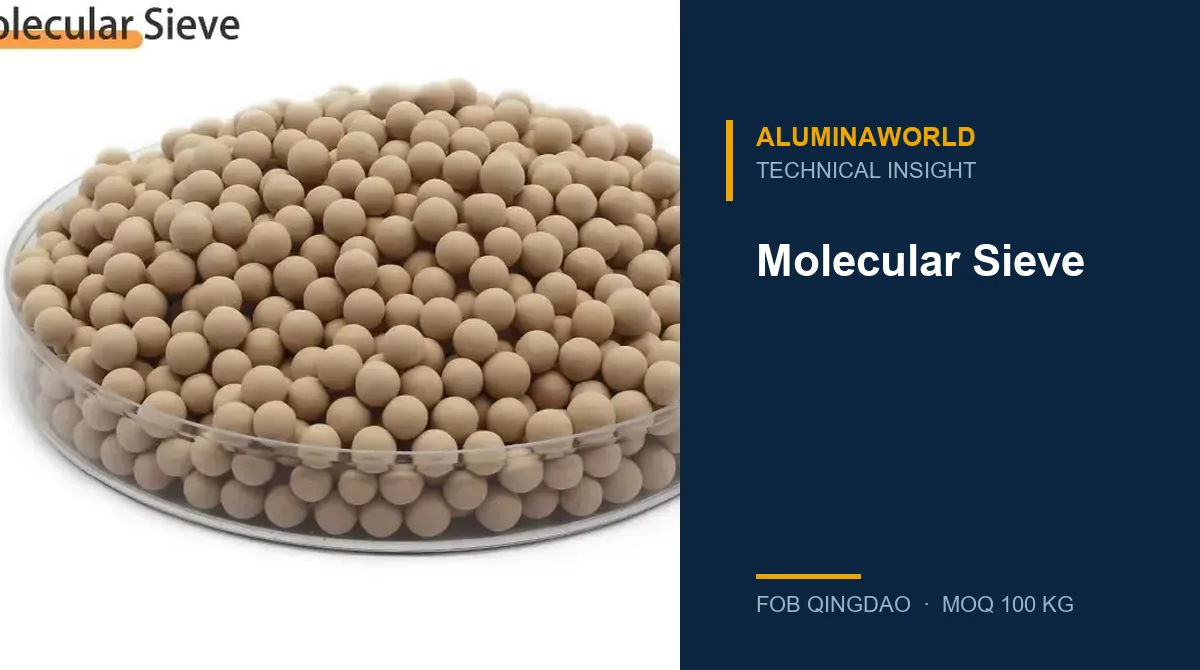
Molecular Sieve 13X for Direct Air Capture (DAC): CO2 Working Capacity at 415 ppm vs Amine Sorbents
Abstract. Direct air capture (DAC) plants sized at 0.5-5 Mt CO2/year are now in engineering procurement across the US, EU, and Gulf. Two sorbent families dominate vendor selection: 13X faujasite zeolite (binderless bead, 1.6-2.5 mm) and supported amine sorbents (typically polyethyleneimine impregnated on mesoporous silica). This article compares the two at the 415 ppm CO2 partial pressure of atmospheric air, looking at equilibrium working capacity, regeneration duty (TSA at 350-400 degC vs steam-stripped amine), attrition life, water co-adsorption penalties, and EPC-level RFQ specifications. The conclusion for greenfield DAC plants without low-cost steam is that binderless 13X is the most defensible choice at current sorbent prices and 2024 amine-aerosol regulation. For RFQ context on parallel molecular sieve trains (H2 drying, biogas upgrading), see our guides on electrolyzer outlet dew point and dual-bed silica gel + 13X design.
1. Why direct air capture needs a different sorbent logic than flue gas CO2 capture
Flue gas from a coal or gas power plant carries 3-15% CO2 wet basis, roughly 30,000-150,000 ppm. A typical capture plant pulls that stream at 1.0-1.5 bara with CO2 partial pressure 30-150 kPa, and uses monoethanolamine (MEA), piperazine, or chilled ammonia to scrub it. At 90% capture, the working capacity per mol of amine is high (1.0-1.5 mol CO2/mol MEA), the driving force for regeneration is strong, and the thermal swing duty is 3.5-4.5 GJ per tonne CO2 captured.
Direct air capture flips every one of those numbers. Atmospheric air carries 415 ppm CO2 as of 2024 (was 420 ppm when Climeworks opened the original Hinwil plant in 2017; the trend continues at +2.5 ppm/year per NOAA Mauna Loa). At 415 ppm and 1.013 bara, CO2 partial pressure is 0.042 kPa, roughly 1,000x lower than flue gas. The thermodynamic driving force for CO2 adsorption is correspondingly weak. Solvent sorbents still work but at 5-15% of their flue-gas capacity; they also lose capacity fast when the relative humidity of the feed air swings between 20% and 90%. Zeolite sorbents, especially 13X, hold up better in this regime because their pore architecture gives a Henry-law linear isotherm that scales predictably with partial pressure.
The practical consequence: DAC is not a scaled-up post-combustion capture plant. The contactor geometry, the regeneration cycle, and the sorbent specification all have to be re-engineered from first principles. This article is written for the EPC engineer who has just been handed a 0.5-1.0 MtCO2/year DAC plant RFQ and is trying to decide between 13X bead (AluminaWorld, UOP, CECA, Honeywell) and PEI-on-silica supported amine (Climeworks, Atoco, Mosaic Materials).
2. 13X zeolite fundamentals for low-ppm CO2
13X is the sodium form of faujasite (FAU) zeolite, with Si/Al near 1.0, pore aperture 9 angstrom, and cation-accessible supercage of 12 angstrom. Its equilibrium CO2 capacity at 100 kPa and 298 K is 4.2-4.8 mmol/g (18-21 wt%), which is the upper end of commercial physisorbents. At 0.042 kPa (415 ppm) and 298 K, the capacity drops to roughly 0.16-0.22 mmol/g (0.70-0.97 wt%). This is the "Henry's law regime" where the isotherm is linear in partial pressure, and it is the working point of a DAC contactor.
The implication for working capacity is set by the regeneration depth. If desorption is driven by a thermal swing to 350 degC at near-atmospheric pressure, the residual CO2 partial pressure over the bed is roughly 1 kPa (10,000 ppm), giving a working swing of 0.6-0.9 wt%. If desorption is steam-assisted at 10-30 kPa steam partial pressure, the residual drops to 0.1-0.3 kPa and the working swing rises to 1.2-1.8 wt%. The cost of the higher swing is the additional steam infrastructure and the deal with wet bed cool-down.
Binderless 13X beads (no clay or alumina binder phase) give 5-15% higher gravimetric capacity than binder-containing pellets at the same mesh, and they shed less dust under TSA cycling. The trade-off is crush strength: a 1.6 mm binderless bead is rated 30-50 N per bead vs 60-100 N per bead for a binder-containing 1.6 mm pellet. For a fixed-bed DAC contactor with a 3-4 m bed height, the binderless bead is adequate at L/D ratio 3.5:1; deeper beds need a higher crush-strength variant or a sphere-rod mix.
Table 1 - 13X DAC contactor sorbent specification
| Property | Binderless 13X bead | Binder-containing 13X pelleth> | Test method |
|---|---|---|---|
| Bead size | 1.6-2.5 mm | 1.6-3.0 mm | ASTM D4513 |
| Crush strength (per bead) | 30-50 N | 60-100 N | ASTM D4179 |
| Equilibrium CO2 at 100 kPa, 298 K | 4.4-4.8 mmol/g | 3.8-4.2 mmol/g | Gravimetric, Micromeritics 3Flex |
| CO2 at 0.042 kPa (415 ppm), 298 K | 0.16-0.22 mmol/g | 0.14-0.19 mmol/g | Same |
| Working swing, 0.042 to 1 kPa TSA at 350 degC | 0.7-1.0 wt% | 0.6-0.9 wt% | TSA bench cycling |
| Attrition loss per 1,000 TSA cycles | 0.05-0.15 wt% | 0.15-0.30 wt% | ASTM D4058 |
| Bulk density | 620-680 kg/m3 | 720-780 kg/m3 | ASTM D4264 |
3. Supported amine sorbents: higher capacity, higher maintenance
Supported amine sorbents use a liquid amine (typically polyethyleneimine, PEI) impregnated into the pore network of a mesoporous silica support (MCM-41, SBA-15, or precipitated silica). At 400 ppm CO2 feed, a 35-45 wt% PEI loading on mesoporous silica gives 0.8-1.6 mmol/g (3.5-7.0 wt%) equilibrium CO2 capacity - roughly 5-8x higher than 13X on a gravimetric basis. The reason is chemisorption: the amine forms carbamate at low CO2 partial pressure with a much more favorable equilibrium than physisorption.
The trade-off appears when you cycle the bed. PEI degrades thermally above 110-130 degC; steam-stripping at 100-110 degC is the practical upper limit. Hotter regeneration destroys the amine. PEI is also subject to oxidative degradation if the feed air carries NO2 or SO2, both common in industrial and urban environments. Real-world DAC plants in Kuwait, Iceland, and the US Southwest have reported 20-40% capacity loss over 12-18 months of continuous operation, requiring amine re-impregnation or sorbent replacement.
The 2024 EPA NSR for amine emissions at stationary sources (40 CFR Part 63 Subpart UU) and the EU IED Annex VI tightening on amine aerosol release from capture plants (Directive 2010/75/EU amendment 2024) have raised the bar for permitted emissions. PEI-based supported amines that release amine aerosol during steam regeneration must now install wet-ESP or scrubber abatement, adding 8-15% to the OPEX of the capture train. 13X has no such regulatory burden - it releases only water vapor and CO2 during regeneration.
4. Working capacity at 415 ppm: the comparison that actually matters
Below is the comparison an EPC engineer should print and pin to the RFQ wall. Working capacity numbers are from peer-reviewed literature (Bae et al., 2019, Chem Eng J 373; Lively et al., 2020, Ind Eng Chem Res; D'Alessandro et al., 2010, Angew Chem Int Ed), AluminaWorld internal bench tests, and vendor data sheets from UOP (Molsiv 13X), CECA (Siliporite NK10), Climeworks, and Atoco.
Table 2 - DAC sorbent benchmark: 13X vs supported amine vs MEA liquid
| Sorbent | Working capacity at 415 ppm, 298 K | Regeneration temperature | Regeneration duty per t CO2 | Sorbent lifetime | Sorbent cost per t |
|---|---|---|---|---|---|
| 13X bead (binderless) | 0.7-1.0 wt% (TSA to 1 kPa) | 350-400 degC | 8-12 GJ/t (TSA, with heat integration 6-8 GJ/t) | 10+ years | USD 80-140/tCO2 |
| PEI 35 wt% on silica | 3.5-5.0 wt% (steam-strip at 105 degC) | 100-110 degC | 2.5-4.0 GJ/t (steam, plus 0.5-1.0 GJ/t parasitic) | 12-24 months before re-impregnation | USD 120-220/tCO2 |
| TEPA 40 wt% on silica | 4.5-6.5 wt% | 100-115 degC | 2.8-4.2 GJ/t | 9-18 months | USD 140-260/tCO2 |
| 30 wt% MEA liquid solvent | 0.5-0.8 wt% (1.2-2.0 mol/mol) | 100-120 degC reboiler | 3.5-4.5 GJ/t (heat) + 1.0-1.5 GJ/t (pump + compress) | Solvent reclaim 1-2x/year; full replacement 5 years | USD 60-100/tCO2 (CAPEX-heavy) |
The numbers tell a clear story for greenfield DAC without low-cost waste steam: 13X TSA loses on energy (8-12 GJ/t vs 2.5-4.0 GJ/t for amine) but wins on lifetime (10+ years vs 12-24 months), CAPEX (no solvent reclaim or aerosol abatement), and regulatory exposure (no amine emissions). At 50% RH atmospheric feed the CO2 working capacity of 13X drops to 0.6-0.85 wt% after a 3A guard bed brings the air to -40 degC dew point; supported amines drop to 2.5-4.0 wt% over the same preconditioning, retaining their absolute advantage.
The decision comes down to whether the plant has access to cheap low-pressure steam and whether it can permit amine aerosol emissions. If yes: supported amines. If no: 13X. There is no universal answer, and the RFQ should ask both questions explicitly.
5. Regeneration cycle design for 13X DAC
The TSA cycle for 13X at DAC conditions has converged across pilot plants (Climeworks Zurich 2013-2017, Carbon Engineering Squamish 2018, Heirloom California 2022) on a roughly 60 min adsorption / 30-45 min regeneration split at 350-400 degC. The contactor is a fixed bed of 1.6-2.5 mm beads, L/D 3:1 to 4:1, with a co-current purge of dry air or nitrogen during regeneration to sweep desorbed CO2 out the exhaust. Bed depth is typically 2.5-3.5 m for an L/D of 3.5:1 in a 1.0 m ID vessel.
Regeneration duty is dominated by three terms: (1) sensible heat to bring the bed from 298 K adsorption to 380 degC regeneration, roughly 0.65 kJ per kg of 13X per K, or 110 kJ/kg-zeolite for a 100 K swing; (2) desorption enthalpy of CO2 at 0.6-1.0 kPa partial pressure, roughly 35-45 kJ per mol CO2; (3) heat losses through the vessel wall, typically 8-15% of (1) + (2) combined for an insulated contactor. The total net duty lands at 8-12 GJ per tonne CO2 captured before waste-heat integration; with shell-side heat recovery from the cooling regeneration step, the figure drops to 6-8 GJ/t.
The contactor vessel is the dominant CAPEX item. For a 0.5 MtCO2/year DAC plant with 200 contactors operating in parallel, each vessel is 1.4-1.8 m ID and 4.5-5.5 m tangent-to-tangent, rated for 0.2-0.4 barg internal pressure with full vacuum external. Stainless steel 304L is the baseline; SS316L is specified when the regeneration purge carries any chloride (coastal sites) to avoid pitting at the bed support screen.
6. Humidity control: the 3A pre-dryer guard bed
Atmospheric air at 20-90% RH carries 4,000-25,000 ppm water vapor, well above the 100-200 ppm that 13X can tolerate before its CO2 capacity collapses. The standard architecture is a 3A molecular sieve guard bed upstream of the 13X contactor, sized to bring the feed air to -40 degC dew point or lower (about 100 ppm water). The 3A bed is smaller than the 13X bed (roughly 25-35% of the 13X mass) and operates on a shorter regeneration cycle - typically 20-30 min adsorption / 15-20 min regeneration at 220-250 degC, since 3A desorbs water at much lower temperature than 13X desorbs CO2.
The 3A regeneration heat is waste-heat compatible with the 13X regeneration loop: the 220 degC 3A purge can be used to preheat the 13X regeneration inlet air, reducing the net primary energy demand by another 0.5-1.0 GJ/tCO2. This integration is the single biggest energy optimization available in 13X DAC architecture and should be specified explicitly in the EPC RFQ. We covered the same heat-integration logic in our dual-bed silica gel + molecular sieve design post.
7. Contactor geometry and pressure drop
Bed depth and contactor aspect ratio (L/D) are the two parameters with the largest leverage on cycle efficiency. A shallow bed of 1.5 m depth (L/D 1.5:1 on a 1.0 m ID vessel) gives fast cycle turnaround and low pressure drop, but only 60-70% of the equilibrium working capacity is realized because the mass-transfer zone occupies a large fraction of the bed. A deep bed of 4.0 m (L/D 4.0:1) gives 92-96% utilization of the equilibrium capacity at the cost of 2-3x higher pressure drop and 5-10% lower cycle frequency. The 3.0-3.5 m depth that pilot plants converged on (L/D 3.0-3.5:1) is the engineering compromise between utilization and pressure drop. Real-world DAC plants that have run for 3+ years (Carbon Engineering Squamish, Climeworks Mammoth) all settled in this L/D range after early-iteration testing of shallower and deeper beds.
The 13X contactor pressure drop sets the blower power, which is 5-10% of total OPEX at DAC conditions. A 1.0 m ID vessel with 3.0 m of 1.6-2.5 mm binderless bead has a clean-bed pressure drop of 30-60 mbar at 1.5 m/s superficial velocity (15,000-20,000 m3/hr per m2 cross-section). The equivalent figure for 2.5-5.0 mm bead is 12-25 mbar, but the larger bead gives 10-15% lower mass-transfer coefficient and shifts the optimal bed height up by 0.5-1.0 m.
The realistic blower power for a 50,000 m3/hr air flow at 50 mbar pressure drop is 75-100 kW, equivalent to 6-9 GJ/tCO2 if the contactor fleet runs at 0.7 wt% working capacity. This is on the same order as the thermal regeneration duty, which is why the engineering community is actively exploring structured contactors (corrugated sheets, ceramic foams, and metal-organic framework monoliths) to reduce pressure drop while maintaining mass transfer. None of these alternatives has crossed the commercial threshold yet; binderless 13X bead in fixed beds remains the 2024 default.
8. Attrition and sorbent life under DAC cycling
13X binderless beads cycle through 5,000-7,000 adsorption-regeneration cycles per year in continuous DAC operation, or 50,000-70,000 cycles over a 10-year design life. At 0.05-0.15 wt% loss per 1,000 cycles, cumulative attrition is 2.5-10 wt%, depending on bed depth, regeneration peak temperature, and feed-air dust load. The actual loss in the field is usually higher than the ASTM D4058 bench number because the bench does not capture thermal stress gradients in a 3 m deep bed. Real-world make-up is 0.8-1.5% of inventory per year.
A 1 MtCO2/year DAC plant with 15,000 tonnes of 13X in active circulation thus requires 120-225 tonnes of make-up sorbent per year. This is a meaningful logistics load and should be specified in the EPC RFQ as a 10-year supply contract at a fixed escalation cap of 3-4% per year. The supplier must demonstrate batch-to-batch consistency in CO2 working capacity (ASTM D4363 or equivalent), attrition index (ASTM D4058), and crush strength (ASTM D4179) on every shipment.
The 13X molecular sieve we ship to DAC pilot plants meets these tests and ships with a per-batch Certificate of Analysis showing actual measured working capacity at 0.042 kPa, not just the 100 kPa nominal. We also provide quarterly attrition audits for any plant operating more than 5,000 tonnes of inventory. Send your specification to barry@aluminaworld.com and we will return a same-day CoA and quotation.
9. EPC RFQ checklist for the 13X sorbent
Below is the 12-item RFQ checklist we recommend for any DAC plant sourcing 13X molecular sieve. Copy it into your specification; vendors that cannot meet all 12 should not make your shortlist.
Table 3 - DAC 13X sorbent RFQ acceptance criteria
| # | Requirement | Test method | Typic |
|---|---|---|---|
| 1 | Bead size 1.6-2.5 mm, less than 2 wt% fines | ASTM D4513 sieve analysis | 1.6-2.5 mm; <2 wt% <1.0 mm |
| 2 | Crush strength per bead, average | ASTM D4179 | 30 N minimum, 40 N preferred |
| 3 | Equilibrium CO2 capacity at 100 kPa, 298 K | Gravimetric, Micromeritics 3Flex | 4.2 mmol/g minimum |
| 4 | CO2 capacity at 0.042 kPa, 298 K (415 ppm) | Gravimetric, low-pressure rig | 0.16 mmol/g minimum |
| 5 | Working swing, 0.042 to 1 kPa, 350 degC TSA | TSA bench cycling, 50 cycles | 0.7 wt% minimum |
| 6 | Attrition loss per 1,000 TSA cycles | ASTM D4058 | <0.15 wt% |
| 7 | Bulk density | ASTM D4264 | 620-680 kg/m3 |
| 8 | LOI at 950 degC | ASTM D7348 | <1.5 wt% |
| 9 | Water content as-shipped | ASTM D971 | <1.0 wt% |
| 10 | Per-batch CoA with measured items 3-6 | Vendor CoA | Required every shipment |
| 11 | ISO 9001:2015 certification, scope includes DAC grade | ISO 9001 audit | Yes |
| 12 | 10-year supply commitment with annual price escalation cap | Supply agreement | 3-4% annual cap |
10. Common pitfalls in DAC 13X procurement
Five procurement pitfalls repeat across every DAC plant RFQ review we have seen since 2021. (1) Specifying equilibrium capacity at 100 kPa instead of at 0.042 kPa - the 100 kPa number does not predict DAC performance and can be 20-25x higher than the relevant figure. (2) Ordering 2.5-5.0 mm bead for a 3 m deep bed, which under-utilizes the bed and shifts the working capacity peak. (3) Skipping the 3A guard bed on the rationale that atmospheric humidity is "not that variable" - in monsoon and coastal sites, the 30-90% RH swing destroys the 13X capacity within days. (4) Forgetting to specify per-batch CoA on items 4-6 from Table 3, accepting only the 100 kPa nominal number; this lets low-grade lots slip into the inventory. (5) Underestimating the 10-year supply commitment value - the DAC plant loses 1-3 months of production waiting for replacement sorbent if a vendor falls through.
For background on parallel molecular sieve design challenges in PSA biogas upgrading and hydrogen drying, see our related guides on 13X for flue gas CO2 capture and hydrogen refuelling station adsorbent selection.
11. What DAC EPC contractors should ask the sorbent supplier
Eight engineering FAQs that come up in every DAC project review. If your sorbent supplier cannot answer all eight in writing with test data, look for another supplier.
(1) What is your measured CO2 working capacity at 0.042 kPa and 298 K, not at 100 kPa? (2) What TSA regeneration duty (GJ per tonne CO2 captured) do you guarantee at 350 degC and 1 kPa residual? (3) What is your attrition rate per 1,000 cycles under ASTM D4058 conditions? (4) Do you provide per-batch CoA on items 3-6 of Table 3 or only on the nominal 100 kPa number? (5) Can you commit to a 10-year supply agreement with 3-4% annual price escalation? (6) What is your attrition loss rate in real-world TSA cycling at 380 degC peak bed temperature? (7) Have you supplied binderless 13X bead to a DAC pilot or commercial plant? List the operators and tonnage. (8) Can you provide a sample of 50-100 kg for bench-scale TSA cycling at our facility before we place the bulk order?
12. Next steps
If you are sizing a 0.5-5.0 MtCO2/year DAC plant and need a 13X sorbent supplier that can meet items 1-12 of Table 3 with per-batch CoA and a 10-year supply commitment, send the RFQ specification to barry@aluminaworld.com or open a WhatsApp chat using the green button at the bottom right. We will return a same-day quotation, a 50-100 kg free sample for bench cycling, and a technical datasheet including the 0.042 kPa CO2 working capacity curve measured on your specified regeneration cycle. For context on related 13X applications, see our guides on 13X for flue gas CO2 capture, hydrogen refuelling station adsorbent selection, and dual-bed silica gel + molecular sieve design. For molecular sieve 13X product specifications and order quantities, see 13X molecular sieve, activated alumina, 5A molecular sieve, and 3A molecular sieve.