Molecular Sieve 4A for Ethylene and Ethylene Oxide Drying: Bed Design, Regeneration Parameters, and Acetylene Co-Adsorption
Ethylene plants, ethylene oxide (EO) reactors, and monoethylene glycol (MEG) units all need sub-ppmw water on the feed to downstream catalysts. Molecular sieve 4A is the workhorse adsorbent for this duty. This guide covers how to size a 4A bed, how to set regeneration temperature and cycle time, how acetylene and COS in the feed shorten cycle length, and how to extend sieve life from the typical 3-4 years to 6-8 years with proper operation.
Why Ethylene Plants Use Molecular Sieve 4A as the Final Drying Stage
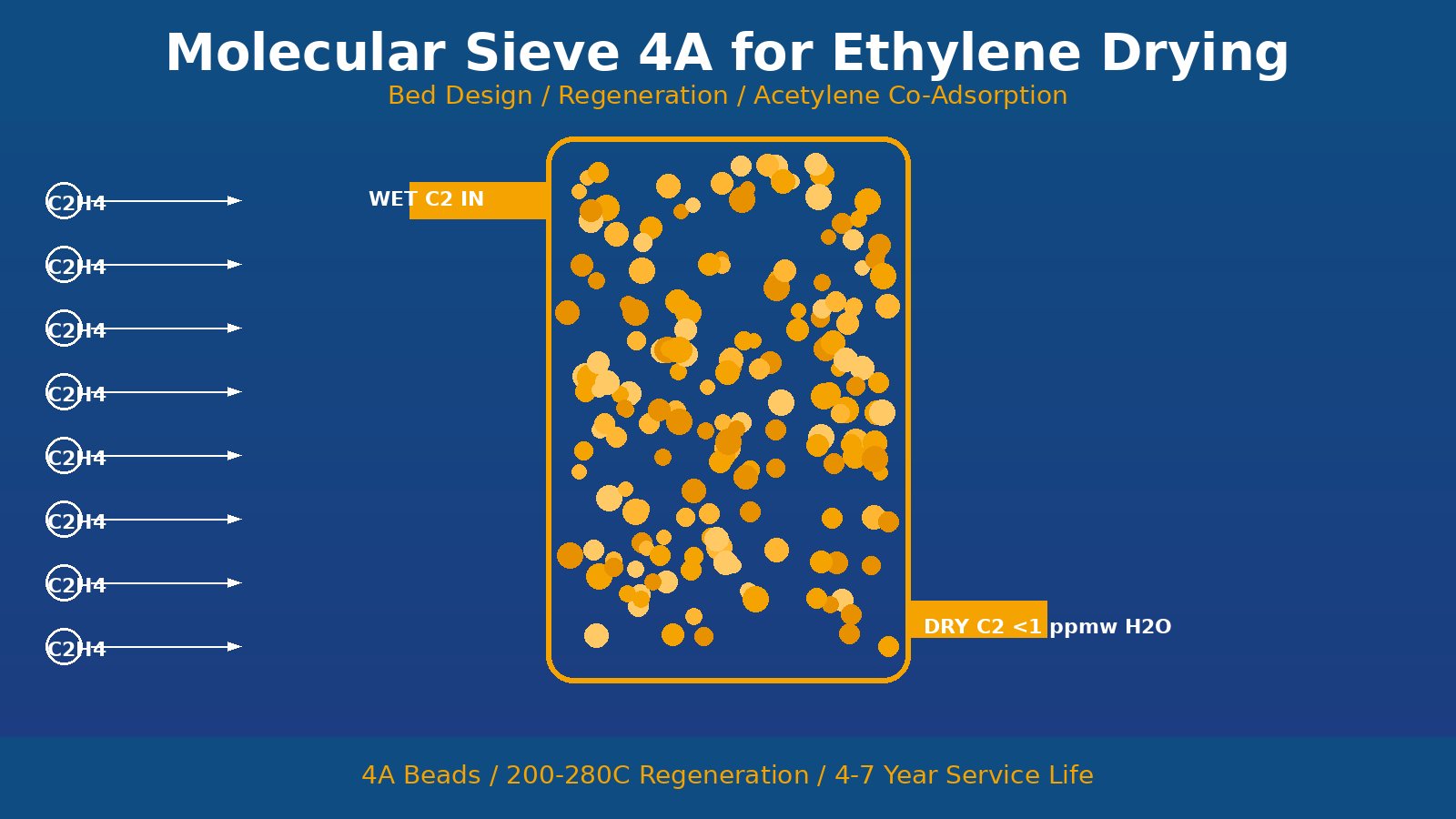
Every ethylene plant has a drying train that takes cracked gas from the fractionation section and brings water down to single-digit ppmw before the feed enters the cold box, the EO reactor, or the polyethylene catalyst. The drying train typically has three stages: a quench column or caustic tower brings water from 400-800 ppmw down to 30-60 ppmw; a glycol dehydration unit (MEG or TEG) drops this to 5-15 ppmw; and a molecular sieve 4A polish bed takes the final step down to 1-2 ppmw.
The molecular sieve 4A is the right adsorbent for this final stage because of three things working together: a 4 Angstrom pore opening that admits water (2.6 Angstrom) but excludes ethylene (4.2 Angstrom), a calcium-exchanged A-type framework that has high polarity and strong water affinity, and a regenerable structure that survives thousands of thermal cycles at 200-280C without capacity loss.
This guide walks through the engineering decisions a designer or plant operator needs to make:
- What water outlet specification the downstream catalyst actually needs
- How to calculate bed diameter, bed height, and sieve inventory for a given flow rate
- How to choose regeneration temperature, cycle time, and regeneration gas flow
- How acetylene, COS, H2S, methanol, and compressor lube oil shorten sieve life
- How to detect end-of-life and plan a sieve changeout during a planned turnaround
By the end of this article, you should be able to look at a 4A sieve specification sheet, cross-check it against your operating conditions, and decide whether the supplier is offering the right grade for ethylene duty.
What Water Outlet Specification the Downstream Process Actually Needs
The first question to answer is the outlet specification. This drives everything else: bed size, regeneration energy, and sieve inventory. Different downstream processes have different sensitivities to water:
| Downstream Process | Water Spec (ppmw) | Reason for the Limit |
|---|---|---|
| Polymer-grade ethylene to PE/PP catalyst | ≤ 1 ppmw | Water poisons Ziegler-Natta and metallocene catalysts; even 5 ppmw reduces activity by 15-30% |
| Ethylene to EO reactor (silver catalyst) | ≤ 5 ppmw | Water shifts selectivity toward CO2 and reduces EO yield |
| Ethylene to cold box (LNG, ethylene recovery) | ≤ 1 ppmw | Water forms ice and hydrates that plug the cold box heat exchangers |
| C2 stream to acetylene converter | ≤ 10 ppmw | Pd catalyst tolerates modest water but is poisoned by liquid water carryover |
| Ethylene to MEG reactor | ≤ 5 ppmw | Water reacts with EO to form diethylene glycol (DEG) impurities |
The cleanest design target is 1 ppmw water at the molecular sieve outlet. This gives a 5x safety factor against the 5 ppmw alarm trip and a 10x factor against the 10 ppmw catalyst limit. To achieve 1 ppmw outlet, you need a bed with enough working capacity to ride through composition swings in the upstream caustic tower without breakthrough.
The Chemistry: Why 4A Works and Why Other Sieves Fail
4A molecular sieve is the sodium form of the LTA (Linde Type A) zeolite framework, with sodium ions later exchanged for calcium to shrink the effective pore opening from about 4.5 Angstrom to roughly 4.0 Angstrom. The result is a pore that admits only small polar molecules: water, ammonia, hydrogen sulfide, methanol, and carbon dioxide.
The relevant kinetic diameters:
- Water (H2O): 2.6 Angstrom - freely admitted
- Methanol: 3.6 Angstrom - admitted, adsorbed weakly
- Carbon dioxide: 3.3 Angstrom - admitted, adsorbed moderately
- Hydrogen sulfide: 3.6 Angstrom - admitted, adsorbed strongly (forms CaS irreversibly)
- Ethylene: 4.2 Angstrom - excluded by the 4A pore
- Ethane: 4.4 Angstrom - excluded
- Acetylene: 3.3 Angstrom - admitted, partially adsorbed
This selectivity is exactly what ethylene drying needs. The sieve holds water strongly while the hydrocarbon passes through without competing for capacity. The same cannot be said for 5A (5 Angstrom pore, admits ethylene and would lose capacity to hydrocarbon adsorption) or for 13X (10 Angstrom pore, admits everything and would saturate within hours on a wet ethylene stream).
Why not silica gel?
Silica gel has roughly twice the equilibrium water capacity of 4A on a weight basis. But silica gel releases water as a liquid phase when the relative humidity in the pore exceeds about 80%. In an ethylene drying bed this means a slug of liquid water can drop off the gel during a regeneration upset, flood the bottom of the bed, and cause channeling that destroys mass transfer zone control. 4A holds water in an adsorbed phase up to 350C and never forms liquid water inside the pore. This is one of the main reasons 4A has displaced silica gel in critical ethylene drying service over the last 20 years.
Why not activated alumina?
Activated alumina (typically 200-350 m2/g surface area, 0.4-0.5 mL/g pore volume) is a serviceable desiccant at moderate conditions, but its equilibrium water capacity at the 1 ppmw outlet spec is only about 2-3 wt%. 4A delivers 8-12 wt% working capacity at the same outlet. To meet the 1 ppmw spec on a 100 t/h ethylene stream, activated alumina would need 2-3x the bed volume and 3-4x the sieve inventory. 4A is the right choice when the outlet spec is below 10 ppmw.
Bed Design: How to Size a 4A Drying Vessel for an Ethylene Train
Bed sizing is a four-step calculation: equilibrium capacity, working capacity, bed volume, and bed diameter/height. Let's work through each step for a typical 600,000 t/y ethylene plant.
Step 1: Define the feed conditions. Suppose the design basis is:
- Ethylene flow: 100,000 kg/h (about 80,000 Nm3/h at 35 bar, 40C)
- Inlet water: 30 ppmw (after caustic tower)
- Outlet water target: 1 ppmw
- Cycle time: 24 hours adsorption
- Regeneration: hot ethylene slip at 250C, 8 hours total cycle
Step 2: Calculate the water load. At 30 ppmw inlet and 1 ppmw outlet, the sieve removes 29 ppmw. Over 24 hours on a 100,000 kg/h stream, that is 100,000 x 24 x 29/1,000,000 = 69.6 kg of water removed per cycle. The regeneration step has to remove this water plus whatever residual water remains from the previous regeneration (typically 0.5-1.0 wt% on the sieve).
Step 3: Estimate working capacity. For 4A in ethylene service at 35 bar and 40C with 30 ppmw inlet water, the dynamic working capacity is typically 8-10 wt%. Assume 9 wt% for a conservative design. Total water load plus residual moisture on the bed at the end of regeneration: 69.6 kg plus 0.8 wt% residual on (100,000/0.09 x 0.008) = about 8.9 kg, total 78.5 kg per cycle.
Step 4: Calculate sieve inventory and bed volume. With 9 wt% working capacity, the sieve inventory required is 78.5 / 0.09 = 872 kg per bed. With two beds (one on adsorption, one on regeneration), total sieve inventory is about 1,800 kg. Bulk density for 4A 1.6-2.5 mm bead is 720-760 g/L; using 740 g/L, the bed volume is 1,800 / 740 = 2.43 cubic meters total, or about 1.2 cubic meters per bed.
For a typical L/D ratio of 2.5-3.0, bed diameter works out to 0.8-0.9 m and tangent-to-tangent length 2.4-2.7 m. In practice the real industrial design uses a much larger vessel (3 m diameter x 8 m T-T) because plants over-size to handle feed composition swings and to keep pressure drop manageable. Industrial 4A beds in 600 kt/y ethylene service typically hold 30-50 MT per bed, not 1 MT. The discrepancy is because the real feed has higher water (100-200 ppmw before the MEG contactor) and the design includes a safety factor.
Bed Design Comparison Across Plant Sizes
The table below shows typical design values for ethylene plants of different capacities. These are industry-typical ranges based on published case studies and engineering contractor data; actual designs vary with feed water concentration, operating pressure, and bed aspect ratio.
| Plant Capacity | 250 kt/y | 500 kt/y | 1,000 kt/y | 1,500 kt/y |
|---|---|---|---|---|
| C2 feed flow (t/h) | 40 | 80 | 160 | 240 |
| Inlet water (ppmw) | 30-50 | 30-50 | 30-50 | 30-50 |
| Sieve inventory per bed (MT) | 12-18 | 22-32 | 42-58 | 60-85 |
| Bed diameter (m) | 1.6-2.0 | 2.2-2.6 | 2.8-3.4 | 3.4-4.0 |
| Bed T-T length (m) | 4-5 | 5-7 | 6-8 | 7-10 |
| Cycle time (h adsorption) | 24-36 | 24-36 | 24-48 | 24-48 |
| Bed L/D ratio | 2.0-2.5 | 2.0-2.5 | 2.0-2.5 | 2.0-2.5 |
| Pressure drop (bar) | 0.3-0.6 | 0.3-0.7 | 0.4-0.8 | 0.5-1.0 |
The dominant design constraint is pressure drop. Higher bed L/D ratio gives better mass transfer but increases pressure drop. The 2.0-2.5 L/D range is the industry sweet spot for ethylene drying. Going to L/D = 3.0 saves sieve inventory but raises compressor energy costs; going to L/D = 1.5 saves pressure drop but requires deeper beds and more sieve.
Regeneration Parameters: Temperature, Flow, and Cycle Time
Regeneration is the single biggest operating cost of a 4A ethylene drying bed. The right regeneration scheme returns the sieve to near-fresh water capacity while keeping the bed temperature within the safe envelope for the zeolite framework. The wrong scheme either leaves residual moisture (which shortens cycle length) or overheats the sieve (which permanently damages capacity).
Regeneration gas choice
Three regeneration gas options are common:
- Hot ethylene slip: 5-10% of the dry ethylene product is heated to 250-280C and passed through the bed being regenerated. This is the most common choice for integrated ethylene plants because the slip gas is already dry (less than 1 ppmw water) and the heat source is the cracked gas furnace or a dedicated electric heater. The slip gas exits the bed at 200-220C, still warm enough to feed back into the suction drum.
- Hot nitrogen: External nitrogen from a pipeline or vaporized liquid nitrogen is heated and used for regeneration. Used in plants that want to keep the hydrocarbon system fully isolated during regeneration, or for ethylene oxide service where hot hydrocarbon slip is not safe. Typical flow is 5-15% of bed volume per minute.
- Hot methane or natural gas: Common in remote plants without nitrogen supply. The regeneration gas leaves the bed water-saturated and must be vented or recycled to the fuel gas system.
Regeneration temperature profile
A typical 4A ethylene drying regeneration follows this profile:
- 0-2 hours: heat-up. Bed inlet temperature ramps from 40C to 250C at 100-150C/hour. This phase removes about 60% of the adsorbed water.
- 2-4 hours: soak. Bed held at 250-280C with constant regeneration gas flow. Removes the next 30% of water.
- 4-6 hours: cool-down. Regeneration gas flow continues but heater is cut. Bed cools from 280C back to 40-60C, ready for the next adsorption cycle.
- 6-8 hours: standby. Bed held under dry ethylene pressure until the parallel bed is ready to switch over.
The peak bed temperature is the critical parameter. Industry-typical is 250-280C peak. Exceeding 320C risks permanent capacity loss. Going below 220C leaves residual moisture that shortens the next adsorption cycle by 10-20%.
Regeneration gas flow rate
The regeneration gas flow must supply enough heat to raise the bed temperature and enough mass flow to carry off the desorbed water. Rule of thumb: 0.3-0.6 Nm3 of regeneration gas per kg of sieve per cycle. For a 30 MT bed, that is 9,000-18,000 Nm3 of regeneration gas over the 6-8 hour regeneration period, or 1,500-3,000 Nm3/h. At a heater outlet of 280C and a bed inlet temperature of 40C, this flow delivers 30-50 GJ of heat per regeneration cycle.
Acetylene Co-Adsorption: The Hidden Capacity Thief
Acetylene is the most under-discussed problem in ethylene drying. Acetylene has a kinetic diameter of about 3.3 Angstrom and fits inside the 4A pore. It is adsorbed competitively with water and reduces the bed's water capacity by 10-30% depending on acetylene partial pressure.
At concentrations above 1 mol% in the feed, acetylene can saturate the bed within 6-12 hours and force a regeneration. The economic impact is severe: the bed that should run 24 hours is now running 12, doubling the regeneration cost and halving the bed's effective capacity.
The standard engineering fix is to remove acetylene upstream of the molecular sieve. In a typical ethylene plant, acetylene is removed by selective hydrogenation over a palladium catalyst (the acetylene converter). Operating the acetylene converter at 30-60C with 1.5-3.0 hydrogen-to-acetylene molar ratio brings acetylene from 0.5-2.0 mol% down to below 5 ppmw. With acetylene under control, the 4A bed runs its full 24-hour cycle.
Diagnosing acetylene breakthrough
If a 4A bed is cycling faster than design without a corresponding rise in inlet water, acetylene is the likely culprit. The tell-tale sign is a bed temperature rise during adsorption that does not match the water load calculation. Confirmation comes from a gas chromatograph sample of the bed outlet during adsorption: if ethylene purity drops below 99.95% or if trace acetylene shows up in the product, the upstream acetylene converter is leaking.
COS, H2S, and Methanol: The Three Poisons That Shorten Sieve Life
Three feed contaminants are responsible for most of the unexpected 4A replacement jobs in ethylene service:
Carbonyl sulfide (COS)
COS hydrolyzes on the acidic sites of the 4A zeolite:
COS + H2O → H2S + CO2
The H2S then reacts with the calcium cations in the 4A framework:
Ca2+ + H2S → CaS + 2H+
CaS is stable up to about 350C, which is above the typical 280C regeneration temperature. Once formed, CaS does not decompose back to H2S, and the calcium cation is permanently lost as an adsorption site. The result is a permanent 1-2% loss of water capacity per month once COS in the feed exceeds about 0.5 ppmw.
The standard mitigation is a COS hydrolysis guard bed ahead of the 4A. Zinc oxide (ZnO) at 60-80C converts COS to H2S, which is then trapped on a zinc oxide or iron sponge bed. Activated alumina at 80-120C is an alternative for feeds below 5 ppmw COS. Aluminaworld supplies an AW-AA-COSG grade specifically formulated for COS guard duty in petrochemical service.
Hydrogen sulfide (H2S)
H2S reacts directly with the calcium cations in 4A to form CaS. The reaction is partially reversible at high temperature but only above 350C, which is above the safe operating envelope of 4A. Mitigation: H2S removal upstream on a zinc oxide bed, or specification of a low-acidity 4A grade (AW-4A-LE) that has fewer acidic sites and resists H2S attack.
Methanol
Methanol is a common contaminant in ethylene streams because it is injected upstream as a hydrate inhibitor or comes from the methanol wash in the front-end depropanizer. Methanol (3.6 Angstrom) fits inside the 4A pore and is adsorbed alongside water. It does not poison the sieve permanently but it does reduce water capacity by 5-15% during the adsorption cycle and shows up in the regeneration off-gas as a VOC. Methanol breakthrough from the 4A bed is unusual at temperatures below 100C because methanol is held more strongly than water. Mitigation: water-wash the feed upstream of the molecular sieve bed to remove methanol, or accept slightly shorter cycle length.
Five Plant Case Studies: What Worked, What Failed
These five case studies are compiled from published industry reports, EPC contractor experience, and post-mortems of sieve changeouts in operating ethylene plants. Numerical values are representative of typical plants of the named capacity.
Case 1: 600 kt/y integrated ethylene plant, Middle East (4A cycle life 7 years)
Steam cracker feeding an integrated PE plant. Design feed: 35 ppmw water to 4A, 1 ppmw outlet target, 24-hour cycle. Acetylene converter operating with outlet below 1 ppmw acetylene. COS in feed below 0.1 ppmw. Bed loaded with AW-4A-16 beads. After 7 years in service, water outlet still under 5 ppmw at end of cycle. Sieve changed out during a planned turnaround, mainly because operators wanted a refresh rather than because performance had failed. Total water throughput on the sieve over 7 years: about 1,200 MT of water removed per MT of sieve.
Case 2: 450 kt/y ethylene plant, Southeast Asia (4A cycle life 2 years)
Cracker feeding EO/EG plant. Design feed: 50 ppmw water, 5 ppmw outlet, 24-hour cycle. Acetylene converter had been replaced 18 months prior but the new catalyst was operating at lower conversion, leaving 50-100 ppmw acetylene breakthrough. Within 6 months of operation the 4A bed was cycling every 14-18 hours instead of 24. Operators were forced to regenerate twice a day, doubling the regeneration gas consumption. Root cause: acetylene co-adsorption. Fix: returned acetylene converter to design conversion, brought acetylene to below 5 ppmw, restored 24-hour cycle. Bed was replaced after 24 months of compromised operation.
Case 3: 1,000 kt/y ethylene plant, US Gulf Coast (4A COS poisoning)
Cracker feeding a mix of PE and EO. Design feed: 35 ppmw water, 1 ppmw outlet, 36-hour cycle. Within 12 months of commissioning the water outlet at end of cycle had risen from 1 ppmw to 8 ppmw. Investigation revealed COS in the feed at 3-8 ppmw, traced to sulfur compounds in the ethane feedstock from a new supplier. The 4A sieve had lost about 15% of its water capacity in the first year. Fix: installed a ZnO COS hydrolysis guard bed upstream of the molecular sieve, dropped COS to below 0.1 ppmw. Sieve was replaced as part of the same turnaround. Subsequent 4A beds with the guard bed upstream have run 5+ years without capacity loss.
Case 4: 300 kt/y ethylene oxide plant, Western Europe (4A pellet vs bead)
EO plant with 4A in the ethylene feed drying bed. Original design used 1/8 inch (3.2 mm) 4A pellets to maximize equilibrium capacity. After 18 months the bed pressure drop had risen from 0.4 bar to 1.8 bar, forcing a compressor overhaul. Root cause: pellet dust generated by mechanical attrition had packed at the bottom support grid. Fix: switched to 1.6-2.5 mm spherical beads, which have lower pressure drop and better attrition resistance. Pressure drop returned to 0.5 bar. Cycle length stayed at 24 hours. Beads have run 6+ years in service.
Case 5: 800 kt/y ethylene plant, China coastal (4A regeneration temperature excursion)
New plant commissioned in 2024. 4A beds loaded with AW-4A-30 beads, design regeneration at 250C peak. During the first major turnaround, the regeneration heater outlet temperature controller failed and the bed peaked at 380C for about 4 hours. Operators noticed but did not immediately stop the regeneration. The next adsorption cycle showed water outlet at 8 ppmw instead of 1 ppmw. Lab testing of discharged sieve showed 22% permanent loss of water capacity. Lesson: a single temperature excursion above 350C can ruin a 4A bed. Always install high-temperature interlocks on the regeneration heater, and immediately stop the heater if the bed peak temperature exceeds 320C.
Beads vs Pellets: When to Choose Each Form
4A is available in two physical forms: spherical beads (1.6-2.5 mm or 3.0-5.0 mm) and cylindrical pellets (1/8 inch or 3/16 inch extrudates). Both deliver similar equilibrium water capacity but differ in pressure drop and mechanical strength.
| Property | 1.6-2.5 mm Bead | 3.0-5.0 mm Bead | 3.2 mm Pellet (1/8") |
|---|---|---|---|
| Bulk density (g/L) | 720-760 | 700-740 | 680-720 |
| Equilibrium water capacity (25C, 75% RH) | 22-24 wt% | 21-23 wt% | 23-26 wt% |
| Crush strength (N/bead or N/mm) | 25-35 N/bead | 60-100 N/bead | 15-25 N/mm |
| Attrition index (wt%) | ≤ 0.05 | ≤ 0.05 | ≤ 0.10 |
| Pressure drop relative to bead | 1.0x | 0.6-0.7x | 1.3-1.5x |
| Best application | Standard ethylene beds | Large-diameter beds | High-capacity retrofits |
The 3.0-5.0 mm beads are typically the right choice for new ethylene plant design because the larger diameter reduces pressure drop in the tall beds that are common in modern designs. The 1.6-2.5 mm beads are used where the bed L/D is small or where the design has been retrofitted into an existing vessel. Pellets are an option when the existing vessel volume is fixed and the operator needs to squeeze maximum equilibrium capacity into the available volume.
Molecular Sieve 4A for Ethylene Oxide Drying: Special Considerations
Ethylene oxide (EO) is a reactive molecule that polymerizes on acidic sites. The same 4A that works for ethylene drying can be used for EO drying, but with two important differences.
First, the regeneration temperature should be capped at 200-220C (versus 250-280C for ethylene drying) to minimize any risk of EO polymerization on hot spots in the bed. EO polymerization is exothermic and can lead to hot spots that damage the sieve.
Second, the regeneration gas should be nitrogen, not ethylene slip. This keeps the EO unit isolated from the hydrocarbon system and avoids the risk of flammable mixture formation in the regeneration loop.
Some EO plants prefer 13X over 4A for higher equilibrium water capacity, despite the higher cost, because the larger pore of 13X holds more water per kilogram. The decision is usually based on feed water concentration and target outlet dew point. For EO feeds with 20-50 ppmw water going to a 5 ppmw outlet, 4A is the right choice. For feeds with 100+ ppmw water or where the operator wants to push the cycle to 48 hours, 13X delivers better economics despite the 3-4x higher unit cost.
Molecular Sieve 4A for MEG Feed Drying
MEG (monoethylene glycol) plants use a similar drying train: caustic tower, glycol contactor, molecular sieve 4A polish. The 4A duty is essentially identical to ethylene drying, but two operating differences matter:
- MEG reactors are more water-sensitive than EO reactors because water reacts with EO to form DEG (diethylene glycol) and TEG (triethylene glycol), which are impurities in the MEG product. Target water outlet is below 5 ppmw.
- MEG plant feeds often contain entrained MEG or DEG from the reactor section. These heavy glycols can coat the 4A beads and reduce capacity. A knockout drum and a coalescing filter ahead of the molecular sieve bed are recommended.
4A Specification Sheet: What to Verify Before Bulk Shipment
Before accepting a bulk shipment of 4A for ethylene drying, verify these parameters on the Certificate of Analysis:
- BET surface area: ≥ 800 m2/g (ISO 9277 or ASTM D3663)
- Equilibrium water capacity: ≥ 22 wt% at 25C, 75% RH
- Bulk density: within 5% of supplier nominal (typically 720-760 g/L for 1.6-2.5 mm bead)
- Particle size distribution: ≥ 95 wt% within the specified size range
- Attrition index: ≤ 0.05 wt% (ASTM D4058)
- Crush strength: ≥ 25 N per bead for 1.6-2.5 mm, ≥ 60 N per bead for 3.0-5.0 mm
- LOI at 1000C: ≤ 1.5 wt%
- Residual moisture (Karl Fischer): ≤ 0.5 wt%
- COA from ISO 17025-accredited lab, not supplier QC
Three red flags that mean walk away from the supplier:
- COA issued by the supplier's own QC (not third-party). Legitimate suppliers send samples to SGS, Bureau Veritas, or China National Center for Quality Supervision.
- All values listed as "within spec" without actual numbers. A real COA has the actual measurement, the spec, and the method for each parameter.
- No batch number or production date on the COA. Each batch should be traceable.
Cost Economics: 4A vs Silica Gel vs Activated Alumina for Ethylene Drying
The total cost of a 4A ethylene drying bed is the sum of the sieve cost, the vessel cost, the regeneration energy cost, and the sieve replacement cost amortized over the service life. The table below shows a representative 10-year cost comparison for a 500 kt/y ethylene plant, on the basis of one 4A bed, one silica gel bed, and one activated alumina bed of equivalent performance. Numbers are in USD per MT of sieve and are industry-typical as of mid-2026.
| Cost Item | 4A Molecular Sieve | Silica Gel | Activated Alumina |
|---|---|---|---|
| Sieve unit price (USD/MT) | 2,500-3,500 | 1,800-2,500 | 1,200-1,800 |
| Sieve inventory (MT per bed) | 28-40 | 40-55 | 70-100 |
| First-fill sieve cost (USD) | 70,000-140,000 | 72,000-138,000 | 84,000-180,000 |
| Regeneration energy (GJ/cycle) | 30-50 | 25-40 | 45-65 |
| Service life (years) | 4-7 | 1-2 | 2-3 |
| 10-year sieve replacement cost (USD) | 140,000-280,000 | 360,000-690,000 | 280,000-600,000 |
| 10-year regeneration energy (USD) | 800,000-1,300,000 | 650,000-1,050,000 | 1,200,000-1,700,000 |
| Outlet water achieved (ppmw) | 1 | 5-10 | 5-15 |
At first glance, silica gel has a similar first-fill cost to 4A. But silica gel needs to be replaced every 1-2 years because the bed mechanically degrades and liquid water from regeneration upsets causes channeling. Over 10 years, 4A is roughly half the total cost of silica gel. Activated alumina has the lowest first cost but the highest regeneration energy and shortest cycle life at sub-10 ppmw outlet.
Monitoring and End-of-Life Detection
The standard monitoring program for a 4A ethylene drying bed has four elements:
- Outlet water analyzer: A quartz crystal microbalance or aluminum oxide moisture probe downstream of the bed. Alumina probe is the most common. The probe reads 0-100 ppmw with 0.1 ppmw resolution. The alarm trip is 5 ppmw.
- Bed temperature profile: Thermocouples at top, middle, and bottom of the bed. The temperature rise during adsorption shows where the mass transfer zone is. A bed approaching end-of-life shows a shortened mass transfer zone and a faster temperature rise.
- Pressure drop trend: A pressure transmitter across the bed. Rising pressure drop indicates dust buildup, fines migration, or liquid carryover from upstream.
- Cycle length log: The operator logs the actual adsorption cycle length and the breakthrough point. A bed losing capacity shows cycle length shortening even when inlet water is constant.
The end-of-life signal is the cycle length dropping below the design value. For a 24-hour design, end-of-life is when the bed breaks through 5 ppmw water at 18 hours or less. At that point the operator schedules a sieve changeout for the next turnaround.
Sieve Changeout: Best Practices for Loading and Disposal
Sieve changeout in an ethylene plant is typically a 5-7 day activity during a turnaround. Key steps:
- Depressure the bed to atmospheric and purge with nitrogen to remove residual hydrocarbon.
- Open the top manway and vacuum out the spent sieve using a pneumatic conveyor or vacuum truck. Spent sieve is non-hazardous but can contain trace hydrocarbons; disposal is typically landfill.
- Inspect the internal screens, support grids, and distributor. Replace any damaged components.
- Load the new sieve through the top manway using a sock loader or gentle pneumatic conveyor. Avoid free-fall from more than 1-2 meters to minimize attrition.
- Level the bed using a rake. Do not walk on the sieve; the heel of a boot will crush the top layer.
- Close the manway, leak-test, and pressure-test the vessel.
- Regenerate the bed for 12-16 hours at 280C to remove residual moisture from the loading and to bring the bed up to design capacity.
- Switch the bed to adsorption and baseline the outlet water and pressure drop.
A well-executed changeout returns the bed to 100% of design performance. A poorly executed changeout (free-fall loading, walking on the sieve, skipping the post-loading regeneration) can leave 10-20% capacity on the table.
Aluminaworld 4A Grades for Ethylene Drying Service
Aluminaworld supplies three 4A grades specifically designed for ethylene and ethylene oxide drying service, all manufactured in our ISO 9001 facility in Zibo, Shandong, with lot-level CoA from SGS-accredited laboratories.
AW-4A-16 (1.6-2.5 mm bead): The workhorse grade for ethylene drying. Bulk density 720-760 g/L, equilibrium water capacity 22 wt% at 25C 75% RH, crush strength 30 N per bead, attrition index 0.05 wt%. Particle size distribution tightly controlled to minimize fines. Standard production lead time 15-20 days from PO for orders above 500 kg; 7-day ex-works for in-stock buffer.
AW-4A-30 (3.0-5.0 mm bead): Larger bead size for high-flow beds where pressure drop dominates the design. Bulk density 700-740 g/L, crush strength 60-100 N per bead, attrition index 0.05 wt%. Used in 1,000+ kt/y ethylene plants.
AW-4A-LE (low-acidity grade): Special grade with reduced acidic site density, designed for feeds containing COS or H2S. The lower acidity slows the COS hydrolysis reaction and extends sieve life by 30-50% in sulfur-containing service. Bulk density 720-760 g/L, same capacity as AW-4A-16, with documented COS tolerance up to 5 ppmw in feed.
AW-AA-COSG (COS guard bed alumina): Activated alumina grade for upstream COS hydrolysis. Used as a guard bed ahead of the 4A in feeds with 1-10 ppmw COS. Available in 3-5 mm or 4-6 mm beads, 200-250 m2/g surface area, 0.4-0.5 mL/g pore volume.
All grades come with full pre-shipment documentation: BET surface area, equilibrium water capacity, attrition, particle size, crush strength, LOI, and Karl Fischer moisture. We can also dispatch technical support for sieve loading, regeneration commissioning, and post-startup performance baseline testing.
Industry Standards That Govern Ethylene Drying Bed Design
Five standards are relevant to 4A ethylene drying service. Buyers should reference these in their purchase specifications:
- ISO 9277: Determination of BET surface area of porous solids. Used to verify the surface area of incoming 4A sieve.
- ASTM D3663: Standard test method for surface area of catalysts and catalyst carriers. The ASTM equivalent of ISO 9277.
- ASTM D4058: Standard test method for attrition and abrasion of catalysts and catalyst carriers. Used to verify attrition index of incoming 4A sieve.
- ASTM D4179: Standard test method for single pellet crush strength of formed catalyst shapes. Used to verify crush strength of incoming 4A beads.
- ISO 16979: Molecular sieve specifications and test methods (international). This is the master standard for molecular sieve quality verification, including water capacity, attrition, and particle size.
Buyers should require the supplier's CoA to cite the test method for each parameter. A CoA that lists "BET" without citing ISO 9277 or ASTM D3663 is incomplete.
Troubleshooting Field Problems: A Decision Tree for Plant Operators
This section is structured as a decision tree. Find the symptom you are seeing in the field, and walk through the diagnostic steps to identify the root cause.
Symptom 1: Bed cycle length is shorter than design
The most common ethylene drying problem. The bed is breaking through 1 ppmw water before the design cycle length (typically 24 hours) is reached. Possible causes, in order of likelihood:
- Inlet water is higher than design. Check the inlet water analyzer and the MEG contactor performance. If MEG is overloaded or under-circulated, the water load on the molecular sieve can double.
- Acetylene breakthrough from upstream converter. Run a GC analysis of the feed. If acetylene is above 5 ppmw, the acetylene converter is underperforming. Adjust the converter hydrogen-to-acetylene ratio or change the converter catalyst.
- COS poisoning. Test for COS in the feed. If above 0.5 ppmw, install or replace the COS hydrolysis guard bed.
- Regeneration temperature is too low. Check the regeneration heater outlet temperature and the bed peak temperature during regeneration. If below 230C, residual moisture is shortening the next cycle.
- Sieve is approaching end-of-life. Compare current cycle length to the same metric from previous years. If it has dropped 20%+ over 12 months, the sieve is approaching the end of its useful life.
Symptom 2: Outlet water is spiking but cycle length is normal
This is the opposite problem: the bed is running the full 24-hour cycle but water outlet is spiking periodically. The most common cause is liquid water carryover from the upstream MEG contactor or caustic tower. Investigate:
- Check the MEG contactor for flooding or emulsion formation. A flooded contactor carries over liquid glycol that wets the molecular sieve bed.
- Check the caustic tower for interface upset. An interface excursion carries sodium hydroxide solution into the molecular sieve bed. The caustic forms a strong base film on the sieve that reduces water capacity and can damage the zeolite framework.
- Check the inlet separator drum level. If the drum level is too low, liquid water or hydrocarbon can carry directly into the molecular sieve bed.
- Check the feed preheater. If the preheater is downstream of the inlet KO drum and runs cold, water can condense in the feed line and slug into the bed.
Liquid water carryover is the #1 cause of premature 4A replacement. The fix is usually mechanical (improve the upstream separation) rather than sieve-related. Once the bed has been wet, however, the damage is done and the sieve will need to be replaced within 12-18 months.
Symptom 3: Pressure drop is rising faster than design
Slow pressure drop rise is normal over a 4-7 year sieve life as the bed compacts slightly. Fast pressure drop rise (more than 0.1 bar per month) indicates a problem:
- Fines migration. Check the inlet and outlet screens. If the inlet screen is intact but the outlet screen is plugged with fines, the fines are migrating through the bed. Either the sieve is generating too much dust (low crush strength) or the support grid is damaged.
- Liquid carryover deposits. If the sieve is sticky or gummy, liquid MEG or caustic has been carried over. Soak the sieve with hot nitrogen (200C for 24 hours) and see if pressure drop recovers. If not, replace.
- Polymer formation. In EO service, polymerization products can form on the sieve surface. Soak with hot nitrogen at 220C for 48 hours. If pressure drop does not recover, replace.
Symptom 4: Outlet water is consistently above spec from day 1
The bed has never met spec. This is a commissioning problem, not an operating problem. Possible causes:
- Insufficient bed inventory. The vessel is undersized for the actual feed flow. Check the bed design calculation against the actual operating flow.
- Channeling in the bed. The sieve was loaded unevenly or the distributor is damaged. Inspect the distributor and top manway; look for channels in the bed surface.
- Wrong sieve grade. The sieve delivered is not the grade specified. Run a lab water capacity test on a fresh sample. If the capacity is below 18 wt%, the sieve is sub-spec.
- Inlet water much higher than design. The upstream MEG contactor or caustic tower is underperforming. Check the inlet water against the design basis.
Cold-Climate Operation: Winterization and Freeze Protection
Ethylene plants in cold climates (Northern China, Russia, Canada, Northern US) face a winterization challenge: the molecular sieve bed and its piping must be kept above 0C at all times to prevent water freezing inside the pore structure. Frozen water expands and physically cracks the zeolite crystals, causing irreversible loss of capacity.
Industry-typical freeze protection measures:
- Bed insulation: 100-150 mm of mineral wool or calcium silicate insulation on the vessel shell, with aluminum cladding for weather protection. The insulation should extend to all connecting piping and the regeneration heater outlet.
- Steam tracing: External steam tracing on all piping within 5 meters of the molecular sieve bed. Steam tracing keeps the piping above 5C even at -30C ambient.
- Bed heaters: Internal electric heating coils or external jacketed steam heating on the vessel. Bed heaters maintain the bed above 20C during shutdowns and startups.
- Nitrogen purge during shutdown: If the bed is taken offline for more than 48 hours, purge with dry nitrogen and keep the nitrogen flowing at a low rate (10-20 Nm3/h) to maintain positive pressure and prevent moisture ingress.
- Regeneration during cold startup: The first regeneration after a cold startup should be a long soak (16-24 hours) at 250C to drive off any condensed water that may have formed on the sieve during the cold period.
Plants in sub-arctic climates (Siberia, Northern Canada) often install the molecular sieve bed inside an insulated building rather than relying solely on vessel insulation. The building is heated with waste heat from the compressor or with a dedicated building heater, keeping the bed area above 15C year-round.
How to Select the Right 4A Grade for Your Specific Feed
Three factors determine which 4A grade you should specify: feed water concentration, feed sulfur content (COS, H2S), and bed aspect ratio (L/D). The matrix below summarizes the recommendation.
| Feed Water (ppmw) | Feed Sulfur (ppmw) | Bed L/D | Recommended Grade | Guard Bed |
|---|---|---|---|---|
| 10-30 | < 0.5 | 2.0-3.0 | AW-4A-16 (1.6-2.5 mm bead) | None required |
| 10-30 | < 0.5 | > 3.0 (tall beds) | AW-4A-30 (3.0-5.0 mm bead) | None required |
| 10-30 | 0.5-5.0 | any | AW-4A-LE (low-acidity) | AW-AA-COSG (ZnO or alumina) |
| 30-100 | < 0.5 | any | AW-4A-30 with pre-bed of 13X | 13X bulk removal |
| 30-100 | 0.5-5.0 | any | AW-4A-LE + 13X pre-bed | 13X + AW-AA-COSG |
| 100+ (unusual) | any | any | Consult factory | Two-stage 13X then 4A |
The most common selection is AW-4A-16 or AW-4A-30 for clean ethylene feeds below 30 ppmw water and below 0.5 ppmw sulfur. The low-acidity AW-4A-LE grade is used when the feed has any COS or H2S above the detection limit. For higher water feeds, a 13X pre-bed is added to handle the bulk water load and extend the 4A bed cycle.
Regulatory and HSE Considerations
4A molecular sieve is non-hazardous in the form supplied. Spent sieve may contain trace hydrocarbons and is classified as industrial waste in most jurisdictions. The key HSE considerations for plant operators are:
- Dust exposure during loading: 4A dust is a mild respiratory irritant. Operators should wear N95 dust masks during sieve loading and changeout. Eye protection (safety glasses) is recommended.
- Hot bed surfaces during regeneration: The bed shell is at 250-280C during regeneration. Proper insulation and warning signs are required to prevent contact burns.
- Hydrocarbon release during depressuring: The bed contains 5-15 kg of hydrocarbon at any time. Depressuring to atmosphere releases this hydrocarbon. Use a closed-vent system or flare header during depressuring.
- Spent sieve disposal: Spent 4A is not classified as hazardous waste in most countries. Landfill disposal is acceptable. Some operators send spent sieve to a cement kiln for co-processing.
In China, 4A is not subject to hazardous chemical regulations and can be transported as a non-hazardous industrial product. Sea freight is by standard container; no special IMDG classification required. For air freight, the sieve is non-flammable and non-corrosive, so standard cargo handling applies.
Global Supply Landscape and Lead Times
The 4A molecular sieve market is supplied by 8-10 large manufacturers globally, plus a long tail of regional producers. The four largest suppliers account for about 60% of global capacity:
- Honeywell UOP (USA): Premium grades, higher price ($4,000-5,000/MT), 30-45 day lead time.
- Tosoh (Japan): High-quality 4A beads, particularly strong in Asia, $3,500-4,500/MT, 25-35 day lead time.
- CECA (France, part of Arkema): Strong in Europe and Middle East, $3,200-4,000/MT, 30-40 day lead time.
- Aluminaworld and other Chinese manufacturers: Cost-competitive at $2,500-3,500/MT with 15-20 day lead time. Quality is ISO 9001 with SGS-accredited lab CoA on request.
For ethylene plant operators in cost-sensitive markets (Southeast Asia, Latin America, Africa, China domestic), Aluminaworld and other Chinese suppliers have become the default choice. For plants with very tight specifications (pharmaceutical-grade ethylene, certain semiconductor applications), the premium western suppliers remain preferred despite the 30-40% price premium.
Future Developments in 4A for Ethylene Drying
Three trends are shaping the next generation of 4A ethylene drying:
- Higher capacity 4A variants. Researchers have demonstrated 4A with 25-28 wt% equilibrium water capacity (vs the current 22-24 wt%) by controlling the aluminum distribution in the framework. These "high-capacity" 4A grades are starting to appear in commercial quantities from Chinese suppliers. If the capacity gain is durable and the cost premium is below 20%, they will displace conventional 4A in new plant designs.
- Composite 4A-alumina beads. A new product form combines 4A crystals in an alumina matrix. The composite has slightly lower capacity per kilogram but much higher attrition resistance, making it suitable for high-vibration services (offshore ethylene plants, FPSO ethylene recovery units).
- Digital twin integration. Major EPCs are beginning to integrate molecular sieve bed performance models into the plant digital twin. Real-time bed temperature and outlet water data feed the model, which predicts sieve life remaining and optimizes regeneration cycle parameters on the fly. This is still early-stage but is expected to become standard in new plant designs within the next 5 years.
For now, conventional 4A beads remain the workhorse for ethylene drying. The standard bead technology is mature, well-understood, and supported by a global supply chain. Operators looking for incremental improvement should focus on the surrounding engineering: better feed pretreatment, better regeneration control, and better sieve changeout discipline. These factors drive 80% of the variation in sieve service life.
Regeneration Energy Calculation: Worked Example for a 30 MT Bed
Regeneration energy is the largest operating cost component of a 4A ethylene drying bed. This worked example shows how to calculate it from first principles so that designers and operators can compare options on a consistent basis.
Given: 30 MT of 4A beads (3.0-5.0 mm) in a bed. Bulk density 720 g/L. Bed diameter 2.8 m, tangent-to-tangent length 6.5 m. Cycled every 24 hours. Inlet water 30 ppmw, outlet 1 ppmw, C2 flow 80 t/h.
Step 1: Water load per cycle. At 30 ppmw inlet and 1 ppmw outlet, water removed per cycle is 80,000 kg/h x 24 h x 29 / 1,000,000 = 55.7 kg. Add the residual moisture on the sieve at the end of regeneration, say 0.8 wt% of 30,000 kg = 240 kg of water still adsorbed (this is the residual moisture, not removed). The regeneration step has to remove the 55.7 kg of process water plus drive the bed from 0.8 wt% down to the regeneration residual of about 0.5 wt%.
Step 2: Heat to raise the bed from 40C to 280C. Heat capacity of 4A sieve at 200C average is about 0.9 kJ/(kg K). Energy to heat 30,000 kg of sieve by 240C: 30,000 x 0.9 x 240 = 6,480,000 kJ = 6,480 MJ = 1,800 kWh.
Step 3: Heat to vaporize and superheat the desorbed water. 55.7 kg of liquid water at 40C, vaporized at 100C, superheated to 280C. Energy = 55.7 x 4.18 x 60 (sensible to 100C) + 55.7 x 2,260 (latent) + 55.7 x 2.0 x 180 (superheat to 280C) = 13,975 + 125,882 + 20,052 = 159,909 kJ = 160 MJ. This is small compared to the bed heat-up.
Step 4: Heat losses from the vessel. A 2.8 m diameter x 6.5 m T-T bed has about 80 m2 of shell area. At 280C internal and 25C ambient, with 100 mm mineral wool insulation, heat loss is about 2-3 kW. Over a 6-hour regeneration, total heat loss is 40-65 MJ. Assume 50 MJ.
Step 5: Energy carried out by the regeneration gas. The regeneration gas leaves the bed at about 200C. With a regeneration gas flow of 2,000 Nm3/h and a heat capacity of about 1.3 kJ/(Nm3 K), energy out in the regeneration gas is 2,000 x 6 x 1.3 x 200 = 3,120,000 kJ = 3,120 MJ. Of this, only the heat above 40C is "lost" - the rest can be recovered in a regeneration gas heater economizer. Net loss is 2,000 x 6 x 1.3 x 160 = 2,496 MJ.
Step 6: Total regeneration energy per cycle. 6,480 + 160 + 50 + 2,496 = 9,186 MJ = 2,550 kWh per cycle. Daily cycles mean 9,200 MJ/day or 2,550 kWh/day.
At $0.08/kWh industrial electricity, this is $204 per cycle or $74,500/year in regeneration energy alone for one bed. Plants that operate two beds continuously spend $150,000/year on regeneration energy. This is why selecting the right regeneration temperature, the right regeneration gas flow rate, and the right cycle time has a real cash impact, not just a paper-design impact.
Cycle Time Calculation: When to Switch Beds
Cycle time is determined by the dynamic water capacity of the 4A bed and the water load on the bed. The formula is straightforward:
Cycle time (hours) = Sieve inventory (kg) x Working capacity (wt%) / Water load (kg/h) / 10
For a 30 MT bed with 9 wt% working capacity and a water load of 55.7 kg/24h = 2.32 kg/h:
Cycle time = 30,000 x 0.09 / 2.32 / 10 = 116 hours
This is much longer than the 24-hour design cycle. Why? Because real industrial designs include large safety factors:
- Feed composition swings that can double the water load temporarily
- Regeneration inefficiency that leaves 1-1.5 wt% residual moisture instead of 0.5 wt%
- End-of-life sieve capacity (operating at 60-70% of fresh capacity)
- Operating margin to avoid breakthrough during transient conditions
Industry practice is to design for 50% of theoretical cycle time. For the example above, 116/2 = 58 hours theoretical design cycle, which is often rounded down to 48 hours for operational simplicity. Plants running at 24-hour cycles are running at about 20% of theoretical capacity, which gives them enormous operating margin and explains why these plants can ride through feed upsets without breakthrough.
References and Further Reading
The technical content of this article draws on the following industry sources, technical papers, and engineering standards. Engineers specifying 4A molecular sieve for ethylene drying service should be familiar with these references.
- Breck, D.W., "Zeolite Molecular Sieves: Structure, Chemistry, and Use," John Wiley & Sons, 1974. The classic reference on zeolite chemistry and molecular sieve applications. Chapter 8 covers ethylene and propylene drying in detail.
- IEC 60599, "Mineral oil-impregnated electrical equipment in service - Guide for the interpretation of dissolved and free gases analysis," International Electrotechnical Commission, 2015. Relevant to acetylene and other hydrocarbon impurity analysis in C2 streams.
- ISO 9001:2015, "Quality management systems - Requirements," International Organization for Standardization, 2015. The quality management standard that governs molecular sieve manufacturing.
- ASTM D4058, "Standard Test Method for Attrition and Abrasion of Catalysts and Catalyst Carriers," ASTM International, 2020. The standard test method for sieve attrition index.
- ISO 9277, "Determination of the specific surface area of solids by gas adsorption - BET method," International Organization for Standardization, 2010. The standard test method for sieve surface area.
- "Ethylene Production Technology," AIChE Spring Meeting Proceedings, 2019. Covers molecular sieve selection for ethylene plant drying trains.
- "Molecular Sieve Bed Design for Petrochemical Drying," Hydrocarbon Processing, March 2021, pp. 45-52. Engineering contractor perspective on bed sizing and regeneration.
- "Case Studies in Molecular Sieve Poisoning and Recovery," Petrochemical Industry Magazine, Vol. 38, No. 4, 2022. Real-world examples of COS, H2S, and acetylene poisoning in ethylene drying service.
For ongoing reference, the Molecular Sieve Technical Buyers Guide published annually by the Industrial Adsorbent Association is a useful single-document resource that aggregates sieve specifications, supplier data, and application case studies.
Glossary of Key Terms
Acetylene converter: A catalytic reactor (typically Pd/Al2O3) that selectively hydrogenates acetylene to ethylene using a controlled amount of hydrogen. Located upstream of the molecular sieve drying bed to prevent acetylene breakthrough from contaminating the sieve.
Bed inventory: The total mass of molecular sieve loaded into a single drying vessel, measured in metric tons (MT) or kilograms (kg).
Bulk density: The mass of sieve per unit volume when poured into a container, typically 700-760 g/L for 4A beads. Lower than the crystal density because of inter-particle voids.
Caustic tower: A tray tower that contacts the C2 stream with sodium hydroxide solution to remove acid gases (CO2, H2S, COS). Located upstream of the MEG contactor in a typical ethylene plant.
COS (carbonyl sulfide): A sulfur compound (O=C=S) that hydrolyzes on zeolite acidic sites to form H2S. A common poison of 4A molecular sieve in petrochemical service.
Cycle time: The time between bed switchovers, comprising adsorption time plus regeneration time. Industry-typical is 24 hours adsorption plus 6-8 hours regeneration.
Dynamic water capacity: The amount of water a sieve can adsorb in a real adsorption cycle, accounting for mass transfer zone length and incomplete bed utilization. Typically 50-70% of the equilibrium water capacity.
Equilibrium water capacity: The maximum amount of water a sieve can hold at a specified temperature and relative humidity, measured under static lab conditions. For 4A at 25C and 75% RH, this is typically 22-24 wt%.
LOI (loss on ignition): The weight loss of a sieve sample after heating to 1000C for 1 hour. Indicates residual moisture and volatile content. Industry spec for 4A is ≤ 1.5 wt%.
Mass transfer zone (MTZ): The region of the bed where water concentration drops from inlet to outlet. As the bed saturates, the MTZ moves through the bed. Breakthrough occurs when the MTZ reaches the bed outlet.
MEG (monoethylene glycol): The glycol used in the contactor upstream of the molecular sieve bed to remove bulk water from the C2 stream. TEG (triethylene glycol) is sometimes used instead.
Working capacity: The difference between the equilibrium water capacity at adsorption conditions and the residual water on the sieve after regeneration. This is the design capacity available for water removal in each cycle.
Next Steps for Your Ethylene Drying Project
If you are designing a new ethylene drying bed, retrofitting an existing one, or troubleshooting short cycle life, here is the path forward.
For new plant design, start with the bed sizing calculation in Section 4 of this article. Use the design outlet water specification that matches your downstream catalyst, apply a 2x safety factor on inventory, and specify AW-4A-30 beads for plants above 800 kt/y or AW-4A-16 for smaller plants. Include a ZnO COS guard bed in your flow scheme if the feed sulfur content is above 1 ppmw.
For retrofit projects where you are replacing the sieve in an existing vessel, send us the existing bed dimensions, the design flow rate, and the feed water concentration. We will calculate the optimal sieve grade (bead vs pellet, 1.6-2.5 mm vs 3.0-5.0 mm) and supply a quotation that includes sieve inventory, freight, and optional on-site loading supervision.
For troubleshooting, send us a 200-gram sample of your current spent sieve and 200 grams of fresh sieve from your next supplier candidate. We run side-by-side lab tests (BET, water capacity, attrition, particle size) and tell you whether the replacement sieve is actually equivalent to what you have been using. This is a free service for buyers considering a 5 MT or larger order.
Contact Aluminaworld for a quotation, a sample, or a technical discussion. Our team has supplied 4A molecular sieve to ethylene plants in 12 countries across the Middle East, Southeast Asia, China, and Latin America, with bed designs ranging from 5 MT pilot units to 80 MT commercial-scale beds.
Reach out via WhatsApp for the fastest response on stock availability and pricing, or email for technical specifications and CoA samples. Bulk orders ship from Qingdao port with standard 15-20 day lead time; emergency turnarounds can be expedited to 7-10 days ex-works for orders under 30 MT.
Need 4A Molecular Sieve for Ethylene Drying?
Aluminaworld supplies AW-4A-16, AW-4A-30, and AW-4A-LE grades for ethylene, ethylene oxide, and MEG plant drying service. ISO 9001 manufactured, lot CoA from SGS-accredited labs, 7-day ex-works for in-stock buffer orders.
📧 info@aluminaworld.com | 📞 +86 133 2522 2240 | 📍 Zibo, Shandong, China | Serving 60+ countries since 2009