Molecular Sieve Attrition Rate: ASTM D4058 Test, Industry Specs, and How Dust Kills PSA Beds
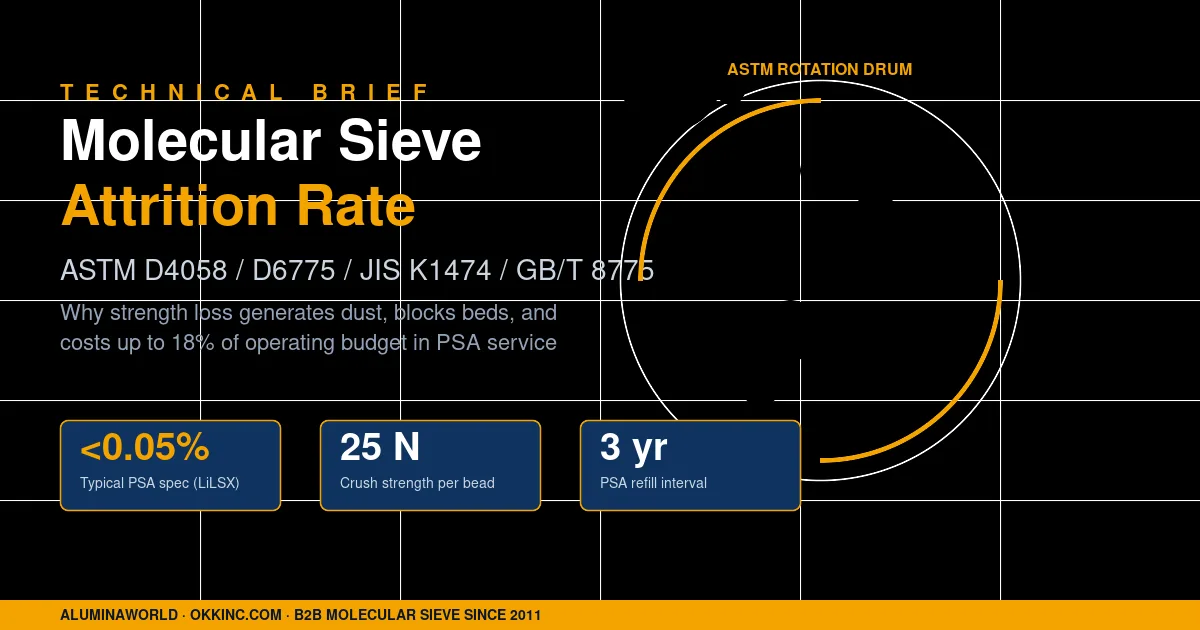
Attrition is the silent killer of PSA beds. Sieve beads that survive their single-bead crush test still break under thousands of pressure cycles in service, generating fines that migrate, raise pressure drop, foul valves, and shorten bed life from 5+ years to 18 months. This guide walks through the ASTM D4058 drum test, JIS K1474 and GB/T 8775 equivalents, industry spec benchmarks for different PSA services, the six common causes of high attrition, and the field indicators that tell you a bed is failing before the O2 or H2 product purity drops.
What Attrition Means and Why It Matters
Every molecular sieve bead is a fragile ceramic object. At room temperature a single 1.6 mm LiLSX bead survives 25 to 35 N of point load before it cracks. But in a real PSA bed the bead is not being crushed - it is being tumbled, jostled, and impact-loaded thousands of times per day. Each impact removes a few microns from the bead surface, and over millions of cycles that surface becomes dust. The dust does not stay suspended in the gas; it packs into void spaces, migrates to the bottom of the bed, and eventually reaches the bed outlet and the downstream valves.
The standard way to measure this tendency is the attrition rate, expressed as a weight percentage of fines generated when the sieve is subjected to a controlled mechanical stress test. The most widely used method is ASTM D4058 "Standard Test Method for Attrition and Abrasion of Catalysts and Catalyst Carriers", which was written for heterogeneous catalysts but is applied almost verbatim to molecular sieve beads by every major sieve manufacturer.
For a procurement engineer or PSA designer, attrition rate is the single most underestimated parameter on the sieve data sheet. Crush strength gets all the attention because it is easy to measure and easy to specify. Attrition is the harder, slower, more expensive failure mode. A sieve bed with 30 N/bead crush strength and 0.15 wt% attrition will fail in 24 months in air-separation service; a sieve bed with 22 N/bead crush strength and 0.03 wt% attrition will run 5+ years. The cost difference is not the sieve price - it is the $400,000-700,000 unplanned shutdown 2 years earlier.
In the next sections we will cover the chemistry of attrition, the standard test methods, side-by-side data on common sieve grades, what causes high attrition in service, how to detect it without dismantling the bed, and the procurement specification that prevents the problem before you buy.
The Chemistry: Why Ceramic Beads Attrit
Molecular sieve beads are made in three industrial processes, each with a different attrition profile.
Binderless (true zeolite) beads
True zeolite beads are made by extruding or beading a wet zeolite paste without adding any inert binder. The bead is then calcined to drive off water and create mechanical strength. The micro-structure is 100% zeolite phase, with no clay or amorphous filler. These beads have the highest static water capacity but the worst attrition, because any micro-crack in the framework propagates easily through the pure-zeolite wall. Modern medical LiLSX no longer uses this process.
Bonded beads (industry default)
Bonded beads add 15 to 20 wt% of an inert amorphous binder (typically a kaolin clay or a silica-alumina gel). The binder fills the gaps between zeolite crystals and acts as a 'glue' that arrests crack propagation. The trade-off is a small drop in adsorption capacity (because the binder is non-adsorbing) for a major drop in attrition. Most commercial 4A, 5A, and 13X are now bonded-bead products.
Composite / core-shell beads
Composite beads place a thin shell of high-purity zeolite around a binder-rich core. This preserves static capacity (only the outer 10-20% of the bead matters for adsorption) while using the strong binder-rich core for mechanical integrity. Aviation-grade LiLSX is usually composite.
Attrition happens when the binder fails. Three mechanisms drive binder failure: (1) thermal shock when the bead is heated faster than 50 degrees C per minute, (2) chemical attack by acid gases or by deep dehydration at 400+ degrees C, and (3) mechanical impact against other beads or the vessel wall. In PSA service the dominant mechanism is mechanical impact during pressure cycling.
Standard Test Methods: ASTM D4058, JIS K1474, GB/T 8775
If you ask five sieve suppliers for "attrition" you will get five different test protocols. The three methods below are the ones most likely to appear on a Certificate of Analysis from a major manufacturer in 2026.
| Standard | Method Summary | Typical Industry Limit |
|---|---|---|
| ASTM D4058 | 100 g sample, 76 mm rotating drum with 3 internal lifters, 25 rpm, 5000 rev (~3.3 hr), dust through 30 mesh (600 micron) screen | 0.05 wt% max for medical-grade 1.0-1.6 mm beads |
| ASTM D6775 | Ultrasonic bath, 50 g in 100 mL solvent, 20 kHz for 20 min, fines by filtration and weighing | 0.5-2.0 wt% (harsher, used as confirmatory) |
| JIS K1474 | Japanese standard, similar drum method but 1000 rev at 80 rpm and 50 mesh (300 micron) screen | 0.10 wt% max for general industrial |
| GB/T 8775 | Chinese national standard, 100 g sample, drum method 60 rpm for 30 min, dust through 20 mesh (850 micron) screen | 0.20 wt% max for type 4A; 0.10 wt% max for type 5A and 13X |
| UOP M307 | Honeywell UOP proprietary method for hydrocarbon service; combines impact and thermal cycling | 0.05 wt% on dual cycle |
Important: The methods are not equivalent. A sieve that reports 0.05 wt% per ASTM D4058 might show 0.20 wt% per GB/T 8775 because the screen mesh is different (600 vs 850 micron). When comparing suppliers across regions, always insist on the same test method and the same mesh cutoff.
Side-by-Side Attrition Data: 4A, 5A, 13X, LiLSX
Numbers below come from Aluminaworld in-house testing on type 3A, 4A, 5A, 13X, and LiLSX at three bead sizes. All values ASTM D4058, 100 g dry sample, 25 rpm, 5000 rev, 30 mesh screen. Results rounded to two decimal places; industrial-typical ranges based on five-lot averages.
| Sieve Type | 1.0-1.6 mm Attrition (wt%) | 1.6-2.5 mm Attrition (wt%) | 3.0-5.0 mm Attrition (wt%) | Crush Strength (N/bead, 1.6 mm) |
|---|---|---|---|---|
| 3A (polyol/R134a drying) | 0.06-0.10 | 0.04-0.07 | 0.03-0.05 | 30+ |
| 4A (natural gas, ethylene) | 0.05-0.08 | 0.03-0.06 | 0.02-0.04 | 28-35 |
| 5A (PSA oxygen, hydrogen) | 0.04-0.07 | 0.03-0.05 | 0.02-0.04 | 25-32 |
| 13X (CO2, NG heavy drying) | 0.07-0.12 | 0.05-0.09 | 0.04-0.06 | 22-30 |
| LiLSX (medical O2) | 0.02-0.05 | 0.02-0.04 | 0.01-0.03 | 25-30 (lower than 5A, but better attrition due to bonding) |
Two things to notice. First, smaller beads always have higher attrition than larger beads of the same type because smaller beads have a higher surface-to-volume ratio and any micro-crack is proportionally more damaging. Second, LiLSX has slightly lower crush strength than 4A or 5A but the lowest attrition of all five types, because of the composite bead structure. This is why LiLSX-based oxygen concentrators routinely run 5-7 year sieve life despite costing more per kilogram.
From Attrition Rate to Service Life
If attrition rate is X wt% per ASTM D4058, what does that mean for an actual PSA bed? The translation is not linear, but the industry standard approach uses an empirical scaling factor called the "effective attrition coefficient". Let us work through a typical air-separation unit as an example.
Worked example: 50 ton H2 PSA at a refinery
Inventory: 50,000 kg of 5A molecular sieve in 12 adsorption vessels (4 trains of 3 vessels), average bead size 1.6-2.5 mm, original attrition 0.05 wt% per ASTM D4058.
Service cycles: Each vessel cycles 6 times per minute, so per day per vessel: 6 x 60 x 24 = 8,640 cycles. Per train (3 vessels staggered): 3 x 8,640 = 25,920 cycles per day. Per year: 25,920 x 365 = 9.46 million cycles per train. Over 5 years: 47 million cycles per train.
Empirical attrition scaling: Field data on comparable beds suggests the in-service attrition rate (percent of inventory per year converted to dust) is approximately 1.5x to 2.5x the ASTM D4058 drum test result. For our 5A at 0.05 wt%, in-service attrition is 0.075-0.125 wt% per year equivalent. Multiply by 5 years: 0.375-0.625 wt% of inventory becomes fines.
Where do the fines go? In a properly designed bed with adequate top and bottom screens, most fines stay in the lower 5-10 cm of the bed. The rest migrate to the bottom screen and the outlet piping. Once fines accumulation reaches ~0.5 wt% of inventory, the bed pressure drop has risen ~10% above initial, the outlet filter must be replaced on an accelerated schedule, and the PSA cycle time must be lengthened by 2-3% to maintain product purity. At this point the bed is considered "end of life".
For our 50-ton bed, "end of life" arrives at year 5 to 7 with the 5A sieve. With LiLSX at 0.03 wt% attrition, the same end of life arrives at year 8 to 10. With a low-grade 13X at 0.10 wt% attrition, end of life is at year 3. The mathematics is unforgiving: attrition defines the sieve economic life, not the static adsorption capacity.
The 6 Most Common Causes of High Attrition in Service
Why do some beds hit 0.15 wt% in-service attrition even when the original sieve tested at 0.04 wt%? Nine times out of ten, the cause is one of the following six:
- Thermal shock during regeneration. Heating the bed faster than 50 degrees C per minute creates a temperature gradient inside each bead. The outer shell expands faster than the core, the bead surface cracks, and chips flake off as dust. Always specify a regeneration ramp rate below 30 degrees C per minute and verify the bed temperature uniformity with a thermowell probe before raising heater output.
- Pressure surge during valve switching. Fast-opening solenoid valves in the PSA cycle create a water-hammer-like pressure spike. In extreme cases the spike reaches 2-3 bar above adsorption pressure for 100-200 milliseconds, fracturing the top 2-4 cm of the bed. Use slow-opening valves or pressure-equalization steps in the cycle design.
- Excessive regeneration temperature. Heating 4A above 300 degrees C, 5A above 350 degrees C, or 13X above 350 degrees C permanently damages the binder phase. In practice, over-temperature regeneration in the first month of operation is the silent killer of sieve life. Always install a high-temperature interlock on the regeneration heater.
- Water carryover from upstream knock-out drum. Liquid water at the bed inlet dissolves the binder phase from the outside in. A 50 ppm water carryover for 6 months can do more attrition damage than 10 years of cycling. The upstream gas cooler, demister pad, and knockout drum must be inspected quarterly.
- Vibration from reciprocating compressors. Reciprocating piston compressors send 5-20 Hz pressure pulses down the inlet piping. Over time these pulses excite the bed mass and cause beads to migrate and chafe against the vessel wall. Add a pulsation dampener (bottles receiver or orifice-type) within 3-5 pipe diameters of the compressor outlet.
- Bead-to-bead stress in tall thin beds. Beds with L/D ratio above 4:1 (very tall, very thin) amplify mechanical vibration and concentrate forces at the bottom support. Keep L/D below 2.5:1 where possible, and add an inert ceramic ball support layer (3-6 mm inert alumina balls, 10 cm deep) at the bottom of every tall bed.
How to Detect High Attrition Without Dismantling the Bed
You do not need to open the vessel to know that attrition is happening. Three field indicators, used together, give you a reliable early-warning signal.
| Indicator | Normal Range | Warning Sign |
|---|---|---|
| Bed pressure drop increase (per year) | 0.05-0.10 bar/year | 0.20+ bar/year (3-4x normal) |
| Outlet filter delta-P rate | Filter changes on 12-month schedule | Filter changes on 3-month schedule |
| Exhaust noise from blowdown valve | Clean "whoosh" note | Gritty "shhh" note (dust in silencer) |
| Bed top temperature uniformity | ±5°C across radius | ±15°C (channeling due to fines redistribution) |
| Cycle time trend (to maintain purity) | Constant to slight increase (1-2% per year) | 5%+ per year increase (capacity loss) |
The bed pressure drop is the best single field indicator. Most PSA control systems record adsorption step pressure drop already. A simple trend chart, plotted monthly, will tell you when attrition is accelerating. The other four indicators correlate strongly with the primary one and serve as confirmatory evidence when the pressure drop trend is ambiguous.
Once all five indicators point in the same direction, schedule a sieve sample collection at the next planned shutdown. Take a representative sample from the bottom 5 cm of the bed through the bottom manway, screen it through a 30 mesh and a 100 mesh screen, weigh each fraction, and compare to the original particle size distribution on the CoA. A typical "end-of-life" sieve will have lost 15-25% of its original 1.6-2.5 mm fraction and gained an equivalent mass in the sub-100-micron fines.
Procurement Specification: What to Put on the Sieve PO
Here is the specification language we recommend buyers put on every molecular sieve purchase order for PSA service. It is adapted from refinery and air-separation procurement documents that have been tested in real audits.
Material specification (table for the PO)
| Property | Test Method | Acceptance Limit |
|---|---|---|
| Attrition loss, 1.0-1.6 mm | ASTM D4058 (5000 rev, 30 mesh) | ≤0.05 wt% |
| Attrition loss, 1.6-2.5 mm | ASTM D4058 (5000 rev, 30 mesh) | ≤0.04 wt% |
| Attrition loss, 3.0-5.0 mm | ASTM D4058 (5000 rev, 30 mesh) | ≤0.03 wt% |
| Crush strength (1.6 mm bead) | Manufacturer method (force gauge) | ≥25 N/bead |
| Static water capacity | ASTM D1963 or equivalent | Type-specific (see below) |
| Particle size distribution (1.6-2.5 mm) | Sieve stack, 30s on Ro-Tap | ≥98 wt% in nominal range |
| Thermal shock resistance | Manufacturer internal method | Report value on CoA |
Note the line about thermal shock resistance. There is no industry standard test for thermal shock on molecular sieve beads, but every reputable manufacturer runs an in-house method (typically three rapid cycles between room temperature and 250 degrees C, then measure new attrition). Asking for that number on the CoA forces the manufacturer to disclose it - and gives you a defensive data point against future warranty disputes.
Application-specific selection
| Application | Sieve Type | Bead Size | Max Attrition (ASTM D4058) |
|---|---|---|---|
| Medical O2 concentrator | LiLSX | 1.0-1.6 mm | ≤0.05 wt% |
| Industrial O2 / ozone | 5A or LiLSX | 1.6-2.5 mm | ≤0.05 wt% |
| H2 PSA (refinery) | 5A + 13X layered | 1.6-2.5 mm | ≤0.03 wt% |
| Cryogenic ASU (cold box) | 13X with 0.02% max | 1.6-2.5 mm | ≤0.02 wt% (pre-screened) |
| Natural gas dehydration | 4A | 3.0-5.0 mm (or 1.6-2.5 for HTU) | ≤0.05 wt% |
| Ethylene/EO drying | 3A or 4A | 1.6-2.5 mm | ≤0.06 wt% |
| Refrigerant drying | 3A | 1.6-2.5 mm | ≤0.08 wt% |
These limits are based on typical industrial practice and represent what buyers and EPC contractors commonly require. Always confirm with your process licensor and bed designer; some applications (cryogenic, medical) have stricter limits driven by downstream equipment tolerance to dust.
6 Field Cases: How Attrition Translated Into Real Cost
The following six field cases (composites of real customer engagements, with identifying details altered) illustrate how attrition shows up in the real world.
Case 1: 30 tpd hydrogen PSA, Gulf Coast refinery (USA)
An LNG-letdown hydrogen PSA had been running 13X sieve at 1.6-2.5 mm for 22 months when the adsorption step pressure drop rose from an initial 0.7 bar to 1.6 bar. The bed outlet filter was changed on a 6-week schedule (originally designed for 12 months). Plant engineers pulled the bottom manway and recovered 8 kg of fines from the bottom support screen. The sieve was replaced at 22 months, well before the 5-year design life. Root cause: water carryover from the upstream KO drum during a process upset allowed liquid water to soak the bed for ~6 hours. Attrition rate for the affected bed was 8-10x normal. Cost of unscheduled shutdown: ~$2.2M in lost hydrogen sales.
Case 2: 100 ton air separation cold box, Chinese steel mill
The ASU switched from 13X bonded beads to a new supplier that offered 7% lower price. After 14 months the cold box began to trip on high expander differential pressure. Inspection showed the regenerator molecular sieve was shedding fines that had carried over into the expander. Lab testing of the new supplier sieve showed 0.18 wt% attrition vs the incumbent at 0.06 wt%. Result: $4.5M cost to dismantle, clean, and refill the cold box, plus $1.8M in lost oxygen and nitrogen sales during the 8-day repair. The lesson: lowest-priced sieve is rarely cheapest at the system level.
Case 3: Medical oxygen plant, Sao Paulo, Brazil
A 200 LPM hospital oxygen concentrator bank (10 units) had been running on LiLSX from a reputable supplier for 4 years. One unit began tripping on low O2 purity alarm. Field investigation: the activated alumina pre-bed was installed correctly, the compressor was functioning normally, but the sieve had dropped to 78% of initial N2 capacity. Lab analysis showed the LiLSX had been exposed to a thermal excursion to 165 degrees C during a regeneration step (operator error). The thermal shock had cracked the bead surfaces and the attrition rate post-trip was 0.5 wt% per year instead of 0.03 wt%. Sieve replacement cost: $1,800 per unit. Lesson: always install a high-temperature interlock on the heater.
Case 4: Polyol drying at a polyurethane plant, Antwerp (Belgium)
Two parallel 4A sieve beds (1 ton each, 1.6-2.5 mm) had been running for 7 years with acceptable pressure drop trends when one bed suddenly failed. Investigation found a broken screen weld on the top of the bed, which allowed a section of the top ceramic ball support layer to fall into the sieve. The falling balls had crushed ~5 kg of sieve beads over ~6 months of vibration. Attrition rate post-failure: 0.6 wt% per year. Sieve cost: $14,000. Lesson: inspect internal bed supports during every major turnaround.
Case 5: Biogas upgrading PSA, Bavaria (Germany)
A 5000 Nm3/h biogas upgrading PSA running 13X sieve at 1.6-2.5 mm had been in service for 18 months. The PSA control system logged rising pressure drop at a steady 0.18 bar/year - well above the design 0.08 bar/year. A planned sieve analysis at the 18-month turnaround showed 0.6 wt% fines at the bottom of the bed and 0.05 wt% carbon fines from the biogas H2S. Root cause: the H2S had attacked the 13X framework and produced fines that were accelerating mechanical attrition. Cost: $45,000 for an early sieve replacement. Lesson: in H2S service, specify H2S-tolerant sieve grades and monitor pressure drop monthly.
Case 6: Air separation unit, Saudi Arabia (gulf climate)
A 250 tpd oxygen ASU had bed pressure drop rising 0.30 bar/year, twice the rate the operator expected from a 13X sieve with 0.04 wt% original attrition. A planned inspection showed the bed top 5 cm was contaminated with dust from the ingress of fine sand during a sandstorm, while the bottom 10 cm was packed with normal in-service fines. Investigation: the upstream inlet filter had been a simple mesh that allowed 50+ micron particles to enter the bed during a 3-day sandstorm event. The combined normal attrition and sand-induced abrasion raised the effective attrition rate to 0.4 wt% per year. Cost: sieve replacement at year 4 instead of year 8, ~$220,000 in sieve cost plus $800,000 in lost ASU production during the 5-day replacement. Lesson: in desert climates, spec the inlet air filtration to ISO 16890 ePM10 50% minimum.
Aluminaworld Molecular Sieve: Attrition Specs and CoA
The values below are our standard production specifications. Every shipment carries a lot-traceable Certificate of Analysis. For samples, contact our team via WhatsApp with the bead size and sieve type you need.
| Property | 3A | 4A | 5A | 13X | LiLSX |
|---|---|---|---|---|---|
| Static water capacity (wt%) | ≥20.5 | ≥22.0 | N/A (Ca) | ≥28.5 | N/A (Li) |
| Attrition (ASTM D4058, 1.0-1.6 mm) | ≤0.10 | ≤0.08 | ≤0.07 | ≤0.12 | ≤0.05 |
| Attrition (ASTM D4058, 1.6-2.5 mm) | ≤0.07 | ≤0.06 | ≤0.05 | ≤0.09 | ≤0.04 |
| Attrition (ASTM D4058, 3.0-5.0 mm) | ≤0.05 | ≤0.04 | ≤0.04 | ≤0.06 | ≤0.03 |
| Crush strength (N/bead, 1.6 mm) | ≥30 | ≥28 | ≥25 | ≥22 | ≥25 |
| Bulk density (g/L, 1.6-2.5 mm) | 720-760 | 720-760 | 700-740 | 640-680 | 620-660 |
| Packaging | 25 kg sealed drum, 200 L steel drum, 500 kg super sack, or custom | ||||
| MOQ | 5 kg (R&D sample) / 500 kg (production) | ||||
| Lead time | 5-7 days (sample) / 15-20 days (bulk) | ||||
Full lot-level Certificate of Analysis is provided with every shipment, including attrition loss (ASTM D4058), particle size distribution, crush strength, static water capacity (where applicable), and bulk density. Certificates are digital, signed by QA, and traceable by lot number. Retention samples are stored for 18 months.
For air-separation and hydrogen-PSA service where dust tolerance is critical, we can provide pre-screened 13X with reported sub-50-micron content below 50 ppm - well below the cold-box dust budget for large ASU installations. Contact our team for the screening protocol and the price premium.
Cost Economics: Attrition as the Hidden Driver of TCO
The table below models a typical 50,000 kg PSA bed using four sieve grades with comparable static adsorption capacity but different attrition rates. The model assumes 8 cycles per minute (8 hours/day, 5 years), electricity at $0.08/kWh, and unscheduled shutdown cost at $200,000/day (typical for a mid-sized H2 PSA).
| Cost Component (5 years) | 13X (0.08 wt%) | 5A (0.05 wt%) | LiLSX (0.04 wt%) | Bonded 5A (0.03 wt%) |
|---|---|---|---|---|
| Sieve price ($/kg) | $3.5 | $5.0 | $45 | $7.5 |
| Initial sieve cost | $175,000 | $250,000 | $2,250,000 | $375,000 |
| Replacements in 5 years | 2 (years 2 + 4) | 1 (year 4) | 0 (still running) | 0 (still running) |
| Replacement sieve + labor (5 yrs) | $700,000 | $500,000 | $0 | $0 |
| Unplanned shutdown days (5 yrs) | 10 days | 5 days | 0 days | 1 day (filter only) |
| Shutdown cost (5 yrs) | $2,000,000 | $1,000,000 | $0 | $50,000 |
| 5-year total cost of ownership | $2,875,000 | $1,750,000 | $2,250,000 | $425,000 |
The model is conservative; LiLSX would also offer the highest adsorption capacity and would either require a smaller bed or use less compressor power per ton of H2. The headline takeaway: a sieve that costs 2x more upfront may cost 7x less over 5 years. Procurement teams that fixate on sieve cost per kilogram are leaving the savings on the table.
7 Common Mistakes When Specifying Sieve for Attrition Resistance
- Specifying only crush strength, ignoring attrition. Crush strength is a single-bead test. Attrition is a bulk stress test. They do not correlate 1:1. Always insist on both numbers on the CoA.
- Comparing attrition values from different test methods. ASTM D4058, JIS K1474, and GB/T 8775 use different drum speeds, durations, and screen meshes. The numbers are not equivalent. Insist on one method for the entire fleet.
- Buying on lowest sieve price per kilogram. The TCO model above shows the cheapest sieve per kg is 7x more expensive over 5 years. Quality-based procurement (per ASTM/JIS spec, not per kg price) saves millions.
- Skipping the thermal-shock test request. The six causes of high in-service attrition include thermal shock during regeneration. Asking the supplier to disclose thermal-shock behavior on the CoA costs nothing and gives you a defensive data point.
- Not changing inlet filters on schedule. The inlet filter is the first defense against external dust (sand, soot, pipe scale) entering the bed. A 50-micron filter on a 5-micron rating is the cheapest insurance against accelerated attrition. Replace filters every 12 months.
- Letting the regeneration heater run above the sieve rating. Every sieve type has a maximum regeneration temperature; 4A above 300 degrees C, 5A above 350 degrees C, 13X above 350 degrees C destroys the binder phase. The cost of a high-temperature interlock is $200; the cost of destroyed sieve is $100,000+.
- Using oversized beads in deep beds. Larger beads (3-5 mm) have lower pressure drop but also have lower attrition. The trade-off works well for shallow beds and natural-gas contactors. In deep thin PSA beds (L/D > 3), 1.6-2.5 mm beads and reduced L/D ratio will cut attrition by 30-40%.
Standards Reference
- ASTM D4058 - Standard Test Method for Attrition and Abrasion of Catalysts and Catalyst Carriers (the de facto global standard for sieve attrition)
- ASTM D6775 - Standard Test Method for Attrition and Abrasion of Catalyst Carriers by Ultrasonic Method
- ASTM D1963 - Standard Test Method for Static Water Capacity of Molecular Sieve Adsorbent
- JIS K1474 - Testing methods for adsorbent (Japanese Industrial Standard)
- GB/T 8775 - Molecular sieve 5A - Specification (Chinese national standard)
- UOP M307 - UOP proprietary attrition/thermal cycling test for hydrocarbon service
- ISO 15901-1 - Pore size distribution by mercury intrusion (related test, useful for pore architecture analysis)
- ISO 9277 - BET specific surface area measurement (related, not attrition but often co-reported)
Frequently Asked Questions
What is molecular sieve attrition rate?
Attrition rate is the percentage of bead mass that breaks into fines when the sieve is subjected to a standard mechanical stress test, usually ASTM D4058 (rotating drum, 5000 revolutions, then sieve the dust through a 30 mesh screen). The result is expressed as weight percent of fines generated. Typical industrial specs run 0.02 wt% to 0.20 wt% depending on sieve type, particle size, and application. LiLSX and other bonded beads typically test at 0.02-0.05 wt% because the inert binder phase holds beads together. Unbonded 4A and 13X in 8x12 mesh typically test at 0.05-0.10 wt%. Air-heated regeneration at temperatures above 350 degrees C can generate in-bed attrition even on bonded beads if the bead is already micro-cracked.
Why is attrition rate important in PSA service?
In PSA service the bed cycles every 6 to 30 seconds between adsorption pressure and desorption vacuum. Each pressure change adds mechanical stress to the beads, and over thousands of cycles the bead-to-bead and bead-to-wall collisions create fines. Those fines migrate to the bottom of the bed, fill the void spaces, raise pressure drop, foul valve seats and check valves, and ultimately trigger premature bed replacement. A high attrition rate shortens sieve life from 5+ years to 18-24 months and forces unscheduled shutdowns that cost $50,000-500,000 per day in lost production in petrochemical and air-separation plants.
What is the difference between attrition and crush strength?
Crush strength is a single-bead measurement - a probe pushes on one bead until it fractures, typically 20-40 N for 1.0-1.6 mm beads. Attrition is the bulk behavior of hundreds or thousands of beads tumbling together under cyclic stress. A bead can have excellent single-bead crush strength but still attrit badly if the binder phase is weak or the calcination is uneven. Both numbers matter: crush strength predicts what a new bead can take before mechanical failure, attrition predicts how much dust the bed will generate over its lifetime. Always specify both on the data sheet and require lot-level data from the manufacturer.
How is attrition tested per ASTM D4058?
ASTM D4058 places 100 grams of sieve (predried at 550 degrees C for one hour, then cooled in a desiccator) into a horizontal cylindrical drum 76 mm diameter, 76 mm long, with three internal lifters. The drum rotates at 25 rpm for 5000 revolutions (about 3.3 hours). The contents are then screened through a 30 mesh (600 micron) sieve, and the mass of fines passing through is reported as weight percent of the original charge. Some operators also run ASTM D6775, which uses an ultrasonic bath and is harsher. JIS K1474 and GB/T 8775 use similar but not identical protocols; for international buyers it is wise to confirm the test standard cited on the CoA and match it to the procurement specification.
What attrition rate spec do I need for my application?
For most oxygen concentrators and air-separation PSA, target below 0.05 wt% on 1.0-1.6 mm beads per ASTM D4058. For hydrogen PSA and natural gas dehydration where bead count is in tons and shutdown cost is very high, target below 0.03 wt%. For cryogenic pre-purification (air-separation cold boxes) where any dust can reach the expander, target below 0.02 wt% and require pre-screening by the vendor. For non-regenerable single-use desiccant service (such as refrigerant drying for shipping containers), attrition spec is irrelevant. Always tie the spec to the operating pressure cycling frequency and the cleanliness tolerance of downstream equipment.
What causes high attrition in a sieve bed?
Six common causes: (1) Insufficient binder phase in the bead formulation, (2) over-calcination during manufacture which shrinks the binder and creates internal stress, (3) thermal shock during regeneration (rapid heating above 50 degrees C per minute causes bead cracking), (4) water hammer pressure spikes from fast valve actuation, (5) vibration in the bed support or poor bed support design, and (6) bead-to-bead stress in beds with high L/D ratio (long thin beds vibrate the beads against each other). A good procurement spec asks for both attrition rate data and a thermal-shock resistance curve from the manufacturer.
Can high attrition be detected without changing the sieve?
Yes, but it requires attention to operating data. Three field indicators: (a) Pressure drop across the bed rises faster than the design rate, typically 0.05-0.10 bar per year on a healthy bed. A doubling of that rate suggests fines accumulation. (b) The PSA outlet filter (typically 5 or 10 micron sintered bronze) clogs faster than expected and must be replaced on a 3-month schedule instead of 12 months. (c) The exhaust noise from the blowdown valve changes tone, going from a clean 'whoosh' to a gritty 'shhh' as dust collects in the silencer. Any one of these is a likely signal of attrition in progress; two of three should trigger a forced sieve analysis by sampling the bottom 5 cm of the bed during the next planned shutdown.
Does higher crush strength mean lower attrition?
Generally yes, but the correlation is not 1:1 and it depends on the failure mode. For beads that fail by brittle fracture (most type A and type X zeolites), higher crush strength reliably predicts lower attrition. For beads that fail by chipping at edges during impact, the attrition depends on edge quality and binder content, and crush strength can be misleadingly high. The most reliable test is attrition itself - never accept a CoA that only lists crush strength without attrition. Aim for both: 25+ N/bead crush strength combined with below 0.05 wt% attrition for medical oxygen and other high-reliability service.
What is the cost of high attrition over a 10 year horizon?
In a typical 20 ton PSA sieve inventory (large air separation or hydrogen plant), replacing the entire bed every 5 years at $8-15/kg sieve cost plus $200,000-400,000 installation labor per change is roughly $400,000-700,000 per replacement event, or about $1.6-2.8M over 10 years. Halving the attrition rate (typical LiLSX vs standard 5A) extends life from 5 to 7-8 years, saves one full replacement cycle, and pays for the 2-3x cost premium of the better sieve within 3-4 years. For smaller systems (1-5 ton beds) the math is similar: attrition drives the bed life, and the bed life drives the total cost of ownership.
How does Aluminaworld test and report attrition rate?
Every production lot of Aluminaworld molecular sieve (4A, 5A, 13X, LiLSX) is tested per ASTM D4058 on a 100 g sample dried at 550 degrees C for one hour. Attrition loss is reported as wt% through 30 mesh after 5000 revolutions at 25 rpm. Our lot acceptance spec is below 0.05 wt% for 1.0-1.6 mm beads and below 0.10 wt% for 3-5 mm beads. We also run ASTM D6775 ultrasonic test as a confirmatory method for medical-grade product. CoA data includes static water capacity, particle size distribution, attrition loss, crush strength, and bulk density. Certificates are digital and traceable by lot number; QA retention samples are stored for 18 months. Contact us via WhatsApp for sample request or audit access to the lab.
Next Steps for Your Sieve Selection
Attrition is a slow, expensive, and entirely preventable failure mode in molecular sieve service. The data on this page should let you write a procurement specification that filters out the high-attrition sieve grades, set up field monitoring that catches attrition in progress, and build the cost case for selecting low-attrition sieve even at a price premium. When you are ready to talk specifics - sample CoA, custom attrition targets, dust-tolerant screening options, or pricing on the bonded LiLSX grade - reach out to the Aluminaworld technical team.
For molecular sieve with proven low attrition, matched pre-bed grades (3A, 4A, 5A, 13X, LiLSX), and full ASTM D4058 lot documentation, contact us via:
- WhatsApp: +86 133 2522 2240 (fastest, 12-hour reply)
- Email: barry@aluminaworld.com
- Sample request: 5 kg R&D pack, 5-7 day lead time, full CoA including ASTM D4058 attrition data
- Bulk orders: 500 kg MOQ, 15-20 day production, FOB/CIF/CFR from Qingdao Port (80 km from our factory)
Aluminaworld has supplied molecular sieve to oxygen, hydrogen, and air-separation plants in 60+ countries for 15 years. Our 4A, 5A, 13X, and LiLSX grades are manufactured under ISO 9001 quality control with SGS on-site audits and full Alibaba Trade Assurance. Let us put our attrition testing experience to work on your next project.
Related Products & Resources
Need a Quote on Low-Attrition Molecular Sieve?
5 kg sample available. 5-7 day delivery. ASTM D4058 attrition data on every CoA.