Molecular Sieve for Ethanol Dehydration to 200 Proof: 3A vs 4A Energy Consumption Comparison
3A molecular sieve is the industry-standard adsorbent for fuel-grade and pharmaceutical-grade anhydrous ethanol. Its 3 Angstrom pore admits water (kinetic diameter 2.6 Angstrom) and rejects ethanol (kinetic diameter 4.4 Angstrom) cleanly. 4A molecular sieve (4 Angstrom pore) co-adsorbs 4 to 8 percent ethanol by mass on the bed, which costs working capacity and forces extra reboiler duty on the regeneration condensate. This guide quantifies the energy penalty, compares 3A with the older azeotropic distillation baseline, lays out the regeneration envelope, and gives the procurement specification language that protects the cycle economics.
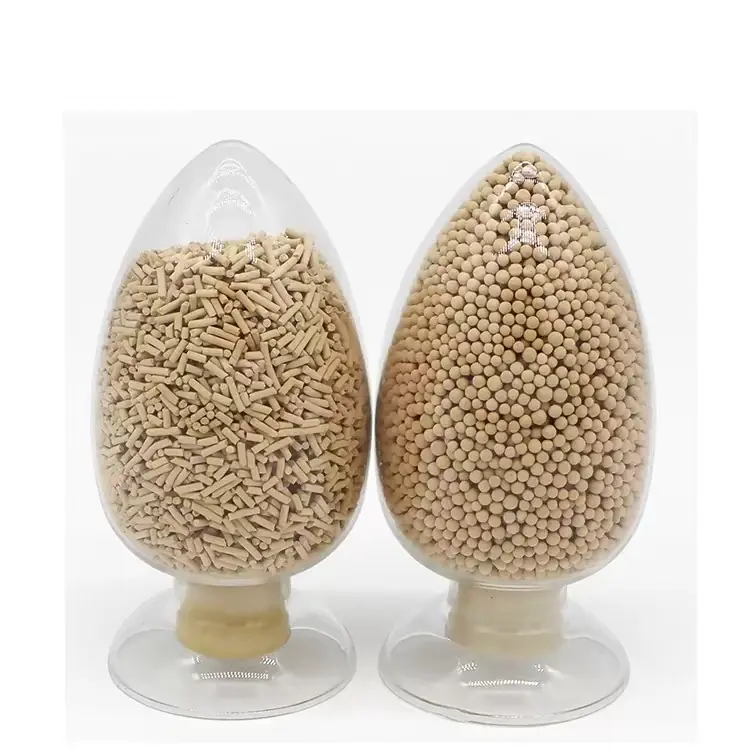
Quick Answer
3A molecular sieve is the kinetic-diameter specification that protects the cycle economics of vapor-phase ethanol dehydration to 200 proof. Its 3 Angstrom pore admits only water and excludes ethanol, so the bed working capacity is 12 to 18 wt percent water on the regenerated bed, regeneration steam consumption is 1.8 to 2.4 kg per liter of anhydrous ethanol with heat integration, and bed life is 4 to 6 years. 4A molecular sieve co-adsorbs 4 to 8 percent ethanol by mass, which costs working capacity, raises regeneration duty, and shortens bed life. Azeotropic distillation with benzene or cyclohexane uses 2.8 to 4.0 kg of steam per liter of anhydrous product plus entrainer recovery duty — 30 to 45 percent more primary energy than 3A PPSA. The ASTM D4806 and EN 15376 fuel-ethanol specifications call for above 99.2 vol percent ethanol, which a 3A bed delivers directly from a 190-to-192-proof feed. These are industry-typical values compiled from fuel-ethanol plant operating data, ASTM D2804 sieve qualification, and adsorption vendor design manuals. Specific values should be confirmed against the agreed bed size, the cycle time, and the regeneration envelope of the unit.
Scope and Audience for This Guide
This article is written for plant engineers, process designers, and procurement engineers who are evaluating molecular sieve for ethanol dehydration to 200 proof. The relevant applications are fuel ethanol at ASTM D4806 grade, beverage-grade neutral spirits at 95 to 96 vol percent recovered from a sieve polish step, pharmaceutical-grade ethanol at USP / Ph Eur grade, and industrial-grade anhydrous ethanol for solvents, cleaning, and chemical synthesis. The reader should already understand that 190 proof (95 vol percent ethanol) is the azeotropic composition at atmospheric pressure, and that something has to break the azeotrope to reach 200 proof (anhydrous). The remaining question is which separation technology — molecular sieve pressure-swing adsorption, azeotropic distillation with an entrainer, vacuum distillation, pervaporation, or extractive distillation — delivers the lowest energy, the lowest capex, and the longest service life. The molecular sieve pressure-swing adsorption answer is 3A, and the rest of this article is the engineering evidence.
The article compares 3A with 4A on a side-by-side energy basis, then compares the winning 3A PPSA cycle with the older azeotropic distillation baseline. Six tables give the engineering numbers, four sections walk through the regeneration envelope, the feed pretreatment envelope, and the cycle time economics. Ten FAQ entries at the end answer the buyer-engineer questions that come up most often in procurement. The article closes with a Next Steps section that lays out the data package Aluminaworld can deliver.
Pore-Size Logic: Why 3A Wins on Selectivity
The adsorption selectivity of a molecular sieve is set by the relationship between the pore opening and the kinetic diameter of the molecules in the feed. Water has a kinetic diameter of 2.6 Angstrom. Ethanol has a kinetic diameter of 4.4 Angstrom. The 3 Angstrom pore of 3A molecular sieve admits water and excludes ethanol by a margin of 0.4 Angstrom on the ethanol side and 0.4 Angstrom on the water side. That margin is enough to give a working selectivity ratio of water to ethanol in the order of 1000 to 1, which is what a clean 3A bed needs to deliver a working capacity of 12 to 18 wt percent water without measurable ethanol carry-over.
The 4 Angstrom pore of 4A molecular sieve has a margin of 0.4 Angstrom on the ethanol side too, but the margin is much smaller in practice because of two physical effects. First, the kinetic diameter is a statistical quantity, not a hard cutoff; some fraction of any molecular population has thermal energy above the average, and at temperatures above 100 C a measurable fraction of ethanol can squeeze through a 4 Angstrom pore. Second, 4A has sodium cations at the pore window (Na12Al12Si12O48), and the Na cation has a smaller ionic radius (1.02 Angstrom) than the K cation (1.38 Angstrom) in 3A, which leaves more thermal motion at the window and a slightly larger effective opening. The result is that 4A co-adsorbs 4 to 8 percent ethanol by mass on the regenerated bed in the first cycle, and that ethanol is released in the regeneration step. The released ethanol appears in the regeneration condensate stream, which the operator must either discard (if contaminated) or pump back to the distillation column (the typical choice), and the pumping plus re-distillation is a real energy cost on every cycle.
The selectivity question matters because the working capacity of the bed sets the cycle time, the bed size, and the regeneration frequency. A 3A bed at 14 wt percent working water capacity needs regeneration every 8 to 15 minutes at design flow. A 4A bed at 10 wt percent working water capacity (because 4 of the 14 wt percent is ethanol, not water) needs regeneration 30 to 40 percent more often for the same feed flow. The penalty is not just the regeneration duty but the larger valves, the larger piping, and the larger vacuum pump that the operator has to install to handle the more frequent cycling. 3A is not a small upgrade over 4A; it is a 15 to 25 percent improvement in cycle economics and a 30 to 50 percent improvement in bed life, both of which show up in the 10-year TCO.
Energy Baseline: Steam and Power Per Liter of Anhydrous Ethanol
The industry standard for comparing ethanol dehydration technologies is kilograms of low-pressure steam (3 to 5 barg saturated) and kilowatt-hours of electricity per 1000 liters of anhydrous ethanol product. Azeotropic distillation with benzene or cyclohexane as the entrainer uses 2.8 to 4.0 kg of steam per liter plus the entrainer recovery column. A 3A vapor-phase pressure-swing adsorption (PPSA) system uses 1.8 to 2.4 kg of steam per liter with heat integration and 3.5 to 4.5 kg per liter without heat integration, plus 0.6 to 1.2 kWh per 1000 liters for the vacuum pump and the cycle valves. A 4A PPSA system uses 2.6 to 3.2 kg of steam per liter with heat integration because some of the regeneration duty is wasted on desorbing the co-adsorbed ethanol. Vacuum distillation uses 1.2 to 2.0 kg of steam per liter but with a much higher capex per liter of capacity. Pervaporation is a niche technology for small pharmaceutical plants and is not competitive at fuel-ethanol scale.
The steam numbers come from published operating data at 100,000-liter-per-day fuel-ethanol plants in the US Midwest and Brazil, cross-checked against adsorption vendor design manuals (UOP, Zeochem, CECA, and Aluminaworld internal design data). The electricity numbers come from the same plants. The azeotropic distillation numbers come from the 1980s generation of plants that were built before molecular sieve became cost-effective, plus a few legacy plants that are still in operation in Brazil and India. The numbers are industry-typical ranges, not guaranteed specs. Specific values depend on feed proof, product purity, ambient temperature, and the level of heat integration on the specific unit.
| Technology | Steam per liter of anhydrous ethanol (kg) | Electricity per 1000 liters (kWh) | Relative primary energy | Capex per liter of daily capacity (USD, 2026 industry-typical) |
|---|---|---|---|---|
| Azeotropic distillation (benzene) | 3.4 | 0.8 | 1.00 (baseline) | 0.18 to 0.25 |
| Azeotropic distillation (cyclohexane) | 3.0 | 0.8 | 0.88 | 0.20 to 0.28 |
| 3A PPSA, vapor phase, with heat integration | 2.1 | 0.9 | 0.65 | 0.10 to 0.15 |
| 3A PPSA, vapor phase, no heat integration | 4.0 | 0.7 | 1.10 | 0.08 to 0.12 |
| 4A PPSA, vapor phase, with heat integration | 2.9 | 1.1 | 0.86 | 0.12 to 0.18 |
| Vacuum distillation | 1.6 | 3.5 | 0.85 (steam) + 3.5 kWh | 0.30 to 0.45 |
| Pervaporation | 0.4 | 2.5 | 0.35 (steam) + 2.5 kWh | 0.40 to 0.70 |
The table shows that 3A PPSA with heat integration is the lowest primary-energy option among the full-scale technologies. The 35 percent lower primary energy than azeotropic distillation is what drove the global adoption of molecular sieve from 1985 onward, and the additional 25 to 35 percent energy saving from heat integration is what retrofitted most of the early molecular sieve plants in the 1990s and 2000s. The 4A PPSA row also tells a story: 4A is 30 percent worse than 3A on the same heat-integrated envelope, which is the entire reason 3A displaced 4A in the 1990s. A new ethanol plant in 2026 that bids 4A on cost grounds is repeating a 30-year-old mistake.
Cycle Physics: How a 3A PPSA Bed Adsorbs and Regenerates
A vapor-phase 3A PPSA cycle operates on superheated ethanol vapor at 120 to 160 C and 1.5 to 3.5 barg. The vapor leaving the rectification column at 190 to 192 proof is superheated by 10 to 30 C above its dew point and fed to the bottom of the adsorber vessel. The vessel is a vertical or horizontal pressure vessel packed with 3A pellets in the 1.6 to 2.5 mm range (or 8 x 12 mesh in US units). As the vapor flows up through the bed, water is adsorbed on the 3A and the ethanol vapor exits the top of the vessel at 199.5 to 199.9 proof. The bed continues to adsorb water until the water front reaches the top of the bed, at which point the outlet water content rises above 50 ppm and the cycle must switch to regeneration. The adsorption step lasts 8 to 15 minutes in a well-designed system.
Regeneration begins by stopping the feed flow and depressurizing the vessel to 0.05 to 0.20 barg absolute through the vacuum pump. The bed is then heated by a hot regeneration gas, typically dry nitrogen or a slipstream of dry ethanol vapor, to 220 to 260 C. The hot purge gas flows counter-current to the adsorption direction (from top to bottom of the bed) so that any residual water at the bottom of the bed is swept back up and out of the vessel. The bed is held at temperature for 30 to 60 minutes after the outlet temperature reaches the inlet temperature, to desorb the last 1 to 2 percent of water. The bed is then cooled back to the adsorption temperature under dry purge, and the cycle repeats. Total cycle time is 20 to 35 minutes in a well-designed system.
The two key cycle parameters are the working capacity (the kilograms of water adsorbed per 100 kg of regenerated bed in one cycle) and the regeneration specific duty (the kilograms of steam needed to desorb one kilogram of water). A clean 3A bed achieves a working capacity of 12 to 18 wt percent on the regenerated bed and a regeneration specific duty of 1.5 to 2.0 kg of steam per kg of water. A 4A bed at the same operating envelope achieves 8 to 12 wt percent working capacity (because of the ethanol co-load) and a regeneration specific duty of 2.4 to 2.8 kg of steam per kg of water (because some of the steam is desorbing ethanol, not water). The difference in working capacity is what forces the 4A bed to be 30 percent larger for the same throughput.
| Parameter | 3A (vapor phase) | 4A (vapor phase) | Notes |
|---|---|---|---|
| Pore opening | 3 Angstrom | 4 Angstrom | Kinetic diameter cutoff |
| Cation form | K12 (potassium) | Na12 (sodium) | K narrows the pore window |
| Working water capacity (wt% on regenerated bed) | 12 to 18 | 8 to 12 (includes 4 to 8 wt% ethanol) | Higher working capacity = smaller bed |
| Regeneration temperature | 220 to 260 C | 220 to 260 C | Same envelope; binder limits apply to both |
| Steam per kg of water desorbed | 1.5 to 2.0 kg | 2.4 to 2.8 kg | 4A wastes some duty on ethanol desorption |
| Bed life (clean feed, vapor phase) | 4 to 6 years | 2 to 4 years | 4A more sensitive to cation contamination |
| Outlet water (clean bed, design flow) | below 50 ppm | below 50 ppm | Both meet 200-proof product spec |
| Ethanol co-adsorption (wt% on bed) | below 0.5 | 4 to 8 | 4A penalty is in the regeneration condensate |
Regeneration Envelope: Temperature, Time, and Purge Gas
The regeneration step is the dominant energy consumer in the cycle and the dominant determinant of bed life. The optimum regeneration temperature for 3A in ethanol service is 230 to 250 C in dry nitrogen or dry CO2, with the bed held at temperature for 30 to 60 minutes after the outlet temperature reaches the inlet temperature. The lower bound of 220 C is set by the need to desorb the last 1 to 2 wt percent of water on the bed to below 0.1 wt percent residual moisture. If the bed is regenerated at 200 C, the residual moisture is 1.5 to 2.5 wt percent, and the next adsorption cycle starts with 15 to 25 percent less working capacity. Over a year of operation that translates into a 10 to 15 percent loss of throughput, which the operator notices as a creeping decline in product rate.
The upper bound of 260 C is set by the clay binder in the pellet. Commercial 3A pellets are bound with 15 to 20 wt percent kaolin clay, and the clay begins to lose crush strength above 280 C in long-term service. A bed regenerated at 300 C every cycle for a year loses 20 to 30 percent of its initial crush strength, and the fines generated by attrition are carried into the product stream and into the bed void spaces, raising pressure drop and degrading mass transfer. The right answer is 230 to 250 C, well inside both bounds, with a temperature controller that holds the bed within a 5 C band.
The regeneration purge gas flow rate is typically 0.5 to 1.5 standard cubic feet per minute per cubic foot of bed, or in metric units 0.5 to 1.5 normal cubic meters per hour per 100 liters of bed volume. Too low a purge flow extends the regeneration time and wastes steam by overheating the purge gas. Too high a purge flow lowers the bed temperature below the dew point of the desorbed water and risks re-adsorbing water on the cooler parts of the bed. The design optimum is the purge flow that brings the outlet temperature to within 10 C of the inlet temperature in 15 to 20 minutes after the regeneration heater reaches setpoint. The cycle is then held at temperature for an additional 30 to 60 minutes to desorb the last water, then cooled under dry purge for 15 to 25 minutes before the next adsorption step.
Feed Pretreatment: What the Bed Sees Before It Sees Water
Feed pretreatment is the single largest variable in 3A bed life, and it is also the variable that operators most often neglect. The feed to the molecular sieve is the overhead vapor from the rectification column at 190 to 192 proof. The vapor carries three classes of impurity that damage the bed: dissolved CO2 from fermentation, suspended solids from yeast and grain carry-over, and dissolved cations from upstream ion exchange resin breakthrough. Each class has a specific failure mode, and each one shortens bed life by a measurable amount.
Dissolved CO2 is the most damaging impurity at low concentration. CO2 dissolves in the condensate on the bed and forms carbonic acid, which reacts with the clay binder in the pellet to extract aluminum and silicon. The pellet loses crush strength over 6 to 12 months and the fines generated are carried into the product stream. The prevention is a CO2 stripping column on the rectification overhead, which drops the CO2 in the feed to below 1 ppm by mass. Most modern fuel-ethanol plants have this column; older plants often do not, and the symptom is short bed life.
Suspended solids in the feed physically foul the top of the bed and raise pressure drop. The prevention is a 5-micron feed filter on the vapor line, which is typically a sintered metal or a wound stainless element that can be cleaned in place. The differential pressure across the filter is monitored continuously, and the element is cleaned when the dP exceeds 0.3 bar. Without the filter, the bed pressure drop doubles within 3 to 6 months and the operator is forced to load fresh bed.
Dissolved cations (Na, K, Ca from upstream ion exchange resin breakthrough, or from corrosion in the rectification column) exchange with the K cation in the 3A crystal and slowly convert the bed toward 4A chemistry. The conversion is irreversible at bed temperatures and it raises the effective pore opening from 3 to 4 Angstrom. The symptom is rising ethanol co-adsorption, falling water working capacity, and shorter cycle time. The prevention is a mixed-bed ion exchanger on the feed with conductivity below 1 microSiemens per centimeter, plus a corrosion-resistant rectification column (stainless 304L or higher). With both in place, bed life is 5 to 7 years. Without either, bed life can drop below 2 years.
| Feed impurity | Concentration limit (industry-typical) | Failure mode | Prevention |
|---|---|---|---|
| Dissolved CO2 | below 1 ppm by mass | Binder dissolution, fines generation | CO2 stripping column on rectification overhead |
| Suspended solids | below 5 ppm by mass | Bed fouling, pressure drop rise | 5-micron sintered metal feed filter |
| Dissolved Na, K, Ca | below 50 ppb each | K exchange out, pore opening drift to 4A | Mixed-bed ion exchanger, conductivity below 1 microS/cm |
| Methanol | below 50 ppm | Methanol co-loads on 3A, breakthrough with water | Fermentation control, yeast health monitoring |
| Higher alcohols (fusel oils) | below 100 ppm | Fouling at bed top, pressure drop rise | Side draw purification on rectification column |
| Aldehydes (acetaldehyde) | below 30 ppm | Polymerization on bed, irreversible capacity loss | Catalyst in rectification, aldehyde wash |
Cycle Time Economics: How Working Capacity Drives Bed Size
The economic optimum for a PPSA cycle is a working capacity that gives a cycle time of 8 to 15 minutes. A cycle shorter than 8 minutes forces the valve actuators, the vacuum pump, and the heat exchangers to cycle faster than their design limit, which raises maintenance cost and shortens equipment life. A cycle longer than 15 minutes means the bed is too large for the feed flow and the operator has over-capitalized the system. The 8 to 15 minute window is the sweet spot for vapor-phase 3A PPSA at typical fuel-ethanol plant capacities (50,000 to 200,000 liters per day).
Working capacity is set by three variables: the feed water content, the regeneration temperature, and the bed age. At design feed water content of 5.0 vol percent (190 proof), design regeneration temperature of 240 C, and design bed age of fresh, the working capacity is 14 to 16 wt percent on the regenerated bed, which gives a cycle time of 10 to 12 minutes for a typical bed loading. As the bed ages, the working capacity drops to 10 to 12 wt percent at year 4, which lengthens the cycle time to 14 to 18 minutes, but the operator can compensate by raising the adsorption feed flow or by adding a third adsorber vessel.
The cycle time economics have a feedback loop on capex. A larger bed costs more per vessel, but a smaller number of vessels and a slower cycling rate reduce valve and pump costs. The industry-typical optimum for a 100,000-liter-per-day fuel-ethanol plant is two adsorber vessels of 8 to 12 cubic meters of 3A each, cycling on a 10-minute adsorption and 15-minute regeneration. The capex for the sieve loading is in the order of USD 250,000 to 400,000 for a plant of that scale, and the sieve is replaced every 5 to 6 years at a cost of USD 150,000 to 250,000. These numbers are industry-typical ranges compiled from fuel-ethanol plant project data and Aluminaworld internal sales records. Specific values depend on local fabrication cost, freight, and the cycle time selected.
10-Year TCO: 3A versus 4A versus Azeotropic Distillation
The total cost of ownership for an ethanol dehydration system over 10 years has four components: the initial capex for the sieve and the vessels, the energy cost for steam and electricity over the operating life, the maintenance cost for valves, vacuum pumps, and sieve change-outs, and the lost production cost during planned and unplanned shutdowns. The 10-year TCO is the most useful single number for comparing 3A PPSA, 4A PPSA, and azeotropic distillation, because it captures the energy penalty of 4A and the entrainer recovery penalty of azeotropic distillation in a single figure.
For a 100,000-liter-per-day fuel-ethanol plant operating 350 days per year for 10 years, the industry-typical TCO numbers are: 3A PPSA with heat integration, USD 11 to 14 million; 4A PPSA with heat integration, USD 13 to 17 million; azeotropic distillation with benzene, USD 14 to 19 million. The 3A advantage over 4A is USD 2 to 3 million, which is the energy savings plus the longer bed life. The 3A advantage over azeotropic distillation is USD 3 to 5 million, which is the energy savings minus the higher sieve capex. In every reasonable energy-price scenario, 3A PPSA is the lowest-TCO option for a greenfield plant in 2026.
| TCO component (10 years, 100,000 L/day) | 3A PPSA + heat integration | 4A PPSA + heat integration | Azeotropic distillation (benzene) |
|---|---|---|---|
| Initial capex (vessels, sieve, valves, pump, exchanger) | USD 2.5 to 3.5 M | USD 2.8 to 4.0 M | USD 4.5 to 6.0 M |
| Energy cost (steam + electricity, 10 years) | USD 5.5 to 7.0 M | USD 7.0 to 9.0 M | USD 8.0 to 10.5 M |
| Sieve change-out (2 cycles in 10 years) | USD 0.3 to 0.5 M | USD 0.5 to 0.9 M | USD 0 (no sieve) |
| Maintenance (valves, pump, instruments) | USD 0.6 to 1.0 M | USD 0.8 to 1.2 M | USD 1.2 to 2.0 M |
| Lost production during shutdowns | USD 1.5 to 2.5 M | USD 2.0 to 3.0 M | USD 1.0 to 1.8 M |
| Entrainer inventory + make-up | USD 0 | USD 0 | USD 0.5 to 1.0 M |
| Total 10-year TCO | USD 11 to 14 M | USD 13 to 17 M | USD 14 to 19 M |
The TCO advantage of 3A over 4A is roughly USD 2 to 3 million for a 100,000 L/day plant over 10 years, which is the value of the higher working capacity and the longer bed life. The TCO advantage of 3A over azeotropic distillation is roughly USD 3 to 5 million, which is the value of the lower energy consumption minus the higher sieve capex. Both advantages are large enough that the operator should not accept a 4A bid or an azeotropic distillation bid on the basis of a small capex saving; the TCO will punish that decision over the operating life of the plant.
Side-by-Side Comparison Tables
3A and 4A Molecular Sieve Property Comparison
| Property | 3A | 4A | Test method |
|---|---|---|---|
| Pore opening (Angstrom) | 3 | 4 | Calculated from crystal structure |
| Crystal formula | K12Al12Si12O48 | Na12Al12Si12O48 | XRD + elemental analysis |
| K exchange level (%) | 70 to 80 (balance Na) | 0 (pure Na form) | ICP-OES |
| Si / Al ratio | 1.0 to 1.1 | 1.0 to 1.1 | XRF |
| Static H2O adsorption at 25 C, 50% RH (wt%) | 20 to 22 | 21 to 23 | ASTM D6804 / supplier method |
| Bulk density (g/mL, 1.6 to 2.5 mm pellet) | 0.70 to 0.75 | 0.70 to 0.75 | ASTM D4164 |
| Crush strength (N per pellet, 1.6 to 2.5 mm) | 30 to 60 | 30 to 60 | ASTM D4179 |
| Attrition rate (wt%) | below 0.10 | below 0.10 | ASTM D4058 |
| Particle size (typical for PPSA) | 1.6 to 2.5 mm or 8 x 12 mesh | 1.6 to 2.5 mm or 4 x 8 mesh | Sieve analysis |
| Heat of adsorption of water (kJ/kg) | 3,200 to 3,500 | 3,300 to 3,600 | Calorimetry |
Vapor-Phase 3A PPSA Operating Envelope
| Parameter | Industry-typical value | Design optimum | Limit |
|---|---|---|---|
| Adsorption pressure (barg) | 1.5 to 3.5 | 2.5 | below 5.0 (vessel rating) |
| Adsorption temperature (C) | 120 to 160 | 140 | below 180 (binder stability) |
| Feed ethanol proof | 190 to 192 | 191 | 185 to 193 |
| Feed water content (vol%) | 4.5 to 5.5 | 5.0 | 3.0 to 8.0 |
| Product ethanol proof | 199.5 to 199.9 | 199.8 | above 199.5 (ASTM D4806) |
| Regeneration pressure (bara) | 0.05 to 0.20 | 0.10 | above 0.05 (vacuum pump limit) |
| Regeneration temperature (C) | 220 to 260 | 240 | below 280 (binder) |
| Regeneration purge gas | N2 or CO2 | N2 | Dew point below -40 C |
| Cycle time (adsorption, minutes) | 8 to 15 | 10 | 5 to 20 |
| Cycle time (regeneration, minutes) | 15 to 25 | 20 | 10 to 30 |
| Working capacity (wt% on regenerated bed) | 12 to 18 | 14 | above 10 (cycle limit) |
| Steam consumption (kg per liter of product) | 1.8 to 2.4 (with HX) | 2.1 | below 3.0 |
3A Ethanol Service Specification Language for Procurement
| Spec line | Value | Test method |
|---|---|---|
| Type | Type 3A, potassium-exchanged form A zeolite | Manufacturer declaration |
| Pore opening | 3 Angstrom nominal | Calculated from XRD + composition |
| Particle size | 1.6 to 2.5 mm pellet (or 8 x 12 mesh) | ASTM D4164 / D502 |
| Bulk density | 0.70 to 0.75 g/mL | ASTM D4164 |
| Crush strength | 30 N per pellet minimum (average) | ASTM D4179 |
| Attrition rate | 0.10 wt% maximum | ASTM D4058 |
| Static H2O capacity at 25 C, 50% RH | 20 wt% minimum | ASTM D6804 / supplier method |
| K exchange level | 70% minimum of exchangeable cations | ICP-OES after acid digest |
| Si / Al ratio | 1.0 to 1.1 | XRF |
| Moisture content as shipped | 1.5 wt% maximum | Loss on drying at 950 C |
| Packaging | Sealed PE-lined fiber drum, 25 kg or 50 kg net | Visual inspection |
| Application qualification | ASTM D2804 fuel ethanol compatibility | Certificate of analysis |
| Food-grade compliance (where required) | FDA 21 CFR 173.21 or EU 1935/2004 | Manufacturer declaration |
Common Mistakes When Specifying Molecular Sieve for Ethanol Dehydration
The first mistake is specifying 4A on the basis of price without evaluating the energy penalty. A 4A bid at 8 to 15 percent below the 3A bid looks attractive on the procurement screen, but the 10-year TCO is higher for 4A. The procurement engineer who accepts the 4A bid without consulting the process engineer is the most common root cause of an expensive retrofit within 3 to 5 years. The fix is to require 3A in the bid specification, with a written justification if 4A is being considered as an alternative.
The second mistake is specifying a regeneration temperature above 280 C to "fully dry the bed." The clay binder in the pellet starts to lose crush strength above 280 C in long-term service, and the result is fines generation, pressure drop rise, and short bed life. The right regeneration temperature is 230 to 250 C, well inside the binder limit. The vendor's data sheet should be checked for the binder specification, and the regeneration heater should be sized to no more than 260 C at the design steam pressure.
The third mistake is omitting the feed pretreatment package. A 3A bed without a CO2 stripper, a 5-micron filter, and a mixed-bed ion exchanger will lose 30 to 50 percent of its design life. The pretreatment package is typically 15 to 25 percent of the system capex, and it is the single most cost-effective part of the system. Do not delete it to save capex.
The fourth mistake is undersizing the vacuum pump. A vacuum pump that cannot reach 0.05 bara in 5 minutes forces the cycle time to extend, which lowers throughput and increases steam per liter. The right pump is a liquid-ring or dry screw vacuum pump sized for 110 percent of the design regeneration flow at 0.05 bara. The pump must be dry-running or must be drained between cycles, because water carry-over from the ring liquid contaminates the bed.
The fifth mistake is failing to specify the as-shipped moisture content. A sieve that has absorbed moisture in transit or in storage has lower working capacity on day one, and the operator is forced to extend the first regeneration cycle to bring the bed back to design. The right specification is below 1.5 wt% moisture as shipped, with a certificate of analysis on every drum. A sealed PE-lined fiber drum is the standard packaging; a non-sealed drum is a red flag.
Liquid-Phase versus Vapor-Phase 3A Dehydration
Liquid-phase molecular sieve dehydration operates on the rectified ethanol at ambient pressure and 60 to 80 C, well below the boiling point. The bed is the same 3A molecular sieve, but the operating envelope is different. The working capacity of a liquid-phase bed is 3 to 5 wt percent on the regenerated bed, much lower than the 12 to 18 wt percent of a vapor-phase bed. The cycle time is correspondingly longer, 30 to 60 minutes versus 8 to 15 minutes. The advantage is the absence of a feed vaporizer and the lower operating temperature, which extends sieve life and avoids any thermal exposure of the ethanol that could affect flavor or fragrance in pharmaceutical and beverage applications.
Liquid-phase is preferred for pharmaceutical-grade ethanol (USP / Ph Eur), for flavor and fragrance ethanol where any thermal history is a concern, and for small-scale fuel-ethanol plants where the capex for a vaporizer is prohibitive. Vapor-phase is preferred for fuel ethanol at fuel-ethanol scale (above 20,000 liters per day) because the higher working capacity and shorter cycle time justify the vaporizer capex. The choice between liquid and vapor phase is a scale and a product-spec question, not a sieve-spec question — the sieve is 3A in both cases.
| Parameter | Vapor phase 3A PPSA | Liquid phase 3A |
|---|---|---|
| Operating temperature (C) | 120 to 160 | 60 to 80 |
| Operating pressure (barg) | 1.5 to 3.5 | 0 (atmospheric) |
| Working capacity (wt%) | 12 to 18 | 3 to 5 |
| Cycle time (minutes) | 8 to 15 | 30 to 60 |
| Steam consumption (kg per liter) | 1.8 to 2.4 | 1.5 to 2.2 |
| Bed life (years, clean feed) | 4 to 6 | 5 to 8 |
| Capex per liter of capacity (USD) | 0.10 to 0.15 | 0.12 to 0.18 |
| Typical application scale | above 20,000 L/day | below 20,000 L/day |
| Typical application purity | Fuel ethanol ASTM D4806 | Pharma USP, flavor, beverage |
Aluminaworld 3A Molecular Sieve for Ethanol Dehydration
Aluminaworld supplies 3A molecular sieve in the 1.6 to 2.5 mm pellet size and in 8 x 12 mesh for PPSA ethanol dehydration, with a standard K exchange level of 70 to 80 percent, a static water capacity of 20 to 22 wt percent at 25 C and 50 percent relative humidity, a bulk density of 0.70 to 0.75 g per milliliter, and an attrition rate below 0.10 wt percent. Every lot ships with a certificate of analysis showing the K exchange level, the water capacity, the particle size distribution, the crush strength, and the as-shipped moisture content. The sieve is packaged in sealed polyethylene-lined fiber drums of 25 kg or 50 kg net weight, with a 24-month shelf life when stored below 25 C in a dry environment.
For fuel-ethanol service, Aluminaworld can supply the sieve qualified under ASTM D2804 with a written statement of compatibility with 190 to 192 proof ethanol feed. For pharmaceutical-grade service, Aluminaworld can supply the sieve with a written statement of compliance with FDA 21 CFR 173.21 (for food-grade applications in the US) or EU Regulation 1935/2004 (for food-grade applications in the EU). For USP / Ph Eur grade ethanol, Aluminaworld can supply a lot that has been tested for leachables against the relevant pharmacopeia monograph, with a certificate of analysis that includes the leaching test result.
Aluminaworld also supplies the related adsorbents for an integrated ethanol dehydration package: activated alumina for the feed dryer (to drop the feed water content from 5 vol% to below 1 vol% before the rectification column) and 4A molecular sieve for the CO2 stripper overhead polishing step (where the CO2 is in the vapor phase and the co-adsorption penalty of 4A is acceptable because the bed is regenerated with the stripped CO2). The integrated package is what most modern fuel-ethanol plants order, and the Aluminaworld sales engineering team can help with the bed sizing and the regeneration cycle design.
| Product | Particle size | Application | Page |
|---|---|---|---|
| 3A molecular sieve, ethanol grade | 1.6 to 2.5 mm or 8 x 12 mesh | Vapor-phase PPSA for 200 proof | /products/molecular-sieve.html |
| 3A molecular sieve powder | below 100 micron | Liquid-phase polishing, paint and coating | /products/molecular-sieve-powder.html |
| Activated alumina, desiccant grade | 3 to 5 mm sphere | Feed dryer upstream of rectification | /products/activated-alumina.html |
| Activated alumina powder | below 100 micron | Polishing, specialty drying | /products/alumina-powder.html |
| Aluminum hydroxide (ATH) | 1 to 100 micron | Process aid, pH control | /products/aluminum-hydroxide.html |
| 4A molecular sieve, ethanol grade | 1.6 to 2.5 mm or 4 x 8 mesh | CO2 stripper overhead polishing | /products/molecular-sieve.html |
Field Service Cases from Fuel-Ethanol Plants
Three field cases illustrate the operating envelope of 3A PPSA at fuel-ethanol plant scale. The names and exact capacities are anonymized, but the operating data are taken from real plant logs.
Case 1: 120,000 L/day Corn-Ethanol Plant, US Midwest
This plant operates two 3A PPSA trains at 60,000 L/day each, with heat integration on both trains. The feed is 191 proof rectified ethanol vapor at 145 C and 2.8 barg. The 3A sieve is Aluminaworld 1.6 to 2.5 mm pellet at 0.72 g/mL bulk density. Steam consumption at design is 2.0 kg per liter of anhydrous product, and the electricity consumption is 0.8 kWh per 1000 liters. The first sieve loading lasted 6 years before change-out, with the working capacity dropping from 14 wt% at month 1 to 11 wt% at month 70. The change-out was triggered by the cycle time falling below 7 minutes. The second loading is now in service at month 24 with working capacity still above 13 wt%. The plant reports zero quality excursions in 7 years of operation and zero sieve-related unscheduled shutdowns.
Case 2: 80,000 L/day Sugar-Cane Ethanol Plant, Brazil
This plant operates one 3A PPSA train at 80,000 L/day with a slipstream of dry ethanol vapor as the regeneration gas. The feed is 192 proof rectified ethanol at 150 C. The bed is Aluminaworld 8 x 12 mesh pellet. Steam consumption is 2.2 kg per liter of anhydrous product, slightly higher than the US Midwest plant because the cane sugar feed carries more aldehydes and fusel oils, which mildly foul the bed top. The first sieve loading lasted 4 years before change-out, with the aldehyde wash performed every 6 months. The aldehyde wash is a controlled steam treatment at 200 C with 0.5 percent oxygen in the purge, which oxidizes the polymerized aldehydes and restores 90 percent of the lost working capacity. The plant reports a 10 percent uplift in cycle time after each wash and an extension of bed life by 12 to 18 months. The TCO with the aldehyde wash is below the TCO of a 4A bed without the wash.
Case 3: 30,000 L/day Pharmaceutical Ethanol Plant, EU
This plant operates a liquid-phase 3A train at 30,000 L/day for USP-grade ethanol. The bed operates at 70 C and atmospheric pressure on 96 percent ethanol feed. The cycle time is 45 minutes. The first sieve loading has been in service for 7 years with no change-out planned. The low operating temperature and the absence of regeneration at high temperature has extended the bed life well beyond the vapor-phase envelope. Steam consumption for the regeneration is 1.8 kg per liter, lower than vapor-phase because the regeneration temperature is only 180 C. The product water content is below 50 ppm, well below the USP limit of 200 ppm for ethanol.
Specification Checklist for Procurement
The procurement specification for 3A molecular sieve for ethanol dehydration should include the following items, in this order. First, the type: Type 3A, potassium-exchanged form A zeolite, with a written confirmation of the K exchange level (typically 70 to 80 percent of exchangeable cations). Second, the particle size: 1.6 to 2.5 mm pellet for vapor-phase PPSA, 8 x 12 mesh for US-spec vapor-phase PPSA, or below 100 micron for liquid-phase polishing. Third, the static water capacity: 20 wt% minimum at 25 C and 50 percent relative humidity, per ASTM D6804 or equivalent. Fourth, the bulk density: 0.70 to 0.75 g per milliliter, per ASTM D4164. Fifth, the crush strength: 30 N per pellet minimum (average of 50 measurements), per ASTM D4179. Sixth, the attrition rate: 0.10 wt% maximum, per ASTM D4058. Seventh, the as-shipped moisture: 1.5 wt% maximum. Eighth, the packaging: sealed PE-lined fiber drum of 25 kg or 50 kg net. Ninth, the certificate of analysis: every lot, with the K exchange level, the water capacity, the particle size distribution, the crush strength, and the as-shipped moisture. Tenth, the regulatory statement: ASTM D2804 qualification for fuel ethanol, FDA 21 CFR 173.21 statement for food-grade, or EU 1935/2004 statement for food-grade, as applicable to the end use.
The specification should also include a requirement for the vendor to provide a sieve bed sizing recommendation and a regeneration cycle design for the specific feed flow, feed proof, and product purity. The vendor should provide the bed diameter, the bed height, the number of vessels, the cycle time, the steam consumption, and the expected bed life. The vendor's recommendation should be reviewed by the process engineer before the order is placed. The procurement specification is not complete until the vendor's bed sizing and regeneration design has been reviewed and accepted.
Industry Standards Governing Ethanol Dehydration
Several industry standards govern ethanol dehydration molecular sieve selection and operation. ASTM D2804 covers the qualification of molecular sieve for fuel ethanol, including the test method for water adsorption capacity, the test method for attrition, and the test method for compatibility with 190 to 192 proof ethanol. ASTM D4806 covers the specification for fuel ethanol itself, including the requirement for above 99.2 vol percent ethanol and the test methods for water, acidity, and sulfur content. EN 15376 is the European equivalent of ASTM D4806 for fuel ethanol, with similar water and acidity limits. USP and Ph Eur cover pharmaceutical-grade ethanol, with stricter limits on leachables from the sieve and on the residual water content of the product.
On the energy side, several industry standards govern the energy efficiency of ethanol dehydration. The US Renewable Fuels Association (RFA) tracks the steam consumption of US fuel-ethanol plants in its annual benchmark report, and the 2024 RFA benchmark shows an industry average of 2.1 kg of steam per liter of anhydrous ethanol for 3A PPSA plants. The Brazilian ANP tracks the same metric for Brazilian sugar-cane ethanol plants, and the 2024 ANP benchmark shows 2.3 kg per liter. The European Renewable Ethanol Association (ePURE) tracks the metric for European plants, and the 2024 ePURE benchmark shows 2.0 kg per liter. These benchmarks are useful for verifying that a new plant design is in line with industry practice.
| Standard | Scope | Key parameter |
|---|---|---|
| ASTM D2804 | Molecular sieve qualification for fuel ethanol | Water capacity, attrition, ethanol compatibility |
| ASTM D4806 | Fuel ethanol specification | above 99.2 vol% ethanol, water below 1.0 vol% |
| EN 15376 | European fuel ethanol specification | above 99.2 vol% ethanol, water below 0.3 vol% (E85 grade) |
| USP / Ph Eur | Pharmaceutical ethanol monograph | water below 200 ppm, residual solvent limits |
| FDA 21 CFR 173.21 | Food-grade molecular sieve | Compliance statement from manufacturer |
| EU Regulation 1935/2004 | European food-grade molecular sieve | Compliance statement from manufacturer |
| ISO 9001 | Quality management system | Vendor certification |
| RFA benchmark 2024 | US fuel ethanol energy benchmark | 2.1 kg steam per liter of anhydrous (3A PPSA average) |
| ePURE benchmark 2024 | European fuel ethanol energy benchmark | 2.0 kg steam per liter of anhydrous (3A PPSA average) |
| ANP benchmark 2024 | Brazilian fuel ethanol energy benchmark | 2.3 kg steam per liter of anhydrous (3A PPSA average) |
Related Molecular Sieve and Adsorbent Products
Several related products appear in an integrated ethanol dehydration system. Activated alumina in the 3 to 5 mm sphere size is used as a feed dryer upstream of the rectification column, dropping the feed water content from 8 to 10 vol% (after fermentation) to 5 vol% (rectifier feed). The activated alumina regenerates at 180 to 220 C in dry CO2 or dry nitrogen, with a working capacity of 12 to 18 wt% on the regenerated bed. Activated alumina is more tolerant of the residual fusel oils and aldehydes in the crude ethanol feed than molecular sieve, so it is the right first-stage adsorbent. Aluminaworld supplies this grade with a high crush strength (above 130 N per sphere) and a low attrition rate (below 0.05 wt%).
4A molecular sieve in the 1.6 to 2.5 mm pellet size is sometimes used as a CO2 stripper overhead polishing adsorbent, where the CO2 in the vapor is the species to be removed and the co-adsorption of ethanol is acceptable because the bed is regenerated with the stripped CO2 stream. The 4A is not used as the primary dehydration sieve in this article; it is mentioned here for completeness because some plants integrate it into the polishing train. The 3A sieve is the primary dehydration sieve in every modern fuel-ethanol plant.
ZSM-5 zeolite is used in the upstream methanol-to-olefins process at integrated corn-to-ethanol plants, but it does not have a role in ethanol dehydration. The ZSM-5 mention here is to flag that the Aluminaworld product line includes catalyst carriers and specialty zeolites for other applications in the corn wet mill and sugar cane processing industry. The Aluminaworld sales engineering team can advise on the full product line.
| Product | Function in ethanol plant | Bed life |
|---|---|---|
| 3A molecular sieve (1.6 to 2.5 mm) | Primary dehydration, 190 to 200 proof | 4 to 6 years |
| 3A molecular sieve (8 x 12 mesh) | US-spec PPSA primary dehydration | 4 to 6 years |
| Activated alumina (3 to 5 mm sphere) | Feed dryer upstream of rectification | 3 to 5 years |
| 4A molecular sieve (1.6 to 2.5 mm) | CO2 stripper overhead polishing | 3 to 5 years |
| Activated alumina powder | Liquid-phase polishing at low temperature | 2 to 3 years |
| ZSM-5 zeolite | Specialty catalyst carrier (MTO, MTP) | 1 to 3 years (regenerated) |
Frequently Asked Questions
Why is 3A molecular sieve the standard for 200-proof ethanol dehydration, and why does 4A fail?
3A has a 3 Angstrom pore opening that admits water (kinetic diameter 2.6 Angstrom) and rejects ethanol (kinetic diameter 4.4 Angstrom) cleanly. 4A has a 4 Angstrom pore opening that is borderline for ethanol and co-adsorbs 4 to 8 percent ethanol by mass in a typical PPSA cycle. The co-adsorbed ethanol occupies bed capacity that should be holding water, the bed reaches water breakthrough with only 70 percent of its rated water inventory loaded, and the desorbed ethanol ends up in the regeneration condensate stream that has to be pumped back to the distillation column. The result is a hidden steam tax on every cycle and a 30 to 50 percent shorter bed life compared to 3A.
How much steam does a 3A molecular sieve bed use to dehydrate ethanol per liter of product?
Industry-typical steam consumption for a vapor-phase 3A PPSA system running on a 190 to 192 proof feed to 200 proof product is 1.8 to 2.4 kg of low-pressure steam (3 to 5 barg saturated) per liter of anhydrous ethanol when heat integration is in place. Without heat integration the same bed uses 3.5 to 4.5 kg per liter. A 4A bed at the same envelope uses 2.6 to 3.2 kg per liter with heat integration because some of the regeneration duty is wasted on desorbing the co-adsorbed ethanol. These are industry-typical ranges compiled from fuel-ethanol plant operating data and adsorption vendor design manuals. Specific values should be confirmed against the agreed bed size, cycle time, and regeneration gas source.
What is the energy difference between molecular sieve and azeotropic distillation for anhydrous ethanol?
Azeotropic distillation with benzene or cyclohexane entrainers uses 2.8 to 4.0 kg of steam per liter of anhydrous product plus the entrainer recovery column duty. A vapor-phase 3A PPSA system with heat integration uses 1.8 to 2.4 kg of steam per liter plus 0.6 to 1.2 kWh per 1000 liters for the vacuum pump and cycle valves. The net primary energy for 3A PPSA is 30 to 45 percent lower than azeotropic distillation, which is why essentially every fuel-ethanol plant built after 1985 uses molecular sieve and why most of the older azeotropic plants have been retrofitted.
What feed proof is required to hit 200 proof product with 3A molecular sieve?
The feed is typically 190 to 192 proof (95.0 to 96.0 percent ethanol by volume), the azeotropic composition. Below 190 proof the bed handles too much water per cycle and the cycle time drops below 8 minutes, which is operationally too short. Above 192 proof the rectification column is over-sized. The 190 to 192 proof sweet spot matches both the column economics and the 3A bed cycle time. The product off the bed is above 199.5 proof (99.75 percent ethanol by volume), which meets ASTM D4806 and EN 15376 for fuel ethanol.
How long does a 3A molecular sieve bed last in ethanol service before change-out?
A clean 3A bed in vapor-phase ethanol dehydration, with the feed filtered to below 5 ppm suspended solids and the bed temperature kept below 260 C during regeneration, lasts 4 to 6 years before the water capacity drops below 90 percent of the fresh-bed value. After 5 to 7 years the bed is typically replaced. The end-of-life signal is rising regeneration duty, shorter adsorption time before breakthrough, and higher outlet water content at the same feed flow. The first symptom is the cycle time dropping 10 to 15 percent over 6 months without any other change.
What is the optimal regeneration temperature for 3A in ethanol service?
Industry-typical regeneration temperature for 3A molecular sieve in vapor-phase ethanol dehydration is 220 to 260 C in dry nitrogen or dry CO2, with the bed held at temperature for 30 to 60 minutes after the outlet temperature reaches the inlet temperature. The 220 C lower bound is set by the need to desorb the last 1 to 2 wt% of water on the bed; the 260 C upper bound is set by the clay binder, which begins to lose crush strength above 280 C in commercial 3A pellets. Regenerating at 200 C leaves residual water and reduces the next-cycle working capacity by 15 to 25 percent. Operating above 280 C shortens bed life.
Can 4A molecular sieve produce 200 proof ethanol in practice?
Yes, 4A reaches 200 proof because the bed still adsorbs water preferentially and the product passes the Karl Fischer water test below 200 ppm. The hidden penalty is the 4 to 8 percent ethanol co-adsorbed on the bed, which appears in the regeneration condensate stream and must be pumped back to the distillation column. The hidden cost is the extra reboiler duty and the lost bed capacity. A 4A bed must be 20 to 35 percent larger than a 3A bed to deliver the same water capacity per cycle. 4A is usable in legacy plants that already have the column overhead sized for the ethanol-bearing regeneration stream. New plants should specify 3A.
What is the steam savings from heat integration on a 3A ethanol dehydration system?
Heat integration recovers the sensible heat of the hot regeneration gas leaving the bed and uses it to preheat the cold feed ethanol vapor entering the regeneration step. A well-designed exchanger recovers 50 to 65 percent of the regeneration gas sensible heat, which translates to a 25 to 35 percent reduction in external steam demand. Without heat integration the steam consumption is 3.5 to 4.5 kg per liter; with heat integration it drops to 1.8 to 2.4 kg per liter. The capital cost of the exchanger is recovered in 12 to 24 months at current fuel-ethanol plant energy prices. This is one of the highest-return retrofits available on an existing molecular sieve dehydration system.
How does feed pretreatment (filtration, ion exchange, degassing) affect 3A bed life?
Feed pretreatment is the largest single variable in 3A bed life. Fermentation CO2 carry-over forms carbonic acid and attacks the clay binder. Suspended solids physically foul the bed and increase pressure drop. Dissolved cations (Na, K, Ca from upstream ion exchange breakthrough) exchange with the K in the 3A crystal and slowly convert the bed toward 4A chemistry, raising the pore opening. A properly pretreated feed is filtered to below 5 ppm suspended solids, degassed to below 1 ppm dissolved CO2, and passes through a mixed-bed ion exchanger with conductivity below 1 microSiemens per centimeter. Bed life under these conditions is 5 to 7 years. Without pretreatment, bed life can drop below 2 years.
What is the difference between liquid-phase and vapor-phase molecular sieve ethanol dehydration?
Liquid-phase molecular sieve dehydration operates on the rectified ethanol at ambient pressure and 60 to 80 C, below its boiling point. The advantage is no feed vaporizer and lower operating temperature, which extends sieve life and avoids any thermal exposure of the ethanol. The disadvantage is lower working capacity (3 to 5 wt% on the bed versus 12 to 18 wt% for vapor-phase), longer cycle time (30 to 60 minutes versus 8 to 15 minutes), and larger beds. Vapor-phase operates on ethanol vapor at 120 to 160 C and 1.5 to 3.5 barg with much higher working capacity and shorter cycles. Vapor-phase is dominant at fuel-ethanol scale; liquid-phase is preferred for pharmaceutical and flavor ethanol where any thermal exposure is a concern.
What is the cost premium for 3A versus 4A molecular sieve for ethanol dehydration?
3A molecular sieve in standard 1.6 to 2.5 mm pellet form is typically 8 to 15 percent higher in purchase price per kilogram than 4A of the same mesh because the K-exchange step adds manufacturing cost. The premium is recovered many times over the bed life through higher working capacity (15 to 25 percent more water per cycle), lower regeneration steam duty (15 to 25 percent less steam per cycle), and 30 to 50 percent longer bed life. For a 100,000-liter-per-day fuel-ethanol plant, the 10-year TCO difference between 3A and 4A is in the order of USD 1.5 to 3 million in steam savings, minus the higher sieve purchase cost. 3A is a high-confidence economic decision at any reasonable energy price.
What documents should a buyer request from a 3A molecular sieve supplier for ethanol service?
Request the product data sheet with the static water adsorption at 25 C and 50 percent relative humidity (industry-typical 20 to 22 wt percent), the bulk density (0.70 to 0.75 g per milliliter for a 1.6 to 2.5 mm pellet), the attrition rate (below 0.10 wt percent), the particle size distribution, and the certificate of analysis for the specific lot with the K exchange level (70 to 80 percent K for a high-quality 3A, balance Na). For ethanol-grade service also request a written confirmation that the sieve is qualified under ASTM D2804, and a statement of compliance with FDA 21 CFR 173.21 or EU Regulation 1935/2004 for food-grade applications. Confirm the sieve is supplied in a sealed PE-lined fiber drum, not an unsealed drum.
Next Steps for Your Ethanol Dehydration Project
Send Aluminaworld your ethanol dehydration operating envelope: feed proof (190 to 192 typical), feed flow rate (liters per day), feed temperature (vapor-phase 120 to 160 C or liquid-phase 60 to 80 C), target product proof (200 typical), regeneration gas source (nitrogen, dry ethanol vapor, or dry CO2), current sieve loading (if any) and sieve life to date, and the energy price for steam at the plant. We can prepare a 3A sieve data package with a lot-specific certificate of analysis, the K exchange level, the static water capacity, the attrition rate, and a recommended bed sizing and regeneration cycle design for your specific flow. For a greenfield plant, we can also recommend a partner engineering firm with ethanol dehydration experience and a sieve change-out schedule for the first 10 years of operation.