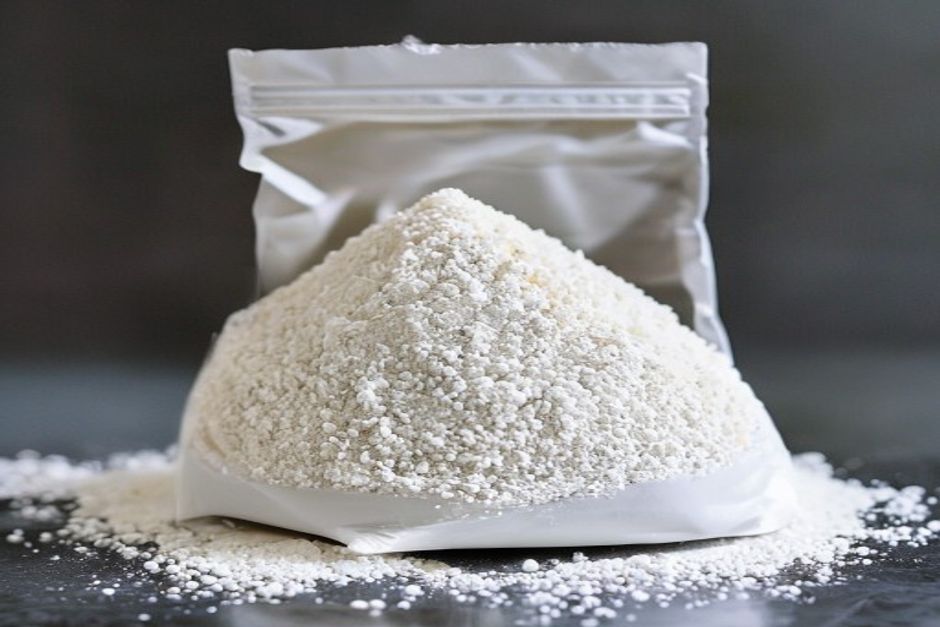
Why pseudo boehmite is the standard ceramic coating for lithium battery separators
AluminaWorld is a Zibo, Shandong-based Chinese manufacturer of high-purity pseudo boehmite (AlOOH) supplied to lithium battery separator coating lines in 25+ countries. In a lithium-ion battery, the separator is a porous polymer membrane (typically polyethylene PE or polypropylene PP) that physically separates the anode and cathode while allowing lithium ions to pass through the electrolyte. Bare PE separators shrink at 130-135°C, which can cause internal short circuits and thermal runaway if the cell temperature rises during abuse conditions (overcharge, external short, nail penetration). A ceramic coating of pseudo boehmite (AlOOH) on the separator surface raises the thermal shutdown temperature to 170-180°C, providing critical seconds of additional time for safety systems to respond.
Beyond thermal protection, the AlOOH coating layer improves electrolyte wettability — the hydroxyl groups (-OH) on the boehmite surface attract polar carbonate-based electrolytes (EC, EMC, DMC), reducing the time required for electrolyte filling during cell assembly. The coating also provides a uniform scaffold that helps distribute lithium-ion flux evenly across the separator area, reducing localized current density hot spots that cause lithium plating and capacity fade.
Chemistry: how AlOOH transforms into a protective ceramic layer
Pseudo boehmite (γ-AlOOH) is a layered aluminum oxyhydroxide with the composition Al₂O₃·H₂O. When applied as a water-based slurry to PE or PP separator and dried at 80-120°C, the boehmite layer retains its crystal structure. Above 450°C, it transitions irreversibly to γ-Al₂O₃ (gamma alumina). For separator coating applications, the boehmite is NOT calcined to gamma alumina before coating — instead, the dried AlOOH layer is preserved, and any subsequent thermal exposure (cell formation, hot pressing, abuse conditions) drives the in-situ transition to γ-Al₂O₃.
The key property difference between pseudo boehmite and gamma alumina for separator coating is dispersibility. Pseudo boehmite disperses easily in water at 20-40% solids with simple stirring, while gamma alumina typically requires organic solvents (NMP, ethanol) or specialty dispersants. Water-based coating is strongly preferred in lithium battery manufacturing because it eliminates NMP solvent recovery and reduces fire risk during the drying process.
Separator-grade pseudo boehmite specifications
AluminaWorld's separator-grade pseudo boehmite meets tight specifications on purity, particle size, and surface chemistry. The table below summarizes typical values for the three most-requested grades.
| Parameter | PB-Sep-1.0 | PB-Sep-1.5 | PB-Sep-2.0 |
|---|---|---|---|
| D50 (median particle size) | 1.0 μm | 1.5 μm | 2.0 μm |
| D90 (90th percentile) | < 3.0 μm | < 4.0 μm | < 5.0 μm |
| Al₂O₃ content (after calcination) | ≥ 99.9% | ≥ 99.9% | ≥ 99.9% |
| Fe₂O₃ impurity | ≤ 30 ppm | ≤ 30 ppm | ≤ 30 ppm |
| SiO₂ impurity | ≤ 50 ppm | ≤ 50 ppm | ≤ 50 ppm |
| Na₂O impurity | ≤ 50 ppm | ≤ 50 ppm | ≤ 50 ppm |
| BET surface area | 200-280 m²/g | 180-240 m²/g | 150-200 m²/g |
| Pore volume | 0.40-0.55 cm³/g | 0.35-0.50 cm³/g | 0.30-0.45 cm³/g |
| Moisture (105°C, 2h) | ≤ 0.5% | ≤ 0.5% | ≤ 0.5% |
| Typical application | Consumer Li-ion | EV power battery | ESS energy storage |
Purity is critical for lithium battery applications. Iron contamination above 50 ppm catalyzes electrolyte decomposition at the cathode, causing gas generation, swelling, and capacity fade over 200-500 cycles. Sodium contamination above 100 ppm interferes with the SEI (solid electrolyte interphase) layer formation, increasing irreversible capacity loss during the first cycle. AluminaWorld's ISO 9001-certified Zibo production line delivers Fe₂O₃ ≤ 30 ppm and Na₂O ≤ 50 ppm on every batch, with certificate of analysis (COA) provided per shipment.
Why D50 0.7-2.0μm is the optimal particle size range
Particle size directly determines coating quality, electrolyte uptake, and cell performance. Below D50 0.5 μm, boehmite particles are too fine — they clog the slot die during coating, producing pinhole defects in the coated layer that allow dendrite growth and short circuits. Above D50 3.0 μm, the coating layer becomes too rough, creating uneven lithium-ion flux and localized current density spikes that accelerate capacity fade.
AluminaWorld's separator grades are tuned to three D50 targets: 1.0 μm for consumer Li-ion cells (high energy density requirement, 2-3 μm coating thickness), 1.5 μm for EV power batteries (high cycle life, 3-4 μm coating thickness), and 2.0 μm for ESS energy storage systems (lower cost focus, 4-5 μm coating thickness). D90 is held below 5 μm across all three grades to ensure uniform slot-die coating without streaking.
Coating process: slot-die vs gravure vs spray
Three coating methods dominate lithium battery separator manufacturing. Slot-die coating is the most common for single-side or double-side continuous coating of wide-format rolls (1000-1500 mm width), producing 2-4 μm uniform thickness at line speeds of 30-80 m/min. Gravure coating uses an engraved roll to transfer a metered amount of slurry, suitable for thinner 1-2 μm layers and pattern-coated separators. Spray coating is used for laboratory-scale R&D and small-batch production, but is rarely used in mass production because of overspray losses and uneven coverage.
AluminaWorld's PB-Sep grades are optimized for slot-die coating with a viscosity range of 50-500 mPa·s at 25°C (Brookfield, spindle 2, 60 rpm) — the recommended starting point for a 30% solids water-based slurry. Customers using gravure coating may need to dilute to 15-25% solids and add a rheology modifier (typically 0.1-0.5% HPMC or CMC) to achieve the right transfer characteristics.
Thermal stability: 180°C shutdown vs 130°C uncoated
The thermal protection mechanism of boehmite-coated separators works in two stages. At 130-140°C, the PE base film begins to shrink and lose porosity, but the boehmite ceramic layer remains intact, holding the separator geometry and preventing the anode-cathode contact. The "shutdown temperature" is conventionally defined as the temperature at which the separator maintains integrity; for boehmite-coated PE, this is 170-180°C, a 40-50°C improvement over uncoated PE.
At 180-200°C, the boehmite layer itself begins to transition to γ-Al₂O₃, but the structural integrity of the coating is maintained until 220-250°C, beyond which the separator fails completely. This multi-stage protection is a key reason boehmite-coated separators are now standard in EV power batteries, where regulatory requirements (UN 38.3, IEC 62660, GB/T 31467) mandate thermal abuse testing at 150°C and nail penetration without fire or explosion.
AluminaWorld's separator-grade pseudo boehmite supply
AluminaWorld operates a 28,000 m² production facility in Zibo, Shandong Province, China, with 4 dedicated pseudo boehmite production lines. Annual capacity is 12,000 metric tons, with 40% allocated to lithium battery separator coating grades. The company has supplied PB to separator coating lines in China, South Korea, Japan, Germany, and the United States since 2018, with ISO 9001:2015 certification and REACH registration for the EU market.
Standard MOQ is 500 kg per grade per shipment, with lead time 7-15 days for stock specifications (PB-Sep-1.0, PB-Sep-1.5, PB-Sep-2.0) and 15-25 days for custom D50 targets. Sample orders of 1-5 kg ship within 3 days via DHL/FedEx for customer evaluation. Packaging is 25 kg sealed HDPE drums with nitrogen purge to prevent moisture pickup during transit. Bulk packaging in 500 kg or 1000 kg super sacks is available on request.
Related products and applications
Pseudo boehmite is one of six major alumina product families supplied by AluminaWorld. The other five are activated alumina (for gas drying and water treatment), molecular sieve 3A/4A/5A/13X (for gas purification), ZSM-5 zeolite (for catalysis and MTO), alumina ceramic balls (for catalyst support and heat storage), and aluminum hydroxide ATH (for flame retardancy). For lithium battery applications, customers often pair separator-grade pseudo boehmite with activated alumina for electrolyte drying and molecular sieve 4A for nitrogen purification in dry rooms.
For technical datasheets, COAs, or a quote for separator-grade pseudo boehmite, contact AluminaWorld via WhatsApp at +86 133 2522 2240 or by email at sales@aluminaworld.com. Sample requests are typically processed within 24 hours.
Frequently Asked Questions
What is pseudo boehmite used for in lithium batteries?
Pseudo boehmite (AlOOH) is used as a ceramic coating on PE/PP lithium battery separators to raise thermal shutdown from 130-135°C to 170-180°C and improve electrolyte wettability. AluminaWorld's separator-grade PB has D50 0.7-2.0μm and 99.9% Al₂O₃ purity.
Why pseudo boehmite over gamma alumina for separator coating?
Pseudo boehmite disperses in water at 20-40% solids, while gamma alumina typically requires organic solvents. Water-based boehmite coating eliminates NMP recovery, reduces fire risk, and the -OH groups improve electrolyte wettability.
What particle size is best for separator coating?
D50 0.7-2.0μm is optimal. Below 0.5μm clogs slot die; above 3μm creates rough coating. D90 should be below 5μm. AluminaWorld supplies three stock grades: 1.0, 1.5, 2.0μm.
What is the typical coating thickness and weight?
2-4 μm per side, 8-15 g/m² coating weight. Thinner coatings (under 2μm) lack thermal protection; thicker (over 6μm) increase internal resistance.
What is the MOQ and lead time?
MOQ 500 kg. Lead time 7-15 days for stock grades, 15-25 days for custom D50. Sample 1-5 kg ships in 3 days. Packaging: 25 kg HDPE drums, nitrogen purged.
Can pseudo boehmite be used as a cathode binder or additive?
Limited use as binder. Nano-boehmite (D50 < 0.3 μm) is used at 1-3% loading as a cathode coating additive to scavenge HF from LiPF6 decomposition, extending cycle life. AluminaWorld supplies this as a separate grade.
Get a Quote for Separator-Grade Pseudo Boehmite
AluminaWorld supplies high-purity AlOOH to separator coating lines worldwide. Standard MOQ 500 kg. Sample 1-5 kg ships in 3 days.