
Activated Alumina Guard Bed in Air Separation Plants
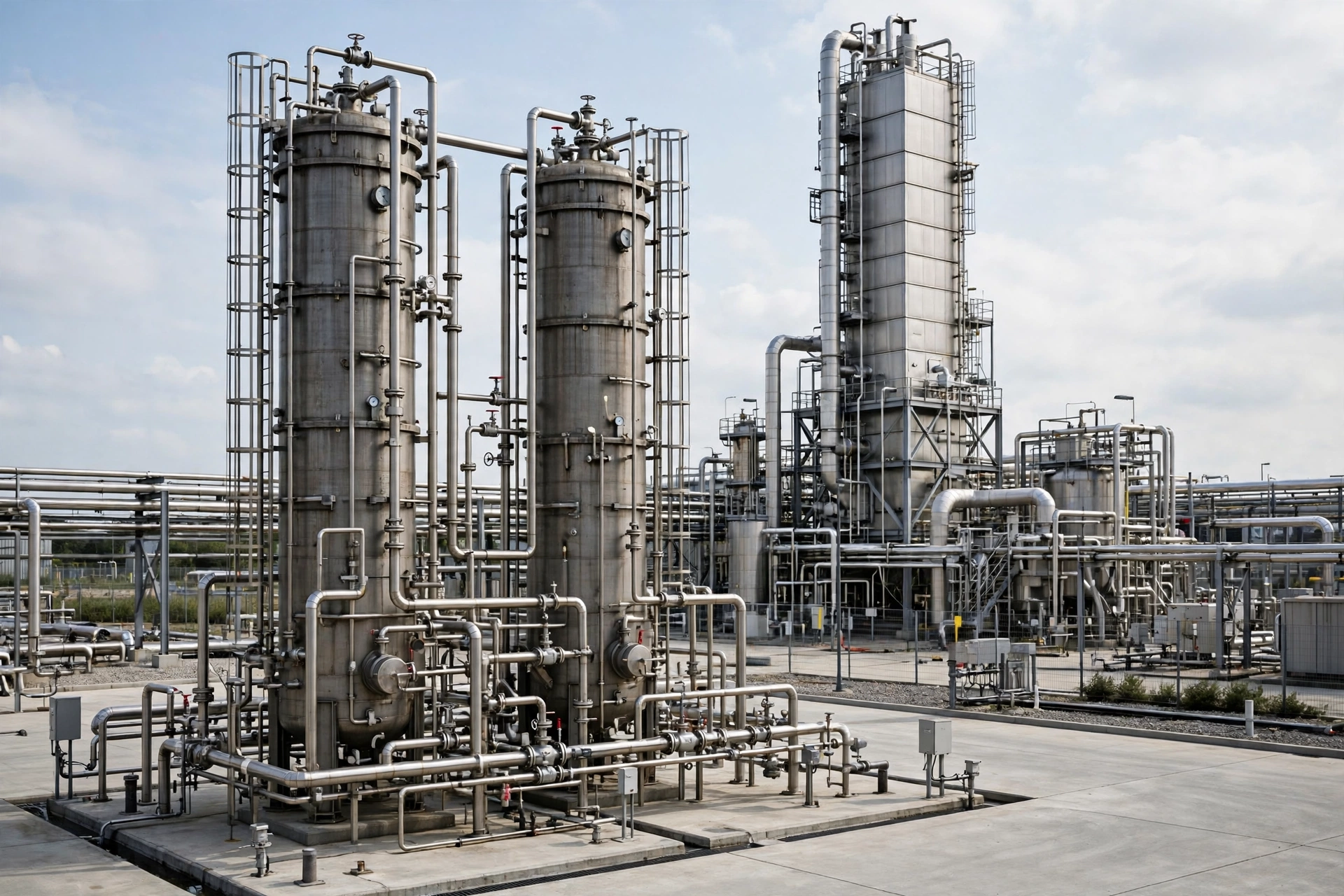
An air separation unit freezes air to below −170 °C to split it into oxygen, nitrogen and argon. At those temperatures, water and carbon dioxide do not stay gases — they freeze solid, block exchangers and shut the cold box down. That is why every cryogenic air separation plant puts a pre-purifier in front of the cold box, and why the first layer inside that pre-purifier is almost always activated alumina.
This guide is for plant engineers and buyers: what the activated alumina guard layer does, how the two-layer bed works, how to size and specify it, how to tell when the guard layer — rather than the 13X behind it — is failing, and how to plan a change-out.
Why Water Has to Go First — and Why 13X Cannot Take It Alone
In an air separation pre-purifier, activated alumina takes the water so 13X can take the CO2.
Compressed feed air arrives saturated with water vapour, and the aftercooler always lets some liquid water through as carryover. Molecular sieve 13X is the adsorbent that removes CO2 to cryogenic specification — but its CO2 capacity collapses when it is wet, and liquid water damages the sieve structure over repeated cycles. So the water has to be taken out first, by an adsorbent that is good at water and tolerant of it. Activated alumina is that adsorbent: at humid conditions its static water capacity is higher than 13X — our 13X pre-purification guide notes 17–22 wt% at 25 °C and 50% relative humidity — and it tolerates occasional liquid water carryover that would shorten a zeolite bed’s life. It is also cheaper per tonne than 13X, so bulk water removal belongs on alumina, not on the more expensive sieve.
One limit to state plainly: activated alumina does not remove CO2 in air separation service. At the low CO2 partial pressure of compressed feed air, its CO2 capacity is small. CO2 removal is 13X’s job, and any specification that asks the guard layer to remove CO2 is mis-specified. The guard layer’s job is water — and protecting the layer behind it.
How the Two-Layer Bed Works
The pre-purifier is one vessel with two jobs, split between two layers in series.
Feed air enters the bottom of the vessel and meets the activated alumina layer first. That layer strips the bulk of the water vapour and catches liquid carryover. Dry air then passes into the 13X layer, which removes CO2 and trace hydrocarbons down to the parts-per-million levels the cold box needs. Two vessels alternate: while one adsorbs, the other regenerates, so the plant never stops for the pre-purifier. Regeneration gas flows in the reverse direction, driving water off the alumina and CO2 off the sieve, and the regeneration temperature follows the adsorbent datasheet — 170–250 °C for activated alumina.
| Layer | Position in feed flow | Main job | If it fails |
|---|---|---|---|
| Activated alumina guard layer | First — feed enters here | Removes bulk water vapour; catches liquid water carryover | Outlet dew point rises; 13X wets up and CO2 slips soon after |
| Molecular sieve 13X layer | Second — after the guard layer | Removes CO2 and trace hydrocarbons to cryogenic specification | CO2 breakthrough; ice forms in the cold box |
The split is deliberate: the cheaper, water-tolerant layer takes the heavy load, and the expensive, CO2-selective layer sees only dry air and lasts longer. Support layers of inert ceramic balls at the top and bottom of the vessel hold the adsorbents in place and spread the flow evenly.
Sizing and Specifying the Guard Layer
Specify the guard layer from the datasheet, not from a catalogue headline.
Three numbers decide whether a guard layer survives its service life: crush strength, attrition and surface area. Large vessels usually load 3–5 or 4–6 mm spherical beads — small enough for fast water uptake, large enough to keep pressure drop low. Check crush strength against the weight of the bed above and the thermal cycling of regeneration: on the Aluminaworld datasheet the values run ≥130, ≥180 and ≥210 N/particle by bead size. Attrition loss of ≤0.1 wt% matters because fines raise pressure drop and migrate into the 13X layer, where they cannot be removed without a full rebed.
| Property | Unit | Value |
|---|---|---|
| Bead size | mm | 1–3 · 2–4 · 3–5 · 4–6 · 5–8, spherical beads |
| BET surface area | m²/g | 300–360 |
| Pore volume | cm³/g | 0.38–0.48 |
| Bulk density | g/cm³ | 0.68–0.75 |
| Crush strength | N/particle | ≥130 / ≥180 / ≥210 by size |
| Attrition loss | wt% | ≤0.1 |
| Al2O3 content | % | ≥93 |
Order quantity comes from the bed volume: mass (kg) = bed volume (m³) × bulk density (680–750 kg/m³). Add a small top-up allowance for settling after the first regeneration cycles, and confirm the bead size against the vessel design and the pressure-drop budget before ordering — changing size after delivery means re-ordering, not re-grading.
Failure Signals That Point at the Guard Layer
When a pre-purifier underperforms, the order in which symptoms appear tells you which layer is failing.
1. Outlet dew point rises while CO2 stays in specification
The guard layer is exhausted, flooded or channelled; the 13X is still dry and doing its job. Check regeneration first: heater output, purge gas flow and cycle time.
2. CO2 slips while the dew point stays low
The 13X layer is the problem, not the guard layer. Do not rebed alumina to fix a sieve fault.
3. Pressure drop climbs across the vessel
Fines from attrition or crushed beads are blocking flow. Check the outlet filter for dust; a dusty lot usually traces back to rough handling or a low crush-strength grade.
4. The bed will not dry during regeneration
The regeneration outlet temperature stays low or the cycle runs long. Check the heater and the dry purge gas supply before blaming the adsorbent; a guard layer that never fully regenerates loses capacity a little every cycle.
If a full regeneration at 170–250 °C does not restore the outlet dew point, plan a rebed. Oil or heavy hydrocarbon contamination does not regenerate out — it coats the pores and the capacity is gone.
Planning a Guard-Layer Change-Out
A guard-layer change-out is planned around a turnaround, not ordered when the bed is already failing.
Plan the change-out with the 13X bed at a plant turnaround, and order early: bulk production lead time is 15–25 days, and a shutdown slot waits for no supplier. Order the full bed quantity plus a top-up allowance, in the packaging that fits the job — 25 kg bags for top-ups, 150 kg steel drums for medium lots, 800/1000 kg bulk bags for a full bed. Keep the packaging sealed until loading day: alumina that dries the warehouse air has no capacity left for the feed air.
Check every delivery before it is loaded — COA against the order, packaging intact, and the delta-T spot test described in our storage and receiving guide. Load dense, on inert support layers, and avoid free-fall from height: beads that break on loading become the fines that raise pressure drop a year later.
For the numbers behind this guide, see the activated alumina product page, our 13X pre-purification guide for cryogenic air separation and the regeneration temperature guide.
Frequently Asked Questions
Does activated alumina remove CO2 in an air separation pre-purifier?
No. At the low CO2 partial pressure of compressed feed air, activated alumina's CO2 capacity is small. Its job is water; 13X removes the CO2. Specifying the guard layer for CO2 removal is a mis-specification.
How long does an activated alumina guard layer last?
There is no fixed calendar life. With clean feed air and correct regeneration, a guard layer serves for multiple years; plants plan change-outs together with the 13X bed at turnarounds. Replace on evidence — outlet dew point and capacity after regeneration — not on a date.
What bead size should I order for a pre-purifier guard layer?
3–5 or 4–6 mm spherical beads suit most large vessels. Confirm the size against the vessel design and the pressure-drop budget; smaller beads suit small skids and pilot units.
Can a spent guard layer be regenerated instead of replaced?
Yes — in place, by a full regeneration cycle at 170–250 °C with dry purge gas. If the outlet dew point does not recover, or the bed is oil-fouled, rebed: contamination that coats the pores does not regenerate out.
If your pre-purifier outlet dew point is drifting up, or a turnaround change-out is coming up, send us the vessel size, bead size and feed conditions — our engineers will confirm the grade and quantity: barry@okkinc.com.
Get a Quote
Tell us the product, grade and quantity. We reply within 12 hours with EXW pricing and lead time.
- ✓ COA and technical datasheet with every shipment
- ✓ EXW pricing — freight calculated per order
- ✓ Engineering consultation on grade selection and loading
Prefer to talk now?
WhatsApp +86 133 2522 2240
or email barry@okkinc.com