Activated Alumina for Pharmaceutical Process Air: GMP, FDA 21 CFR Part 211 Moisture Control, and Validation Protocol
If you operate a GMP pharmaceutical plant - API synthesis, oral solid dose, aseptic filling, lyophilization, or cleanroom HVAC - your compressed air and process gas quality is regulated by FDA 21 CFR Part 211.72 and EU GMP Annex 1. Activated alumina desiccant beds are the equipment that delivers the moisture part of that requirement. This guide covers the chemistry, sizing math, dew point targets, validation IQ/OQ/PQ, USP <659> extractables, oil-vapor handling, and 7-year total cost of ownership for pharmaceutical-grade desiccant air dryers.
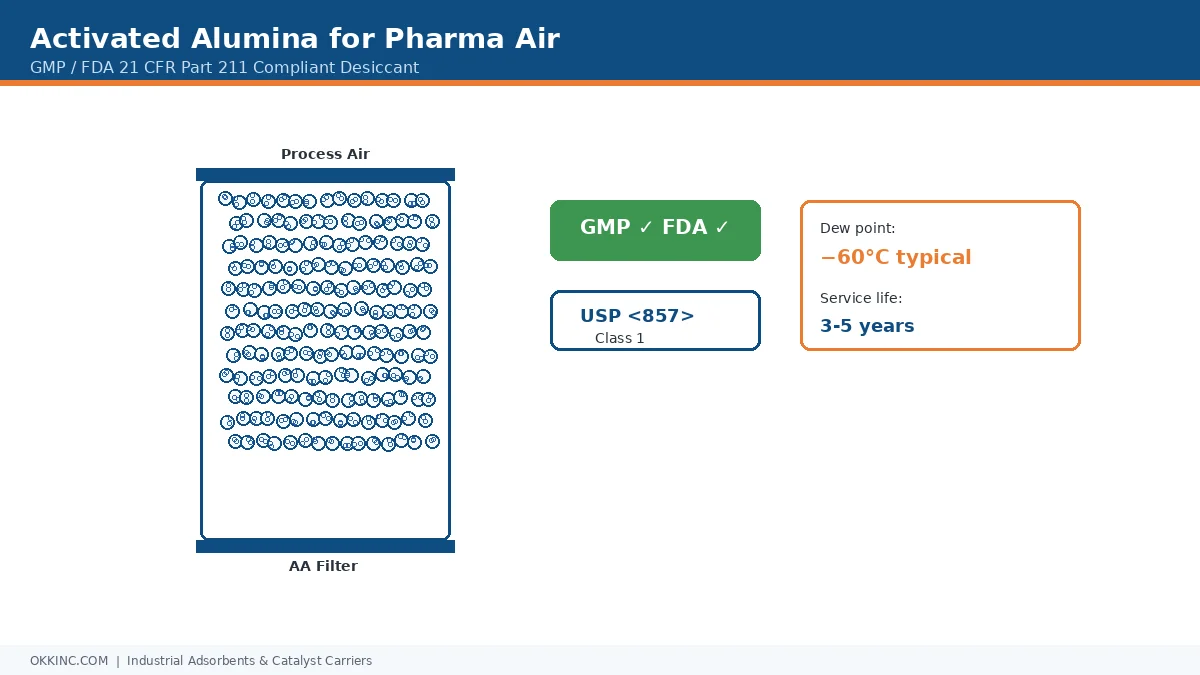
Why Pharmaceutical Process Air Quality Is a Regulatory Topic
In a pharmaceutical plant, the air that contacts your product is just as critical as the water that goes into your formulation. Compressed air drives pneumatic conveyors, blow-off nozzles, fluid-bed granulators, and coating pans. Nitrogen blankets API synthesis reactors, lyophilizer chambers, and sterile holding tanks. Process air aerates fermentation broths and dries wet granules before milling. In every one of these applications, the air or gas reaches the product - either directly through a vent filter or indirectly through a piece of equipment that touches the product.
FDA 21 CFR Part 211.72 says, in plain language, that any gas that contacts a drug product or its container-closure must be filtered, dried, and handled in a way that does not contaminate the product. The regulation does not name a specific dew point, but it requires the manufacturer to define and justify a limit based on product risk. In practice that limit is set by referencing ISO 8573-1 purity classes, and the equipment that meets those classes is almost always an activated alumina desiccant dryer paired with particulate and coalescing filters.
EU GMP Annex 1 (the 2022 revision) tightened this further. Paragraph 8.123 requires Grade A and Grade B aseptic zones to be supplied with appropriately filtered air at controlled temperature, humidity, and differential pressure. Paragraph 8.124 limits viable and total particle counts in those zones to the ISO 14644-1 Class 5 / Grade A envelope. The activated alumina bed in your dryer is what guarantees the humidity part of that envelope. If the dew point drifts from -40 degrees C to -20 degrees C because the alumina is exhausted, you may not detect a particle excursion immediately, but the relative humidity in the aseptic core will rise, the differential pressure will collapse, and microbial contamination risk rises sharply.
This article is for the pharmaceutical engineer, validation specialist, QA manager, and procurement lead who needs to specify, validate, and maintain an activated alumina desiccant dryer that satisfies cGMP. We will cover:
- The chemistry of activated alumina and why it is preferred over silica gel and molecular sieve for pharmaceutical service
- FDA 21 CFR Part 211 and EU GMP Annex 1 requirements, mapped to ISO 8573-1 dew point classes
- Dew point targets for each pharmaceutical application: non-sterile API, oral solid dose, aseptic filling, lyophilizer nitrogen, cleanroom HVAC
- Bed sizing math, twin-tower dryer design, and regeneration parameters
- IQ/OQ/PQ validation protocol, including USP <659> extractables and ICH Q3D elemental impurities
- Oil vapor handling, compressor selection, and three-stage filtration train
- Bed replacement intervals, performance trending, and 7-year total cost of ownership
The Chemistry: Why Activated Alumina Works for Pharma Air
Activated alumina is a synthetic, porous form of aluminum oxide (gamma-Al2O3) made by carefully dehydrating aluminum hydroxide (Al(OH)3 or AlOOH) at 300 to 600 degrees C. The dehydration leaves a rigid framework of interconnected micropores with a total surface area of 300 to 360 m2/g and a pore volume of 0.40 to 0.50 cm3/g. Most of the pore volume is in the 2 to 10 nanometer range - wide enough to admit water molecules easily but narrow enough to provide a high density of adsorption sites per unit volume.
Water adsorption on activated alumina is a combination of physisorption and chemisorption. At low relative humidity (below 30 percent), water molecules hydrogen-bond to surface hydroxyl groups in a chemisorbed monolayer. As humidity rises, additional layers physisorb on top of the first layer, and below the bulk saturation pressure capillary condensation fills the smaller pores. The resulting isotherm has a Type IV shape with a steep rise between 10 and 50 percent relative humidity. For a pharmaceutical air dryer, the relevant part of the isotherm is the very low humidity tail - dew points below -40 degrees C correspond to roughly 100 to 500 ppmv water in the air, or relative humidity below 0.5 percent at room temperature.
Activated alumina can take up 12 to 18 wt percent water at 60 percent relative humidity and 25 degrees C, of which 6 to 9 wt percent is recoverable under standard regeneration conditions. Compared to silica gel (which adsorbs 30 to 40 wt percent water at the same humidity but tops out near -40 degrees C dew point) and to molecular sieve 4A (which adsorbs only 18 to 22 wt percent water but can reach -80 degrees C dew point), activated alumina sits in the practical middle. It hits the dew point range that most pharmaceutical plants actually need (-20 to -70 degrees C pressure dew point), regenerates at moderate temperatures (150 to 200 degrees C), and tolerates the occasional oil or particulate upset better than either of the alternatives.
Comparison with silica gel
Silica gel is cheaper per kilogram but has two structural disadvantages for pharmaceutical service. First, its equilibrium water capacity drops sharply above 120 degrees C, which limits regeneration temperature. Second, silica gel beads are mechanically weaker than activated alumina, with crush strength of 30 to 50 N per bead versus 65 to 130 N for high-grade activated alumina. In a tall pharmaceutical dryer bed (1 to 1.5 m), silica gel can crush under its own weight plus the pressure drop load, generating fines that migrate downstream and clog the final filter. Activated alumina avoids this failure mode. Silica gel is still used in some packaging applications (desiccant sachets, container desiccants) where its lower cost and lower regeneration temperature are acceptable.
Comparison with molecular sieve (4A, 13X)
Molecular sieves achieve deeper dew points because their uniform pore openings create a much stronger adsorption field. 4A has 4 Angstrom pores that admit water but exclude oxygen and nitrogen; 13X has 10 Angstrom pores that admit everything. In a pharmaceutical air dryer, 4A and 13X are sometimes used for the polishing leg of a two-stage dryer - activated alumina up front to handle the bulk water, then a molecular sieve bed to bring the dew point below -70 degrees C. The downside is that molecular sieve must be regenerated at 220 to 280 degrees C, which requires a more powerful heater, longer cooldown, and more elaborate validation. For most pharmaceutical plants the single-stage activated alumina dryer is sufficient and easier to qualify.
Regulatory Framework: FDA 21 CFR Part 211, EU GMP Annex 1, and ISO 8573-1
The cGMP regulations do not write a single dew point number into the rulebook. Instead, they require the manufacturer to define and justify appropriate limits. This is intentional - the regulators want you to do the engineering thinking, not just check a box. The practical framework that most pharmaceutical QA departments use to do that thinking is built on three layers.
Layer 1: FDA 21 CFR Part 211.72
This is the US baseline. It reads, in relevant part: "Equipment for adequate control over air pressure, dust, humidity, and temperature shall be provided when appropriate for the manufacture, processing, packing, or holding of a drug product. Equipment used to filter, dry, or otherwise handle compressed air or other gases that contact a drug product or its container-closure system shall be designed and constructed so that it does not contribute to product contamination." The regulation requires filtration, drying, and prevention of contamination. It does not specify dew point or filter rating; that comes from the next two layers.
Layer 2: ISO 8573-1 purity classes
ISO 8573-1:2010 defines contaminant classes for compressed air. The relevant class for most pharmaceutical applications is shown in the table below. Each class sets a maximum contaminant level; you pick the class that matches your product risk profile and design the dryer to meet it. The dew point numbers in ISO 8573-1 are referenced at line pressure, not at atmospheric - this matters because the same water vapor concentration reads as a colder dew point at higher pressure.
| ISO 8573-1 Class | Pressure Dew Point (degrees C) | Typical Pharmaceutical Use |
|---|---|---|
| Class 1 | -70 | Lyophilizer chamber N2, biologics aseptic filling, blow-fill-seal |
| Class 2 | -40 | Aseptic filling, sterile API synthesis, fermentor air, blow-off nozzles |
| Class 3 | -20 | Non-sterile API, oral solid dose granulation, fluid bed, coating |
| Class 4 | +3 | Instrument air, pneumatic conveyors (non-product-contact) |
| Class 5 | +7 | General plant air, utilities (not for product contact) |
| Class 6 | +10 | Workshop air (rarely used in pharma) |
Layer 3: EU GMP Annex 1 (2022 revision)
The Annex 1 revision, which came into force in August 2023, added explicit expectations for aseptic processing environments. Paragraph 8.123 requires Grade A and Grade B zones to be supplied with HEPA-filtered air at controlled temperature, relative humidity (typically 30 to 65 percent for Grade B), and differential pressure (10 to 15 Pa between Grade B and Grade C). Paragraph 8.124 sets the particle limits for those zones. Paragraph 8.129 explicitly requires that the air supplied to aseptic zones be of appropriate quality, with periodic monitoring of pressure differentials, airflow, and humidity.
The point for the desiccant dryer specification is that the activated alumina bed is the equipment that controls the humidity term. If you are sizing a new aseptic facility or upgrading an existing one, the dryer capacity must match the AHU capacity with a margin for upset conditions, and the dew point must be at least one class better than the worst-case room condition you are willing to accept.
Dew Point Targets by Pharmaceutical Application
Different pharmaceutical applications require different dew point levels, and the activated alumina bed is sized differently for each. The list below is the consensus target that most cGMP plants use; specific products may require tighter limits based on stability data.
Non-sterile API synthesis
Air supplied to API reactor vents and transfer lines should be at ISO 8573-1 Class 3 moisture (-20 degrees C pressure dew point) at minimum. Most chemical synthesis reactions tolerate small amounts of water vapor, but moisture control prevents hydrolysis of sensitive intermediates and reduces the load on the reactor's molecular sieve driers downstream. Class 2 (-40 degrees C) is increasingly common in modern API plants as a margin against upset conditions.
Oral solid dose manufacturing
Fluid bed granulators, coating pans, and tablet presses all use compressed air. The critical quality attribute is residual moisture in the granules, which is controlled by the dryer in the fluid bed itself, not by the compressed air. However, the air supplied to the product-contact surfaces of the tablet press should be Class 2 (-40 degrees C) or better to prevent tablet sticking and picking. Most OSD facilities use Class 3 (-20 degrees C) for general process air and Class 2 (-40 degrees C) for the press envelope.
Aseptic filling and lyophilization
Aseptic filling lines are the most demanding pharmaceutical application for compressed air and nitrogen. The air that contacts the open vial, the stopper hopper, or the lyophilizer chamber must be at ISO 8573-1 Class 2 (-40 degrees C) or Class 1 (-70 degrees C) for biologics and freeze-dried injectables. The activation alumina dryer must be sized with enough margin to maintain Class 1 throughout the adsorption cycle, not just at the start. Most modern aseptic lines use a heated blower-purge dryer with 350 to 1300 kg of activated alumina per tower, paired with a 0.01 micron final filter on each gas service line.
Cleanroom HVAC make-up air
The cleanroom air handling unit controls temperature, humidity, and particle counts. The desiccant dryer's role is to dry the make-up air enough to (1) prevent coil sweating in the AHU cooling coil, (2) prevent microbial growth in ductwork, and (3) maintain the room relative humidity between 30 and 65 percent as required by Annex 1. The target for make-up air is typically ISO 8573-1 Class 3 (-20 degrees C pressure dew point), which is sufficient when paired with a downstream cooling and reheat coil. Higher humidity setpoints in Grade C and Grade D zones may allow Class 4.
Nitrogen for API and biologics
Nitrogen is supplied from cylinders, dewars, or PSA generators. Cylinder and liquid nitrogen dew points are inherently very low (-60 degrees C or better at source), so the activated alumina dryer on a nitrogen service is typically a polishing unit to ensure the distribution piping does not introduce moisture downstream. For on-site PSA nitrogen, the activated alumina bed is part of the generator and is sized to deliver Class 2 (-40 degrees C) dew point at the user station.
Bed Sizing and Twin-Tower Dryer Design
A pharmaceutical air dryer is almost always a twin-tower (sometimes three-tower) pressure swing adsorption unit with two parallel beds of activated alumina. While one bed is on adsorption drying the process air, the other is being regenerated by a slipstream of dry, heated purge gas. The towers switch at fixed intervals (typically 6 to 10 hours per cycle for heated dryers) or based on a dew point trigger.
The sizing calculation
The starting point is the required air flow and target dew point. The desiccant loading per tower is calculated from the adsorption cycle time and the working water capacity of the activated alumina at the operating conditions.
| Variable | Symbol | Typical Value |
|---|---|---|
| Inlet air flow | Q | 1000 Nm3/h (example) |
| Operating pressure | P | 7 bar(g) |
| Inlet air temperature | T_in | 35-40 degrees C (after-cooler outlet) |
| Inlet pressure dew point | DPP_in | +3 degrees C (saturated, after after-cooler) |
| Outlet pressure dew point | DPP_out | -40 degrees C (Class 2) |
| Adsorption cycle time | t_ads | 8 hours |
| Working water capacity at DPP_in | X | 6-9 wt percent (grade-dependent) |
| Required alumina mass per tower | M | M = (Q x t_ads x rho_air x w) / X |
For the example values above, the calculation works out to roughly 380 to 500 kg of activated alumina per tower, which lines up with the rule of thumb we gave earlier (0.35 to 0.50 kg per Nm3/h for Class 2). The bed diameter and height are then chosen to give an acceptable pressure drop. For a typical 2 to 5 mm alumina grade, superficial velocity of 0.15 to 0.30 m/s through the bed gives a pressure drop of 0.05 to 0.15 bar, which is acceptable for most pharmaceutical compressors. Bed L/D ratio of 1.5 to 2.5 gives good flow distribution without channeling.
Heated blower-purge regeneration
The desiccant bed is regenerated by a slipstream of dry air taken from the dried outlet, passed through an electric heater (or steam heater) to 150 to 200 degrees C, then blown upflow through the saturated tower by a small blower. The purge gas picks up water from the alumina, exits the top of the tower wet, and is vented to atmosphere. The tower is then allowed to cool (or actively cooled with unheated dry air) to within 10 to 15 degrees C of the inlet air temperature before being switched back into adsorption. Total regeneration time is 4 to 6 hours including the cooling step.
For a 1000 Nm3/h pharmaceutical dryer, the heater rating is typically 10 to 25 kW and the purge blower is 0.5 to 1.5 kW. The purge air consumption is 3 to 6 percent of the nameplate inlet flow - much lower than the 12 to 18 percent of a heatless (pressure swing) dryer. The lower purge consumption saves 50,000 to 100,000 kWh per year of compressed air energy at typical pharmaceutical electricity costs, which usually justifies the heater within 2 to 3 years.
IQ/OQ/PQ Validation Protocol
The validation package for a pharmaceutical-grade desiccant air dryer is anchored in FDA 21 CFR Part 211.63 (equipment design and construction), Part 211.72 (compressed air handling), and Part 211.100 (written procedures), plus EU GMP Annex 15 (qualification and validation). Below is the minimum validation tree that most QA departments require. Each item is a separate document or section in the validation master plan.
| Document | Purpose | Key Content |
|---|---|---|
| URS | User Requirement Specification | Flow, pressure, dew point class, ISO 8573-1 class, ambient conditions, utilities available |
| FRS | Functional Requirement Specification | Instruments, alarms, interlocks, control loop architecture, redundancy |
| DS | Design Specification | Vessel drawings, P&ID, material certificates, ASME / PED compliance |
| IQ | Installation Qualification | Component verification, calibration certificates, weld inspection, utility connections |
| OQ | Operational Qualification | Heater, valve, controller, alarm tests; challenge tests for sustained overload |
| PQ | Performance Qualification | Dew point, pressure drop, noise across three consecutive adsorption cycles |
| SAT | Site Acceptance Test | Vendor and user QA sign-off at site |
| Extractables / Leachables | ICH Q3D, USP <659>, BPOG protocol | Alumina CoA, elemental impurities, water-soluble extractables |
| Sieve Change SOP | Spent-bed removal and disposal | Quarantine of drug product during changeover, disposal route, change control |
USP <659> extractables and elemental impurities
USP <659> (Packaging and Storage Requirements) classifies activated alumina as a desiccant and permits its use in pharmaceutical packaging. For indirect product contact in process air dryers, the activated alumina is not a drug component, so it is not directly subject to ICH Q3D elemental impurities limits. However, EU and FDA inspectors increasingly expect a documented extractables study for any air dryer that supplies aseptic zones. The minimum package is:
- Certificate of Analysis from the alumina supplier showing heavy metals (Pb <10 ppm, As <3 ppm, Cd <1 ppm, Hg <1 ppm)
- Water-soluble extractables test (gravimetric, <0.1 percent by weight)
- Elemental impurities screen by ICP-OES against ICH Q3D oral PDE limits
- For aseptic applications, a full BPOG-style extractables study with multiple solvents and analytical techniques (LC-MS, GC-MS, ICP-MS)
Most reputable activated alumina suppliers provide the first two as standard with every lot. The BPOG-style study is project-specific and is usually commissioned by the pharmaceutical company, not the alumina supplier. Plan for 6 to 12 weeks of lab work and 50,000 to 150,000 USD per study.
Dew point verification during PQ
The PQ must include three consecutive adsorption cycles at the nameplate flow, with the outlet dew point measured at the end of each cycle. The measurement should be done with a calibrated chilled mirror hygrometer (e.g., MBW or EdgeTech) traceable to NIST. Capacitive polymer sensors are too inaccurate for cGMP work; they read 5 to 10 degrees C high at -40 degrees C and should not be used for PQ. Aluminum oxide capacitance sensors are a step better but still not as accurate as chilled mirror at pharmaceutical dew points.
The acceptance criterion is that the outlet dew point remains at or below the URS target (e.g., -40 degrees C for Class 2) at the end of the 8-hour adsorption cycle. A typical PQ trend shows the dew point starting at -60 to -70 degrees C right after tower switch and drifting up to -40 to -45 degrees C as the bed saturates. If the end-of-cycle dew point exceeds the target, the bed is undersized and the PQ fails.
Oil Vapor Handling and Compressor Selection
Activated alumina adsorbs water vapor by design and tolerates incidental oil exposure, but it is not an oil-removal media. Pharmaceutical-grade dry air and nitrogen must meet ISO 8573-1 oil class 1 or 2 (less than 0.01 mg/m3 for Class 1). The standard approach is to install a three-stage filtration train upstream of the dryer:
- Particulate pre-filter (1 micron): Removes compressor wear debris and atmospheric dust that would otherwise load the coalescing filter.
- Coalescing filter (0.01 micron): Removes liquid water and oil aerosol; drains automatically. This filter must be sized for the full flow and replaced annually or at 6000 hours of operation, whichever comes first.
- Activated carbon tower (optional, oil-flooded compressors only): Removes oil vapor that the coalescer cannot catch. Carbon capacity is 30 to 50 wt percent but is consumed continuously; expect 1 to 2 years of service life.
- Desiccant dryer with activated alumina: Final water removal to the ISO 8573-1 class target.
- Particulate after-filter (0.01 micron): Stops any desiccant fines from migrating downstream.
- Sterile filter (for aseptic service, 0.2 micron hydrophobic): Final barrier before the aseptic envelope.
The compressor choice has a direct impact on the filter train. Oil-flooded screw compressors (the most common type in pharmaceutical plants) discharge oil aerosol at 2 to 5 mg/m3 at the outlet, which requires the carbon tower and frequent coalescer changes. Oil-free compressors (scroll, oil-free reciprocating, centrifugal) discharge less than 0.01 mg/m3 and may not require the carbon tower. For new pharmaceutical facilities, the trend is to install oil-free compressors for product-contact air and instrument air, accepting the higher capital cost (15 to 30 percent premium) in exchange for simpler filter trains and lower validation burden.
Bed Replacement, Performance Trending, and 7-Year TCO
Activated alumina in pharmaceutical service typically lasts 5 to 7 years before its equilibrium water capacity drops below the validated dew point target. The decline is gradual - capacity fades 5 to 10 percent per year as the micropore structure slowly degrades with thermal cycling and exposure to trace contaminants. Three things shorten the interval:
- Oil carryover. Even 1 ppmv oil vapor in the feed air coats the alumina and reduces capacity 30 to 50 percent within 6 to 12 months. Always verify the coalescer performance and replace the carbon tower if oil breakthrough is detected.
- High inlet temperature. Above 50 degrees C the adsorption isotherm shifts down. Install an after-cooler with a 35 to 40 degrees C outlet temperature for best results.
- Mechanical shock during shipping or installation. This causes fines that channel and reduce effective bed length. Always inspect alumina on receipt and reject lots with more than 1 percent fines passing a 1.4 mm sieve.
The 7-year total cost of ownership for a 1000 Nm3/h pharmaceutical activated alumina dryer, including the dryer hardware, the activated alumina consumable, the electric heater energy, the filter consumables, and the validation work, breaks down approximately as follows. The numbers are typical 2026 USD values for a turnkey installation in a regulated market.
| Cost Component | Year 1 (CAPEX + Install) | Years 2-7 (Annual OPEX) | 7-Year Total |
|---|---|---|---|
| Dryer hardware (twin-tower, 1000 Nm3/h, heated blower-purge) | $95,000 | $0 | $95,000 |
| Installation, piping, electrical | $35,000 | $0 | $35,000 |
| Initial activated alumina fill (2 x 450 kg @ 5 USD/kg pharma grade) | $4,500 | $0 | $4,500 |
| IQ/OQ/PQ validation, extractables study, BPOG | $80,000 | $5,000 | $105,000 |
| Heater electricity (15 kW x 4000 hr/yr x 0.10 USD/kWh) | $0 | $6,000 | $36,000 |
| Blower electricity (1 kW x 8760 hr/yr x 0.10 USD/kWh) | $0 | $876 | $5,256 |
| Filter consumables (coalescer, pre-filter, after-filter, sterile) | $1,200 | $1,800 | $12,000 |
| Activated alumina replacement (Year 6, full changeout) | $0 | $0 (Year 6: $5,500) | $5,500 |
| Annual dew point verification, calibration, change control | $0 | $4,500 | $27,000 |
| 7-Year TCO | $215,700 | $24,176/yr average | $325,256 |
Two notes on this TCO. First, the validation cost in Year 1 is roughly 25 percent of the total; this is normal for regulated pharmaceutical equipment and should not be cut. Second, the activated alumina consumable is only 3 percent of the 7-year TCO - the equipment, validation, and energy dominate. Buying the cheapest alumina on the market is a false economy; a 1 USD/kg price difference on 900 kg of alumina saves 900 USD in Year 1 but may trigger a 50,000 USD revalidation if the new lot fails USP <659> or has different extractables.
Aluminaworld Pharmaceutical-Grade Activated Alumina
Aluminaworld supplies a dedicated pharmaceutical grade of activated alumina that meets the requirements above. The product is manufactured under ISO 9001 quality control, with lot-level USP <659> documentation and ICH Q3D elemental impurities data on file. Each shipment includes a Certificate of Analysis and an extractables summary.
| Parameter | AW-AA-Pharma Specification |
|---|---|
| Product code | AW-AA-Pharma 2-5 |
| Particle size | 2.0-5.0 mm beads (also 1-3, 3-5, 4-6, 5-7, 6-8 mm on request) |
| Al2O3 content | >= 93 wt percent |
| Surface area (BET) | >= 320 m2/g |
| Pore volume | >= 0.40 cm3/g |
| Bulk density | 750-820 g/L |
| Crush strength | >= 130 N/bead (2-5 mm grade) |
| Attrition loss | <= 0.05 wt percent |
| Water-soluble extractables | <= 0.10 wt percent (USP <659> method) |
| Heavy metals (Pb / As / Cd / Hg) | <= 10 / 3 / 1 / 1 ppm (ICH Q3D oral PDE) |
| Equilibrium water capacity (60 percent RH, 25 degrees C) | >= 16 wt percent |
| Working capacity (regen at 180 degrees C) | >= 6.5 wt percent |
| Packaging | 25 kg sealed HDPE drum with foil liner, 200 L steel drum, or custom |
| MOQ | 25 kg (validation sample) / 500 kg (production) |
| Lead time | 7-10 days (validation sample) / 15-25 days (production) |
Full lot-level USP <659> Certificate of Analysis is provided with every shipment, including heavy metals, water-soluble extractables, surface area, pore volume, particle size distribution, attrition, and crush strength. For aseptic applications, we can supply a BPOG-style extractables summary on request (6 to 8 week lead time, additional fee).
Selection Guide: Which Activated Alumina Grade and Which Dryer
Choosing the right grade and the right dryer depends on three questions: what dew point do you need, what is the upstream oil exposure, and what is the validation budget. The table below maps the common pharmaceutical scenarios to the recommended alumina grade and dryer configuration.
| Application | Dew Point Target | Alumina Grade | Dryer Type |
|---|---|---|---|
| Non-sterile API synthesis | -20 degrees C (Class 3) | AW-AA-Pharma 3-5 | Heated blower-purge, single-stage |
| Oral solid dose, fluid bed, tablet press | -20 to -40 degrees C (Class 2 to 3) | AW-AA-Pharma 2-5 | Heated blower-purge, single-stage |
| Aseptic filling, blow-fill-seal | -40 degrees C (Class 2) | AW-AA-Pharma 2-5 | Heated blower-purge + 0.2 micron sterile filter |
| Lyophilizer chamber N2, biologics | -70 degrees C (Class 1) | AW-AA-Pharma 2-5 + 13X polishing | Two-stage: alumina + molecular sieve |
| Cleanroom HVAC make-up air | -20 degrees C (Class 3) | AW-AA-Pharma 3-5 | Heated blower-purge, single-stage |
| WFI storage tank N2 blanket | -40 degrees C (Class 2) | AW-AA-Pharma 2-5 | Heated blower-purge + 0.2 micron sterile filter |
7 Common Mistakes When Specifying Pharmaceutical Desiccant Dryers
- Specifying the dew point at atmospheric pressure instead of line pressure. A 100 ppmv water concentration reads as -40 degrees C dew point at 7 bar(g) but +10 degrees C at atmospheric. Always specify pressure dew point at the actual line pressure of the dryer outlet.
- Skipping the oil vapor analysis. An oil-flooded compressor upstream of the desiccant bed can shorten alumina life from 7 years to 1 year. Always audit the compressor oil carryover before selecting the dryer.
- Using a heatless (pressure swing) dryer for aseptic service. Heatless dryers achieve Class 2 dew point only at the start of the adsorption cycle. The dew point drifts as the bed loads. For aseptic service use a heated blower-purge dryer with a controlled regeneration temperature.
- Buying USP <659> food-grade alumina instead of pharma-grade. Food-grade alumina is suitable for indirect food contact but typically lacks the heavy metals documentation and ICH Q3D extractables data that pharmaceutical inspectors expect.
- Undersizing the heater. A 10 kW heater on a 1000 Nm3/h dryer barely reaches 150 degrees C at full purge flow. Specify the heater at the worst-case ambient temperature (typically 40 degrees C summer) and confirm it can hold 180 degrees C at full purge.
- Forgetting the spent-bed disposal SOP. When the alumina is replaced, the change must be performed under change control with a documented sieve change SOP that addresses batch quarantine, spent-bed disposal route, and replacement lot traceability.
- Not trending the dew point. A chilled mirror hygrometer with no data logging tells you the dew point today but does not show the slow drift that signals end-of-life. Install a continuous dew point transmitter with 4-20 mA output to the plant historian, and review the trend quarterly.
Frequently Asked Questions
Why do pharmaceutical plants use activated alumina instead of silica gel or molecular sieve in process air dryers?
Activated alumina is the workhorse for pharmaceutical process air drying because it hits the ISO 8573-1 Class 1 to Class 2 pressure dew point band (-40 to -70 degrees C) at moderate regeneration temperatures (150 to 200 degrees C), survives accidental oil carryover from oil-flooded compressors better than molecular sieve, and has a documented USP <659> packaging extractables profile that simplifies FDA 21 CFR Part 211.72 validation. Silica gel tops out around -40 degrees C dew point and degrades quickly above 120 degrees C. Molecular sieve (4A, 13X) achieves deeper dew points but requires 220 to 280 degrees C regeneration, which is harder to validate in cGMP plants and raises the lifetime cost of the steam or electric heater. Activated alumina is the practical choice for non-sterile API manufacturing, oral solid dose facilities, and cleanroom HVAC make-up air where Class 1 to Class 2 dryness is the regulatory target.
What does FDA 21 CFR Part 211 say about compressed and process air moisture?
FDA 21 CFR Part 211.72 requires that compressed air or other gases that contact a drug product or its container-closure be filtered, dried, and handled so that they do not contaminate the product. The regulation does not name a specific dew point number; instead, it requires the manufacturer to define and justify an appropriate limit based on the product risk. In practice this means a URS (User Requirement Specification) that names a target dew point (typically -40 degrees C pressure dew point per ISO 8573-1 Class 2 for non-sterile, -70 degrees C Class 1 for aseptic processing), backed by IQ/OQ/PQ validation. EU GMP Annex 1 (2022 revision, paragraph 8.123) tightened this further, requiring Grade A and Grade B aseptic zones to be supplied with HEPA-filtered air at controlled temperature, humidity, and differential pressure. The activated alumina bed in your dryer is the equipment that delivers the humidity part of that requirement.
What pressure dew point should I specify for an aseptic filling line?
For aseptic filling and terminal sterilization lines, the consensus target is ISO 8573-1 Class 1 for solid contaminants and moisture Class 2 or better, which means a pressure dew point of -40 degrees C or lower (typically -40 to -70 degrees C in practice). For lyophilizer chamber nitrogen, most biologic manufacturers target -70 degrees C pressure dew point because residual moisture above 10 ppmv in the nitrogen will appear as ice fog in the chamber and may degrade vial-stopper vacuum. For cleanroom HVAC make-up air, the typical target is ISO 8573-1 Class 3 for moisture (pressure dew point -20 degrees C or lower) because the room humidity is controlled separately by the AHU cooling coil, and the desiccant's job is mainly to prevent coil sweating and microbial growth in ductwork. Always specify the dew point at line pressure, not at atmospheric pressure, since the two values differ by roughly 10 to 15 degrees C at the same moisture content.
How much activated alumina does a pharmaceutical air dryer need?
A typical pharmaceutical twin-tower desiccant air dryer sized for 1000 Nm3/h at 7 bar(g) inlet and 8 hour adsorption cycle holds 350 to 500 kg of 2 to 5 mm activated alumina per tower. Bed diameter is usually 400 to 500 mm and bed length 800 to 1100 mm. Larger plants (3000 Nm3/h class) hold 900 to 1300 kg per tower. As a rule of thumb, activated alumina consumption is 0.35 to 0.50 kg per Nm3/h of nameplate capacity for the -40 degrees C Class 2 target, and 0.55 to 0.80 kg per Nm3/h for the -70 degrees C Class 1 target. The actual loading should be sized from the manufacturer equilibrium isotherm, not from these rule-of-thumb numbers, but they are useful for sanity-checking a vendor proposal.
Can activated alumina be regenerated in place, and what temperature does it need?
Yes, pharmaceutical desiccant dryers are almost always twin-tower (or three-tower) units that regenerate the saturated tower with a slipstream of dry expanded air or nitrogen. The standard regeneration temperature for activated alumina is 150 to 200 degrees C, with 180 degrees C as the typical control setpoint. Adsorption time is 6 to 10 hours per tower; regeneration time is 4 to 6 hours including cooldown. A small electric heater (10 to 25 kW for a 1000 Nm3/h dryer) is the most common heating source in cGMP plants because it is easy to qualify. Steam-heated units are also used in plants that already have clean steam at 0.3 to 0.5 MPa(g). Avoid direct-flame regeneration because combustion products can contaminate the bed and trigger extractables concerns under USP <659>.
What IQ/OQ/PQ validation documents does an activated alumina dryer need?
The minimum validation package for a pharmaceutical-grade desiccant air dryer under FDA 21 CFR Part 211.63 and Part 211.72, plus EU GMP Annex 15, includes: (1) URS with named dew point, flow, pressure, and air quality class; (2) FRS (Functional Requirement Specification) listing instruments, alarms, and interlocks; (3) IQ (Installation Qualification) confirming material certificates, calibration of pressure / temperature / flow instruments, and weld inspection; (4) OQ (Operational Qualification) confirming that heaters, valves, and controllers operate across the design range, including challenge tests (e.g., sustained overload); (5) PQ (Performance Qualification) confirming the dew point, pressure drop, and noise meet URS over three consecutive adsorption cycles; (6) a SAT (Site Acceptance Test) report signed by the vendor and the user QA representative; (7) extractables data on the activated alumina (USP <659> and where relevant ICH Q3D elemental impurities); and (8) a sieve change SOP that covers spent-bed disposal and quarantined batch rejection.
How often must activated alumina be replaced in a pharmaceutical process air dryer?
Activated alumina in a pharmaceutical air dryer typically lasts 5 to 7 years before equilibrium moisture capacity drops below the validated dew point target. Three things shorten that interval: (1) oil carryover from a failed oil-flooded compressor - even 1 ppmv oil vapor in the feed air can coat the alumina and reduce capacity by 30 to 50 percent within 6 to 12 months; (2) sustained high inlet temperature above 50 degrees C, which shifts the adsorption isotherm down; and (3) channeling in the bed caused by mechanical impact during shipment or by repeated thermal cycling. Most plants run a quarterly dew point verification with a chilled mirror hygrometer and replace the alumina when the measured dew point drifts 5 degrees C above the URS target for two consecutive quarters. Annual Sieve Analysis (USP <659>) on a representative sample is the alternative long-term monitoring approach.
Does activated alumina meet USP <659> and FDA 21 CFR requirements for indirect product contact?
Activated alumina is a synthetic aluminum oxide (gamma-Al2O3) produced by thermal dehydration of aluminum hydroxide. Under USP <659> (Packaging and Storage Requirements), it is classified as a desiccant and is permitted for use in pharmaceutical packaging. For indirect product contact in process air dryers, it is not a drug component and is not subject to ICH Q3D elemental impurities limits unless extractables leach into the air stream in quantities that affect the drug product. Most activated alumina suppliers provide a Certificate of Analysis showing low heavy metals (Pb <10 ppm, As <3 ppm, Cd <1 ppm, Hg <1 ppm), low water-soluble extractables (<0.1 percent), and USP <659> compliance. Always request and file this CoA as part of the IQ documentation. For aseptic processes where the air contacts the open vial, EMA and FDA inspectors increasingly expect a full extractables study per ICH Q3D and BPOG extractables protocol, not just the supplier CoA.
What is the difference between a heatless and a heated desiccant air dryer?
A heatless (or pressure swing) desiccant dryer uses dry purge air at line pressure to regenerate the saturated tower, with no external heat input. It is simple, compact, and easy to validate, but it consumes 12 to 18 percent of the inlet air as purge and achieves a Class 2 dew point at best. A heated (or heat-of-purge or blower purge) dryer uses an external electric or steam heater to warm the regeneration gas to 150 to 200 degrees C, then circulates it with a small blower. Purge consumption drops to 3 to 6 percent, and dew points of -70 degrees C (Class 1) are routinely achieved. For pharmaceutical process air, heated dryers are the standard choice because (1) the lower purge consumption means less compressed air waste, (2) the higher dew point margin handles upset conditions, and (3) the validation package is simpler because the regeneration temperature is fixed and traceable rather than dependent on a 30 to 60 minute purge cycle.
Can activated alumina remove oil vapor from compressed air, and what is the limit?
Activated alumina adsorbs oil vapor but it is not a primary oil removal media. In pharmaceutical plants the standard approach is a three-stage filtration train: a particulate filter (1 micron) to catch compressor wear debris, a coalescing filter (0.01 micron) to remove liquid oil and water aerosol, and then the activated alumina desiccant bed. The alumina will tolerate residual oil vapor up to about 0.5 ppmv without measurable capacity loss; above 1 ppmv the oil gradually blocks micropores and the dew point rises 5 to 10 degrees C over 6 to 12 months. If your compressor is oil-flooded, install an activated carbon tower ahead of the desiccant - oil vapor adsorbs strongly on carbon (capacity 30 to 50 wt percent) but should never be allowed to reach the alumina. Oil-free compressors (scroll, oil-free reciprocating, centrifugal) eliminate this concern but are more expensive at the 100 kW and larger sizes.
Next Steps for Your Pharmaceutical Process Air Project
If you are designing, qualifying, or upgrading a pharmaceutical compressed air or nitrogen system, the desiccant specification is the single most important decision that drives both regulatory compliance and lifetime cost. The data above should let you match the right grade and dryer configuration to your application. When you are ready to talk specifics - bed sizing, dew point targets, IQ/OQ/PQ templates, USP <659> documentation, or pricing - reach out to the Aluminaworld technical team.
For pharmaceutical-grade activated alumina, matched filter consumables, or BPOG extractables study support, contact us via:
- WhatsApp: +86 133 2522 2240 (fastest, 12-hour reply)
- Email: barry@aluminaworld.com
- Validation sample: 25 kg USP <659> pharma-grade, 7-10 day lead time, full CoA included
- Bulk orders: 500 kg MOQ, 15-25 day production, FOB/CIF/CFR from Qingdao Port (80 km from our factory)
- Documentation: USP <659> extractables, ICH Q3D elemental impurities, ISO 9001 CoA, SGS audit reports
Aluminaworld has supplied pharmaceutical-grade activated alumina to drug manufacturers in 60+ countries for 15 years. Our pharma-grade alumina is manufactured under ISO 9001 quality control with SGS on-site audits and full Alibaba Trade Assurance. We can also support your BPOG extractables study with our partner labs in Europe and the United States. Let us put our experience to work on your next project.
Related Products & Resources
Need a Quote on Pharmaceutical-Grade Activated Alumina?
25 kg validation sample available. 7-10 day delivery. USP <659> and ICH Q3D documentation included.