
When to Replace a Catalyst Carrier Bed: 5 Signals
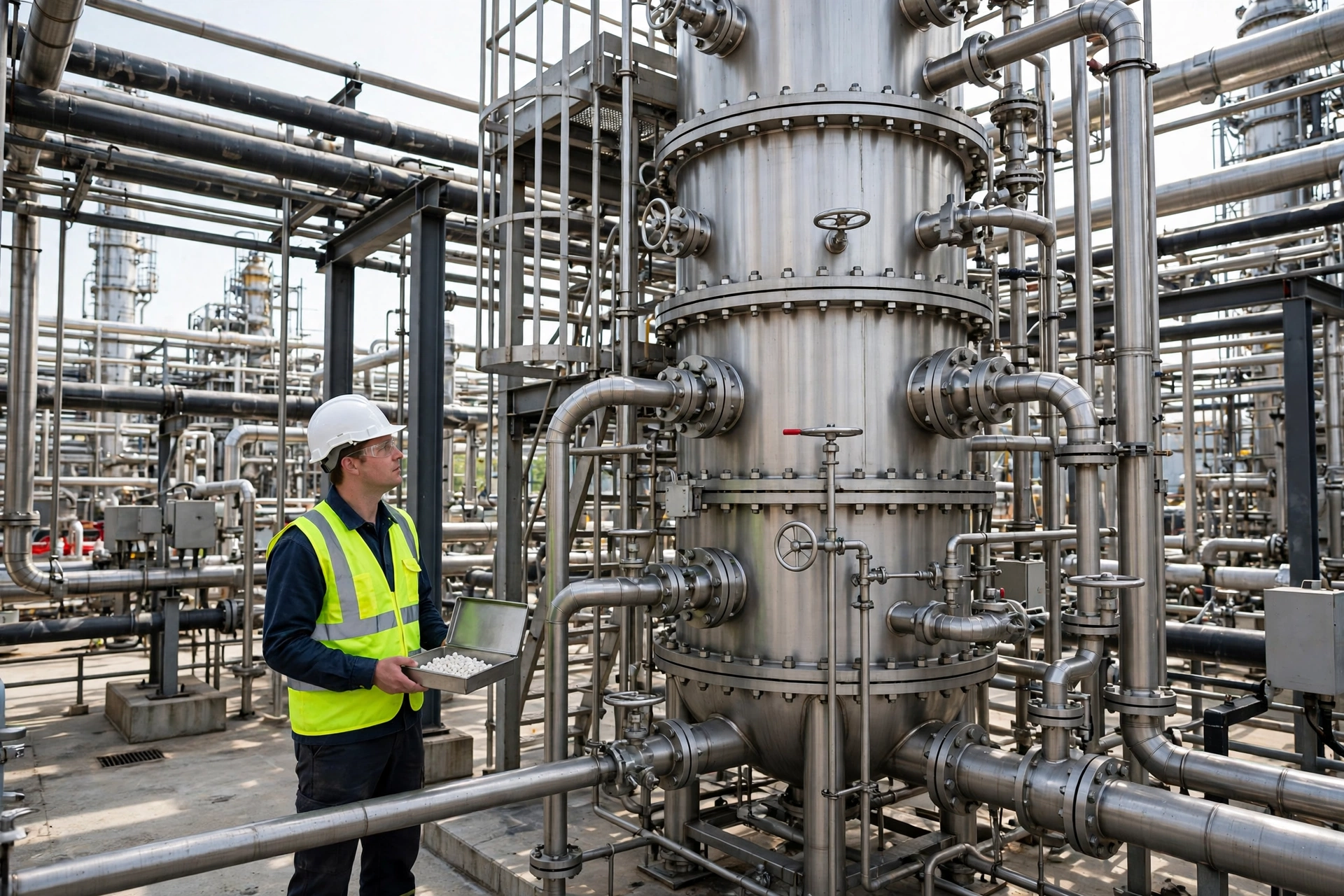
A fixed-bed catalyst does not fail on a date. It fades — a little conversion here, a little more pressure drop there — until one turnaround the numbers no longer add up. The carrier underneath the active phase is often the reason: sintered pores, crushed pellets, poison that will not wash out.
This guide is for plant engineers and buyers deciding whether to regenerate, repair or replace a catalyst carrier bed — and when to order so a planned change-out does not become a forced shutdown.
Signal 1: Activity Loss That Regeneration Cannot Recover
If conversion or selectivity keeps falling after a standard regeneration, the carrier itself — not the active metal — is usually the problem.
Regeneration burns off coke and restores the active phase, but it cannot rebuild a sintered carrier. At sustained high temperature, gamma-alumina grains grow and pores collapse — and a carrier that started at 180–320 m²/g BET with 0.55–0.85 ml/g pore volume (our trilobe range) can come back from service far below those values. Check it fresh-versus-spent: measure BET surface area and pore volume on a spent sample and compare against the fresh datasheet. If the numbers stay low after regeneration, the loss is structural. That is the point to plan a replacement, not to schedule another burn-off.
Signal 2: Pressure Drop Keeps Climbing
A bed that needs more and more energy to push the same flow is telling you its voids are closing.
Pressure drop across a fixed bed rises when fines fill the voids, pellets crush, or the bed settles. Track differential pressure against the clean-bed baseline: a slow climb points to attrition and dust; a sudden step often means a crushed layer. Before blaming the carrier, rule out a fouled feed filter or a blocked distributor. Then sample the bed: dust at the outlet and crushed pellets in a core sample confirm it. Fresh material must be strong enough for the duty — our trilobe carriers are rated at ≥ 110 N/cm side crush strength with ≤ 0.5 wt% abrasion loss — but strength is spent over years of thermal cycling, and a spent bed keeps shedding fines.
Signal 3: Fines and Dust at the Outlet
Fines in the downstream filter or dust in a bed sample mean the carrier is breaking down.
Some dust at start-up is normal, when sharp edges knock off during first loading. Dust that keeps appearing months or years later is different: pellets are still fracturing in service. Sample the bed top, middle and bottom, and weigh the dust caught in the downstream filter between turnarounds. If the fines rate rises turnaround over turnaround, the bed is consuming itself — and the fines will go on raising pressure drop and threatening downstream equipment. A change-out decision can be made on this trend alone; waiting for the pressure-drop alarm only shortens the time to order.
Signal 4: Poisoning That Washing Cannot Reverse
Sulfur, chloride, alkali metals and heavy metals can poison a carrier permanently — and no wash brings back the lost pore volume.
Some poisons sit on the active metal and can be stripped. Others migrate into the carrier itself: sulfur and chloride attack the alumina surface, alkali metals neutralise acid sites, heavy metals lodge in the pores. The result is the same — activity that does not return after regeneration, even when the BET numbers look almost normal. The check is the feed history: what the bed has actually seen, not what it was designed for. If the poison source cannot be removed upstream, a fresh bed alone will repeat the failure; specify the replacement with the poison in mind — a different alumina phase, a guard layer, or a more tolerant pore structure. Have that conversation with the supplier before ordering, not after the new bed is loaded.
Signal 5: The Economics Have Tipped
When lost yield, extra energy and unplanned stops cost more than a planned change-out, the bed is already overdue.
A bed is rarely replaced because one number crosses a line. It is replaced because the losses add up: a few percent of conversion, a higher pressure drop and its energy cost, a filter change every month instead of every turnaround, and the risk of an unplanned stop mid-campaign. Add those up over a year and compare with a planned change-out — new carrier, planned labour, no rush freight. Plan the replacement while the old bed still runs: bulk orders take 15–25 days, priced EXW Zibo, and the grade should be confirmed against your incumbent material first — send the specification, or a sample, and we will match it from our own production lines. Carrier ships in 25 kg bags, steel drums or bulk bags to match your unloading and storage. Order the replacement before the shutdown, not after the bed forces one.
Change-Out Decision at a Glance
Five signals, five checks — and when each means replace.
| Signal | How to check | Replace when |
|---|---|---|
| Activity loss | Fresh vs spent BET and pore volume | Values stay low after regeneration |
| Pressure drop | Differential pressure vs clean-bed baseline | Steady climb or sudden step, fines confirmed |
| Fines and dust | Bed core samples; dust from the downstream filter | Fines rate rising turnaround over turnaround |
| Poisoning | Feed history; activity after regeneration | Activity does not return and the poison source remains |
| Economics | Lost yield + energy + stop risk vs planned change-out cost | Planned replacement beats another campaign on a spent bed |
For the numbers behind this guide, see the catalyst carrier product page, attrition index vs abrasion index (ASTM D4058) and spherical vs extrudate carriers: pressure drop, diffusion and strength.
Frequently Asked Questions
How often should a catalyst carrier bed be replaced?
There is no fixed interval — replace on measured condition, not the calendar. Track the five signals at every turnaround and start procurement when two or more point the same way. Bulk orders run on a 15–25 day lead time, so order before the shutdown, not during it.
Can a spent catalyst carrier be regenerated instead of replaced?
Regeneration restores the active phase by burning off coke, but it cannot rebuild sintered pores, restore collapsed surface area, or remove lodged poisons. If BET and pore volume stay low after regeneration, the carrier is spent and replacement is the only fix.
What should I send a supplier to quote a replacement carrier?
The incumbent specification — or a physical sample — plus the process type, required form and size, pore data if you have it, and the quantity. We match against those values from our own production lines and confirm the grade with a datasheet and a batch COA.
How do I avoid damaging the new carrier during loading?
Keep it dry and sealed until loading, handle it gently, and never drop it from height into the vessel — use a loading sock or a controlled pour. After loading, check the outlet for fines before start-up; a clean first filter confirms the bed went in intact.
If your bed shows two or more of these signals, send us the incumbent specification or a sample, the process type and the quantity — our engineers will confirm the replacement grade: barry@okkinc.com.
Get a Quote
Tell us the product, grade and quantity. We reply within 12 hours with EXW pricing and lead time.
- ✓ COA and technical datasheet with every shipment
- ✓ EXW pricing — freight calculated per order
- ✓ Engineering consultation on grade selection and loading
Prefer to talk now?
WhatsApp +86 133 2522 2240
or email barry@okkinc.com