
How to Load a Molecular Sieve Bed: 5 Costly Mistakes
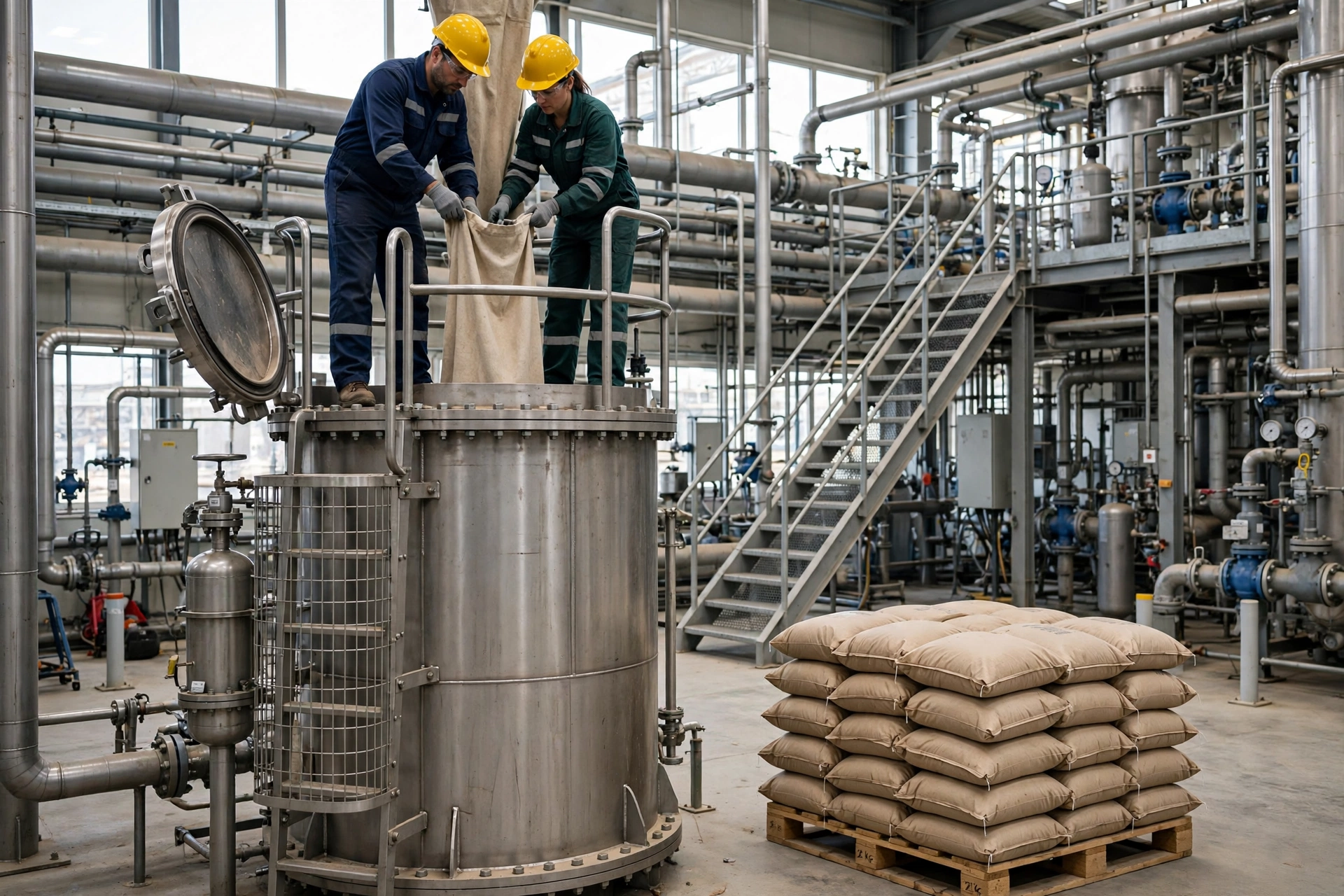
A molecular sieve bed is won or lost before it ever sees process gas. The beads arrive strong — a 3.0–5.0 mm bead is rated at a crush strength of 120 N or more — but a careless loading turns some of them into dust, leaves channels in the bed, and shortens the life of the whole charge. Loading is the cheapest step in a bed change, and the one most often rushed.
This guide is for the engineers and buyers who order and load the bed: dense loading, support layers, the loading sequence, and the five mistakes that cost a bed its life.
Why the Loading Method Decides Bed Life
A badly loaded bed never recovers: crushed beads and flow channels formed on day one stay with the bed until it is replaced.
Two things go wrong at loading, and both are permanent. First, breakage. Beads that crack under impact become fines, and fines raise pressure drop and blind the bed. Our 3A beads are rated at crush strength ≥ 60 N for 1.5–3.0 mm beads and ≥ 120 N for 3.0–5.0 mm beads, with attrition loss ≤ 0.10 wt% — laboratory values on a fresh bead, and a bead dropped from a height can crack before the bed is even in service. Second, channelling. Gas takes the path of least resistance, so a loosely packed zone carries most of the flow while the rest of the bed idles; breakthrough comes early and the outlet dew point drifts up months before the bed's rated life is over.
A loosely loaded bed also settles under vibration and thermal cycling, leaving a void at the top where gas short-circuits across the bed — another reason the loading method, not just the grade, decides how long the charge lasts.
Support Layers: What Goes Under the Sieve
The sieve never sits directly on the support grid: graded layers of inert balls carry it, spread the flow and protect it.
Layers are graded from large at the bottom to small at the top. The largest balls sit on the support grid itself — too big to fall through its openings — and spread the incoming gas evenly across the vessel. Each layer above is smaller, so the sieve beads cannot work their way down. The usual material is inert alumina balls: hard, chemically inert and stable at regeneration temperature.
A top layer of inert balls is often added as well: it holds the bed down, stops the top beads fluidising and dusting, and keeps fines inside during blowdown. Order the support media with the sieve, sized against the grid openings — a support ball that fits through the grid is worse than no support at all.
Dense Loading vs Sock Loading
Two methods dominate industrial loading, and the choice is a trade-off between speed and bead breakage.
| Method | How it works | Bead breakage | Bed density and settling | Best for |
|---|---|---|---|---|
| Dense loading | Beads rain through a rotating spreader and land evenly across the bed face | Low — each bead falls a short distance at low velocity | High settled density; little later settling | Large fixed beds, air separation pre-purifiers, gas dryers |
| Sock loading | A fabric sock is lowered to the bed surface; beads slide down it | Very low — the gentlest method | Looser packing; some settling after startup | Small vessels, fragile grades, or where a spreader cannot be fitted |
Whichever method you use, keep the free fall short: beads dropped a metre or more onto a hard surface break, and the dust stays in the bed. Never walk on a loaded bed — spread boards over the surface if access is needed — and level each lift as you go, because a bed that starts uneven channels from the first cycle.
The Loading Sequence, Step by Step
Load in lifts, level as you go, and keep the beads dry from the bag to the bed.
1. Inspect and dry the vessel
Check the support grid, distributor and vessel walls, and make sure the vessel is clean and dry. Any water left inside starts loading the sieve before startup, spending capacity the first regeneration must win back.
2. Install the support layers
Lay the graded inert layers and level each one. Check the grid openings against the smallest support ball before the sieve goes in — the last moment the grid is reachable.
3. Open containers only as needed
Beads start adsorbing shop-air moisture the moment the seal is broken. Package moisture on arrival is ≤ 1.5 wt%, so open one bag or drum at a time and reseal anything left over.
4. Load in lifts and level the top
Pour in stages rather than filling the vessel in one drop, and level each lift with a rake or board. Lifts keep the packing even and stop the pile coning in the middle. Finish with a flat top: a crowned or dished surface sends gas to one side, and the idle half never earns its keep.
5. Close up and regenerate
Seal the vessel, run a first regeneration at 200–300 °C — the grade range on the datasheet — then purge before the bed goes into service, so it starts its first cycle dry.
Five Mistakes That Shorten Bed Life
Most early bed failures trace back to one of these five loading errors — all preventable.
| Mistake | What it does to the bed | Prevention |
|---|---|---|
| Dropping beads from a height | Cracked beads and dust; pressure drop climbs from the first cycle | Keep the free fall short; use a sock or spreader |
| Mixing bead sizes or grades | Uneven packing and channelling; early breakthrough | One grade, one size per bed; segregate lots |
| Skipping or misgrading support layers | Sieve falls through the grid; flow maldistribution | Graded inert layers sized to the grid openings |
| Loading wet or open-stored beads | Capacity spent before startup; poor first-cycle dew point | Sealed containers until loading; regenerate after loading |
| An uneven top surface | Gas channels to the low side; part of the bed idles | Level every lift and the final surface |
Ordering for a Bed Change: Quantities, Packing and Lead Time
Order the support media with the sieve — and order by bed volume, not by guesswork.
The quantity is the bed volume multiplied by the bulk density on the grade datasheet: 3A at 0.68–0.75 g/cm³, 4A at 0.70–0.78 g/cm³ and 13X at ≥ 0.64 g/ml. A 1 m³ bed of 3A needs roughly 680–750 kg, plus the support layers and a small handling allowance. Check the batch COA before loading — package moisture (≤ 1.5 wt%), bead size and attrition — and hold any lot out of specification.
Packing is 25 kg bags, steel drums or bulk bags, confirmed at quotation, and bulk orders ship in 15–25 days. Prices are quoted EXW Zibo, freight calculated per order. Molecular sieves are produced on our own lines in Zibo, so grade and bead size are matched to the vessel before the first order.
For full grade data, see the Molecular Sieves product page. For the quantity calculation, read our guide to calculating molecular sieve quantity, and for the first regeneration, the molecular sieve regeneration best practices.
Frequently Asked Questions
Can I top up an old bed with fresh beads?
Only as a stopgap, and only with the same grade and bead size. Old and fresh beads differ in crush strength and fines content, and a mixed bed channels. If the bed is near the end of its life, replace it in full.
How much molecular sieve do I need for my vessel?
Multiply the bed volume by the bulk density on the grade datasheet — 3A at 0.68–0.75 g/cm³ means roughly 680–750 kg per cubic metre of bed — then add the support layers and a handling allowance.
Do I need to regenerate the bed after loading?
Yes. Loading exposes the beads to humid air, and even brief exposure costs capacity. Run a first regeneration at 200–300 °C and purge before the bed goes into service.
Which bead size should I load?
Use 3.0–5.0 mm beads for large beds, where low pressure drop matters, and 1.6–2.5 mm where a finer bed is needed. Match the size to the support grid and distributor, and keep one size in a bed. Pellets on request.
Planning a bed change? Send us the vessel volume, the grade in use and the distributor type — our engineers will confirm the quantity, bead size and support layers: barry@okkinc.com.
Get a Quote
Tell us the product, grade and quantity. We reply within 12 hours with EXW pricing and lead time.
- ✓ COA and technical datasheet with every shipment
- ✓ EXW pricing — freight calculated per order
- ✓ Engineering consultation on grade selection and loading
Prefer to talk now?
WhatsApp +86 133 2522 2240
or email barry@okkinc.com