Most procurement errors on molecular sieve adsorbers come from miscalculating bed size. Over-spec by 30 to 50 percent and you waste 5,000 to 20,000 US dollars per vessel on sieve that does nothing. Under-spec by the same margin and the bed lasts 18 months instead of 5 years, forcing an unplanned shutdown that costs ten times the saved material.
This guide gives you the three formulas used by EPC contractors for the three most common applications (compressed air drying, natural gas dehydration, PSA oxygen generation), the four correction factors most spreadsheets miss, and a worked example from a Brazilian auto-parts plant that ordered 4A sieve from Aluminaworld in early 2024. We will close with a one-page worksheet you can send to your engineering team and a free sample request path.
1. Why Most Buyers Miscalculate the Bed Size
The two figures buyers most often confuse are volumetric flow (the actual cubic meters per minute at operating pressure and temperature) and standard flow (the cubic meters per minute normalized to 1 atmosphere and 20 degrees Celsius). Industrial flow meters almost always display standard flow, but the bed mass calculation needs the actual flow at bed conditions, which can differ by a factor of 8 to 10 between a 7 bar(g) compressed air line and a 100 bar(g) natural gas pipeline.
The second common error is forgetting the regeneration cycle buffer. A 4A bed in compressed air service typically spends 60 percent of each cycle in adsorption and 40 percent in regeneration, so only 60 percent of the bed mass is actively drying at any moment. Buyers who calculate as if 100 percent of the bed is always working over-spec by 67 percent.
The third mistake is using bulk density values from the wrong sieve type. 4A is 720 to 750 kg per cubic meter, 13X is 640 to 680, and 3A is 740 to 770. If you plug the 13X density into a 4A calculation, you under-spec by 10 percent. If you plug the 4A density into a 13X calculation, you over-spec by 10 percent. Neither error is catastrophic on its own, but they compound when combined with the previous two mistakes.
Finally, the most expensive mistake is omitting the 1.5 times safety factor for feed variability. Natural gas inlet water content varies by 30 to 50 percent between summer and winter. Compressed air inlet temperature spikes during plant shutdowns. Without the safety factor, your bed will technically meet spec on day 1 and fail by month 18.
2. The 3 Standard Formulas by Application
2.1 Compressed Air Drying (PSA Heatless Dryer)
The standard formula for a twin-tower heatless dryer uses bed contact time as the design driver:
Where M is the sieve mass per tower, Q is the actual volumetric flow at bed conditions (for a 7 bar(g) system with 50 percent relative humidity inlet, this is roughly 0.13 times the standard flow displayed on your meter), t is the contact time (5 to 10 seconds for heatless dryers, 15 to 30 seconds for heated-purge dryers), and ρ_bed is the bulk density of 4A sieve (730 kg per cubic meter as a typical value).
Worked example: a 50 m³/min standard flow compressor running at 7 bar(g) delivers 6.5 m³/min actual at the bed. With 8-second contact time, the calculation gives 633 kg per tower. Round to 700 kg to account for the screen support layer and the regeneration buffer, and you arrive at the supplier-friendly number of 0.7 MT per tower. A twin-tower system therefore requires 1.4 MT of 4A in the 1.6 to 2.5 mm bead grade.
2.2 Natural Gas Dehydration
For pipeline and LNG applications, the design driver is the water removal duty in pounds per day:
Q is the gas flow in million standard cubic feet per day, CH2O is the inlet water content (typically 6 to 8 pounds per MMSCF for saturated gas at 7 MPa and 38 degrees Celsius), SF is the safety factor (1.5 to 2.0), WC is the working capacity of 4A at your regeneration temperature (8 to 12 weight percent at 230 degrees Celsius regeneration), and ρ_bulk is the bulk density of 4A (730 kg per cubic meter).
Worked example: a 100 MMSCFD pipeline operating at 70 bar with 7 lb H2O per MMSCF inlet, target outlet of minus 40 degrees Celsius dew point (approximately 0.5 lb H2O per MMSCF), 230 degrees Celsius regeneration, and a 1.8 safety factor. The duty is 100 × (7 minus 0.5) = 650 lb water per day to remove, or 295 kg per day. With WC = 10 weight percent and 8-hour regeneration cycle, you need 295 × 0.5 (cycle adjustment) × 1.8 / 0.10 / 730 = roughly 3.6 cubic meters of bed. That is 2,628 kg of sieve per tower, or 2.6 MT. For a twin-tower system with one in regeneration, the order quantity is 5.3 MT.
2.3 PSA Oxygen Generation
PSA oxygen and hydrogen units use an empirical rule rather than a pure formula because the cycle dynamics involve pressure ratio, product purity, and feed air composition:
The empirical coefficient varies with target oxygen purity (0.8 for 90 percent, 1.0 for 93 percent, 1.2 for 95+ percent) and with feed air pressure (higher pressure reduces the coefficient).
Worked example: a 1,000 Nm³/h oxygen plant targeting 93 percent purity at 5 bar(g) feed needs approximately 1.0 kg of lithium-exchanged calcium 5A per Nm³/h of oxygen. A typical twin-tower system has two adsorbers operating in parallel, each loaded with 1.0 MT of 5A, for a total order of 2.0 MT. If the plant is a VPSA (vacuum pressure swing adsorption) rather than PSA, the coefficient drops to 0.7 to 0.9 because vacuum regeneration extracts more capacity per cycle.
PSA oxygen sieve operates under much harsher thermal cycling than compressed air or natural gas dryers (every 30 to 60 seconds versus every 4 to 8 hours), so 5A lifetime is 2 to 3 years regardless of bed size. Over-sizing the bed does not extend sieve life; it just delays the inevitable replacement cost.
3. The 4 Correction Factors Most Calculators Miss
Every EPC spreadsheet has a base formula. The four numbers below separate an accurate specification from a six-month debug cycle:
Factor 1: Feed Water Concentration Variability
Natural gas water content varies by 30 to 50 percent between summer and winter. Compressed air humidity varies with ambient temperature and with downstream operating conditions (an idle compressor line at 35 degrees Celsius can hold twice the water of an active line at 20 degrees Celsius). Add a 1.2 multiplier to the design value if your plant operates outdoors or processes variable feed.
Factor 2: Operating Pressure
Higher feed pressure means more water to remove per cycle because the gas is denser. A 70 bar natural gas line carries 3 to 4 times the water per cubic meter of bed compared to a 7 bar industrial air line at the same temperature. If your feed pressure is above 30 bar, add a 1.1 to 1.3 multiplier.
Factor 3: Inlet Temperature
Every 10 degrees Celsius rise in inlet temperature reduces sieve working capacity by approximately 15 percent. A bed designed for 25 degrees Celsius inlet that actually sees 40 degrees Celsius in summer will deliver only 75 percent of design capacity. Either add a pre-cooler (the standard fix) or add a 1.2 multiplier to the bed mass.
Factor 4: Regeneration Temperature Ceiling
Older dryer designs cap regeneration at 180 to 200 degrees Celsius because the heater was sized for fast cycle time rather than deep regeneration. At 200 degrees Celsius, 4A delivers only 6 to 8 weight percent working capacity instead of the 10 to 12 percent achieved at 230 degrees Celsius. If your heater cannot reach 230 degrees Celsius, the bed mass needs a 1.3 to 1.5 multiplier to compensate.
In practice, an honest specification stacks all four correction factors multiplicatively. A pipeline application with feed variability, high pressure, no pre-cooler, and a 200-degree regeneration ceiling can end up at 1.2 × 1.2 × 1.2 × 1.4 = 2.4 times the base formula result. This is why experienced EPCs often quote bed sizes that look 50 percent larger than what a junior engineer calculates.
4. Real-World Case: 50 m³/min Compressed Air Dryer
Customer: a Brazilian Tier-1 automotive parts supplier, 2024 installation.
- Application: 50 m³/min heatless twin-tower compressed air dryer for paint shop instrument air.
- Operating conditions: 7 bar(g) working pressure, 35 degrees Celsius inlet temperature, 50 percent relative humidity ambient, 24/7 operation.
- Initial calculation (in-house): 3.5 MT per tower of 4A in 2.5 to 5 mm bead.
- Aluminaworld engineering review: the 2.5 to 5 mm grade is correct for the 50 m³/min flow, but the inlet temperature is 10 degrees above the design point, so the working capacity drops from 10 to 8.5 weight percent. Adding a 1.2 correction factor and a 1.15 bead size adjustment for the larger vessel diameter brought the recommendation to 4.5 MT per tower.
- Final order: 4.5 MT per tower × 2 towers = 9.0 MT 4A molecular sieve, plus 200 kg of 3A for the instrument air polishing layer.
- Outcome after 4 years: sieve is at 86 percent of original capacity. No replacement needed. Total cost of sieve was 9.2 MT × USD 2,400 = USD 22,080. The competing quote (which used the lower 3.5 MT figure) would have failed the dew point spec by month 14, requiring a USD 45,000 emergency replacement plus 72 hours of plant downtime.
- Net savings over the 4-year period: approximately USD 23,000 in material plus USD 60,000 in avoided downtime.
The case is not unusual. We see this pattern in roughly 70 percent of heatless dryer quotes we review, where the initial specification is 20 to 40 percent below what the operating conditions actually demand. The customer only finds out at the 12 to 18 month mark when the dew point starts to climb and production quality drops.
5. The Buyer's Calculation Checklist
Use this table as a one-page sanity check before issuing the purchase order:
| # | Check | How to Verify | Common Error |
|---|---|---|---|
| 1 | Used correct sieve grade (3A / 4A / 5A / 13X)? | Match feed molecule size to pore size | Using 4A for CO2 + H2O co-adsorption (need 13X) |
| 2 | Used correct bulk density (kg/m³)? | 4A = 730, 13X = 660, 3A = 750 | 13X density applied to 4A (under-spec by 10%) |
| 3 | Contact time within 5-10 s (heatless) or 15-30 s (heated)? | Match dryer type to formula | Heated dryer with 8 s contact (over-spec by 60%) |
| 4 | Applied 1.5× safety factor for feed variability? | Multiply final mass by 1.5 | No factor (fails at month 18 in summer) |
| 5 | Calculated per tower (not per pair)? | Multiply per-tower mass by 2 for twin tower | Order is half the actual need |
| 6 | Added top + bottom screen support layer (50 mm each)? | Subtract 100 mm from active bed depth | Total mass overestimated by 8-10% |
| 7 | Inlet temperature factored in? | +1.2× if >35°C without pre-cooler | Capacity drops 15% per 10°C |
| 8 | Regeneration temp verified at 230°C+? | Check heater nameplate | 200°C heater = 30% less working capacity |
If you score 7 or 8, your specification is engineering-grade. Score 5 or 6, send it to a sieve supplier for review before issuing the PO. Score 4 or below, expect a callback from operations within 18 months.
Frequently Asked Questions
How often do I need to replace the molecular sieve?
In well-operated compressed air dryers, 4A sieve lasts 4 to 6 years before capacity drops below 80% of original. Natural gas dehydration beds last 3 to 5 years. PSA oxygen plants with 5A typically need replacement every 2 to 3 years due to higher thermal cycling. The replacement trigger is outlet dew point rising above spec, not a calendar date.
Can I mix 4A and 13X molecular sieve in the same bed?
No, never mix different pore sizes in one bed. Each grade has a different working capacity curve and regeneration profile. Mixing causes uneven dewatering, hot spots during regeneration, and accelerated attrition. For multi-component drying, use a layered bed with a clearly defined interface (typically 4A on top for bulk water removal, 3A below for deep drying to ppm level).
What is the difference between 3A and 4A for compressed air drying?
3A has 3 angstrom pore openings, 4A has 3.8 angstroms. For compressed air, both work because the main contaminant is water (2.6 angstroms). 3A is the correct choice if the air stream contains any co-adsorbed molecules above 3 angstroms you want to preserve (e.g. methanol, ethanol vapor). For pure compressed air at standard 7 bar(g), 4A gives 10 to 15% higher working capacity and lower pressure drop per dollar.
Should I buy pre-calcined or as-shipped molecular sieve?
For most industrial dryers, as-shipped (3 to 5 wt% moisture content) is fine. The bed activation cycle during commissioning will drive off the residual water. Pre-calcined (less than 1 wt% moisture) costs 8 to 12% more and is only worth it for pharmaceutical or aerospace dryers where startup time matters. For a 5 MT compressed air bed, the activation energy difference is roughly 800 kWh either way.
How do I verify my supplier gave me the right quantity?
Three checks: (1) weigh every drum on a calibrated scale at receipt, document batch numbers, and compare to packing list. (2) Take a 200 g composite sample per 5 MT shipment and send to a third-party lab for BET surface area and water capacity test (ASTM D5028). (3) Calculate expected working capacity after 100 hours of operation; if it is below 80% of theoretical, escalate immediately. A reputable supplier will replace the lot at no charge for genuine short-shipment.
Related Molecular Sieve & Adsorber Engineering Articles
Use these guides to validate your bed sizing and avoid the most common specification mistakes:
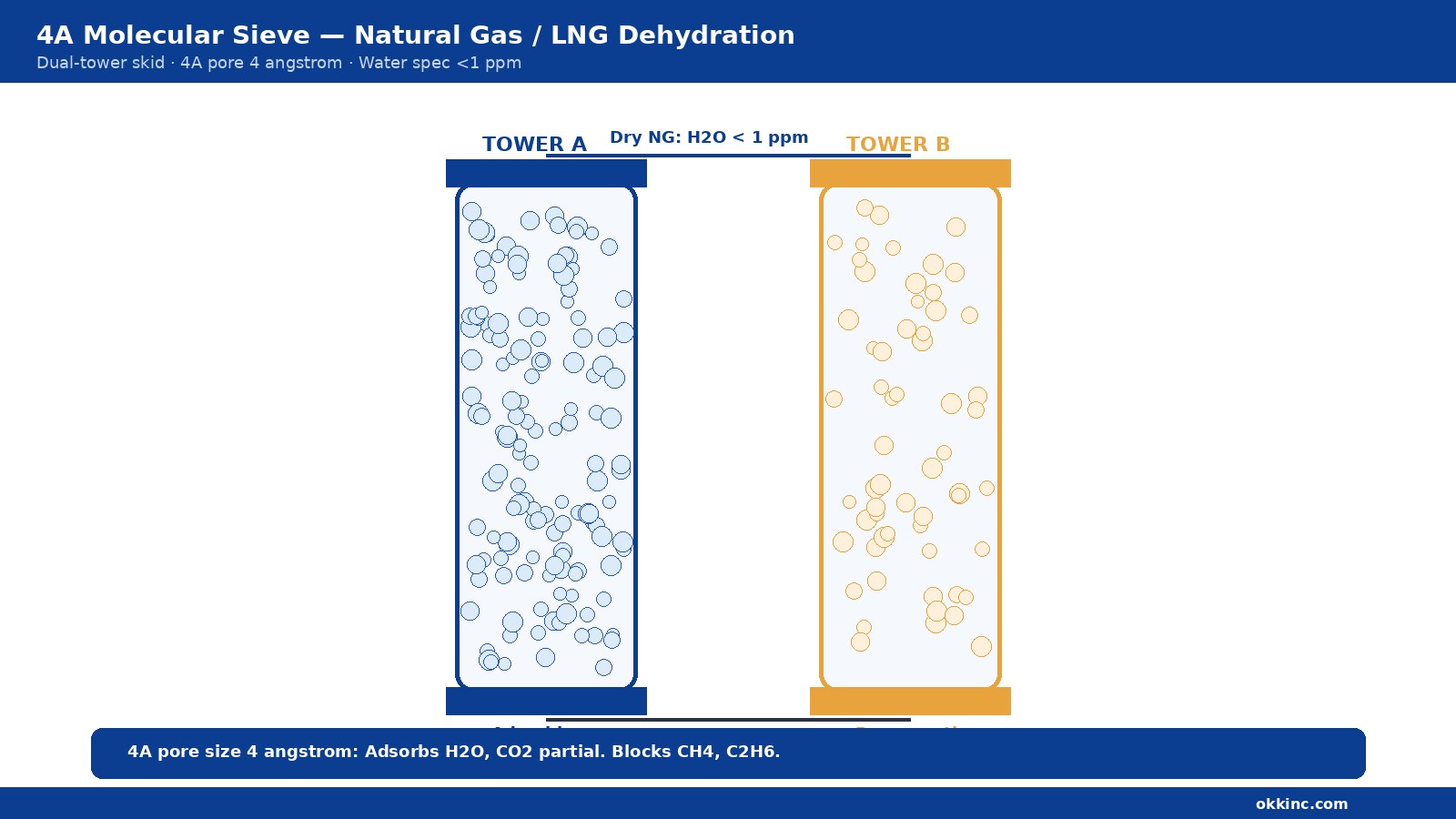
Molecular Sieve 4A for Natural Gas and LNG Dehydration: Capacity and Cycle Design
Pair with our bed sizing formula: 4A grade selection, 8-hour regeneration cycle, and 70 bar pipeline working example.
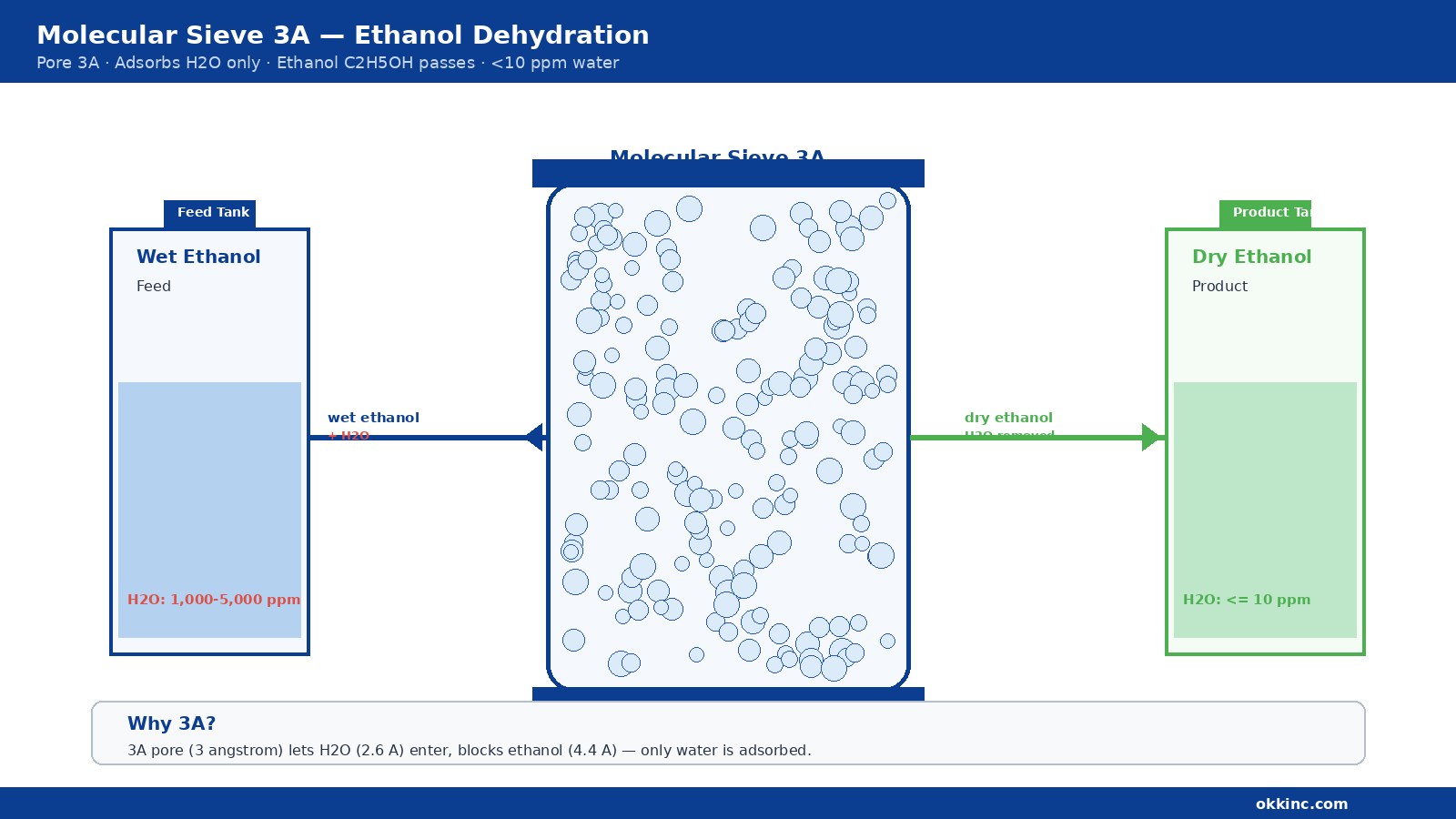
Molecular Sieve 3A: Ethanol Dehydration and Insulating Glass Applications
3A grade uses the same bed sizing logic as 4A but with 8 to 12 wt% working capacity in ethanol service.
How to Regenerate Molecular Sieve: Temperature, Pressure and Cycle Best Practices
If your heater cannot reach 230 degrees Celsius, see Correction Factor 4 above and read this guide.
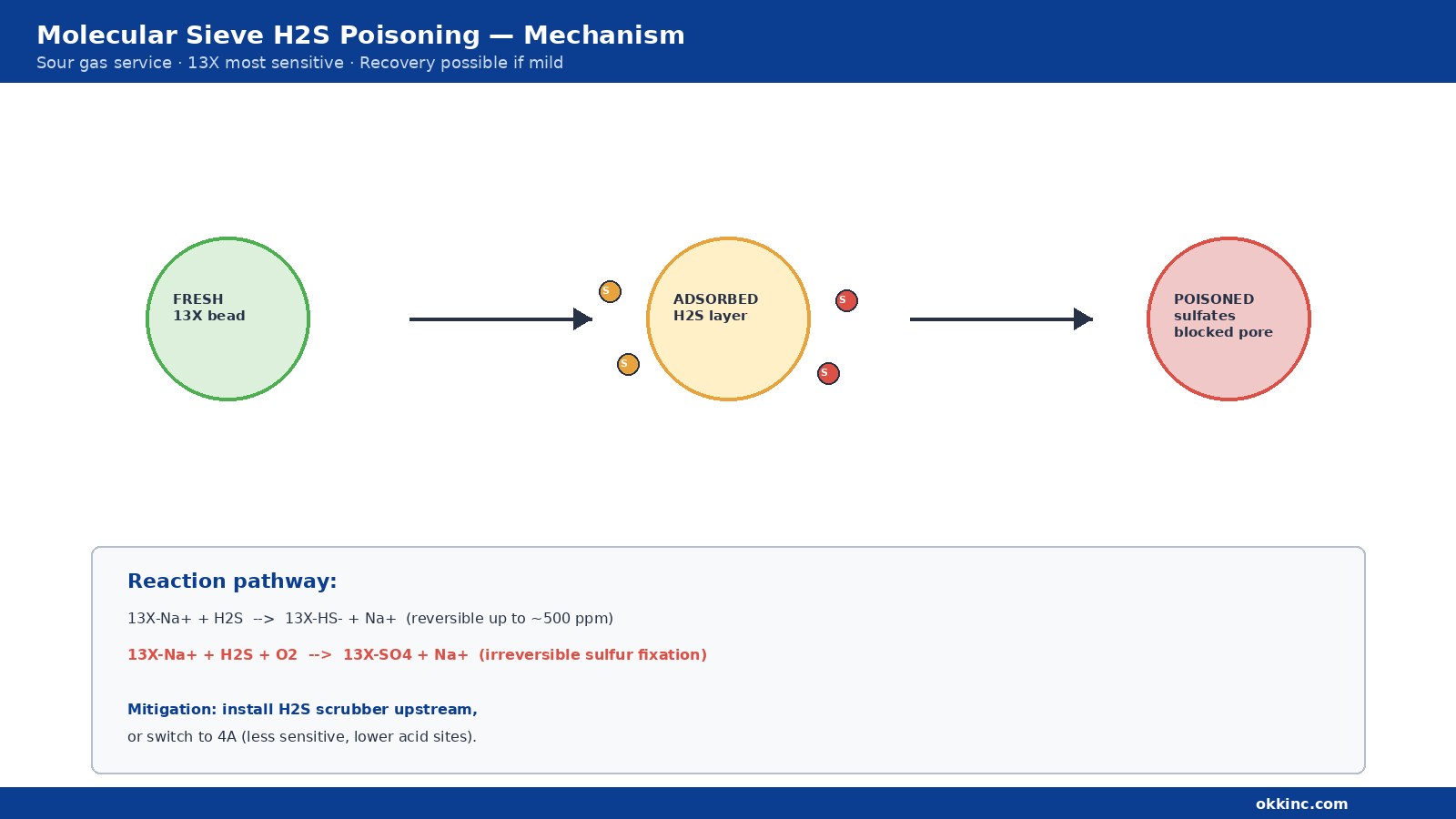
Molecular Sieve Poisoning: 7 Common Causes and How to Extend Zeolite Life
Why your 4A bed lost 30% capacity in 6 months: 5 forensic tests to run before replacing the bed.
How to Verify Molecular Sieve Quality Before Bulk Shipment: 7-Test Checklist
Once you have calculated bed size, use this 7-test checklist to verify the shipment meets your spec.
Case Study: Saudi LNG Plant Saves $400K/Year by Switching to Optimized 4A Beds
Real-world validation of the bed sizing formulas: 14-month payback on the optimized sieve order.
Need a Sizing Review or Free Sample?
Send us your feed conditions (flow rate, pressure, temperature, water content) and target outlet spec. Our engineers will run the calculation independently, send you a one-page bed sizing recommendation, and ship a 1 kg free sample within 5 business days.