
LPG Drying with Molecular Sieve: 4A vs 13X Explained
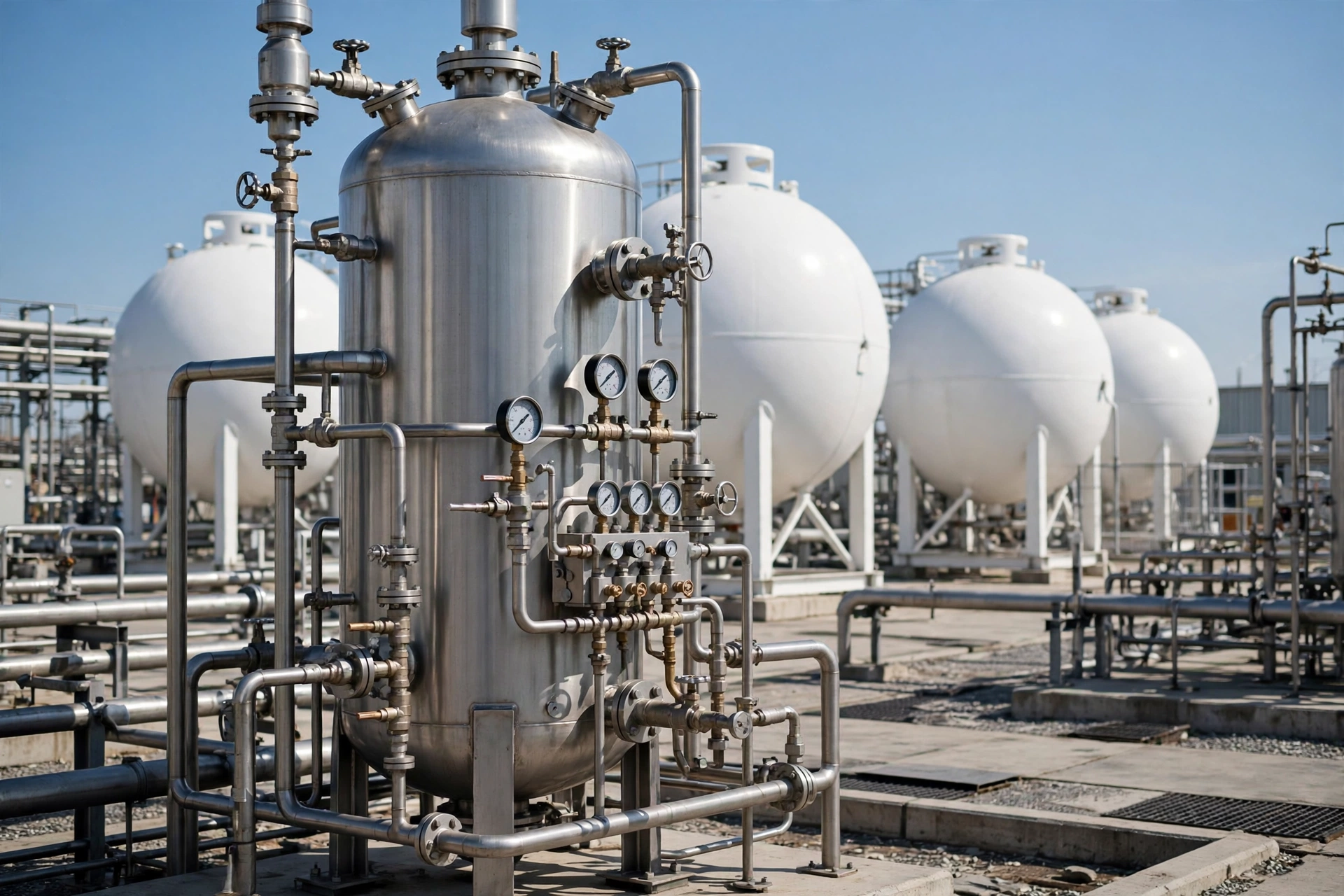
LPG leaves the plant dry on paper and arrives wet in practice: even tens to a few hundred parts per million of water form hydrates, corrode valves and push a cargo off specification. For most LPG dryers the choice comes down to two grades: 4A for water alone, and 13X when sulfur compounds have to go too.
This guide covers grade choice, liquid-phase operation, regeneration, and what to check when ordering the next charge.
Why LPG Arrives Wet — and What Water Does
Water is the one contaminant every LPG stream carries, and its damage shows up downstream of the dryer, not at the dryer outlet.
LPG picks up water at every step — dissolving during processing and storage, condensing when a warm stream cools, entering with wet gas or wash water. Free water settles to low points; dissolved water stays invisible until temperature or pressure drops.
The damage takes three familiar forms. Hydrates — water plus light hydrocarbons — form ice-like crystals that plug lines and stick valves, usually at the coldest point — a regulator or a let-down valve. Corrosion follows when water meets hydrogen sulfide or carbon dioxide, attacking carbon steel. And off-specification product: a rejected cargo costs far more than the drying step that would have prevented it.
That is why LPG drying is almost always a molecular sieve job rather than a refrigeration or glycol job: a sieve bed polishes the liquid to a very low residual water level, works at line pressure, and regenerates in place.
4A vs 5A vs 13X: Which Grade Dries LPG?
The grade decision is a pore-size decision: the pore must admit water and exclude the LPG molecules you want to keep.
4A is the default for water-only LPG drying: its 4 Å pore admits water and excludes propane and butane, so the bed's capacity goes to water and nothing else. Our 4A beads carry an equilibrium water capacity of ≥22% at 25 °C and 50% relative humidity, a crush strength of ≥60–130 N and a package moisture of ≤1.5 wt%.
5A is rarely the first choice for LPG drying: its 5 Å pore admits normal paraffins as well as water, so a 5A bed spends part of its capacity adsorbing the product itself and breaks through earlier than a 4A bed of the same size.
13X is the grade for LPG that needs sweetening as well as drying: its 10 Å pore admits water, hydrogen sulfide, mercaptans and carbon dioxide, so one bed removes the water and the sulfur compounds that cause odour and corrosion. Our 13X beads are rated at a static water adsorption of ≥26.0 wt% at 25 °C and 60% relative humidity, with carbon dioxide adsorption of ≥18.0 wt%. The trade-off is selectivity: a heavily sour feed shortens the cycle. Sweet LPG, water only — choose 4A; water plus sulfur — choose 13X.
| Grade | Pore size | Water capacity | Also removes | Best LPG use |
|---|---|---|---|---|
| 4A | 4 Å | ≥22% (25 °C, 50% RH) | Water only | Water-only drying |
| 5A | 5 Å | ≥21.5% | n-Paraffins | Not recommended |
| 13X | 10 Å | ≥26.0% (25 °C, 60% RH) | H₂S, mercaptans, CO₂ | Drying + sweetening |
If the feed analysis is uncertain, send the water and sulfur figures, and the grade can be confirmed before ordering.
Liquid-Phase Service: How an LPG Dryer Actually Runs
Most LPG dryers run in the liquid phase, and that changes the bed design: liquid is dense, slow and unforgiving of channelling.
An LPG dryer is normally a two-bed swing system: one bed adsorbs while the other regenerates, so product flow never stops. Liquid LPG enters the adsorbing bed and dry LPG leaves for storage. When the bed approaches saturation — judged by time on stream or an outlet water monitor — the beds swap.
Downflow is common because it keeps the bed packed, but velocity must stay low enough that beads do not grind together, and the bed must stay fully covered: a partly dry bed channels and breaks through early while most of its capacity sits unused.
A coalescer upstream takes out free water and solids, so the sieve only handles dissolved water; free water slugs saturate the top of the bed in minutes.
Regeneration: Temperature, Purge Gas and the Liquid Problem
A liquid-phase bed cannot be regenerated wet: drain the liquid first, then heat with dry gas.
Liquid LPG must be drained from the vessel before heating starts: heating a bed full of liquid flashes LPG to vapour inside the vessel, and the sudden expansion can lift the bed, carry fines downstream and shock the beads. Drain the bed, purge with vapour until no liquid remains, and only then bring it up to temperature.
The bed is then heated with a dry gas — dry fuel gas, nitrogen or dry LPG vapour — to 200–300 °C and held until the water is driven off, then cooled with dry gas before returning to service: a bed put back on line hot will flash LPG and channel, so the cool-down is part of the regeneration.
Two limits deserve respect. 13X must never be heated above 450 °C: above that, the X crystal lattice degrades and the capacity is lost permanently. And a regeneration cut short leaves water in the bottom of the bed, where the next cycle starts already loaded — cycle times that keep getting shorter are the signature of incomplete regeneration, and the fix is a longer hot step, not a larger bed.
Five Signs the Bed Is Failing
A bed rarely fails overnight; it drifts, and the outlet water trend is the first warning.
| Sign | What it means | Check first |
|---|---|---|
| Outlet water rising | Spent capacity or incomplete regeneration | Regeneration temperature, hot-step duration |
| Cycles getting shorter | Working capacity walking down | Purge gas dryness, cool-down |
| Pressure drop climbing | Fines or crushed beads blocking flow | Bead integrity, flow velocity |
| Mercaptan or H₂S breakthrough (13X) | Sulfur capacity exhausted first | Feed sulfur level, cycle length |
| Dust in downstream filters | Bead attrition, thermal shock | Flow rate, liquid flashing |
Ordering LPG Dryer Sieve: Specs, Quantity and Packing
Order by bed volume and grade, not by weight alone: the quantity follows the bulk density on the datasheet.
The quantity is the bed volume multiplied by the bulk density: 4A at 0.70–0.78 g/cm³ needs roughly 700–780 kg per cubic metre of bed, and 13X at ≥0.64 g/ml needs at least 640 kg per cubic metre. Add the support layers and a small handling allowance, and check the batch certificate of analysis before loading — package moisture (≤1.5 wt%), bead size and attrition.
Bead size follows bed size: 1.6–2.5 mm beads for small dryers, 3.0–5.0 mm for large beds where low pressure drop matters. Match the size to the support grid, keep one size in a bed, and order the support media with the sieve. Pellets are available on request.
Packing is 25 kg bags, steel drums or bulk bags, confirmed at quotation, and bulk orders ship in 15–25 days. Prices are quoted EXW Zibo, freight calculated per order. Molecular sieves are produced on our own lines in Zibo.
For full grade data, see the Molecular Sieve 13X product page; for the regeneration cycle, our molecular sieve regeneration best practices; and for the same grade on gas service, the 4A natural gas dehydration guide.
Frequently Asked Questions
Can 4A remove mercaptans from LPG?
No. The 4 Å pore admits water and excludes larger molecules, including mercaptans and hydrogen sulfide. If the LPG needs sweetening too, use 13X, whose 10 Å pore adsorbs hydrogen sulfide, mercaptans and carbon dioxide with the water.
Can I regenerate a wet LPG bed in place?
Yes, after the liquid is drained: purge with vapour until no liquid remains, then heat the bed with dry gas to 200–300 °C and cool it before returning it to service. Never heat a bed that still contains liquid LPG, and never heat 13X above 450 °C.
Which bead size should I use in an LPG dryer?
Use 1.6–2.5 mm beads for small dryers and 3.0–5.0 mm for large beds, one size per bed. Pellets are available on request.
How much molecular sieve do I need for my LPG dryer?
Multiply the bed volume by the bulk density: 4A at 0.70–0.78 g/cm³ means roughly 700–780 kg per cubic metre of bed, and 13X at ≥0.64 g/ml means at least 640 kg per cubic metre.
Not sure which grade your feed needs? Send us the water content, the hydrogen sulfide and mercaptan figures, and the dryer volume — our engineers will confirm the grade, bead size and quantity: barry@okkinc.com.
Get a Quote
Tell us the product, grade and quantity. We reply within 12 hours with EXW pricing and lead time.
- ✓ COA and technical datasheet with every shipment
- ✓ EXW pricing — freight calculated per order
- ✓ Engineering consultation on grade selection and loading
Prefer to talk now?
WhatsApp +86 133 2522 2240
or email barry@okkinc.com