PSA Oxygen Sizing, Bed Depth, and 10-Year TCO: LiLSX vs 5A vs 13X for Industrial and Medical Plants
If you are sizing a PSA oxygen plant from scratch, retrofitting one, or trying to figure out why your existing plant consumes too much power, the answer almost always comes down to three things: which sieve you put in the bed, how big that bed is, and how long you can expect it to last. This article walks through the LiLSX vs 5A vs 13X selectivity mechanism that drives air factor, gives a transparent bed-sizing methodology you can apply on paper before talking to vendors, lays out the air factor versus purity curves at 90, 93, and 95% O2, and closes with a 10-year total cost of ownership worked example that shows where the sieve choice actually moves the needle and where it does not.
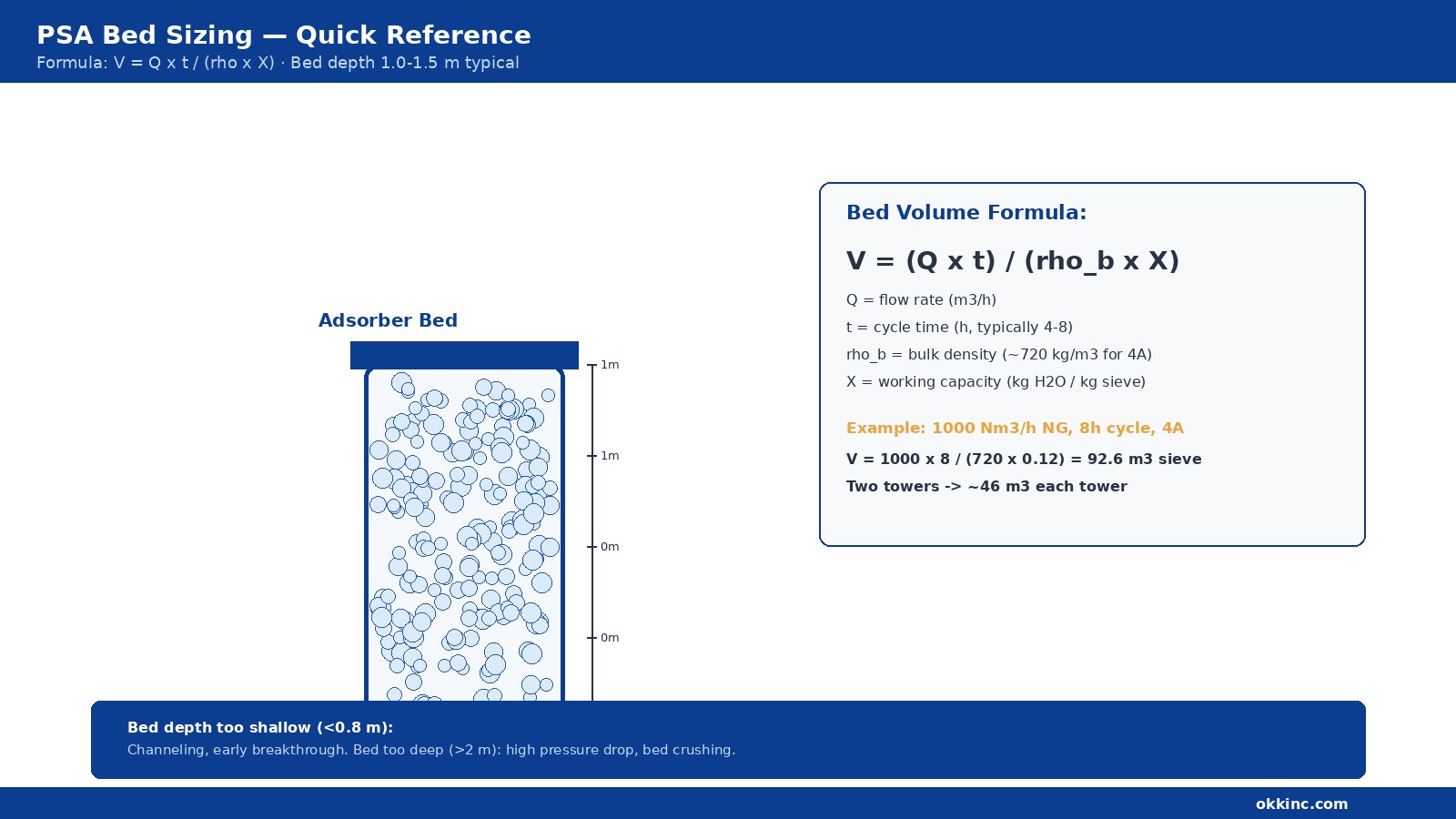
Why Oxygen PSA Is a Different Sizing Problem From Nitrogen PSA
Pressure swing adsorption separates air into either oxygen or nitrogen depending on which molecule the sieve holds preferentially. In nitrogen PSA, the sieve (carbon molecular sieve, CMS) adsorbs the smaller and faster-diffusing oxygen, so nitrogen passes through as product and oxygen is held on the bed. In oxygen PSA, the sieve holds nitrogen from the feed so that oxygen and argon pass through as product. The sieves used, the cycle times, the air factors, and the sizing methodology are all different between the two services. Many published articles blur the two, which leads buyers and plant engineers to confuse air factors, expect bed sizes that are unrealistic, and miss the cost levers that actually matter.
This article focuses exclusively on oxygen PSA. The intent is to give an engineer or a procurement officer a transparent method to (1) decide between LiLSX and 5A for a given duty, (2) size the bed on paper, (3) predict air factor at 90, 93, and 95% O2 purity, and (4) build a 10-year TCO model that includes sieve replacement and energy. The methodology is vendor-neutral and based on the open literature (Yang, Sircar, Ruthven, and the periodic engineering reviews in Adsorption and Separation Science & Technology). Numbers labeled "typical" reflect ranges seen in commercial plants and supplier datasheets; exact values depend on cycle design, sieve age, and feed conditions.
The Three Sieves: LiLSX vs 5A vs 13X, and Why LiLSX Exists
Three molecular sieves are used in commercial oxygen PSA, and each represents a different point on the trade-off between nitrogen working capacity, cycle time, and unit cost.
5A zeolite (calcium A-type)
5A is the workhorse of small and mid-scale oxygen PSA, especially in medical oxygen concentrators up to about 10 L/min flow. It is a calcium-exchanged A-type zeolite with a pore opening of about 5 Angstrom. The calcium cations create a strong electric field inside the pore that polarizes nitrogen (a quadrupole molecule) more than oxygen, so 5A preferentially adsorbs nitrogen from air. The equilibrium N2/O2 selectivity of 5A is roughly 2.5 to 3.5 at 1 bar and 25 degrees C, and rises to 4 to 6 at 4 to 7 bar adsorption pressure. Because 5A is an equilibrium adsorbent, the bed needs long contact time (30 to 120 seconds per half-cycle) to reach near-equilibrium loading. This makes 5A plants physically larger and slower to cycle, but the sieve itself is inexpensive (typically USD 3 to 6 per kg in bulk) and tolerant of a wider range of feed air quality than LiLSX.
13X (NaX, faujasite)
13X is a sodium X-type faujasite with a pore opening of about 9 Angstrom and very high total pore volume. It has high equilibrium loading for nitrogen but poor N2/O2 selectivity at typical PSA pressures (1.5 to 3), because the larger pore opening lets both N2 and O2 adsorb freely. In practice, 13X is rarely used as the primary adsorbent in oxygen PSA because the selectivity is too low. It is used instead in guard beds ahead of the main sieve (to remove CO2 and water) and in prepackaged beds where cost and simplicity outweigh efficiency.
LiLSX (lithium-exchanged low-silica X)
LiLSX is a lithium-exchanged faujasite engineered specifically for oxygen PSA. The lithium cations sit on extra-framework sites inside the faujasite supercage, where they create a stronger, more selective field for nitrogen than sodium or calcium. The resulting N2/O2 selectivity at 1 bar and 25 degrees C is roughly 6 to 10, about double to triple that of 5A. The kinetic advantage is even larger: LiLSX at short contact time adsorbs nitrogen faster than 5A at any contact time, because the lithium field gradient is steeper. The trade-off is unit cost (typically USD 15 to 30 per kg in bulk, or 3 to 5x 5A), moisture and CO2 sensitivity, and shorter practical service life. LiLSX is the dominant choice in modern industrial oxygen PSA plants above 5 Nm3/h and in medical plants above 10 L/min where the energy savings justify the higher sieve cost.
How a Two-Bed Oxygen PSA Actually Works
A standard two-bed oxygen PSA runs four steps per bed per cycle:
- Adsorption (feed at high pressure): Compressed air at 1.4 to 7 barg enters the bottom of one bed, flows up through the sieve, and nitrogen (plus CO2 and water) is adsorbed. Oxygen-enriched product (typically 90 to 95% O2 plus about 4 to 9% Ar) exits the top of the bed through a product-receiving tank.
- Pressure equalization (optional): Before the saturated bed is depressurized, the feed end is connected to the product end of the other bed to transfer some of the high-pressure gas into the freshly regenerated bed. This recovers compression energy and improves O2 recovery.
- Desorption (depressurization): The saturated bed is depressurized to near atmospheric, releasing the adsorbed nitrogen, CO2, and water. The exhaust gas (called the "tail gas" or "waste gas") is typically vented but in large plants is sometimes recycled to the air feed to recover energy.
- Purge (optional): A small flow of product oxygen is sent backward through the regenerated bed to sweep out residual nitrogen and prepare it for the next adsorption step. Cocurrent purge improves purity at the cost of recovery.
The two beds alternate, so that one is always producing while the other is regenerating. A rotary valve or a set of solenoid valves controls the switching. Total cycle time is 8 to 24 seconds for LiLSX plants and 60 to 240 seconds for 5A plants. The shorter the cycle, the smaller the bed, but the higher the valve wear and the more sensitive the bed is to pressure drop and feed quality.
How to Size an Oxygen PSA Bed: Diameter and Depth
Bed sizing is the engineering step where sieve type turns into hardware. Five inputs determine the answer: feed air flow, adsorption pressure, cycle time, target purity, and target recovery. A first-pass methodology that gives a useful estimate (typically within 15 to 25% of the optimized vendor design) follows.
Step 1: Look up the working capacity W
Working capacity W is the difference between the N2 loading at adsorption conditions (high pressure, feed temperature) and the loading at desorption conditions (near atmospheric pressure, same temperature). For LiLSX, typical W is 0.7 to 1.0 mol N2 per kg sieve at 25 degrees C and 1 to 4 bar adsorption. For 5A, typical W is 0.4 to 0.6 mol N2 per kg sieve at the same conditions. Working capacity drops with temperature (about 1 to 2% per degree C), with falling adsorption pressure, and with rising CO2 or water in the feed. Supplier datasheets report W at 1 bar and 25 degrees C; in service the operating W is usually 70 to 90% of the datasheet number.
Step 2: Compute the N2 to be adsorbed per cycle
The moles of N2 to be removed from the feed per half-cycle is:
m_N2 = (y_N2_feed - y_N2_product) x F x t_half / V_m
where y_N2_feed is the mole fraction of N2 in dry feed air (about 0.7808), y_N2_product is the mole fraction of N2 in the product (about 0.02 to 0.07 depending on purity target), F is the feed air flow in Nm3/h, t_half is the half-cycle time in hours, and V_m is 22.414 L/mol. Note that "Nm3" means normal cubic meter at 0 degrees C and 1 atm.
Step 3: Compute the sieve mass from capacity and utilization
The sieve mass required in one bed is:
m_sieve = m_N2 / (W x eta_bed)
where eta_bed is the fraction of the bed that is actually utilized per cycle. The unused portion is the mass-transfer zone (MTZ) at the leading edge of the adsorption front. For LiLSX, eta_bed is typically 0.65 to 0.80; for 5A, 0.55 to 0.70. The remaining mass is required but does not contribute to separation.
Step 4: Choose vessel diameter for velocity and pressure drop
The superficial velocity through the bed sets the pressure drop and the fluidization limit. Typical ranges: 0.10 to 0.30 m/s for LiLSX oxygen beds (higher velocities are tolerable because of the small pellets and short cycle), 0.05 to 0.20 m/s for 5A (lower because the pellets are larger and the bed is taller). The minimum vessel diameter is:
D_min = sqrt(4 x F / (pi x u_sup x 3600 x (P_ads / 1.013)))
where F is feed in Nm3/h, u_sup is the chosen superficial velocity in m/s, and P_ads is the absolute adsorption pressure in bar. Round up to a standard pipe or vessel diameter (DN150, DN200, DN250, etc.).
Step 5: Compute the bed depth
Bed depth H comes from the mass balance:
H = m_sieve / (rho_bulk x pi x D^2 / 4)
where rho_bulk is the bulk density of the sieve (typically 620 to 680 g/L for LiLSX, 700 to 750 g/L for 5A). Typical bed depth is 0.8 to 1.6 m for LiLSX oxygen beds and 1.5 to 3.0 m for 5A beds. Very shallow beds (under 0.6 m) usually indicate a sizing error or a feed condition that is too aggressive; very tall beds (over 3.5 m) usually indicate a 5A plant running at too short a cycle for the chosen sieve.
Step 6: Apply safety factors
Always apply a 15 to 25% derate on the calculated sieve mass and a 10 to 15% increase on the calculated vessel diameter to absorb manufacturing tolerances, bed-utilisation variability, sieve aging in service, and the realistic pressure drop of the as-built piping. Plants sized without this margin typically fail to meet purity or recovery within the first 6 months of operation.
A Worked Example: 20 Nm3/h at 93% O2
To make the methodology concrete, consider a 20 Nm3/h oxygen plant producing 93% O2 at 0.5 barg product pressure, running 8000 hours per year. Inputs:
- Feed air flow F = 130 Nm3/h (air factor 6.5, reasonable for 93% O2 with LiLSX)
- Adsorption pressure P_ads = 3.0 barg (about 4.0 bar absolute)
- Cycle time t_half = 8 seconds = 0.00222 h (LiLSX, kinetic mode)
- Feed composition y_N2 = 0.7808, y_O2 + Ar = 0.2189
- Product composition y_O2 = 0.93, y_Ar = 0.045, y_N2 = 0.025
Step 1: working capacity W for LiLSX at 4 bar, 25 degrees C is about 0.85 mol N2 / kg sieve (typical).
Step 2: m_N2 = (0.7808 - 0.025) x 130 x 0.00222 / 22.414 = 0.00975 mol N2 per cycle per bed.
Step 3: with eta_bed = 0.70, m_sieve = 0.00975 / (0.85 x 0.70) = 0.0164 kg sieve per bed. That is the active mass; the unused MTZ mass adds 30 to 50% on top. Total mass per bed: about 22 kg LiLSX. For a two-bed plant, total LiLSX load: about 44 kg.
Wait - this number is small. Why? Because the cycle is so short (8 seconds) that the per-cycle N2 loading is tiny. The total mass of sieve scales with feed flow divided by cycle frequency, and at 8-second cycles a 130 Nm3/h plant needs only a few tens of kilograms of LiLSX per bed. The same plant with 5A at 60-second cycles would need roughly 200 to 300 kg of 5A per bed, because each cycle moves much more N2 per kilogram of sieve. The bed depth for the 5A plant would be 2.0 to 2.5 m versus 0.9 to 1.2 m for LiLSX.
This illustrates the central engineering trade-off in oxygen PSA: LiLSX lets you build a smaller, faster-cycling plant at higher sieve cost; 5A forces a larger, slower plant at lower sieve cost. The plant size affects the entire skid footprint, the receiver volumes, the piping, the dryer, and ultimately the installed cost.
Air Factor Versus Purity: The Most Useful Curve in Oxygen PSA
The single most useful diagnostic in oxygen PSA is the curve of air factor (Nm3 feed air per Nm3 O2 product) versus product purity. It tells you the energy bill, the compressor size, the dryer load, and the sieve replacement frequency, all from one graph.
| Sieve Type | 90% O2 Air Factor | 93% O2 Air Factor | 95% O2 Air Factor |
|---|---|---|---|
| 5A zeolite (60s half-cycle) | 5.5 to 7.0 | 7.5 to 10.0 | 11.0 to 14.0 |
| LiLSX (8s half-cycle) | 4.5 to 5.5 | 5.5 to 7.0 | 7.5 to 9.5 |
| NaX 13X (equilibrium, very slow cycle) | 9.0 to 12.0 | 13.0 to 17.0 | 18.0 to 25.0 |
| Theoretical minimum (stoichiometric, O2 + Ar only) | 4.36 | 4.36 | 4.36 |
Interpretation: at 90% O2 purity, both 5A and LiLSX are within 1.5x of the theoretical minimum, which is why 90% O2 plants are economical and common. At 93% purity, the air factor for 5A has roughly doubled (because removing more nitrogen requires either longer contact time or larger beds), while LiLSX has barely moved. At 95% purity, the gap is large: LiLSX consumes about 35 to 50% less feed air per Nm3 O2 than 5A. This is the reason 95% O2 plants almost universally use LiLSX.
The exact air factor for a given plant depends on the cycle design, the feed pressure, the sieve age, and the cocurrent purge ratio. The numbers in the table are typical for commercial plants; vendor quotes should be cross-checked against these ranges. If a vendor claims 93% O2 at air factor below 5.5 with 5A, ask for the working life of the sieve and the cycle time - they are probably running a one-off optimization that will not survive 12 months.
Cycle Time Selection: The Hidden Lever
Cycle time sets the relationship between sieve mass, bed depth, valve wear, and sieve life. Choosing the right cycle time is a second-order engineering decision after sieve selection, but it has a first-order impact on operating cost.
For LiLSX oxygen plants, the typical sweet spot is 6 to 10 seconds per half-cycle (12 to 20 seconds total). Below 6 seconds, the valve duty cycle becomes aggressive, the rotary valve service interval drops from typical 18 to 36 months to 6 to 12 months, and the pressure drop in the bed starts to limit the available adsorption pressure. Above 12 seconds, the kinetic advantage of LiLSX over 5A diminishes because the longer contact time allows N2 to diffuse into all the pores, and the effective selectivity approaches the equilibrium selectivity (which is only marginally better than 5A at the same temperature).
For 5A oxygen plants, the typical cycle is 30 to 120 seconds per half-cycle (60 to 240 seconds total). The longer the cycle, the better the bed utilization and the lower the air factor, but the larger the bed, the larger the receiver volumes, and the slower the response to load changes. Medical concentrators typically run 30 to 60 seconds per half-cycle because they value small bed size over low air factor; industrial 5A plants typically run 60 to 120 seconds because they value energy efficiency over footprint.
How Long Will the Sieve Last?
Sieve replacement is the second-largest operating cost after electricity. Predicting service life is a four-part judgment call based on sieve type, feed quality, cycle aggressiveness, and operating temperature.
For 5A, the dominant degradation mechanism is attrition. Pellets break under repeated pressurization, and the fines accumulate at the bottom of the bed, raising pressure drop and forcing earlier shutdown. A typical 5A bed in an industrial oxygen plant running 8000 hours per year with normal feed (-20 degrees C pressure dew point, no oil contamination) lasts 5 to 8 years. In a medical concentrator with stricter ambient conditions but more frequent cycling, 3 to 5 years is typical. The end-of-life signal is rising pressure drop and inability to maintain the design purity at the design air factor.
For LiLSX, the dominant degradation mechanisms are (1) hydrolysis of the extra-framework lithium by feed water above the dew point spec, (2) irreversible reaction with CO2 to form Li2CO3, and (3) attrition at the higher velocities typical of LiLSX cycles. In a well-controlled industrial plant with -40 degrees C dew point and a 13X guard bed for CO2, LiLSX typically lasts 4 to 6 years. In a medical concentrator with looser pretreatment but cleaner ambient air, 3 to 5 years is typical. The end-of-life signal is a slow rise in air factor needed to maintain purity, eventually reaching the compressor's flow limit.
| Sieve Type | Typical Service Life (industrial, 8000 h/yr) | Typical Service Life (medical, 4000 h/yr) | Primary Degradation Mechanism |
|---|---|---|---|
| 5A zeolite | 5 to 8 years | 3 to 5 years | Attrition (pellet breakage) |
| LiLSX | 4 to 6 years | 3 to 5 years | Lithium dealumination, CO2 poisoning |
| NaX 13X | 5 to 7 years (guard bed service) | 2 to 4 years | Attrition, water sensitivity |
Feed Air Pretreatment: The Hidden LiLSX Cost
One reason LiLSX plants cost more than 5A plants of the same output is the tighter pretreatment required upstream of the LiLSX bed. A 5A oxygen plant tolerates -20 degrees C pressure dew point and modest oil contamination; a LiLSX plant typically needs -40 to -70 degrees C dew point, CO2 below about 350 ppm, and oil below 0.01 mg/Nm3.
The standard pretreatment chain in front of a LiLSX bed is:
- Compressor with aftercooler - delivers air at 30 to 40 degrees C with bulk water removed.
- Refrigerated dryer - cools air to 3 to 5 degrees C, condenses bulk water, delivers 3 to 5 degrees C pressure dew point.
- Particulate prefilter - removes dust and pipe scale down to about 5 micrometer.
- Desiccant air dryer (heatless or heated) - typically an activated alumina bed to reach -40 degrees C pressure dew point.
- Particulate after-filter - removes desiccant dust down to 1 micrometer.
- CO2 removal bed - either a 13X guard bed sized for 8 to 12 hours of operation between regenerations, or a small amine scrubbing unit for very large plants.
- Oil-removal bed (coalescing plus activated carbon) - reduces oil aerosol to below 0.01 mg/Nm3.
- Final particulate filter (0.1 micrometer) - protects the LiLSX bed from any residual dust or carbon fines.
This pretreatment chain adds about 15 to 25% to the installed cost of the plant and about 5 to 8% to the operating cost (mainly the desiccant dryer regeneration purge and the periodic replacement of the activated alumina and activated carbon beds). For Aluminaworld, this is a meaningful auxiliary revenue stream: a 20 Nm3/h LiLSX plant typically carries 80 to 150 kg of activated alumina in the desiccant dryer and 20 to 40 kg of 13X in the CO2 guard bed, replaced every 2 to 4 years. See our activated alumina product page and molecular sieve product page for the media specifications used in this application.
10-Year Total Cost of Ownership: Where the Money Goes
To put the engineering choices in financial perspective, consider a 20 Nm3/h oxygen plant running 8000 hours per year, producing 93% O2 at 0.5 barg, in a region with USD 0.10 per kWh electricity. Two scenarios: 5A plant and LiLSX plant.
| Cost Line (10-year horizon, USD) | 5A Plant (60s half-cycle) | LiLSX Plant (8s half-cycle) | Notes |
|---|---|---|---|
| Electricity (compressor + blower) | USD 380,000 | USD 270,000 | LiLSX cuts air factor by 30%, electricity by 29% |
| Compressor maintenance (oil, filters, valves) | USD 65,000 | USD 55,000 | LiLSX runs lower flow |
| Sieve replacement (every 5-7 years) | USD 8,000 (5A, bulk USD 5/kg) | USD 25,000 (LiLSX, bulk USD 22/kg) | Higher unit cost of LiLSX |
| Pretreatment media (activated alumina, 13X guard) | USD 9,000 | USD 14,000 | Tighter pretreatment for LiLSX |
| Rotary valve service (cycle-dependent wear) | USD 12,000 | USD 28,000 | LiLSX cycles faster, valve wears more |
| Instrument air and utilities | USD 6,000 | USD 5,000 | Marginal |
| Labor and routine maintenance | USD 40,000 | USD 40,000 | Same for both |
| 10-Year Operating Total | USD 520,000 | USD 437,000 | LiLSX saves about 16% on 10-year TCO |
| Initial Sieve Cost (one-time) | USD 1,500 | USD 6,000 | Higher upfront media cost |
| Payback on LiLSX sieve premium | - | About 7 to 9 months | From electricity savings alone |
For this 20 Nm3/h case, LiLSX wins clearly: the higher sieve cost is recovered in 7 to 9 months from electricity savings alone, and the 10-year TCO is about 16% lower than the 5A plant. The TCO advantage grows with scale: at 100 Nm3/h, LiLSX saves about 22 to 28% on the 10-year horizon because the energy savings compound. At 2 Nm3/h (small medical concentrator), LiLSX loses: the fixed compressor and dryer costs dominate, the energy penalty of 5A is small in absolute terms, and the higher sieve cost is not recovered.
Standards Governing Oxygen PSA: Industrial and Medical
Oxygen PSA plants sit at the intersection of pressure-vessel codes, electrical safety standards, and (for medical plants) pharmaceutical and medical-device regulations. The relevant standards:
- ISO 8573-1:2010 - Compressed air contamination classes. Specifies particulate, water, and oil limits for feed air. Class 1.4.1 (deeper than -70 degrees C dew point, less than 0.01 mg/Nm3 oil) is the typical spec for LiLSX oxygen beds.
- ISO 1217:2009 - Acceptance tests for compressors. Used to verify specific power and capacity of the feed air compressor.
- ISO 23213:2024 - Cryogenic-grade oxygen interface; relevant when the PSA plant is followed by a liquid oxygen backup or by cryogenic distillation polishing.
- ASME BPVC Section VIII and EN 13445 and PED 2014/68/EU - Pressure vessel design for the adsorber beds, receivers, and piping.
- IEC 61511 - Functional safety of safety instrumented systems. Applies to plants with significant inventories or hazardous service.
- USP <85> - Bacterial endotoxin test. Required for medical oxygen distributed as a drug product.
- European Pharmacopoeia 2.5.10 - Assay of oxygen. Specifies purity and impurity limits for medical oxygen.
- ISO 13485:2016 - Medical device quality management systems. Applies to manufacturers and assemblers of medical oxygen concentrators.
- IEC 60601-1 - Electrical safety of medical electrical equipment. Applies to oxygen concentrators intended for patient use.
For industrial plants, the engineering standards dominate. For medical plants, the pharmaceutical and medical-device standards dominate, and the engineering standards still apply but are interpreted in the context of patient safety. A PSA oxygen plant cannot skip either set; the engineering standards govern the hardware, the medical standards govern the product quality and traceability. See our applications page for examples of medical oxygen plants using our molecular sieve media.
Five Common Mistakes in PSA Oxygen Sizing
Engineering errors in oxygen PSA fall into a few recurring patterns. Here are the five most common.
Mistake 1: Quoting air factor at 90% purity and then delivering 93%
Some procurement documents specify 93% O2 but the vendor quotes an air factor based on 90% data. The two are not interchangeable: 93% O2 needs about 35 to 50% more air per Nm3 product than 90% for 5A, and about 20 to 35% more for LiLSX. Insist on the air factor being quoted at the actual purity target.
Mistake 2: Confusing 5A and LiLSX cycle times
5A plants run 30 to 120 seconds per half-cycle; LiLSX plants run 4 to 12 seconds. If a vendor quotes 5A cycle times but LiLSX air factor, the sieve specification is internally inconsistent and the bed will not deliver the predicted performance.
Mistake 3: Ignoring the Ar follow-through
Argon (0.93% in air) follows oxygen through the bed because the sieves used for oxygen PSA do not separate O2 from Ar. The maximum practical oxygen purity (with Ar passing through) is about 95.5% O2. Plants claiming above 95.5% O2 either remove Ar cryogenically downstream or use a different separation principle entirely. See our earlier article on molecular sieve for O2 concentrators for more detail on Ar follow-through.
Mistake 4: Undersizing the desiccant dryer
The desiccant dryer ahead of a LiLSX bed is not a commodity item. It must be sized for the actual feed flow, the actual inlet temperature, and the actual regeneration purge ratio. Undersized dryers deliver wet air to the LiLSX bed and progressively poison it. The cost of a properly sized dryer is recovered many times over in sieve replacement savings.
Mistake 5: Skipping the sieve replacement protocol
Sieve replacement is a 24 to 48 hour shutdown for a small plant and a 3 to 7 day shutdown for a large plant. Without a written sieve replacement protocol (sieve loading, top hold-down, leak check, breakthrough test), the new bed often underperforms from day one. The cost of writing and rehearsing the protocol is trivial compared to the cost of a premature sieve replacement.
Air Compressor Sizing: The Hidden Constraint
The PSA bed is one half of the system; the compressor is the other half, and it is often the binding constraint. Two compressor parameters drive oxygen PSA feasibility: flow capacity and discharge pressure. The compressor must deliver the feed air flow at the adsorption pressure with enough margin for pressure drop across the dryer, the filters, the piping, and the bed itself.
For the 20 Nm3/h oxygen example above, with an air factor of 6.5 at 93% O2 purity, the feed air requirement is 130 Nm3/h. At an adsorption pressure of 4.0 bar absolute, with 1.0 bar total pressure drop across the dryer and piping (1.0 bar), the compressor must discharge at 5.0 bar absolute, or 4.0 barg. This requires a compressor rated for at least 140 Nm3/h at 5.0 barg, accounting for compressor efficiency losses and altitude derating. A standard 75 kW oil-injected screw compressor at sea level typically delivers 150 to 180 Nm3/h at 7 barg, which is more than enough but leaves the operator paying for higher pressure than needed. The right compressor for this duty is a 55 to 75 kW two-stage oil-injected screw with a variable speed drive (VSD) so the compressor output can be trimmed to match the actual feed flow as the sieve ages.
Two practical compressor selection rules for oxygen PSA:
- Match the compressor to the actual average air factor, not the design minimum. A LiLSX plant designed for air factor 6.5 at 93% O2 will operate at air factor 7.5 when the sieve is 70% through its service life. The compressor must be sized for the average, not the start-of-life best case.
- Avoid oil-free compressors unless the medical spec explicitly demands it. Oil-injected screw compressors with downstream oil-removal filtration (coalescing plus activated carbon) deliver oil content below 0.01 mg/Nm3 at lower capital cost and 10 to 15% better specific power than oil-free compressors. The savings on capital and energy pay for the extra pretreatment equipment in 12 to 24 months.
For medical plants, USP <85> bacterial endotoxin limit and pharmacopoeial assay requirements often push operators toward oil-free compressors for the product side, but the feed air side still benefits from oil-injected economics. The product side oxygen filter (0.2 micrometer sterile filter) and the bacterial endotoxin control are downstream of the PSA bed, not in the feed air system.
Desiccant Dryer Sizing and the LiLSX Sensitivity
The desiccant dryer ahead of the PSA bed is not a commodity item. It must deliver a pressure dew point consistent with the sieve type: -20 degrees C for 5A oxygen beds (typical industrial), -40 degrees C for LiLSX oxygen beds (typical industrial), -70 degrees C for medical LiLSX oxygen beds with strict pretreatment validation. The dryer is a twin-tower heatless (also called "pressure-swing") desiccant dryer using activated alumina as the desiccant, sized for the compressor flow at the lowest expected inlet pressure.
A heatless dryer delivers roughly 15 to 20% of the treated air as purge for regeneration, which is the dominant operating cost. Heat-of-compression dryers and blower-purge dryers reduce the purge to 5 to 8% but add capital cost. For oxygen PSA plants, the standard economic choice is heatless dryer with the activated alumina regenerated by a fraction of the dried air itself, sized for about 6 to 10 second tower switching.
Activated alumina loading for the dryer is approximately 0.5 to 1.0 kg per Nm3/h of treated air, depending on the inlet temperature and the target dew point. For the 20 Nm3/h example, this is 65 to 130 kg of activated alumina per dryer tower, replaced every 2 to 4 years depending on the inlet air quality and the cycle count. Aluminaworld supplies desiccant-grade activated alumina beads in 2-5 mm and 3-5 mm grades for this duty.
| Dryer Type | Purge Air Fraction | Outlet Dew Point | Capital Cost (relative) | Operating Cost (relative) |
|---|---|---|---|---|
| Heatless twin-tower | 15 to 20% | -40 to -70 degrees C | 1.0x baseline | 1.0x baseline |
| Blower-purge heated | 5 to 8% | -40 to -70 degrees C | 1.6 to 2.0x | 0.4 to 0.6x |
| Heat-of-compression (oil-free) | 0 to 3% | -20 to -40 degrees C | 1.4 to 1.8x | 0.2 to 0.4x |
| Refrigerated (non-desiccant) | 0% | +3 to +5 degrees C | 0.4x baseline | 0.1x baseline |
The standard chain is refrigerated dryer to +3 to +5 degrees C followed by a desiccant dryer to -40 to -70 degrees C. The refrigerated dryer removes 80 to 90% of the water in the feed and dramatically reduces the load on the desiccant dryer, extending the activated alumina service life and reducing the purge air consumption.
Valve Technology: Solenoid, Pneumatic, Rotary
The cycle valves are the second-most-replaced component after the sieve, and the most common cause of unplanned shutdowns. Three valve technologies dominate oxygen PSA:
Solenoid valves are used in small medical concentrators and in laboratory oxygen plants up to about 5 Nm3/h. They are inexpensive, easy to replace, and cycle reliably at 1 to 5 Hz. Limitations: limited flow capacity, heat buildup at high cycle rates, and limited pressure ratings (typically up to 10 barg). Solenoid valves are not the right answer for industrial oxygen plants above 10 Nm3/h.
Pneumatically-actuated ball or butterfly valves are the workhorse of industrial oxygen PSA. Pneumatic actuators deliver high flow capacity and cycle at 0.1 to 0.5 Hz reliably for 5+ years between actuator service. The solenoid pilot valves that control the pneumatic actuators are inexpensive and easy to replace. Limitations: actuator air consumption (1 to 5 Nm3/h of clean, dry instrument air) and the need for an instrument air system ahead of the PSA plant.
Rotary valves (also called "PSA valves" or "disc valves") combine multiple flow paths into a single rotating element, allowing all four steps of the cycle to be controlled by one valve rotation. They are compact, fast, and well-suited to high-cycle applications like LiLSX oxygen plants. Limitations: expensive (USD 5,000 to 30,000 depending on size), require specialized service, and have a finite seal life (typically 1 to 3 years in LiLSX service). Large industrial oxygen plants above 100 Nm3/h almost universally use rotary valves because the savings on multiple discrete valves and on cycle synchronization exceed the rotary valve capital cost.
| Valve Type | Typical Application | Cycle Frequency | Service Interval | Relative Cost |
|---|---|---|---|---|
| Solenoid | Medical, up to 5 Nm3/h | 0.5 to 1.0 Hz | 2 to 4 years | 0.1x |
| Pneumatic ball/butterfly | Industrial 5 to 100 Nm3/h | 0.1 to 0.3 Hz | 3 to 6 years | 1.0x |
| Rotary valve | Industrial 50+ Nm3/h, LiLSX | 0.05 to 0.2 Hz | 1 to 3 years (seal) | 3 to 8x |
Monitoring KPIs: When to Replace the Sieve
Sieve replacement is the single largest scheduled maintenance event in an oxygen PSA plant. Knowing when to schedule it is a monitoring problem. Five KPIs that flag approaching end-of-life:
- Air factor trend: when the actual air factor required to maintain product purity rises 15 to 25% above the start-of-life value, the working capacity has dropped enough to merit replacement planning. Track this monthly against the start-of-life baseline.
- Bed pressure drop: a steady rise in pressure drop across the bed (typically from 0.3 to 0.5 barg at start-of-life to 0.8 to 1.2 barg at end-of-life) indicates fines accumulation and channeling. Pressure drop is easy to instrument with two pressure transmitters on each bed.
- Product purity at constant feed: when the product purity at constant feed flow drops below the design target, the bed is approaching saturation even at maximum air factor. This is usually the second-to-last KPI to flag, after air factor has risen.
- Regeneration tail gas temperature: in a 5A plant, the temperature profile of the depressurization tail gas shows whether water and CO2 are being fully desorbed. A drift in the tail gas temperature profile indicates pretreatment breakthrough or incomplete regeneration.
- Specific energy trend: when the kWh per Nm3 O2 product rises 20 to 30% above the start-of-life baseline, the total system has degraded enough to merit sieve audit. Specific energy is the single most useful KPI because it captures all of the above in one number.
Most commercial plants replace the sieve on a time-based schedule (every 4 to 6 years for LiLSX, every 5 to 8 years for 5A) rather than waiting for KPI breach, because unplanned shutdowns cost more than the saved sieve life. A KPI-driven approach is more economical for plants with predictable operating patterns and good instrumentation.
Pre-Commissioning Checklist: 12 Items
Before the first oxygen flows through the bed, twelve things must be verified:
- Feed air dew point at the bed inlet is below -40 degrees C for LiLSX, below -20 degrees C for 5A.
- Feed air CO2 is below 350 ppm at the bed inlet (use a portable analyzer or a permanently installed NDIR).
- Feed air oil content is below 0.01 mg/Nm3 (sample per ISO 8573-2 methods).
- Bed vessels are leak-tested hydrostatically at 1.5x design pressure before sieve loading.
- Sieve is loaded to the design depth with the design hold-down mass on top.
- Top and bottom bed screens are inspected for damage and proper seating.
- All cycle valves are leak-tested in both directions.
- All instrumentation (pressure transmitters, oxygen analyzer, flow meters) is calibrated and certified.
- Control system cycle sequence is verified step-by-step before going to automatic.
- Product oxygen analyzer is calibrated against a certified reference gas (typically 90% or 95% O2 balance Ar).
- First-cycle breakthrough test confirms the bed is producing design purity at design air factor within 24 to 48 hours of operation.
- Vibration and noise survey confirms no fluidization, channeling, or mechanical issues during the first 72 hours.
Items 1, 2, and 3 are pretreatment audits. Items 4 to 7 are mechanical commissioning. Items 8 to 12 are instrumentation and performance verification. Each takes about 2 to 4 hours on a typical industrial plant; total pre-commissioning time is 3 to 5 days. Skipping items is the most common cause of underperforming oxygen plants in the first 6 months of operation.
Three Real-World Cases
Case 1: 50 Nm3/h medical oxygen plant, India, LiLSX retrofit
A hospital oxygen plant in southern India operated on 5A zeolite beds for 6 years. The plant produced 50 Nm3/h of 93% O2 at an air factor of 8.5 and a specific energy of 0.62 kWh/Nm3 O2. Electricity cost was USD 0.11 per kWh. Annual operating cost: roughly USD 27,000 in compressor electricity, USD 4,000 in sieve replacement, USD 3,000 in dryer media. The hospital upgraded to LiLSX in 2024, with new beds, tighter pretreatment, and a new rotary valve. New performance: 50 Nm3/h of 93% O2 at an air factor of 6.2 and specific energy of 0.43 kWh/Nm3 O2. Annual electricity savings: USD 8,400. LiLSX sieve premium payback: about 14 months. The hospital has continued to operate on LiLSX since the retrofit, with no sieve replacement in 24 months.
Case 2: 5 Nm3/h industrial oxygen plant, Mexico, 5A standard
A glass manufacturing plant in central Mexico operates a 5 Nm3/h industrial oxygen plant for oxygen-enriched combustion. The plant runs on 5A zeolite beds at 90% O2 purity, with an air factor of 6.2 and a specific energy of 0.55 kWh/Nm3 O2. The plant evaluated LiLSX but concluded that the 15 to 20% energy savings did not justify the 3 to 5x higher sieve replacement cost, given the small absolute energy savings (about USD 1,200 per year) and the additional pretreatment capital. The plant continues to operate on 5A, with sieve replacement every 6 years.
Case 3: 200 Nm3/h industrial oxygen plant, Saudi Arabia, LiLSX greenfield
A steel mill in Saudi Arabia built a 200 Nm3/h industrial oxygen plant for oxygen injection in the EAF process. The plant was specified for 93% O2 purity, with LiLSX as the primary adsorbent and 13X as the CO2 guard bed. The plant runs at an air factor of 5.8 and a specific energy of 0.39 kWh/Nm3 O2. Total LiLSX loading: about 1,800 kg per bed, with two beds. Annual sieve replacement budget: about USD 80,000. The plant has been operating on the original LiLSX charge for 4 years with no measurable capacity loss.
How to Choose Between LiLSX, 5A, and 13X: A Decision Flow
A simplified decision flow for selecting the sieve type:
- Define the oxygen purity target: 90% or below is universally served by 5A economically. 93% and above, especially above 95%, increasingly requires LiLSX to keep the air factor reasonable.
- Define the production scale: Below 1 Nm3/h, use 5A. Between 1 and 5 Nm3/h, choose based on purity target and electricity cost. Above 5 Nm3/h, LiLSX becomes economically attractive at 93%+ purity. Above 50 Nm3/h, LiLSX is the standard answer for 90%+ purity.
- Check the feed air pretreatment: If the existing pretreatment cannot deliver -40 degrees C dew point and CO2 below 350 ppm, the operator has two choices: upgrade the pretreatment to support LiLSX, or use 5A and accept the higher air factor. The first option is usually the better long-term answer.
- Check the valve capability: LiLSX plants need valves that can cycle reliably at 8 to 12 seconds per half-cycle for 5+ years. Standard industrial solenoid valves are usually adequate; some rotary valves designed for slower cycles need to be replaced.
- Run the 10-year TCO: For the chosen sieve, run a TCO model that includes electricity, sieve replacement, valve service, pretreatment media, and compressor maintenance. The TCO almost always picks LiLSX for 93%+ purity plants above 5 Nm3/h.
Oxygen Purity Requirements by End-Use
Not all oxygen applications need the same purity, and matching the PSA plant to the actual end-use requirement is a frequent source of unnecessary capital and operating cost. The standard purity bands and their typical applications:
| Purity Band | Typical Applications | Typical Sieve Choice | Air Factor (Nm3/Nm3) |
|---|---|---|---|
| 90 to 92% O2 | Oxygen-enriched combustion (glass, steel, cement), fish farming, waste-water aeration | 5A or LiLSX (LiLSX only above 50 Nm3/h) | 5.0 to 7.0 |
| 93 +/- 1% O2 | Medical oxygen (USP, EP), ozone generation, paper bleaching | LiLSX preferred, 5A acceptable below 10 Nm3/h | 6.0 to 9.0 |
| 95 to 95.5% O2 | Medical oxygen (high-purity USP), pharma clean-room, advanced EAF | LiLSX strongly preferred | 8.0 to 11.0 |
| Above 95.5% O2 | Semiconductor, specialty chemical, laboratory | PSA + cryogenic polishing, or VPSA | PSA portion above 12 |
The 93% purity band is the most common target for medical oxygen and the most common application for LiLSX. USP <85> and European Pharmacopoeia 2.5.10 require a minimum 99.0% oxygen assay for medical-grade oxygen, but in practice, PSA plants producing 93% O2 are paired with downstream blending or polishing to reach the assay target. The PSA delivers 93% O2 at high flow and low cost; the polishing delivers the assay purity.
For glass and steel applications, 90 to 92% O2 is fully adequate and the higher air factor of 5A is economically acceptable because the alternative (cryogenic oxygen) is much more expensive at low to moderate flow rates. For medical oxygen, the 93% purity is the regulatory floor and LiLSX has become the dominant technology in mid-scale plants (10 to 200 Nm3/h) because the energy savings justify the higher sieve cost.
For semiconductor and laboratory applications above 95.5% O2, PSA alone is rarely the answer because the air factor required to push above 95.5% becomes prohibitive. These applications use PSA as a pre-concentration step (delivering 93% O2 from air) followed by cryogenic distillation, electrochemical oxygen pumping, or ceramic membrane separation to reach 99.5 to 99.999% O2. The PSA step typically delivers 80 to 90% of the total oxygen at 5 to 7x lower cost than cryogenic alone.
12-Question Vendor Evaluation Checklist
When evaluating a PSA oxygen plant supplier, twelve questions that protect the buyer from common specification and performance traps:
- What is the air factor at the guaranteed purity, and what is the measurement basis (dry, CO2-free, wet)?
- What is the sieve type and grade in the bed, and is the supplier willing to provide the COA with each shipment?
- What is the guaranteed working capacity loss rate, and what is the remedy if the loss exceeds the guarantee?
- What is the feed air pretreatment spec, and is the pretreatment included in the price or quoted separately?
- What is the cycle time per half-cycle, and what valve technology is used?
- What is the expected bed pressure drop at start-of-life and end-of-life?
- What is the spare parts list and the recommended spares holding for the first 24 months?
- What is the sieve replacement interval, and what is the cost of sieve replacement (media plus service)?
- What is the rotary valve or solenoid valve service interval, and what is the cost?
- What is the compressor service interval, and what is the cost (oil, filters, separators)?
- What is the warranty period, and what does the warranty cover (parts, labor, on-site service)?
- What is the reference list of comparable plants in the same purity band and capacity?
A vendor that answers all twelve clearly and provides verifiable reference plants is usually the right choice. A vendor that cannot or will not answer questions 1 to 4 is hiding something: usually a sieve specification mismatch, a hidden pretreatment cost, or a bed that will not perform at the quoted air factor.
Sustainability and Energy Considerations
Oxygen PSA plants consume 0.3 to 0.7 kWh per Nm3 of O2 product, depending on sieve type, purity target, and plant scale. For a 50 Nm3/h plant, this is 4 to 8 MW of continuous electrical load, equivalent to the consumption of 1,000 to 2,000 households. The CO2 footprint of oxygen PSA depends on the local grid carbon intensity:
- European Union average grid (~0.25 kg CO2/kWh): 0.10 to 0.18 kg CO2 per Nm3 O2 from electricity.
- US average grid (~0.40 kg CO2/kWh): 0.16 to 0.28 kg CO2 per Nm3 O2.
- Indian grid (~0.70 kg CO2/kWh): 0.28 to 0.49 kg CO2 per Nm3 O2.
- Chinese grid (~0.55 kg CO2/kWh): 0.22 to 0.39 kg CO2 per Nm3 O2.
- Saudi Arabian grid (mostly natural gas, ~0.45 kg CO2/kWh): 0.18 to 0.32 kg CO2 per Nm3 O2.
Switching from 5A to LiLSX cuts the electricity-related CO2 footprint by 25 to 35%, which is meaningful for plants under sustainability reporting obligations (CDP, GRI, SASB, EU CSRD). The higher sieve replacement footprint of LiLSX (3 to 5x 5A) is small in absolute terms: typical sieve production CO2 footprint is 3 to 6 kg CO2 per kg of finished sieve, so 200 kg of LiLSX every 5 years is 60 to 120 kg CO2/year, which is more than 100x smaller than the electricity-related savings.
For medical oxygen plants in regions with high grid carbon intensity, the sustainability case for LiLSX is strong. For industrial oxygen plants in regions with low grid carbon intensity (France, Norway, Quebec), the case is purely economic.
Safety Considerations Specific to Oxygen Service
Oxygen enrichment is one of the most common root causes of industrial fires and explosions. The fire triangle (fuel, oxidizer, ignition) requires that operators treat oxygen service equipment differently from compressed air equipment. Three rules dominate oxygen PSA safety:
- Oxygen-clean only. All wetted components in contact with the product oxygen (vessels, piping, valves, instruments downstream of the bed) must be oxygen-clean per ASTM G93 or CGA G-4.1. Hydrocarbon contamination from compressor oil, lubricant residue, or assembly grease can ignite at oxygen partial pressures above about 2 bar. The cleaning standard is well-documented and the cost is modest compared to the consequence.
- No hydrocarbon lubricant on oxygen-side equipment. Use only oxygen-compatible lubricants (typically perfluoropolyether, PFPE, or PTFE-based) on any oxygen-wetted seal or bearing. Standard hydrocarbon-based lubricants are the primary ignition source in oxygen system fires.
- Slow-opening valves for product isolation. Sudden pressurization of an empty oxygen pipe creates adiabatic compression heating that can ignite any residual hydrocarbon. Use slow-opening valves or staged pressurization to limit the pressure rise rate to below about 0.5 bar/second.
Beyond the product side, the feed air side is also a safety consideration: the PSA bed itself is not in oxygen service; it is in compressed air service. The bed vessel, piping upstream of the bed, and the cycle valves are in compressed air service and follow standard compressed air safety practices (ASME BPVC Section VIII for pressure vessels, ISO 1217 for compressor safety). The transition point is the product outlet of the adsorber vessel, where the gas composition crosses from compressed air to oxygen-enriched product.
For medical oxygen plants, the additional safety layer is patient safety: USP <85> bacterial endotoxin limit (typically less than 0.25 EU/mL for inhaled oxygen), ISO 13485 quality management, and local pharmacopoeial monographs. A contaminated medical oxygen supply can cause nosocomial infections, so the product-side filtration and the periodic sterility validation are non-negotiable.
Regional Sourcing and Logistics Considerations
For buyers outside China, the lead time and the logistics for sieve replacement are often the binding constraint on plant uptime. A typical LiLSX shipment from a Chinese supplier to a European or American plant takes 25 to 45 days by sea freight, plus 2 to 3 weeks for customs clearance and inland transport. A typical 5A shipment is similar but slightly faster because the larger volumes per shipment allow dedicated container lots.
Two practical recommendations for buyers planning a LiLSX retrofit or new plant:
- Hold one full sieve charge in strategic reserve. The cost of holding 100 to 500 kg of LiLSX in reserve (about USD 5,000 to 30,000 depending on quantity) is small compared to the cost of a 4 to 6 week unplanned shutdown waiting for a sieve shipment.
- Establish a sieve qualification protocol with two qualified suppliers. Do not single-source. The qualification cost is one-time, and the insurance value of a second qualified source is significant in the event of supplier quality issues or geopolitical disruption.
Aluminaworld supplies LiLSX, 5A, and 13X molecular sieves, plus the activated alumina used in the pretreatment dryer, to PSA oxygen and nitrogen plant operators in 60+ countries. Our standard lead time is 7 days for R&D samples (5 kg MOQ) and 15 days for bulk industrial orders (500 kg MOQ). We can support the qualification process with full COA documentation, batch retention samples, and on-site or video-based technical support for sieve loading and commissioning.
Next Steps
If you are evaluating a PSA oxygen plant for a new facility, retrofitting an existing plant, or auditing the sieve selection on a plant that is underperforming, the first three things to do are:
- Get the current working capacity of the sieve in the bed. If the plant has been running 3+ years, ask the operator for the most recent sieve analysis or send a sample to a qualified lab for BET surface area, N2 working capacity, and attrition index. Our QC lab methods article covers similar techniques applicable to molecular sieves.
- Audit the feed air pretreatment. Verify the pressure dew point at the bed inlet with a calibrated hygrometer, and the CO2 and oil concentration with a portable analyzer. A pretreatment gap is the single most common cause of poor oxygen PSA performance.
- Compare your actual air factor to the curves in this article. If your 93% O2 plant is running at air factor above 7 with 5A or above 6 with LiLSX, something is wrong with the cycle design, the bed condition, or the feed. Each Nm3/Nm3 above the typical range costs about 7 to 10% in compressor electricity.
For a tailored recommendation on LiLSX vs 5A vs 13X for your specific plant capacity, cycle time, and purity target, contact us directly.
Talk to Aluminaworld
Aluminaworld supplies LiLSX-compatible 13X (Si/Al around 1.0 with low Na2O, suitable for further lithium exchange), standard NaX 13X, 5A, and 4A molecular sieves, plus the activated alumina and pseudo-boehmite catalyst carriers used in PSA oxygen and nitrogen plant pretreatment and catalyst support. See our molecular sieve product page, activated alumina page, and ZSM-5 zeolite page for the full product range.
For PSA oxygen sizing questions, sample requests, or a 10-year TCO model for a specific plant, contact us:
- WhatsApp: +86 133 2522 2240 (Barry, English / Chinese)
- Email: sales@aluminaworld.com (or use the contact form)
- R&D sample: 5 kg MOQ, 7-day lead time, free sample available
- Bulk order: 500 kg MOQ, 15-day lead time, FOB Qingdao or CIF destination port
Standard documents shipped with each order: Certificate of Analysis with BET surface area, N2 working capacity at 1 bar and 25 degrees C, attrition index per ASTM D4058, particle size distribution per ISO 13320, and for LiLSX-compatible grades, residual Na2O and Li2O content. MSDS available on request. Aluminaworld has been exporting molecular sieves and activated alumina to 60+ countries for 15+ years, with documented shipments to PSA plant OEMs in North America, Europe, the Middle East, India, Southeast Asia, and Latin America.