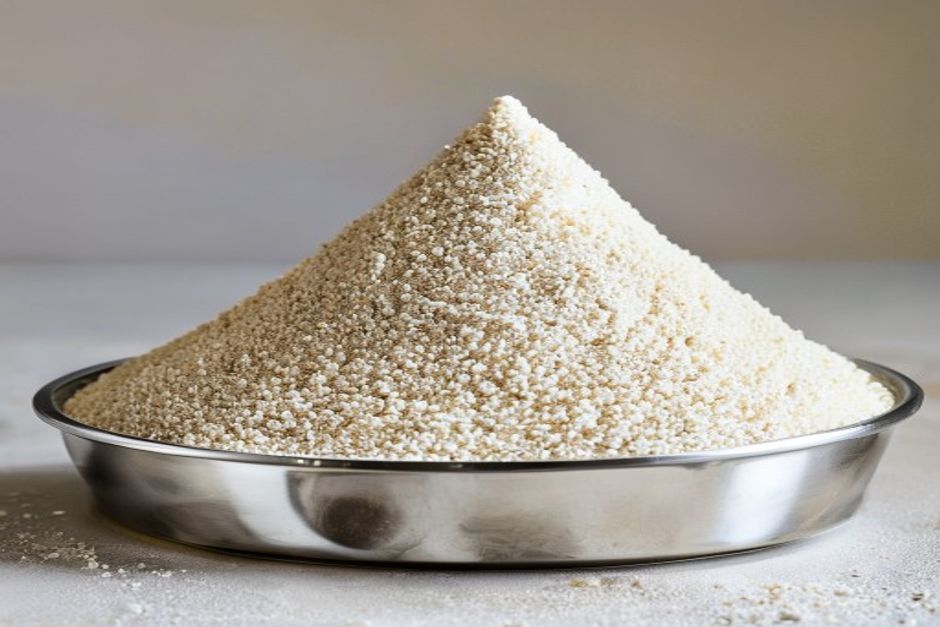
What is ZSM-5 Zeolite?
ZSM-5 (Zeolite Socony Mobil-5) is an aluminosilicate zeolite with the MFI (Mordenite Framework Inverted) framework type, discovered by Mobil Oil scientists in 1972. It features a unique two-dimensional pore system with straight channels (5.5×5.1 Å) intersected by sinusoidal channels (5.3×5.6 Å), giving it exceptional shape selectivity that no other zeolite matches.
This shape selectivity enables reactions that are impossible with larger-pore zeolites: para-xylene production from mixed xylenes (rejecting ortho and meta isomers), selective production of olefins from methanol (MTO/MTP), and selective cracking of n-alkanes in dewaxing. ZSM-5 has become the workhorse of modern petrochemical catalysis and is used in nearly every major refinery and petrochemical complex worldwide.
Three Physical Forms
1. ZSM-5 Powder (D50 2-10 μm)
Fine crystalline powder for catalyst manufacturers who shape and metal-impregnate ZSM-5 in-house. Used as FCC additive (mixed with Y zeolite at 1-25%), MTO catalyst component, and specialty catalyst ingredient.
- Particle size: D50 2-5 μm (standard), 5-10 μm (coarse)
- Crystal size: 0.5-5 μm depending on synthesis conditions
- Crystallinity: ≥95% (XRD)
- Applications: FCC catalyst additive, MTO catalyst, research-grade zeolite, custom catalyst synthesis
2. ZSM-5 Pellet (1.5-3 mm extrudate)
Cylindrical extrudate shaped with inert binder (typically alumina or attapulgite clay) for direct use in fixed-bed reactors. Used in xylene isomerization, ethylbenzene synthesis, and toluene disproportionation.
- Size: 1.5 mm, 2 mm, 3 mm diameter (length 3-10 mm)
- Binder: 20-30 wt% alumina (standard), or custom
- Crush strength: ≥50 N/mm (axial)
- Applications: Xylene isomerization, ethylbenzene synthesis, cumene production, toluene disproportionation
3. ZSM-5 Ball (1-3 mm sphere)
Spherical beads made by oil-drop or pan granulation for low pressure drop and uniform packing. Used in fixed-bed reactors with deep catalyst beds or in moving-bed applications.
- Size: 1-2 mm, 2-3 mm, 3-5 mm
- Bulk density: 0.6-0.8 g/cm³
- Crush strength: ≥60 N/bead (2mm)
- Applications: Fixed-bed alkylation, deep-bed isomerization, moving-bed regenerator catalyst
Technical Specifications
Powder Grades by SiO₂/Al₂O₃ Ratio
| Parameter | ZSM-5-25 | ZSM-5-50 | ZSM-5-100 | ZSM-5-200 | Silicalite-1 |
|---|---|---|---|---|---|
| SiO₂/Al₂O₃ (molar) | 25 | 50 | 100 | 200 | >1000 |
| Na₂O (wt%) | ≤0.10 | ≤0.10 | ≤0.10 | ≤0.10 | ≤0.10 |
| Surface Area (m²/g) | ≥350 | ≥380 | ≥400 | ≥400 | ≥400 |
| Pore Volume (cm³/g) | ≥0.15 | ≥0.18 | ≥0.20 | ≥0.20 | ≥0.20 |
| Crystallinity (XRD, %) | ≥95 | ≥95 | ≥95 | ≥95 | ≥95 |
| D50 (μm) | 2-5 | 2-5 | 2-5 | 2-5 | 2-5 |
| Relative Acidity | Very High | High | Medium | Low | Negligible |
| Primary Use | MTO, FCC | Xylene iso | EB synthesis | Dewaxing | Adsorption |
Shaped Forms (Pellet / Ball)
For pellet and ball grades, ZSM-5 is bound with 20-30 wt% inert alumina or attapulgite clay. Active ZSM-5 content typically 70-80 wt%. Shaped grades can be supplied in H-form (proton-exchanged, active acid sites) or as metal-impregnated (Ni, Pt, Cu, Zn) for specific reactions. Custom SiO₂/Al₂O₃ ratio and metal loading available on request.
Key Applications
- Methanol-to-Olefins (MTO) and Methanol-to-Propylene (MTP): Converts coal or natural-gas-derived methanol to ethylene and propylene — core technology for coal-to-olefins (CTO) and methanol-to-olefins (MTO) plants in China
- Fluid Catalytic Cracking (FCC) Additive: Mixed with Y zeolite at 1-25% to boost gasoline octane and increase propylene yield. Standard ZSM-5-25 used for this application.
- Xylene Isomerization: Converts mixed xylenes to para-xylene (PX) — the precursor for purified terephthalic acid (PTA) and PET. Shape selectivity of ZSM-5 enables >90% PX selectivity in single pass.
- Ethylbenzene Synthesis: Liquid-phase alkylation of benzene with ethylene to produce ethylbenzene, the precursor for styrene and polystyrene.
- Cumene Production: Alkylation of benzene with propylene to produce cumene (isopropylbenzene), the precursor for phenol and acetone.
- Toluene Disproportionation: Converts toluene to xylenes and benzene, used to balance aromatic production.
- Catalytic Dewaxing: Selective cracking of n-alkanes to improve diesel and lube oil cold-flow properties (pour point, cloud point).
- NOx SCR Catalyst: Cu- or Fe-exchanged ZSM-5 is the standard NH₃-SCR catalyst for NOx reduction in diesel exhaust and industrial off-gas.
Why Choose Our ZSM-5?
- 5 standard SiO₂/Al₂O₃ ratios from 25 to 1000, plus custom ratios
- 3 physical forms — powder, pellet, ball — to fit any reactor design
- High crystallinity ≥95% XRD for consistent performance
- Custom metal exchange — H-form, Na-form, or metal-impregnated (Cu, Ni, Pt, Zn, Fe)
- ISO 9001:2015 certified with batch-to-batch CV <5% for key parameters
- Free 1-2 kg sample for laboratory evaluation
- 15+ years export experience serving catalyst manufacturers and refineries worldwide
Frequently Asked Questions
What is ZSM-5 zeolite and what makes it special?
ZSM-5 (Zeolite Socony Mobil-5) is an aluminosilicate zeolite with the MFI framework type, discovered by Mobil Oil in 1972. Its unique two-dimensional pore system (straight channels 5.5×5.1 Å and sinusoidal channels 5.3×5.6 Å) provides shape selectivity unmatched by other zeolites. This means only molecules of specific sizes can enter and react within the pores, enabling selective reactions like para-xylene production from mixed xylenes, and methanol-to-propylene (MTP) selectivity. ZSM-5 is the workhorse of modern petrochemical catalysis.
What is ZSM-5 used for?
Major applications: (1) Methanol-to-Olefins (MTO) and Methanol-to-Propylene (MTP) - converts coal/natural-gas-derived methanol to ethylene and propylene. (2) Fluid Catalytic Cracking (FCC) additive - boosts gasoline octane and produces propylene. (3) Xylene isomerization - converts mixed xylenes to para-xylene (PX), the precursor for PET and polyester. (4) Ethylbenzene synthesis from benzene + ethylene. (5) Cumene production from benzene + propylene. (6) Toluene disproportionation to xylenes and benzene. (7) Catalytic dewaxing of diesel and lube oils.
What is the difference between ZSM-5 and Y zeolite?
ZSM-5 and Y zeolite (faujasite, FAU) are both industrial catalysts but with different properties: ZSM-5 has medium pore size (5.5 Å) providing shape selectivity for C6-C10 aromatics and olefins, while Y zeolite has large pore size (7.4 Å) allowing access to larger molecules like VGO and residues. Y zeolite is the main FCC catalyst (cracking heavy oils to gasoline), while ZSM-5 is used as FCC additive (boosts octane and light olefins). In MTO, ZSM-5 gives higher propylene/ethylene ratio; SAPO-34 (a silicoaluminophosphate) gives higher ethylene selectivity.
How is ZSM-5 synthesized?
ZSM-5 is synthesized hydrothermally from a gel containing: (1) silica source (sodium silicate, colloidal silica, or fumed silica), (2) alumina source (sodium aluminate or aluminum sulfate), (3) alkali (NaOH), (4) structure-directing template (typically tetrapropylammonium hydroxide, TPAOH, or tetrapropylammonium bromide, TPABr), and (5) water. The gel is crystallized in an autoclave at 150-180°C for 24-96 hours, then washed, dried, and calcined at 500-550°C to remove the template and open the pore structure. The SiO2/Al2O3 ratio, template type, and crystallization conditions control crystal size, morphology, and acidity.
What SiO2/Al2O3 ratios do you offer for ZSM-5?
Standard SiO2/Al2O3 molar ratios: 25 (high acidity, for cracking and MTO), 50 (medium, for xylene isomerization), 100 (low acidity, for shape-selective reactions), 200-500 (very low acidity, for high-temperature selective reactions), 1000 (silicalite-1, hydrophobic, for organic adsorption). All grades available as powder (D50 2-10 μm), extrudate pellets (1.5-3 mm), or spherical beads (1-3 mm). Custom SiO2/Al2O3 ratio and metal exchange (H-form, Na-form, or metal-impregnated) available on request. MOQ 100 kg for powder, 500 kg for shaped forms.