Zeolite 4A Ammonia Pickup: When 4A Fails in NH3 Service and 13X Should Be Substituted
Aluminaworld is a Zibo, Shandong-based Chinese manufacturer (ISO 9001 certified) producing 4A molecular sieve (8x12 / 4x8 mesh beads, ISO 22489 NH3 capacity 12-15 mg/g), 13X molecular sieve (10 Angstrom pore aperture, basic-hydrocarbon-tolerant grade available), activated alumina (BET 300-360 m2/g), pseudo-boehmite, and aluminum hydroxide (ATH), with 15+ years of export experience serving 60+ countries and direct technical support for syngas polishing, hydrogen PSA, and refinery drying service. In this engineering guide we document the failure mode where 4A molecular sieve loses water co-adsorption capacity under sustained NH3 exposure in syngas polishing service, the ammonium-ion-exchange mechanism that drives the failure, the comparative NH3 tolerance of 13X, and the substitution protocol that takes a 4A bed offline and replaces it with 13X (or basic-hydrocarbon-tolerant 13X) without taking the unit down for an unscheduled shutdown.
1. The failure mode: 4A is not a physisorption problem, it is a cation exchange problem
Zeolite 4A is the sodium form of type A zeolite: Na12-Al12-Si12-O48·nH2O with a sodalite cage (beta-cage) structure and a 4 Angstrom pore aperture. The water co-adsorption capacity that makes 4A the workhorse desiccant for natural-gas dehydration, compressed-air drying, and refrigerant drying depends on the Na+ cations staying in their framework sites. When NH3 enters the cavity, the standard picture (NH3 adsorbs on Na+ surface ionites and is released on thermal regeneration) holds for low cumulative loading - up to roughly 5-10 mg NH3 per gram of zeolite at 25 deg C and 100 ppmv NH3 in N2 carrier. Above that loading, the Na+ cations begin to undergo cation exchange with NH4+:
Na12-A + x NH3 + x H2O -> Na(12-x)(NH4)x-A + x NaOH (aqueous phase within the cavity)
The exchange is irreversible under typical regeneration conditions (220-260 deg C / 4 hours, which is standard for water-only regeneration): NH4+ does not reduce back to NH3 + H+ at temperatures below 400 deg C in the sodalite environment, and the regenerated Na+ that leaches into the aqueous phase deposits as NaOH or Na2CO3 (if any CO2 was co-present) in the cavity, blocking water access. The practical consequence: cumulative NH3 loading on 4A above approximately 30-50 mg/g produces a permanent, unrecoverable 50% loss of water co-adsorption capacity. Above approximately 80 mg/g, the cage structure partially collapses and the desiccant must be replaced.
2. NH3 inlet concentration thresholds: where 4A is safe, where it fails
The NH3 tolerance envelope for 4A is well-characterized in the UOP and CECA technical bulletins from the 1980s-90s syngas polishing era, and the field data have been re-confirmed in more recent BP/Hydro/Mobil troubleshooting reports. The three operational regimes are:
| Inlet NH3 (ppmv continuous) | 4A failure mode | Recommended material |
|---|---|---|
| Below 0.5 | Safe (no measurable capacity loss over 3-5 year design life) | 4A (standard) |
| 0.5 to 5 | Slow poisoning (1-3% per 1,000 hr); annual sampling recommended | 4A (with annual NH4+/Na+ IC verification) |
| 5 to 50 | Fast poisoning (10-25% capacity loss in 50-200 hr); replace within 6-9 months | 13X (standard or NH3-tolerant grade) |
| Above 50 (SMR/POX typical) | Catastrophic poisoning (50% loss in 80-120 hr at 100 ppmv) | 13X NH3-tolerant grade (La/Ba exchanged) |
The 5 ppmv threshold is the engineering decision boundary. Most syngas polishing trains from SMR (steam methane reformer) and POX (partial oxidation) units operate well above this threshold because the upstream methanation guard beds and the partial-oxidation step generate 5-50 ppmv (SMR) and 100-500 ppmv (POX) of NH3 slip. Without an upstream scrubber or guard bed, a 4A polishing bed will fail within weeks. With a water-wash or impregnated-carbon guard layer upstream, the NH3 at the 4A inlet can be dropped to below 5 ppmv and 4A can be used at its rated life.
3. Why 13X is the standard substitute: NH3 loading isotherms and capacity-loss kinetics
Zeolite 13X is the sodium form of type X zeolite: Na86-Al86-Si106-O46-X·nH2O with the faujasite (FAU) framework and a 10 Angstrom pore aperture. The cation-site density in 13X is approximately one-third that of 4A per unit cavity volume, which is the structural reason 13X tolerates NH3 to roughly 5-10x higher cumulative loading before measurable water-capacity loss.
The NH3 equilibrium loading isotherm at 25 deg C and 100 ppmv NH3 in N2 (per ISO 22489 test conditions) for a standard 8x12 mesh 13X bead is approximately 18-22 mg NH3/g at 60 minutes equilibrium. At the same conditions, a standard 4A bead is approximately 12-15 mg NH3/g. The crossover that matters for the substitution decision is the capacity-loss kinetics, not the equilibrium loading:
| Cumulative NH3 loading (mg/g zeolite) | 4A water capacity remaining | 13X water capacity remaining |
|---|---|---|
| 0 (fresh) | 100% | 100% |
| 20 | ~88% | ~99% |
| 40 | ~70% | ~97% |
| 60 | ~55% | ~94% |
| 80 | ~45% (collapse onset) | ~91% |
| 100 | Replace (irreversible) | ~88% |
| 150 | Replace | ~82% (regeneration needed) |
The crossover is structural: 4A's sodalite cage undergoes NH4+ cation exchange (irreversible), while 13X's faujasite cavity accommodates NH3 as a physisorbed species (reversible under standard 280-320 deg C regeneration with NH3 partial pressure below 10 ppmv during the regeneration half-cycle). At sustained 100 ppmv NH3 inlet, the bed-life differential is approximately 80-120 hours to 50% capacity loss for 4A vs 1,500-2,500 hours for standard 13X. NH3-tolerant 13X grades (La or Ba exchanged) extend this to approximately 4,000-6,000 hours at the same inlet conditions.
4. Field verification: the ion-chromatography NH4+/Na+ test
When a 4A polishing bed shows rising outlet dew point or shortening adsorption half-cycle (the two most common NH3-poisoning symptoms), the field confirmation step is straightforward. Pull a 50-100 g sample from the top 10% of the bed after depressurizing and purging the vessel with dry N2. Extract the sample in 200 mL of deionized water for 30 minutes, filter, and run ion chromatography (IC) for NH4+ and Na+. The diagnostic ratios are:
- NH4+/Na+ mass ratio below 0.05: bed is fresh or has only seen trace NH3; no replacement needed.
- NH4+/Na+ ratio 0.05-0.20: measurable cation exchange; bed is in slow poisoning regime; annual recheck and monitor outlet dew point.
- NH4+/Na+ ratio 0.20-0.50: severe poisoning; bed will lose 50% capacity within weeks; schedule replacement.
- NH4+/Na+ ratio above 0.50: catastrophic poisoning; replace immediately at next planned outage.
The IC test takes approximately 4-24 hours depending on whether the sample is run in-plant or shipped to an external lab. A faster field screening method is the conductivity test: NH4+ in the extract raises solution conductivity in proportion to concentration, with a detection limit of approximately 5 mg/L NH4+ (corresponds to NH4+/Na+ ratio approximately 0.02-0.03). Conductivity is not as accurate as IC but gives a same-shift answer for the go/no-go decision.
5. The 4-step substitution protocol from 4A to 13X
Before the substitution, document the existing bed's NH3 exposure history and verify the IC ratio on the spent 4A. This pre-substitution audit takes 2-4 hours and provides the baseline against which the new 13X bed's performance is measured in the months after the changeout.
6. Post-substitution monitoring schedule and bed-life KPIs
When the IC test confirms severe NH3 poisoning on a 4A bed, the substitution to 13X is a 4-step protocol designed to minimize unit downtime and to avoid the common mistake of mixing 4A and 13X in the same vessel (a layering issue that produces stratified water breakthrough at the 4A/13X interface).
- Step 1 - Drain and purge the vessel. Depressurize the vessel to atmospheric, purge with dry N2 at 5-10 Nm3/hr for 2-4 hours to remove residual NH3 and hydrocarbon vapors. Confirm NH3 below 2 ppmv at the vessel vent before opening. This step is critical: opening a poisoned 4A bed to atmosphere in a confined space will release trapped NH3 above the IDLH (immediately dangerous to life and health) threshold of 300 ppmv.
- Step 2 - Remove all 4A and clean the vessel internals. Vacuum-extract the spent 4A into sealed drums for proper disposal as a basic-catalyst waste (NH4+ exchanged zeolite can be regenerated in some cases for non-water applications, but is not reuseable for water service). Inspect the vessel for NaOH or Na2CO3 deposits (white crystalline deposits at the bottom dish and on the inlet distributor) and clean with deionized water rinse. Replace the lower support grid if it shows any corrosion from the alkaline deposits.
- Step 3 - Load 13X in a single uniform lift. Load the new 13X (standard or NH3-tolerant grade) using the sock-loading or gravity-drop method to avoid bead fracture. Critical: load the entire bed in one operation, do not attempt to layer 13X on top of a residual 4A layer. The 4A/13X interface will produce a sharp dew-point rise at the breakthrough curve because the two materials have different water isotherms. After loading, top off the vessel with the same 13X grade and level the bed surface.
- Step 4 - Commission with elevated-temperature regeneration. Initial regeneration at 320 deg C for 8-12 hours to drive off any residual NH3 and adsorbed moisture from the new 13X. Drop to operating regeneration setpoint (typically 280-300 deg C) after the first cycle. Verify bed outlet dew point at design value before returning the unit to service.
Total downtime for the substitution is typically 16-32 hours depending on vessel size, NH3 purging time, and operator availability. For a 25 MT 4A bed in a typical SMR polishing train, the field time breakdown is: depressurize/purge 3 hours, drain 2 hours, clean internals 2 hours, load 13X 5-7 hours, regenerate/commission 4-6 hours. Plan for a 24-hour outage window and verify with operations.
7. TCO comparison: 4A replacement cycle vs 13X substitution vs NH3-tolerant 13X
The total cost of ownership calculation for a typical 25 MT polishing bed in sustained 50 ppmv NH3 service is dominated by bed changeout frequency and unit-downtime cost. The three options:
| Option | Initial changeout (USD) | Bed life in 50 ppmv NH3 | Annual TCO (USD/yr) |
|---|---|---|---|
| Stay with 4A (status quo) | 25-40k (material + labor) | 6-9 months | 50-80k |
| Switch to standard 13X | 35-55k (+20-30% vs 4A) | 18-30 months | 25-45k |
| Switch to NH3-tolerant 13X (La/Ba) | 45-70k (+40-50% vs 4A) | 30-48 months | 15-30k |
Net TCO difference favors the 13X substitution by approximately 25-50k USD/year per bed; the NH3-tolerant grade improves that to approximately 35-50k USD/year per bed. The capital premium for the upgrade pays back in 6-12 months for sustained 50 ppmv NH3 service. For lower-NH3 service (5-50 ppmv), the payback extends to 12-24 months but is still positive.
8. Standards, references, and procurement specification
The procurement specification for NH3-service molecular sieve should reference ISO 22489 (NH3 capacity) and should explicitly require the supplier to disclose:
- NH3 equilibrium loading at 25 deg C, 100 ppmv NH3 in N2, 60 min (mg/g per ISO 22489)
- Water co-adsorption capacity at 25 deg C, 75% RH (wt%) per ISO 22489 or equivalent (typically 22-26 wt% for 13X, 27-29 wt% for 4A fresh)
- NH4+/Na+ cation exchange tolerance expressed as the maximum cumulative NH3 loading at which water capacity remains above 90% of fresh value (a supplier-specific test, not standardized but routinely available on request)
- Particle size distribution per ASTM D4365 or equivalent laser diffraction
- Bulk density, attrition loss per ASTM D4058, and crush strength per ASTM D4179 or D6175
- COA and batch traceability documentation
Reference standards: ISO 22489 (Molecular sieves - Determination of NH3 adsorption capacity), GB/T 10504 (equivalent Chinese standard, but note the higher NH3 test concentration; results not directly comparable to ISO), ASTM D4365 (Particle Size by Laser Diffraction), ASTM D4058 (Attrition Loss), ASTM D6175 (Bulk Density), DIN 66191 (BET Surface Area). For 13X basic-hydrocarbon-tolerant grades, request the supplier's NH3-tolerant grade data sheet (e.g., UOP Molsiv X13-BH or CECA Siliporite NH3-resistant 13X) and verify La or Ba exchange levels.
9. Bottom line and next steps
Zeolite 4A is the wrong material for sustained 5+ ppmv NH3 service. The failure mode is irreversible ammonium-ion exchange in the sodalite cage, not reversible NH3 adsorption. The substitution to 13X (standard or NH3-tolerant) is the correct engineering choice and the TCO calculation supports it across all but the lowest NH3 inlet ranges. The 4-step substitution protocol can be executed in a 24-hour planned outage window without compromising unit reliability.
For procurement-side questions on the NH3-tolerant 13X grade, sample request for in-plant IC verification of a current 4A bed, or a TCO comparison for a specific polishing train, contact Aluminaworld engineering. We supply both 4A and 13X (standard and NH3-tolerant) from Zibo, Shandong with full COA, ISO 22489 test report, and technical support for substitution planning.
Frequently Asked Questions
Field troubleshooting, regeneration parameters, and procurement specification for 4A vs 13X in NH3 service.
Why does zeolite 4A fail in ammonia (NH3) service when 4A is supposed to be a strong adsorbent for polar molecules?
Zeolite 4A has a 4 Angstrom pore aperture. NH3 is a small polar molecule with kinetic diameter ~2.6 Angstrom, so it physically enters the 4A cavity. But the Na+ cations in 4A's sodalite cage undergo ion exchange with NH4+ at ambient and process temperatures, producing (NH4)12-A zeolite, an irreversible structural analogue that loses ~50% of its water capacity within the first 50-100 hours of NH3 exposure. The failure is not simple reversible adsorption; it is chemisorption-driven cation exchange. By contrast, 13X's 10 Angstrom pore aperture and lower Na+ exchange-site density tolerate NH3 as a physisorbed species and can be thermally regenerated to baseline capacity if the NH3 partial pressure drops back to zero during the regeneration half-cycle.
What is the typical NH3 partial pressure range in industrial SMR (steam methane reformer) and POX (partial oxidation) syngas polishing service that causes this failure mode?
SMR syngas polishing trains typically see 5-50 ppmv NH3 slip from upstream methanation guard beds, depending on reformer severity and H2/CO ratio. POX syngas polishing sees 100-500 ppmv NH3 because the partial-oxidation step generates fixed nitrogen from any N2 co-feed. Both ranges are well above the 4A tolerance threshold of 0.5-2 ppmv continuous NH3 above which ammonium-ion exchange starts to measurably reduce water capacity. The 4A failure mode therefore manifests within days to weeks of NH3 breakthrough at any of these typical syngas concentrations.
How does NH3 exposure affect 4A's water co-adsorption capacity? Is the failure profile linear or step-shaped?
The water capacity loss profile is roughly linear in cumulative NH3 exposure (mg NH3 per gram of zeolite), reaching -50% at approximately 30-50 mg NH3/g zeolite for a typical 4A bead (1.6-2.5 mm). Above 80 mg/g the profile becomes step-shaped: the sodalite cage structure partially collapses as the cation exchange approaches the structural limit of NH4+ substitution. At that point the desiccant must be replaced; thermal regeneration cannot reverse the structural change.
Does 13X molecular sieve also fail in NH3 service, or is it immune?
13X is not immune, but it tolerates NH3 to roughly 5-10x higher cumulative loading before measurable water-capacity loss, because 13X's faujasite structure has approximately 1/3 the Na+ exchange-site density per unit cavity volume. At sustained 100 ppmv NH3 inlet, a typical 13X bed will reach -50% water capacity in approximately 1,500-2,500 hours vs 80-120 hours for 4A at the same inlet NH3. 13X can also be thermally regenerated to within 5-10% of original water capacity provided the regeneration temperature reaches 280-320 deg C and the regeneration gas carries NH3 partial pressure below 10 ppmv for at least 30 minutes per regeneration cycle.
What is the recommended regeneration temperature to reverse NH3 pickup on 13X?
280-320 deg C is the practical regeneration temperature window for 13X recovering from sustained NH3 pickup. Lower temperatures (220-260 deg C, typical for water-only regeneration) leave NH3 partially adsorbed on the strongest cation sites and the water capacity does not fully recover. Above 330 deg C there is risk of binder degradation in clay-bound 13X grades (e.g., UOP Molsiv X13), reducing attrition resistance. The 300 deg C / 4-hour regeneration cycle is the standard practice in PSA H2 and air prep units that see routine NH3 slip.
Is there a quick field test to confirm NH3 poisoning vs water-only overloading on a 4A or 13X bed?
Yes. A drum-side thermal probe (3-5 point thermocouples along the bed height during adsorption half-cycle) showing an exotherm wave earlier than expected in the cycle, combined with an unexpected NH3 odor at the bed outlet and an outlet dew point that is rising despite nominal regeneration, is a clear NH3-poisoning fingerprint. Confirmation: pull a 50-100 g sample from the top 10% of the bed (after depressurizing and purging with dry N2), extract with deionized water, and run ion chromatography for NH4+ vs Na+. A NH4+/Na+ mass ratio above 0.05 indicates measurable cation exchange; above 0.20 indicates severe poisoning.
What is the role of guard bed material (e.g., activated carbon, impregnated carbon, or wash water) upstream of the 4A or 13X NH3-tolerance bed?
A water-wash or acid-wash scrubber upstream can drop NH3 from 200-500 ppmv to below 5 ppmv, which moves the bed chemistry from the poisoning regime to the trace-contaminant regime. Activated carbon impregnated with phosphoric acid or with a metal halide (e.g., CuCl2, ZnCl2) can drop NH3 from 50 ppmv to below 1 ppmv at typical space velocities (500-2,000 h-1). In syngas polishing, a sacrificial activated-alumina or acidic ion-exchange resin guard layer ahead of the 4A/13X bed is the most common engineering choice and typically extends the 4A bed life from months to years. The trade-off is pressure drop (an additional 0.2-0.5 bar across the guard layer) and the cost of the periodic guard-layer replacement.
Are there molecular sieve grades specifically formulated for NH3 tolerance?
Yes. Several manufacturers offer NH3-tolerant or basic-resistant grades. UOP Molsiv X13-BH (basic-hydrocarbon-resistant) and CECA Siliporite NH3-resistant 13X are two examples. The modification typically involves partial exchange of Na+ with rare-earth (La, Ce) cations or with Ba2+, which lowers the strongest cation-site basicity and reduces NH3 chemisorption. Capacity penalty is usually 5-10% vs standard 13X. The cost premium is typically 20-40% over standard 13X. For sustained NH3 service above 50 ppmv inlet, the NH3-tolerant grade pays back in 6-12 months vs standard 13X.
How is NH3 measured at the bed inlet and outlet for routine monitoring?
FTIR (Fourier-transform infrared) at 3335 cm-1 (NH3 symmetric stretch) is the standard online measurement with detection limit approximately 0.5 ppmv and response time 5-15 seconds. Alternative: electrochemical NH3 sensor (range 0-100 ppmv, accuracy +/-5 ppmv, slower response 30-60 seconds). For grab-sample verification, draeger-tube colorimetric method (5-100 ppmv range, +/-15% accuracy) or impinger-bottle acid-trap with ion chromatography (more accurate but lab-based, 4-24 hour turnaround). Sampling line must be heated to 150 deg C to prevent NH3 adsorption on cold stainless surfaces; unheated lines typically lose 30-70% of NH3 within 1-2 meters.
What standards (ISO, ASTM, DIN) cover NH3 adsorption capacity testing on molecular sieves?
ISO 22489 (Molecular sieves - Determination of NH3 adsorption capacity) is the primary test method, specifying 25 deg C, 100 ppmv NH3 in N2 carrier, 1 atm total, equilibrium at 60 minutes. The corresponding Chinese standard is GB/T 10504 (equivalent to ISO 22489, but with a slightly different test gas composition: 1000 ppmv NH3 vs ISO's 100 ppmv; the test results are therefore not directly comparable). For deeper characterization, ASTM D4365 covers laser-diffraction particle size, and DIN 66191 covers BET surface area. A 4A grade that passes ISO 22489 with 12-15 mg NH3/g at equilibrium should NOT be used in sustained 50+ ppmv NH3 service, even if the COA says "NH3 tested" - the equilibrium capacity number is not the same as the dynamic poison-tolerance number.
What is the actual TCO (total cost of ownership) penalty for sticking with 4A in an NH3 service that calls for 13X, vs just swapping the charge?
The charge-out cost for a 25 MT 4A bed changeout is typically 25-40k USD per bed (material + labor + production loss). The TCO penalty of running 4A in sustained 50 ppmv NH3 service is approximately one bed changeout every 6-9 months (water capacity rolls off faster than rated life), so 50-80k USD/year per bed. Swapping to standard 13X is approximately 35-55k USD per initial changeout (13X costs 20-30% more per MT than 4A), and bed life extends to 18-30 months in the same service. Net TCO difference: approximately 25-50k USD/year per bed in favor of 13X. Adding an NH3-tolerant 13X grade costs another 15-25% on the initial changeout but extends life to 30-48 months, improving TCO by a further 30-50%.
Is there a guidance threshold - for example, an inlet NH3 ppmv number - below which 4A can still be safely used?
Yes. Below approximately 0.5 ppmv continuous NH3 at the bed inlet, 4A is effectively NH3-stable and can be used for water-only service for the rated 3-5 year life. Between 0.5 and 5 ppmv, 4A water capacity degrades by approximately 1-3% per 1,000 hours of exposure (slow poisoning, manageable with annual sampling). Above 5 ppmv, the failure rate accelerates non-linearly and 13X is the correct engineering choice. In practice, most SMR and POX polishing beds operate above 5 ppmv unless an upstream scrubber is installed, which is why 13X is the de facto standard for syngas polishing service in modern H2 plants.
Related reading from Aluminaworld
The NH3 pickup failure mode is one of several poisoning mechanisms that shorten molecular sieve life in industrial service. Related engineering guides cover the parallel failure modes and the substitution protocols for each:
- Acid Gas Breakthrough in Molecular Sieve 13X: H2S/SO2 Poisoning Reversibility by Thermal Swing - companion piece covering the H2S/SO2 poisoning analogue.
- Molecular Sieve Poisoning: Causes and Prevention - catalog of poisoning mechanisms including water co-adsorption interference, hydrocarbon fouling, and amine carryover.
- Compressed Air Dryer Oil Carryover Cracking: How Hydrocarbon Fouls 4A and 13X (IR Detection Method) - the oil-flooded screw compressor fouling mechanism that often co-occurs with NH3 pickup in refinery compressed air service.
- Exothermic Spots in Molecular Sieve Bed: Runaway Adsorption Heating and Carbon Lay-Down Prevention - covers the parallel thermal-runaway mechanism that often accompanies poisoning-related capacity loss.
- Why Your Regeneration Cycle Keeps Getting Longer: 7 Root Causes Ranked by Frequency - the regeneration-prolongation diagnostic guide that includes NH3 poisoning as one of the 7 ranked root causes.
Next steps
For a free NH3-tolerance evaluation of your current 4A or 13X polishing bed, or to request a 13X NH3-tolerant grade sample for in-plant IC verification, contact Aluminaworld engineering directly. We supply both standard and NH3-tolerant 13X from Zibo, Shandong with full ISO 22489 test report, COA, and substitution planning support. Typical sample request turnaround is 5-7 business days; engineering consultation is free for evaluation projects.
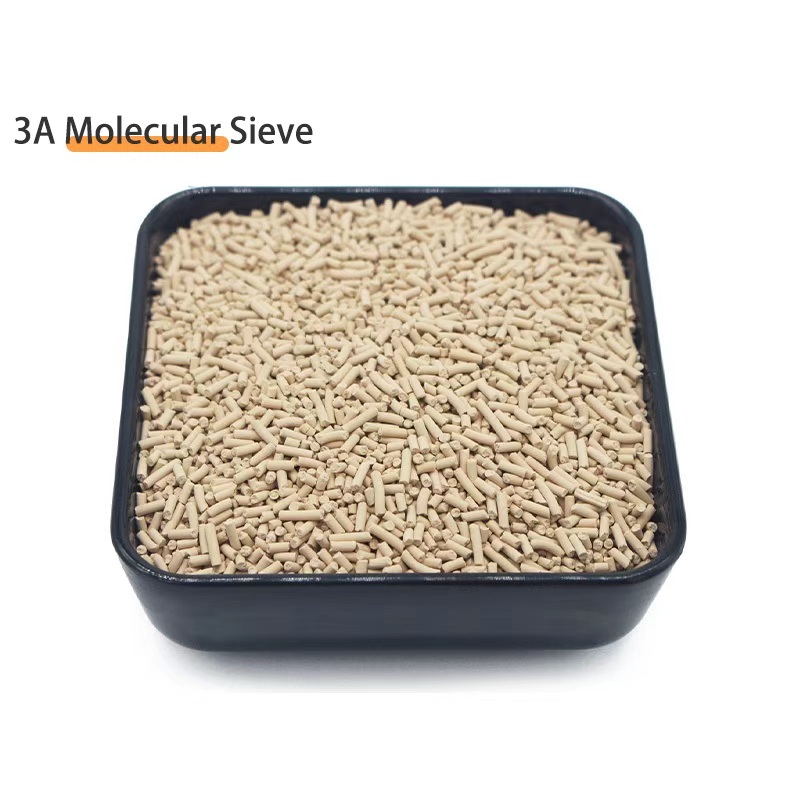
Molecular Sieve 4A and 13X (Standard + NH3-Tolerant Grades)
Synthetic 8x12 / 4x8 mesh beads with Na+ cation framework - 4A for water-only service below 0.5 ppmv NH3, 13X (standard or La/Ba-exchanged NH3-tolerant grade) for sustained 5-500 ppmv NH3 service in syngas polishing, SMR/POX H2 plants, and refinery drying trains.
View Product Details