A poisoned molecular sieve bed is one of the most expensive unplanned events in industrial gas processing. Bed replacement runs from $50,000 for a small air dryer to $1.5 million for a large hydrogen plant, plus 7 to 21 days of lost production. The good news: 90% of poisoning incidents are preventable with proper feed pretreatment and operating discipline.
regeneration best practices for poisoned bedsAcross our customer base, we have seen bed lives range from 18 months (catastrophic poisoning) to 12+ years (well-maintained). The seven causes below account for the vast majority of early-life failures we have investigated.
If you are seeing capacity loss earlier than 36 months in a 4A or 5A bed, one of these seven factors is almost certainly involved.
1. The 7 Most Common Poisoning Agents
- Heavy hydrocarbons (C6+). Common in refinery and petrochemical streams. Cause pore blockage; cannot be removed by standard TSA regeneration. Fix: upstream activated carbon guard bed or refrigeration knock-out.
- Compressor lube oil. Even 0.5 ppm in feed creates a surface film that blocks pore mouths. Fix: coalescing filter with 0.1 μm rating plus activated carbon polishing.
- H2S and mercaptans. Form acid in the presence of adsorbed water; attack the cation exchange sites. Fix: H2S scavenger (zinc oxide or iron sponge) upstream, target inlet below 5 ppm H2S.
- Ammonia and amines. Form strongly-bound surface complexes that are not removed by TSA. Fix: water wash or acid neutralization upstream of the sieve bed.
- Salt aerosols (offshore platforms). Create a crust on bead surface. Fix: saltwater wash and demister pad.
- Polymerizing hydrocarbons (dienes, styrenes). Polymerize inside the pore structure at regeneration temperatures. Fix: lower regeneration temperature below polymerization onset or use a guard bed of activated alumina.
- Particulate carry-over from upstream reactors. Catalyst fines, corrosion products, and rust plug the support screen and create channeling. Fix: 25 μm particulate filter on feed line.
2. Diagnostic Tests to Identify Poisoning Agent
If your bed is failing earlier than expected, three tests can identify the poison:
Test 1: Spent Bed Analysis (Most Definitive)
Sample 100 g of spent sieve from the top, middle, and bottom of the bed. Send to our lab for thermogravimetric analysis (TGA), BET surface area, and solvent extraction. We can identify hydrocarbons, amines, and salts within 5 business days. Cost: $800 to $1,500 per sample.
Test 2: Outlet Water Breakthrough Curve
Run the bed at design flow and record outlet water content every 30 minutes. Compare to the fresh-bed curve. A compressed curve (breakthrough occurring sooner than expected) indicates reduced working capacity. The slope of the breakthrough indicates the dominant effect: gradual slope = poisoning; sharp slope = channeling.
Test 3: Pressure Drop Trend
Track delta-P weekly. A rising trend means fines accumulation or screen blockage. A sudden spike means mechanical failure (bed settlement, broken distributor). Both require immediate inspection.
If the bed is contaminated but not fully poisoned, in-situ regeneration with hot nitrogen (300 to 350°C, 6 to 12 hours) can sometimes recover capacity. If the poison is polymerized hydrocarbons or strongly-bound acid, in-situ regeneration will not help.
3. Feed Pretreatment: The 1% Investment That Saves 100% of Bed Cost
The single most cost-effective improvement you can make to extend bed life is upstream feed pretreatment. The economics are stark:
- Activated carbon guard bed (1 m³ for a typical bed): $8,000 to $15,000
- Coalescing filter system: $5,000 to $12,000
- Particulate filter: $2,000 to $5,000
- H2S scavenger (annual media cost): $4,000 to $20,000 depending on H2S level
Total pretreatment investment: $20,000 to $50,000. Bed replacement avoided: $200,000 to $1,500,000. ROI: 4 to 7x even at conservative bed life assumptions.
If you are designing a new installation or troubleshooting an existing one, our engineering team can review your P&ID and recommend a pretreatment package sized to your specific feed composition. We respond within 24 hours with a quotation and 1 kg free sample for lab evaluation.
Frequently Asked Questions
Can a poisoned bed be restored in place?
Sometimes. If the poison is water or weakly-bound hydrocarbons, extended TSA regeneration (300°C, 12 hours) can recover 60 to 80% of capacity. If the poison is polymerized hydrocarbons or amines, the bed must be replaced.
How do I know if poisoning is happening vs. normal aging?
Compare your operating data year-over-year. If breakthrough time drops by more than 10% per year or delta-P rises by more than 15% per year, accelerated poisoning is likely.
Is there a poison-resistant sieve grade?
Not exactly. Different grades tolerate different poisons (3A tolerates H2S better than 13X; 13X tolerates CO2 better than 4A). But the fix is always pretreatment, not sieve selection.
What is the cost of a 1 MT sieve bed?
Depending on grade: $4,000 to $7,000 per MT for 4A, $5,000 to $8,000 for 13X. Bulk discounts apply above 10 MT.
Can I reuse a partially poisoned bed in a less critical service?
Sometimes. A 4A bed that has dropped to 60% of original capacity in hydrogen service may still perform adequately in compressed air drying. Talk to our engineers before redeploying.
Related Molecular Sieve Articles
Molecular Sieve 3A: Ethanol Dehydration and Insulating Glass Applications
Molecular Sieve 4A for Natural Gas and LNG Dehydration: Capacity and Cycle Design
Molecular Sieve 5A vs 13X in PSA Hydrogen Purification: Which Grade Wins?
regeneration best practices for poisoned beds
calculate replacement bed size
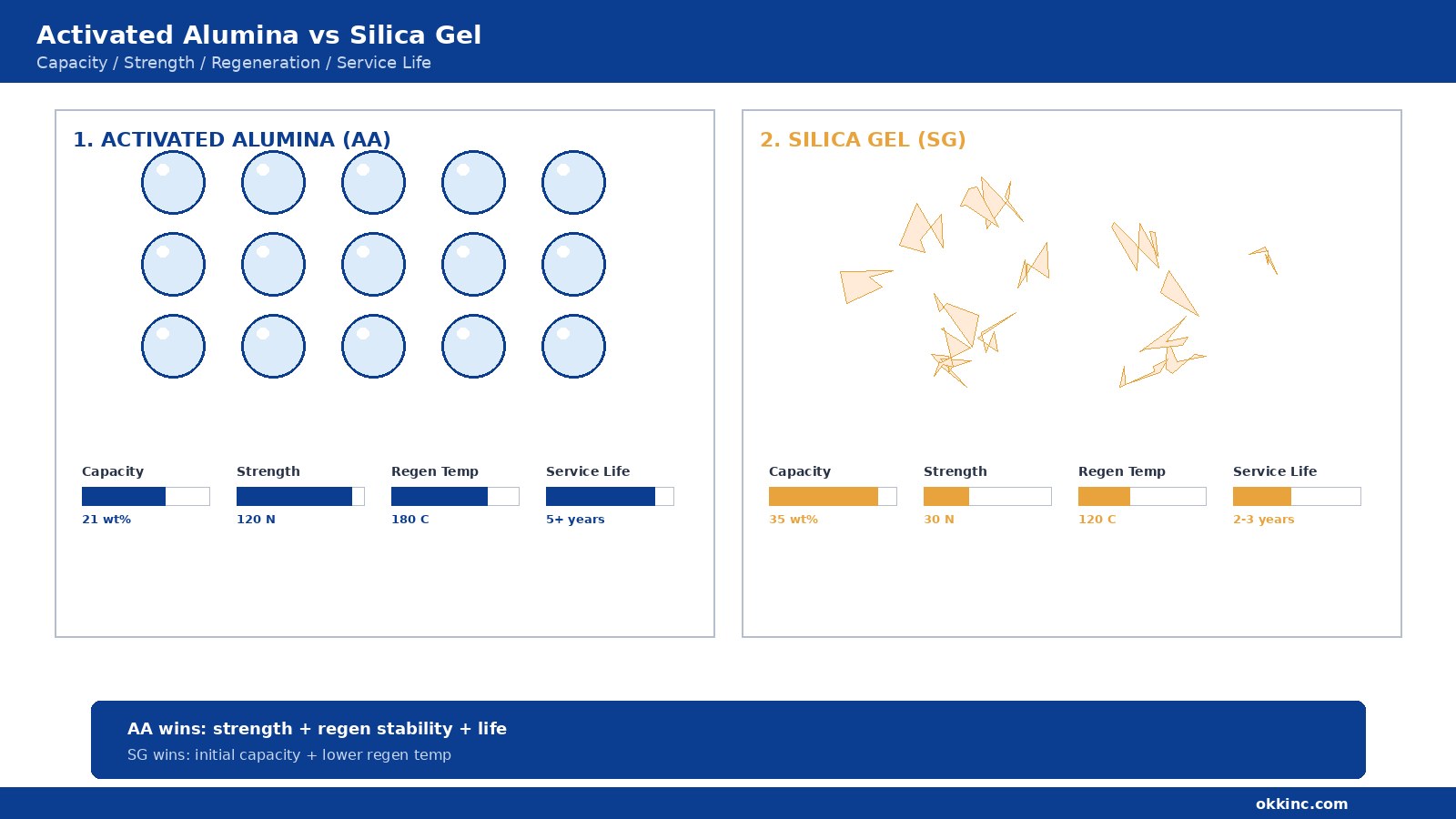
Activated Alumina Vs Silica Gel Desiccant
Need a Quote or Free Sample?
Tell us your feed conditions and target outlet spec. Our engineers reply within 24 hours with a recommendation and a 1 kg free sample.