
Activated Alumina Bead Size: How to Choose the Right One
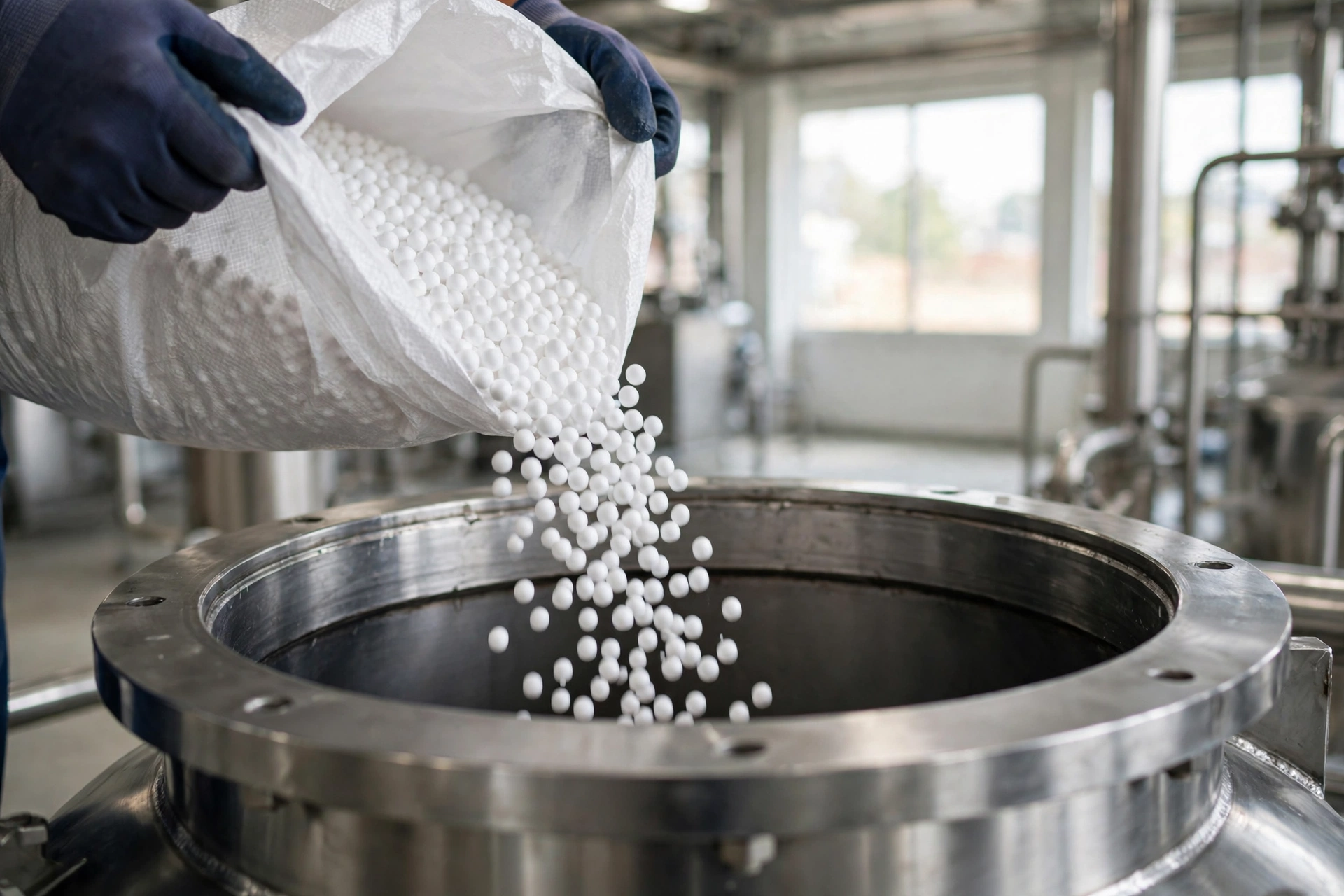
Order activated alumina and the first question after grade is bead size: 1–3 mm, 3–5 mm or 5–8 mm? The chemistry is the same in every size — Al₂O₃ ≥93% and a BET surface area of 300–360 m²/g — but the geometry changes how the bed behaves: how fast it dries, how much pressure it costs, and how long the beads survive.
This guide explains what each size does in a dryer, which size fits which duty, and what to check when you order.
Why Bead Size Is a Decision, Not a Detail
Bead size sets the balance between drying speed and pressure drop: smaller beads dry faster and cost more pressure; larger beads cost less pressure and dry slower.
A smaller bead has a shorter path from surface to centre, so water reaches the internal pore surface sooner and the bed reaches its working dew point faster — the whole reason small beads exist. The price is pressure drop: a bed of small beads packs tighter, leaves narrower passages for the gas, and takes more pressure to push the same flow through. A larger bead opens the passages, so the same flow costs less pressure — but water takes longer to reach the centre, so the bed needs more depth or contact time to finish the job.
Size also decides how the beads survive: larger beads carry higher crush strength — our 5–8 mm beads are rated at ≥210 N per particle against ≥130 N for 3–5 mm — and lose less to attrition over repeated regeneration cycles. One rule holds for every size: use one size per bed. Mixed sizes segregate during loading and in service, the fine beads settle, flow channels through the coarse zones, and the bed breaks through early.
The Sizes on the Datasheet
Our desiccant beads run 1–3 to 5–8 mm, with a finer water-treatment range of 1–2 to 3–5 mm — the same material, graded by size.
The air-drying grade covers 3–5, 4–6 and 5–8 mm; the water-treatment grade covers 1–2, 2–3 and 3–5 mm. Across the range the material stays the same: Al₂O₃ ≥93% for air drying and ≥92% for water treatment, BET surface area 300–360 m²/g, bulk density 0.68–0.75 g/cm³, static water adsorption ≥18% at 60% relative humidity, and attrition loss ≤0.1 wt%. Regeneration is a hot-air purge at 170–250 °C, and a regenerated bed reaches dew points down to −70 °C. What changes with size is crush strength — and the duty the size is made for.
| Size | Al₂O₃ | BET (m²/g) | Crush strength | Typical duty |
|---|---|---|---|---|
| 1–2 mm | ≥92% | ≥300 | ≥60 N | Defluoridation, water treatment |
| 2–3 mm | ≥92% | ≥300 | ≥100 N | Defluoridation, small filters |
| 3–5 mm | ≥93% | 300–360 | ≥130 N | Compressed air, gas drying |
| 4–6 mm | ≥93% | 300–360 | ≥180 N | Large dryers, guard beds |
| 5–8 mm | ≥93% | 300–350 | ≥210 N | High-flow beds, air separation |
Small Beads (1–3 mm): Fast Drying, Higher Pressure Drop
Small beads reach equilibrium fastest, which is why water treatment uses 1–2 and 2–3 mm — but they charge the highest pressure drop.
In water treatment the contact time is short and the water is liquid, so the fast kinetics of a small bead matter more than the pressure it costs: a 1–2 mm bead removes fluoride at ≥2.5 mg/g, and defluoridation works best at pH 5.5–6.5. The same logic applies to small gas and instrument-air dryers, where the bed is shallow and the flow low, so the pressure penalty stays small.
The limit is flow. Push a high flow through a deep bed of small beads and the pressure drop climbs steeply, the compressor works harder, and the beads at the bottom of the bed carry the load. If the dryer is large or the flow is high, the answer is not a smaller bead — it is a larger one. And whatever the size, the support grid must hold the beads: a grid sized for 5–8 mm will pass 1–3 mm beads straight through.
Mid Sizes (3–5 mm): The Default for Most Dryers
For most compressed-air and gas dryers, 3–5 mm is the default: fast enough to reach −40 to −70 °C dew points, open enough to keep pressure drop manageable.
Most orders are placed in this size, and the reason is balance rather than any single number. At 300–360 m²/g and ≥130 N crush strength, a 3–5 mm bead dries quickly, survives repeated regeneration at 170–250 °C, and keeps the pressure drop within what a standard compressor and dryer design expect. Order it when the dryer manual gives no size, when you are replacing a bed and the old size is unknown, or when the duty is ordinary compressed-air or gas drying with no extreme flow or depth.
One check before ordering: confirm the size the dryer was designed for. If the vessel was built for 5–8 mm, dropping to 3–5 mm raises the pressure drop and can push a marginal compressor over its limit.
Large Beads (5–8 mm): Low Pressure Drop, Long Bed Life
Large beads are the choice when flow is high and the bed is deep: the lowest pressure drop per metre of bed and the strongest beads we make.
A 5–8 mm bead carries a crush strength of ≥210 N per particle, the highest in the range, and the open bed it forms keeps the pressure drop low even at high flow — which is why large beads are the standard for guard beds in air-separation front-end purification and for other deep, high-flow beds. The trade-off is kinetics: water takes longer to reach the centre of a large bead, so the bed needs its full depth and its designed contact time to reach the same outlet dew point.
Large beads also lose the least to attrition: at ≤0.1 wt% attrition loss the bed stays clean, the downstream filters stay clear, and the pressure drop stays flat across regeneration cycles instead of climbing as fines accumulate. For a bed that runs for years between change-outs, that stability is worth more than a slightly faster first cycle.
Ordering: Quantity, Packing and the Checks Before Loading
Order by bed volume, not by habit: the quantity follows the bulk density on the datasheet.
The quantity is the bed volume multiplied by the bulk density: at 0.68–0.75 g/cm³, one cubic metre of bed needs 680–750 kg of beads. Add the support layers and a small handling allowance, and order the support media with the beads so the grid, the support and the adsorbent arrive matched. Packing is 25 kg bags, 150 kg steel drums or 800/1000 kg bulk bags, and bulk orders run 15–25 days. Prices are quoted EXW Zibo, freight calculated per order. Activated alumina is produced on our own lines in Zibo.
Before loading, check the batch certificate of analysis: bead size, package moisture and attrition against the datasheet. A COA that confirms the size is the last chance to catch a wrong size before it goes into the vessel.
For the full grade data, see the activated alumina product page; for handling and storage after delivery, our storage and receiving guide; and for the guard-bed duty where large beads earn their keep, the guard bed in air separation plants.
Frequently Asked Questions
Which bead size gives the lowest dew point?
No size on its own sets the dew point: with the same material — Al₂O₃ ≥93% and static water adsorption ≥18% at 60% relative humidity — any size can reach −40 to −70 °C once the bed is regenerated at 170–250 °C. Small beads get there faster; large beads need a deeper bed or longer contact time.
Can I mix bead sizes in one bed?
No. Mixed sizes segregate during loading and in service, so the fine beads settle, flow channels through the coarse zones, and the bed breaks through early while most of its capacity sits unused. Use one size per bed and match the support layer to it.
Why is the pressure drop higher after a bed change?
Check the size first: changing from 5–8 mm to 3–5 mm raises the pressure drop at the same flow, as do fines from attrition and a support layer that is too fine. Confirm the size on the batch COA before loading and keep the flow within the design velocity.
How much activated alumina do I need?
Multiply the bed volume by the bulk density: at 0.68–0.75 g/cm³, one cubic metre of bed needs 680–750 kg. Add the support layers and a small handling allowance, and check the batch COA before loading.
Not sure which size your dryer needs? Send us the dryer type, the flow rate, the bed dimensions and the target dew point — our engineers will confirm the size and the quantity: barry@okkinc.com.
Get a Quote
Tell us the product, grade and quantity. We reply within 12 hours with EXW pricing and lead time.
- ✓ COA and technical datasheet with every shipment
- ✓ EXW pricing — freight calculated per order
- ✓ Engineering consultation on grade selection and loading
Prefer to talk now?
WhatsApp +86 133 2522 2240
or email barry@okkinc.com