
Receiving Alumina & ATH: 7 Checks Before You Accept
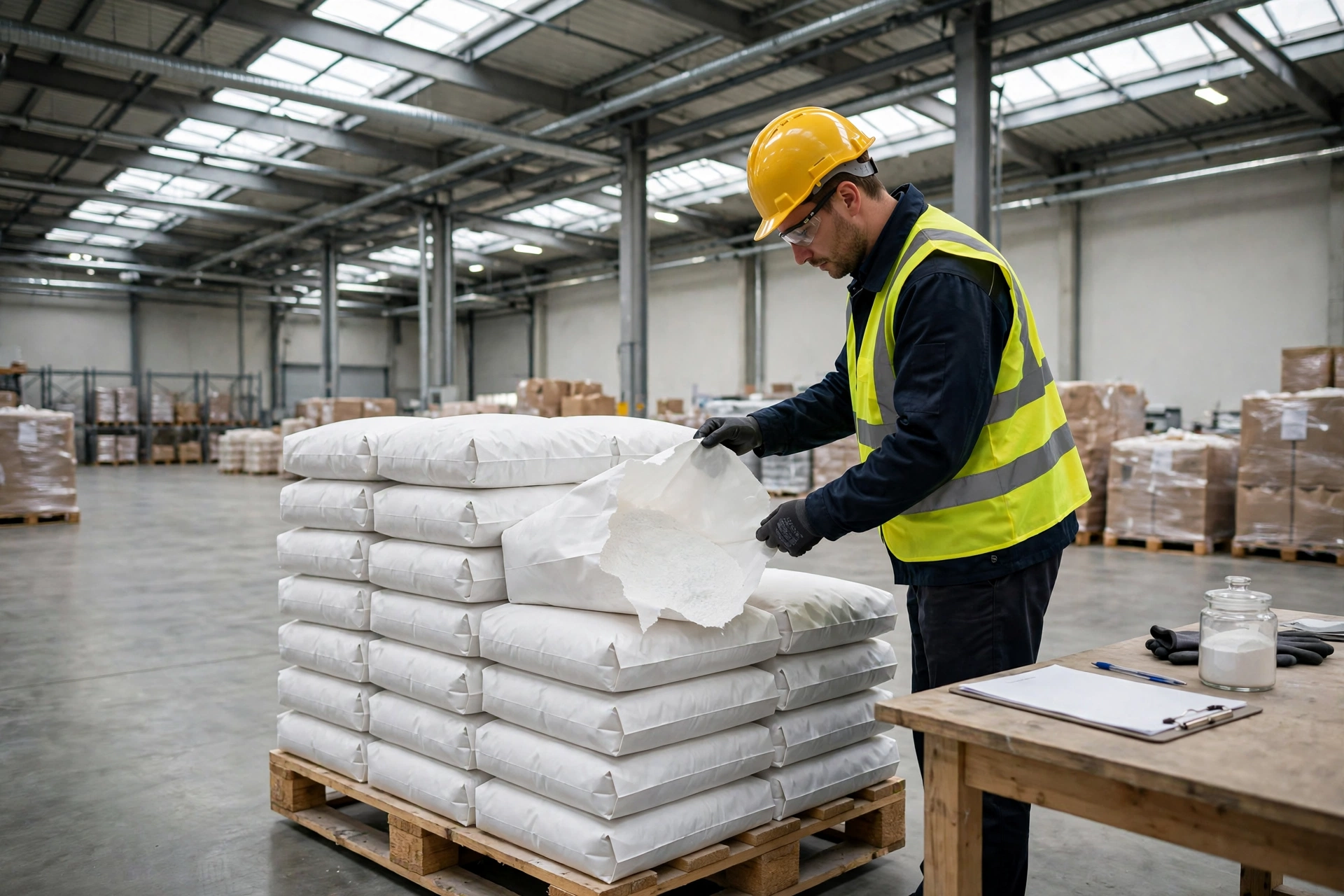
A drum of calcined alumina or a pallet of ATH looks identical whether it is in spec or not. Both arrive as fine white powders in sealed bags — and the difference between a good lot and a bad one only shows up weeks later, in a dull coated sheet, a cracked refractory lining, or a flame-retardant compound that fails its test. By then the supplier has been paid and the lot is already in your process.
Receiving inspection exists for exactly that reason: seven checks, done at the dock in under an hour, that catch the problems while you still have leverage. This guide is for the engineer who signs for the delivery and the buyer who owns the purchase order — what to check on alumina powder and aluminium hydroxide (ATH), in what order, and what to do when a check fails.
Checks 1–2: The COA Against Your Order
Start with paper, not powder: if the certificate does not match the order, nothing else you check matters.
The batch certificate of analysis (COA) should list the batch number, the production date, and every value you specified — Al₂O₃ content, Na₂O, and for ATH, loss on ignition. Compare each line against the purchase order and the producer datasheet, not against the quotation. On the Aluminaworld datasheet, calcined alumina is supplied in three grades: standard Al₂O₃ ≥ 99.0%, high purity ≥ 99.5% and ultra pure ≥ 99.7%, with Na₂O limits tightening from ≤ 0.40% to ≤ 0.10% and the alpha phase rising from ≥ 90% to ≥ 97%. ATH is ≥ 99.5% Al(OH)₃ on the industrial grade and ≥ 99.6% on the micro-fine grade, with loss on ignition of 34.5 ± 0.5% at 1000 °C on both grades. If a value is missing from the COA, the batch is not verified — ask for the missing line before you sign. And check that the batch number printed on the bags matches the COA: a certificate for a different batch is the most common paperwork failure in powder deliveries, and it is also the easiest to catch.
Check 3: Whiteness and Iron — the Brightness Pair
Whiteness is what you see; iron is what ruins it. Check both, because a powder can pass one and fail the other.
For ATH, whiteness is the headline number: ≥ 93% on the industrial grade and 96–98% on the micro-fine grade. But whiteness alone is a weak guarantee, because iron is what yellows a sheet over time — which is why the Fe₂O₃ limit tightens from ≤ 0.02% on the industrial grade to ≤ 0.01% on the micro-fine grade. The same logic applies to calcined alumina: Fe₂O₃ is capped at ≤ 0.05% on the standard grade, ≤ 0.03% on high purity and ≤ 0.02% on ultra pure, with SiO₂ capped at ≤ 0.10% to ≤ 0.03%. At the dock, hold a scoop of the powder next to the retained sample from your approved lot and compare them under the same light: a visible grey or yellow tint is a reason to hold the lot and run a whiteness check before release, even if the COA numbers look fine. Numbers on paper and powder in the hand should agree; when they do not, trust the powder and test it.
Check 4: Particle Size — the D50 Must Match the Grade
A powder with the wrong particle size is the wrong product, even when the chemistry is perfect.
| Material | Grade | D50 (median) | Top cut |
|---|---|---|---|
| ATH | ATH-1 | 1.0–1.5 μm | ≤ 10 μm |
| ATH | ATH-2 | 2.0–3.0 μm | ≤ 15 μm |
| ATH | ATH-5 | 5.0–7.0 μm | ≤ 25 μm |
| ATH | ATH-10 | 10–15 μm | ≤ 45 μm |
| ATH | ATH-25 | 20–25 μm | ≤ 75 μm |
| Calcined alumina | 200 mesh | 15–25 μm | — |
| Calcined alumina | 325 mesh | 5–10 μm | — |
| Calcined alumina | 400 mesh | 3–7 μm | — |
| Calcined alumina | 600 mesh | 2–5 μm | — |
| Calcined alumina | 800 mesh | 1–3 μm | — |
| Calcined alumina | 1250 mesh | < 1 μm | — |
Particle size decides how the powder behaves: fine grades disperse faster and give a smoother surface in coatings and polishing, while coarser grades carry bulk and opacity at lower cost. The wrong D50 changes viscosity in a coating colour, surface finish in a polishing slurry, and sintering behaviour in a ceramic body — all without changing a single chemistry number on the COA. Check the grade code on the bag label against the order, and if you run a laser-diffraction check in-house, compare the D50, not just the top cut: a top cut can pass while the median drifts.
Checks 5–6: Packaging, Moisture and Weight
A torn bag is not cosmetic damage: powder that has picked up moisture will not disperse, and a short bag is a short delivery.
Inspect every pallet before you sign: torn or re-taped bags, damp patches, crushed drums, broken seals on bulk bags. Alumina powder and ATH are supplied in 25 kg bags, steel drums or bulk bags — confirm the format matches the order, and confirm the count. Damp powder clumps, and clumps do not disperse in a coating colour or a polymer compound, and they will not break up in your mixer. Weigh a sample of the bags on a calibrated scale: a 25 kg bag that weighs 24.2 kg is not a rounding error, it is a short delivery — and a reason to check the rest of the lot. Keep the lot labels with the batch number: if a problem appears in production, the label is what traces it back to a COA.
Check 7: Sample the Lot — and Know What to Do When a Check Fails
One bag is not a lot: sample across the delivery, test what you can in-house, and hold the lot until the result is in.
Take samples from several bags on different pallets and combine them into one composite sample — a single scoop from the top bag tells you nothing about the bottom of the pallet. In-house, the checks most buyers can run are loss on ignition for ATH (34.5 ± 0.5% at 1000 °C), a whiteness reading against your retained sample, and a sieve or laser-diffraction particle-size check. Record the result against the batch number and keep the retained sample with it. If any check fails, quarantine the lot, photograph the labels and the defect, and notify the supplier the same day with the COA, the photos and your test result. Do not blend a failed lot with a good one to “average it out”, and do not use it “just for this batch”: a powder that fails at receiving fails in the process, and the cost of rework is always larger than the cost of a replacement shipment. A supplier that answers with a corrected COA and a replacement date is a supplier worth keeping; one that argues the paperwork is fine when the powder is not is telling you something about the next order.
For the numbers behind this guide, see the aluminium hydroxide (ATH) product page and the calcined alumina product page, plus why ATH whiteness and particle size must be specified together and how to read an alumina particle-size report: laser diffraction vs sedimentation.
Frequently Asked Questions
What documents should arrive with an alumina or ATH shipment?
The producer datasheet before you order, and the batch COA with the shipment. The batch number on the COA must match the number printed on the bags. If a specified value is missing from the COA, the batch is not verified — ask for it before you sign.
What is the fastest check I can do at the dock?
Compare the COA with the order, check the grade code and batch number on the bag labels, look for torn or damp bags, weigh a sample bag, and hold a scoop of the powder next to your retained sample. The whole sequence takes under half an hour.
My ATH whiteness reads 92% but the specification says ≥ 93%. Can I still use it?
Not for a brightness-critical coating, where whiteness is the result the customer sees. For a less demanding application, ask the supplier for the deviation in writing before you decide — and do not blend the lot with a good one to hide the shortfall.
How should I store alumina powder and ATH after receiving?
Dry, sealed and off the floor, first in first out, with the lot labels kept. Damp powder clumps and clumps do not disperse, so use opened bags promptly and never leave a bulk bag open between jobs.
If a delivery fails a check — or you want the grade confirmed before you order — send us the product, the grade and the application, and our engineers will confirm the specification to trial: barry@okkinc.com.
Get a Quote
Tell us the product, grade and quantity. We reply within 12 hours with EXW pricing and lead time.
- ✓ COA and technical datasheet with every shipment
- ✓ EXW pricing — freight calculated per order
- ✓ Engineering consultation on grade selection and loading
Prefer to talk now?
WhatsApp +86 133 2522 2240
or email barry@okkinc.com