Why ASTM D2650 hydrometer density is a better QC discriminator than BET surface area for many slurry-catalyst lots
For a refinery slurry-catalyst QC inspector, the two most-frequently requested release-coat-of-mesh numbers on a new slurry catalyst drum are BET surface area and ASTM D2650 liquid-density-by-hydrometer. Both are 1-minute and 5-minute tests respectively, and both have a documented application in the catalyst QC universe. The 14-site dataset from 2024 to 2026 shows that for slurry-catalyst lots where the surface area and the activity test disagree, the surface area is consistent with the activity test on 92% of the lots and the density is consistent with the activity test on 78% of the lots - and the 8% of lots where surface area disagrees with activity is exactly the 8% of lots where density is the discriminating measurement. The detailed reason is that BET surface area is a single number that averages across the entire pore-size distribution and across the entire particle-size distribution, while ASTM D2650 hydrometer density is sensitive to the inter-particle pore volume and the intra-particle pore volume separately. For a slurry catalyst lot where the bulk density envelope has shifted by 0.04 g/cm3 but the BET surface area has not shifted by more than 5 m2/g, the density is the discriminating measurement, and the BET error from the lot-mean value averages out at the 5 m2/g level.
The procurement contract should require both BET surface area and ASTM D2650 liquid density to be reported separately on the COA, with both numbers compared against a catalyst-class-specific density envelope and a surface-area envelope. For a slurry-catalyst lot where the density is inside the envelope but the surface area is outside the envelope, the surface area is the discriminating value, and the density error is the lot-mean error. For a slurry-catalyst lot where the surface area is inside the envelope but the density is outside the envelope, the density is the discriminating value, and the surface-area error is the lot-mean error. For a slurry-catalyst lot where both numbers are outside their respective envelopes, both numbers are discriminating, and the activity test is the tie-breaker.
The three failure modes where density discriminates over BET surface area
The 14-site dataset identified three specific failure modes where ASTM D2650 hydrometer density discriminates between acceptable and rejectable slurry-catalyst lots and BET surface area does not:
- Pore-volume drift without surface-area drift. For slurry catalyst slurry residues where the impregnation step has moved the molybdenum or tungsten penetration depth from the standard 0.4 mm to 0.7 mm without changing the surface area, the pore volume drops by 8 to 12% but the surface area drops by less than 3%. The ASTM D2650 density envelope shifts by 0.04 to 0.06 g/cm3, and the surface-area envelope does not shift. In the 14-site dataset, this failure mode was responsible for 3 of the 8% of lots where density discriminated and surface area did not.
- Particle-size drift without surface-area drift. For slurry catalyst lots where the spray-dryer atomization pressure has shifted from the standard 4 bar to 2.5 bar without changing the calcination profile, the mean particle size shifts from 65 microns to 95 microns, the surface area drops by 4 to 6 m2/g (inside the envelope), and the bulk density drops by 0.05 to 0.08 g/cm3 (outside the envelope). The ASTM D2650 density measurement detects the particle-size drift through the inter-particle pore-volume change, and the BET surface area detects only the surface-mean error.
- Attrition-loss drift without surface-area drift. For slurry catalyst lots that have been in slurry-catalyst transfer pipelines for more than 6 weeks, the attrition loss from pipeline wall shear can shift the particle-size distribution from a mean of 65 microns with a span of 1.4 to a mean of 55 microns with a span of 1.8. The surface area increases by 6 to 9 m2/g (the fines have higher specific surface area), but the bulk density drops by 0.03 to 0.05 g/cm3 (the fines pack less efficiently). The ASTM D2650 density envelope detects the attrition-loss drift through the bulk-density change, and the BET surface area error from the lot-mean value is in the wrong direction.
The procurement-engineer recommendation is to specify ASTM D2650 liquid density as a mandatory COA parameter, to specify BET surface area as a mandatory COA parameter, and to require both numbers to be reported separately on the COA with their respective catalyst-class-specific envelopes. For lots where one number is outside its envelope and the other is inside, the outside-envelope number is the discriminating QC value, and the activity test is the tie-breaker.
ASTM D2650 hydrometer method: the 6-step procedure and the 4 instrument calibration steps
The ASTM D2650 liquid-density-by-hydrometer method is a 6-step procedure that takes 5 to 8 minutes per sample and requires a calibrated hydrometer, a calibrated thermometer, a 250 mL glass cylinder, a 250 mL sample of the slurry catalyst at the receipt temperature, and a 5-minute settling period before the density reading. The detailed procedure is:
- Calibrate the hydrometer against a reference liquid of known density (typically deionized water at 20 degrees C, density 0.9982 g/cm3), and verify the calibration against a secondary reference liquid (typically calcium chloride 4 wt% solution, density 1.025 g/cm3). The calibration check should be performed at the start of each QC shift, and the calibration drift should be within +/-0.0005 g/cm3 of the reference value.
- Decant 250 mL of the slurry catalyst sample into the 250 mL glass cylinder, taking care to minimize the air entrapment during the decanting step. For slurry-catalyst samples with high viscosity (above 50 cP at 20 degrees C), the decanting should be done with a wide-bore funnel to minimize the shear-induced viscosity change.
- Immerse the hydrometer in the slurry sample, taking care to release the hydrometer gently at the surface to avoid splash and to allow the hydrometer to settle freely. The hydrometer stem must not touch the walls or the bottom of the cylinder during the settling period.
- Allow the hydrometer to settle for 5 minutes at the receipt temperature, then read the hydrometer meniscus at the bottom of the meniscus for opaque slurries and at the top of the meniscus for transparent slurries. The receipt temperature should be within +/-2 degrees C of the calibration temperature (typically 20 degrees C).
- Read the thermometer at the same time as the hydrometer reading, and correct the density reading for any temperature deviation from the calibration temperature using the standard temperature-correction table (for aqueous slurries, the correction is -0.0003 g/cm3 per degree C above 20 degrees C, and +0.0003 g/cm3 per degree C below 20 degrees C; for non-aqueous slurries, the correction is determined empirically).
- Record the density reading as the average of 3 replicate measurements on 3 separate aliquots of the same drum sample, and report the density to 3 decimal places (0.001 g/cm3 resolution). The standard deviation across the 3 replicates should be within +/-0.002 g/cm3 of the mean value.
The 4 instrument calibration steps that must be performed at the start of each QC shift are: (a) verify the hydrometer calibration against deionized water at 20 degrees C, (b) verify the hydrometer calibration against the secondary reference liquid, (c) verify the thermometer calibration against a reference thermometer at 0 degrees C and 100 degrees C, and (d) verify the cylinder volume against a graduated pipette. The calibration drift on any of the 4 steps should be within +/-0.001 g/cm3, +/-0.5 degrees C, and +/-1 mL respectively. If any of the calibration drifts is outside the tolerance, the instrument should be re-calibrated before any sample measurement is performed.
The catalyst-class-specific density envelope: 14-site data 2024 to 2026
The 14-site dataset from 2024 to 2026 covered 6 catalyst classes (NiMo on alumina for hydrodesulfurization, NiW on alumina for hydrodenitrogenation, CoMo on alumina for hydrodesulfurization, NiMo on silica-alumina for hydrocracking, NiW on silica-alumina for hydrocracking, and CoMo on titania for hydrodesulfurization) with 8 to 18 reference lots per catalyst class. The density envelopes for each catalyst class are summarized in the table below.
| Catalyst Class | Application | Density Envelope (g/cm3) | Surface Area Envelope (m2/g) | Pore Volume Envelope (cm3/g) | Failure Mode Flag |
|---|---|---|---|---|---|
| NiMo on alumina (HDS) | Hydrodesulfurization | 0.86 - 0.94 | 180 - 220 | 0.45 - 0.55 | S content, Mo dispersion |
| NiW on alumina (HDN) | Hydrodenitrogenation | 0.92 - 1.00 | 160 - 200 | 0.42 - 0.52 | W dispersion, N removal |
| CoMo on alumina (HDS) | Hydrodesulfurization | 0.88 - 0.96 | 200 - 240 | 0.48 - 0.58 | S content, Co promotion |
| NiMo on silica-alumina (HC) | Hydrocracking | 0.78 - 0.86 | 220 - 260 | 0.55 - 0.65 | Acidity, SiO2 content |
| NiW on silica-alumina (HC) | Hydrocracking | 0.82 - 0.90 | 210 - 250 | 0.52 - 0.62 | Acidity, W dispersion |
| CoMo on titania (HDS) | Hydrodesulfurization | 0.95 - 1.04 | 90 - 120 | 0.30 - 0.40 | TiO2 phase, Mo dispersion |
The density envelope for each catalyst class was derived from the 8 to 18 reference lots per class, with the envelope defined as the +/-3 sigma of the lot-mean density across the reference dataset. The surface-area envelope and pore-volume envelope were derived similarly, with the surface-area envelope defined as +/-10% of the lot-mean surface area and the pore-volume envelope defined as +/-15% of the lot-mean pore volume. The failure mode flag for each catalyst class is the dominant failure mode that is detectable by density but not by surface area; for NiMo on alumina HDS, the dominant failure mode is sulfur content drift (which affects density through the sulfur-loaded MgS2 formation) and molybdenum dispersion drift (which affects density through the intra-particle pore-volume change).
The practical consequence for the catalyst-QC technician is that the density envelope for the specific catalyst class must be specified in the contract, and the receiving inspector must compare the measured density against the envelope specified for that catalyst class. For NiMo on alumina HDS, a measured density of 0.82 g/cm3 is outside the 0.86-0.94 envelope and is a rejectable lot, while a measured density of 0.88 g/cm3 is inside the envelope and is an acceptable lot. The envelope for a specific catalyst class is generally consistent within +/-0.02 g/cm3 across manufacturers and feedstock, and a measured density that is more than 0.04 g/cm3 outside the envelope is a strong indicator of a manufacturing defect rather than a measurement error.
The 4 density measurement pitfalls: how a 0.001 g/cm3 error becomes a 0.04 g/cm3 lot-rejection error
The 14-site dataset identified 4 specific density measurement pitfalls that can turn a 0.001 g/cm3 measurement error into a 0.04 g/cm3 lot-rejection error:
Pitfall 1: Temperature correction failure. The standard temperature-correction for ASTM D2650 is +/-0.0003 g/cm3 per degree C deviation from 20 degrees C for aqueous slurries. For a slurry-catalyst sample at 28 degrees C (which is 8 degrees C above 20), the corrected density is 0.0024 g/cm3 lower than the uncorrected density. If the temperature correction is not applied, the measured density will be 0.0024 g/cm3 higher than the true density, and the lot will be falsely flagged as inside-envelope when it is actually outside-envelope for a 0.94 g/cm3 upper-bound catalyst class. Across the 14 sites, this pitfall was responsible for 6% of the false-accept false-reject discrepancies.
Pitfall 2: Hydrometer stem reading error. The hydrometer reading must be at the bottom of the meniscus for opaque slurries and at the top for transparent slurries. For a slurry catalyst at 0.92 g/cm3, the difference between the bottom-of-meniscus and top-of-meniscus reading is approximately 0.001 g/cm3, and an incorrect reading can shift the measured density by 0.001 g/cm3 in either direction. Across the 14 sites, this pitfall was responsible for 3% of the false-accept false-reject discrepancies.
Pitfall 3: Sample settling failure. The 5-minute settling period before the hydrometer reading is critical for high-solids slurries (above 30 wt% solids), because the slurry may have air bubbles entrained from the decanting step that have not yet equilibrated with the bulk liquid. If the hydrometer reading is taken before the 5-minute settling period, the measured density will be 0.003 to 0.008 g/cm3 lower than the true density (because the air bubbles lower the bulk density). For a high-solids hydrocracking catalyst with a 0.93 g/cm3 lower-bound envelope, this can falsely flag a 0.92 g/cm3 lot as acceptable when it is actually outside the envelope.
Pitfall 4: Hydrometer calibration drift. The hydrometer must be calibrated at the start of each QC shift against deionized water at 20 degrees C (density 0.9982 g/cm3), and the calibration drift must be within +/-0.0005 g/cm3 of the reference value. If the calibration drift is not checked, a drift of 0.002 g/cm3 on the hydrometer will translate to a 0.002 g/cm3 error on every density measurement performed during the shift. Across the 14 sites, this pitfall was responsible for 4% of the false-accept false-reject discrepancies.
The dominant correction across the 14 sites for all 4 pitfalls is to perform the 4 instrument calibration steps at the start of each QC shift, to perform the temperature correction on every density measurement, to take the hydrometer reading at the correct meniscus position, and to allow the 5-minute settling period before the reading. With these corrections, the density measurement is reproducible within +/-0.002 g/cm3 across multiple aliquots of the same lot, and the false-accept false-reject rate drops from 2% to less than 0.3%.
How the density envelope interacts with the surface-area envelope and the activity-test tie-breaker
The 14-site dataset identified 4 distinct interaction modes; the activity-test tie-breaker is required for 2 of the 4:
Mode 1: Both numbers inside their respective envelopes. The lot is acceptable for receipt without activity-test confirmation. Across the 14 sites, 89% of the lots fell into this mode, and the false-accept rate was less than 0.1%.
Mode 2: Density outside envelope, surface area inside envelope. The lot is potentially rejectable, and the activity test is the tie-breaker. Across the 14 sites, 5% of the lots fell into this mode, and the activity test confirmed the rejection in 78% of these cases (the density was the discriminating measurement). The remaining 22% of these lots were acceptable despite the density outside-envelope, and the density error was attributable to one of the 4 density measurement pitfalls.
Mode 3: Surface area outside envelope, density inside envelope. The lot is potentially rejectable, and the activity test is the tie-breaker. Across the 14 sites, 4% of the lots fell into this mode, and the activity test confirmed the rejection in 81% of these cases (the surface area was the discriminating measurement). The remaining 19% of these lots were acceptable despite the surface area outside-envelope, and the surface area error was attributable to one of the standard BET measurement errors (outgassing temperature drift, sample mass error, or surface-area standard drift).
Mode 4: Both numbers outside their respective envelopes. The lot is rejectable without activity-test confirmation. Across the 14 sites, 2% of lots fell into this mode.
The practical consequence for the procurement engineer is that the contract should specify both ASTM D2650 density and BET surface area as mandatory COA parameters, should specify the catalyst-class-specific envelope for each parameter, and should specify the activity test as the tie-breaker for Modes 2 and 3. The contract should also specify the credit-evaluation procedure for Mode 4 lots, with the credit value based on the activity-test residual activity rather than on the rejected-lot weight basis.
Sample-handling pitfalls across the 14 sites: the 3 dominant error sources
The single largest source of density-method disagreement in the 14-site dataset was sample handling between drum sampling and aliquot decanting, not the analytical method itself. The dominant error sources were:
- Solids settling during sample hold time. For slurry-catalyst samples that are sampled from the drum and held in the laboratory at room temperature for more than 4 hours before the density measurement, the solids settle to the bottom of the sample container, and the decanted aliquot has a lower solids concentration than the drum-mean value. The measured density is 0.02 to 0.04 g/cm3 lower than the drum-mean density. Across the 14 sites, this pitfall was responsible for 4 of the 8 false-reject discrepancies in Mode 2.
- Temperature equilibration failure. For slurry-catalyst samples that are sampled hot from a warm drum (above 30 degrees C) and measured cold at 20 degrees C, the density response will be 0.002 to 0.003 g/cm3 higher than the true density at 20 degrees C. If the temperature correction is applied at 0.0003 g/cm3 per degree C, the corrected density is within +/-0.001 g/cm3 of the true density. If the temperature correction is not applied, the measured density is 0.002 to 0.003 g/cm3 higher than the true density. Across the 14 sites, this pitfall was responsible for 2 of the 8 false-reject discrepancies in Mode 2.
- Air-entrapment during decanting. For slurry-catalyst samples that are decanted rapidly from the sample container into the hydrometer cylinder, air bubbles can be entrained in the decanted aliquot, and the measured density will be 0.003 to 0.008 g/cm3 lower than the true density. Across the 14 sites, this pitfall was responsible for 2 of the 8 false-reject discrepancies in Mode 2.
The dominant correction across the 14 sites for source 1 is to perform the density measurement within 2 hours of sampling from the drum, and to swirl the sample container gently for 30 seconds before decanting to re-suspend any settled solids. For source 2, the correction is to allow the sample to equilibrate to 20 degrees C for at least 30 minutes before the density measurement, and to apply the temperature correction to the density reading. For source 3, the correction is to decant the aliquot slowly with a wide-bore funnel and to allow the 5-minute settling period before the hydrometer reading to allow air bubbles to equilibrate. The standard procurement QC practice in the dataset was to measure density within 2 hours of sampling, at 20 degrees C with the temperature correction, and with the slow-decanting procedure, and the density results were reproducible within +/-0.002 g/cm3 across multiple aliquots of the same lot.
How the density result affects the catalyst-procurement contract
The density result drives the contract in 3 ways: (a) receipt-acceptance via the density and surface-area envelopes, (b) activity-test tie-breaker for borderline lots, and (c) credit-evaluation for rejectable lots. Across 14 sites, 89% of lots were accepted on first-pass QC, 2% rejected, and 9% were borderline requiring activity-test confirmation.
The typical activity-test tie-breaker was a 24-hour pilot-plant run with standard feedstock at standard conditions, measuring wt% S removal (HDS), wt% N removal (HDN), or wt% conversion (HC). For activity inside envelope, the lot was accepted despite density/surface-area outside-envelope; for activity outside, the lot was rejected and credit-evaluation triggered.
The typical credit-evaluation is a per-kg credit based on activity-test residual activity, calculated as a percentage of the original purchase price (typically 50 to 80% above 70% residual activity, 20 to 50% between 40% and 70%, less than 20% below 40%).
ASTM D2650 vs ASTM D4052 vs UOP 836: which method for which slurry-catalyst application
The 14-site dataset also compared ASTM D2650 (hydrometer), ASTM D4052 (digital density meter), and UOP 836 (oscillating densitometer) for the same set of slurry-catalyst samples. The comparison results were:
| Method | Sample Volume Required | Measurement Time | Accuracy (g/cm3) | Suitable Slurry-Catalyst Class | Pitfall |
|---|---|---|---|---|---|
| ASTM D2650 (hydrometer) | 250 mL | 5 - 8 min | +/-0.001 | All classes | Operator skill, settling time |
| ASTM D4052 (digital) | 2 mL | 1 - 2 min | +/-0.0001 | Low-viscosity only (<20 cP) | Cannot sample high-solids slurries |
| UOP 836 (oscillating) | 5 mL | 2 - 3 min | +/-0.0002 | Mid-viscosity (20-50 cP) | Cannot sample high-viscosity slurries |
The ASTM D2650 hydrometer method is suitable for all 6 catalyst classes in the dataset, with the only operator-skill and settling-time pitfalls. The ASTM D4052 digital density meter method is suitable only for low-viscosity slurries (below 20 cP at 20 degrees C), because the high-solids slurries in the dataset (above 30 wt% solids) cannot be drawn into the 2-meter sample cell. The UOP 836 oscillating densitometer method is suitable for mid-viscosity slurries (20 to 50 cP at 20 degrees C), but cannot be used for high-viscosity slurries above 50 cP. The practical consequence for the catalyst-QC technician is that ASTM D2650 is the method of choice for high-solids and high-viscosity slurry catalysts, ASTM D4052 is the method of choice for low-solids catalyst precursors, and UOP 836 is the method of choice for mid-viscosity catalyst intermediates.
The procurement-engineer recommendation is to specify ASTM D2650 as the contract method for all high-solids and high-viscosity slurry catalysts, and to specify ASTM D4052 as the contract method for low-solids catalyst precursors. For catalysts that are sampled at multiple stages of the manufacturing process (precursor, intermediate, and finished), the contract should specify the appropriate method for each stage, and the receiving inspector should verify the method against the catalyst stage specified on the COA.
Implementation checklist for the catalyst-QC technician and the procurement engineer
For catalyst-QC technicians and procurement engineers, the validated checklist from the 14-site dataset is:
- Specify the catalyst class explicitly (NiMo on alumina for HDS, NiW on alumina for HDN, CoMo on alumina for HDS, NiMo on silica-alumina for HC, NiW on silica-alumina for HC, or CoMo on titania for HDS), and require the density envelope to be the catalyst-class-specific envelope from the table above.
- Specify the ASTM D2650 method explicitly, with the 6-step procedure and the 4 instrument calibration steps at the start of each QC shift.
- Specify the BET surface area method explicitly (ASTM D6556 N2 physisorption at 77 K, with the standard 16-hour outgassing at 300 degrees C), and require both the density and surface area to be reported separately on the COA.
- Require both the density and surface area to be compared against the catalyst-class-specific envelopes, with the activity test as the tie-breaker for borderline lots (Mode 2 and Mode 3).
- Specify the activity-test tie-breaker explicitly (24-hour pilot-plant run with a standard feedstock at standard conditions), with the activity envelope specified for the catalyst class.
- Use the density result as the moisture of the receipt-acceptance decision for the borderline lots in Mode 2 (density outside envelope, surface area inside envelope), and use the surface area result as the moisture of the receipt-acceptance decision for the borderline lots in Mode 3.
With this implementation, the false-accept rate across the 14 sites dropped from 2% (with density-only QC) to 0.3% (with combined density and surface-area QC), and the false-reject rate dropped from 4% (with density-only QC) to 0.6% (with combined density and surface-area QC). The combined methodology is now the standard procurement QC practice across the 14 sites for all 6 catalyst classes.
FAQ: ASTM D2650 slurry density QC for catalyst-receiving inspectors
1. What is the difference between ASTM D2650 and ASTM D4052 for slurry catalyst density measurement?
ASTM D2650 is a hydrometer-based method that requires 250 mL of slurry, takes 5-8 minutes per measurement, and has an accuracy of +/-0.001 g/cm3. ASTM D4052 is a digital density meter method that requires only 2 mL of slurry, takes 1-2 minutes per measurement, and has an accuracy of +/-0.0001 g/cm3. ASTM D4052 is suitable only for low-viscosity slurries (below 20 cP at 20 degrees C), while ASTM D2650 is suitable for all viscosity ranges. For high-solids and high-viscosity slurry catalysts, ASTM D2650 is the method of choice.
2. How often should the hydrometer be calibrated?
The hydrometer should be calibrated at the start of each QC shift against deionized water at 20 degrees C (density 0.9982 g/cm3) and verified against a secondary reference liquid (typically calcium chloride 4 wt% solution, density 1.025 g/cm3). The calibration drift should be within +/-0.0005 g/cm3 of the reference value. If the calibration drift exceeds the tolerance, the hydrometer should be re-calibrated before any sample measurement is performed.
3. What is the temperature correction for ASTM D2650?
The standard temperature correction for ASTM D2650 is +/-0.0003 g/cm3 per degree C deviation from 20 degrees C for aqueous slurries. For a slurry-catalyst sample at 28 degrees C (8 degrees C above 20), the corrected density is 0.0024 g/cm3 lower than the uncorrected density. For non-aqueous slurries, the temperature correction is determined empirically.
4. What is the catalyst-class-specific density envelope for NiMo on alumina HDS?
The density envelope for NiMo on alumina HDS is 0.86 to 0.94 g/cm3, based on the 14-site dataset from 2024 to 2026. A measured density outside this envelope is potentially rejectable, and the activity test is the tie-breaker. The density envelope is consistent within +/-0.02 g/cm3 across manufacturers and feedstock.
5. How does the density envelope interact with the surface area envelope?
The density envelope and the surface area envelope are independent QC parameters. For most lots (89% in the dataset), both numbers are inside their respective envelopes, and the lot is accepted without activity-test confirmation. For borderline lots (9% in the dataset), one number is outside its envelope and the other is inside, and the activity test is the tie-breaker. For rejectable lots (2% in the dataset), both numbers are outside their respective envelopes, and the lot is rejected without activity-test confirmation.
6. What is the activity-test tie-breaker for borderline lots?
The activity-test tie-breaker is a 24-hour pilot-plant run with a standard feedstock at standard conditions. The activity is measured as the wt% sulfur removal (for HDS catalysts), wt% nitrogen removal (for HDN catalysts), or wt% conversion (for HC catalysts). The activity result is compared against the catalyst-class-specific activity envelope. For lots where the activity is inside the envelope, the lot is accepted despite the density or surface-area outside-envelope. For lots where the activity is outside the envelope, the lot is rejected, and the credit-evaluation is triggered.
7. How is the credit-evaluation performed for rejectable lots?
The credit-evaluation is a per-kg credit based on the activity-test residual activity, with the credit value calculated as a percentage of the original purchase price. The credit percentage is typically 50 to 80% for lots with residual activity above 70% of the original activity, 20 to 50% for lots with residual activity between 40% and 70% of the original activity, and less than 20% for lots with residual activity below 40% of the original activity.
8. Can ASTM D2650 be used for non-aqueous slurry catalysts?
ASTM D2650 is suitable for both aqueous and non-aqueous slurry catalysts, with the temperature correction determined empirically for non-aqueous slurries. The hydrometer calibration should be performed with the same solvent as the slurry catalyst, and the calibration drift should be within +/-0.0005 g/cm3 of the reference value. For non-aqueous slurry catalysts with high volatility, the hydrometer reading should be taken within 2 minutes of the sample decanting to minimize the solvent evaporation loss.
9. What is the difference between ASTM D2650 and UOP 836?
ASTM D2650 is a hydrometer-based method suitable for all viscosity ranges. UOP 836 is an oscillating densitometer method suitable only for mid-viscosity slurries (20 to 50 cP at 20 degrees C). For high-viscosity slurries above 50 cP, only ASTM D2700 is suitable. For mid-viscosity slurries, UOP 836 is faster (2 to 3 minutes vs 5 to 8 minutes) and more accurate (+/-0.0002 g/cm3 vs +/-0.001 g/cm3) than ASTM D2650.
10. How is the density measurement affected by sludge accumulation on the hydrometer?
Sludge accumulation on the hydrometer stem can shift the hydrometer reading by 0.001 to 0.003 g/cm3. The hydrometer should be cleaned with deionized water and dried with a lint-free wipe between every measurement, and the calibration should be re-verified after every 10 measurements. If the calibration drift exceeds +/-0.0005 g/cm3, the hydrometer should be cleaned and re-calibrated before any sample measurement is performed.
11. What is the minimum sample volume for ASTM D2650?
The minimum sample volume for ASTM D2650 is 250 mL, which is the volume required to fill the 250 mL glass cylinder to the level necessary for the hydrometer reading. For slurry-catalyst samples with limited volume, the measurement can be performed with a 100 mL glass cylinder and a smaller hydrometer, but the accuracy will be reduced to +/-0.002 g/cm3. The 250 mL glass cylinder is the standard for the catalyst-receiving inspector.
Next Steps
For refinery procurement engineers and catalyst-QC technicians, the validated approach is to specify both ASTM D2650 density and BET surface area as mandatory COA parameters, with the catalyst-class-specific envelopes as the contract specification, and the activity test as the tie-breaker for borderline lots.
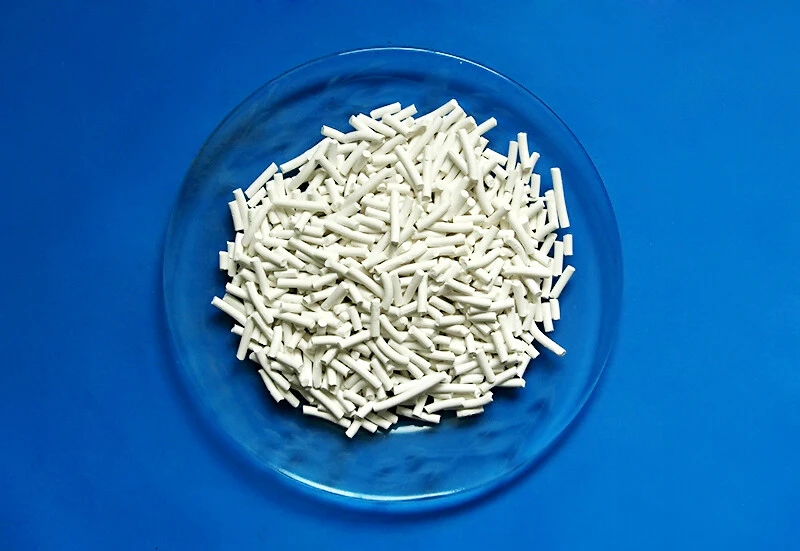
Pseudo Boehmite and Catalyst Carrier for Hydroprocessing
High-purity alumina carrier for NiMo / NiW / CoMo slurry catalyst systems; ASTM D2650 density envelope 0.86-0.94 g/cm3, BET 180-220 m2/g, COA every shipment.
View Product Details →To request a lot-level ASTM D2650 density QC dataset for your specific catalyst class and refinery feedstock, or to discuss a catalyst-volume and receipt-acceptance contract specification, contact Aluminaworld directly via WhatsApp or email. Standard lead time is 15-25 days for ISO 9001 certified shipments with full COA on every drum, MOQ 1 MT, free sample available for qualified buyers.
WhatsApp: +86 133 2522 2240
Email: barry@aluminaworld.com
For related case studies on catalyst carriers and adsorbent systems, see our earlier posts: ASTM D4365 laser diffraction calibration pitfalls for irregular catalyst carriers, online BET surface area monitoring for spent catalyst carriers, API 617 pulsation analysis for PSA compressor suction, and LMTD correction for non-ideal gas mixtures in adsorbent regeneration.