
ATH in Sealants and Adhesives: Fire Safety That Holds
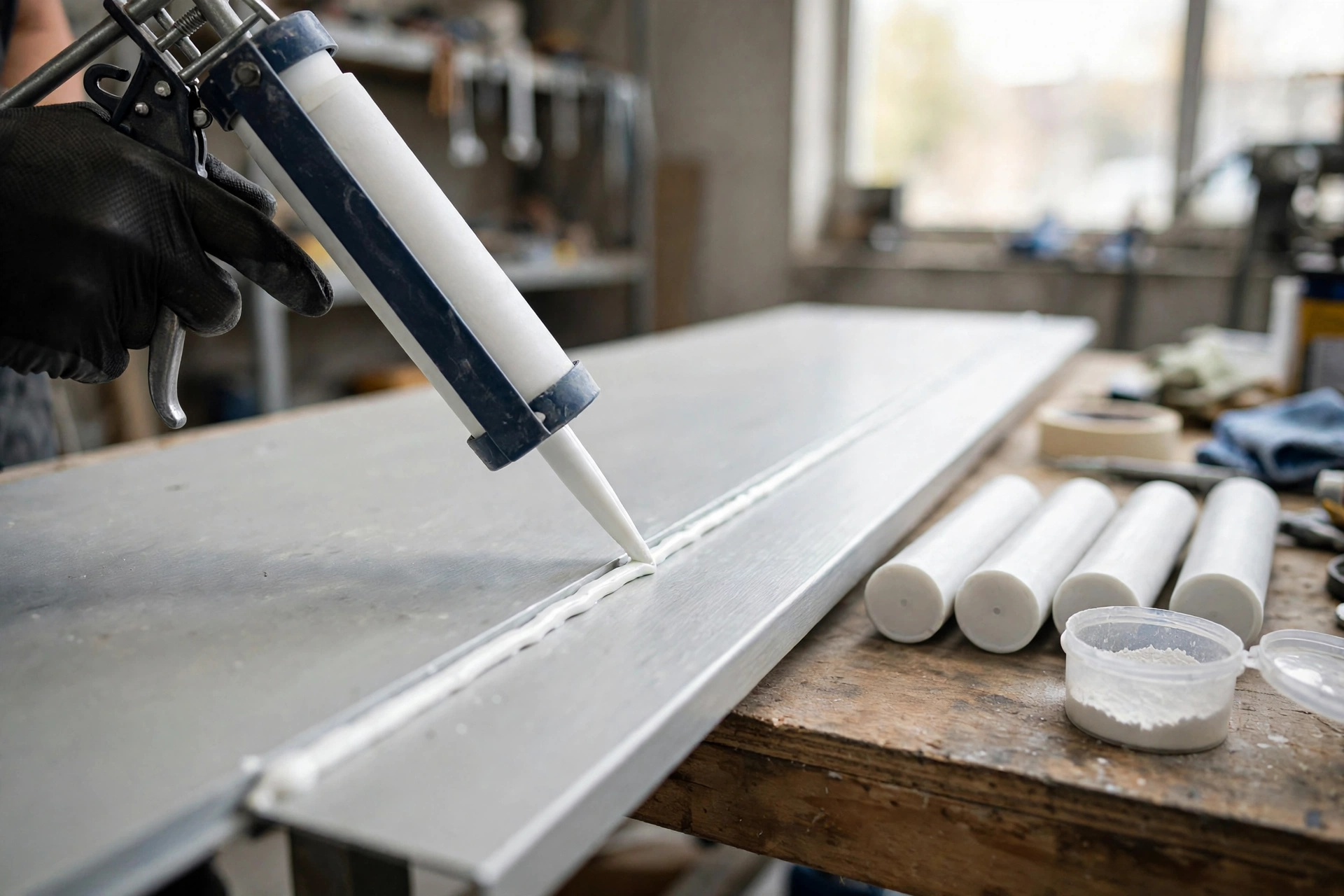
A sealant joint is the weakest link in a fire: the panel survives, the adhesive chars, and the joint opens. ATH — aluminium hydroxide — is the filler formulators reach for when a sealant or adhesive must pass a flame test without halogens, but the same filler that stops the flame can also break the bond when the grade and loading are wrong.
This guide is for the formulator who must meet a flame-retardancy target and the buyer who must source the filler: how ATH works in a sealant or adhesive, which grade fits which joint, where the loading trade-off sits, and what to check before you order.
Why ATH Works in Sealants and Adhesives
ATH is the only common flame-retardant filler that actively cools the joint: above about 200 °C it decomposes, absorbs heat, and releases its bound water as vapour.
ATH decomposes endothermically above about 200 °C, releasing about 34.5% of its weight as water vapour. The reaction absorbs heat from the polymer, the water vapour dilutes flammable gases, and the alumina residue left behind forms a protective layer that slows further burning. Unlike halogenated flame retardants, ATH produces no halogens and no corrosive gases, and smoke stays low — which is why it is the default choice where low smoke and low toxicity are specified, such as sealants in buildings, rail and marine use. In a sealant, that matters twice over: the joint is often the path fire and smoke travel along, yet it must keep holding the panels together while heated.
Choosing the Grade: Particle Size Decides the Finish
Start from the bond line, not the datasheet: a grade that is too coarse for a thin joint shows in the finish and weakens the bond.
Particle size is the main selection lever. Fine grades disperse faster, give a smoother sealant surface and suit thin bond lines; coarser grades are economical fillers where the joint is thick and the finish is not critical. The table below lists the ATH grades on the Aluminaworld product page, with the joint each one fits.
| Grade | D50 (median) | Top cut | Best fit in sealants and adhesives |
|---|---|---|---|
| ATH-1 | 1.0–1.5 μm | ≤ 10 μm | Thin bond lines, smooth sealant finish |
| ATH-2 | 2.0–3.0 μm | ≤ 15 μm | General-purpose sealants and adhesives |
| ATH-5 | 5.0–7.0 μm | ≤ 25 μm | Gap-filling mastics, thicker joints |
| ATH-10 | 10–15 μm | ≤ 45 μm | Economical filler where finish is not critical |
| ATH-25 | 20–25 μm | ≤ 75 μm | Bulk filling where surface finish does not matter |
Whiteness matters where the sealant is visible: the industrial grade is ≥ 93% white and the micro-fine grade 96–98%, with Al(OH)₃ purity ≥ 99.5% and ≥ 99.6% respectively. Check the grade code on the bag label against the order — a fine grade delivered as coarse will not show on the COA chemistry, only in the finished joint.
Loading vs Bond Strength: The Trade-Off You Have to Test
ATH only works at high loadings, and every extra point of loading takes something from adhesion — so the right loading is the lowest one that still passes your flame test.
The trade-off is the whole job. As loading rises, flame retardancy improves, but viscosity rises, elongation falls and peel strength drops; push too far and the sealant stops wetting the substrate or cracks under movement. Surface-treated grades help here: the treatment lowers viscosity at high loadings, so the same flame performance is reachable without the mix turning to paste — that is the grade to ask for when the untreated grade will not process. No universal loading number is worth quoting: the target depends on the polymer system, the joint geometry and the test itself. So trial it: define the flame requirement first, mix two or three loadings, and test peel adhesion and elongation on each. The loading you buy is the lowest one that passes the flame test with the adhesion your joint needs.
Processing Checklist: Dispersion, Cure Temperature and Moisture
Most ATH failures in sealants are processing failures: an agglomerate in the bead is a weak spot, and a cure that runs too hot starts the flame-retardant reaction in the oven.
Disperse fully — agglomerates do not just look bad, they are weak spots where the bond fails first, so mix until the bead is uniform and check the dispersion on a trial batch. Watch the cure temperature: ATH starts decomposing above about 200 °C, so a cure or service temperature that crosses that line releases water inside the joint and leaves voids — keep curing and service below it, and if the application runs hot, ATH is the wrong filler. Keep the powder dry and sealed before use: damp powder clumps and clumps do not disperse, so use opened bags promptly and never leave a bulk bag open between jobs. Confirm compatibility with your own polymer system on a trial batch before a bulk order — the datasheet describes the filler, not your formulation.
What to Ask Your Supplier Before You Order
Five questions before the purchase order separate a supplier who understands ATH from one who just sells white powder.
Ask for the grade and D50 in writing, with the surface treatment named if any; the batch COA with Al(OH)₃, whiteness, Fe₂O₃ and Na₂O — industrial grade Al(OH)₃ ≥ 99.5%, whiteness ≥ 93%; a sample quantity to run on your own line first; packing — 25 kg bags, steel drums or bulk bags — confirmed in the quotation; and the EXW price with lead time — bulk orders typically ship in 15–25 days, freight calculated per order. A supplier that answers all five with documents is a supplier worth keeping; one that cannot name the grade is telling you something about the next delivery.
For the numbers behind this guide, see the aluminium hydroxide (ATH) product page, plus how ATH flame retardance works and surface-treated ATH grades: when the coating matters.
Frequently Asked Questions
Does ATH weaken a sealant's bond?
At the loading a flame test needs, yes: viscosity rises and peel strength and elongation fall as loading rises. The fix is not to drop the filler but to find the lowest loading that passes your flame test, and to try a surface-treated grade, which processes at lower viscosity at the same loading. Test peel adhesion at each loading before you commit.
Which ATH grade fits a construction sealant?
Start with a fine to mid grade: ATH-1 (D50 1.0–1.5 μm) or ATH-2 (D50 2.0–3.0 μm) for thin bond lines and a smooth finish, ATH-5 (D50 5.0–7.0 μm) for thicker gap-filling joints. Coarser grades are economical fillers, not finish grades. Confirm the choice on a trial batch.
Can I use ATH in a sealant that cures above 200 °C?
No. ATH starts decomposing above about 200 °C and releases its bound water — about 34.5% by weight — so curing above that temperature leaves voids in the joint. Keep cure and service temperatures below 200 °C, or choose a filler rated for the temperature.
How do I trial ATH in my adhesive?
Ask for a sample quantity, run it on your own line at two or three loadings, then test peel adhesion, elongation and the flame requirement on each. Check the batch COA for Al(OH)₃, whiteness and D50 before you run the trial, and keep the grade code from the trial batch for the bulk order.
If you are formulating a flame-retardant sealant or adhesive, or want the grade confirmed against your polymer system and flame target, send us the application, the polymer and the loading you have in mind — our engineers will confirm the specification to trial: barry@okkinc.com.
Get a Quote
Tell us the product, grade and quantity. We reply within 12 hours with EXW pricing and lead time.
- ✓ COA and technical datasheet with every shipment
- ✓ EXW pricing — freight calculated per order
- ✓ Engineering consultation on grade selection and loading
Prefer to talk now?
WhatsApp +86 133 2522 2240
or email barry@okkinc.com