Aluminum hydroxide (ATH) is the world's largest-volume flame retardant by volume, with global consumption exceeding 1.5 million MT/year. Its flame retardant mechanism is fundamentally different from halogen-based systems: instead of interfering with the gas-phase chemistry of combustion, ATH works in the condensed phase by absorbing heat, releasing water, and promoting char formation.
ATH vs MDH flame retardant comparisonAt Aluminaworld, we manufacture ATH specifically for flame retardant applications, with annual capacity of 80,000 MT across multiple surface-treated and untreated grades. The data below reflects our standard grades and the performance our customers achieve in cable, compound, and engineered stone applications.
This article explains the chemistry of ATH flame retardancy, the practical loading limits in common polymers, and how to formulate for optimal performance.
1. The Decomposition Reaction: 1,300 kJ/kg Absorbed
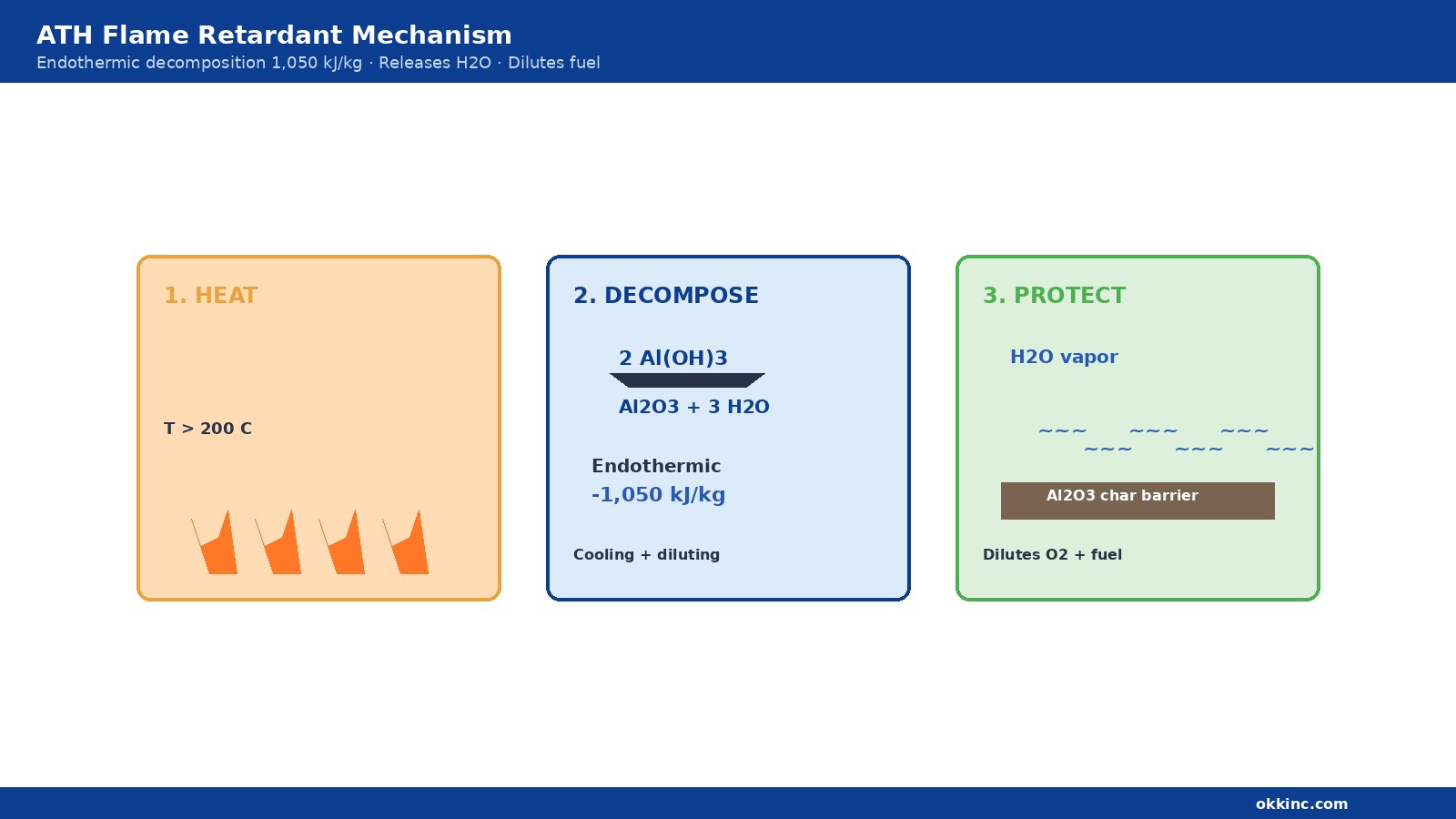
When ATH is heated to 200 to 300°C, it decomposes endothermically:
2 Al(OH)3 = Al2O3 + 3 H2O (vapor), delta-H = +1,300 kJ/kg
This single reaction accomplishes four things simultaneously:
- Heat absorption (1,300 kJ per kg ATH). The polymer is cooled below its ignition temperature, slowing or stopping the combustion cycle.
- Water vapor release (35 wt% of the original mass). The vapor dilutes flammable gases and oxygen in the flame zone.
- Alumina residue formation. The Al2O3 char acts as a barrier, insulating the underlying polymer from heat and oxygen.
- Smoke suppression. Unlike halogen systems, ATH produces minimal smoke and no corrosive or toxic gases.
The decomposition temperature window (200 to 300°C) is critical: it must be below the polymer's processing temperature but above its normal use temperature. For most thermoplastics processed at 180 to 220°C, ATH decomposes during processing. For polyolefins processed at 200 to 240°C, special surface treatment is needed to prevent premature decomposition.
2. Loading Levels by Polymer System
Polyethylene and Polypropylene (Cables, Pipe)
ATH loading: 50 to 65 wt% (the maximum that allows reasonable melt flow). Below 40%, flame retardancy is marginal. Above 65%, mechanical properties (especially elongation at break) suffer significantly. Common compromise: 55 to 60% ATH with a coupling agent to maintain mechanical performance.
EVA and Other Elastomers (Cable Jacketing)
ATH loading: 60 to 75 wt% achievable because the elastomeric matrix tolerates higher filler content. EVA + 65% ATH is the industry-standard LSZH cable compound.
Unsaturated Polyester and Epoxy (Engineered Stone, Electronics)
ATH loading: 40 to 60 wt% depending on the application. Lower loading (40 to 50%) is used in cast polymer countertops where surface aesthetics matter. Higher loading (55 to 60%) is used in electrical laminates where maximum flame retardancy is needed.
PVC (Wire and Cable)
ATH loading: 20 to 40 wt% as a smoke suppressant and acid scavenger. Used together with antimony trioxide synergist in flexible PVC. The combination cuts smoke emission by 50 to 70% in cone calorimeter tests.
3. Common Formulation Mistakes
Mistake 1: Using Standard ATH Instead of Surface-Treated Grades
Untreated ATH has polar surface that does not bond well with polyolefins. The result is poor mechanical properties (especially impact strength and elongation) and high viscosity that makes processing difficult. Surface-treated ATH (silane, stearate, or titanate coating) costs 20 to 30% more but improves compound properties dramatically. Use it for any loading above 40 wt%.
Mistake 2: Ignoring Particle Size Effects
ATH particle size affects both flame retardancy and processing. Coarse ATH (10 to 20 μm) gives better flame retardancy (more char, slower heat release) but worse mechanical properties. Fine ATH (1 to 3 μm) gives better surface finish and mechanical strength but slightly worse flame retardancy. Most LSZH cable compounds use a bimodal blend: 70% coarse + 30% fine.
Mistake 3: Not Using a Coupling Agent
A coupling agent (typically 0.5 to 1.5% of ATH weight) bridges the polar ATH surface to the non-polar polymer matrix. Without coupling, the compound has 30 to 50% lower elongation at break. Common coupling agents: silanes (best for polyolefins), titanates (best for filled composites), and maleated polyolefins (cost-effective all-rounder).
For new ATH formulations or troubleshooting existing ones, our technical team can review your recipe and recommend specific grades, treatments, and coupling agents. We supply free 1 kg samples of multiple grades for lab evaluation.
Frequently Asked Questions
Is ATH safer than halogen flame retardants?
Yes. ATH releases only water when it decomposes. Halogen systems release HCl or HBr, which are corrosive and toxic. ATH is also non-bioaccumulative, unlike some brominated flame retardants.
What is the maximum temperature ATH can withstand?
ATH starts losing water at 200°C and is fully converted to alumina by 300°C. For continuous high-temperature applications above 200°C, consider aluminum hydroxide carbonate (AHC) or magnesium hydroxide, which decompose at 300 to 400°C.
Does ATH affect polymer color?
Pure ATH is white (whiteness at least 96%). It is used as a white pigment extender in many formulations. For colored compounds, use our low-iron grades (Fe2O3 below 50 ppm) to avoid yellow tint.
What is the price for ATH flame retardant?
$400 to $800 per MT depending on grade, particle size, and surface treatment. Surface-treated grades are 20 to 40% higher than untreated. Fine-particle grades are 30 to 50% higher than coarse.
Is ATH suitable for food contact applications?
Yes, our FDA-grade ATH meets 21 CFR 186.1307 for direct and indirect food contact. Common in food packaging films and disposable containers.
Related Aluminum Hydroxide Articles
ATH vs MDH Flame Retardant: Which Works Better in Your Polymer System?
Surface-Treated ATH: How Silane Coating Improves Polymer Loading and Dispersion
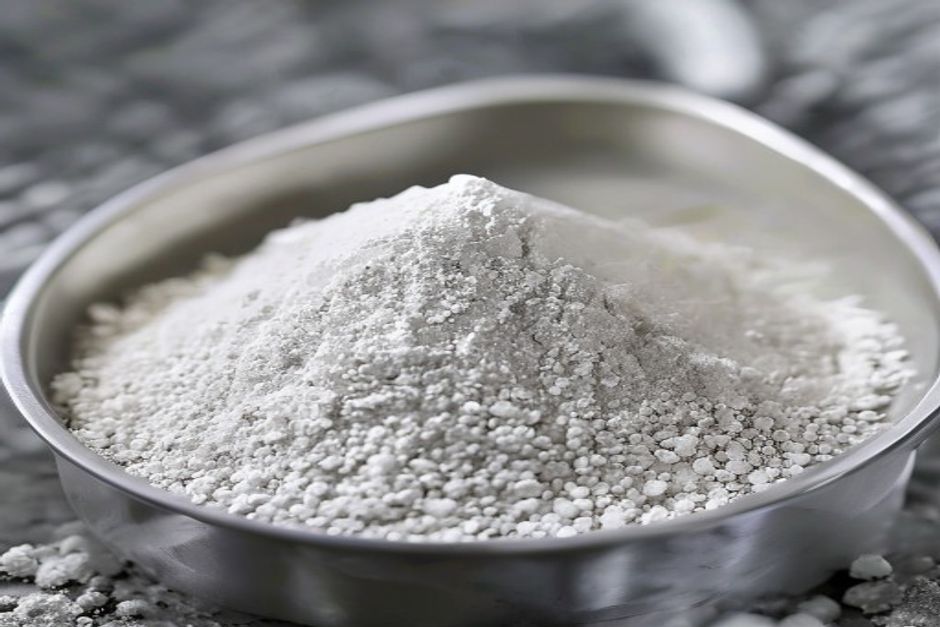
ATH in Artificial Marble: How Aluminum Hydroxide Enables Stone-Look Surfaces
ATH vs MDH flame retardant comparison
surface-treated ATH grades
Alumina Powder Ceramic Glaze Application
Need a Quote or Free Sample?
Tell us your feed conditions and target outlet spec. Our engineers reply within 24 hours with a recommendation and a 1 kg free sample.