How to Read a Catalyst Carrier Datasheet: 7 Key Numbers
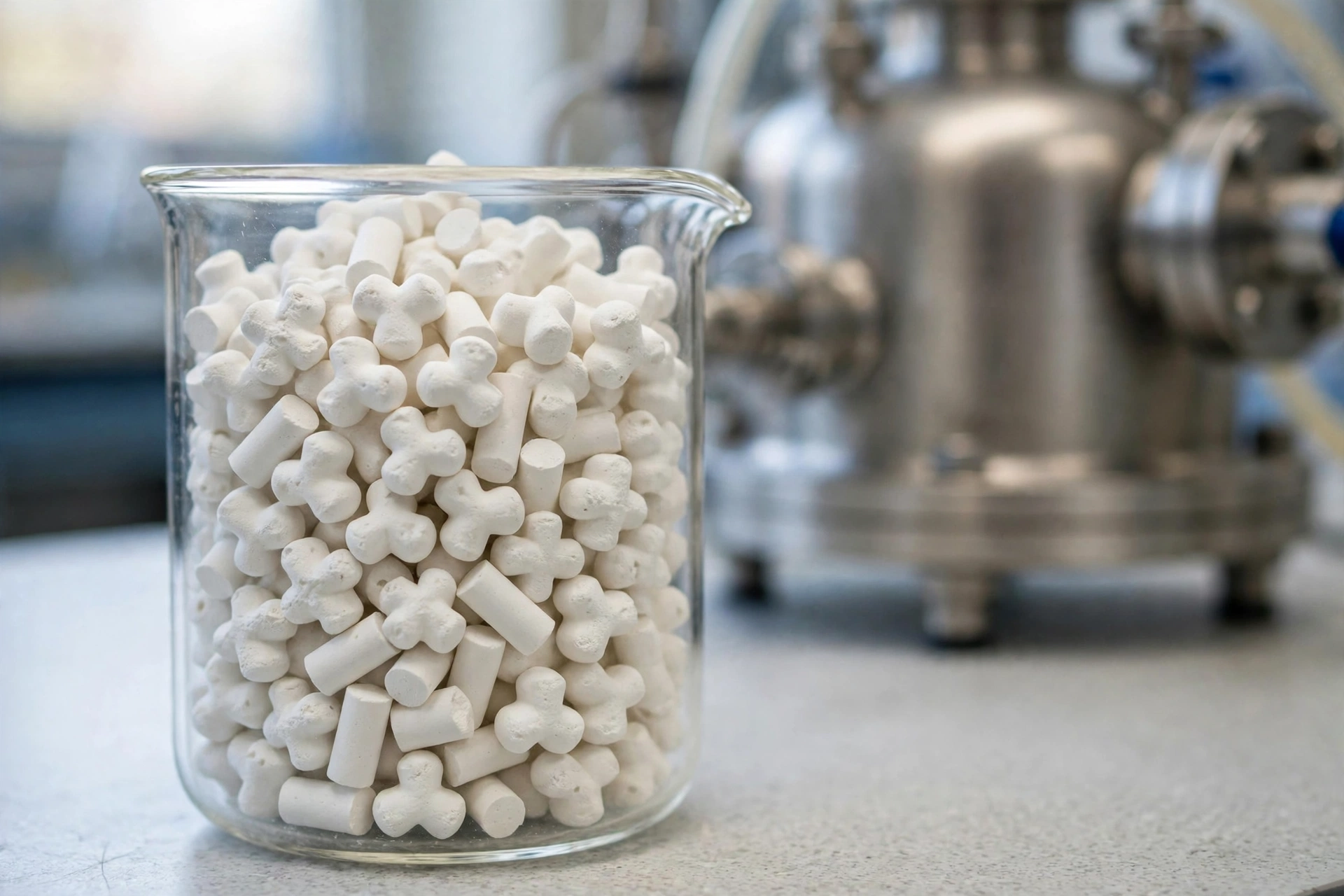
Two catalyst carrier datasheets can look identical — same alumina, same size, same reassuring words — yet describe materials that behave very differently in your reactor. Only seven numbers decide whether a grade fits your duty.
This guide explains each number in plain language: what it measures, what a good value looks like for shaped alumina carriers, and what to ask the supplier before you order. All values below come from our own catalyst carrier range, so you can check them against any datasheet you are comparing.
1. BET Surface Area: Where the Chemistry Happens
BET surface area is the total surface inside one gram of carrier, measured by nitrogen adsorption — and it sets the ceiling on how much active metal the carrier can hold.
For shaped alumina carriers, the working range is wide: our trilobe and quadlobe grades run 180–320 m²/g, hollow rings 120–240 m²/g and multi-hole shapes 100–220 m²/g. Higher means more room for the active phase and finer metal dispersion.
But more is not automatically better. Surface area trades against strength and thermal stability: the highest-area grades sinter fastest at sustained high temperature. Ask for the number for the exact grade and shape you will receive, not the family range. If your incumbent carrier works, its BET is your target, not the market maximum.
2. Pore Volume and Pore Size: Room for Metal, Roads for Molecules
Pore volume is how much empty space one gram of carrier holds; pore size is how wide the roads into that space are. Together they decide how much metal you can load and how fast reactants reach it.
Our trilobe grades carry 0.55–0.85 ml/g of pore volume, hollow rings 0.50–0.75 ml/g and multi-hole shapes 0.45–0.70 ml/g, with pore-size distribution adjustable from 5 to 100 nm to match the impregnation profile.
Judge the pair together: high pore volume with very fine pores loads poorly and chokes diffusion; wide pores with low volume leave little room for the active phase. If a datasheet gives pore volume but no pore-size distribution, ask for it.
3. Crush Strength and Abrasion Loss: Will It Survive Loading and Service?
A carrier that powders during loading or crumbles under its own bed weight becomes pressure drop and dust — however good its chemistry looks on paper.
Check two numbers: side crush strength and abrasion loss. Our trilobe grades are rated at ≥ 110 N/cm side crush with ≤ 0.5 wt% abrasion loss; hollow rings ≥ 80 N/cm radial with ≤ 0.8 wt%; multi-hole shapes ≥ 120 N/cm with ≤ 0.6 wt%. Note the units — N/cm, not N per pellet — and that rings are quoted radially.
Always ask which test method the number follows: results move with the method, sample size and pellet orientation, so two suppliers' numbers are only comparable when the method matches. Ask for the batch-to-batch range and check the shipment's COA.
4. Bulk Density: From Reactor Volume to Order Weight
Bulk density turns the volume of your reactor into the weight on your purchase order — and it is the number most buyers get wrong first.
Our trilobe grades run 0.50–0.65 g/ml, hollow rings 0.42–0.58 g/ml and multi-hole shapes 0.48–0.62 g/ml. Bed volume × bulk density = order weight; the wrong density means running short at loading or paying freight on surplus stock.
It also hints at pore structure: a very light carrier usually means high pore volume, a heavy one more solid alumina and more strength. If the datasheet quotes tapped density instead of loose bulk density, ask which — your loading calculation needs the loose figure.
5. Purity: Alumina Content and the Sodium Number
Impurities are small numbers with outsized effects — sodium especially, because it poisons acid sites and speeds up sintering.
Our trilobe grades are ≥ 98.5 wt% Al₂O₃ with Na₂O ≤ 0.05 wt%; hollow rings run 95.0–99.5 wt% Al₂O₃ with Na₂O ≤ 0.10 wt%; multi-hole shapes ≥ 92.0 wt% Al₂O₃ with Na₂O ≤ 0.08 wt%. For acid-sensitive duties such as reforming, the sodium number deserves as much attention as the BET.
Ask for the full impurity picture, not just alumina. Verify the numbers on the batch COA that ships with the material, not the marketing datasheet.
6. Alumina Phase: Gamma, Theta or Alpha
The crystal phase of the alumina sets the trade-off between surface area and thermal stability — and the wrong phase fails slowly, not loudly.
Gamma gives the high surface area hydroprocessing needs; theta holds up better as temperature rises; alpha is the dense, low-area phase for the hottest duties. Our trilobe and quadlobe grades are γ/θ-Al₂O₃, hollow rings γ/α-Al₂O₃, and multi-hole shapes alumina or silica-alumina.
Match the phase to the duty: a gamma carrier in a hot service will sinter and lose area campaign by campaign, while an alpha carrier in a cool duty wastes the surface area you paid for. If your incumbent works, ask what phase it is before changing it.
7. Form and Size: Shape Decides Pressure Drop and Diffusion
Spheres, trilobes, rings and multi-hole shapes are not styling choices — each one moves pressure drop, diffusion distance and bed strength in a different direction.
Equivalent diameter runs 1.2–3.2 mm for trilobe and quadlobe extrudates, 4.0–10.0 mm for hollow rings and 5.0–15.0 mm for multi-hole shapes. Small shapes shorten diffusion paths and raise activity per litre of bed but raise pressure drop; large shapes and rings cut pressure drop at the cost of longer diffusion paths.
Change shape only with a reason: a ring replacing a trilobe without a bed redesign can leave voids and channelling, and a smaller pellet replacing a larger one can push a blower or compressor past its limit. Keep the incumbent shape unless the case for changing it is written down.
The Seven Numbers at a Glance
Our shaped-carrier ranges, side by side — use them as a benchmark when you read any supplier's datasheet.
| Number | Trilobe / Quadlobe | Hollow Ring | Multi-Hole |
|---|---|---|---|
| BET surface area | 180–320 m²/g | 120–240 m²/g | 100–220 m²/g |
| Pore volume | 0.55–0.85 ml/g | 0.50–0.75 ml/g | 0.45–0.70 ml/g |
| Crush strength | ≥ 110 N/cm (side) | ≥ 80 N/cm (radial) | ≥ 120 N/cm |
| Bulk density | 0.50–0.65 g/ml | 0.42–0.58 g/ml | 0.48–0.62 g/ml |
| Al₂O₃ purity | ≥ 98.5 wt% | 95.0–99.5 wt% | ≥ 92.0 wt% |
| Na₂O impurity | ≤ 0.05 wt% | ≤ 0.10 wt% | ≤ 0.08 wt% |
| Abrasion loss | ≤ 0.5 wt% | ≤ 0.8 wt% | ≤ 0.6 wt% |
Before you order, send the supplier your incumbent specification — or a physical sample — plus the process type, the form and size you need, any pore data you hold, and the quantity. Ask for the datasheet before ordering and the batch COA with the shipment. Carrier ships in 25 kg bags, steel drums or bulk bags, priced EXW Zibo with a standard lead time of 15–25 days.
For the numbers behind this guide, see the catalyst carrier product page, surface area vs pore volume: which matters more and when to replace a catalyst carrier bed: 5 signals.
Frequently Asked Questions
What BET surface area should I ask for?
Match your incumbent carrier first — our trilobe grades run 180–320 m²/g, hollow rings 120–240 m²/g and multi-hole shapes 100–220 m²/g. A higher BET gives more room for metal dispersion but trades against strength and thermal stability, so the right number is the one your duty needs.
Is a higher pore volume always better?
No. Pore volume sets how much metal the carrier can hold — our trilobe grades run 0.55–0.85 ml/g — but it must be balanced against crush strength and pore size. The distribution from 5 to 100 nm matters as much as the total.
Why does the Na₂O content matter?
Sodium is an alkali residue that neutralises the carrier's acid sites and accelerates sintering at high temperature. For acid-sensitive duties the limit matters: our trilobe grades hold Na₂O to ≤ 0.05 wt%. Always check the batch COA, not just the datasheet headline.
What documents should come with my order?
A datasheet before you order, and a batch COA, packing list and commercial invoice with the shipment. The COA is where you verify BET, pore volume, crush strength and Na₂O for the batch you received — if a supplier cannot provide it, pause.
Send us your incumbent specification or a sample, the process type and the quantity, and our engineers will confirm the grade and the seven numbers that matter for it: barry@okkinc.com.
Get a Quote
Tell us the product, grade and quantity. We reply within 12 hours with EXW pricing and lead time.
- ✓ COA and technical datasheet with every shipment
- ✓ EXW pricing — freight calculated per order
- ✓ Engineering consultation on grade selection and loading
Prefer to talk now?
WhatsApp +86 133 2522 2240
or email barry@okkinc.com