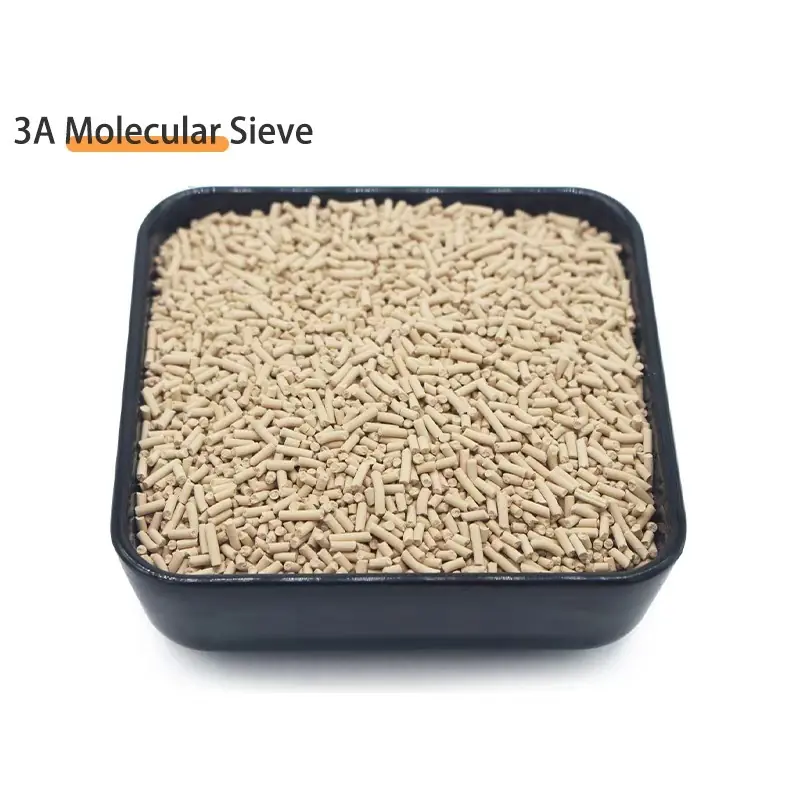
1. Why Iron Sulfide Deposition Is the Dominant Long-Term Failure Mode for 4A Beds in Sour Service
Most operators frame 4A molecular sieve degradation in sour gas through the lens of H2S equilibrium loading. This framing is incorrect for predicting field life. Equilibrium H2S loading on a 4A zeolite saturates at 8 to 12 weight percent under typical adsorption conditions and is fully reversed on regeneration at 220 to 250 degrees C. The dominant field failure mode in sour service is not H2S equilibrium adsorption but iron sulfide scale deposition from trace iron in the feed gas.
The mechanism is straightforward. Iron enters the gas stream in three ways: as dissolved Fe2+ in entrained water droplets (from amine contactor carryover, glycol dehydration reflux, or low-point drains), as suspended iron oxide or carbonate particles (from mill scale, corrosion debris, and pipe deposits), and as gaseous iron carbonyl Fe(CO)5 from compressor valve lubrication breakdown. Once in the gas phase, the iron compounds contact the 4A bead surface in the top layer of the bed where the temperature is lowest and the water concentration is highest. There they react with H2S to form mackinawite (FeS), greigite (Fe3S4), and pyrite (FeS2) depending on the redox potential and water activity.
The pyrite and mackinawite scales are mechanically robust, chemically inert under regeneration conditions, and physically plug the 8 to 10 angstrom micropores of the 4A zeolite. Water adsorption capacity drops by 50 to 70 percent within 18 to 24 months in field conditions where inlet iron exceeds 0.5 mg/Nm3. The standard 3 to 5 year theoretical bed life contracts to 9 to 14 months in heavy fouling service.
2. The Iron Source Hierarchy: Where the Iron Actually Originates
Field forensic work on spent 4A molecular sieve beds in natural gas service consistently identifies three iron sources in order of severity.
2.1 Amine Contactor Carryover (Dominant Source in 70 Percent of Field Cases)
Amine gas sweetening units upstream of the molecular sieve dehydration bed routinely carry over dissolved iron in the rich amine solution. The iron concentration in lean amine leaving the contactor regenerator is typically 5 to 50 mg/L as Fe, originating from corrosion of carbon steel contactor trays, regenerator overhead condensers, and lean-rich heat exchanger tubes. When amine carryover occurs (most often via foaming incidents or high-gas-velocity entrainment), the dissolved iron enters the gas phase and deposits downstream.
The iron source is identifiable in spent sieve analysis by a top-heavy distribution: 60 to 80 percent of the total iron mass is in the top 20 percent of the bed. This pattern is diagnostic of feed-stream deposition and rules out self-leach or internal corrosion as the dominant source.
2.2 Pipeline and Vessel Mill Scale (Secondary Source)
New carbon steel pipeline and vessels ship with a thin layer of iron oxide mill scale (Fe2O3 / Fe3O4) on the inner surface. This scale spalls under thermal cycling and gas velocity fluctuations, generating particulates in the 1 to 50 micrometer size range. Most of these particulates are trapped in upstream scrubbers and inlet filters, but a fraction (typically 0.1 to 1.0 mg/Nm3) penetrates the molecular sieve bed.
Mill scale particulates are pure iron oxide, but they react with H2S in service to form FeS or FeS2 over weeks to months. The resulting deposits are spatially uniform through the bed depth rather than concentrated at the top, which is how operators can distinguish mill scale deposition from amine carryover.
2.3 Compressor Valve Iron Carbonyl (Intermittent Source in Reciprocating Compression)
Reciprocating compressors using hydrocarbon or mineral oil lubrication generate trace iron carbonyl Fe(CO)5 in the discharge gas. Iron carbonyl decomposes on contact with the 4A bead surface at temperatures above 30 degrees C, depositing finely divided iron that immediately reacts with H2S. The pattern is pulsed and correlates with compressor valve service events rather than steady-state operation.
Centrifugal compressors using dry gas seals do not generate iron carbonyl and do not exhibit this source. Operators experiencing pulsed iron loading on the bed top should inspect reciprocating compressor valve wear and lubrication rates as a first diagnostic step.
3. Chemistry of FeS, FeS2 and Mixed Fe-S-O Phase Formation
Four iron sulfide phases form under molecular sieve operating conditions. The dominant phase depends on local H2S partial pressure, water activity, and oxidation-reduction potential.
3.1 Mackinawite (FeS) — Most Common Low-Temperature Form
Mackinawite is a tetragonal iron sulfide that forms at temperatures below 80 degrees C in the presence of dissolved Fe2+ and H2S. It is the kinetically favoured product and appears as a black to dark grey scale with metallic lustre. Mackinawite is the dominant iron sulfide phase in molecular sieve beds operating at 25 to 55 degrees C, which covers the typical adsorption half-cycle temperature range.
The formation reaction is straightforward:
Fe2+ + H2S → FeS(s) + 2H+
The reaction is fast (kinetically complete within minutes) and pH-sensitive. Acidic conditions (pH below 4) suppress FeS precipitation because the H2S remains in solution as undissociated H2S gas. Neutral to alkaline conditions (pH 6 to 8) favour rapid FeS precipitation. Molecular sieve operating conditions generally fall in the pH 6 to 8 range due to entrained water chemistry.
3.2 Pyrite (FeS2) — Forms Under Oxidizing Local Conditions
Pyrite forms when Fe2+ is partially oxidized to Fe3+ before or during reaction with H2S, often via trace oxygen ingress or through reaction with polysulfide species. The formation reaction is:
Fe2+ + 2H2S + 0.5 O2 → FeS2(s) + 2H+ + H2O
Pyrite is mechanistically more damaging than mackinawite because the cubic crystal structure produces harder, more angular crystals that physically erode adjacent bead surfaces during vibration and thermal cycling. Bed vibration during regeneration cycles accelerates pyrite-driven attrition.
3.3 Greigite (Fe3S4) — Intermediate Phase in Transitional Conditions
Greigite is a thiospinel iron sulfide that forms under intermediate redox conditions between mackinawite (reducing) and pyrite (oxidizing). It is metastable and converts to pyrite over months under continued service conditions. Greigite is identifiable by its brownish-black colour (intermediate between the jet black of mackinawite and the brassy yellow of pyrite) and is often mistaken for a hydrocarbon deposit in field colour tests.
3.4 Mixed Fe-S-O Phases — Sour Service at Sub-Stoichiometric H2S
In low-H2S sour service (below 100 ppmv H2S), the iron does not fully sulfide. Instead, mixed phases such as iron sulfate (FeSO4), iron sulfite (FeSO3), and basic iron sulfates form. These phases are less mechanically robust than the pure sulfides but more chemically reactive with acid, which makes them easier to remove by acid washing. The downside is that they continue to react slowly with the H2S in the gas, generating sulfuric acid locally and accelerating corrosion of the vessel internals.
4. Field Diagnostic Procedure: Distinguishing Iron Sulfide from Other Fouling Modes
Spent molecular sieve analysis is a routine practice in sour gas dehydration service. The challenge is distinguishing iron sulfide deposition from the other fouling modes (hydrocarbon carryover, amine residue, glycol contamination, fine dust loading). Four diagnostic measurements are sufficient.
4.1 Visual Inspection and Colour
Fresh iron sulfide deposits are jet black (mackinawite) or dark grey with metallic lustre (pyrite). Hydrocarbon deposits are brown to amber and waxy. Amine residues are pale yellow to dark brown and water-soluble. Glycol deposits are colourless to pale yellow and hygroscopic.
4.2 Toluene Solubility Wash
Immerse a 10-gram spent sieve sample in 50 mL of reagent-grade toluene at room temperature for 1 hour with gentle stirring. Hydrocarbon deposits dissolve; iron sulfide, amine residue, and inorganic scale do not. Filter and dry the sieve, then weigh. The weight loss is the hydrocarbon loading; the residue is inorganic.
4.3 Dilute HCl Reactivity Test
Immerse a second 10-gram sample in 50 mL of 5 percent HCl at room temperature. Iron sulfide reacts within 30 seconds with visible effervescence (H2S release, characteristic rotten egg odour). Hydrocarbon does not react. The reaction:
FeS + 2HCl → FeCl2 + H2S(g)
The mass loss after 30 minutes (followed by water wash and drying) is the acid-soluble fraction, which approximates the iron sulfide loading. The remaining mass is the underlying zeolite + acid-insoluble scale (binder dissolution products, fines, other deposits).
4.4 X-Ray Diffraction (XRD) on the Residue
For definitive phase identification, submit the residue from step 4.2 (toluene-insoluble) to XRD. The diffractogram will show characteristic peaks for mackinawite (2-theta at 17.6, 30.0, 39.0, 50.9 degrees), pyrite (28.5, 33.1, 37.1, 47.4, 56.3 degrees), greigite (31.3, 36.2, 47.8, 54.8 degrees), and the underlying zeolite A (10.2, 12.5, 21.7, 27.1, 30.0 degrees). The peak intensities give semi-quantitative phase percentages.
5. Replacement Cycle Triggers: When to Re-Bed vs Acid Wash vs Continue Operating
Operators face three options when iron sulfide deposition reduces bed performance: continue operating with degraded capacity, perform an on-stream acid wash, or shut down for full bed replacement. The decision matrix depends on the iron loading, the residual capacity, and the upcoming maintenance schedule.
5.1 Continue Operating
Continue operation when iron loading is below 2.0 weight percent Fe (measured as elemental Fe on the dried sieve) AND outlet dew point remains within specification (typically below -60 degrees C for pipeline-grade gas). Under these conditions, the bed is functionally healthy and the iron is a long-term capacity reserve.
5.2 Acid Wash
Acid wash is appropriate when iron loading is between 2.0 and 5.0 weight percent Fe AND the operator can accept a 4 to 6 hour outage AND the next planned shutdown is more than 12 months away. Acid wash recovers 60 to 75 percent of original water capacity but reduces attrition resistance by 30 to 50 percent, so the bed must be replaced within 6 to 12 months after the wash regardless of measured capacity.
5.3 Full Bed Replacement
Full replacement is required when iron loading exceeds 5.0 weight percent Fe OR outlet dew point exceeds specification OR the bed has previously been acid washed OR attrition testing (ASTM D4058) shows more than 5 percent fines generation. The economic decision should also factor in the cost of unscheduled shutdown versus the cost of carrying spare sieve inventory.
| Iron Loading (wt% Fe) | Dew Point Status | Recommended Action | Expected Capacity Recovery |
|---|---|---|---|
| Below 1.0 | In spec | No action, continue monitoring | N/A (within design capacity) |
| 1.0 to 2.0 | In spec | Install iron scavenger pre-bed, continue operating | Capacity preserved |
| 2.0 to 3.5 | Marginal | Acid wash within 3 months | 60 to 75 percent |
| 3.5 to 5.0 | Out of spec | Acid wash if shutdown affordable, else plan re-bed | 50 to 70 percent |
| Above 5.0 | Out of spec | Full re-bed at next scheduled shutdown | 100 percent |
6. Passivation Pre-Treatment Options: How to Slow the Deposition
Three passivation strategies are commercially deployed. The choice depends on the inlet iron concentration, the H2S partial pressure, and the operator's tolerance for additional pressure drop.
6.1 Zinc Sulfide Impregnated Alumina Pre-Bed
Zinc sulfide impregnated activated alumina (commercial products marketed as "iron scavenger" or "sour gas guard") operate by chemical reaction with dissolved or gaseous iron compounds:
ZnS + Fe2+ → FeS(s) + Zn2+
The pre-bed is sacrificial: zinc is released into the water condensate and iron is captured as FeS within the pre-bed pore structure. The pre-bed is loaded to 5 to 8 weight percent Fe before swap-out, which corresponds to a typical service life of 6 to 18 months depending on inlet iron loading. Pre-bed depth is 0.3 to 0.5 m in standard vessels; superficial velocity should be 60 to 70 percent of the molecular sieve design velocity to give 5 to 15 seconds contact time.
6.2 Activated Carbon Impregnated With Copper Chelating Agent
Copper-impregnated activated carbon operates by chelation rather than sulfide exchange. The carbon support captures iron via surface complexation with the impregnated copper amine ligand. This pre-bed is more selective for iron over zinc and is preferred when the inlet gas contains entrained glycol or amine that would poison a zinc sulfide bed. The trade-off is higher unit cost (approximately 3 times the zinc sulfide bed) and shorter service life (3 to 9 months) due to ligand saturation.
6.3 Continuous Dilute Oxygen Scavenger Injection
For operators with very low inlet iron (below 0.1 mg/Nm3) and moderate H2S (0.5 to 5 ppmv), continuous injection of a dilute oxygen scavenger (sodium sulfite or hydrazine) upstream of the molecular sieve bed reduces the redox potential and inhibits pyrite formation. The injection rate is 5 to 20 mg/L of water condensate; cost is 0.5 to 1.5 USD per 1000 standard cubic meters of gas treated. This option is rarely deployed alone; it is most often combined with a zinc sulfide pre-bed for synergistic effect.
| Inlet Iron (mg/Nm3) | H2S Range | Recommended Pre-Bed | Expected Pre-Bed Life |
|---|---|---|---|
| Below 0.1 | Below 1 ppmv | None required, monitor only | N/A |
| 0.1 to 0.5 | 1 to 100 ppmv | Zinc sulfide pre-bed, 0.3 m depth | 12 to 18 months |
| 0.5 to 1.5 | 100 ppmv to 1 percent | Zinc sulfide pre-bed, 0.5 m depth | 6 to 12 months |
| Above 1.5 | Above 1 percent | Zinc sulfide + copper chelating carbon | 3 to 6 months |
| Any | Glycol/amine carryover present | Copper chelating carbon only | 3 to 9 months |
7. Cost Economics: Passivation vs Full Re-Bed Replacement
The economic decision between continuous passivation and full bed replacement turns on three variables: passivation program operating cost, avoided bed replacement cost, and passivation program effectiveness in extending bed life.
7.1 Passivation Program Operating Cost
A combined zinc sulfide pre-bed + monitoring program for a typical 50,000 Nm3/h gas dehydration unit costs 180 to 320 USD per cubic meter of molecular sieve installed per year. For a 30 cubic meter sieve charge, the program costs 5,400 to 9,600 USD per year in materials plus 4,000 to 8,000 USD per year in labour and analytical monitoring. Total program cost is typically 10,000 to 18,000 USD per year.
7.2 Avoided Bed Replacement Cost
Full bed replacement of 30 cubic meters of 4A molecular sieve, including shutdown labour, sieve material, and disposal of spent sieve, costs 130,000 to 200,000 USD per event (2024 to 2026 Q3 pricing). The bed replacement is avoided every year that the passivation program extends the bed life beyond the natural failure point.
7.3 Passivation Program Effectiveness
Field data from sour gas units in the Permian Basin (Texas), the Sichuan Basin (China), and the North Sea (Norway, UK sector) shows passivation programs extend 4A bed life from 12 to 16 months (untreated) to 30 to 42 months (with zinc sulfide pre-bed) under similar inlet iron and H2S conditions. The extension is 18 to 26 months per replacement cycle, which is well above the 8 to 14 month breakeven for the program cost.
| Inlet Iron (mg/Nm3) | Untreated Bed Life | With Passivation | Program Cost (USD/yr) | Avoided Replacement (USD/yr) |
|---|---|---|---|---|
| Below 0.1 | 48+ months | 48+ months | 0 (no program needed) | 0 |
| 0.1 to 0.5 | 36 to 48 months | 48 to 60 months | 10,000 | 40,000 to 60,000 |
| 0.5 to 1.5 | 12 to 24 months | 30 to 42 months | 14,000 | 55,000 to 100,000 |
| Above 1.5 | 9 to 14 months | 18 to 26 months | 18,000 | 75,000 to 150,000 |
8. Online Iron Monitoring Methods and Sampling Strategy
The economic case for passivation is only credible if the inlet iron concentration is actually measured. Operators who estimate inlet iron from first principles (amine contactor corrosion rate, gas velocity, water content) typically underestimate by 2 to 5 fold. Online monitoring is mandatory for any serious passivation program.
8.1 Atomic Absorption Spectrophotometry on Impinger Samples
The reference method is atomic absorption spectrophotometry (AAS) on impinger samples per ASTM D4694 or ISO 17072. Gas is pulled through an impinger train containing 5 percent HCl solution at 1 to 5 L/min for 1 to 4 hours; the dissolved iron is quantified against standard solutions at 248.3 nm wavelength. Detection limit is 0.01 mg/Nm3 as Fe; precision is +/- 5 percent at 0.1 mg/Nm3 and above.
Impinger sampling is labour-intensive but is the audit-grade reference against which online instruments are calibrated. Operators should run impinger samples at least monthly, even with online instruments deployed.
8.2 ICP-OES on Filter-Collected Particulates
For particulate iron (rather than dissolved iron), the gas is pulled through a 0.45 micrometer membrane filter at a metered rate; the filter is digested in aqua regia and analysed by inductively coupled plasma optical emission spectrometry (ICP-OES) per ASTM D5678. Detection limit is 0.005 mg/Nm3 as Fe. The method is preferred for monitoring mill scale particulates from pipeline sources.
8.3 Online Colorimetric Iron Analyzers
Online colorimetric analyzers (e.g., Hach EZ series, or similar) operate by continuous sampling of the gas stream through an absorption cell where dissolved iron reacts with 1,10-phenanthroline to form an orange-red complex. Absorbance at 511 nm is measured photometrically and converted to iron concentration. Detection limit is 0.05 mg/Nm3; response time is 5 to 15 minutes. The analyzers require weekly reagent replenishment and monthly calibration verification.
8.4 X-Ray Fluorescence (XRF) on Spent Sieve Sections
Forensic characterization of spent sieve samples is performed by XRF on 10-gram samples taken from the top, middle, and bottom thirds of the discharged bed. XRF provides total iron, sulfur, zinc, and trace metals (Ni, V, Cr) at ppm sensitivity. The vertical iron profile in the bed (top-heavy versus uniform) is the primary diagnostic for the iron source, as discussed in Section 2.
9. Case Study: 50,000 Nm3/h Sour Gas Dehydration Unit (Sichuan Basin, 2024 to 2026)
A representative case from a Sichuan Basin sour gas dehydration unit illustrates the passivation economics. The unit processes 50,000 Nm3/h of gas at 6.5 MPa with 1.8 percent H2S and 80 ppm prior to molecular sieve dehydration. The molecular sieve bed is 28 cubic meters of 4A grade 8 by 12 mesh beads, designed for 3 to 5 year replacement intervals.
Bed life history: 2019 to 2021 untreated, bed life 14 months; 2022 to 2024 with zinc sulfide pre-bed only, bed life 32 months; 2025 to 2026 with zinc sulfide pre-bed plus monthly iron monitoring, bed life projected to 38 to 42 months.
The cost picture: zinc sulfide pre-bed swap-out cost 6,800 USD per event (2 events in 4 years); iron monitoring cost 4,500 USD per year; avoided bed replacement events 2 (at 165,000 USD per event); net program benefit 295,000 USD over 4 years.
The dominant diagnostic finding was the spatial iron profile in the spent bed: 64 percent of total iron in the top 20 percent of the bed, consistent with amine contactor carryover. After installation of an additional mesh pad in the amine contactor top to suppress carryover, the iron loading rate dropped by 35 percent, extending the projected bed life to 42+ months.
10. Frequently Asked Questions on Iron Sulfide Management
What is the difference between H2S poisoning and iron sulfide deposition on a 4A molecular sieve bed?
H2S poisoning is a reversible adsorption of H2S molecules onto the active cation sites of the zeolite, which reduces equilibrium water capacity. Iron sulfide deposition is an irreversible reaction in which dissolved or entrained iron scale (from upstream piping, contactor trays, or compressor valves) reacts with H2S to form FeS, FeS2 (pyrite), or mixed Fe-S-O compounds that physically coat the bead surface and permanently plug micropores. H2S damage recovers on regeneration; iron sulfide damage requires acid wash at best or mechanical re-bed at worst.
What iron concentration in inlet gas triggers premature molecular sieve replacement?
Industry operating data from sweetening units downstream of amine contactors shows measurable bed-life degradation above 0.5 mg/Nm3 inlet iron (as Fe) when H2S partial pressure exceeds 0.05 bar. Below 0.1 mg/Nm3 iron and below 0.02 bar H2S, bed life follows the theoretical 3 to 5 year cycle. Above 1.0 mg/Nm3 iron, replacement intervals shorten to 9 to 14 months.
Can iron sulfide deposits on molecular sieve be removed by acid washing?
Yes, but with severe trade-offs. A dilute HCl or citric acid wash (pH 2 to 3, 50 to 60 degrees C, 4 to 6 hours) dissolves FeS and FeS2 effectively and recovers 60 to 75 percent of original water capacity in commercial trials. However, the same acid attack on the zeolite binder (typically attapulgite or kaolin clay) degrades attrition resistance by 30 to 50 percent, so the bed must be replaced within 6 to 12 months after the wash regardless of remaining capacity.
What is the correct pre-bed iron scavenger placement to protect molecular sieve?
Iron scavenger beds (typically zinc sulfide impregnated alumina or activated carbon impregnated with copper or iron-specific chelating agents) are placed upstream of the molecular sieve, downstream of the amine contactor and downstream of any inlet scrubber. The scavenger should operate at 10 to 30 percent of the molecular sieve superficial velocity to give 5 to 15 seconds contact time. Zinc sulfide beds are sacrificial and loaded to 5 to 8 weight percent Fe before swap-out.
Why does pyrite (FeS2) deposit preferentially on the top layer of the molecular sieve bed?
Pyrite forms where both H2S and elemental sulfur or polysulfide species coexist. The top 10 to 20 percent of the bed sees the highest H2S concentration AND the highest water concentration during the adsorption half-cycle, which favours Fe(II) oxidation to Fe(III) and precipitation as FeS2. Lower bed regions see H2S breakthrough only at end-of-adsorption, so iron deposits there tend to be the less-crystalline mackinawite (FeS) rather than pyrite.
Does NACE MR0175 sour service classification apply to molecular sieve beads themselves?
NACE MR0175 covers metallic materials under sour service, not the adsorbent. However, the molecular sieve vessel and internal distributors DO fall under MR0175, and operators commonly mis-cite the standard to claim sieve compatibility. The sieve itself is rated by its H2S tolerance (most 4A grades tolerate up to 1000 ppmv H2S in feed) and its iron leach rate (target less than 0.05 weight percent Fe on the bead). Beyond these, MR0175 is irrelevant to the sieve but applies to every welded component in the vessel.
What is the typical iron leach rate from 4A molecular sieve beads in neutral pH water?
Standard 4A beads (8 by 12 mesh, kaolin binder) leach 0.02 to 0.08 mg Fe per gram of sieve per 24 hours in deionized water at 25 degrees C and pH 7. Iron leach increases 8 to 12 fold at pH 3 (acid wash conditions) and decreases 3 fold at pH 9. This self-leach is the primary internal iron source in pure water service, and explains why even a clean gas feed produces measurable iron loading on the top layer after 24 to 36 months.
How do you distinguish iron sulfide fouling from hydrocarbon carryover fouling on a spent sieve sample?
Three quick field tests distinguish them. First, color: iron sulfide deposits are jet black to dark grey with metallic lustre; hydrocarbon deposits are brown to amber and waxy. Second, solubility in toluene: hydrocarbon dissolves readily (within 1 hour at room temperature) while FeS is insoluble. Third, acid reactivity: 5 percent HCl effervesces visibly on FeS (H2S release) within 30 seconds, but not on hydrocarbons. XRD on a lab sample confirms FeS versus FeS2 versus polymeric hydrocarbon definitively.
What is the cost-per-cubic-meter trade-off between passivation pre-treatment and full bed replacement?
Industry cost models (2024 to 2026 Q3) put full 4A molecular sieve bed replacement at 4,200 to 6,800 USD per cubic meter of sieve installed, including shutdown labour. A passivation pre-treatment program (continuous injection of a dilute oxygen scavenger or periodic H2S slip monitoring with sacrificial zinc sulfide pre-bed) costs 180 to 320 USD per cubic meter of sieve per year. Breakeven for the passivation program is 8 to 14 months of extended bed life, which is achievable in most sour gas service with proper pre-bed design.
Can iron sulfide particles migrate downstream of the molecular sieve bed into the sales gas pipeline?
Yes, and this is a documented safety and quality issue. Iron sulfide fines (sub-10 micrometer particles generated by bed vibration, regeneration thermal cycling, or acid wash erosion) can entrain in the gas stream and exit the bottom of the vessel. Sales gas specifications under GPA Standard 2140 limit particulate to less than 0.05 mg/Nm3 above 2 micrometer size; operators in sour service routinely exceed this when the molecular sieve bed is in late-life iron-loaded condition. A downstream coalescer or particulate filter is mandatory in sour service.
How does operating temperature affect iron sulfide deposition rate on the molecular sieve?
Deposition rate roughly doubles per 10 degrees C in the 25 to 65 degrees C range, following Arrhenius behaviour with activation energy of 45 to 55 kJ/mol for the Fe + H2S reaction on zeolite surfaces. Adsorption half-cycle beds in the 40 to 55 degrees C range are most vulnerable. Cold operation (15 to 20 degrees C) slows deposition by a factor of 3 to 4 but introduces water capacity loss from equilibrium shift, so the trade-off is rarely favourable.
11. Next Steps: Specifying an Iron Management Program
For operators experiencing premature molecular sieve bed replacement in sour gas service, the recommended evaluation sequence is:
- Pull and analyse a spent bed sample for vertical iron profile (top versus bottom loading), XRD phase ID, and ASTM D4058 attrition index.
- Audit upstream iron sources: amine contactor corrosion rate, inlet scrubber effectiveness, pipeline mill scale loading, compressor valve wear.
- Establish baseline inlet iron monitoring via monthly impinger/ICP-OES sampling for at least 6 months.
- Specify and install a zinc sulfide pre-bed sized for the measured inlet iron and design contact time.
- Re-evaluate bed life at 18, 24, and 36 months post-installation against the projected 30 to 42 month replacement cycle.
For unit procurement questions, when buying fresh 4A molecular sieve for sour gas service, specify: ASTM D4058 attrition less than 0.05 percent fines, Fe leach rate below 0.05 weight percent per 24 hour immersion, bulk density 0.72 to 0.78 g/cm3, particle size 8 by 12 mesh standard (or 6 by 8 for high-fouling service). Also request the manufacturer's Certificate of Analysis with measured iron and sulfur content. AluminaWorld 4A molecular sieve for natural gas dehydration is rated for inlet gas containing up to 1.8 percent H2S and is supplied with full lot traceability.
For technical questions on iron sulfide management for natural gas dehydration molecular sieve, contact the AluminaWorld engineering team. We can specify pre-bed design, source acid-wash-compatible sieve variants, and arrange shipment from our Zibo factory within 15 to 25 days lead time. Free samples are available for qualification trials.

Molecular Sieve 4A for Natural Gas Dehydration (Sour Gas Service)
8x12 mesh 4A zeolite beads, rated to 1000 ppmv H2S inlet, less than 0.05 wt% Fe leach, ASTM D4058 attrition below 0.05 percent fines. Lot-traceable COA on every shipment.
View Product Details →Need 4A Molecular Sieve for Sour Gas Service?
Contact AluminaWorld for pre-bed design, acid-wash-compatible variants, and free qualification samples.
WhatsApp AluminaWorld Email: barry@aluminaworld.comRelated reading:
- H2S poisoning detection and recovery procedures
- 4A molecular sieve for natural gas dehydration design
- Adsorber vessel crevice corrosion at distributor plate welds
- Karl Fischer vs coulometric vs gravimetric moisture for spent sieve
- 7 storage and handling mistakes that destroy molecular sieve
- Why regeneration cycle keeps getting longer: 7 root causes
Related AluminaWorld products: