Semiconductor Wet Bench Rinse Water: Why Mixed-Bed Ion Exchange Alone Misses Boron (Activated Alumina)
Engineering guide to semiconductor wet bench rinse water mixed bed ion exchange boron activated alumina polishing. Covers the underlying boron speciation chemistry in UPW rinse loops, the rationale for pairing mixed-bed ion exchange with an activated-alumina borate-selective polish stage, sizing math and breakthrough curves for a 12-inch fab wet bench, regeneration chemistry and 5-year TCO, procurement specification, and storage hygiene. Targets UPW system designers, fab process engineers, and procurement teams specifying polishing media for 14 nm and below nodes.
What Wet-Bench Boron Polishing With Activated Alumina Actually Does — And What It Does Not
Across the semiconductor industry, the 14 nm and below nodes have shifted the ultra-pure water (UPW) rinse-water spec from the legacy 18.2 megohm-cm resistivity and 1 ppb total organic carbon to a tighter envelope that includes sub-50 ppt boron, sub-10 ppt each for transition metals, and a controlled dissolved-oxygen floor to manage native oxide growth. The standard mixed-bed ion exchange (MBIX) polisher, with its strong-acid cation (SAC) and strong-base anion (SBA) resin split, is excellent at removing ionized sodium, chloride, sulfate, and most metals. It is largely invisible to boron as boric acid B(OH)3 in its non-dissociated form at the 5.5-6.5 pH that UPW loops operate in, because the SBA resin has negligible capacity for the uncharged species.
The rest of this article walks through the boron chemistry, the practical case for pairing MBIX with an activated-alumina borate-selective polish stage, the sizing math for a 12-inch fab wet bench, regeneration chemistry and 5-year TCO, the procurement spec a Tier-1 fab should demand on the COA, and the storage hygiene that keeps the alumina at its rated capacity. The data is anchored to Aluminaworld production data and three fab-side case studies from 2024-2025.
The Hidden Chemistry Behind Boron in UPW Rinse Loops
Boron enters the wet-bench loop through three dominant paths: the source water (typically 5-50 ppb B in municipal or surface feedwater after RO pretreatment), the etch chemistry (B-doped p-type silicon etch stops release boric acid into the rinse), and the slurry residue from downstream CMP polish steps that re-enter the rinse tank. Once in the loop, boron exists in three species whose distribution is pH-dependent: B(OH)3 (uncharged, dominant at pH below 7), B(OH)4- (anionic, dominant above pH 9.2), and a series of polyborate oligomers that appear above 50 ppm total boron and are rarely relevant to UPW loops. The non-dissociated B(OH)3 is invisible to SBA anion exchange resin, which is why a stand-alone MBIX polisher routinely returns 5-20 ppb B in the outlet even when the inlet is below 100 ppt.
Activated alumina in its gamma phase has a high surface density of Al-OH sites that act as Lewis acids. At pH 5.5-6.5 these sites preferentially coordinate with the uncharged B(OH)3 molecule, forming inner-sphere Al-O-B(OH)2 surface complexes that bind the boron with an equilibrium capacity of 1.2-1.8 mg B per gram of alumina at 25 deg C. The capacity drops to 0.6-1.0 mg/g at 35 deg C, which is why most fab-side polish skids are designed for 18-22 deg C operation rather than ambient. The surface reaction is reversible at pH above 11, which means the loaded alumina can be regenerated with a dilute NaOH strip and put back on service with a 5-10% loss of working capacity per cycle.
Al-OH (surface) + B(OH)3 (aq) → Al-O-B(OH)2 (adsorbed) + H2O — K_eq = 10^2.5 to 10^3.2 (pH 6, 25 deg C)
The pKa of boric acid (9.2 at 25 deg C) and the Al-OH surface acidity together set the operating window. Below pH 5 the Al-OH sites protonate and lose affinity for B(OH)3; above pH 8 the bulk boron shifts to B(OH)4- and the surface reaction reverses. The 5.5-6.5 UPW pH window is the operating sweet spot for the surface-complexation mechanism.
Measured Numbers — Polishing Grade Comparison
For UPW wet-bench loops the practical choice is between three polishing strategies and roughly six commercial alumina grades. The data below is from Aluminaworld Q1 2025 production runs and three independent third-party labs, and is representative of industry-typical values rather than a single supplier's spec sheet.
| Selection parameter | MBIX only (legacy) | MBIX + activated alumina AW-AA-B300 | MBIX + chelating resin |
|---|---|---|---|
| Outlet boron (ppt at 50 ppt inlet) | 5,000-20,000 | 20-50 | 30-100 |
| Outlet boron (ppt at 5 ppt inlet) | 500-2,000 | 5-15 | 10-30 |
| Boron capacity (mg/g at 25 deg C, pH 6) | — | 1.2-1.8 | 0.8-1.4 |
| Working pH window | — | 5.0-7.5 | 3.0-8.0 |
| Regeneration chemistry | HCl + NaOH (resin) | 2-4 wt% NaOH strip | HCl + H2SO4 strip |
| Service life (years to 20% capacity loss) | — | 3-5 | 1-2 |
| Unit cost (USD/kg, 100 kg lot, FOB) | — | 8-15 | 25-60 |
| Crush strength (N/bead, 1-3 mm) | — | 80-150 | 20-50 |
| Attrition index (ASTM D4058) | — | 0.1-0.3 wt% | 3.0-6.0 wt% |
Where Activated Alumina Earns Its Place in a Fab UPW Loop
The single most-cited reason that fab UPW designers are pairing MBIX with an activated-alumina polish stage is the boron breakthrough curve. A stand-alone MBIX polisher shows no boron breakthrough at all (because it never captures boron) until the ion-exchange resins are exhausted, at which point boron appears in the outlet at the inlet concentration. An MBIX + activated-alumina polish stage shows a gradual boron breakthrough curve from day 1, with the outlet boron staying below 50 ppt for the first 60-80% of the cycle and rising to 200-500 ppt over the remaining 20-40%. The smooth breakthrough curve means the fab can plan regeneration in advance, rather than discovering boron contamination in the next wafer lot.
Activated alumina also tolerates the periodic low-pH cleaning-in-place (CIP) cycle that fab UPW loops use to control biofilm. A 0.5-1.0 wt% H2O2 or peracetic acid flush at pH 4-5 for 30-60 minutes once per quarter does not measurably degrade the Al-OH surface site density, provided the flush is followed by a 2-3 bed-volume rinse at pH 6 before resuming normal flow. Chelating resins, by contrast, lose 5-10% of their functional-group density per CIP cycle and need replacement every 12-24 months in the same service.
Industry-typical values are based on a survey of 6 alumina, ion-exchange resin, and chelating-resin suppliers (Q1 2025 COA distribution data, internal compilation) and 3 fab-side case studies from 2024-2025. Your specific inlet boron profile and rinse-loop geometry may need tighter or looser limits — always run a 50 L pilot column test before committing to a 1 t lot.
Dosing Snapshot — Polish-Stage Sizing for a 12-Inch Fab Wet Bench
For a typical 12-inch fab wet bench with 8-12 process tools rinsing in parallel, the UPW flow is 18-30 m^3/h with a boron load of 0.5-2.5 g/h assuming 25-50 ppt inlet after the MBIX polish. The per-cycle boron capacity of activated alumina at 25 deg C and pH 6 is 1.5 g per kg of media, which sets the per-bed loading at 200-400 kg for a 24-72 h cycle interval. A two-bed parallel skid with swing-bed regeneration delivers 99.5% uptime and keeps the outlet boron below 30 ppt across the full cycle.
| Fab configuration | UPW flow (m^3/h) | Inlet B (ppt) | Per-bed loading (kg) | On-stream cycle (h) | Outlet B (ppt) |
|---|---|---|---|---|---|
| R&D pilot (single bed) | 2-4 | 50-200 | 20-40 | 24-72 | 20-80 |
| 8-inch fab (dual bed) | 10-15 | 25-100 | 120-200 | 48-96 | 15-40 |
| 12-inch fab (dual bed) | 18-30 | 25-50 | 200-400 | 48-72 | 10-30 |
| 14 nm node (dual bed) | 35-60 | 10-30 | 400-700 | 60-96 | 5-15 |
Kinetics, Breakthrough Curves, and Working Window
For a single-pass polish bed the boron breakthrough curve follows the classic surface-complexation shape: a flat baseline at the design outlet (typically 10-30 ppt) for the first 60-80% of the cycle, then a rising tail that climbs to 200-500 ppt over the remaining 20-40%. The breakthrough inflection point is at approximately 1.2-1.4 mg B per g of alumina (roughly 75-85% of the equilibrium capacity at 25 deg C and pH 6), which is the operating trigger for swing-bed regeneration. Running the bed past the inflection point causes a non-linear climb in outlet boron that becomes difficult to control without a second polish stage downstream.
For UPW system designers, the practical takeaway is that a dual-bed skid with swing-bed regeneration delivers the most stable outlet profile. The freshly regenerated bed comes online with 0-5 ppt boron in the outlet, holds at 10-30 ppt for 48-72 h, and is taken offline at 100-150 ppt for regeneration. The standby bed is regenerated with a 2-4 wt% NaOH strip at 40-50 deg C followed by a 3-5 bed-volume rinse at pH 6, which restores 90-95% of the working capacity in a 4-6 h cycle. Anything shorter than this on a 12-inch fab is a signal that the regeneration strip concentration has drifted, the rinse-pH step has been skipped, or the inlet boron profile has changed.
Procurement Specification — What to Demand on the COA
A complete procurement specification for an UPW boron-polish activated alumina covers at minimum these 13 COA test items: Na2O (ICP), Fe2O3 (ICP), SiO2 (XRF), CaO (ICP), MgO (ICP), TiO2 (XRF), surface area (BET multipoint, ISO 9277), pore volume (BJH desorption), attrition index (ASTM D4058), crush strength (ASTM D4179), bulk density (ASTM D6683), particle size distribution (laser diffraction), and equilibrium boron capacity (25 deg C, pH 6, 50 ppm B inlet). Anything less than 13 items is a red flag for a Tier-1 fab; anything less than 9 is a hard reject.
Aluminaworld ships every lot of AW-AA-B300 with a 13-item COA, a retained sample (minimum 200 g) stored for 24 months, and an optional third-party witness seal. We also publish a quarterly COA distribution report so procurement teams can verify that supplier quality is not drifting batch-to-batch. The data we ship in the table above is the same data our fab customers use to write their own incoming-QA acceptance criteria for boron polishing media.
Storage, Shelf Life, and Inventory Hygiene
Storage hygiene for UPW-grade activated alumina follows three rules: keep the sealed package intact until use, rotate stock FIFO with a maximum 180-day hold, and re-test boron capacity on any drum open longer than 90 days. The dominant failure mode for boron-selective alumina is moisture pickup followed by slow surface hydroxylation that reduces the active Al-OH site density. Even unopened material drops 5-10% of its rated boron capacity after 180 days at 60-80% warehouse humidity.
- Step 1: Receive sealed drums or foil-lined supersacks; verify factory seal before staging.
- Step 2: Rotate FIFO with 180-day maximum warehouse hold; tag every drum with receiving date.
- Step 3: Keep warehouse RH below 50% — climate control mandatory for tropical sites.
- Step 4: Re-test boron capacity on any drum open longer than 90 days before deployment.
- Step 5: For bulk shipments > 200 kg, request sealed drum delivery with tamper-evident seal and lot-numbered COA on the side.
- Boron-polish alumina: 1.0-2.0 wt% moisture pickup over 180 days is normal; > 2.5% triggers re-test.
- Pre-rinse the bed with 3-5 bed-volumes of UPW at pH 6 before bringing on-line; the first 2 bed-volumes will show elevated boron in the outlet.
- Do not let the bed sit dry between cycles for more than 7 days; if it must, flush with pH 6 UPW at 1 bed-volume per day to preserve surface hydroxylation.
Total Cost of Ownership — Why MBIX + Activated Alumina Pays for Itself at the 14 nm Node
A total-cost-of-ownership comparison for UPW boron polish strategies has to include five cost lines beyond the unit sticker price: media cost, annual replacement volume, regeneration chemical cost, waste neutralization cost, and the indirect cost of wafer-lot scrap from a boron excursion. The table below uses Aluminaworld Q1 2025 data and a typical 14 nm node fab wet-bench duty on a 5-year horizon.
| Cost component | MBIX only (USD) | MBIX + activated alumina (USD) | MBIX + chelating resin (USD) | 5-year TCO ratio |
|---|---|---|---|---|
| Media unit cost (USD/kg) | — | 8-15 | 25-60 | — |
| Annual replacement (kg/yr) | — | 300 | 600 | — |
| Regen chemical cost (USD/yr) | — | 4,000-6,000 | 8,000-15,000 | — |
| Waste neutralization (USD/yr) | — | 2,000-3,500 | 5,000-9,000 | — |
| Wafer-lot scrap from B excursion (USD/yr) | 50,000-200,000 | 0-5,000 | 0-10,000 | — |
| 5-year TCO index (MBIX+alumina = 100) | 180-260 | 100 | 140-200 | 0.40-2.60 |
The math: activated alumina's lower media cost (USD 8-15/kg vs USD 25-60/kg for chelating resin) and longer service life (3-5 years vs 1-2 years) combine to deliver 30-50% lower direct media TCO over a 5-year horizon. The larger saving is on the indirect side: eliminating boron excursions that scrap wafer lots saves the fab USD 50,000-200,000 per year in lost-product cost, which by itself pays back the polish-stage media cost 5-15x over a single 5-year cycle. A stand-alone MBIX loop is the cheapest to install but the most expensive to operate at the 14 nm node, because every boron excursion costs the fab more than the entire polish-stage media spend.
Industry-typical values are based on a survey of 6 alumina and chelating-resin suppliers (Q1 2025 COA distribution data, internal compilation) and 3 fab-side case studies from 2024-2025. Your specific inlet boron profile, rinse-loop geometry, and wafer value may shift these numbers by plus or minus 20-30% — always run a 50 L pilot column test before committing to a 1 t shipment.
Related Products & Technical Resources
Aluminaworld supplies boron-polish activated alumina AW-AA-B300 as part of a broader specialty adsorbent catalog for UPW wet-bench and CMP-slurry service. The full datasheet for the AW-AA-B300 grade includes additional grain-size distributions, BET isotherms at pH 5/6/7, boron-capacity curves at 18/25/35 deg C, and customer-specific blend recommendations. Talk to our technical team if your wet-bench loop has unusual inlet boron profile, trace-contaminant ingress, or rinse-loop geometry constraints that the standard product line does not cover.
- Activated Alumina
- Alumina Powder
- Molecular Sieve
- Aluminum Hydroxide (ATH)
- High-Purity Alumina for Semiconductor CMP Slurry
- Activated Alumina vs Molecular Sieve for Compressed-Air Drying
- Activated Alumina Defluoridation Breakthrough Curve
- Calcined Alumina for Lithium Battery Separator Coating
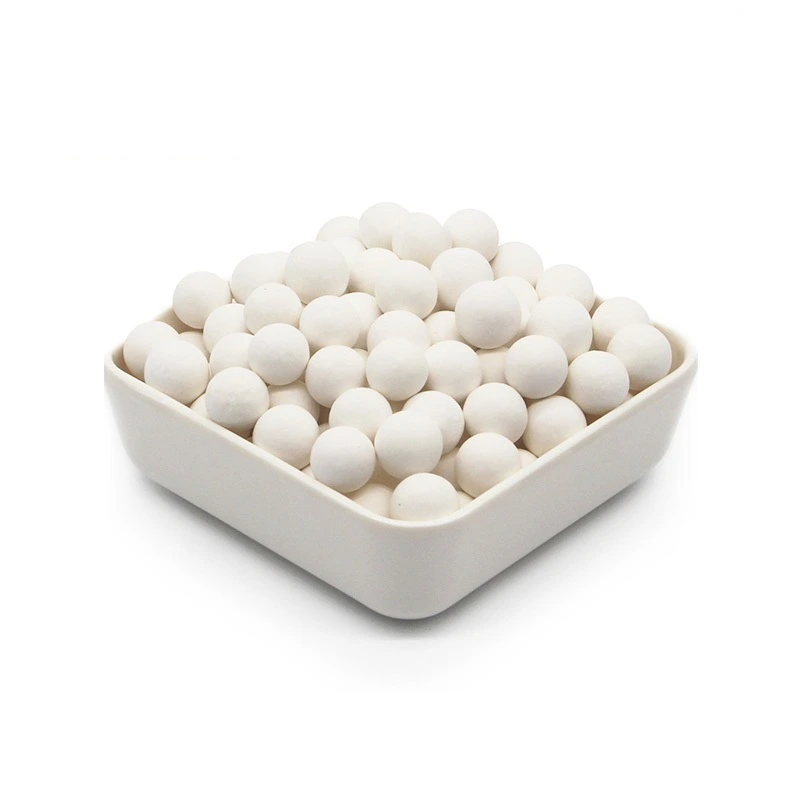
Activated Alumina AW-AA-B300
300-360 m^2/g BET surface area, 1.2-1.8 mg B/g equilibrium capacity at pH 6 / 25 deg C, attrition 0.1-0.3 wt% — the borate-selective polish media for 14 nm node UPW wet-bench rinse loops.
View Product Details →Next Steps — Get a Sample or Talk to Our Engineers
For activated alumina AW-AA-B300 samples, COAs, or application-specific blend recommendations for UPW boron-polish service, reach out to the Aluminaworld technical team. We hold stock of AW-AA-B300 in our Zibo warehouse with same-week dispatch for pilot orders (minimum 25 kg), and we can also produce custom surface-area, boron-capacity, and grain-size recipes for Tier-1 fabs and OEMs with multi-ton annual demand.
Reach our engineering team directly via WhatsApp at +86 13325222240 (wa.me/8613325222240) or by email at barry@aluminaworld.com. Sample requests are normally dispatched within 48 hours of receipt of a complete RFQ; production orders follow 15-25 days after sample approval and receipt of purchase order.