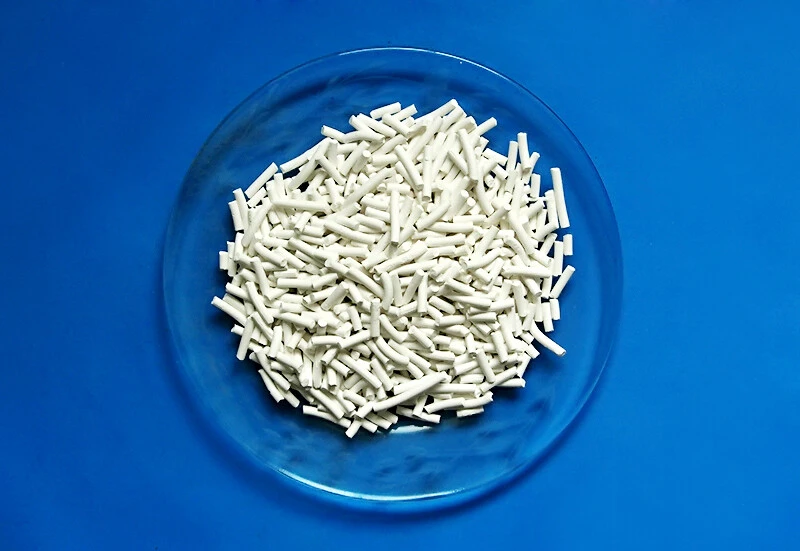
¿Qué es un Soporte de Catalizador?
Un soporte catalítico (también llamado carrier catalítico) es un material de alta superficie específica que proporciona resistencia mecánica, estabilidad térmica y dispersión para los metales activos del catalizador (Pt, Pd, Ni, Mo, Co, etc.). El soporte en sí es típicamente catalíticamente inerte, pero aporta sitios ácidos y propiedades texturales que influyen en el rendimiento del catalizador.
Para la catálisis industrial, los soportes a base de alúmina son los más ampliamente utilizados debido a su exclusiva combinación de propiedades: alta superficie específica (150-380 m²/g para la forma gamma), estructura porosa ajustable, resistencia mecánica, inercia química y bajo coste. La forma del soporte también importa: los soportes esféricos ofrecen baja caída de presión, las formas trilobulares y extruidas proporcionan una mayor superficie geométrica, y las microesferas macroporosas permiten reacciones limitadas por difusión.
Nuestra Línea de Soportes Catalíticos
Como fabricante líder en China con más de 15 años de experiencia, AluminaWorld suministra seis formas estándar de soportes de catalizador de alúmina de alta pureza. Cada forma está diseñada para tipos de reactores específicos y condiciones de proceso.


1. Bola de Soporte de Catalizador
Soportes de catalizador esféricos fabricados mediante el método de goteo de aceite para lograr forma uniforme, superficie lisa y excelente resistencia mecánica. Utilizados en reactores de lecho móvil y lecho ebullido donde la baja atrición es crítica.
- Rango de tamaño: 1-3 mm, 3-5 mm, 5-8 mm, 8-10 mm (personalizado disponible)
- Contenido de Al₂O₃: ≥96% (γ-alúmina) o ≥99% (α-alúmina)
- Área superficial: 180-280 m²/g (γ) o 5-10 m²/g (α)
- Resistencia al aplastamiento: ≥80 N/perla (3 mm), ≥150 N/perla (5 mm)
- Aplicaciones: Soporte de catalizador de reformado, hidrocraqueo de lecho en ebullición, hidrotratamiento de lecho fijo, catalizador de lecho móvil
2. Soporte de catalizador con forma trilobular
Forma de extrudido de tres lóbulos que proporciona un 30-40 % más de área superficial geométrica en comparación con cilindros estándar, mejorando la actividad catalítica por unidad de volumen del reactor.
- Tamaño: 1,5 mm, 2,0 mm, 3,0 mm (diámetros personalizados)
- Contenido de Al₂O₃: ≥95%
- Área superficial: 200-300 m²/g
- Resistencia a la trituración: ≥50 N/mm (axial)
- Aplicaciones: Hidrodesulfuración (HDS), hidrodenitración (HDN), aditivos para catalizadores FCC, hidrocraqueo
3. Soporte de catalizador en forma de extruido
Extruidos cilíndricos estándar: la forma más utilizada por su rentabilidad y rendimiento probado en procesos de refinería.
- Tamaño: 1,5 mm, 3 mm, 5 mm de diámetro (longitud 3-15 mm)
- Contenido de Al₂O₃: ≥95%
- Área superficial: 180-280 m²/g
- Volumen de poro: 0,4-0,7 cm³/g
- Aplicaciones: Hidrotratamiento, pretratamiento de hidrocraqueo, purificación de gases, recuperación de azufre Claus
4. Soporte de Catalizador Esférico de Cinco Dientes
Forma especial que combina la baja caída de presión de las esferas con el área superficial mejorada de los diseños multilobulados. Reduce la formación de puntos calientes en reacciones altamente exotérmicas.
- Tamaño: 3-5 mm, 5-8 mm
- Contenido de Al₂O₃: ≥96%
- Área superficial: 200-280 m²/g
- Aplicaciones: Hidrogenación selectiva, oxidación en lecho fijo, hidrodesulfuración profunda
5. Soporte de catalizador en forma de anillo
La geometría de anillo hueco reduce drásticamente la caída de presión en lechos catalíticos profundos, ideal para reactores de lecho fijo con alta altura de lecho.
- Tamaño: DE 3-10 mm × DI 1-5 mm × Altura 3-10 mm
- Contenido de Al₂O₃: ≥95%
- Área superficial: 150-250 m²/g
- Aplicaciones: Hidroprocesamiento de lecho profundo, torres de secado de gas, lechos de preparación para separación de aire
6. Microesferas de alúmina macroporosa
Microesferas de alúmina de alta pureza con estructura macroporosa diseñada (tamaño de poro de 50-500 nm) para reacciones limitadas por difusión y procesamiento de aceite pesado.
- Tamaño: 0,5-1 mm, 1-2 mm, 2-3 mm
- Contenido de Al₂O₃: ≥95%
- Tamaño de poro: 100-500 nm (macroporoso)
- Área superficial: 80-200 m²/g (con alto volumen de poro 0.8-1.2 cm³/g)
- Aplicaciones: Hidroprocesamiento de aceite pesado, HDS de residuos, soporte de catalizador FCC, catalizador de lecho en ebullición
7. Soporte de Catalizador de Reformado
Alúmina esférica de alta pureza específicamente diseñada como soporte para catalizadores de reformado (Pt-Re, Pt-Sn) utilizados en refinerías de petróleo para convertir nafta en gasolina de alto octanaje.
- Tamaño: 1.5-2.5 mm
- Al₂O₃: ≥99.5% (bajas impurezas críticas para catalizadores de metales nobles)
- Área superficial: 180-220 m²/g
- Na₂O: ≤0.02% (el sodio envenena los sitios de Pt)
- Aplicaciones: Reformado catalítico continuo (CCR), reformado semi-regenerativo
8. Microesferas de α-Alúmina Activa Calcinada
Microesferas de alúmina alfa completamente calcinadas con muy baja superficie específica, utilizadas como soporte de lecho inerte, diluyente o capa superior en reactores de lecho fijo para evitar la distribución desigual y los puntos calientes.
- Tamaño: 1-3 mm, 3-5 mm, 5-8 mm
- Al₂O₃: ≥99% (fase α)
- Área superficial: ≤10 m²/g
- Resistencia al aplastamiento: ≥200 N/esfera (5 mm)
- Aplicaciones: Lecho de soporte, diluyente para reacciones altamente exotérmicas, capa superior para distribución de líquidos
Especificaciones Técnicas — Grados Estándar
Gamma-Alúmina (γ-Al₂O₃) Soporte de Catalizador
| Parámetro | GA-S (Estándar) | GA-H (Alta SA) | GA-U (Ultra-Alto SA) |
|---|---|---|---|
| Al₂O₃ (%) | ≥96 | ≥95 | ≥94 |
| SiO₂ (%) | ≤0.05 | ≤0.05 | ≤0.05 |
| Fe₂O₃ (%) | ≤0.03 | ≤0.03 | ≤0.03 |
| Na₂O (%) | ≤0.10 | ≤0.10 | ≤0.10 |
| Área Superficial (m²/g) | 180-220 | 250-300 | 320-380 |
| Volumen de Poro (cm³/g) | 0.4-0.5 | 0.5-0.7 | 0.7-1.0 |
| Densidad Aparente (g/cm³) | 0.7-0.8 | 0.6-0.7 | 0.5-0.6 |
| Resistencia a la Trituración (N/perla, 3mm) | ≥80 | ≥60 | ≥40 |
| Pérdida por Desgaste (%) | ≤0.5 | ≤0.8 | ≤1.0 |
Soporte Inerte de Alfa-Alúmina (α-Al₂O₃)
| Parámetro | AA-S | AA-H (Alta Resistencia) |
|---|---|---|
| Al₂O₃ (%) | ≥99 | ≥99.5 |
| SiO₂ (%) | ≤0.05 | ≤0.03 |
| Fe₂O₃ (%) | ≤0.03 | ≤0.02 |
| Área Superficial (m²/g) | ≤10 | ≤5 |
| Densidad Aparente (g/cm³) | 1.8-2.0 | 2.0-2.1 |
| Resistencia al Aplastamiento (N/perla, 5 mm) | ≥200 | ≥350 |
| Pérdida por Atrición (%) | ≤0.2 | ≤0.1 |
Aplicaciones Clave
- Refinación de Petróleo: Hidrodesulfuración (HDS), hidrodenitración (HDN), hidrocraqueo (HC), craqueo catalítico (FCC): la pseudoboehmita y la alúmina gamma son los soportes predominantes para catalizadores de Mo-Co, Mo-Ni, Ni-W
- Reformado Catalítico: Soporte de catalizador de reformado Pt-Re y Pt-Sn para la mejora de nafta a gasolina de alto octanaje
- Hidrocrequiado de Lecho Ebullente: Microesferas macroporosas con resistencia a la atrición para HDS/HDN de residuos
- Catálisis Automotriz: Capa de lavado (washcoat) para catalizador de tres vías (TWC), catalizador de oxidación diésel (DOC), soporte de catalizador SCR
- Petroquímica: Reformado con vapor, óxido de etileno, soporte de catalizador de acetato de vinilo
- Proceso Claus: Catalizador de recuperación de azufre para procesamiento de gas natural y gas de escape de refinería
- Producción de Hidrógeno: Soportes de catalizador para reformado y desplazamiento de gas de agua para hidrógeno azul/verde
¿Por qué elegir los Soportes de Catalizador AluminaWorld?
- 6 formas estándar + geometría personalizada — un proveedor para todas sus necesidades de soportes de catalizador
- Más de 15 años de experiencia en exportación — con la confianza de fabricantes de catalizadores en más de 30 países
- Especificaciones personalizables — área superficial, tamaño de poro, PSD, resistencia a la trituración y pureza química
- Grados bajos en Na₂O disponibles — ≤0,02% alcanzable para aplicaciones con catalizadores de metales nobles
- Certificado ISO 9001:2015 — consistencia entre lotes CV < 5% for key parameters
- Muestra gratuita de 1-2 kg — en un plazo de 5 días para evaluación
Preguntas Frecuentes
¿Qué formas de soporte de catalizador ofrecen?
Fabricamos seis formas estándar: bola (1-10 mm de diámetro), trilobulado (1,5-3 mm), extruido (1,5-5 mm de diámetro), esférico de cinco dientes, anillo (3-10 mm de diámetro exterior) y microesferas macroporosas (0,5-3 mm). Cada forma ofrece ventajas específicas: las bolas proporcionan baja caída de presión y empaquetamiento uniforme, los trilóbulos ofrecen mayor área superficial geométrica, los extruidos son rentables, los anillos minimizan la caída de presión en lechos profundos y las microesferas macroporosas permiten reacciones limitadas por difusión.
¿Cuál es la diferencia entre los soportes de catalizador de alúmina gamma y alfa?
La alúmina gamma (γ-Al₂O₃) es la forma de transición con alta área superficial (150-380 m²/g) utilizada como soporte de catalizador para metales activos. La alúmina alfa (α-Al₂O₃) es la forma termodinámicamente estable con un área superficial muy baja (<10 m²/g), used as an inert top layer, bed support, or diluent to prevent hot spots in catalyst beds. Most catalyst manufacturers use gamma-alumina for the active layer and alpha-alumina for support and dilution.
¿Para qué se utiliza la alúmina macroporosa?
Las microesferas de alúmina macroporosa (tamaño de poro >50 nm, a menudo 100-500 nm) se utilizan en aplicaciones donde moléculas grandes necesitan acceder a los sitios activos, o donde la difusión de coque es una preocupación. Aplicaciones comunes: hidroprocesamiento de aceite pesado, hidrodesulfuración de residuos, aditivos de craqueo catalítico fluidizado (FCC) y soportes de catalizador de lecho en ebullición. Los poros grandes resisten el ensuciamiento y permiten la difusión de hidrocarburos de alto peso molecular.
¿Pueden personalizar las especificaciones del soporte catalítico?
Sí. Personalizamos: (1) forma y tamaño (cualquiera de las 6 formas estándar más geometrías personalizadas), (2) composición química (contenido de Al₂O₃, límites de SiO₂, Fe₂O₃, Na₂O), (3) propiedades físicas (área superficial 5-380 m²/g, volumen de poro 0.2-1.2 cm³/g, distribución de tamaño de poro), (4) resistencia al aplastamiento y pérdida por atrición, (5) densidad aparente. Nuestro equipo de I+D trabaja directamente con sus químicos de catalizadores para adaptar las propiedades del soporte a su receta de metal activo.
¿Cuál es la cantidad mínima de pedido para el soporte catalítico?
Formas y grados estándar: MOQ 500 kg. Formas o especificaciones personalizadas: MOQ 1-2 toneladas métricas (para cubrir la configuración de moldes/herramientas y la producción de prueba). Muestras gratuitas de 1-2 kg disponibles para evaluación. Plazo de entrega: 7-15 días para grados estándar, 25-40 días para especificaciones personalizadas. También podemos procesar por contrato su pseudoboehmita en soportes conformados en nuestras instalaciones de Zibo.