What CRDS actually measures, and why the number is not the number you read
Cavity Ring-Down Spectroscopy is a time-domain absorption technique. A laser pulse is injected into a high-finesse optical cavity (typical finesse F = 10,000-50,000, cavity length 0.5-1.0 m, effective path length 5-50 km after multiple round trips). The decay constant of the transmitted light intensity, called the ring-down time, is proportional to the total optical loss in the cavity. When the laser wavelength is tuned to an H2O rotational-vibrational transition in the 1392-1394 nm or 1877-1879 nm window, the difference between the empty-cavity ring-down time and the sample-filled ring-down time yields the absolute absorbance. Beer-Lambert conversion, anchored to NIST-traceable water-in-nitrogen primary standards (typically 10-100 ppmv), gives the H2O mole fraction directly.
The point that procurement engineers miss is that CRDS does not measure moisture - it measures the integrated absorbance of the H2O rotational-vibrational line, which is then converted to a mole fraction using a lineshape model that includes pressure, temperature, and the collision-broadening coefficients of the buffer gas. CO2 is a far stronger collision broadener than N2 or air - the foreign-gas broadening coefficient for H2O in CO2 is roughly 1.4-1.7 times the value in N2. If the analyzer was calibrated against water-in-nitrogen standards and is then used to measure water-in-CO2 without a matrix correction, the reported number can be off by 5-12 percent at the same true ppmv. The correction is well documented in the VDI 3490-0301 guideline and in the API chapter 9.4 / GPSA engineering data book, but it is rarely configured in the field because the default factory calibration assumes natural gas (mostly CH4) or nitrogen, not dense-phase CO2.
The 1 ppmv threshold is a capacity line, not a corrosion or hydrate line
For natural gas pipelines, the 1 ppmv threshold is set by gas processors to avoid hydrate formation and to control corrosion in sales-gas piping. The threshold is justified by thermodynamics and by pipeline steel metallurgy. For DAC columns, the threshold has nothing to do with hydrate formation (CO2 hydrates only form below ~5 degC and at 30+ bar). The 1 ppmv threshold in DAC is a capacity and durability line. Three mechanisms drive it:
First, amine-based liquid sorbents (the 30 wt % monoethanolamine / MEA baseline and the sterically hindered amines such as KS-3000-4000 series) react with H2O in a reverse direction - water dilutes the amine, shifts the CO2 loading curve, and reduces the effective working capacity by 4-8 percent per 1 ppmv of feed slip. For a 1000 t/day DAC plant, this is 40-80 t/day of CO2 capture lost to water slip alone. At a carbon credit value of 80-150 USD/tCO2, the daily loss is 3200-12000 USD.
Second, supported amine sorbents (the polyethyleneimine / PEI impregnated silica class) and 13X zeolite sorbents lose working capacity through competitive adsorption. The 13X framework binds H2O before CO2 in the 0.01-1 ppmv range. A 1 ppmv slip in the feed can occupy 3-5 percent of the available exchange sites per cycle. Regeneration duty at 100-140 degC must be sustained 15-25 percent longer to push the water off, increasing steam consumption and reducing the column's daily cycle count.
Third, water accelerates the oxidative degradation of amine solvents. Carbamate polymerization, the formation of heat-stable salts, and the oxidative cleavage of the amine-carbon bond all proceed 3-7 times faster in wet solvent than in dry. At 1 ppmv feed slip, solvent replacement intervals drop from a typical 6-12 months to 3-6 months, with a per-tonne replacement cost of 1500-3000 USD for the amine.
CRDS vs QCM vs piezoelectric vs electrolytic: the analyzer short-list
The moisture analyzer market splits into four technology families. Each has a different floor, a different response time, and a different failure mode when the gas matrix deviates from the calibration assumption. The procurement-engineer decision is not "which is best" but "which is best for my matrix and my control bandwidth."
| Technology | Detection floor (in CO2) | Response time (90% step) | Matrix sensitivity | Drift per year | Typical CAPEX (USD) |
|---|---|---|---|---|---|
| CRDS | 0.020-0.100 ppmv | 1-3 s | Low (built-in matrix model) | <1 percent of full scale | 35,000-75,000 |
| QCM (Quartz Crystal Microbalance) | 0.050-0.200 ppmv | 5-15 s | High (coating selectivity) | 2-5 percent of reading | 15,000-30,000 |
| Piezoelectric sorption | 0.100-0.500 ppmv | 30-60 s | Very high (acid gases poison) | 5-10 percent of reading | 8,000-20,000 |
| Electrolytic (P2O5) | 1-10 ppmv | 60-300 s | Critical (absolute, not selective) | 5-15 percent of reading | 3,000-8,000 |
For DAC at the 1 ppmv threshold, only CRDS and the better QCM instruments are mechanically capable of resolving the measurement. Electrolytic analyzers saturate below the threshold. Piezoelectric sorption analyzers lose 30-50 percent sensitivity in CO2 because the acid-gas poisoning of the hygroscopic coating changes faster than the reference drift correction can keep.
ASTM D5454-19 traceability chain, and the three weak links
ASTM D5454-19 is the U.S. standard that anchors moisture measurement in natural gas to NIST-traceable water-in-nitrogen or water-in-methane primary standards. The traceability chain runs NIST primary standard - gravimetric permeation tube or NIST dynamic dilution system - working standard (your analyzer's internal reference) - field measurement. Each transfer step has a documented uncertainty budget. The combined uncertainty (k=2, 95 percent confidence) for a well-maintained CRDS instrument measuring water-in-nitrogen is +/- 2-3 percent of reading at 1 ppmv. For water-in-CO2, the published uncertainty is wider because of the matrix correction term - typically +/- 4-8 percent of reading at 1 ppmv.
Three weak links break the traceability chain in practice. First, the analyzer's internal standard is usually a permeation tube or a sealed gas cylinder. Permeation tubes drift 2-5 percent per year; gas cylinders drift 1-3 percent per year. If you do not re-certify annually, your five-year drift can be 10-25 percent of the reading. Third, the sample line between the analyzer and the CO2 stream is a moisture source. Every foot of 1/4" 316L stainless tubing, even baked out at 200 degC, has a desorption time constant of 15-60 minutes after a wet event. If your analyzer sees a wet spike on a process upset, it does not see the actual process number for the next 30-90 minutes.
The ISO 18421:2022 standard (formerly IGC document 96/01/E) was written specifically for moisture in dense CO2 transport and storage. It requires a documented matrix correction, an annual re-validation against a water-in-CO2 standard, and a sample line conditioning protocol that limits the desorption time constant to under 5 minutes. If your CRDS analyzer is certified only to ASTM D5454 and your process is dense-phase CO2 at 30-80 bar, the measurement is not traceable to ISO 18421 and your CO2 custody transfer to the pipeline cannot use it as a referee number.
Matrix correction is not optional for CO2 feed at the 1 ppmv threshold
The collision broadening effect described in the previous section scales with the CO2 partial pressure and with the operating temperature. At 30 degC and 1 atm total pressure (typical DAC atmospheric feed after the blower), the broadening correction factor for an analyzer calibrated in N2 is 1.04-1.06. At 80 degC and 0.3 atm (post-vacuum pump, pre-compressor), the factor is 1.10-1.15. At 50 degC and 30 bar (dense-phase transport to sequestration well), the factor is 1.18-1.30 depending on the specific H2O transition line the analyzer is tuned to. These factors are not vendor-uniform; they depend on the exact cavity design, the laser line selection, and the data-processing firmware version. The procurement specification should require the vendor to publish a matrix correction table for the specific analyzer serial number, with a NIST-traceable uncertainty budget.
A useful procurement check: ask the vendor for a measured comparison of their analyzer against a chilled-mirror hygrometer (the MBW 373 or equivalent) at three CO2 partial pressures (1, 10, 30 bar) and three H2O concentrations (0.1, 1.0, 10 ppmv). A vendor who can deliver this comparison in writing with a NIST-traceable calibration certificate is a vendor you can buy from at the 1 ppmv threshold. A vendor who refuses or charges for the data is selling an instrument that has not been validated for your matrix.
Sample line and conditioning system design
The single largest source of measurement error in trace H2O measurement is the sample conditioning system. The conditioning system must (a) drop the pressure from the process to the analyzer inlet (typically 1-3 barg analyzer inlet vs 30-80 barg process), (b) drop the temperature from process to the analyzer operating temperature (typically 40-80 degC at the analyzer cell), (c) reject particulate and entrained liquid that would poison the analyzer, and (d) provide a fast loop / vent bypass that limits the analyzer lag time to under 30 seconds.
The pressure regulator must be a dome-loaded design with a metal-to-metal seat, not a spring-loaded design with an elastomeric seat. Elastomeric seats absorb H2O in wet conditions and desorb H2O in dry conditions, adding a slow-varying offset of 0.1-0.5 ppmv to the analyzer reading. The regulator body should be 316L stainless with electropolish internal surfaces to limit adsorption sites. The needle valve downstream of the regulator should be the same material and surface finish.
The sample line should be 1/4" OD 316L stainless with electropolish internal finish (Ra less than 0.4 micrometers), heated and insulated to maintain 60-80 degC from the sample tap to the analyzer inlet. A 10-meter line at 60 degC has a moisture desorption time constant of about 8 minutes from a 10 ppmv wet spike to a 1 ppmv reading; a line that is not heated has a time constant of 60-180 minutes. The bypass / fast loop should provide a flow of 2-5 L/min through the analyzer cell while the pressure regulator drops the bulk of the flow to 0.1-0.5 L/min vent.
For DAC columns where the CO2 feed contains amine carry-over (the 1-3 ppmv MEA or KS-3000 slip from the contactor overhead), the conditioning system must include a knock-out pot with a heated drain, a membrane separator, or a coalescing filter to remove the amine mist before it reaches the analyzer. Amine deposits on the CRDS cavity mirrors shift the cavity finesse and add 0.05-0.30 ppmv of apparent H2O within 4-8 weeks of operation. The cavity cleaning interval drops from a typical annual schedule to a quarterly schedule.
Choosing between 13X zeolite and amine sorbent for DAC: how the moisture spec interacts with capacity
The choice between supported amine sorbents (PEI on silica, KS-3000 series amines) and 13X zeolite sorbents for DAC columns is driven primarily by the moisture specification of the feed gas and the regeneration duty that follows. Both technologies are sold commercially for DAC. The moisture interaction is the deciding factor at the 1 ppmv threshold.
Supported amine sorbents work best when the feed H2O is below 100 ppmv. Above 100 ppmv, the amine sites are protonated and the CO2 working capacity drops to zero. Pre-drying to 1 ppmv requires an upstream desiccant bed (typically 13X or 4A molecular sieve) operating in a temperature-swing adsorption (TSA) cycle. The bed size for a 1000 t/day DAC plant is 15-30 tonnes of 13X per bed, with two beds in parallel for continuous operation. The TSA regeneration duty at 220-280 degC is 1.5-2.5 GJ/tCO2, which is 40-60 percent of the total DAC thermal duty.
13X zeolite sorbents for direct CO2 capture are used in vacuum-swing adsorption (VSA) configurations. The 13X framework binds both H2O and CO2, with H2O preferred at low ppmv. The feed moisture must be below 1-10 ppmv to maintain the CO2 working capacity at the design value. Without pre-drying, the 13X bed saturates with H2O in 3-7 days and the CO2 capture rate drops by 30-50 percent. With pre-drying to 1 ppmv, the 13X bed life is 3-5 years before CO2 working capacity falls below 80 percent of the design value.
The CRDS measurement on the feed gas becomes the reference number for both bed sizing and bed lifetime. If the analyzer reads 1 ppmv and the actual value is 5 ppmv (due to matrix correction error or sample line adsorption), the bed lifetime prediction is wrong by a factor of 5 and the operating cost is 15-30 percent above the design budget.
Procurement-engineer questions for the CRDS vendor
The procurement specification for a CRDS analyzer at the 1 ppmv threshold should include nine items, all written into the purchase order, not just the data sheet. Items 1-3 cover the analyzer itself, items 4-6 cover the matrix correction and traceability, items 7-9 cover the service and lifecycle.
- Vendor provides a NIST-traceable calibration certificate for the specific serial number, dated within 90 days of shipment, with a measured comparison to a water-in-CO2 reference at three partial pressures (1, 10, 30 bar) and three concentrations (0.1, 1.0, 10 ppmv).
- Vendor provides a published uncertainty (k=2, 95 percent confidence) for the specific serial number at the operating conditions, not a generic "less than 1 percent of reading" specification. The published uncertainty is committed in writing, not estimated.
- Vendor confirms the cavity construction material (typically stainless with UV-grade fused silica or sapphire mirrors), the mirror coating (typically dielectric, with reflectivity greater than 99.98 percent), and the expected cavity cleaning interval in CO2 feed service. Vendor commits to a 12-month warranty on the cavity in CO2 feed service at the named H2O range.
- Vendor provides a matrix correction table for the specific analyzer at the operating CO2 partial pressure, temperature, and H2O range. The correction is committed in writing and is configurable in the field.
- Vendor confirms the analyzer meets ISO 18421:2022 traceability requirements for moisture in dense CO2, not just ASTM D5454 for moisture in natural gas. The ISO 18421 certificate or test report is included in the shipment documentation.
- Vendor confirms the analyzer has a documented sample line conditioning package (pressure regulator, heated line, bypass / fast loop) sized for the operating pressure and the named gas composition. The conditioning package is supplied as a single skid, not as separate vendor items.
- Vendor provides an annual re-certification service with a guaranteed turnaround time of 10 working days from the day the analyzer is received at the service center. The re-certification includes the same matrix correction as the factory certificate.
- Vendor provides a 5-year parts availability guarantee and a 10-year service support commitment for the specific analyzer model. The support includes firmware updates that do not require a hardware upgrade.
- Vendor provides a reference list of at least three operating installations measuring H2O in dense CO2 at less than 5 ppmv, with the named operators' permission to be referenced. The reference list is updated annually.
Calibration and verification protocol in the field
Once the analyzer is installed and commissioned, the field calibration and verification protocol keeps the measurement within the published uncertainty. The protocol is a combination of automatic internal diagnostics, scheduled external verification, and unscheduled event-driven verification. The protocol should be written into the operating procedures and reviewed annually.
Automatic internal diagnostics run continuously. The ring-down time, the cavity temperature, the cavity pressure, the laser wavelength lock, and the photodetector signal level are all monitored against pre-set limits. Any out-of-limit condition raises an alarm and locks the analyzer output to the last good value or a configurable fail-safe value. The diagnostics do not replace external verification - they catch drift between external verifications.
Scheduled external verification runs quarterly. The analyzer is challenged against a NIST-traceable water-in-CO2 standard at 1 ppmv and 10 ppmv, and the response is recorded. A drift of more than 5 percent from the previous quarter's value triggers a full matrix re-verification and a cleaning check. The external standard is supplied by an ISO 17025-accredited laboratory and is independent of the analyzer vendor.
Event-driven verification runs after any process upset that pushes the feed H2O above 10 ppmv for more than 30 minutes. The verification is a single-point check at 1 ppmv against the same external standard. A drift of more than 3 percent triggers a cavity cleaning and a full re-verification. The event log is retained for the analyzer's service life and is part of the annual audit trail.
Cost of ownership over 10 years
The total cost of ownership (TCO) for a CRDS analyzer at the 1 ppmv threshold over a 10-year operating period depends on four line items: the initial CAPEX, the annual re-certification, the cavity cleaning labor and materials, and the unscheduled repair budget. The numbers below are typical for a well-maintained analyzer in CO2 feed service; vendor-specific quotes will vary.
| Line item | Year 1 | Years 2-5 (per year) | Years 6-10 (per year) | 10-year total |
|---|---|---|---|---|
| CAPEX (analyzer + conditioning skid + installation) | 55,000 | 0 | 0 | 55,000 |
| Annual re-certification (NIST-traceable, ISO 17025) | included | 4,500 | 4,500 | 40,500 |
| Cavity cleaning labor + materials (quarterly) | included | 3,000 | 4,500 | 33,000 |
| Permeation tube replacement (annual) | included | 1,200 | 1,200 | 10,800 |
| Unscheduled repair budget (15% of CAPEX/yr) | included | 8,250 | 8,250 | 74,250 |
| Annual total | 55,000 | 16,950 | 18,450 | 213,550 |
The 10-year TCO of 213,550 USD compares with the cost of a measurement failure at the 1 ppmv threshold. A 5 ppmv error in the feed moisture reading (a common drift pattern when the matrix correction is not configured) translates to 15-30 percent higher operating cost across the DAC column - 15-30 million USD per year for a 1000 t/day plant. The CRDS analyzer is a 1-2 percent line item in the DAC plant budget and a 15-30 percent line item in the operating cost recovery. The ROI on a properly specified CRDS analyzer is under 6 months.
Frequently asked questions
What is the lowest H2O concentration a CRDS analyzer can measure in CO2?
Modern CRDS analyzers reach 20-100 ppbv detection floor in CO2 feed gas, well below the 1 ppmv threshold for DAC columns. The published detection floor is 3-sigma over the zero-gas baseline, measured against a NIST-traceable dry CO2 standard over a 24-hour averaging window. Faster response (1-3 second) gives a higher detection floor, typically 100-200 ppbv.
Does CRDS require a NIST-traceable water-in-CO2 standard, or is water-in-N2 acceptable?
For the 1 ppmv threshold in DAC, only a NIST-traceable water-in-CO2 standard is acceptable. Water-in-N2 standards are available from NIST and from commercial sources, but they introduce a 4-12 percent matrix correction error that exceeds the published uncertainty budget. ISO 18421:2022 requires the matrix-matched standard for any number used as a custody transfer or as a DAC operating reference.
How often should the CRDS cavity be cleaned in CO2 feed service?
Quarterly cleaning is the industry baseline for CO2 feed service with 0.5-1.0 ppmv moisture. With amine carry-over from the DAC contactor, the cleaning interval drops to monthly. The cleaning protocol is documented in the analyzer service manual; typical cleaning time is 2-4 hours per cavity, with a 24-hour recovery period before the analyzer returns to service.
What is the response time of a CRDS analyzer to a 1 ppmv step change?
The intrinsic analyzer response is 1-3 seconds for a 90 percent step change at the analyzer cell. The system-end response, including the sample line and conditioning system, is 30-90 seconds for a well-designed fast loop, and 5-30 minutes for a poorly designed system. The process control loop should be tuned to the system-end response, not the intrinsic analyzer response.
Can CRDS be used for moisture measurement in amine-impregnated sorbents during regeneration?
Yes, with modifications. The regeneration off-gas from an amine-impregnated sorbent contains amine vapor at 1-50 ppmv, depending on the regeneration temperature. The amine poisons the CRDS cavity mirrors within 4-12 weeks. The solution is either an amine scrubber upstream of the analyzer (a packed column of 13X molecular sieve removes 95+ percent of the amine) or a heated membrane separator. The scrubber adds 30-90 seconds to the system lag time and 2000-4000 USD per year in operating cost.
How does CRDS compare with FTIR for moisture in CO2?
FTIR (Fourier Transform Infrared Spectroscopy) reaches 50-200 ppbv detection floor in CO2 with a slower response time (30-120 seconds) and a higher CAPEX (80,000-150,000 USD). FTIR is more selective (it can measure multiple species simultaneously) but less sensitive at the 1 ppmv threshold. CRDS is preferred for dedicated trace moisture measurement; FTIR is preferred for multi-species analysis at higher concentrations (CO2, CH4, H2S, NH3 at 10-1000 ppmv).
What is the difference between a CRDS analyzer and a TDLAS analyzer for moisture in CO2?
TDLAS (Tunable Diode Laser Absorption Spectroscopy) and CRDS are both laser-based spectroscopic techniques. TDLAS uses direct absorbance measurement with a single-pass or Herriott cell multi-pass configuration (effective path length 10-100 m). CRDS uses time-domain ring-down measurement with a high-finesse cavity (effective path length 5-50 km). CRDS reaches 20-100 ppbv; TDLAS reaches 100-500 ppbv. Both are sensitive to matrix broadening; both require matrix correction for CO2 feed service. TDLAS is faster (sub-second response); CRDS is more sensitive.
Does the CRDS analyzer require a separate dry gas reference?
Yes. The analyzer has an internal dry gas reference that is used to zero the measurement. The reference is a sealed chamber with a desiccant (typically 13X molecular sieve) that dries the gas to less than 10 ppbv. The reference must be re-certified annually as part of the re-certification service. A failed reference is the most common field service issue and is corrected by replacing the desiccant and re-zeroing the analyzer.
What is the expected lifetime of a CRDS analyzer in continuous CO2 feed service?
10-15 years for a well-maintained analyzer in clean CO2 feed service. The cavity cleaning and laser replacement are the most common service items. The laser replacement interval is typically 5-8 years; the cavity cleaning interval is quarterly. End-of-life is usually driven by the cavity mirror degradation beyond the cleaning recovery threshold, not by an electronic failure.
Can a CRDS analyzer be calibrated in the field, or must it be returned to the factory?
Field calibration is possible for the verification check, but the full NIST-traceable matrix-matched re-certification requires the analyzer to be returned to an ISO 17025-accredited laboratory. The vendor's service center is typically accredited. The field verification check uses a portable NIST-traceable water-in-CO2 standard (a small cylinder and a flow controller) and confirms the analyzer reading within 3 percent of the certified value.
What is the procurement lead time for a CRDS analyzer?
12-20 weeks from the purchase order for a vendor-stocked model with the standard matrix correction. 24-36 weeks for a custom-configured analyzer with a non-standard measurement range or a custom matrix correction. The lead time is dominated by the cavity assembly and the matrix correction certification, not by the electronics. Plan the procurement 6-9 months before the analyzer is needed on site.
Glossary of key terms
CRDS (Cavity Ring-Down Spectroscopy) - A time-domain laser absorption technique that measures the decay of light intensity in a high-finesse optical cavity. The ring-down time is proportional to the total optical loss, which is the sum of the empty-cavity loss and the absorbance of the sample gas at the laser wavelength.
Matrix correction - The numerical adjustment applied to the analyzer reading to account for the difference between the calibration gas matrix (typically N2 or CH4) and the process gas matrix (CO2 in this guide). The correction is driven by the collision-broadening coefficient of the analyte in the matrix gas.
Foreign-gas broadening - The broadening of an analyte spectral line by collisions with molecules other than the analyte. The broadening coefficient is matrix-specific; for H2O in CO2, it is 1.4-1.7 times the value in N2.
DAC (Direct Air Capture) - A technology that captures CO2 directly from ambient air, typically at 400-450 ppmv CO2 concentration, using either liquid solvents (amine-based) or solid sorbents (supported amines, 13X zeolite, MOFs). The captured CO2 is compressed, liquefied, and sequestered or utilized.
MEA (Monoethanolamine) - A primary amine solvent widely used as a baseline for liquid DAC and post-combustion CO2 capture. MEA is degraded by H2O at high concentrations and by SOx/NOx traces in the flue gas.
VSA (Vacuum Swing Adsorption) - An adsorption process that regenerates the sorbent by dropping the pressure to a vacuum (typically 50-200 mbar absolute). VSA is used with 13X zeolite for DAC and for CO2 capture from biogas.
TSA (Temperature Swing Adsorption) - An adsorption process that regenerates the sorbent by raising the temperature (typically 100-300 degC). TSA is used with supported amines, with 13X molecular sieve as a pre-drier, and with silica gel.
What to do next
If you are specifying a CRDS analyzer for trace H2O in CO2 feed for a DAC column or a CO2 utilization plant, the procurement-engineer decision is not which vendor to choose - it is whether the analyzer at the 1 ppmv threshold is traceable to ISO 18421 with a NIST-traceable water-in-CO2 standard and a documented matrix correction. The vendor's published uncertainty at your operating conditions, the cavity cleaning interval in CO2 service, and the sample conditioning package are the three numbers that decide the TCO and the ROI.
Aluminaworld supplies the molecular sieve beds that sit upstream of the CRDS analyzer in the DAC pre-drying train. Our 13X HP grade (high-purity 13X with greater than 99.5 percent exchange capacity) is specified for CO2 feed pre-drying at the 1 ppmv threshold, with a particle-size distribution of 1.6-2.5 mm or 2.5-5.0 mm sealed-bed-stable for variable-pressure operation. The 13X HP grade is also the standard pre-drier for biogas upgrading to pipeline-grade methane and for cryogenic CO2 liquefaction pre-treatment.
For a specification discussion, a budget quote, or a sample of the 13X HP grade for laboratory evaluation, contact us by WhatsApp or email. We can ship a 1-2 kg lab pack within 7 days, and a 100-500 kg engineering pack within 14-21 days. The lead time for a full container (16-20 MT) is 15-25 days from the confirmed order.
Related reading on Aluminaworld
For adjacent topics on trace H2O measurement, molecular sieve regeneration in CO2 service, and DAC column design, see the following buyer-engineer field guides:
- Molecular Sieve 13X for Direct Air Capture (DAC): CO2 Working Capacity at 415 ppm vs Amine Sorbents - the case for 13X VSA over amine scrubbing at atmospheric CO2, including the pre-drying train that CRDS monitors.
- Molecular Sieve 13X for CO2 Capture from Flue Gas: PSA vs Chemical Absorption TCO Comparison - 13X VSA economics and bed sizing for flue-gas CO2 capture, the industrial-scale counterpart to DAC.
- Electronic-Grade Specialty Gas Moisture Control: NF3 and SiH4 at ppb level - the ppb measurement regime for electronic specialty gases, the high-purity sibling of the 1 ppmv threshold discussed here.
- Molecular Sieve Regeneration Best Practices: Temperature, Flow, and Cycle Timing - the regeneration procedure that brings a 13X bed back to 100 percent working capacity after water slip exposure.
- TDLAS vs Quartz Crystal Microbalance Dew-Point Measurement for PSA Tail Gas: ASTM D5454 vs ISO 18421 Cross-Validation - the companion guide on the alternate moisture measurement technology stack, with the same traceability requirements.
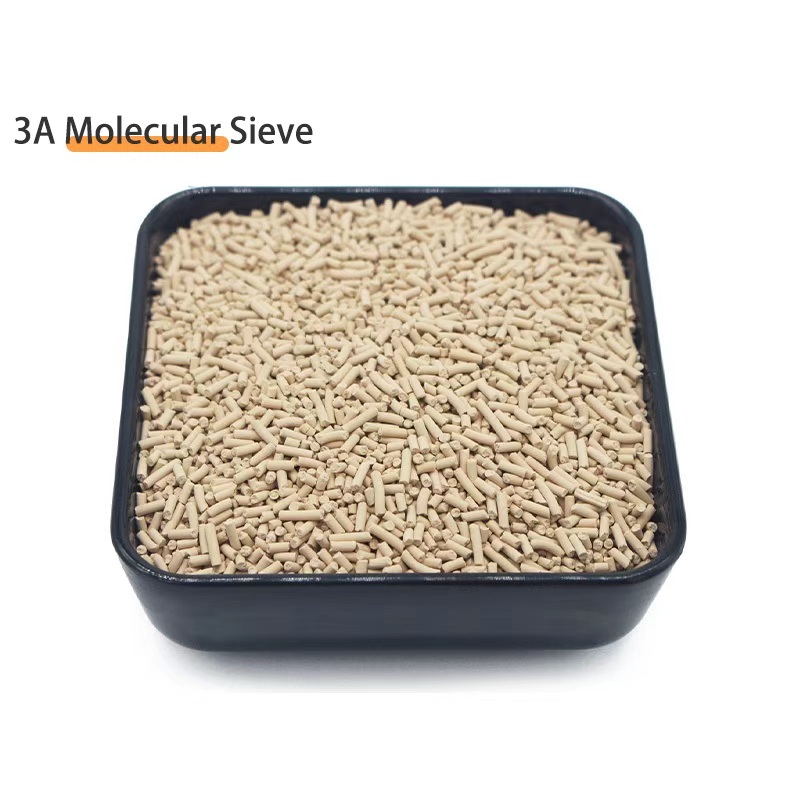
Molecular Sieve 13X / 5A / 3A for CO2 Pre-Drying and DAC Columns
High-purity 13X HP grade specified for 1 ppmv H2O control in CO2 feed streams - particle size 1.6-2.5 mm or 2.5-5.0 mm, BET surface area 700-800 m2/g, sealed-bed-stable for variable-pressure TSA / VSA operation.
View Product Details →Need help specifying CRDS for your CO2 feed?
WhatsApp our technical team for a 30-minute consultation on analyzer selection, matrix correction, and sample conditioning design. We support English / Russian / Spanish / Arabic / Turkish.
WhatsApp: +86 133 2522 2240 Email Inquiry