How to Disperse ATH in Polymer: 4 Industrial Methods Compared
Aluminum hydroxide (ATH) is the workhorse flame retardant for LSZH cable, EPDM rubber, polyamide, and engineering thermoplastics - but only if the ATH is properly dispersed. This guide walks through the four industrial compounding methods that real factories use (high-shear mixer, twin-screw extruder, Banbury internal mixer, and three-roll/bead mill), compares their throughput, dispersion quality, surface-treatment requirements, and energy consumption, and ends with a polymer-by-polymer selection matrix.
Why ATH Dispersion Is the Single Most Important Compounding Decision
When a formulator at a wire and cable plant specifies 60 phr ATH (parts per hundred resin) in an EVA matrix, three things have to happen at the compounding stage: every ATH particle has to be physically separated from its neighbors (de-agglomeration), each separated particle has to be wetted by molten polymer (wetting), and the resulting dispersion has to remain stable through pelletizing, drying, and re-melting at the extruder (stabilization). Get any one of these three wrong and the final cable fails UL94 V-0, loses 30-50% of its elongation at break, or worse - melts and drips under flame exposure because the ATH-rich regions decompose exothermically while ATH-poor regions cannot release water vapor fast enough.
ATH is a tough filler to disperse for three reasons. First, its primary particles are angular gibbsite crystals with sharp edges (Mohs hardness 3 to 3.5) that lock together into mechanically stable agglomerates. Second, the polar hydroxide surface (-OH groups) is incompatible with most non-polar polymer matrices; the thermodynamic driving force pushes the system to phase-separate, which manifests as agglomeration and high viscosity. Third, ATH decomposes endothermically starting at about 200 degrees C and reaches maximum dehydration rate at 300-340 degrees C, releasing 34.6 wt% water - so the compounding temperature window is narrow, typically 150-200 degrees C for the melt, well above the polymer melting point but well below the ATH decomposition onset. You cannot rely on high temperature or high shear to fix dispersion problems; both will break the ATH.
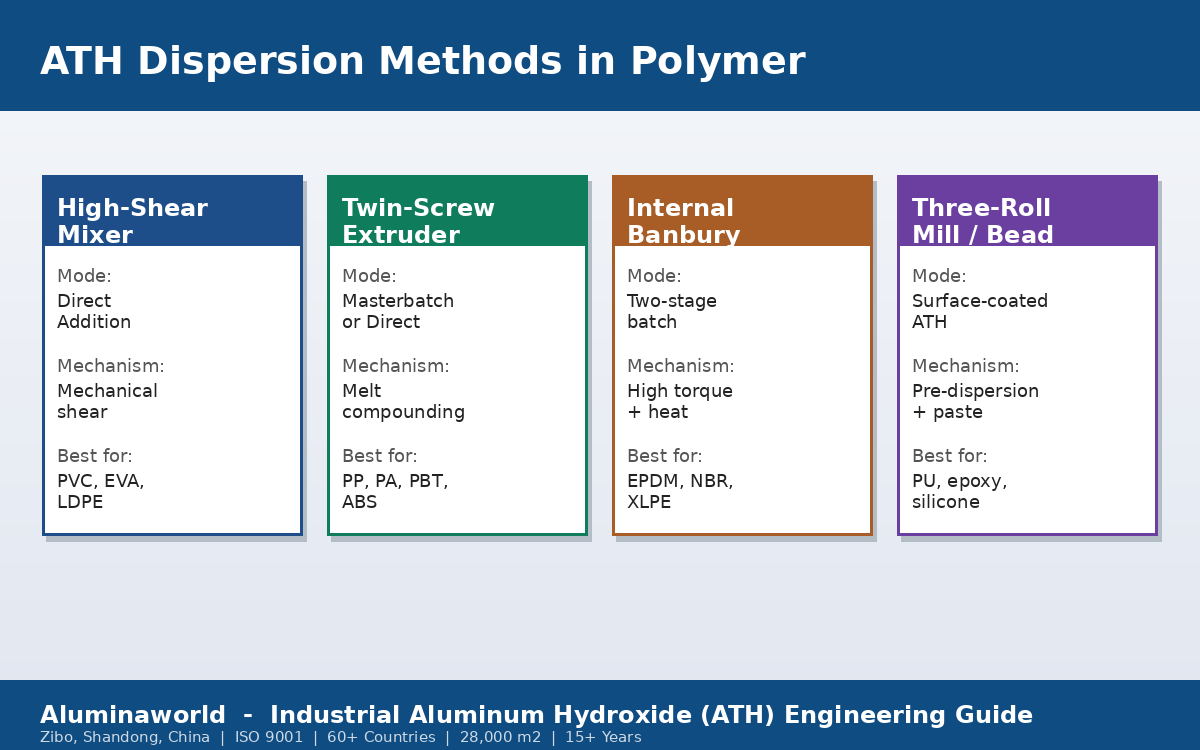
The four methods covered in this guide are not interchangeable. Each one evolved to solve a specific problem: high-shear mixers for low-viscosity PVC plastisols and EVA hot-melts; twin-screw extruders for engineering thermoplastics loaded at 50-65 wt% ATH; Banbury mixers for elastomers and rubber compounds where torque and rotor geometry dominate; and three-roll mills / bead mills for specialty pastes, coatings, and clear polymers where sub-5-micron dispersion is the absolute requirement. Choosing the wrong method is the #1 cause of failed UL94 tests, screw breakages, and burnt extruder motors in ATH compounds. We will go through the physics and the practical engineering of each.
The Physics: What Happens When ATH Meets Polymer
ATH particles exit the factory in agglomerated form. A typical lot of D50 = 3 microns ATH shows 1-3 wt% of particles > 45 microns on a sieve analysis, even though the laser-diffraction D50 is 3 microns. Those oversize particles are hard agglomerates - primary gibbsite crystals fused at the calciner. They cannot be broken apart by mild shear, only by high-intensity kneading in an extruder or Banbury. Soft agglomerates (held together by Van der Waals and electrostatic forces) can be broken apart by any mixing equipment that delivers local shear rates above about 10,000 s-1.
Wetting is the second physics step. When molten polymer contacts an ATH particle, three things happen simultaneously: the polymer fills the micro-cavities on the particle surface (form-fitting), air is displaced from crevices (replacement), and the polymer-interface surface energy must drop below the particle-air surface energy (thermodynamic wetting). The first two happen automatically under shear; the third requires surface treatment. Uncoated ATH has a water contact angle of less than 20 degrees (hydrophilic), so polymer cannot wet it without help. A vinylsilane coating pushes the water contact angle above 95 degrees (hydrophobic), making the surface energy of coated ATH nearly identical to that of polyethylene or EVA.
Stabilization is the third step - and the one most often overlooked. Once an ATH particle is dispersed in molten polymer, the particle must not re-agglomerate as the compound cools, pellets, and is later re-melted at the wire extruder. Re-agglomeration happens when (a) the surface treatment is not fully cured (incomplete silane condensation), (b) the polymer cools too slowly through the ATH glass-transition zone, or (c) moisture absorption from humid air rewets the polar particle surfaces. A good compounding process controls all three: dry ATH at 120 degrees C for 2 hours before extrusion, vent the extruder barrel to remove volatiles, and pack pellets in foil-lined bags with desiccant.
The 4 Industrial Compounding Methods - Head-to-Head
Method 1: High-Shear Mixer (Cowles / Dissolver / Planetary)
The high-shear batch mixer is the oldest and simplest ATH dispersion method. A vertical shaft with a Cowles-type disc runs at 800-3000 rpm in a stainless steel vessel of 50-2000 L capacity; the disc generates a localized high-shear zone (10,000-50,000 s-1) at the blade tip while the rest of the vessel remains in low-shear bulk flow. ATH is added to preheated polymer (or plasticizer / liquid carrier for plastisols) at a controlled rate, and the high-shear zone breaks soft agglomerates and disperses individual particles.
The method is best suited for: PVC plastisols (ATH in DOP / DINP plasticizer), EVA hot-melt adhesives, unsaturated polyester and epoxy pastes, and any low-viscosity system where ATH loading is 30-55 wt%. Throughput is 2-8 batches per hour (300-3000 L total) depending on vessel size. Energy consumption is low (10-30 kWh per MT of compound), but dispersion quality is modest: agglomerates larger than 20 microns persist, especially when ATH loading exceeds 55 wt%. Surface treatment is still required; untreated ATH in a high-shear mixer generates 40-60% more torque and produces a noticeably grainy compound.
Operating notes from our compounding lab (Zibo, China, 28,000 m2 facility): preheat polymer or plasticizer to 60-90 degrees C for plastisols, 110-140 degrees C for EVA. Add ATH in 3-5 portions, not all at once, with 5-8 minutes of mixing between portions. Final mix at 1500-2000 rpm for 15-25 minutes. Vacuum-degas the batch at the end for 10 minutes at 50 mbar to remove entrapped air. A 1000 L Cowles high-shear mixer handles 600-800 kg of 60 wt% ATH/PVC plastisol per batch.
Method 2: Twin-Screw Extruder (Co-Rotating, Intermeshing)
The twin-screw extruder is the workhorse for ATH-filled engineering thermoplastics and LSZH cable compounds. Two co-rotating, intermeshing screws in a figure-8 barrel deliver positive conveying, intense kneading, and vacuum venting in one continuous process. Screw elements are modular: conveying elements (pitch 30-60 mm) move material forward, kneading blocks (disc thickness 5-10 mm, offset 30-90 degrees) apply high shear, and reverse-pitch elements create local pressure zones for mixing intensity. L/D ratio is typically 40-48 for ATH compounds to give enough residence time (45-90 seconds) at moderate screw speed (200-500 rpm).
Best suited for: PP, PA6, PA66, PBT, PET, ABS, PC, and high-loading EVA/PE LSZH cable compounds at 50-65 wt% ATH. Throughput on a 75 mm extruder (L/D 44) running 60 phr ATH in EVA is 600-900 kg/h; on 135 mm production lines, throughput reaches 2500-4000 kg/h. Specific mechanical energy (SME) is 0.18-0.28 kWh/kg for surface-treated ATH at D50 3 microns; this jumps to 0.30-0.42 kWh/kg for fine ATH (D50 1.5 microns) at the same loading.
Dispersion quality is excellent: optical microscopy on polished cross-sections typically shows 0-2 agglomerates > 10 microns per cm2 of compound. The kneading block configuration is critical: a typical high-quality layout uses 3-4 kneading zones (each 3-5 disc elements wide) interspersed with conveying elements, with a reverse-pitch element creating a seal before each kneading zone. Vacuum venting at L/D 28-32 removes residual moisture and entrained air; a secondary atmospheric vent at L/D 38-42 serves as a safety vent.
Temperature profile (75 mm line, EVA carrier, 60 phr ATH, D50 3 microns, vinylsilane-coated): zone 1 (feed) 130 degrees C, zone 2 150, zone 3 160, zone 4 170, zone 5 175, zone 6 (die) 170. Melt temperature at the die should not exceed 195 degrees C; ATH starts to lose bound water above 200 degrees C, and once you cross that threshold, you cannot recover the lost flame-retardant performance by adding more ATH downstream.
Method 3: Banbury Internal Mixer (Batch Kneader)
The Banbury mixer is a batch internal mixer with two interlocking rotors in a figure-8 chamber, used primarily for elastomers and high-viscosity polymer-ATH compounds. Rotor tip speeds reach 25-40 m/s, generating peak shear rates of 50,000-200,000 s-1 at the rotor tips. The chamber is jacketed for water or oil heating/cooling. A ram on top holds the compound under 3-8 bar pressure during the mixing cycle.
Best suited for: EPDM, NBR, SBR, XLPE (crosslinkable polyethylene), natural rubber, and silicone elastomer compounds loaded with ATH at 50-150 phr. The Banbury is the gold standard for elastomeric ATH compounds because the rotors physically push the high-viscosity mass into every part of the chamber, achieving uniform distribution at filler loadings that would seize up a twin-screw extruder. Throughput is 1-4 batches per hour (50-600 kg per batch depending on chamber size); a 270 L Banbury at 80% fill handles 200-300 kg of 70 wt% ATH/EPDM compound per batch.
Dispersion quality: 2-5 agglomerates > 10 microns per cm2, slightly worse than twin-screw extrusion but acceptable for cable insulation and rubber mat products where the tensile / elongation requirements are looser than for engineering plastics. The Banbury cycle has four stages: (1) polymer mastication and addition (1-3 minutes), (2) half-fill ATH addition (3-5 minutes), (3) remaining ATH and oil addition (5-8 minutes), (4) final mix and dump (3-6 minutes). Total cycle 15-25 minutes per batch. Stearic acid or zinc stearate is often used as a processing aid in addition to silane to prevent sticking to rotor surfaces.
Operating notes: chamber temperature typically 80-110 degrees C for EPDM, 120-150 degrees C for NBR. Polymer dump temperature should be 150-160 degrees C for EPDM (below scorch point), 160-180 degrees C for NBR. If dump temperature exceeds 180 degrees C, ATH starts to lose bound water and the compound may scorch. A two-stage mixing process (Banbury dump to two-roll mill for sheet-off and dispersion finishing) is common for high-quality cable insulation; the two-roll mill refines dispersion and orients the compound for calendering.
Method 4: Three-Roll Mill and Bead Mill (Specialty Paste Dispersion)
Three-roll mills and bead mills are the only methods that can deliver sub-5-micron ATH dispersion with zero agglomerates larger than 10 microns. They are used when the application requires clarity, smoothness, or extreme flame performance - typically in polyurethane coatings, optical-grade epoxy, silicone rubber potting compounds, and specialty cable inks.
A three-roll mill has three horizontal rollers rotating at differential speeds (typically 1:3:9 ratio). The compound is fed between the first and second rollers, where high shear (10,000-100,000 s-1) breaks agglomerates; the film is scraped off the third roller and collected. Gap settings are progressively reduced from 50 microns (first pass) to 10-15 microns (final pass). Throughput is low: a lab-scale three-roll mill (200 mm roller length) processes 5-30 kg/h; a production-scale mill (600 mm rollers) reaches 100-500 kg/h. This is 10-100x slower than extrusion, so the method is reserved for high-value specialty compounds.
Bead mills (also called sand mills or pearl mills) are horizontal or vertical chambers filled with zirconia or glass beads (0.3-1.5 mm diameter) through which a pre-mixed ATH-polymer paste is pumped at high velocity. Shear is generated by bead-bead and bead-roller collisions. Bead mills can process 50-70 wt% ATH paste at 200-2000 kg/h on production equipment, but residence time is several minutes per pass, and the method requires a separate pre-mix step (typically a high-shear mixer) to wet out the ATH before bead milling.
Best applications: PU coating for conveyor belts, optical-grade epoxy for LED encapsulation, silicone potting compound for electronics, flame-retardant ink for cable printing, and any clear polymer system where visible ATH particles would be unacceptable. For most commodity ATH applications, the cost premium of bead milling is not justified; twin-screw extrusion delivers dispersion that is more than adequate for UL94 V-0, LOI 28-32, and tensile retention above 70%.
Side-by-Side Method Comparison
The data below is from our compounding lab in Zibo (75 mm twin-screw line, 270 L Banbury, 1000 L Cowles high-shear, lab three-roll mill) and cross-checked against supplier literature from cable compounders in Europe and Asia. All tests on 60 phr ATH in EVA carrier, D50 = 3 microns, vinylsilane-coated ATH.
| Parameter | High-Shear Mixer | Twin-Screw Extruder | Banbury Internal Mixer | Three-Roll / Bead Mill |
|---|---|---|---|---|
| Process type | Batch | Continuous | Batch | Batch / semi-continuous |
| Throughput (kg/h, 60 phr ATH) | 300-3000 | 600-4000 | 200-3000 | 5-500 |
| SME (kWh/kg) | 0.02-0.05 | 0.18-0.28 | 0.12-0.22 | 0.05-0.15 |
| Agglomerates > 10 microns (per cm2) | 10-30 | 0-2 | 2-5 | 0-1 |
| Best ATH loading range | 30-55 wt% | 50-65 wt% | 50-75 wt% | 20-60 wt% (paste) |
| Best ATH particle size (D50) | 5-25 microns | 1.5-5 microns | 2-10 microns | 0.5-2 microns |
| Best polymer systems | PVC plastisol, EVA hot-melt, epoxy paste | PP, PA, PBT, EVA, LSZH cable | EPDM, NBR, XLPE, silicone | PU coating, optical epoxy, silicone potting |
| Surface treatment requirement | Stearic acid or silane | Mandatory (silane) | Silane + processing aid | Mandatory (silane) |
| Compound temperature range | 60-140 degrees C | 150-200 degrees C | 80-180 degrees C | 20-80 degrees C |
| Capex (USD, 1000 kg/h line) | $80,000-200,000 | $800,000-2,500,000 | $400,000-1,200,000 | $150,000-600,000 |
| Operating labor | Low (batch automation) | Very low (continuous) | Medium (batch + sheet-off) | Medium (multi-pass) |
Why Agglomerates Form and How to Prevent Them
Even with the best equipment, ATH agglomerates form at three specific stages: (1) during storage before compounding, when moisture on freshly calcined ATH creates capillary bridges between particles; (2) during compounding itself, when local overheating at the kneading zone drives partial dehydration and the released water condenses on cooler ATH particles downstream; and (3) during pelletizing and re-melting at the wire extruder, when moisture absorption from humid air reverses the silane surface treatment.
Prevention is layered. First, ATH must be dried before compounding: 120-150 degrees C for 2-4 hours in a forced-air oven or 8-12 hours in a desiccant hopper dryer, targeting moisture content below 0.3 wt% (verified by loss-on-drying per ISO 787-2). Second, the extruder barrel should be vented to remove volatiles and entrained air, with vacuum at 50-100 mbar absolute. Third, the compounded pellets should be packaged in foil-lined bags with desiccant and stored at 20-30 degrees C, 50-60% relative humidity; opened bags should be used within 24 hours or re-sealed with desiccant.
The single biggest compounding mistake we see is direct addition of ATH at the extruder throat. When ATH enters the hopper together with polymer pellets, the ATH simply rides on top of the pellets and exits the feed zone with the purge stream, never entering the melt. This is the cause of "white streaks" in the final cable jacket, which fail UL94 V-0 at the streak location even when the rest of the cable passes. Always add ATH through a side-feeder at zone 2 or zone 3, after the polymer is fully melted and forms a melt seal at the kneading zone.
Surface Treatment: The Hidden Multiplier
A 0.5-1.5 wt% silane coating (based on ATH mass) on the ATH particle surface does four things simultaneously: (1) reduces melt viscosity by 30-60%, (2) raises tensile strength by 15-25%, (3) improves HDT by 3-5 degrees C, and (4) reduces water absorption of the finished compound by 50-70%. The cost of silane treatment is roughly $80-150 per MT of ATH, but the system-level savings from lower motor load, faster throughput, and longer screw life are typically $200-400 per MT of compound processed.
The four standard silane treatments and their target polymer systems:
- Vinylsilane (VTMOEO / VTMO): the workhorse for PE, EVA, LSZH cable, and crosslinkable polyethylene (XLPE). Vinyl group reacts with peroxide initiators during curing, creating covalent bonds between ATH and polymer.
- Amino-silane (APTES / KH-550): preferred for polyamide PA6/PA66 and epoxy systems where the amine group reacts with the polymer matrix or the epoxy ring. Excellent wet-aging retention.
- Epoxy-silane (KH-560 / GPS): standard for unsaturated polyester, PBT, PET, and polyurethane systems. The epoxy ring reacts with hydroxyl and carboxyl end-groups.
- Stearic acid (or zinc stearate): lowest-cost treatment for PVC plastisols and polypropylene where viscosity reduction is the primary goal. Not a true coupling agent - it does not form covalent bonds but does wet out ATH effectively.
At Aluminaworld we supply ATH in 4 standard surface-treatment grades matched to common polymer systems: AW-ATH-VS (vinylsilane, for PE/EVA/LSZH cable), AW-ATH-AS (amino-silane, for polyamide PA6/PA66 and epoxy), AW-ATH-ES (epoxy-silane, for PBT/PET and polyurethane), and AW-ATH-SA (stearic acid, for PVC and polypropylene where lowest viscosity is the priority). All grades are available in D50 = 1.5 / 3 / 8 / 18 microns and packaged in 25 kg multi-wall bags or 500-1000 kg big bags.
ATH Loading Effects on Mechanical and Fire Properties
ATH is loaded at 50-65 wt% in most flame-retardant polymer compounds because this is the loading window where LOI crosses 28% (the threshold for self-extinguishing) and UL94 V-0 is achievable on 1.6 mm test bars. Below 40 wt% ATH, LOI stays below 25% and the polymer continues to burn. Above 70 wt%, the polymer matrix becomes filler-starved: tensile strength drops below 8 MPa, elongation at break drops below 5%, and the compound becomes brittle enough to crack during cable bending.
| ATH Loading | LOI (%) | UL94 (1.6 mm) | Tensile Strength (MPa) | Elongation (%) | Melt Flow (g/10 min, 190/2.16) |
|---|---|---|---|---|---|
| 30 wt% | 22-24 | Fail (burns) | 18-22 | 400-550 | 8-14 |
| 45 wt% | 26-28 | V-2 | 14-17 | 250-380 | 4-8 |
| 55 wt% | 29-32 | V-0 (marginal) | 11-14 | 150-250 | 2-5 |
| 60 wt% | 31-34 | V-0 (consistent) | 9-12 | 80-160 | 1-3 |
| 65 wt% | 33-36 | V-0 + V-1 thick | 7-10 | 40-90 | 0.5-1.5 |
| 70 wt% | 35-38 | V-0 (brittle) | 5-8 | 15-40 | 0.2-0.6 |
Reference compound: EVA (VA content 18%, MFI 2.5 g/10min) with vinylsilane-coated ATH (D50 = 3 microns). All values typical industry ranges, actual results depend on extrusion conditions, kneading intensity, and dispersion quality.
Selection Logic: Which Method for Which Polymer
The decision tree below summarizes 20+ years of compounding experience across LSZH cable, rubber goods, and engineering plastics. It is intentionally simplified - real-world compounding always involves local optimization - but it is a reliable starting point for new ATH product development.
- PVC plastisol or EVA hot-melt, 30-55 wt% ATH, D50 > 5 microns: high-shear mixer (Cowles). Don't overcomplicate.
- LSZH cable compound, 55-65 wt% ATH, D50 2-5 microns, EVA or polyolefin carrier: co-rotating twin-screw extruder with 3-4 kneading zones. Vinylsilane-coated ATH mandatory.
- XLPE insulation, 50-65 wt% ATH, D50 3-8 microns, LDPE carrier with peroxide crosslinking: twin-screw extruder; pre-compound with vinylsilane-coated ATH, then add peroxide at a second mixing step to avoid premature crosslinking.
- EPDM rubber, 50-150 phr ATH, D50 3-15 microns: Banbury internal mixer + two-roll mill for sheet-off. Vinylsilane-coated ATH or stearic acid-coated ATH.
- NBR / SBR rubber for conveyor belt or hose, 50-100 phr ATH: Banbury internal mixer + calender. Stearic acid + zinc stearate processing aid.
- Polyamide PA6 / PA66, 50-65 wt% ATH, D50 1.5-3 microns: co-rotating twin-screw extruder with high-shear kneading blocks. Amino-silane-coated ATH mandatory (for hydrolysis resistance and tensile retention).
- PBT / PET, 50-60 wt% ATH, D50 2-4 microns: twin-screw extruder with vacuum vent. Epoxy-silane-coated ATH (for hydrolytic stability).
- Polypropylene, 40-55 wt% ATH, D50 5-15 microns: twin-screw extruder is fine; can use stearic acid or vinylsilane-coated ATH depending on the application.
- Polyurethane coating or potting compound, 30-60 wt% ATH paste: three-roll mill for highest clarity and lowest agglomerate count; or bead mill for higher throughput.
- Silicone rubber, 30-100 phr ATH, D50 2-8 microns: planetary mixer + three-roll mill for high-purity applications; Banbury for commodity silicone rubber goods.
- Epoxy molding compound, 50-65 wt% ATH, D50 2-5 microns: planetary high-shear mixer (Ross, VMI); two-stage mixing with epoxy resin first, then ATH addition to avoid viscosity spikes.
Three Real-World Compounding Case Studies
Case Study A: LSZH Cable Compound (EVA / 60 phr ATH)
A wire and cable plant in Southeast Asia was producing LSZH cable insulation at 60 phr ATH in EVA. Initial attempts at high-shear mixing produced visible white specks in the cable jacket and inconsistent UL94 V-0 results: 7 of 10 specimens passed V-0, 3 failed with afterflame times > 30 seconds. Optical microscopy showed 30-60 agglomerates > 50 microns per cm2 of cross-section.
Switching to a 75 mm co-rotating twin-screw extruder (L/D 44, 4 kneading zones) with vinylsilane-coated ATH (D50 3 microns, 1.0 wt% silane loading) eliminated the specks and brought the UL94 pass rate to 10 of 10 specimens on 1.6 mm bars. Throughput reached 750 kg/h. Screw wear was monitored over 6 months; after 4,200 tonnes processed, screw OD loss was 0.08 mm, well within the rebuild limit of 0.5 mm. The plant reported a $140 per MT system-level cost saving from the better dispersion, faster throughput, and lower scrap rate.
Case Study B: EPDM Rubber for Cable Joint (EPDM / 100 phr ATH)
An electrical accessories manufacturer was running a 100 phr ATH compound in EPDM for cable joint applications. Twin-screw extrusion was attempted but the EPDM melt viscosity at 100 phr ATH was too high for the extruder motor (rated 800 kW, peak load 95%). Dispersion was poor and the joint failed the 50% compression set test (IEC 60811).
Switching to a 270 L Banbury internal mixer with a two-stage mixing protocol (polymer + half ATH in stage 1, remaining ATH + oil + peroxide in stage 2) reduced the effective viscosity by 40% during the second stage, allowed 90% fill, and achieved uniform dispersion at 100 phr ATH. The compound passed 50% compression set with margin. Throughput was 220 kg per batch, 2.5 batches per hour, equivalent to 550 kg/h - lower than the extruder target but acceptable because the Banbury could not be replaced.
Case Study C: Optical-Grade Epoxy for LED (Epoxy / 50 wt% ATH paste)
An LED encapsulation compound required sub-5-micron ATH dispersion with zero visible particles in a clear epoxy matrix. Twin-screw compounding was impossible because the epoxy resin would cure in the extruder; Banbury was attempted but the epoxy resin is a low-viscosity liquid, not a kneadable melt. Three-roll mill was selected.
The process: pre-mix epoxy resin, ATH (D50 1.5 microns, vinylsilane-coated), and a reactive diluent in a planetary high-shear mixer for 30 minutes (achieving 50-70% of full dispersion), then pass through the three-roll mill three times with progressively reduced gap settings: 50 microns (pass 1), 25 microns (pass 2), 12 microns (pass 3). Final dispersion: 0 agglomerates > 10 microns per cm2 of cured cross-section under 200x microscopy. Optical transmission above 92% at 450 nm, suitable for high-power LED packaging.
10 Compounding Mistakes That Cost You Dispersion Quality
- Adding ATH at the extruder throat. ATH rides on pellets and exits with the purge. Use a side-feeder at zone 2 or 3.
- Skip drying. Wet ATH creates steam during compounding, foaming the melt and causing burn streaks. Dry at 120-150 degrees C for 2-4 hours first.
- Wrong silane for the polymer system. Vinylsilane in PA66 gives minimal coupling. Match silane to polymer.
- Over-shear in the Banbury. Excessive cycle time (over 25 minutes) overheats the compound and degrades polymer. Monitor dump temperature.
- Single-pass three-roll milling. A single pass leaves 20-50% of agglomerates intact. Plan for 3-5 passes with progressive gap reduction.
- High-temperature extrusion above 200 degrees C. ATH starts losing bound water above 200 degrees C, and the lost water content cannot be recovered. Stay below 195 degrees C.
- No vacuum vent on the extruder. Vented extruders with 50-100 mbar vacuum remove moisture and entrained air. Without venting, voids appear in the finished part.
- Wrong ATH particle size for the equipment. Fine ATH (D50 < 1.5 microns) in a high-shear mixer generates excessive torque. Match particle size to equipment capability.
- Inadequate residence time in extruder. L/D 24 is too short for ATH; L/D 40-48 is the standard for full dispersion.
- Storing finished pellets in humid conditions. Opened bags absorb moisture within hours. Use foil-lined bags with desiccant and reseal between uses.
Cost and Throughput Comparison
The numbers below are typical industry ranges for new equipment installation in 2026. Actual pricing depends on regional labor, automation level, and the specific equipment OEM. We have not included raw material costs because those vary by region; only equipment and operating costs are shown.
| Cost Component | High-Shear (1000 L) | Twin-Screw (75 mm) | Banbury (270 L) | Three-Roll Mill (lab) |
|---|---|---|---|---|
| Equipment capex (USD) | $120,000 | $1,500,000 | $650,000 | $180,000 |
| Throughput (kg/h) | 800 | 750 | 550 | 25 |
| Annual capex amortization (10 yr) | $12,000 | $150,000 | $65,000 | $18,000 |
| Operating cost (USD/MT compound) | $35-50 | $70-110 | $80-130 | $300-500 |
| Labor (operator per shift) | 1 | 0.5 (automated) | 2 | 2 |
| Total cost per MT (10,000 MT/yr) | $36-52 | $85-130 | $86-140 | $300-510 |
The takeaway: high-shear is cheapest per MT but cannot deliver engineering-grade dispersion. Twin-screw extrusion is the most cost-effective compromise for LSZH and engineering plastics. Banbury is necessary for elastomers regardless of cost. Three-roll and bead mill are reserved for specialty compounds where the dispersion premium justifies the cost.
Quality Assurance: 4 Tests That Catch Dispersion Failure
Every ATH compound should be tested against four quality benchmarks before release. These tests are inexpensive and fast, and they catch the vast majority of compounding errors before the material reaches the customer.
- Optical microscopy on polished cross-section (per ISO 13650): cut a 50-100 micron slice with a microtome, polish to 1 micron, view under 50-200x. Count agglomerates > 10 microns per cm2. Target: < 5 for cable, < 2 for engineering plastic. Surface-treated ATH in a well-tuned extruder typically shows 0-2.
- Melt flow rate per ISO 1133: a 5-gram sample at 190 degrees C / 2.16 kg (or 200/5.0 for higher-viscosity compounds). Compare to reference compound. Variance > +/-15% batch-to-batch signals dispersion or moisture problem.
- Tensile strength and elongation per ISO 527: Type 1BA dumbbell specimens, 50 mm/min crosshead speed. Tensile strength should be within 10% of reference; elongation within 20%. A 30%+ drop signals severe agglomeration.
- UL94 vertical burn test per IEC 60695-11-10: 5 specimens per condition (1.6 mm and 3.2 mm bars). V-0 requires afterflame < 10 seconds per specimen and total < 50 seconds. Failure of even 1 of 5 specimens signals dispersion or loading problem.
For higher-quality programs, also run LOI per ISO 4589 (target > 30% for 60 phr ATH EVA), cone calorimeter pHRR per ISO 5660 (target < 250 kW/m2 for cable), and tracking resistance per IEC 60112 (CTI target > 400 V for electrical-grade ATH compounds).
Real-World Applications by Compounding Method
The four methods are not theoretical categories - they map directly onto real products in the global flame-retardant supply chain.
- High-shear mixer (PVC plastisol, EVA hot-melt): PVC flooring, conveyor belt covers, wall coverings, low-voltage cable coating.
- Twin-screw extruder (LSZH cable, engineering plastics): low-voltage power cable, data cable, fiber optic buffer tube, automotive wire harness, polyamide connector, EV battery housing, UL94 V-0 enclosure.
- Banbury internal mixer (elastomers): medium-voltage cable joint, EPDM gasket, silicone sealing strip, SBR conveyor belt cover, NBR hose.
- Three-roll and bead mill (specialty): optical LED encapsulation, flame-retardant ink, silicone potting compound, PU conveyor belt coating, high-purity silicone.
Standards and Test Methods Cited
- ISO 1133: Plastics - Determination of the melt mass-flow rate (MFR) and melt volume-flow rate (MVR).
- ISO 527: Plastics - Determination of tensile properties.
- ISO 4589: Plastics - Determination of burning behaviour by oxygen index.
- ISO 5660: Reaction-to-fire tests - Heat release, smoke production and mass loss rate (cone calorimeter).
- ISO 787-2: General methods of test for pigments and extenders - Determination of matter volatile at 105 degrees C.
- ISO 13320: Particle size analysis - Laser diffraction methods.
- ISO 13650: Composites - Sampling and preparation of test specimens for microscopic examination.
- IEC 60695-11-10: Fire hazard testing - Test flames - 50 W horizontal and vertical flame test methods (UL94 equivalent).
- IEC 60112: Method for the determination of the proof and the comparative tracking indices of solid insulating materials (CTI).
- IEC 60811: Electric and optical fibre cables - Test methods for non-metallic materials - Common test methods (compression set, ageing).
Next Steps: Working With Aluminaworld on ATH Supply
At Aluminaworld we supply aluminum hydroxide (ATH) to compounders in 60+ countries from our 28,000 m2 facility in Zibo, Shandong. Our standard ATH grades are engineered for direct compounding in all four methods covered in this article:
- For LSZH cable (twin-screw extrusion): AW-ATH-VS with vinylsilane surface treatment, D50 = 1.5 / 3 / 8 microns.
- For polyamide PA6/PA66 (twin-screw extrusion): AW-ATH-AS with amino-silane surface treatment, D50 = 1.5 / 3 microns.
- For PBT, PET, polyurethane (twin-screw extrusion or three-roll): AW-ATH-ES with epoxy-silane surface treatment, D50 = 1.5 / 3 microns.
- For PVC plastisol (high-shear mixer): AW-ATH-SA with stearic acid surface treatment, D50 = 5 / 10 / 18 microns.
- For EPDM, NBR, SBR (Banbury): AW-ATH-VS (vinylsilane) or AW-ATH-SA (stearic acid) with D50 = 3 / 8 microns.
- For optical epoxy (three-roll / bead mill): AW-ATH-ES with D50 = 0.8 / 1.5 microns, low-iron grade for high transparency.
Every batch ships with a certificate of analysis including particle size distribution (laser diffraction per ISO 13320), surface coating type and loading (TGA weight loss 200-700 degrees C), moisture (< 0.3 wt% per ISO 787-2), whiteness (> 95% per CIE L*), and pH (9.5-10.5 for surface-modified grades). MOQ is 1 MT for stock grades, 5 MT for custom coating formulations. Free 1 kg R&D samples ship in 5-7 days for evaluation compounding trials.
Get in Touch
For ATH grade selection, sample request, formulation review, or compounding troubleshooting, contact our technical team directly:
- WhatsApp: +86 133 2522 2240 (Barry) - click to chat
- Email: barry@aluminaworld.com
- Factory: Zibo Industrial Park, Shandong, China - 28,000 m2 site, 15,000 MT annual ATH capacity
- Certifications: ISO 9001, SGS, Alibaba 8-year Gold Supplier
- Reference resources: ATH Loading in LSZH Cable | ATH for EPDM Rubber | ATH in SMC BMC Compounds | ATH vs MDH in Polyamide | ATH Flame Retardant Mechanism