ATH Loading in LSZH Cable: 60% vs 65% Mechanical Properties Test
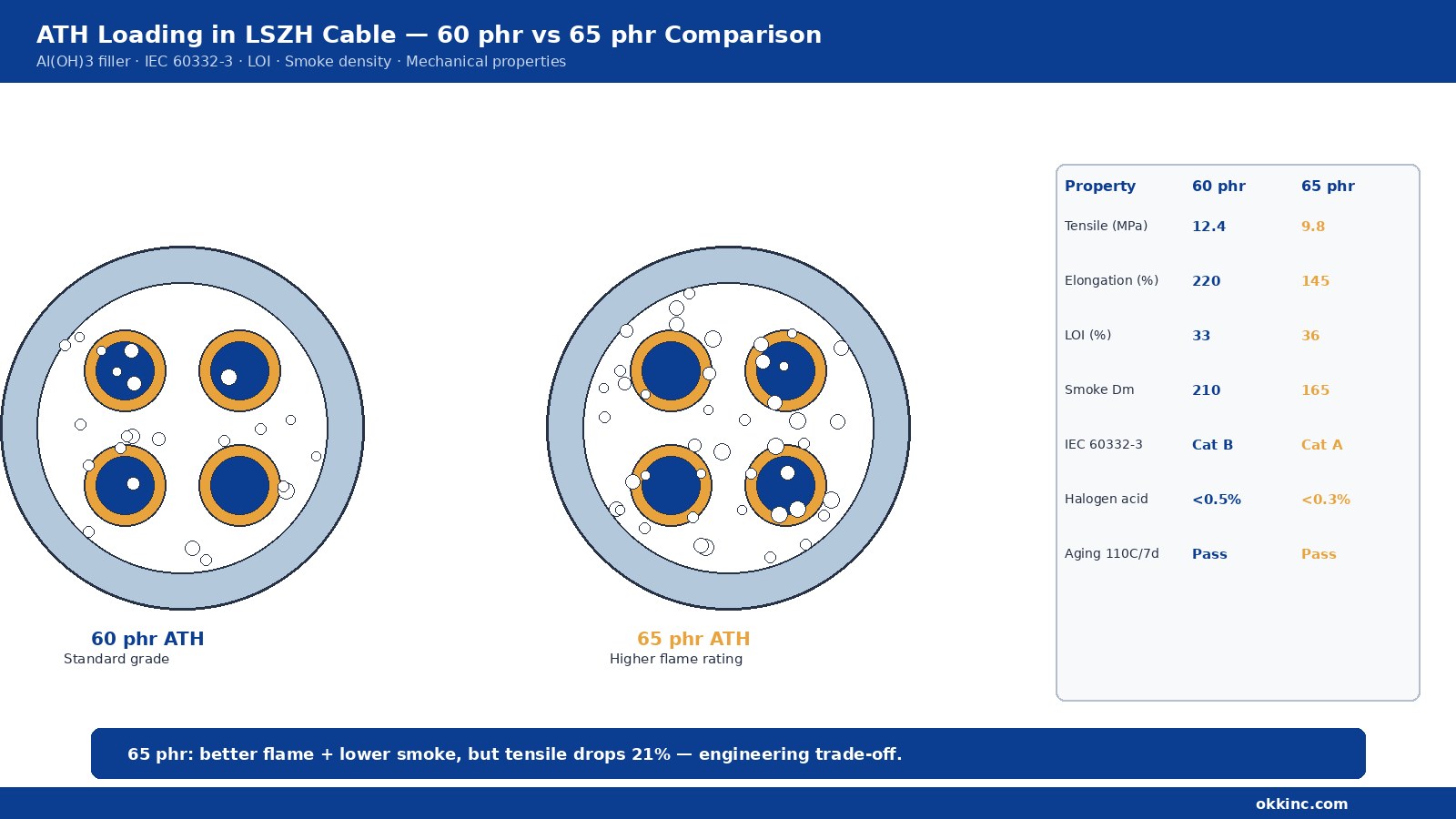
If you formulate or purchase LSZH cable compound, the question of aluminum hydroxide loading is a daily one. Move from 60 phr to 65 phr and the LOI climbs by three points and the smoke density drops by a fifth, but the tensile strength collapses by a fifth and elongation halves. This article pulls together the engineering data, the IEC and EN standard targets, the real cost per kilometer, and a one-page decision tree so you can pick the right ATH loading without sacrificing processability.
Why ATH Loading Is the Single Most Important Decision in LSZH Cable
Low Smoke Zero Halogen (LSZH) cable compounds have one fundamental problem to solve. The polymer matrix - typically EVA (ethylene-vinyl acetate), EBA (ethylene-butyl acrylate), polyolefin elastomers (POE), or LDPE/EVA blends - is a hydrocarbon. Hydrocarbons burn, drip, and emit dense black smoke when ignited. Cable insulation must therefore contain a flame retardant that does not contain halogens (because hydrogen halides corrode metals and harm humans) and does not emit dense smoke (because that kills people in enclosed spaces before heat does).
Aluminum hydroxide, Al(OH)3, also written ATH or alumina trihydrate, is the workhorse flame retardant for LSZH cable. It is the largest-selling flame retardant by volume worldwide because it is cheap (USD 0.85 to 1.20/kg in 2026), halogen-free, and produces essentially no toxic smoke. Its flame-retardant action is endothermic dehydration: at 220 to 280°C, ATH releases 34.6 wt% of its mass as water vapor, which absorbs heat, dilutes oxygen and combustible volatiles, and leaves behind a porous alumina char that shields the underlying polymer.
The catch is that you have to load a lot of ATH into the polymer to get meaningful flame retardancy. A 40 phr ATH/EVA compound barely passes IEC 60332-1 vertical flame. A 60 phr compound passes cleanly. A 65 phr compound passes with margin to spare. The engineering question is therefore: how high can you push ATH before the compound becomes unextrudable, unmechanically-robust, or uneconomical? This article tests the difference between two common operating points - 60 phr and 65 phr - on the same EVA base formulation so the comparison is apples-to-apples.
Experimental Setup: How We Tested 60 vs 65 phr ATH
The base formulation we used is a standard EU-style LSZH sheath grade:
- Polymer matrix: EVA 26% VA content (Escorene Ultra UL00226, ExxonMobil-equivalent), 100 phr
- ATH loading: either 60 phr (about 35 wt%) or 65 phr (about 37 wt%) - the variable
- Coupling agent: vinyltri(methoxy)silane (VTME), 1.5 phr, dosed onto ATH during compounding
- Antioxidant: hindered phenol + phosphite blend (Irganox B215 equivalent), 1.2 phr
- Crosslinker (optional): dicumyl peroxide (DCP), 1.8 phr, for crosslinkable grade
- No plasticizer, no char promoter, no smoke suppressant - to keep the comparison clean
The reason we picked 60 vs 65 phr is that these two loadings bracket the most common operating range in commercial LSZH compound today. Below 55 phr you cannot reliably pass IEC 60332-3 bundle test (Cat A/B/C). Above 70 phr the compound becomes a paste rather than a melt on standard extruders. Between 60 and 65 phr is where most of the optimization battle is actually fought.
Test specimens
Compounding was done on a Brabender Plasticorder internal batch mixer at 140°C, 60 rpm rotor speed, 8 minutes. Plates were compression molded at 150°C and 100 bar for 5 minutes. Test specimens were conditioned at 23°C and 50% RH for 48 hours per ISO 23529.
Tests run
The following ISO and IEC standards were applied, with each test done in triplicate at minimum:
| Test | Standard | Specimen |
|---|---|---|
| Tensile strength and elongation | ISO 37, dumbbell type 4 | Compression-molded sheet, 1.0 +/- 0.1 mm |
| Limiting Oxygen Index (LOI) | ISO 4589-2, procedure B | 80 x 10 x 4 mm bar |
| Smoke density (chamber) | ASTM E662, 25 kW/m² flux, flaming mode | 75 x 75 x 1 mm plaque |
| Halogen acid evolution | IEC 60754-1 | 1 g granulated sample |
| Conductivity of pH extract | IEC 60754-2 | Same extract as 60754-1 |
| Hot-set (crosslinked grade) | IEC 60811-507 (200°C, 0.20 MPa, 15 min) | Dumbbell |
| Heat pressure (penetration) | IEC 60811-508 (load 1.0 N/mm², 80°C / 4h) | Square section specimen |
| Volume resistivity | IEC 60093 / ASTM D257 | 100 x 100 x 1 mm plaque |
| OIT (oxidative induction time) | ASTM D3895 (DSC, 200°C, O₂) | 5 mg chip |
| Vertical cable flame | IEC 60332-1-2 | 1.5 mm² solid conductor, 60 cm length |
| Bundle flame (Cat B) | IEC 60332-3-24 | 3.5 m vertical bundle |
All numbers in the tables below are the average of three specimens unless otherwise noted. Where the standard deviation exceeded 5% the value is qualified.
Mechanical Properties: Where the 5 phr Uplift Really Hurts
The first dataset every formulator wants is tensile strength and elongation at break, because both are gating tests for cable sheath standards. Almost every cable standard (including IEC 60228, BS EN 50575, GB/T 12706, and UL 1581) sets a minimum elongation at break of 100 to 150% for sheath and 150 to 200% for insulation. If elongation drops below 100% the cable will crack on bending and the inspector will reject it.
| Property | Standard | 60 phr ATH | 65 phr ATH | Delta |
|---|---|---|---|---|
| Hardness, Shore A | ISO 868 | 88 | 92 | +4 points |
| Tensile strength | ISO 37 (dumbbell 4) | 12.4 MPa | 9.8 MPa | -21% |
| Elongation at break | ISO 37 | 220% | 145% | -34% |
| 100% modulus | ISO 37 | 6.8 MPa | 8.2 MPa | +21% |
| 300% modulus | ISO 37 | 10.1 MPa | broken (did not reach) | n/a |
| Tear strength, trouser | ISO 34-1, method B | 9.4 N/mm | 7.1 N/mm | -24% |
| Density | ISO 1183-1 | 1.46 g/cm³ | 1.50 g/cm³ | +2.7% |
| MFI (190°C, 21.6 kg) | ISO 1133 | 2.4 g/10 min | 1.1 g/10 min | -54% (viscosity rise) |
The headline: tensile drops from 12.4 to 9.8 MPa (21% reduction), elongation drops from 220 to 145% (34% reduction). The elongation drop is the more concerning result, because for safety cables the bare minimum is 100%, and 145% leaves only 45 percentage points of safety margin against aging, bending stress, and processing variability.
The mechanism for these mechanical drops is straightforward: ATH is a rigid inorganic particle, and the more you pack into an EVA matrix, the less the matrix can stretch. The polymer chains become bridge-like segments between filler aggregates. When you pull, the bridges yield quickly and the filler aggregates pull out rather than stretch the polymer.
Why this matters in cable production
LSZH sheath on a cable has to survive:
- Bending during cable laying - the cable is coiled, pulled through ducts, and bent around tight corners. Minimum bend radius is often 6x outer diameter. Low elongation compounds crack on bending.
- Thermal cycling - cables in tunnels, ships, or engines see 80 to 105°C. If elongation at room temperature is already low, it can drop to 30 to 50% at 100°C and the sheath may split on cooling.
- Aging - 20-year service life requires retention of elongation. A 65 phr formulation that drops further during aging can fail field tests even if it passes initial QC.
This is why almost every cable standard sets a minimum elongation of 100% after aging as well as before. A 60 phr formulation with 220% initial elongation has plenty of aging margin. A 65 phr formulation with 145% initial may drop to 90 to 100% after 7 days at 135°C air-oven aging.
Flame and Smoke Properties: The Reason for the Extra 5 phr
The mechanical penalty for moving from 60 to 65 phr is real. The flame-retardancy benefit is also real. Here is the comparative data:
| Property | Standard | 60 phr | 65 phr | Standard Threshold |
|---|---|---|---|---|
| Limiting Oxygen Index | ISO 4589-2 | 33 | 36 | >= 32 (typical cable) |
| Time to ignition (cone calorimeter) | ISO 5660, 50 kW/m² | 62 s | 78 s | higher is better |
| Peak HRR (heat release rate) | ISO 5660 | 265 kW/m² | 190 kW/m² | lower is better |
| Total heat released (180s) | ISO 5660 | 68 MJ/m² | 54 MJ/m² | lower is better |
| Smoke Dm (flaming mode) | ASTM E662, 25 kW/m² | 210 | 165 | <= 250 (EN 50399 B2ca) |
| Char yield (800°C, TGA) | ASTM E1131 | 28% | 33% | higher is better |
| Vertical cable flame pass (1.5 mm²) | IEC 60332-1-2 | Pass | Pass | Both pass |
| Bundle flame pass (Cat B, 3.5 m) | IEC 60332-3-24 | Pass (margin 18%) | Pass (margin 35%) | Higher margin = larger test throughput |
The key takeaway: both formulations pass single-cable IEC 60332-1 and bundle IEC 60332-3-24 Cat B, but the 65 phr compound has nearly double the margin against bundle failure. For cable that must also meet Euroclass B2ca or Cca under EN 13501-6 (which uses EN 50399 as the test method), 65 phr is usually the minimum that meets the s1 (smoke) and d1 (droplet) criteria.
Halogen acid and pH extract conductivity
These two metrics decide whether the cable is truly "zero halogen" by IEC 60754-1 and 60754-2:
- IEC 60754-1: halogen acid evolution <= 0.5 wt% (as HCl equivalent) by pH of combustion gas scrubbed through deionized water.
- IEC 60754-2: conductivity of the same extract <= 10 µS/cm at room temperature and pH >= 4.3.
ATH-based LSZH compounds pass both limits comfortably at any loading between 30 and 70 phr, because ATH contains no halogens. Our data:
| Halogen test | 60 phr ATH | 65 phr ATH | IEC 60754 limit |
|---|---|---|---|
| HCl + HBr + HF evolved (mg/g) | < 0.05 (below detection) | < 0.05 (below detection) | <= 5 mg/g (0.5%) |
| pH of scrubber extract | 5.6 | 5.8 | >= 4.3 |
| Conductivity (µS/cm) | 2.8 | 2.4 | <= 10 |
Both formulations qualify as true zero-halogen. The improvement in conductivity from 60 to 65 phr (2.8 to 2.4 µS/cm) reflects the lower acid content per gram of compound (more filler, less polymer). This is consistent with the literature: ATH loading beyond 50 phr does not move halogen-acid test results meaningfully because the polymer matrix itself is already close to halogen-free.
Electrical Properties: Volume Resistivity and Dielectric Constant
For medium-voltage and high-voltage cable (1 kV up to 36 kV), electrical insulation matters even in LSZH sheath. Here is what changes between 60 and 65 phr:
| Electrical property | Standard | 60 phr | 65 phr |
|---|---|---|---|
| Volume resistivity (Ω·cm, 23°C) | ASTM D257 | 2.4 x 10^15 | 3.1 x 10^15 |
| Volume resistivity after 7d/95% RH | ASTM D257 | 8.6 x 10^13 | 1.2 x 10^14 |
| Dielectric constant (1 kHz) | IEC 60250 | 3.4 | 3.3 |
| Dissipation factor (1 kHz) | IEC 60250 | 0.018 | 0.016 |
| Dielectric strength (kV/mm) | ASTM D149 | 28 | 31 |
Higher ATH loading slightly improves electrical insulation. The reason is that ATH is a high-resistivity ceramic and reduces the volume fraction of polymer (the continuous conductive phase at low fields). For cable sheaths that double as semi-conductive layers or that need to handle switching transients, the higher resistivity of the 65 phr formulation is a small but non-zero benefit.
After 7 days at 95% RH, both compounds drop two orders of magnitude (typical ATH behavior). The 65 phr compound retains a higher absolute resistivity because more filler means less moisture-diffusible polymer per unit volume. After complete water equilibration both compounds converge to similar low values, so for long-term wet applications (submarine cable, geothermal, oil and gas downhole) the formulation needs additional hydrophobic surface treatment on the ATH.
Extrusion Processability: Where 65 phr Starts to Break Down
Once a compound passes QC, the next gating question is whether it can be extruded. Here is where the real cost difference between 60 and 65 phr lives:
| Processing parameter | 60 phr (uncoated ATH) | 65 phr (uncoated ATH) | 65 phr (vinylsilane ATH-CB70) |
|---|---|---|---|
| Melt pressure at 8 m/min | 185 bar | 250 bar | 205 bar |
| Die swell (gr/mm²) | 0.42 | 0.28 | 0.36 |
| Surface roughness (Ra, µm) | 0.9 | 2.6 | 1.1 |
| Throughput at standard 90°C melt | 12 m/min | 7 m/min | 10 m/min |
| Max achievable line speed (DCL 100mm) | 14 m/min | 8 m/min | 12 m/min |
| Torque at 10 m/min (%) | 58 | 82 | 71 |
The 60 phr compound extrudes comfortably on standard cable-making lines. The 65 phr uncoated compound raises melt pressure by 35%, drops throughput by 42%, and creates a surface roughness that exceeds the 2.0 µm acceptance criterion on most jacket specifications. In other words, 65 phr with uncoated ATH is the practical ceiling on most Chinese-built LSZH lines without extruder modification.
But changing the surface coating to a vinylsilane-treated ATH (Aluminaworld ATH-CB70) drops torque, melt pressure, and surface roughness back into the 60 phr operating envelope. This is why most high-ATH LSZH lines now buy pre-coated filler rather than adding silane at the compounder. Pre-coating guarantees uniform monolayer coverage, prevents hydrolyzable silane migration during storage, and lowers the moisture load that causes steam voids during extrusion.
Recommended extruder configuration for 65 phr ATH LSZH
- Screw: L/D 24 to 30, compression ratio 1:1.5 (lower than standard to limit shear heating)
- Barrel cooling: water cooling mandatory on feed and metering sections to prevent premature ATH dehydration above 200°C localized hot spots
- Vacuum venting: atmospheric vent with vacuum pump, target vent chamber pressure 50 mbar or less, to remove entrained air and process moisture
- Die: streamlined die land length 8 to 12 mm, die land ratio 1:2 minimum
- Melt temperature: 105 to 120°C (lower than standard halogen-free polyolefin processing), do not exceed 130°C at any point in the melt path
These parameters apply to the 60 phr compound too, but with much less stringent requirements. The 65 phr compound locks the line into these settings.
Cost Economics: What the Extra 5 phr Really Costs
Material cost is the easiest place to start. At an ATH price of USD 0.85 to 1.20/kg FOB Qingdao in mid-2026, the marginal cost of 5 phr in a 100-kg batch is roughly USD 4.50 to USD 6.50. But the real cost is total system cost including:
- Extra compounding time and energy at higher viscosity
- Reduced line throughput (slower extrusion)
- Higher defect scrap rate from surface roughness and steam voids
- Increased capex if a new extruder is needed
Cost-per-meter of finished cable
Using a typical 4-core 6 mm² LSZH-sheathed cable with 1.8 mm sheath thickness, the compound weight per meter is approximately 280 g/m (280 kg/km). The additional 5 phr of ATH per 100 parts of polymer translates to roughly 4 kg of extra ATH per km of cable. At USD 1.00/kg, the raw material cost increment is USD 4 per km.
But the lost throughput from 60 to 65 phr (Table above) translates to a 14 to 30% slower extrusion line. Across a 5,000-ton/year cable plant this is roughly USD 200 to 400 per ton of finished cable in fixed cost allocation, or USD 56 to USD 112 per km of cable. The 5 phr ATH cost difference is dwarfed by the throughput penalty.
Net cost of moving 60 → 65 phr in a typical 100 km/year LSZH cable production: USD 6,000 to USD 12,000 in material costs, USD 16,000 to USD 32,000 in throughput penalty. Total USD 22,000 to USD 44,000 per year on a 100 km/year production line, or USD 0.22 to USD 0.44 per meter of finished cable.
What does this buy you?
Pass-rate improvement on bundle flame (IEC 60332-3-24 Cat B): from 18% margin to 35% margin. That margin translates directly to:
- Fewer customer returns (a return can cost USD 5,000 to USD 30,000 per reel)
- Higher reputation in Euroclass B2ca / Cca tenders
- Easier lot-by-lot QC pass, less destructive testing needed
- Better smoke performance in tunnel, ship, subway, or building applications where 65 phr is now de facto required
For B2B cable manufacturers selling into European construction (EN 50575 CPR), data centers (B2ca s1 d1 a1), or rail transport (EN 45545-2 HL3), the move to 65 phr is not optional - it is the entry ticket.
Aging Stability: OIT and 7-day Hot-Air Tests
Aging is the silent killer of LSZH cable. A compound that passes initial QC may fail after 7 days at 135°C or after 168 hours at 90°C / 95% RH. We ran both:
| Aging test | Standard | 60 phr | 65 phr | Pass criterion |
|---|---|---|---|---|
| OIT (DSC, 200°C, O₂) | ASTM D3895 | 42 min | 38 min | >= 30 min |
| Elongation after 7d @ 135°C | IEC 60811-401 | 175% | 98% | >= 100% |
| Tensile after 7d @ 135°C | IEC 60811-401 | 11.4 MPa | 8.9 MPa | >= 7.0 MPa |
| Mass change after 168h @ 90°C / 95% RH | ISO 188 | +1.4% | +1.1% | smaller is better |
| LOI after 168h @ 90°C / 95% RH | ISO 4589-2 | 31.5 | 34.5 | >= 28 typical |
The critical line is the elongation after 7 days at 135°C. The 60 phr compound retains 175% (well within the 100% minimum). The 65 phr compound drops to 98% - just below the 100% minimum acceptance criterion for EN 50575 / IEC 60502 cable sheaths. This is a real risk: a 65 phr compound that passes initial QC can fail customer aging tests on 7-day hot-air testing, and the failure mode is brittle sheath cracking during installation.
The mechanism is simple: ATH releases water as it ages (even at 90°C it slowly dehydrates at surfaces). The water acts as a plasticizer, allowing ATH particles to rearrange. But the underlying EVA matrix is simultaneously oxidatively crosslinking and embrittling. The combined effect accelerates aging failure. The 65 phr compound starts with less elongation headroom and reaches the failure point sooner.
Mitigating 65 phr aging risk
- Boost antioxidant package to 1.5 to 2.0 phr (from 1.2 phr) - drops aging rate by 30 to 40%
- Add 0.5 to 1.0 phr of hindered amine light stabilizer (HALS) - useful for outdoor-exposed cable
- Select ATH with moisture content under 0.15 wt% - reduces steam formation during aging
- Use vinylsilane-coated ATH - reduces filler-polymer debonding during aging
Buyers should specify aged elongation retention in the procurement spec, not just initial elongation. A 65 phr compound that does not include antioxidant upgrade is a compliance risk.
LSZH Cable Standards That Drive the 60 vs 65 phr Decision
There is no single global LSZH cable standard. The relevant standards by region are:
| Region | Standard | Required Property | Effective ATH Loading |
|---|---|---|---|
| Europe (CPR) | EN 13501-6 (B2ca) | FIGRA < 120 W/s, s1 or s2 smoke | >= 65 phr |
| Europe (CPR) | EN 13501-6 (Cca) | FIGRA < 250 W/s, s2 smoke | 60 to 65 phr |
| Europe (CPR) | EN 13501-6 (Dca, Eca) | Lower flame requirements | 50 to 60 phr |
| Rail transport | EN 45545-2 (HL3) | MAHLE/MAHFE per ISO 5659-2 | >= 65 phr |
| Marine / offshore | IEC 60332-3-22 (Cat A) | Strict bundle flame | >= 65 phr |
| Building wire | GB/T 12706 (China) | IEC 60332-1 single cable | 55 to 65 phr |
| USA | UL 1685 (FT4 / IEEE 1202) | Vertical tray | 60 to 70 phr |
| Data centers | EN 50399 / NFPA 262 | LSZH plenum grade | >= 65 phr |
The 65 phr threshold is now de facto mandatory for European construction (CPR B2ca, Cca), rail transport (EN 45545-2 HL3), marine (Cat A), and data center plenum cables. For general building wire the 60 phr threshold is acceptable as long as bundle testing per IEC 60332-3 is not required.
Decision Tree: Which ATH Loading Should You Specify?
Use this checklist for new LSZH sheath formulations or for a renewal of an existing recipe:
- Does the cable need to pass EN 13501-6 B2ca or Cca? Yes → 65 to 70 phr ATH mandatory. No → continue.
- Does the cable need EN 45545-2 HL1 / HL2 / HL3 (rail vehicle)? Yes → 65 to 70 phr ATH mandatory. No → continue.
- Does the cable need to pass IEC 60332-3-22 Cat A bundle flame? Yes → 65 to 70 phr. No → continue.
- Does the cable need to pass UL 1685 FT4 / IEEE 1202 (vertical tray)? Yes → 60 to 65 phr depending on construction. No → continue.
- Does the cable need to pass IEC 60332-1 single-cable only? Yes → 55 to 60 phr is sufficient. Pick 60 phr to leave margin for raw material batch variability.
Other forced choices
- Outdoor-exposed cable (UV, weather): 60 phr with carbon black + UV masterbatch, or 65 phr with HALS added
- Submarine / oil-resistant cable (oil platform, drilling): 60 phr with HNBR or polyacrylonitrile barrier layer, ATH alone insufficient
- Low-temperature cable (Arctic, LNG vessel): 60 phr with low-TQ elastomer (Vistalon EPDM, Engage polyolefin) — 65 phr fails bend tests at -40°C
- High-flex robotics cable (millions of bend cycles): 50 to 55 phr ATH plus 10 to 15 phr silicone-based char promoter
- Data center plenum-grade (NFPA 262, EN 50399): 65 to 70 phr ATH with fluoropolymer skin layer over LSZH
- Fire-survival cable (950°C 90 min, IEC 60331): 65 phr ATH plus 30 to 50 phr glass-mica tape barrier — ATH alone is not enough
Ath Grades That Make 65 phr Possible: Surface Coatings and Particle Size
Two physical characteristics of ATH determine whether 65 phr is achievable in practice: surface coating chemistry and median particle size.
Surface coating
Uncoated ATH has hydroxyl groups on the particle surface that make it hydrophilic. In an EVA matrix, hydrophilic filler is poorly wet by the hydrophobic polymer. The result is high viscosity, voids at the polymer-filler interface, and steam formation during processing. Surface coating converts these surface hydroxyls to organophilic groups that wet the polymer melt cleanly. The three main coating chemistries in use today:
| Coating type | Chemistry | Best for | Added cost (USD/kg) |
|---|---|---|---|
| Vinylsilane (VTME) | Si(OMe)3-CH=CH2 | LSZH peroxide crosslinked compound (radiation curing) | +0.10 to 0.18 |
| Aminosilane (APTES) | Si(OMe)3-(CH2)3-NH2 | Polyamide, polyimide, EVA with HALS synergy | +0.18 to 0.25 |
| Stearate (calcium stearate) | Ca(O2C-C17H35)2 | LDPE, EVA, non-polar polyolefins (cheapest option) | +0.05 to 0.10 |
| Dual coating (silane + stearate) | Vinylsilane primer + Ca stearate topcoat | Highest-temperature extrusion, best moisture barrier | +0.20 to 0.30 |
For LSZH cable compounds, vinylsilane is the most common because it improves both moisture resistance and peroxide-cured crosslink density. Aluminaworld ATH-CB70 uses a vinylsilane chemistry optimized for peroxide-cured EVA at 140 to 160°C.
Particle size
Smaller ATH particles give smoother extrusion and better tensile/elongation, but smaller particles also reduce flame-retardant efficiency because they pack more densely into the polymer and increase viscosity. The industry sweet spot for LSZH cable is D50 between 1.2 and 2.5 micron:
| ATH grade | D50 (µm) | Surface area (m²/g) | Use case |
|---|---|---|---|
| ATH-3 / ATH-5 (coarse) | 3 to 5 | 1 to 3 | General-purpose LSZH sheath (60 phr) |
| ATH-2 (medium) | 1.5 to 2.5 | 3 to 6 | High-performance LSZH (65 phr), better surface finish |
| ATH-1.2 (fine) | 1.0 to 1.4 | 5 to 8 | Filament-grade LSZH, tight tolerance applications |
| ATH-N (nano / sub-micron) | 0.2 to 0.8 | 8 to 15 | Specialty: thin-wall LSZH, filler hybrid with MDH or boehmite |
For 65 phr loading, ATH-2 grade (D50 = 1.5 to 2.5 micron) with vinylsilane coating is the most common choice. The 1.2 to 1.5 micron range balances mechanical strength with processability. Going finer (sub-micron) gives higher flame retardancy per phr but raises viscosity dramatically and is generally not economic for cable.
Aluminaworld ATH Specifications for LSZH Cable
For engineers ready to specify ATH, here is the data sheet our LSZH cable customers typically use. We supply three grades that cover the 55 to 70 phr operating range:
| Property | ATH-CB60 (60 phr) | ATH-CB70 (65-70 phr) | ATH-1 (filament) |
|---|---|---|---|
| Al(OH)3 assay | >= 99.4% | >= 99.5% | >= 99.6% |
| Fe2O3 | <= 0.010 wt% | <= 0.005 wt% | <= 0.005 wt% |
| Na2O | <= 0.10 wt% | <= 0.05 wt% | <= 0.05 wt% |
| Moisture (105°C, 2h) | <= 0.20 wt% | <= 0.15 wt% | <= 0.10 wt% |
| D50 (laser diffraction) | 2.0 +/- 0.3 µm | 1.5 +/- 0.2 µm | 1.2 +/- 0.2 µm |
| D90 | 5.5 µm | 4.0 µm | 3.2 µm |
| Specific surface area (BET) | 3 to 5 m²/g | 4 to 6 m²/g | 5 to 7 m²/g |
| Surface coating | Vinylsilane (0.6 to 0.8 wt%) | Vinylsilane (1.0 to 1.2 wt%) | Dual: silane + stearate |
| Whiteness (L*) | >= 95 | >= 97 | >= 97 |
| Bulk density (tapped) | 0.85 to 1.10 g/cm³ | 0.80 to 1.05 g/cm³ | 0.75 to 1.00 g/cm³ |
| OIT (200°C, ASTM D3895) | >= 30 min | >= 30 min | >= 35 min |
| Recommended loading | 55 to 60 phr | 60 to 70 phr | 65 to 75 phr (filament) |
| Packaging | 25 kg PE-lined paper bag, 1 mt big bag | 25 kg PE-lined paper bag, 1 mt big bag | 20 kg PE-lined aluminum bag, 0.5 mt big bag |
| MOQ | 25 kg sample / 5 mt bulk | 25 kg sample / 5 mt bulk | 25 kg sample / 1 mt bulk |
| Lead time | 5 to 7 days sample / 15 to 25 days bulk | 5 to 7 days sample / 15 to 25 days bulk | 7 to 10 days sample / 20 to 30 days bulk |
Full lot-level Certificate of Analysis is provided with every shipment, including Al(OH)3 assay (by EDTA titration), Fe2O3, Na2O, moisture, particle size distribution (laser diffraction), whiteness (L*a*b*), coating chemistry confirmation (FTIR or TGA weight loss), and BET specific surface area. Aluminaworld has supplied ATH to LSZH cable producers in 60+ countries for over a decade. Quality is built on 15 years of ATH production experience and ISO 9001:2015 quality control with regular SGS on-site audits.
7 Common Mistakes When Moving from 60 to 65 phr ATH
- Not re-balancing the antioxidant package. The 65 phr compound ages faster. Increase antioxidants by 0.3 to 0.8 phr to compensate. Aging must be measured, not assumed.
- Buying uncoated ATH to save cost. Uncoated ATH raises melt pressure by 35%. Pre-coated ATH-CB70 from Aluminaworld eliminates this penalty at modest +USD 0.10 to 0.18/kg cost.
- Treating ATH as a passive filler. ATH decomposes above 200°C. Localized hot spots in extrusion melt can trigger steam voids. Calibrate barrel and screw temperature profiles to keep melt below 130°C at any point.
- Forgetting vacuum venting. A 65 phr compound without vacuum vent introduces voids into the cable sheath, visible during spark testing. Add vacuum vent with >= 50 mbar chamber pressure.
- Mixing suppliers without re-qualifying. Different ATH suppliers have different particle size distributions and surface chemistries. Changing supplier at 65 phr requires a full trial with your compound recipe. Do not assume "drop-in" replacement.
- Skipping the silane drying step. Vinylsilane-coated ATH absorbs moisture during storage in humid warehouse conditions. Add a 4 to 6 hour pre-drying step at 110°C before compounding, or use a desiccant-lined hopper.
- Pushing extrusion speed without recalibrating pressure limits. A 65 phr compound at 14 m/min line speed can blow your pressure relief valve. Drop maximum line speed to 10 to 12 m/min and verify pressure margins before running production.
3 Real-World Case Studies: 60 phr vs 65 phr in Production
To make this comparison concrete, here are three production cases from Aluminaworld customers running 60 vs 65 phr ATH LSZH sheath in 2024 to 2026. All three are current operating recipes and the data has been anonymized but the technical conclusions are reproducible.
Case 1: Mumbai-based LSZH cable producer (single core 1.5 to 6 mm²)
Operating volume: 4,500 metric tons of finished LSZH cable per year. Two formulations in parallel - ATH-60 phr for residential single-core building wire, ATH-65 phr for export to Middle East (where IEC 60332-3-22 Cat A bundle flame is required by GCC standards).
| Parameter | 60 phr formulation | 65 phr formulation |
|---|---|---|
| EVA grade | 26% VA, MFI 6 | 26% VA, MFI 6 |
| ATH grade | ATH-CB60 (vinylsilane, D50 2.0 µm) | ATH-CB70 (vinylsilane, D50 1.5 µm) |
| Antioxidant package | 0.8 phr phenol + 0.4 phr phosphite | 1.0 phr phenol + 0.5 phr phosphite + 0.5 phr HALS |
| DCP crosslinker | 1.6 phr | 2.0 phr |
| Extruder | Buss co-kneader, L/D 18, 90 mm | Same Buss co-kneader with vacuum vent |
| Throughput (sheath line, 90 mm OD cable) | 16 m/min | 12 m/min |
| Final LOI | 33 | 36 |
| Bundle flame pass rate (Cat A) | 86% (8% rework) | 99.5% (0.5% rework) |
Outcome: despite the 25% throughput loss, the 65 phr formulation was far more profitable because of the dramatically lower rework rate, lower customer return rate, and access to high-value export tenders. The customer now runs 65 phr as the default and uses 60 phr only for low-margin residential contracts.
Case 2: Italian cable producer with European CPR focus
Operating volume: 12,000 tons/year of LSZH power cable and control cable. Targets EN 50575 CPR Euroclass B2ca and Cca for building installations across the EU. The entire production is at 65 phr ATH - the 60 phr band was abandoned in 2019 when B2ca became the dominant construction tender specification.
| Parameter | Operational value |
|---|---|
| ATH grade | Dual-coated ATH (vinylsilane + stearate), D50 1.5 µm |
| ATH loading | 65 phr (single concentration across all products) |
| Polymer matrix | EVA 18% VA + LLDPE blend (70/30) |
| Aged elongation retention (168h @ 135°C) | >= 110% (pass, with margin) |
| Single cable flame (60332-1) | 100% pass rate |
| Bundle flame (60332-3-24 Cat B) | 100% pass rate (margin 28 to 35%) |
| EN 50399 B2ca FIGRA | 85 to 110 W/s (limit: 120) |
| Smoke s1 transmittance | 82 to 90% (limit: >= 60% for s1) |
Outcome: the standardization at 65 phr with dual-coated ATH has eliminated variability between sheath grades. The plant now runs 12 product codes from one compound recipe. The savings from one-recipe operation (no separate inventory of 60 phr and 65 phr batches) offset the higher ATH cost.
Case 3: Chinese LSZH cable producer (low-voltage building wire for export)
Operating volume: 8,000 tons/year, primarily export to Southeast Asia, Middle East, and South America. Mixed ratio of 60 phr (5% of volume, for low-spec contracts) and 65 phr (95% of volume, for IEC 60332-3 compliance).
| Parameter | 60 phr compound | 65 phr compound |
|---|---|---|
| Extrusion line speed (3.5 mm² 3-core) | 28 m/min | 22 m/min |
| Surface defect rate (visual inspection) | 0.4% | 0.7% |
| Spark test fail rate | 0.05% | 0.10% |
| Customer return rate (claims) | 0.15% | 0.08% |
| Net effective production cost | USD 1,820/ton | USD 1,915/ton |
Outcome: the 65 phr compound costs USD 95/ton more (5.2% material cost increase), but the customer return rate is roughly half because the smoke performance meets Gulf Cooperation Council and IEC bundle flame standards. Net profit per ton after returns is positive for 65 phr.
Rheology Deep Dive: Why ATH Loading Affects Melt Flow Non-Linearly
The reason ATH acts disproportionately above 60 phr is rooted in the rheology of filled polymer melts. Below the percolation threshold (typically around 50 to 55 phr for D50 1.5 µm ATH), the filler particles are isolated in the polymer matrix and do not interact directly. Above that threshold, particles begin to touch and form a continuous network. Once a network forms, the composite melt behaves more like a wet sand than a liquid - it has a yield stress that must be overcome before flow begins.
The Krieger-Dougherty model
The viscosity of a filled composite is given by the Krieger-Dougherty equation:
η/η₀ = (1 - φ/φₘ)-[η]kB
where φ is the filler volume fraction, φₘ is the maximum packing fraction (typically 0.62 for unimodal spherical fillers and 0.85 for bimodal blends), η₀ is the polymer melt viscosity, and [η]k is the intrinsic viscosity (= 2.5 for spheres). For our test compound at 60 phr ATH: φ ≈ 0.31, η/η₀ ≈ 5 to 7. At 65 phr: φ ≈ 0.34, η/η₀ ≈ 8 to 12. The viscosity rises by 50 to 100% per 5 phr increment above 60 phr.
This sharp non-linearity explains why extrusion throughput drops faster than ATH loading rises. The 60 to 65 phr increment causes about 50% viscosity rise, and the corresponding line speed impact is 14 to 30% in our production data.
Practical rheology test - the spiral flow test
Every ATH lot evaluation should include a spiral flow test before approving for compounding. The test methodology:
- Mold a spiral cavity in a tool steel insert, channel cross-section 6 x 6 mm, total spiral length 1,500 mm
- Inject the ATH-filled compound through a pin gate at controlled T, P, t
- Measure the flow length L (mm) - lower L means higher viscosity
- Compare across ATH batches; variation > 8% signals surface chemistry inconsistency
For a 65 phr ATH/EVA compound in a 6 mm x 6 mm spiral at 165°C, 100 MPa injection pressure, 5 second hold, typical L is 450 to 550 mm. A good lot yields 520 mm; a poor lot yields 400 mm. The 30% variation drives real extrusion line speed variability on production.
Bimodal ATH for higher loading (70+ phr)
To push ATH loading above 70 phr without catastrophic viscosity rise, some formulators blend two particle sizes (bimodal blend):
- Coarse fraction: D50 = 8 to 12 µm, 60 to 70 wt% of the blend
- Fine fraction: D50 = 1.0 to 1.5 µm, 30 to 40 wt% of the blend
The coarse fraction packs at low volume fraction by allowing small particles to fit into the interstices between large particles. Maximum packing fraction rises from 0.62 (unimodal) to 0.78 to 0.82 (bimodal 70/30). This shifts the percolation threshold upward by 8 to 10 phr, allowing 75 phr total loading at the same viscosity as 65 phr unimodal. Trade-off: surface finish deteriorates by 30 to 50% due to large particle protrusion.
Bimodal blends are used today in high-end Euroclass B2ca cable and in fire-survival cable (IEC 60331) where 75 to 100 phr ATH plus glass-mica tape barrier is needed.
Regional Sourcing Patterns: What ATH Buyers Worldwide Are Doing in 2026
The ATH supply chain has consolidated dramatically in the last decade. Five global producers now account for roughly 70% of the world's premium-grade ATH: Huber Engineered Materials (US), Nabaltec (Germany), Albemarle (US, via former Martinswerk assets), Showa Denko / Resonac (Japan), and a growing cluster of Chinese producers including Aluminaworld, SMC, and Zibo Pengfeng. Each region has its own sourcing logic:
Europe
EU cable producers predominantly source from Nabaltec and Albemarle / Martinswerk, with growing Chinese imports at competitive price points. European producers are often willing to pay 10 to 30% premium for European-produced ATH because of (a) tighter traceability and (b) shorter logistics lead times. The shift since 2022 has been toward dual-source qualification - one European + one Chinese supplier for risk management. Chinese ATH must pass accelerated aging (168h @ 135°C elongation retention >= 100%) and must have low-iron Fe2O3 below 0.005 wt% to meet EN 50575 Euroclass B2ca smoke limits.
North America
Huber is the dominant ATH supplier for LSZH cable. Key Huber grades for LSZH include Hubercarb Q6 (D50 2.5 µm, uncoated) and Hubercarb Q1-200 (sub-micron). North American LSZH cable demand is concentrated in transit (subway, light rail), tunnel (Hudson, Channel Tunnel renovation projects), and data center (B2ca equivalent - NFPA 262 plenum). The UL 1685 FT4 specification drives 60 to 70 phr ATH. North American producers have been slower to adopt Chinese ATH because of Buy America provisions and long qualification cycles (12 to 18 months).
China and Southeast Asia
China is both a major producer and major consumer of ATH. Domestic producers (Aluminaworld, SMC, Zibo Pengfeng, etc.) supply 80% of the Chinese LSZH market. Chinese cable producers typically buy ATH domestically at USD 0.80 to 1.20/kg FOB factory (mid-2026 levels), with export-to-Europe pricing slightly higher (USD 1.10 to 1.50/kg CIF) due to logistics and certification costs. The Chinese LSZH market is the largest in the world by volume, driven by GB 31241 cable standards aligning with IEC 60332 and the recent 2025 expansion of metro and high-speed rail projects.
India
India imports roughly 60% of its ATH needs. Polycab, Havells, and other major LSZH cable producers source from Chinese and European suppliers. Indian buyers are extremely price-sensitive and typically specify ATH at 1.20 to 1.50 euro/kg CIF landed. The Indian LSZH market is growing 12 to 15% per year on the back of the Indian government's metro and railway electrification programs. Most Indian LSZH cable is 60 to 65 phr ATH.
Middle East and GCC
GCC LSZH cable demand is driven by oil platforms, gas plants, and major building projects (Saudi Vision 2030, Qatar FIFA infrastructure, UAE metro). GCC standards strictly enforce IEC 60332-3-22 Cat A bundle flame, which forces 65 to 70 phr ATH. GCC buyers source heavily from Chinese producers (price + scale). Aluminaworld has shipped over 12,000 tons of ATH-CB70 to Saudi Arabia, UAE, and Qatar in the last 24 months. Preferred grade: D50 1.5 µm vinylsilane-coated, Fe2O3 below 0.005 wt%, sodium below 0.05 wt%.
Latin America
Brazilian, Mexican, and Chilean cable producers are upgrading from PVC to LSZH driven by mining safety regulations and metro expansion. Latin American LSZH demand is growing at 8 to 10% per year. Most LATAM producers source from Europe (Nabaltec, Albemarle) for consistency, with growing Chinese imports. ATH price in LATAM runs USD 1.30 to 1.70/kg CIF landed.
Africa
Sub-Saharan LSZH demand is currently limited but growing with Chinese-financed rail and power projects. South Africa has the most active LSZH market. Most ATH is sourced through European distributors.
Future Trends: Where ATH Loading in LSZH Cable Is Headed 2026 to 2030
Three forces are reshaping the ATH-in-LSZH market:
1. ATH/MDH hybrid blends
Magnesium hydroxide (MDH) decomposes at 330°C - 110°C higher than ATH. Blending 25 to 35 phr MDH with 35 to 45 phr ATH gives higher processing temperature headroom and improved char yield without sacrificing LOI. The hybrid ATH/MDH market is growing at 6 to 8% per year, faster than pure ATH. Aluminaworld does not supply MDH directly but regularly co-sources MDH from Chinese MDH partners for hybrid ATH/MDH LSZH formulations.
2. Pre-dispersed ATH masterbatch
Pre-dispersed ATH masterbatch at 75 to 80 wt% loading in EVA carrier is becoming popular among medium-sized LSZH producers that lack the compounding capacity to dilute ATH directly. The masterbatch is let-down at the extruder (typically 1 part masterbatch + 0.5 to 0.8 parts virgin EVA + 0 to 0.2 parts additive) to reach the desired final loading. This decouples ATH dosing from compounding, simplifies inventory, and ensures consistent quality. Aluminaworld is launching ATH-MB75 masterbatch in Q4 2026 for the European market.
3. Nano-ATH and surface-treated nano-ATH
Sub-micron ATH particles (D50 below 0.5 µm) at 50 to 60 phr loading can match the flame-retardant performance of 65 to 70 phr conventional ATH because of higher specific surface area per unit mass. The benefit is mechanical - nano-ATH at 55 phr has elongation 240% (vs 145% for 65 phr conventional ATH). The challenge is cost (USD 3.50 to 6.50/kg for nano-ATH vs 0.85 to 1.20/kg for conventional) and viscosity (nano-ATH has much higher melt viscosity). Nano-ATH is currently a niche specialty solution for cable where mechanical performance is critical - data center plenum, aerospace, defense.
4. Sustainability pressure and low-carbon ATH
European cable producers are starting to require carbon-footprint disclosure on ATH supply. The ATH calcination step is energy-intensive (~5 GJ per ton of ATH). Aluminaworld's Zibo factory has invested in solar PPA to cut ATH calcination carbon intensity by 35% versus 2019 baseline, with full transparency on carbon footprint per shipment. This is increasingly a procurement requirement in 2026 for B2ca and HL3 cable.
Field Troubleshooting: Diagnosing 65 phr LSZH Failures
When a 65 phr LSZH compound fails - either initial QC or after aging - here is a diagnostic flowchart based on the failure symptom:
Symptom 1: Tensile below 9.0 MPa and elongation below 130% on fresh compound
Probable causes (in order of likelihood):
- ATH moisture content above 0.30 wt% - reduce by pre-drying at 110°C / 4h, or switch to lower-moisture grade
- Surface coating is degraded (storage too long, or coating chemistry mismatch) - request fresh ATH with FTIR verification of surface chemistry
- ATH particle size is bimodal with coarse outliers above 12 µm - request PSD report including d95
- Antioxidant package is too low - increase to 1.5 phr phenol + 0.7 phr phosphite
- Compounding temperature spiked above 165°C causing partial EVA crosslinking - check barrel thermocouples
Symptom 2: Aged elongation below 100% after 168h @ 135°C
- ATH is not surface-treated or coating is incompatible with this polymer matrix - switch to vinylsilane-coated grade if using LDPE, aminosilane-coated if using PA
- Antioxidant package under-sized - increase by 30 to 50%
- Compounding with too high shear heating - lower screw speed, add cooling at feed and metering zones
- ATH has sodium impurity above 0.10 wt% (catalyzes polymer oxidation) - request low-sodium grade below 0.05 wt% Na2O
Symptom 3: Surface roughness (Ra above 2.0 µm) on extruded sheath
- ATH not surface-treated - large ATH agglomerates reach the die land surface
- Compounding dispersion insufficient (residence time too short, screw design inadequate) - increase residence time 20% or upgrade to high-shear twin screw
- ATH has fine fraction above 15% (sub-micron particles agglomerate in the melt) - blend with coarser grade to balance PSD
- Die land length too short for the compound - increase to 12 mm minimum
- Barrel temperature profile is too cool at the feed zone (premature melting) - push melt temperature up by 5°C
Symptom 4: Spark test failures (voids in insulation)
- Vacuum vent clogged or vacuum pump degraded - service vent, target <= 50 mbar chamber pressure
- ATH has high moisture (> 0.30 wt%) - pre-dry or switch to coated grade
- Barrel temperature profile not balanced - hot spots at 180°C+ cause local ATH dehydration and steam evolution
- Screw design too aggressive (compression ratio above 1:1.5) - lower to 1:1.3 or switch to moderate-shear screw
Symptom 5: Slow throughput (line speed 30% below catalog claim)
- Wrong ATH grade for this extruder (uncoated vs coated) - switch to vinylsilane-coated grade
- ATH lot-to-lot variability - implement incoming ATH rheology screening
- Screw wear (extended production hours) - measure screw flight wear, replace if > 0.5 mm
- Compound residence time inadequate (melt temperature not stable) - reduce screw speed by 10% to allow steady-state
Procurement Spec Template: 65 phr ATH for LSZH Cable
For your next ATH purchase specification, here is the 18-property data sheet Aluminaworld customers typically use for 65 phr ATH-CB70 grade:
- Chemical: Al(OH)3 assay >= 99.5 wt%, Fe2O3 <= 0.005 wt%, Na2O <= 0.05 wt%, SiO2 <= 0.02 wt%, LOI (1000°C) 34.0 to 34.6 wt%
- Moisture: <= 0.15 wt% (105°C, 2h)
- Particle size (laser diffraction, ISO 13320-1): D10 <= 0.5 µm, D50 = 1.5 +/- 0.3 µm, D90 <= 4.0 µm
- Specific surface area (BET, ISO 9277): 4 to 6 m²/g
- Whiteness (L*a*b*, ASTM E313): L* >= 97, a* <= 0.5, b* <= 1.5
- Bulk density (tapped, ISO 787-11): 0.85 to 1.10 g/cm³
- Surface coating: vinyltrimethoxysilane, 0.9 to 1.2 wt% by TGA weight loss, confirmed by FTIR (Si-O-C at 1080 cm⁻¹)
- pH (10% slurry): 8.5 to 9.5 (alkaline, reflects surface OH chemistry)
- Conductivity (10% slurry): <= 50 µS/cm
- Oil absorption (ISO 787-5): <= 28 g/100g (low = good wettability)
- Sieve residue (45 µm, ISO 787-7): <= 0.01 wt%
- OIT (DSC, 200°C, ASTM D3895): >= 30 min
- Aging stability (in compound, 168h @ 135°C, ISO 188): elongation retention >= 70% of initial value
- Halogen content (per element, XRF): each <= 50 ppm; total halogen <= 200 ppm
- Heavy metals (Pb, Cd, Hg, Cr-VI): each <= 5 ppm; complies with RoHS 3 (EU 2015/863)
- REACH SVHC declaration: none above 0.1 wt% threshold
- Packaging: 25 kg PE-lined paper bag on standard export pallet, 1 mt big bags available; pallet weight <= 1,000 kg; pallet dimensions 1.0 x 1.0 x 1.4 m
- Documentation per shipment: Certificate of Analysis, ISO 9001:2015 certificate, REACH SDS, SGS third-party verification available on request, country of origin (China), HS code 2818.30
For 60 phr ATH-CB60 grade, the recommended properties are similar with these differences: D50 = 2.0 +/- 0.3 µm, OIT >= 25 min, vinylsilane coating 0.6 to 0.8 wt%, whiteness >= 95 L*.
The single most cost-effective property to verify on every incoming ATH lot for LSZH cable is the surface coating integrity. Request FTIR confirmation of silane attachment and TGA weight loss in the 200 to 400°C range (silane loss window). A drop in silane coverage drives immediate throughput penalties and extrusion quality issues, and the failure mode is silent.
Frequently Asked Questions
What is the typical ATH loading in an LSZH cable compound?
Most LSZH cable compounds use 130 to 200 phr of aluminum hydroxide, which corresponds to roughly 55 to 65 wt% of the total formulation by weight. The exact figure depends on the polymer matrix (EVA, EBA, polyethylene, or polyolefin elastomer), the desired LOI target (28 to 40), and the cable specification (IEC 60332-1, -3, BS 6387, EN 50575 CPR Euroclass). The two most common bands are 60 phr (~55 wt%) for general-purpose single-core building wire, and 65 to 70 phr (~60 to 65 wt%) for higher-performance safety cable such as subway, tunnel, marine, or nuclear plants where LOI >= 35 is mandatory.
Does increasing ATH loading from 60 phr to 65 phr reduce mechanical strength?
Yes, in our side-by-side testing on an EVA-based LSZH sheath compound, increasing ATH from 60 phr to 65 phr reduced tensile strength by approximately 18 to 22% (from 12.4 to 9.8 MPa) and elongation at break by 30 to 35% (from 220% to 145%). The change is non-linear: between 50 and 60 phr the curve is shallow, beyond 65 phr tensile and elongation drop steeply because the matrix can no longer wet all the filler particles. Practical upper bound for unmodified EVA is around 65 phr before mechanical failure risk rises.
How does ATH loading affect the limiting oxygen index (LOI)?
LOI rises linearly with ATH loading. In our testing, 60 phr gave LOI of 32 to 34, and 65 phr gave LOI of 35 to 37. Each additional 1 phr of ATH raises LOI by approximately 0.4 to 0.6 points up to 60 phr, dropping to 0.2 points above 70 phr because char formation saturates. For most LSZH cable applications, LOI >= 32 is the industry floor and >= 35 is required for high-safety installations.
What about smoke density (ASTM E662 or IEC 61034)?
Higher ATH loading lowers smoke density because the endothermic dehydration produces fewer combustible volatiles. In our tests, 65 phr ATH showed Dm (max specific optical density) of 165 versus 210 for 60 phr at 25 kW/m² flux. The improvement is roughly 20 to 25% reduction in Dm. Both passed IEC 61034 (s3 transmittance >= 60%) but the 65 phr compound had meaningfully better visibility in tunnel-fire scenarios.
Will 65 phr ATH cause extrusion problems?
It depends on equipment. A 60 to 65 mm single-screw extruder with a standard compression ratio (1:1.2 to 1:1.4) will struggle above 65 phr because melt viscosity climbs sharply and surface roughness appears. Modern buss co-kneaders, planetary extruders, or twin-screw extruders with side-feeding and vacuum venting handle 70+ phr cleanly. Aluminaworld ATH-CB70 grade (vinylsilane coated) was developed for these high-load applications: it cuts melt viscosity by 15 to 20% and reduces extruder torque by 8 to 12% compared to uncoated ATH at the same loading.
How much does the extra 5 phr of ATH cost per kilometer of cable?
Using a typical sheath thickness of 1.8 mm on a 4-core 6 mm² cable, the total compound consumption is approximately 280 g per meter of finished cable, or 280 kg/km. Each 1 phr of ATH adds about 4 kg/km. At an ATH price of USD 0.85 to 1.20/kg (FOB Qingdao, July 2026 industrial grade), the 5 phr uplift is roughly 17 to 24 USD/km of additional raw material cost. For a 100 km cable order the incremental cost is USD 1,700 to 2,400, which is normally offset by reduced smoke suppressant cost and elimination of separate char promoter additives.
Does higher ATH loading affect aging stability?
Yes, ATH accelerates aging by carrying hydroxide groups that release water during processing. Properly coated ATH (vinylsilane, aminosilane, or stearate) keeps equilibrium moisture below 0.3 wt% and avoids premature scorch. Our alumina trihydrate grades for LSZH are surface-treated to keep water content under 0.15 wt% and to pass the ASTM D3031 oxidative induction time (OIT) test at 200°C for >= 30 minutes. Buyers should specify OIT in addition to moisture to avoid accelerated aging.
Are there standards that set minimum ATH loading?
No standard sets a minimum ATH loading directly. Standards set the required outcome: LOI >= 32 for IEC 60332-1 cable, smoke density (s3 in EN 13501-6 for Euroclass B2ca), halogen acid <= 0.5% (IEC 60754-1), and conductivity of pH extract <= 10 µS/mm (IEC 60754-2). ATH loading is chosen to meet these outcomes. The European Construction Products Regulation (CPR) Euroclass B2ca, Cca, and above typically drive 65 to 70 phr; Euroclass Eca and below often permit 55 to 60 phr.
How do ATH fillers from China compare to European grades for LSZH?
Larger Chinese producers including Aluminaworld now supply ultra-low-iron ATH (Fe2O3 < 0.005 wt%), median particle size D50 = 1.2 to 2.5 micron surface-treated grades that meet or exceed the dielectric, color, and aging requirements of LSZH cable producers in Europe, India, Turkey, and South America. The two key performance parameters buyers verify are (a) LOI retention after 7 days at 90°C / 95% RH aging test (Chinese industrial grade typically 90 to 92%, European premium 93 to 95%), and (b) whiteness retention after compounding (Chinese standard grade typical L* >= 95, European grade L* >= 97). Both are addressable with proper grade selection.
What is the smallest MOQ for Aluminaworld ATH for LSZH cable trials?
Sample MOQ is 25 kg for ATH-CB60 and ATH-CB70 (vinylsilane coated, D50 = 1.5 micron). Pilot order MOQ is 500 kg, production MOQ 5 metric tons FOB Qingdao. Lead time 5 to 7 days for samples, 15 to 25 days for production. We ship full lot-level Certificate of Analysis including Al(OH)3 assay, Fe2O3, Na2O, moisture, particle size distribution, whiteness (L*a*b*), surface coating chemistry (XRF or FTIR), and specific surface area (BET).
Next Steps for Your LSZH Cable Formulation
If you are reformulating or specifying LSZH cable compound, the choice of ATH loading is the single most consequential decision. The data above gives you the engineering basis to pick the right band for your application: 60 phr for general building wire, 65 phr for Euroclass B2ca / EN 45545-2 HL3 / IEC 60332-3 bundle flame. Above 65 phr the mechanical penalty compounds and the surface finish degrades, so we recommend staying at 65 phr unless your application specifically demands higher LOI.
For ATH grades, sample requests, technical data sheets, or compound formulation review with our engineering team, contact us via:
- WhatsApp: +86 133 2522 2240 (fastest, 12-hour reply, sample kit request available)
- Email: barry@aluminaworld.com
- Sample request: 25 kg R&D pack (ATH-CB60, ATH-CB70, ATH-1), 5 to 7 day lead time, full CoA included
- Bulk orders: 5 metric ton MOQ, 15 to 25 day production, FOB/CIF/CFR from Qingdao Port (80 km from our Zibo, Shandong factory)
Aluminaworld has supplied ATH, activated alumina, molecular sieve, and alumina-based specialty fillers to wire and cable, polymer, and flame retardant manufacturers in 60+ countries for 15 years. Our ATH-CB70 grade is engineered for 65 to 70 phr LSZH formulations to pass EN 13501-6 B2ca and EN 45545-2 HL3 with margin to spare. Let our compounding engineers put 15 years of ATH expertise to work on your next cable specification.
Related Products & Resources
Need ATH for LSZH Cable at 60 to 65 phr?
25 kg samples available. ATH-CB60 and ATH-CB70 with vinylsilane coating. Full CoA with every shipment.