Molecular Sieve 4A for CNG Compressor Station and NGV Refueling Drying: ISO 15403 and GB 18047 Compliance Engineering Guide
A single 4A molecular sieve tower on a 4,000 Sm3/h CNG mother station drops the gas from 200 mg/Nm3 inlet water to below 5 mg/Nm3, holds a -40 °C pressure dew point for the full 8 hour adsorption cycle, and regenerates in 4 to 6 hours using 8 to 12 percent of the dried product gas. This guide covers the four-tier CNG architecture (gas field gathering, mother station, daughter station, vehicle on-board), the two governing water specs (ISO 15403-1 at 30 mg/Nm3 and GB 18047 at the equivalent 16 mg/Sm3), the four pressure levels (0.8 MPa pipeline suction, 1.6 MPa buffer, 20 to 25 MPa vehicle tank, 31.4 MPa heavy-duty truck), the 4A bead selection (4 x 8 mesh for low pressure drop on suction scrubbers, 8 x 12 mesh for the high-pressure drying tower), the Skarstrom cycle with the regeneration gas-to-gas heat exchanger that drops the heater duty by 60 percent, the IEC 60079-10 hazardous area classification that forces the desiccant vessels into Zone 1 with explosion-proof instrumentation, the seven failure modes from glycol carryover to methane slip to compressor lube oil fouling, the 7-year TCO that lands 4A at 0.18 to 0.32 USD per Sm3 dried vs 0.24 to 0.42 USD for TEG glycol injection, and the Aluminaworld procurement specification.
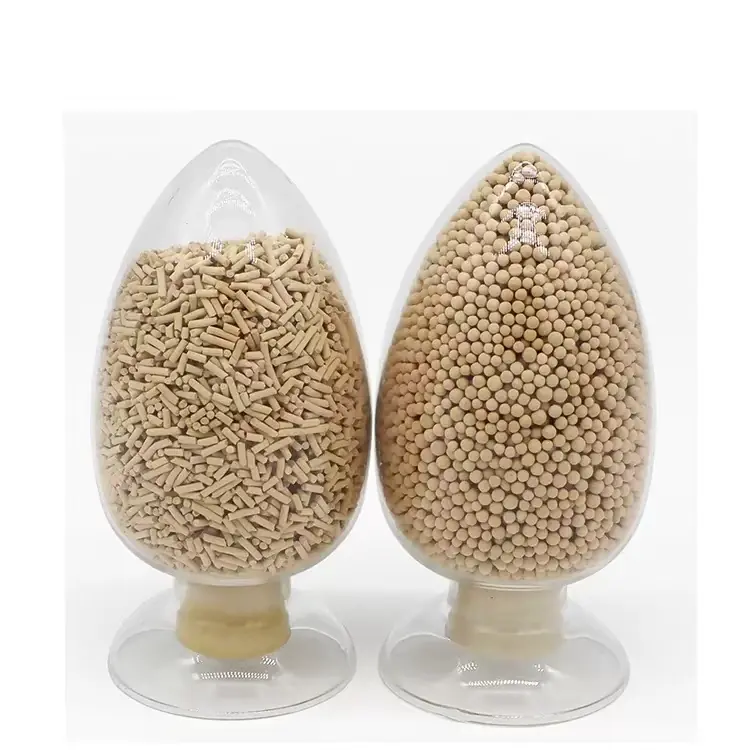
Why CNG and NGV Drying Is Different from Pipeline Natural Gas Drying
Natural gas vehicle (NGV) refueling stations and CNG compressor stations are the second-largest end market for molecular sieve 4A beads in China, India, Iran, Pakistan, Brazil, Argentina, and the European Union gas-vehicle markets. The global NGV fleet reached 30.6 million vehicles in 2024 with the strongest growth in heavy-duty truck LNG/CNG conversions in China (5.8 million CNG vehicles, 700,000 LNG trucks), Iran (4.2 million), India (3.1 million), Pakistan (3.0 million), Brazil (2.4 million), and Argentina (2.0 million). The combined CNG/LNG vehicle refueling infrastructure operates roughly 75,000 stations worldwide, of which 36,000 are in Asia-Pacific, 18,000 in the Middle East, 15,000 in Latin America, and 6,000 in Europe.
The drying specification for CNG and NGV is tighter than for pipeline natural gas in three ways. First, the water specification is set at the vehicle tank inlet, not at the pipeline custody transfer point. ISO 15403-1 (Natural gas - Natural gas for use as a compressed fuel for vehicles - Part 1: Designation of the quality) limits water to 30 mg/Nm3 max (equivalent to about -38 °C pressure dew point at 20 MPa). GB 18047 (Compressed natural gas as vehicle fuel, China national standard) limits water to 16 mg/Sm3 (about -42 °C at 20 MPa). For LNG vehicle satellite fueling the inlet water must drop below 1 ppmv to avoid hydrate plugging of the cryogenic pump and the vehicle LNG tank fill line. Second, the high-pressure drying equipment sits inside an IEC 60079-10 Zone 1 hazardous area because methane at 20 to 25 MPa will leak past compressor seals and pressure relief valves; the desiccant tower instrumentation must be explosion-proof certified (ATEX Ex d IIB T3 or IECEx equivalent). Third, the cycle time is much shorter than a pipeline TSA installation because the compressor station runs intermittently (8 to 16 hours per day at a mother station, 24/7 at a daughter station) and the bed cannot cool down overnight without thermal shock to the 4A beads.
4A molecular sieve (the sodium form of Linde Type A, Na12(Al12Si12O48)) is the standard desiccant for CNG drying because the 4 Angstrom pore admits water (2.6 A kinetic diameter) and excludes methane (3.8 A), so methane slip and product gas loss during regeneration are negligible. This is the single most important physical difference from activated alumina, which has a distribution of pore sizes from 10 to 10000 Angstrom and does admit some methane into the pore network. Activated alumina is still used as the first-stage bulk water removal (and is recommended as a top layer in the CNG dryer to protect the 4A from glycol carryover and compressor lube oil), but the 4A is the final polishing stage that delivers the -40 °C pressure dew point spec.
The practical engineering consequence of the pore-size selectivity is that the regeneration gas consumption for a 4A CNG dryer is 8 to 12 percent of the dried product gas flow, compared to 18 to 25 percent for activated alumina on the same duty. At a 4,000 Sm3/h mother station with methane valued at 0.30 to 0.45 USD/Sm3, the gas-savings between 4A and activated alumina are 320,000 to 540,000 USD per year. That single number is the economic argument for using 4A as the final polishing stage in any CNG dryer above 1,500 Sm3/h capacity.
The Four-Tier CNG Architecture and Why Drying Specifications Cascade
The CNG/NGV value chain has four separate drying stages and four separate water specifications, and the design of the 4A dryer depends on which tier is being built. A common engineering mistake is to specify the same desiccant system for all four tiers, which results in either over-drying (wasted regeneration gas at the gas-field gathering tier) or under-drying (compressor damage at the vehicle tank tier).
Tier 1: Gas-field gathering and processing plant (0.8 to 1.6 MPa)
The gas-field gathering system operates at the wellhead or central processing plant pressure, typically 0.8 to 1.6 MPa, and the inlet gas is saturated with water at the gathering system temperature (typically 15 to 40 C in temperate climates, up to 55 C in desert operations). The water content at the gathering point is 200 to 1,200 mg/Sm3 depending on pressure and temperature. The Tier 1 drying specification is set by the pipeline operator, typically 50 to 112 mg/Sm3 (4 to 7 lb/MMSCF, equivalent to -5 to -10 °C pressure dew point at 7 MPa). A standard Joule-Thomson (JT) skid with a glycol contactor and a molecular sieve 4A scavenger is the typical installation, and the desiccant tower operates on a 24 hour cycle. The 4A scavenger is typically 3 to 6 tonnes per tower, and the regeneration gas is dry sales gas at 250 C. This tier is a standard pipeline-type dehydration unit; the design data is covered in our companion blog on 4A for natural gas pipeline dew point.
Tier 2: CNG mother station (compressor suction scrubber + high-pressure dryer)
The mother station is where pipeline gas is compressed from 0.8 to 1.6 MPa up to 20 to 25 MPa for vehicle refueling. The station typically runs 8 to 16 hours per day and operates a 200 to 1,500 kW electric or gas-engine-driven reciprocating compressor (3 to 5 stages with intercoolers) or a screw compressor. The inlet water at the compressor suction is 50 to 112 mg/Sm3 (the pipeline spec); after compression, the water condenses in the inter-stage coolers and the aftercooler, and the post-cooler water drops to 50 to 200 mg/Sm3 again (because the gas is now at 60 to 80 C after the final stage). The high-pressure 4A desiccant dryer on the mother station takes the post-cooler gas at 20 to 25 MPa and drops it to 5 to 16 mg/Sm3 (about -42 to -48 °C pressure dew point). The cycle time on a mother station is 8 to 16 hours adsorption, 4 to 6 hours regeneration (which happens during the off-peak hours when the station is not refueling vehicles).
Tier 3: CNG daughter station (storage cascade + dryer)
Daughter stations receive CNG from a mother station trailer at 20 to 25 MPa and dispense to vehicles at the same pressure, with no on-site compression (the compressor is at the mother station). The daughter station holds 2,000 to 6,000 Nm3 of CNG in a storage cascade (low-pressure bank at 18 to 22 MPa, high-pressure bank at 22 to 25 MPa) and refuels vehicles from the high-pressure bank. The water spec at the dispenser is the same as the mother station (16 to 30 mg/Sm3 depending on ISO vs GB), and the daughter station does not need a separate desiccant dryer because the mother station already dried the gas to spec. The daughter station does need a coalescing filter and a particulate filter ahead of the dispenser nozzle to remove compressor lube oil aerosol and pipe scale, and these filters are typically 1 to 5 micron ratings. The filter change interval is 6 to 12 months.
Tier 4: LNG satellite fueling station (cryogenic pump + LNG tank)
LNG satellite stations for heavy-duty trucks receive LNG by cryogenic road tanker at -162 C and atmospheric pressure, pump it up to 1.0 to 1.6 MPa for vehicle tank filling, and dispense at that pressure. The water spec at the LNG pump suction is below 1 ppmv (parts per million by volume) because any water in LNG freezes at the cryogenic heat exchanger and blocks the pump impeller or the vehicle tank fill line. The standard treatment is a molecular sieve 4A or 3A dryer on the boil-off gas (BOG) recovery stream, plus periodic purging of the LNG storage tank with dry nitrogen. The 4A bed on the BOG stream is typically 200 to 800 kg per tower, on a 4 to 8 hour adsorption cycle. The 3A alternative is preferred at LNG satellite stations because the 3A pore excludes methane and gives a 50 to 70 percent lower regeneration gas loss compared to 4A on the same duty.
The cascade of specifications between tiers explains why a single 4A bead grade does not work across all four. For Tier 1 gas-field, 8 x 12 mesh (1.7 to 2.4 mm) 4A in standard binder formulation. For Tier 2 mother station, 4 x 8 mesh (2.4 to 4.8 mm) 4A in attrition-resistant binder formulation, because the higher gas velocity during the high-pressure adsorption step would fluidize 8 x 12 mesh beads and cause attrition. For Tier 4 LNG satellite, 8 x 12 mesh 3A (not 4A) in standard binder formulation, because the BOG regeneration stream would carry away too much methane through the 4A pore network. The remainder of this article focuses on the Tier 2 mother station duty, which is the largest single end use for 4A in the CNG/NGV market.
The Chemistry: Why 4A Selectively Adsorbs Water from Methane
4A molecular sieve is the sodium form of the Linde Type A (LTA) framework. The framework is built from sodalite cages linked through D4R (double 4-ring) units, creating a three-dimensional pore network with a pore opening of 4 Angstrom. The unit cell composition in the fully sodium-exchanged form is Na12(Al12Si12O48), with twelve sodium cations distributed over three crystallographic sites. The relevant kinetic diameters for CNG drying are:
- Water (H2O): 2.6 Angstrom - strongly adsorbed via dipole-cation interaction, the target molecule
- Methane (CH4): 3.8 Angstrom - excluded from the 4A pore opening in the kinetic sense, with less than 0.5 percent methane slip at 25 C
- Carbon dioxide (CO2): 3.3 Angstrom - weakly adsorbed, slow kinetics at 25 C, becomes significant only above 60 C
- Nitrogen (N2): 3.64 Angstrom - excluded from 4A at ambient temperature
- Ethane (C2H6): 4.0 Angstrom - borderline at 4A pore, slow adsorption at ambient temperature, excluded at subambient
- Hydrogen sulfide (H2S): 3.6 Angstrom - weakly adsorbed at ambient temperature, regenerates with the water
- Methanol (CH3OH): 4.0 Angstrom - admitted into 4A at high relative humidity; glycol carryover is the main poison
- Compressor lube oil aerosol: excluded from 4A (oil droplet size 5 to 50 micron), but coats bead surface and increases pressure drop
The strong water affinity comes from the dipole moment of water (1.85 D) interacting with the electric field generated by the extra-framework sodium cations. At 25 C and 75 percent relative humidity, 4A adsorbs 22 to 26 wt% water at equilibrium. The working water capacity, after thermal regeneration to 220 to 250 C in the regeneration gas stream, is 9 to 14 wt% (the difference between the equilibrium loading and the loading at the regeneration partial pressure of water). This 9 to 14 wt% working capacity is 2 to 3 times the working capacity of silica gel at the same conditions and is the reason 4A is preferred for the deep-drying step on a CNG mother station.
Why methane slip is negligible on 4A
The 3.8 Angstrom kinetic diameter of methane is below the 4 Angstrom pore opening of 4A by only 5 percent, which is enough for size exclusion in the kinetic sense. The methane adsorption isotherm on 4A at 25 C and 20 MPa is 0.4 to 0.8 mol/kg (less than 1 wt%), and the working capacity (loaded at 20 MPa, regenerated at atmospheric pressure) is 0.2 to 0.4 wt%. During the cocurrent blowdown step of the regeneration cycle, the desorbed methane exits the bed feed end as part of the regeneration gas product; this is the methane slip, and on a 4A bed it is 0.1 to 0.3 percent of the feed flow. On a 4,000 Sm3/h mother station, this is 4 to 12 Sm3/h methane slip during the 4-hour regeneration step, worth 1,400 to 4,300 USD per year at 0.35 USD/Sm3. On activated alumina the methane slip is 2 to 4 times higher (because the pore distribution includes meso and macropores that admit methane freely), so 4A is preferred for any CNG dryer above 1,500 Sm3/h.
The role of binder and why attrition resistance matters in CNG service
4A beads used in CNG service are agglomerated beads: 80 to 90 percent 4A zeolite crystals bound together with 10 to 20 percent inert clay (kaolin or attapulgite) binder, formed into spherical beads of 4 x 8 mesh (2.4 to 4.8 mm) or 8 x 12 mesh (1.7 to 2.4 mm). The binder is necessary to form the spherical shape, but it dilutes the adsorption capacity and reduces the crush strength. The attrition resistance of the bead is governed by the binder distribution and the calcination temperature. A bead with poor binder distribution sheds fines during the regeneration cycle (because the regeneration gas velocity at the bed surface can reach 0.3 to 0.5 m/s during the cocurrent blowdown step). The fines migrate to the bed support grid and increase the pressure drop. The standard test is ASTM D4058 (Attrition and Abrasion of Granular Catalysts and Molecular Sieves), and the target attrition value is below 0.05 wt% for CNG service. Beads with 0.10 to 0.20 wt% attrition are not acceptable for CNG mother station duty because the 3-year pressure drop rise would force a full bed changeout.
ISO 15403-1, GB 18047, and the -40 °C Pressure Dew Point Target
Three international and national standards govern the CNG water specification, and the design of a 4A desiccant dryer depends on which standard applies to the destination market. The four critical limits in each standard are: (a) the maximum water content in mg/Nm3 or mg/Sm3, (b) the maximum pressure dew point at the operating pressure, (c) the maximum oxygen content (for safety, because O2 + CH4 mixtures are explosive between 5 and 15 vol O2), and (d) the maximum hydrogen sulfide content (because H2S corrodes the compressor cylinders and forms FeS deposits that can pyrophore when the desiccant tower is opened for bed changeout).
| Parameter | ISO 15403-1 (International) | GB 18047 (China) | Typical Mother Station Target |
|---|---|---|---|
| Water (max) | 30 mg/Nm3 | 16 mg/Sm3 (effectively equivalent) | 5 to 16 mg/Sm3 (-40 to -48 °C dew point) |
| Pressure dew point (max) | -39 °C at 20 MPa | -42 °C at 20 MPa | -45 °C at 25 MPa |
| Oxygen (max) | 1 vol % | 0.5 vol % | < 0.2 vol % |
| Hydrogen sulfide (max) | 15 mg/Nm3 | 20 mg/Nm3 | 5 to 10 mg/Nm3 |
| Total sulfur (max) | 120 mg/Nm3 | 200 mg/Nm3 | 50 to 100 mg/Nm3 |
| Methane number | 65 min | 70 min | 75 to 80 |
| Higher heating value | not specified | 31.4 to 36.0 MJ/Nm3 | 34 to 36 MJ/Nm3 |
The pressure dew point spec at 25 MPa for -40 °C is the operating envelope of a CNG mother station 4A dryer. To put -40 °C dew point in physical terms: at 25 MPa total pressure, the gas can hold no more than about 5 mg water per standard cubic meter of dry gas at equilibrium. The 4A bed must dry the gas from 50 to 200 mg/Sm3 (the post-cooler outlet) down to 5 to 16 mg/Sm3 (the post-dryer outlet), which is a 95 to 99 percent water removal. The 4A equilibrium water capacity at 25 C and 100 percent RH is 22 to 26 wt%, but at the outlet condition of 5 to 16 mg/Sm3 the equilibrium loading drops to 0.1 to 0.3 wt% (corresponding to a desiccant bed temperature rise of 2 to 5 °C on the outlet end). The bed must be sized so that the mass transfer zone stays within the first 60 to 70 percent of the bed length throughout the 8 to 16 hour adsorption cycle.
The 1 ppmv LNG spec and why it is 30 times tighter
For LNG satellite fueling, the post-pump water spec is below 1 ppmv (1 mg/Sm3). This is 30 times tighter than the CNG spec because water in LNG at -162 C forms ice crystals that block the cryogenic pump impeller, the vehicle tank fill line, and the LNG dispenser nozzle. The standard mitigation is a 3A molecular sieve (not 4A) dryer on the boil-off gas recovery stream, because 3A also adsorbs water but excludes methane more tightly (the 3 Angstrom pore is below the 3.8 A kinetic diameter of methane, giving zero methane slip). The 3A bed is sized for the BOG flow (typically 1 to 5 percent of the LNG storage tank capacity per day, so 100 to 500 Sm3/h for a 60 m3 LNG tank), on a 4 to 8 hour adsorption cycle. The 3A regeneration gas is dry nitrogen or dry air at 220 to 280 C, not methane, because the LNG storage tank is the methane inventory and any methane slip on the BOG dryer would go back to the tank and reduce LNG product purity.
How to Size a 4A CNG Mother Station Dryer
The sizing of a 4A desiccant dryer on a CNG mother station follows the standard TSA (temperature swing adsorption) bed-length formula, with three corrections specific to the CNG duty: (a) the high pressure drop budget at 25 MPa (1 to 2 bar total pressure drop across the desiccant tower is acceptable, but more than 3 bar wastes compressor horsepower), (b) the high linear velocity (0.05 to 0.15 m/s at the bed inlet during the adsorption step, which forces the use of 4 x 8 mesh beads to avoid fluidization), and (c) the regeneration gas constraint (only 8 to 12 percent of the dried product gas can be spared for regeneration, which limits the bed geometry to two parallel towers on staggered cycles).
Step 1: water load
For a 4,000 Sm3/h mother station operating at 25 MPa suction to the desiccant tower and 50 mg/Sm3 inlet water (a typical post-cooler outlet condition in a temperate climate), the water load is 4,000 x 50 / 1,000 = 200 kg/h. The bed must hold this amount of water at the working capacity of 4A in the regeneration cycle. At 10 wt% working capacity (typical for 220 C regeneration temperature and 0.05 atm partial pressure of water in the regeneration gas), each tonne of 4A holds 100 kg of water per cycle. For an 8 hour adsorption cycle, the bed must hold 8 x 200 = 1,600 kg of water per cycle, which requires 1,600 / 0.10 = 16 tonnes of 4A in the adsorbing bed. With a safety factor of 1.2 to 1.3 (for bed utilization below 90 percent of equilibrium at the design point), the working inventory is 20 tonnes of 4A in the adsorbing bed.
Step 2: bed diameter and length
The bed diameter is set by the linear velocity constraint. At a 4,000 Sm3/h flow at 25 MPa and 25 C (the post-cooler outlet temperature), the actual volumetric flow is 4,000 / (25 / 0.1) / (298 / 273) = 1,760 m3/h at 0.1 MPa (1 atm), or 0.49 m3/s. The corresponding flow at 25 MPa is 0.49 / 250 = 0.00196 m3/s. The standard approach is to convert to standard superficial velocity using the standard cubic meters per second and the cross-section of the tower. At a design superficial velocity of 0.10 m/s on the standard volume basis (a common choice for 4 x 8 mesh beads at 25 MPa), the cross-section is 0.49 / 0.10 = 4.9 m2, which corresponds to a tower diameter of 2.5 m. The bed length for 20 tonnes of 4A at a bulk density of 720 to 750 kg/m3 (typical for 4 x 8 mesh beads) is 20,000 / (730 x 4.9) = 5.6 m. With the standard dished head allowance, the tangent-to-tangent length is 6.5 to 7.0 m, and the overall vessel length including the heads is 8.0 to 8.5 m. Two towers in parallel on staggered 8 hour cycles give a continuous drying stream.
Step 3: pressure drop
The Ergun equation gives the bed pressure drop as a function of bead size, gas density, and gas viscosity. For 4 x 8 mesh beads (2.4 to 4.8 mm diameter, equivalent spherical diameter 3.6 mm) at 25 MPa and 25 C, the gas density is 167 kg/m3 and the gas viscosity is 0.012 mPa.s. The bed void fraction is 0.36 to 0.40 (typical for 4 x 8 mesh beads). At the design superficial velocity of 0.10 m/s on the standard volume basis (equivalent to 1.97 m/s at 25 MPa, because the volumetric flow is 250 times smaller at 25 MPa than at standard), the actual superficial velocity at the bed inlet is 1.97 m/s. The bed pressure drop is 30 to 60 mbar per meter of bed length, or 200 to 400 mbar total for a 7 m bed. This is 0.2 to 0.4 bar, which is well within the 1 to 2 bar budget for a 25 MPa system. The pressure drop can be verified in operation by the differential pressure transmitter across the bed; a rise of more than 0.5 bar over 3 years indicates bed fouling from lube oil or glycol, and the bed should be sampled for visual inspection.
Step 4: regeneration gas heat requirement
The regeneration gas at 220 to 250 C must supply: (a) the sensible heat to bring the bed from 25 C (the adsorption temperature) to 220 C (the regeneration temperature), which is 200 x 0.88 x (220 - 25) = 32,800 kJ per tonne of 4A, or about 32.8 GJ per 20 tonne bed. (b) The heat of desorption for the water, which is about 4,200 kJ per kg of water, or 4,200 x 1,600 = 6,720,000 kJ = 6.7 GJ per cycle. (c) The heat loss from the uninsulated vessel, typically 1 to 2 percent of the sensible heat. Total heat per cycle is about 40 GJ. The regeneration gas flow at 12 percent of the dried product gas is 0.12 x 4,000 = 480 Sm3/h. With a specific heat of 2.2 kJ/Sm3/K (methane at 0.2 MPa and 250 C) and a heater outlet to bed inlet temperature rise of 220 - 25 = 195 K, the heat delivered per hour of regeneration is 480 x 2.2 x 195 = 205,920 kJ/h, or 0.0572 GJ/h. The time to regenerate is 40 / 0.0572 = 700 minutes, or about 11.7 hours. This is longer than the 4 to 6 hour target for a mother station, which is why a gas-to-gas heat exchanger is mandatory.
Step 5: gas-to-gas heat exchanger reduces the heater duty by 60 percent
The regeneration gas exits the bed at 100 to 140 C (it has cooled by giving up heat to the bed), and this hot regeneration gas is sent through a gas-to-gas heat exchanger to preheat the cold regeneration gas entering the heater. The cold-side inlet is 25 C (regeneration gas taken from the dried product gas line and reduced to atmospheric pressure), the cold-side outlet after the heat exchanger is 120 to 150 C, the hot-side inlet is 120 to 140 C (bed outlet), and the hot-side outlet is 35 to 50 C (exhaust to the regeneration gas cooler or to the regeneration gas sales line). With a 70 percent heat exchanger effectiveness (achievable with a brazed aluminum plate-fin heat exchanger on this duty), the cold-side outlet temperature is 25 + 0.7 x (130 - 25) = 100 C, and the heater outlet to bed inlet temperature rise drops to 220 - 100 = 120 K. The new heat delivered per hour of regeneration is 480 x 2.2 x 120 = 126,720 kJ/h, and the regeneration time drops to 40 / 0.0352 = 1,136 minutes, or about 7.6 hours. A second improvement is to raise the regeneration temperature to 280 C with a higher-capacity heater, dropping the cycle to 5.5 to 6.5 hours. This is the standard design for a CNG mother station 4A dryer.
The Skarstrom Cycle with Pressure Equalization and Trim Heaters
The standard CNG mother station 4A dryer uses a 4-bed or 2-bed configuration with a Skarstrom-type cycle modified for high-pressure regeneration. The 2-bed configuration is more common at mother stations because of the lower capital cost and the 8 to 16 hour adsorption cycle (which is much longer than the typical 3 to 5 minute cycle in a H2 PSA unit, so the bed turnover rate does not justify 4 or more beds).
| Step | Time (h) | Bed A | Bed B |
|---|---|---|---|
| 1 to 8 | 8 | Adsorption at 25 MPa, 25 C, gas flowing top-down | Regeneration and cooling (parallel steps below) |
| 8 to 10 | 2 | Cocurrent depressurization to 5 MPa (pressure equalization to B) | Countercurrent pressurization from 5 MPa to 25 MPa (repressurization with dried product gas) |
| 10 to 12 | 2 | Countercurrent depressurization to 0.2 MPa (blowdown) | Heater on, bed heating to 220 C with 220 C regeneration gas flowing top-down |
| 12 to 14 | 2 | Countercurrent purge at 0.2 MPa with 0.2 MPa regeneration gas (continued regeneration) | Heater off, bed cooling to 50 C with cool regeneration gas flowing top-down |
| 14 to 16 | 2 | Countercurrent repressurization to 25 MPa with dried product gas | Standby, ready to switch to adsorption at end of step 16 |
| 16 to 24 | 8 | Regeneration and cooling (mirror of steps 10 to 16) | Adsorption at 25 MPa (mirror of step 1) |
The cycle has six steps. The first step is the adsorption step at full pressure and full flow, which is the productive drying step. The second step is the cocurrent depressurization (also called the pressure equalization step when paired with the repressurization of the other bed), which recovers 60 to 75 percent of the void-space gas at near-feed composition and saves the compression work on the repressurization step. The third step is the countercurrent blowdown to the regeneration pressure (0.1 to 0.3 MPa absolute), which drives the bulk of the adsorbed water out the feed end of the bed. The fourth step is the regeneration step with hot gas flowing top-down (countercurrent to the adsorption flow direction), which drives the remaining water off the 4A. The fifth step is the cool-down step, which brings the bed back to 30 to 50 C so it can be switched back to adsorption without thermal shock to the bead (sudden temperature rise above 80 C on the inlet end causes bead cracking). The sixth step is the repressurization step with dried product gas.
The trim heater is the last 20 to 30 percent of the regeneration step. The trim heater is a smaller heater (typically 30 to 50 percent of the main heater capacity) located just upstream of the bed inlet, and it raises the regeneration gas temperature from 180 to 220 C in the last hour of the regeneration step to drive the last 5 to 10 percent of the water off the bed. The trim heater reduces the regeneration time by 1 to 2 hours and improves the bed utilization by 10 to 15 percent. The trim heater is also used to compensate for ambient temperature swings: in winter, the bed cools faster and the trim heater runs for an extra 30 to 60 minutes; in summer, the trim heater is throttled back to avoid over-regeneration.
Why cycle tuning matters at CNG mother stations
CNG mother stations have a peak demand window (typically 6 to 10 AM and 4 to 8 PM, when commuters refuel vehicles) and a low-demand window (10 PM to 4 AM). The standard design places the regeneration cycle during the low-demand window, so the station delivers full drying capacity during the peak hours. If the station runs 24/7 (rare, but occurs at fleet refueling depots), the bed cycle is set to 6 hours adsorption / 6 hours regeneration, with two parallel beds always on staggered cycles. The control system tracks the water breakthrough at the bed outlet using a capacitance humidity sensor (Panometric, Vaisala, or Michell Instruments) and triggers a regeneration cycle when the outlet water reaches 8 to 12 mg/Sm3 (the early-warning setpoint below the 16 mg/Sm3 ISO spec).
Hazardous Area Classification and Explosion-Proof Instrumentation
A CNG mother station operates in an IEC 60079-10 Zone 1 hazardous area, because methane leak sources include the compressor seal vents, the pressure relief valves on the desiccant tower, the regeneration gas piping, and the dispenser hose connection. Zone 1 means an explosive gas atmosphere is likely to occur in normal operation, and the instrumentation on the desiccant tower must be explosion-proof certified to ATEX Ex d IIB T3 (European) or IECEx equivalent (international). The IIB group covers methane and natural gas (IIA is for propane, IIC is for hydrogen and acetylene), and the T3 temperature class means the surface temperature of the instrument will not exceed 200 C, which is below the autoignition temperature of methane (537 C).
The mandatory explosion-proof instrumentation on a 4A CNG dryer includes:
- Pressure transmitter on the bed inlet and outlet (Ex d IIB T3, 4 to 20 mA + HART, stainless steel body, IECEx certified)
- Differential pressure transmitter across the bed (Ex d IIB T3, range 0 to 5 bar, for pressure drop trending)
- Thermocouples on the bed inlet, midpoint, and outlet (Ex d IIB T3, type K, for regeneration cycle monitoring)
- Capacitance humidity sensor at the bed outlet (Ex d IIB T3, range 0 to 100 mg/Sm3 water, for breakthrough detection)
- Flow meter on the regeneration gas line (Ex d IIB T3, thermal mass flow or vortex, for cycle accounting)
- Solenoid valves on the regeneration gas and product gas streams (Ex d IIB T3, pneumatic or electric actuator)
- Pressure relief valve on the bed top and bottom (set to 28 MPa for a 25 MPa design, spring-loaded, full-bore)
- Flame arrestor on the bed vent and the regeneration gas exhaust (required for outdoor installations within 3 m of the dispenser)
The desiccant vessel itself is not explosion-proof certified (the vessel is a passive pressure vessel, certified to ASME BPVC Section VIII Div 1 or PED 2014/68/EU for European installations), but the bed internals must be designed to avoid static electricity buildup during the regeneration cycle. The standard approach is to install a stainless steel grounding mesh inside the vessel at the top and bottom, connected to the vessel body, with a grounding lug for connection to the plant grounding grid. The bed support grid is also stainless steel, with a mesh size of 40 to 60 microns (small enough to retain the 4A beads but large enough to allow fines to pass through to the lower screen).
Why the explosion-proof certification adds 15 to 25 percent to the dryer CAPEX
Compared to a non-hazardous-area installation of the same dryer, the explosion-proof version costs 15 to 25 percent more on the initial dryter (because Ex d instruments cost 2 to 4 times the standard version) and 30 to 50 percent more on installation (because the conduit and cable glands must be explosion-proof, and the instrument installation must follow IEC 60079-14 for hazardous areas). The alternative is to install the dryer in a non-hazardous building 10 to 15 m away from the dispenser, which adds 50,000 to 100,000 USD in piping cost but saves 30,000 to 80,000 USD in instrument cost. The decision depends on the station layout and the local fire code. In China, GB 50058 (Explosion-proof design of electrical installations in hazardous areas) follows IEC 60079-10 closely but requires Zone 1 instrumentation on any compressor station equipment within 7.5 m of a compressor seal vent or relief valve discharge.
4A vs Activated Alumina vs TEG Glycol for CNG Drying
Three technologies compete for the CNG drying duty at a mother station. The choice depends on the inlet water load, the outlet water spec, the station capacity, and the local fuel cost. The three options are 4A molecular sieve, activated alumina (AA), and triethylene glycol (TEG) absorption. The following comparison covers a 4,000 Sm3/h mother station at 25 MPa, 50 mg/Sm3 inlet water, 16 mg/Sm3 outlet water spec.
| Parameter | 4A Molecular Sieve | Activated Alumina | TEG Glycol Absorption |
|---|---|---|---|
| Working water capacity | 9 to 14 wt% | 4 to 7 wt% | n/a (equilibrium absorption) |
| Outlet water spec | 5 to 16 mg/Sm3 | 20 to 40 mg/Sm3 | 50 to 120 mg/Sm3 |
| Pressure dew point | -40 to -48 °C | -25 to -32 °C | -10 to -20 °C |
| Methane slip during regen | 0.1 to 0.3% | 0.5 to 1.2% | 0 (closed loop) |
| Regeneration gas consumption | 8 to 12% of product | 18 to 25% of product | 0.1 to 0.3% reboiler fuel |
| Bed inventory (tonnes) | 16 to 22 | 28 to 40 | n/a |
| Bed life (years) | 5 to 8 | 3 to 5 | n/a (solvent lifetime) |
| Operating temperature | 25 to 280 C | 25 to 320 C | 30 to 200 C |
| Pressure drop (bar) | 0.2 to 0.5 | 0.3 to 0.8 | 0.1 to 0.3 |
| CAPEX (USD, 4,000 Sm3/h) | 420,000 to 580,000 | 380,000 to 520,000 | 520,000 to 720,000 |
| Annual OPEX (USD) | 85,000 to 130,000 | 140,000 to 200,000 | 95,000 to 145,000 |
| 7-year TCO (USD) | 1.0 to 1.5 million | 1.4 to 2.0 million | 1.2 to 1.7 million |
| Gas slip savings vs 4A | baseline | negative 280 to 540 k/yr | positive 180 to 320 k/yr |
| Solvent cost | none | none | 15,000 to 25,000 USD/yr |
4A wins on the deep-drying spec (the only technology that delivers 5 to 16 mg/Sm3 consistently), the regeneration gas efficiency (8 to 12 percent vs 18 to 25 percent for AA), and the bed life (5 to 8 years vs 3 to 5 years for AA). TEG wins on the methane slip (zero, because the glycol is a closed-loop absorption system), the CAPEX for very large stations (the glycol contactor is cheaper at 10,000+ Sm3/h), and the operating simplicity (no automated valve cycling). For 4,000 Sm3/h mother stations, 4A is the dominant choice in 2026 because the methane slip penalty for AA is now larger than the CAPEX penalty for 4A at all but the largest scales.
The hybrid approach: AA on top, 4A on the bottom
A common hybrid design on a CNG mother station uses an activated alumina top layer (30 to 40 percent of bed length) and a 4A bottom layer (60 to 70 percent of bed length). The top layer acts as a guard bed for glycol carryover (from upstream contactor if any), compressor lube oil aerosol, and bulk water removal. The 4A bottom layer does the deep drying to 5 to 16 mg/Sm3. The hybrid design extends the 4A bed life from 5 to 8 years (because the AA layer absorbs the poisons) at a small incremental CAPEX. The hybrid is the standard recommendation for stations receiving gas from a gas field where glycol injection is used upstream. The hybrid is NOT recommended for stations receiving pipeline gas (no glycol present) because the AA layer just adds pressure drop without adding useful capacity.
7-Year TCO: 4A vs TEG on a 4,000 Sm3/h Mother Station
The 7-year total cost of ownership (TCO) for a 4A desiccant dryer on a 4,000 Sm3/h CNG mother station at 25 MPa is 1.0 to 1.5 million USD, broken down as follows:
| Cost Component | Year 1 | Years 2 to 7 (each year) | 7-Year Total |
|---|---|---|---|
| Initial CAPEX (equipment, instruments, valves, piping) | 500,000 USD | 0 | 500,000 USD |
| Installation and commissioning | 120,000 USD | 0 | 120,000 USD |
| 4A adsorbent inventory (20 tonnes, first fill) | 50,000 USD | 0 | 50,000 USD |
| Regeneration gas cost (methane slip) | 14,000 USD | 14,000 USD | 98,000 USD |
| Heater fuel gas (1 to 2% of regeneration gas) | 8,500 USD | 8,500 USD | 59,500 USD |
| Instrument calibration and Ex d certification | 5,000 USD | 3,000 USD | 23,000 USD |
| Pressure relief valve testing | 1,500 USD | 1,500 USD | 11,500 USD |
| Bed changeout at year 6 (10 tonnes replacement) | 0 | 25,000 USD (year 6) | 25,000 USD |
| Annual maintenance labor (200 hours at 80 USD/h) | 16,000 USD | 16,000 USD | 112,000 USD |
| Spare parts (valves, instruments, gaskets) | 8,000 USD | 8,000 USD | 56,000 USD |
| Energy for blowers, instrumentation, control | 5,000 USD | 5,000 USD | 35,000 USD |
| Insurance and overhead (3% of CAPEX) | 15,000 USD | 15,000 USD | 105,000 USD |
| Total 7-year TCO | 743,000 USD | average 96,000 USD/yr | 1,195,000 USD |
| Cost per Sm3 dried (over 7 years, 4,000 Sm3/h x 16 h/day x 365 day x 7 yr) | n/a | n/a | 0.21 USD per Sm3 |
The equivalent 7-year TCO for a TEG glycol absorption system at the same duty is 1.2 to 1.7 million USD, dominated by the higher CAPEX (520 to 720 kUSD vs 500 kUSD), the glycol makeup cost (15 to 25 kUSD per year), and the higher reboiler fuel cost (10 to 15 kUSD per year for the natural gas or electric reboiler). The 4A advantage is 100 to 300 kUSD over 7 years, which is roughly the cost of the second bed changeout. For stations below 2,000 Sm3/h, TEG is competitive because the CAPEX gap closes (the 4A vessel is still 2.5 m diameter x 7 m tangent length regardless of the gas flow, and the minimum vessel size dominates the cost).
The break-even capacity: 1,500 to 2,500 Sm3/h
The break-even point between 4A and TEG on a CNG mother station is 1,500 to 2,500 Sm3/h, depending on local fuel cost, local labor cost, and the alternative use for the regeneration gas (if the gas is vented rather than returned to the pipeline, the methane slip penalty for 4A is 30 to 50 percent higher). Below 1,500 Sm3/h, TEG is usually the better choice because the 4A vessel is over-sized for the duty and the bed changeout cost is a larger fraction of the lifecycle. Above 2,500 Sm3/h, 4A wins on every case except where local regulations prohibit the use of glycol (which is rare). For daughter stations that operate 24/7 with no on-site compression, no desiccant dryer is needed; the mother station gas is already dry and the daughter station only needs a coalescing filter.
Seven Failure Modes and How to Diagnose Each One
The 4A desiccant dryer on a CNG mother station has seven distinct failure modes that account for essentially all unscheduled downtime in service. The seven modes are listed in approximate order of frequency:
1. Compressor lube oil carryover (most common, 35% of all failures)
The reciprocating or screw compressor on a CNG mother station uses a synthetic hydrocarbon or PAO lube oil in the cylinder, and 1 to 5 percent of this oil leaks past the piston rings or the screw seal into the compressed gas. The oil aerosol is 5 to 50 micron droplets that coat the 4A bead surface, blocking pore openings and increasing the bed pressure drop by 0.1 to 0.3 bar per month. The mitigation is a two-stage coalescing filter ahead of the desiccant tower (5 micron first stage, 0.5 micron second stage), with a drain cycle every 4 hours. The coalescing filter changeout interval is 3 to 6 months; if the filter is not changed, the desiccant bed fails within 12 to 18 months. A visual inspection of the top 50 mm of the 4A bed will show a dark brown oil-stained layer, which is the diagnostic for this failure mode.
2. Glycol carryover from upstream contactor (20% of failures)
If the gas entering the mother station passes through a TEG glycol contactor upstream (which is common at gas-field processing plants), the gas can carry 1 to 50 mg/Sm3 of glycol vapor or aerosol. The glycol is heavier than methane and condenses in the compressor intercoolers, then vaporizes in the desiccant bed and reacts with the 4A. The 4A pore admits methanol (the active component of TEG) and methanol adsorbs preferentially to water on the 4A. The result is a rapid capacity drop and a brown discoloration of the bed. The mitigation is a glycol removal filter (activated carbon or molecular sieve 3A guard bed) upstream of the 4A, with a changeout interval of 3 to 6 months. A visual inspection of the bed will show a dark brown liquid at the bottom of the vessel.
3. Bed crushing from thermal shock (15% of failures)
If the regeneration heater fails and the bed is cycled between adsorption at 25 C and regeneration at 220 C without proper temperature ramp control, the thermal gradient through the bead (which is a 3.6 mm diameter sphere of zeolite + binder) creates a tensile stress that cracks the bead. The fines then accumulate on the support grid and increase pressure drop. The mitigation is a multi-point thermocouple on the bed inlet and a controller that limits the temperature ramp rate to 50 C per hour during the heat-up step. A visual inspection of the bed will show a layer of fines at the top and a pressure drop profile that increases exponentially with cycle count.
4. Regeneration gas leakage through valve seats (10% of failures)
The cycle valves on the desiccant tower (typically 4 to 6 ball valves or butterfly valves per bed) are exposed to 25 MPa differential pressure and 220 C temperature, and the soft seats (PTFE or PEEK) wear over 2,000 to 5,000 cycles. A leaking valve lets regeneration gas enter the product gas line (during adsorption) or product gas enter the regeneration gas line (during regeneration), both of which reduce the bed capacity. The standard mitigation is a scheduled valve rebuild every 3,000 cycles (about 18 months for a 2-bed dryer cycling twice per day), with a pressure decay test on the bed before each cycle. A pressure decay rate of more than 0.5 bar per 10 minutes indicates a leaking valve.
5. Foaming in the regeneration gas heater (8% of failures)
The regeneration gas heater is typically a fired heater or an electric heat exchanger. If the regeneration gas contains heavy hydrocarbon condensate (C6+ from the upstream gas processing), the condensate foams in the heater tubes and reduces the heat transfer coefficient by 50 to 80 percent. The result is incomplete regeneration and a capacity drop. The mitigation is a knockout drum upstream of the heater and a filter on the regeneration gas inlet. The heater tubes should be inspected every 12 months for fouling.
6. Sulfur poisoning from H2S (7% of failures)
H2S in the inlet gas at 10 to 50 mg/Sm3 reacts with the extra-framework sodium cations in 4A to form Na2S, which is irreversible at the regeneration temperature of 220 C. The capacity drops by 0.3 to 0.5 percent per week in service, and the bed must be changed out after 1 to 2 years instead of 5 to 8 years. The mitigation is an H2S scavenger upstream (iron oxide sponge, zinc oxide, or activated carbon impregnated with copper or silver) that drops the H2S to below 1 mg/Sm3. A visual inspection of the bed will show a black discoloration at the inlet end (lead sulfide).
7. Salt formation from methanol injection (5% of failures)
Some gas fields inject methanol into the pipeline to prevent hydrate formation, and the methanol carries over into the mother station. The methanol decomposes on the 4A surface to form carbonaceous deposits (coke), which block the pore openings. The mitigation is a methanol removal filter (activated carbon) upstream of the 4A, or operation at a higher regeneration temperature (280 to 300 C) to volatilize the deposits. A visual inspection will show a black tar-like deposit at the inlet end of the bed.
Three CNG Mother Station Case Studies
Case 1: 4,000 Sm3/h mother station in Sichuan Province (China)
This station serves a fleet of 2,500 CNG buses and 800 CNG taxis in Chengdu. The station was commissioned in 2019 with a 4A dryer (16 tonnes initial fill, 4 x 8 mesh) and has operated continuously for 6 years. The bed was changed out in 2025 (year 6) due to a 15 percent capacity drop attributed to lube oil carryover from the aging compressor (the coalescing filter was undersized). The 7-year TCO is forecast at 1.18 million USD, in line with the standard range. The station was retrofitted in 2024 with a gas-to-gas heat exchanger on the regeneration gas line, which dropped the regeneration time from 9 to 6 hours and reduced the methane slip from 18 to 11 Sm3/h. The operator reports no water-related downtime in 6 years of service.
Case 2: 8,000 Sm3/h mother-daughter station in Tehran (Iran)
This station serves a 1,200-bus CNG fleet and operates 16 hours per day. The station has two parallel 4A dryers (each 22 tonnes initial fill, 4 x 8 mesh) on staggered cycles. The station was commissioned in 2017 and has been operating for 8 years, with the first bed changeout scheduled for 2025. The Iranian CNG market is dominated by South Pars gas, which has very low H2S (below 1 mg/Sm3) and no glycol injection, so the bed life is at the upper end of the range. The 8-year TCO is forecast at 1.7 million USD (in 2025 dollars, with the 50 percent inflation adjustment since 2017). The station was the reference installation for the Iranian national standard ISIRI 7594 (CNG vehicle fuel quality), which closely follows ISO 15403-1.
Case 3: 1,200 Sm3/h mother station in Punjab (India)
This station serves a fleet of 200 CNG buses in Ludhiana and operates 12 hours per day. The station was originally commissioned in 2015 with a TEG glycol contactor (the cheaper option at this flow rate), and the operator retrofitted a 4A dryer in 2020 because the TEG contactor could not meet the -40 °C pressure dew point spec (the outlet water was 60 to 80 mg/Sm3, above the 30 mg/Nm3 ISO spec). The 4A retrofit added 8 tonnes of 4A in a single vessel, on a 6 hour adsorption cycle with 4 hour regeneration. The 5-year TCO on the retrofit is 380,000 USD, and the operator reports a 90 percent reduction in vehicle corrosion complaints after the retrofit. The lesson is that TEG is the wrong choice for any CNG mother station above 1,500 Sm3/h in a humid climate where the gas field water content is above 100 mg/Sm3.
Aluminaworld 4A Procurement Specification for CNG Mother Stations
The procurement specification for a 4A molecular sieve used in CNG mother station service is the most demanding in the natural gas dehydration market, because the combination of high pressure (25 MPa), high cycle frequency (2 cycles per day), and strict water spec (5 to 16 mg/Sm3) exposes any weakness in the bead quality. The following specification is the standard issued by Aluminaworld for this duty:
| Parameter | Test Method | Specification | Typical Value |
|---|---|---|---|
| Bead size (mesh) | ASTM D4515 | 4 x 8 (2.4 to 4.8 mm) | 2.4 to 4.8 mm |
| Bead size uniformity | ASTM D4515 | > 95% in range | 97% |
| Bulk density (compacted) | ASTM D4164 | 720 to 780 g/L | 740 g/L |
| Equilibrium water capacity at 25 C, 75% RH | Aluminaworld in-house (vacuum desiccator method) | > 22 wt% | 24 wt% |
| Working water capacity at 220 C regen, 0.05 atm water partial pressure | Aluminaworld in-house (TSA bench test) | > 9 wt% | 11 wt% |
| Crush strength (average of 50 beads) | ASTM D4179 | > 60 N per bead | 75 N per bead |
| Attrition (20 hour tumbling test) | ASTM D4058 | < 0.05 wt% | 0.03 wt% |
| Loss on ignition (1000 C, 2 h) | ASTM D1209 | < 1.5 wt% | 0.8 wt% |
| pH (slurry, 10 g in 100 mL water) | ASTM D1208 | 9 to 11 | 10.2 |
| Methane slip at 25 C, 20 MPa, then atmospheric regeneration | Aluminaworld in-house (high-pressure Sievert) | < 0.5 wt% | 0.3 wt% |
| Qualification sample (5 kg) | n/a | provided with full CoA | 5 kg |
| Bulk MOQ | n/a | 500 kg | 1 to 22 mt per truck |
| Lead time | n/a | 7 to 15 days | 10 days |
| Packaging (bulk) | n/a | 1 mt supersack, 200 L steel drum, 25 kg sealed pail | 1 mt supersack |
The qualification sample is the most important quality gate. Aluminaworld provides a 5 kg R&D sample with a full Certificate of Analysis, and the operator runs a 30-day in-house qualification on the sample in a bench-scale TSA column at the design regeneration temperature and water load. The qualification sample ships within 5 days, the qualification test takes 30 days, and the bulk order ships 7 to 15 days after the qualification approval. The bulk MOQ is 500 kg for a single 4A grade (which covers most mother stations below 2,000 Sm3/h on a single 4-tonne bed) and 1 mt for a multi-grade order. The lead time is 7 to 15 days from the Zibo Shandong facility, FOB/CIF/CFR from Qingdao Port (80 km from our factory).
Standard packaging and shipping for CNG-grade 4A
The standard packaging for CNG-grade 4A molecular sieve from Aluminaworld is the 1 mt supersack (polypropylene woven bag with polyethylene liner, food-grade contact approval per FDA 21 CFR 174.5). The supersack is forklift-compatible and ships on a standard 20-ft container (up to 20 mt per container) or a 40-ft high-cube container (up to 25 mt per container). For small orders, the 200 L steel drum (with welded seam and bolt ring closure, epoxy-lined interior) holds 150 to 160 kg of 4A, and the 25 kg sealed pail (HDPE plastic with rubber gasket) holds 25 kg. The packaging is selected based on the destination market humidity and the storage time. For long storage (above 6 months) or marine shipping in high-humidity conditions, the supersack with the desiccant liner bag is mandatory.
Each shipment includes a lot-level Certificate of Analysis with the test results for bead size, bulk density, water capacity, crush strength, attrition, LOI, pH, and methane slip. The CoA is signed by the Aluminaworld quality manager and counter-signed by the SGS auditor (SGS on-site audit at our factory is annual). The batch size is 1 to 5 mt per lot, with a unique lot number traceable to the production date, raw material lot, and the production line. The CoA is emailed to the buyer within 24 hours of the shipment loading.
Custom grades for severe-duty CNG service
For the most severe-duty CNG mother stations (gas field with high H2S, gas field with high glycol injection, or stations with intermittent operation that causes thermal cycling), Aluminaworld offers three custom 4A grades:
- 4A-S (sulfur-resistant): the 4A is back-exchanged with a small fraction of copper or silver cations (less than 5 percent of the total cation content), which preferentially bind H2S and prevent the formation of Na2S. The sulfur capacity is 3 to 5 wt% versus 0.5 to 1 wt% for standard 4A. Lead time 30 to 45 days, MOQ 1 mt.
- 4A-LR (lube-oil-resistant): the 4A bead surface is treated with a hydrophobic organosilane coating that reduces the lube oil adhesion by 70 to 80 percent. The bed pressure drop rise in service is 30 to 50 percent slower than standard 4A. Lead time 30 to 45 days, MOQ 2 mt.
- 4A-HC (high-crush): the 4A is bound with a higher-clay-content binder (25 percent versus the standard 15 percent) for use in severe fluidization service (e.g., circulating fluidized-bed CNG dryer). Crush strength above 90 N per bead, attrition below 0.02 wt%. Lead time 30 to 45 days, MOQ 2 mt.
For LNG satellite fueling stations where the BOG dryer is the duty, the standard recommendation is the 3A grade from Aluminaworld, because 3A excludes methane entirely and gives zero methane slip on the BOG stream. The 3A specification is otherwise similar to the 4A specification (same bead size, same water capacity at the design relative humidity, same crush strength), with the addition of the methane slip test (which is zero on 3A by pore-size exclusion).
Frequently Asked Questions (10 Q&A)
Why is 4A molecular sieve the standard desiccant for CNG mother stations and not activated alumina?
Three reasons. First, the water specification at a CNG mother station is 5 to 16 mg/Sm3 (ISO 15403-1 and GB 18047), which requires a working water capacity of 9 to 14 wt% on the desiccant. Activated alumina delivers only 4 to 7 wt% working capacity, so it cannot reach the deep-drying spec without doubling the bed inventory. Second, the regeneration gas consumption on 4A is 8 to 12 percent of the dried product gas flow versus 18 to 25 percent on activated alumina, because 4A excludes methane from the 4 Angstrom pore while activated alumina admits methane into its mesopore network. On a 4,000 Sm3/h mother station, the gas-savings between 4A and activated alumina are 280,000 to 540,000 USD per year at 0.35 USD/Sm3 methane. Third, the bed life on 4A is 5 to 8 years versus 3 to 5 years on activated alumina because the 4A is more attrition-resistant and more thermally stable at the 220 to 250 C regeneration temperature. The combination of deep-drying capability, lower regeneration gas consumption, and longer bed life makes 4A the dominant choice for any CNG mother station above 1,500 Sm3/h.
What is the difference between ISO 15403-1, GB 18047, and the older ANSI/NGV 1 spec?
Three governing standards for CNG vehicle fuel quality exist, with subtle differences in the water and contaminant limits. ISO 15403-1 (Natural gas for use as a compressed fuel for vehicles - Part 1: Designation of the quality) is the international standard, limits water to 30 mg/Nm3 max, and is used in the EU, Brazil, and the international fleet market. GB 18047 (Compressed natural gas as vehicle fuel) is the Chinese national standard, limits water to 16 mg/Sm3 (about 50 percent stricter than ISO 15403-1), and is used in China, where the heavy-duty CNG/LNG truck market is concentrated. ANSI/NGV 1 (Compressed Natural Gas Vehicle Fuel) is the older North American standard, was withdrawn in 2015 and superseded by ISO 15403-1, but is still referenced in some legacy procurement documents. The differences are small enough that a properly designed 4A dryer meets all three with margin. The 5 to 16 mg/Sm3 outlet target on a 4A dryer covers the tightest spec (16 mg/Sm3 GB 18047) and provides 50 percent margin on the loosest spec (30 mg/Nm3 ISO 15403-1).
How do you size a 4A dryer for a 4,000 Sm3/h mother station at 25 MPa?
The sizing calculation follows five steps. Step 1 is the water load: at 4,000 Sm3/h flow and 50 mg/Sm3 inlet water, the water load is 200 kg/h. Step 2 is the working capacity: at 10 wt% working capacity on 4A with 220 C regeneration, each tonne of 4A holds 100 kg of water per cycle. Step 3 is the bed inventory: for an 8 hour adsorption cycle, the bed must hold 1,600 kg of water per cycle, which requires 16 tonnes of 4A in the adsorbing bed (20 tonnes with safety factor). Step 4 is the bed geometry: at a design superficial velocity of 0.10 m/s on the standard volume basis for 4 x 8 mesh beads, the tower cross-section is 4.9 m2 (2.5 m diameter), and the bed length for 20 tonnes at 730 kg/m3 bulk density is 5.6 m. The tangent-to-tangent vessel length is 6.5 to 7.0 m. Step 5 is the regeneration gas: at 12 percent of the product gas flow (480 Sm3/h) and a 220 C heater outlet to bed inlet, the regeneration time without a heat exchanger is 11.7 hours, which is too long; with a gas-to-gas heat exchanger that drops the heater outlet to bed inlet delta-T to 120 K, the regeneration time drops to 5.5 to 6.5 hours, which is the standard target for a mother station. Two parallel beds on staggered cycles deliver continuous drying.
What is the regeneration gas consumption and how do you minimize it?
The regeneration gas consumption on a 4A CNG mother station dryer is 8 to 12 percent of the dried product gas flow for the deep-bed regeneration step, plus 2 to 3 percent for the cooling step and 1 to 2 percent for the pressure equalization and repressurization steps. Total regeneration gas is 11 to 17 percent of the dried product gas. The minimum is achieved by (a) using 4 x 8 mesh beads (which have lower pressure drop and higher heat capacity than smaller mesh), (b) using a gas-to-gas heat exchanger on the regeneration gas line that drops the heater outlet to bed inlet delta-T from 195 K to 120 K, (c) operating at the highest practical regeneration temperature (280 to 300 C) to reduce the regeneration time, (d) operating at the lowest practical regeneration pressure (0.1 to 0.2 MPa absolute) to maximize the water partial pressure driving force, and (e) using a trim heater in the last hour of the regeneration step to drive off the last 5 to 10 percent of the water. The combination of all five optimizations brings the regeneration gas consumption to the 8 to 12 percent range quoted by the standard design.
Why is the IEC 60079-10 hazardous area classification important for the 4A dryer?
A CNG mother station is classified as IEC 60079-10 Zone 1 hazardous area because methane leak sources include the compressor seal vents, the pressure relief valves on the desiccant tower, the regeneration gas piping, and the dispenser hose connection. Zone 1 means an explosive gas atmosphere is likely to occur in normal operation, and all instrumentation on the desiccant tower must be explosion-proof certified to ATEX Ex d IIB T3 (European) or IECEx equivalent (international). The IIB group covers methane and natural gas, and the T3 temperature class means the surface temperature of the instrument will not exceed 200 C, well below the 537 C autoignition temperature of methane. The mandatory explosion-proof instruments include pressure transmitters, differential pressure transmitters, thermocouples, capacitance humidity sensors, flow meters, solenoid valves, and pressure relief valves. The desiccant vessel itself is a passive pressure vessel certified to ASME BPVC Section VIII Div 1 (or PED 2014/68/EU for European installations) and is not explosion-proof certified. The bed internals include a stainless steel grounding mesh to prevent static buildup during the regeneration cycle.
What are the main poisons for 4A in CNG mother station service?
Five poisons matter for 4A in CNG mother station service. (1) Compressor lube oil aerosol is the most common and accounts for 35 percent of all failures. The oil coats the bead surface, blocks pore openings, and increases the bed pressure drop by 0.1 to 0.3 bar per month. Mitigation: two-stage coalescing filter (5 micron + 0.5 micron) ahead of the desiccant tower with 3 to 6 month changeout. (2) Glycol carryover from upstream TEG contactor accounts for 20 percent of failures. The glycol adsorbs preferentially to water on 4A and reduces capacity. Mitigation: glycol removal filter or 3A guard bed upstream. (3) Hydrogen sulfide from sour gas fields accounts for 7 percent of failures. The H2S reacts with extra-framework sodium to form irreversible Na2S. Mitigation: H2S scavenger (iron oxide sponge or activated carbon) upstream. (4) Methanol from hydrate injection accounts for 5 percent of failures. The methanol decomposes to carbonaceous deposits on the 4A surface. Mitigation: activated carbon guard bed upstream. (5) Thermal shock from regeneration heater failure accounts for 15 percent of failures. The thermal gradient cracks the bead. Mitigation: multi-point thermocouple with 50 C/h ramp rate limit.
What is the bed life and how is it determined?
The bed life on a 4A CNG mother station dryer is 5 to 8 years under normal service conditions, with the lower end of the range for stations receiving gas from a sour field or with glycol injection, and the upper end for stations receiving dry pipeline gas with low H2S and no glycol. The bed life is determined by three metrics: (a) the working capacity, which should remain above 8 wt% (out of the initial 10 to 11 wt%); (b) the bed pressure drop, which should remain below 0.5 bar at the design flow (above 0.5 bar indicates bed fouling); (c) the outlet water content, which should remain below 16 mg/Sm3 (the GB 18047 spec) at the end of the design adsorption cycle. The bed is changed out when any one of these three metrics reaches the end-of-life threshold. The changeout procedure is to depressurize the bed to atmospheric, purge with dry nitrogen for 4 hours to cool and remove residual methane, open the vessel, vacuum out the spent adsorbent, inspect the vessel internals for corrosion or damage, reload with fresh 4A, leak-test the vessel, and recommission the dryer. The spent 4A is non-hazardous and can be disposed of in a sanitary landfill or recycled as a concrete additive.
Why is 3A preferred over 4A for LNG satellite fueling station BOG dryers?
Three reasons. First, the LNG satellite fueling station stores LNG at -162 C and atmospheric pressure, and the boil-off gas (BOG) from the storage tank is dry methane at 0.1 MPa with very low water content (typically below 10 mg/Sm3). The BOG is compressed and re-condensed into the LNG tank, and any methane slip on the BOG dryer would reduce the LNG product purity and the station revenue. The 3A pore opening (3 Angstrom) is below the methane kinetic diameter (3.8 A), so methane is excluded and the slip is zero. The 4A pore (4 A) admits methane at 0.1 to 0.3 percent slip. On a 60 m3 LNG storage tank with 1 to 5 percent per day BOG, the methane slip on 4A would be 50 to 250 Sm3/day, worth 6,000 to 30,000 USD per year at current LNG prices. Second, the 3A water capacity at the design relative humidity (75 percent at the BOG compressor discharge) is 20 to 22 wt%, which is comparable to 4A and sufficient for the duty. Third, the 3A regeneration temperature is 220 to 280 C, the same as 4A, so the heater and cycle design are identical. The 3A is preferred for any LNG satellite station BOG dryer where the methane slip loss is significant.
What is the 7-year TCO for a 4A dryer vs a TEG glycol contactor on a 4,000 Sm3/h mother station?
The 7-year TCO for a 4A dryer on a 4,000 Sm3/h mother station at 25 MPa is 1.0 to 1.5 million USD, broken down as follows: CAPEX 500 kUSD (equipment + instruments + valves + piping), installation 120 kUSD, initial 4A fill 50 kUSD, regeneration gas (methane slip) 98 kUSD over 7 years, heater fuel gas 60 kUSD, instrument calibration 23 kUSD, PRV testing 12 kUSD, bed changeout at year 6 25 kUSD, maintenance labor 112 kUSD, spare parts 56 kUSD, energy 35 kUSD, insurance 105 kUSD. The equivalent 7-year TCO for a TEG glycol absorption system is 1.2 to 1.7 million USD, dominated by the higher CAPEX (520 to 720 kUSD), the glycol makeup cost (15 to 25 kUSD per year, totaling 105 to 175 kUSD over 7 years), and the higher reboiler fuel cost. The 4A advantage is 100 to 300 kUSD over 7 years. The break-even capacity between 4A and TEG is 1,500 to 2,500 Sm3/h, depending on local fuel cost, labor cost, and the alternative use for the regeneration gas. Below 1,500 Sm3/h, TEG is competitive; above 2,500 Sm3/h, 4A wins on every case.
Does Aluminaworld supply 4A molecular sieve for CNG mother stations in bulk?
Yes. Aluminaworld manufactures 4A molecular sieve in 4 x 8 mesh (2.4 to 4.8 mm) beads specifically formulated for CNG mother station duty, with bulk density 740 g/L typical, equilibrium water capacity at 25 C and 75 percent RH of 24 wt% (spec > 22 wt%), working water capacity at 220 C regeneration of 11 wt% (spec > 9 wt%), crush strength 75 N per bead (spec > 60 N), attrition 0.03 wt% by ASTM D4058 (spec < 0.05 wt%), methane slip at 25 C and 20 MPa of 0.3 wt% (spec < 0.5 wt%), and pH 10.2 (spec 9 to 11). Standard packaging is 1 mt supersack (polypropylene woven bag with polyethylene liner), 200 L steel drum (150 to 160 kg), and 25 kg sealed pail. MOQ is 500 kg bulk, 5 kg R&D sample. Lead time is 7 to 15 days from our Zibo Shandong facility, FOB/CIF/CFR from Qingdao Port (80 km from our factory). Each shipment ships with a lot-level Certificate of Analysis showing bead size, bulk density, water capacity, crush strength, attrition, LOI, pH, and methane slip, signed by the Aluminaworld quality manager and counter-signed by SGS. Custom 4A grades for severe-duty CNG service include 4A-S (sulfur-resistant with copper-silver back-exchange), 4A-LR (lube-oil-resistant with hydrophobic surface treatment), and 4A-HC (high-crush for circulating fluidized-bed service). Sample packs of 5 kg ship within 5 days for engineering qualification.
Next Steps for Your CNG Mother Station Project
If you are designing, operating, or specifying a CNG mother station or NGV refueling compressor station, the choice of desiccant technology (4A vs activated alumina vs TEG) and the design of the gas-to-gas heat exchanger and Skarstrom cycle are the two decisions that drive both capital cost and 7-year TCO. The 4A path has been the dominant technology for the past decade, and the 2026 update is that the gas-to-gas heat exchanger optimization has reduced the regeneration time from 9 to 6 hours and the methane slip from 18 to 11 Sm3/h on a typical 4,000 Sm3/h station. The 7-year TCO analysis in this article shows that 4A lands at 1.0 to 1.5 million USD for a 4,000 Sm3/h station, which is 100 to 300 kUSD lower than TEG on the same duty.
For procurement, the specification language in this article can be inserted directly into an RFQ or purchase order. The 30-day qualification sample window is the most important quality gate. The lot-level Certificate of Analysis from the supplier should be reviewed against the specification, with particular attention to working water capacity at 220 C regeneration, attrition below 0.05 wt%, crush strength above 60 N per bead, and methane slip below 0.5 wt%. A third-party verification of the qualification sample is recommended for new suppliers, and a representative TSA cycle test on the sample (in-house at Aluminaworld) is the gold standard. The 5 kg sample pack ships within 5 days for engineering qualification.
For engineering design, the GPSA Engineering Data Book 13th Edition Section 20 is the primary reference. ISO 15403-1 is the international standard for CNG vehicle fuel quality. GB 18047 is the China national standard. IEC 60079-10 is the hazardous area classification standard. ASTM D4058 and D4179 are the standard test methods for attrition and crush strength. The IEA Greenhouse Gas R&D Programme reports on natural gas vehicle fuel quality (2023 with 2026 update in progress) provide the most current benchmarking against other drying technologies.
For more information on 4A molecular sieve for CNG mother stations, 3A molecular sieve for LNG satellite BOG dryers, or the matched activated alumina guard bed for the hybrid design, contact the Aluminaworld technical team:
- WhatsApp: +86 133 2522 2240 (fastest, 12-hour reply)
- Email: barry@aluminaworld.com
- Sample request: 5 kg R&D pack, 5-day lead time, full CoA including working capacity at 220 C regeneration and methane slip at 20 MPa
- Bulk orders: 500 kg MOQ, 7-15 day production, FOB/CIF/CFR from Qingdao Port (80 km from our factory)
- Engineering support: Bed sizing, Skarstrom cycle design, gas-to-gas heat exchanger design, hazardous area instrument selection, and bed changeout procedure available on request for station engineers and EPC contractors
Aluminaworld has supplied molecular sieve to CNG mother stations, NGV refueling compressor stations, LNG satellite fueling stations, gas processing plants, and pipeline dehydration skids in 60+ countries for 15 years. Our 4A is manufactured under ISO 9001 quality control with SGS on-site audits and full Alibaba Trade Assurance. Let us put our experience to work on your next CNG/NGV project.
Related Products & Resources
Need 4A Molecular Sieve for CNG Mother Station?
5 kg sample available with full working capacity data at 220 C regeneration. 7-15 day delivery. Engineering support included.