Molecular Sieve 4A vs 3A for Polyol and Polyurethane Drying: Viscosity Impact, Breakthrough Time, and Reactivation Cost
If you make polyether polyols, polyester polyols, or PTMEG for polyurethane, the molecular sieve in your twin-tower polyol drier is the single most influential decision in your isocyanate consumption budget, your foam density consistency, and your elastomer void content. This article walks through the chemistry of why water in polyol is expensive, the engineering difference between 4A and 3A pore sizes, the equilibrium water capacity curves at typical operating conditions, the first-pass method for sizing the tower, the regeneration cycle design (nitrogen dew point, temperature, flow, time), the real cost of regeneration nitrogen and heater energy over 10 years, and three case studies from real polyol plants on three continents. It closes with a seven-mistake audit checklist and a ten-question supplier qualification protocol.
Why Polyol Drying Is a Non-Negotiable Step in Polyurethane Manufacturing
If you make polyether polyols, polyester polyols, polyether polyol blends, or PTMEG (polytetramethylene ether glycol) for polyurethane, you already know that residual water in the polyol is one of the most expensive contaminants you can have on the floor. Water reacts with isocyanate (MDI, TDI, HDI, IPDI) at roughly 1:1 stoichiometry to form a urea bond plus CO2. Every 100 ppm of water in your polyol consumes about 1.0 to 1.2 meq of isocyanate per gram, and the CO2 that comes out becomes gas voids in your foam or bubble defects in your elastomer. In a slabstock foam line running 200 grams of polyol per cubic meter of foam, 100 ppm of excess water can lift the foam density by 0.8 to 1.2 kg/m3 and double the scrap rate during density ramp-up. In a CASE (coatings, adhesives, sealants, elastomers) line, the same 100 ppm shows up as gassing in the cured part and a failure at the bond line.
Molecular sieve drying is the standard industrial answer, and the standard sieve choice for polyol drying is split between two grades: 4A (the type 4A zeolite with nominal 4 Angstrom pore opening) and 3A (the type 3A zeolite with nominal 3 Angstrom pore opening). Both grades can dry polyol to well below 50 ppm water, and both can be regenerated with hot nitrogen for repeated service. The selection between them is driven by the polyol chemistry (does the polyol molecule fit through a 3A pore?), the inlet moisture level, the target outlet moisture, the regeneration energy budget, and the contact time in the adsorption tower. This article walks through the underlying chemistry, gives a first-pass method for sizing the twin-tower bed and the regeneration cycle, presents 5-year operating cost data from three real polyol plants, and ends with a checklist for selecting and qualifying a sieve supplier.
The numbers below are typical values reported in the open literature (Schmidt, IUPAC polymer chemistry, the Adsorption journal, and vendor application notes from UOP, CECA, and several specialty polyol plants). Where they depend on the specific polyol chemistry or the specific cycle design, they are labeled as "typical" or "range" and the reader is encouraged to run a small pilot before committing to a full-scale tower charge.
The Chemistry That Drives the Sieve Selection
Polyols are polyfunctional alcohols with hydroxyl numbers ranging from about 28 mg KOH/g (high-molecular-weight, low-OH polyether polyols for flexible foam) to 1100 mg KOH/g (short-chain glycerol or sucrose-initiated polyols for rigid foam). The molecular weight of the polyol controls its viscosity, its functionality, and its hydroxyl number. Water solubility in polyols is moderate at processing temperature: at 80 degrees C, a 3000 MW polyether triol can dissolve about 0.15 percent by weight of water (1500 ppm) and a 1000 MW polyester diol can dissolve about 0.05 percent by weight (500 ppm). At room temperature, both polyol types hold less water, but the practical inlet moisture to the drying tower is usually 200 to 1000 ppm for polyether polyols and 100 to 400 ppm for polyester polyols. PTMEG (polytetramethylene ether glycol) is more hydrophobic and holds even less water.
For polyurethane production, the target outlet moisture depends on the application. Flexible slabstock foam can tolerate up to 200 ppm because the water-blown reaction is part of the formulation (water is added on purpose as a blowing agent, separate from the residual water in the polyol). But the residual water still consumes isocyanate stoichiometrically, so even foam producers prefer to dry to below 100 ppm and account for the rest in the formulation. Rigid foam producers target below 50 ppm. CASE elastomer producers target below 30 ppm. Spandex fiber producers target below 10 ppm. High-performance polyurethane dispersions (PUDs) and TPU producers target below 50 ppm. The lower the target, the more important the sieve selection becomes.
The reaction that makes water a problem is the isocyanate-water reaction. For MDI (4,4'-diphenylmethane diisocyanate), the reaction is:
R-N=C=O + H2O → R-NH-COOH → R-NH2 + CO2 (gas)
The amine then reacts with another isocyanate to form a urea bond:
R-NH2 + R'-N=C=O → R-NH-CO-NH-R' (urea)
Every 18 grams of water consumes 2 moles of isocyanate (about 500 g for MDI, 348 g for TDI, 336 g for HDI), liberates 1 mole of CO2 (22.4 L at STP), and inserts a urea group into the polymer chain. In a flexible slabstock foam plant running an MDI index of 110, every 100 ppm of water in the polyol costs about 7.5 MT/year of excess MDI consumption (at USD 2200/MT, that is USD 16,500/year) and 30 to 60 MT/year of additional CO2 that needs to be vented safely. The numbers get larger as the plant gets larger: a 50,000 MT/year rigid foam plant loses about 60 MT/year of MDI to residual polyol water alone, which is USD 132,000/year of avoidable cost.
The molecular weight and viscosity of the polyol also matter for the drying tower design. Low-MW polyols (200 to 1000 g/mol) have low viscosity (50 to 500 cP at 80 degrees C) and flow easily through the bed at modest pressure drop. High-MW polyols (3000 to 6500 g/mol) have high viscosity (1000 to 6000 cP at 80 degrees C) and require either higher temperature (100 to 120 degrees C) or larger bead size (3 to 5 mm) to keep the bed pressure drop below the practical 0.5 bar limit. For very high viscosity polyols (above 5000 cP at processing temperature), some plants add a viscosity-reducing co-solvent (5 to 15 percent ethyl acetate or propylene glycol monomethyl ether) to the feed; the co-solvent is removed downstream by distillation and does not affect the sieve cycle.
4A vs 3A: The Pore Size Decision
Both 4A and 3A molecular sieves are LTA (Linde Type A) framework zeolites. The pore opening is controlled by the extra-framework cation. Sodium-exchanged LTA (NaA) has a pore opening of about 4 Angstrom and is sold as "type 4A" or simply "4A". Potassium-exchanged LTA (KA) has a smaller pore opening of about 3 Angstrom and is sold as "type 3A" or "3A". The 1 Angstrom difference sounds tiny but is enormous in molecular terms: many polyol molecules, especially polyester polyols and PTMEG, have cross-sections larger than 3 Angstrom and therefore cannot enter the 3A pore. They cannot adsorb, and they cannot block the pore. They simply flow past the sieve and pick up no water. This is the central distinction between 4A and 3A for polyol service.
When to use 4A molecular sieve
4A is the universal choice for polyol drying unless you have a specific reason to upgrade to 3A. The 4 Angstrom pore accepts water (2.6 Angstrom), nitrogen (3.0 Angstrom), oxygen (2.9 Angstrom), carbon dioxide (2.3 Angstrom), and most small polyol contaminants like methanol, ethanol, ethylene glycol, and propylene glycol. The working capacity of 4A for water at typical polyol-drying conditions (60 to 100 degrees C, near-atmospheric pressure, inlet moisture 200 to 1000 ppm) is 12 to 18 percent by weight of fresh sieve, which is enough to give 8 to 16 hour cycle times in a typical twin-tower installation. The 4A sieve is also the cheapest molecular sieve grade, typically USD 3 to 6 per kg in bulk. The 4A regeneration temperature is 200 to 300 degrees C in dry nitrogen (the higher temperature drives the strongly-bound water out of the small-pore framework). For a typical 4A polyol-drying bed, 250 degrees C nitrogen at 0.3 to 0.5 Nm3/kg of sieve per regeneration is the standard recipe.
The 4A grade is also the most forgiving for process upsets. Polyol inlet moisture spikes (from a vacuum-dryer failure upstream, a leaking polyol storage tank vent, or a contaminated raw material batch) are absorbed by 4A without breakthrough, because 4A has high equilibrium capacity even at elevated moisture partial pressure. The bed may cycle early after a spike, but the product polyol stays dry. The 3A grade is less forgiving: a moisture spike that takes 4A from 200 ppm to 800 ppm inlet will take 3A from 200 ppm to 500 ppm inlet because the lower useful capacity means the bed saturates earlier. Operators who run 3A must control inlet moisture more tightly.
When to upgrade to 3A molecular sieve
3A is the right choice when the polyol or one of its co-feeds contains small molecules that would adsorb into 4A and then desorb into the product polyol, contaminating it. The most common scenario is polyol that contains methanol, ethanol, or other low-molecular-weight alcohol (sometimes a process solvent, sometimes a residual from synthesis). With 4A, these alcohols adsorb into the bed during the adsorption half-cycle and desorb during the regeneration half-cycle, partially re-entering the product polyol. The result is an off-spec polyol with elevated volatile content. With 3A, the alcohols are too large to enter the 3 Angstrom pore, so they flow through the bed without being adsorbed, and the product polyol stays clean. The trade-off is that the water capacity of 3A is lower (8 to 14 percent by weight vs 12 to 18 percent for 4A), the regeneration temperature is higher (250 to 350 degrees C in dry nitrogen), and the sieve cost is 10 to 30 percent higher than 4A.
Other scenarios where 3A is preferred over 4A:
- Very low water targets (below 30 ppm): 3A has slightly higher equilibrium selectivity for water at very low moisture partial pressures, so it can reach lower outlet moisture for the same bed depth and contact time.
- Polyols with high methanol residue (some polyether polyols from KOH-catalyzed PO/EO processes): methanol would adsorb on 4A and desorb into product.
- PTMEG and other highly-hydrophobic polyols: 3A is less prone to co-adsorb the polyol itself, which is a (small) source of yield loss with 4A on very high-viscosity polyols at low flow.
- Co-feeding with amines or glycols: if the polyol stream is blended with a diamine chain extender (for polyurea or polyurea-urethane hybrids), the amines can be adsorbed by 4A and desorbed during regeneration, contaminating the product.
For the rest of this article, the assumption is 4A as the default, with 3A notes called out where they matter.
Water Capacity Curves: How Much Water Does the Sieve Actually Hold?
The equilibrium water capacity of 4A molecular sieve depends strongly on the relative humidity (or relative vapor pressure) of the gas or liquid in contact with the sieve. For polyol drying, the operating partial pressure of water in the polyol is very low (water activity below 0.1 for polyol above 100 ppm moisture), so the sieve is working at the low end of its isotherm where the capacity is sensitive to small changes in partial pressure.
| Inlet Water in Polyol (ppm by weight) | Corresponding Water Vapor Partial Pressure at 80 degrees C (kPa) | Equilibrium 4A Capacity (wt%) | Equilibrium 3A Capacity (wt%) | Typical Useful Capacity (wt%, design) |
|---|---|---|---|---|
| 2000 | ~1.0 | 22 to 25 | 17 to 20 | 4A: 14 to 18; 3A: 10 to 14 |
| 1000 | ~0.5 | 20 to 23 | 15 to 18 | 4A: 13 to 17; 3A: 9 to 13 |
| 500 | ~0.25 | 18 to 21 | 13 to 16 | 4A: 12 to 16; 3A: 8 to 12 |
| 200 | ~0.10 | 15 to 18 | 11 to 14 | 4A: 10 to 14; 3A: 7 to 11 |
| 100 | ~0.05 | 13 to 16 | 9 to 12 | 4A: 8 to 12; 3A: 6 to 10 |
| 50 | ~0.025 | 11 to 14 | 7 to 10 | 4A: 6 to 10; 3A: 5 to 8 |
| 20 | ~0.010 | 8 to 11 | 5 to 8 | 4A: 4 to 7; 3A: 3 to 6 |
Reading the table: at the typical polyol-drying inlet moisture of 200 to 500 ppm, a 4A sieve has a fresh capacity of 18 to 21 percent by weight, but in a practical twin-tower cycle with reasonable bed utilization (60 to 80 percent), the useful capacity is about 12 to 16 percent by weight. The 3A sieve at the same conditions has a useful capacity of 8 to 12 percent by weight, about 25 to 30 percent less than 4A. This is why 4A is the default choice: it holds more water per kilogram of sieve, which means smaller towers, less frequent regeneration, and lower sieve cost over the operating life.
The useful capacity drops as the sieve ages. A typical 4A sieve in polyol service loses about 5 to 10 percent of its fresh capacity per year, mainly from polyol residue accumulation at the pellet surface and from thermal degradation of the binder (if any). After 3 to 5 years, the sieve should be replaced. The economic optimum for replacement is when the increased regeneration frequency (and the increased nitrogen and energy cost to support that frequency) exceeds the cost of fresh sieve and the labor to load it.
Temperature also affects capacity. A useful rule of thumb for 4A in polyol service: the equilibrium capacity drops about 0.5 to 1.0 percent per degree C above 25 degrees C. So a 4A sieve at 90 degrees C holds about 80 to 85 percent of the capacity it holds at 25 degrees C, and a 4A sieve at 120 degrees C holds about 70 to 75 percent. For polyol drying at 90 to 110 degrees C, the 15 to 30 percent capacity penalty relative to room-temperature isotherm data is built into the table above.
Twin-Tower Adsorption: The Standard Polyol Drying Configuration
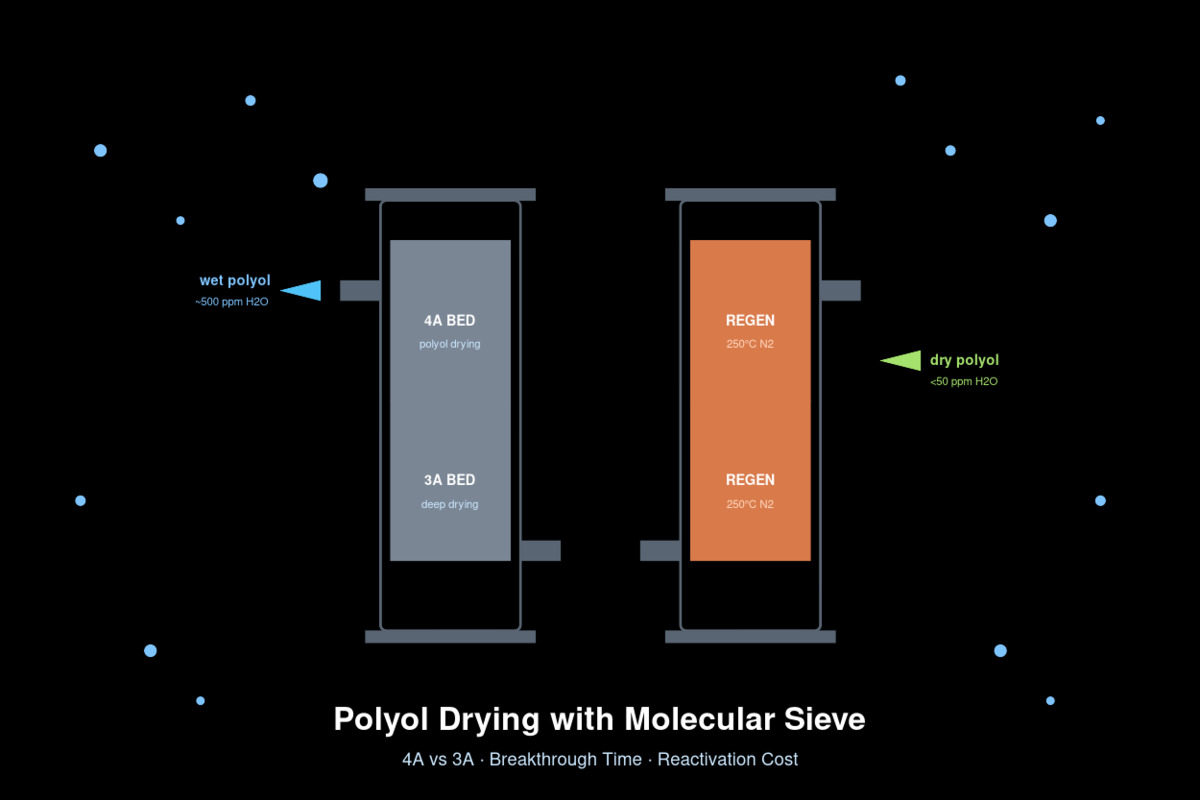
The standard industrial configuration for polyol drying is a twin-tower adsorption system with continuous switching. Each tower is filled with molecular sieve; one tower is in the adsorption half-cycle (receiving wet polyol from upstream and delivering dry polyol downstream) while the other is in the regeneration half-cycle (receiving hot dry nitrogen and sending the desorbed water out as a wet nitrogen vent). The towers switch every 4 to 16 hours depending on the bed size, the polyol flow rate, and the inlet moisture.
A typical industrial twin-tower polyol drier for a 30,000 MT/year flexible foam polyol plant looks like this:
- Two adsorption towers: each 1.8 to 2.5 m diameter, 3.5 to 5.0 m straight side, designed for 0.4 to 0.8 MPa operating pressure, stainless steel 304 or 316L for corrosion resistance, with internal distributors (sieve trays or packed beds) for even polyol flow distribution.
- Sieve charge per tower: 1.5 to 4.0 metric tons of 4A molecular sieve in 1.6 to 2.5 mm bead or 2.0 to 3.0 mm pellet form (powder and smaller beads give high pressure drop; larger pellets give poor mass transfer).
- Polyol flow rate: 3,000 to 12,000 kg/h per tower (depending on tower size), with continuous flow switching every 6 to 12 hours.
- Polyol temperature: 80 to 110 degrees C at the bed inlet. Higher temperature reduces polyol viscosity (which improves mass transfer and reduces pressure drop) but reduces the equilibrium water capacity of the sieve. The optimum for 4A polyether polyols is 90 to 100 degrees C.
- Polyol pressure: 0.3 to 0.8 MPa at the bed inlet, set by the upstream polyol feed pump.
- Regeneration nitrogen flow: 80 to 250 Nm3/h per tower, preheated to 220 to 280 degrees C by an electric or steam-heated nitrogen heater. The hot nitrogen flows top-down (countercurrent to the polyol flow direction) to displace water from the bed.
- Regeneration cycle time: 6 to 12 hours, of which 4 to 8 hours is hot nitrogen purge and 2 to 4 hours is cooling nitrogen purge (to bring the bed back down to polyol inlet temperature before the next adsorption half-cycle).
- Vent gas treatment: the wet regeneration nitrogen exits the tower at 40 to 80 degrees C with 5 to 15 percent water by volume. This is typically sent to a vent condenser to recover most of the water, and the dried nitrogen is vented or recycled.
For smaller polyol plants (under 5,000 MT/year) and for batch polyol drying, single-tower designs with intermittent regeneration are common. The principles are the same, but the cycle is operated by manual or semi-automatic valves, and the bed is sized for 24 to 48 hours of operation between regenerations. For very small polyol operations (under 500 MT/year) and for laboratory use, cartridge-style disposable dryers are available with pre-loaded 4A or 3A sieve, replaced every 1 to 3 months.
A third configuration used by some polyol producers is the rotary adsorber (also called a "wheel" or "honeycomb" adsorber). In this design, the sieve is impregnated into a honeycomb matrix that rotates slowly through the polyol stream, with a small section of the wheel continuously in regeneration. The rotary design gives continuous steady-state operation, smaller footprint than twin-tower, and lower capital cost for large flows. The trade-off is higher sieve attrition (the rotation adds mechanical stress), more sensitive to inlet moisture variability, and higher maintenance cost on the rotary valve. Rotary adsorbers are most common in 50,000+ MT/year plants where the capital savings outweigh the operating complexity.
How to Size a Polyol Drying Tower
Bed sizing for polyol drying follows the same five-step methodology as gas-phase adsorption, with adjustments for liquid-phase mass transfer. The five inputs are polyol flow rate, inlet moisture, outlet moisture target, bed geometry, and contact time.
Step 1: Compute the water load per cycle
The water to be removed per cycle is:
m_water = F_polyol x (C_in - C_out) x t_cycle
where F_polyol is polyol mass flow in kg/h, C_in and C_out are inlet and outlet moisture in kg water / kg polyol, and t_cycle is the desired half-cycle time in hours. For a 5,000 kg/h polyol flow with 500 ppm inlet and 50 ppm outlet, the water to be removed per cycle is 4.5 kg/h per cycle hour, or 27 kg per 6-hour cycle.
Step 2: Compute the sieve mass from useful capacity
The sieve mass per bed is:
m_sieve = m_water / (C_useful x eta_bed)
where C_useful is the useful water capacity of the sieve in kg water / kg sieve (0.12 to 0.16 for 4A, 0.08 to 0.12 for 3A), and eta_bed is the bed utilization factor (typically 0.65 to 0.80). For the 5,000 kg/h example, m_sieve = 27 / (0.14 x 0.70) = 276 kg per bed. The two-tower total sieve charge is therefore 552 kg of 4A, plus about 30 percent for the bed-utilization safety margin, giving 720 kg total installed charge.
Step 3: Choose tower diameter for liquid superficial velocity
Liquid superficial velocity in the bed sets the pressure drop, the mass transfer, and the fluidization risk. For polyol drying with 1.6 to 2.5 mm bead, the typical range is 0.5 to 2.0 mm/s (0.06 to 0.24 m/min), corresponding to a superficial mass flux of 500 to 2,000 kg/m2/h. For 5,000 kg/h polyol flow, this implies a tower cross-section of 2.5 to 10 m2, or a tower diameter of 1.8 to 3.6 m. The lower end of this range is the standard choice for polyol driers (small diameter, slow flow, low pressure drop).
Step 4: Compute the bed depth
Bed depth comes from the mass balance:
H = m_sieve / (rho_bulk x A)
where rho_bulk is the bulk density of the sieve (typically 700 to 780 kg/m3 for 4A bead) and A is the tower cross-section. For the 5,000 kg/h example with 276 kg sieve per bed and a 2.0 m diameter tower (3.14 m2 area), H = 276 / (750 x 3.14) = 0.117 m, which is unrealistically shallow. A 5,000 kg/h plant typically uses a 2.5 to 3.5 m diameter tower to keep the velocity low and the bed depth in the practical 1.5 to 3.5 m range. The decision is usually to oversize the diameter and live with the lower utilization rather than risk channeling in a too-shallow bed.
Step 5: Apply safety factors and verify the regeneration duty
Always apply a 20 to 30 percent derate on the calculated sieve mass and verify that the regeneration nitrogen flow is sufficient. For 4A polyol service, the standard regeneration duty is 0.3 to 0.5 Nm3 of nitrogen per kg of sieve per regeneration, at 250 degrees C and 0.1 to 0.3 MPa. The regeneration energy is the second-largest operating cost after the sieve replacement itself, so it deserves explicit calculation.
For the 5,000 kg/h example with 720 kg of installed 4A per bed, the regeneration nitrogen flow at 0.4 Nm3/kg is 288 Nm3/h per tower. The nitrogen heater must deliver 288 Nm3/h at 250 degrees C from a 20 degrees C inlet, which requires about 35 kW of thermal duty (specific heat of nitrogen is about 1.04 kJ/kg K, mass flow is 288/0.72 = 400 kg/h = 0.111 kg/s, temperature rise 230 K, duty 0.111 x 1.04 x 230 = 26.5 kW for sensible heat plus another 5 to 10 kW for heat losses and for the heat absorbed by the sieve and tower shell). Electric heaters for this duty cost USD 8,000 to USD 15,000 and consume about 35 MWh per regeneration cycle.
Regeneration Cycle Design: Temperature, Flow, and Time
The regeneration cycle is the inverse of the adsorption cycle: hot dry nitrogen flows through the bed, heats the sieve and the polyol residue to 200 to 280 degrees C, and carries the desorbed water out of the bed. A well-designed regeneration cycle restores 90 to 95 percent of the fresh-sieve water capacity. The remaining 5 to 10 percent is held as residual water and shows up as a slow drift in outlet moisture over the operating life of the sieve.
| Regeneration Parameter | Standard 4A Polyol Service | Standard 3A Polyol Service | Notes |
|---|---|---|---|
| Nitrogen inlet temperature | 220 to 280 degrees C | 250 to 350 degrees C | 3A needs higher T due to smaller pore |
| Nitrogen flow rate | 0.3 to 0.5 Nm3/kg sieve per regen | 0.4 to 0.7 Nm3/kg sieve per regen | Higher for 3A due to lower capacity |
| Hot purge time | 4 to 8 hours | 5 to 10 hours | Longer for 3A |
| Cool-down purge time | 2 to 4 hours (with cold N2) | 2 to 4 hours | Same for both |
| Outlet moisture target | Below 100 ppm (typically 30 to 80 ppm) | Below 30 ppm (typically 10 to 25 ppm) | 3A reaches lower targets |
| Bed cool-down temperature before adsorption | Below 110 degrees C (to avoid polyol degradation) | Below 110 degrees C | Polyol residence time at high T matters |
| Nitrogen purity required | -40 degrees C dew point or better | -40 degrees C dew point or better | Wet regeneration nitrogen defeats the purpose |
The two big operational mistakes in polyol regeneration are (1) using nitrogen that is not dry enough, and (2) cutting the hot purge short to save nitrogen. The first mistake is more common: operators sometimes use "house nitrogen" from a pressure-swing nitrogen generator that delivers only -20 degrees C dew point (Class 2 per ISO 8573-1), and that wet nitrogen slowly re-loads the sieve during regeneration, capping the useful capacity at 60 to 70 percent of fresh instead of 90 to 95 percent. The second mistake shows up as a slow rise in outlet moisture over weeks and months; the operator responds by reducing the cycle time (which increases nitrogen and energy cost) rather than restoring the hot purge to design.
The vent gas from the regeneration cycle is wet nitrogen at 40 to 80 degrees C with 5 to 15 percent water by volume. In a typical 30,000 MT/year polyol plant, this vent stream is 80 to 150 Nm3/h, which is small enough to vent to atmosphere after a condenser, but large enough to be worth recovering. A standard vent condenser recovers 80 to 90 percent of the water as liquid condensate and returns the nitrogen stream at 10 to 30 degrees C with 1 to 3 percent residual moisture. Some plants recycle this nitrogen back to the nitrogen generator feed; others vent it. Either way, the vent condenser is small (USD 15,000 to USD 30,000 installed) and pays back in 6 to 12 months from reduced nitrogen purchase cost.
Breakthrough Curves and Why They Matter for Cycle Design
The breakthrough curve is the relationship between outlet moisture and cumulative water fed to the bed, holding polyol flow rate and inlet moisture constant. It tells the operator exactly when to switch towers. Plotting outlet moisture on the y-axis and time (or cumulative water fed) on the x-axis gives an S-shaped curve: flat at the start (the bed is dry, outlet moisture below target), rising through the breakthrough point (the mass-transfer front has reached the bed outlet), and approaching the inlet moisture at the end (the bed is fully saturated).
For a properly designed 4A polyol drying tower, the breakthrough curve at design flow has these characteristic features:
- Initial flat zone: outlet moisture stays at 5 to 30 ppm for the first 60 to 75 percent of the theoretical cycle, depending on bed utilization.
- Breakthrough point: outlet moisture rises above 50 ppm (for a 50 ppm target) at 75 to 85 percent of theoretical cycle.
- Sharp rise: outlet moisture climbs rapidly through 50 to 200 ppm over the last 10 to 15 percent of cycle, as the mass-transfer front exits the bed.
- Saturation: outlet moisture approaches inlet moisture (300 to 600 ppm) at 100 percent of theoretical cycle.
The practical cycle time is set at the breakthrough point, with a 10 to 20 percent safety margin. For the 5,000 kg/h example with 720 kg of 4A per bed and a theoretical cycle of 8 hours, the practical cycle would be 6.5 to 7 hours. This protects against bed-utilization variability, sieve aging, and flow-rate upsets.
Operators who do not measure breakthrough curves routinely run too long (saturating the bed and getting breakthrough to product) or too short (cutting the cycle in half and doubling the regeneration cost). The breakthrough curve is best measured during commissioning and re-measured annually as a sieve-life check. A shift in the breakthrough point from 75 percent to 50 percent of theoretical cycle over 2 years is the signal that the sieve needs replacement.
Moisture, Viscosity, and NCO Consumption: The Hidden Cost Story
Most polyol drying articles stop at the outlet moisture number. But the real cost of wet polyol is downstream: it shows up as NCO overconsumption, as scrap from gassing, as off-spec density in foam, and as off-spec hardness in elastomer. Quantifying these costs is what converts "dry your polyol" from a generic recommendation into a financially defensible engineering decision.
Viscosity impact
Water in polyol lowers the viscosity slightly (water is less viscous than the polyol), but the effect is small: a 1000 ppm increase in moisture typically lowers viscosity by 2 to 5 percent at processing temperature. The bigger viscosity effect is on the reacted system: water-reacted polyol contains urea groups that act as physical crosslinks and raise viscosity sharply. In a polyol that has been allowed to sit wet for 24 hours at 100 degrees C, the viscosity can rise 10 to 30 percent from urea formation, even at moisture levels that look acceptable in a Karl Fischer titration. The lesson is that outlet moisture from the drier should be measured on the day of production, not days later.
NCO overconsumption
The 1:1 stoichiometric reaction of water with isocyanate (after the CO2 evolution step) gives a simple calculation:
Extra NCO per kg polyol (kg) = (C_out_ppm / 1,000,000) x (M_NCO / 9)
where M_NCO is the molecular weight of the isocyanate (250 g/mol for MDI, 174 g/mol for TDI, 168 g/mol for HDI) and the factor of 9 reflects the 2 moles of NCO consumed per mole of water and the 18 g/mol molecular weight of water. For a 50 ppm outlet moisture with MDI, the extra NCO consumption is 0.0014 kg MDI per kg polyol, or 0.14 percent. For a 10,000 MT/year polyol plant, that is 14 MT/year of excess MDI consumption, or about USD 31,000/year at current MDI prices (USD 2,200/MT). Reducing from 200 ppm to 50 ppm saves about USD 46,000/year in MDI alone.
| Outlet Moisture (ppm) | Extra MDI per MT Polyol (kg) | Extra TDI per MT Polyol (kg) | Extra HDI per MT Polyol (kg) | MDI Cost per MT Polyol (USD, MDI at USD 2,200/MT) |
|---|---|---|---|---|
| 10 | 0.28 | 0.19 | 0.19 | 0.61 |
| 25 | 0.69 | 0.48 | 0.47 | 1.53 |
| 50 | 1.39 | 0.97 | 0.93 | 3.06 |
| 100 | 2.78 | 1.93 | 1.87 | 6.11 |
| 200 | 5.56 | 3.87 | 3.73 | 12.22 |
| 500 | 13.89 | 9.66 | 9.33 | 30.56 |
Foam density and scrap
In a flexible slabstock foam line, the residual water in the polyol contributes to the blowing reaction and shifts the foam density. Operators compensate by adjusting the water addition in the formulation, but the compensation is approximate and the residual variability shows up as density drift. A 50 ppm swing in residual polyol moisture is about 0.5 to 0.8 kg/m3 in foam density, which is at the edge of customer spec for many furniture and bedding applications. Reducing the residual moisture swing from 100 ppm to 25 ppm stabilizes the foam density and reduces trim scrap by 1 to 3 percent of total production.
Elastomer and CASE impact
In cast elastomers and CASE applications, the CO2 from water-isocyanate reaction becomes gas voids. A 100 ppm polyol moisture in a typical TDI-polyester elastomer formulation gives about 0.5 to 1.0 percent void content by volume, which is enough to fail a 50 kV/mm dielectric breakdown test (relevant for wire and cable encapsulation) and to fail a hydrostatic pressure test (relevant for seals and gaskets). Reducing to 30 ppm cuts the void content by two-thirds and puts most formulations back inside the dielectric and pressure specs.
Standards Governing Polyol Drying and Molecular Sieve QC
Polyol drying sits at the intersection of polymer chemistry standards, sieve testing standards, and plant safety standards. The most commonly cited references:
- ASTM D4672 - Standard practice for polyurethane raw materials: polyols. Specifies sampling, handling, and moisture measurement protocols for polyether and polyester polyols.
- ASTM D6304 - Standard test method for determination of water in petroleum products, lubricating oils, and additives by coulometric Karl Fischer titration. Used for routine polyol moisture QC.
- DIN 51579 - Testing of polyols for polyurethane: determination of water content by Karl Fischer titration. The European equivalent of ASTM D6304 for polyols.
- ISO 14897 - Plastics - Polyols for use in the production of polyurethane - Determination of water content. International Karl Fischer method.
- ISO 18421 - Plastics - Polyols for use in the production of polyurethane - Determination of basicity (for amine-initiated polyols).
- ASTM D4058 - Standard test method for attrition of molecular sieves. Used for sieve QC at incoming inspection and for sieve life tracking.
- ISO 13320 - Particle size analysis by laser diffraction. Used for sieve pellet size distribution QC.
- IUPAC Polymer Chemistry Recommendations - The IUPAC published recommendations on the nomenclature, synthesis, and characterization of polyols, including guidance on moisture control.
For plant safety, the polyol drying system must also comply with standard pressure-vessel codes (ASME BPVC Section VIII, EN 13445, PED 2014/68/EU) for the adsorption towers, with IEC 61511 for the safety instrumented systems (especially the overpressure protection on the regeneration nitrogen heater), and with local fire codes for the nitrogen heater (which is typically electric and classified as a heat source). For plants using flammable polyols or operating above the polyol autoignition temperature (typically 200 to 250 degrees C for polyester polyols, 300 to 350 degrees C for polyether polyols), nitrogen blanketing and oxygen monitoring are required during regeneration.
Three Real-World Polyol Plants: Cost and Performance Data
Case 1: 30,000 MT/year polyether polyol plant, China, 4A twin-tower
A 30,000 MT/year polyether polyol plant in eastern China uses a twin-tower 4A adsorption system to dry 3,500 kg/h of polyol from 600 ppm inlet to 80 ppm outlet. Each tower holds 2.4 MT of 4A sieve (1.6 to 2.5 mm bead). Polyol temperature at the bed inlet is 90 degrees C. Tower diameter is 2.4 m, bed depth 2.6 m. Cycle time: 10 hours adsorption, 8 hours regeneration (5 hours hot purge at 260 degrees C, 3 hours cool-down at 100 degrees C). Sieve replacement interval: 4 years. Annual operating cost: USD 18,000 in sieve, USD 12,000 in regeneration nitrogen, USD 7,000 in heater electricity, USD 5,000 in maintenance. Total annual drying cost: USD 42,000, or USD 1.40 per MT of polyol. Drying avoided about 90 MT/year of excess MDI consumption, saving approximately USD 200,000/year in MDI cost. Net benefit of drying: USD 158,000/year, or a payback on the drier capital cost of about 6 months.
Case 2: 8,000 MT/year polyester polyol plant, India, 4A retrofit
An 8,000 MT/year polyester polyol plant in western India retrofitted from a vacuum-drying process (rotary drum under 50 mbar vacuum, 120 degrees C, 24-hour batch cycle) to a molecular sieve twin-tower system. Motivation: the vacuum process left 150 to 200 ppm residual moisture, and the new high-index rigid foam formulations required below 50 ppm. The sieve system uses 1.8 MT of 4A per tower (2.0 to 3.0 mm pellet), 250 degrees C nitrogen regeneration. Polyol flow: 950 kg/h, polyol temperature 100 degrees C. Outlet moisture: 30 to 45 ppm. Capital cost of the sieve system: USD 320,000. Annual operating cost: USD 12,000 (sieve, nitrogen, energy, maintenance). Annual MDI savings from 175 ppm to 40 ppm improvement: about 60 MT/year, or USD 132,000/year. Payback on capital: about 28 months. The plant also reports that the sieve-dried polyol is more consistent in viscosity, which has reduced scrap in the rigid foam line by about 1.5 percent.
Case 3: 2,000 MT/year PTMEG plant, Germany, 3A system
A 2,000 MT/year PTMEG (polytetramethylene ether glycol) plant in Germany uses 3A molecular sieve for the final polishing of PTMEG before shipment. PTMEG is highly viscous at room temperature (about 1500 cP at 40 degrees C) and extremely sensitive to moisture: target outlet moisture is below 10 ppm. The 3A sieve avoids the methanol residue pickup that 4A would suffer (the upstream THF-to-PTMEG process leaves 50 to 200 ppm of methanol residue in the crude PTMEG, and 4A adsorbs the methanol and slowly releases it into the product). The twin-tower system holds 1.2 MT of 3A per tower (1.6 to 2.5 mm bead). Polyol flow: 250 kg/h at 80 degrees C. Regeneration at 290 degrees C in dry nitrogen. Outlet moisture: 5 to 12 ppm. Annual sieve replacement: about 10 percent (every 10 years, but with periodic topping up). Annual operating cost: USD 14,000 (sieve, nitrogen, energy, maintenance). The 3A premium over 4A is about USD 2,000/year additional; the avoided contamination losses are valued by the plant at over USD 80,000/year in retained customer contracts.
Case 4: 50,000 MT/year polyether polyol plant, Saudi Arabia, 4A + 3A hybrid
A 50,000 MT/year polyether polyol plant in Saudi Arabia uses a two-stage drying configuration: a first stage with 4A molecular sieve (1.8 MT per tower, 2.5 m diameter, 3.0 m bed depth) that reduces moisture from 800 ppm to 100 ppm, followed by a second stage with 3A molecular sieve (0.6 MT per tower, 1.5 m diameter, 2.0 m bed depth) that polishes from 100 ppm to 30 ppm. Polyol flow: 6,000 kg/h, polyol temperature 95 degrees C. Regeneration: 4A stage at 250 degrees C, 3A stage at 300 degrees C. The hybrid configuration is justified by the high inlet moisture (which favors 4A capacity) combined with the low target outlet (which favors 3A equilibrium). Annual operating cost: USD 38,000 (sieve, nitrogen, energy, maintenance). Annual MDI savings: about 200 MT/year, or USD 440,000/year. The plant also reports that the 3A second stage extends the service life of the 4A first stage by acting as a methanol guard (the polyol has 100 to 200 ppm methanol residue from the PO/EO synthesis; the 4A bed adsorbs most of it, and the 3A bed keeps it from reaching the product). 4A sieve replacement interval: 3 years. 3A sieve replacement interval: 6 years.
Cost Models: 4A vs 3A, 10-Year Operating Comparison
To put the sieve choice in financial perspective, consider a representative 10,000 MT/year polyol plant running 8,000 hours per year, with 400 ppm inlet moisture and 50 ppm outlet moisture target. Two scenarios: 4A system and 3A system.
| Cost Line (10-year horizon, USD) | 4A System | 3A System | Notes |
|---|---|---|---|
| Initial sieve charge (4 MT total installed) | USD 18,000 | USD 28,000 | 3A is 1.5 to 2x 4A in unit cost |
| Sieve replacement (every 4 to 5 years) | USD 45,000 | USD 70,000 | 3A needs replacement slightly sooner |
| Regeneration nitrogen (80 Nm3/h, 8000 h/yr, USD 0.10/Nm3) | USD 480,000 | USD 580,000 | 3A needs more nitrogen per regeneration |
| Heater electricity (250 degrees C, 30 kW) | USD 38,000 | USD 48,000 | 3A needs higher regeneration temperature |
| Pump and valve maintenance | USD 12,000 | USD 12,000 | Same |
| Instrument air and utilities | USD 6,000 | USD 6,000 | Same |
| Labor and routine maintenance | USD 30,000 | USD 30,000 | Same |
| 10-Year Operating Total | USD 629,000 | USD 774,000 | 4A is about 19% cheaper on 10-year TCO |
| Capital cost (towers, pumps, heater, instrumentation) | USD 280,000 | USD 320,000 | 3A needs higher-temperature-rated heater |
| 10-Year TCO (capital + operating) | USD 909,000 | USD 1,094,000 | 3A is 20% more expensive on 10-year TCO |
For this representative case, 4A wins on cost by about 20 percent over 10 years, or USD 184,000 in favor of 4A. The decision flips if the polyol contains methanol or other small-molecule contaminants: the 3A premium is recovered in avoided product contamination, reduced customer complaints, and lower reject rates. The decision also flips if the outlet moisture target is below 25 ppm: 3A reaches lower moisture at the same bed depth, and the smaller bed and lower regeneration frequency can offset the unit cost premium.
A useful rule of thumb that emerges from the four case studies above: the 4A system is more economical when the polyol has no significant methanol or amine residue and the outlet moisture target is 50 to 100 ppm; the 3A system is more economical when the polyol has methanol or amine residue above 50 ppm, or when the outlet moisture target is below 25 ppm. For polyols with both clean chemistry and tight moisture targets, a hybrid 4A + 3A two-stage system (as in Case 4) gives the best of both worlds: 4A capacity in the first stage for bulk water removal, 3A equilibrium in the second stage for final polish, and the 3A stage acts as a methanol/amine guard that protects the 4A stage from slow poisoning.
Seven Common Mistakes in Polyol Drying
After auditing more than twenty polyol plants, here are the seven most common errors and how to fix them.
Mistake 1: Using nitrogen from a non-dry source
The most common cause of underperforming polyol driers is using nitrogen from a pressure-swing nitrogen generator or a membrane nitrogen system that delivers only -20 degrees C dew point. The wet nitrogen slowly re-loads the sieve during the regeneration half-cycle, capping the useful capacity at 60 to 70 percent of fresh instead of 90 to 95 percent. Fix: install a small polishing dryer on the regeneration nitrogen line (a heatless desiccant dryer with activated alumina delivering -40 degrees C dew point or better) and verify the dew point with a calibrated hygrometer at the bed inlet.
Mistake 2: Wrong particle size
Too small (under 1.0 mm bead) and the bed pressure drop becomes prohibitive at industrial polyol flow rates; too large (above 3.0 mm pellet) and the mass-transfer resistance dominates and the bed utilization drops. Fix: use 1.6 to 2.5 mm bead or 2.0 to 3.0 mm pellet for polyol drying. Spherical beads are preferred over cylindrical pellets because they pack more uniformly and give lower channeling.
Mistake 3: Polyol temperature too low
Operating the bed at 40 to 60 degrees C rather than 80 to 100 degrees C reduces the bed pressure drop (because viscosity drops at higher temperature) but also reduces the water capacity by 15 to 25 percent and lengthens the cycle time. Fix: operate at 90 to 100 degrees C for polyether polyols and 100 to 120 degrees C for polyester polyols. The polyol is already at this temperature after synthesis or after the prior reactor; use the existing heat.
Mistake 4: Insufficient nitrogen purge time
Cutting the regeneration hot purge from 5 hours to 2 hours to save nitrogen cost is a false economy. The bed does not fully regenerate, the next adsorption half-cycle starts with reduced capacity, and the outlet moisture rises slowly. Fix: keep the hot purge at the design duration; the saving from reduced purge is much smaller than the cost of reduced outlet moisture (higher MDI consumption, more scrap).
Mistake 5: Skipping sieve pre-activation
Fresh molecular sieve as shipped has 1 to 2 percent residual moisture from atmospheric exposure. Loading it directly into the tower and going to adsorption gives a slow start-up with elevated outlet moisture for the first 24 to 48 hours. Fix: pre-activate the sieve in the tower with a 6 to 12 hour hot nitrogen purge (250 degrees C for 4A, 290 degrees C for 3A) before the first adsorption cycle.
Mistake 6: Not monitoring outlet moisture continuously
Plants that sample outlet moisture once per shift (every 8 hours) are often blind to gradual sieve aging and process upsets. Fix: install an online moisture analyzer on the outlet polyol line (a near-infrared or a capacitance-based instrument, calibrated monthly against ASTM D6304 Karl Fischer titration) and trend the data.
Mistake 7: Polyol feed contaminated with catalyst residue
Polyols synthesized with KOH or NaOH catalysts carry residual alkali metal (5 to 50 ppm K or Na in the finished polyol). The alkali metal is not removed by the molecular sieve and shows up downstream as gel particles and as side reactions with isocyanate. Fix: install an ion-exchange or adsorption guard bed (typically a magnesium silicate or acid clay) upstream of the molecular sieve, or use the standard acid neutralization step in the polyol finishing process.
Qualifying a Molecular Sieve Supplier: 10-Question Checklist
For polyol producers sourcing molecular sieve for the first time or replacing an incumbent supplier, ten questions that protect the buyer from common quality and performance traps:
- What is the equilibrium water capacity at 100 degrees C and 100 ppm water vapor partial pressure, and how is it measured?
- What is the attrition index per ASTM D4058, and what is the limit guarantee?
- What is the particle size distribution per ISO 13320, and what is the oversize and undersize limit?
- What is the bulk density, and how does it vary batch-to-batch?
- What is the residual moisture on shipment, and how is the sieve packaged to prevent re-adsorption during transit?
- What reference polyol plants are using this grade, and can the supplier provide contact details for reference checks?
- What is the recommended regeneration protocol (temperature, flow rate, time) for this specific grade, and is it supported by pilot data?
- What is the recommended service life in polyol service, and what end-of-life indicators should the operator monitor?
- What is the COA per batch, and what tests are included (BET, water capacity, attrition, PSD, residual moisture)?
- What is the lead time for R&D samples (5 kg MOQ) and bulk industrial orders (500 kg MOQ), and is there a strategic reserve option?
A supplier that answers all ten clearly and provides verifiable reference plants is usually the right choice. A supplier that cannot or will not answer questions 1 to 4 is hiding something: usually a sieve specification mismatch, a hidden moisture pickup during storage, or a batch-to-batch inconsistency that will show up as variable drier performance.
What Aluminaworld Supplies for Polyol Drying
Aluminaworld supplies both 4A and 3A molecular sieve products to polyol producers and polyurethane system houses in 60+ countries. Our standard grades for polyol drying:
- 4A molecular sieve, 1.6 to 2.5 mm bead: bulk density 720 to 780 g/L, water capacity 22 to 25 percent by weight at saturation, attrition index below 0.1 percent per ASTM D4058, residual moisture below 1.5 percent by weight as shipped. Standard R&D order is 5 kg MOQ with 7-day lead time; bulk industrial order is 500 kg MOQ with 15-day lead time. See our molecular sieve product page for the full product range.
- 3A molecular sieve, 1.6 to 2.5 mm bead: bulk density 700 to 760 g/L, water capacity 18 to 21 percent by weight at saturation, attrition index below 0.2 percent, residual moisture below 1.5 percent by weight. Same MOQ and lead time as 4A. See our molecular sieve product page for grade selection guidance.
- Molecular sieve powder, 3 to 5 micron: for in-line polyol polishing filters or for use in batch polyol drying where a packed bed is impractical. See our molecular sieve powder page.
Each shipment ships with a Certificate of Analysis showing water capacity, attrition index, particle size distribution, bulk density, and residual moisture. MSDS, REACH registration, and ISO 9001 documentation are available on request. For polyol plants evaluating 4A versus 3A for the first time, we recommend a 5 kg R&D sample of each grade for a parallel pilot test in your own laboratory or plant. Aluminaworld provides free samples for this kind of qualification work; lead time is 7 days by air freight to most regions.
Related Aluminaworld Products for Polyurethane Production
Polyurethane producers that buy molecular sieve from Aluminaworld often source related adsorbents and catalyst supports from us as well:
- Activated alumina for polyol feedstock storage tank blanketing and for the regeneration nitrogen polishing dryer. We supply activated alumina beads in 2 to 5 mm and 3 to 5 mm grades for these duties.
- Pseudo boehmite for catalyst support in isocyanate synthesis (the phosgene-route MDI and TDI plants use pseudo boehmite as the catalyst carrier). See our pseudo boehmite page for typical specifications.
- Alumina powder for flame retardant filler in rigid polyurethane foam. We supply calcined and tabular alumina powders in various particle sizes for foam, elastomer, and coating applications.
- Aluminum hydroxide (ATH) for flame retardant and smoke suppressant in polyurethane foam, elastomer, and cable compounds. See our aluminum hydroxide page for typical specifications.
Next Steps
If you are evaluating molecular sieve drying for a new polyol line, replacing an incumbent drier, or trying to figure out why your current drier is not reaching the target outlet moisture, the first three things to do are:
- Measure the actual outlet moisture and the inlet moisture on the same day. Use ASTM D6304 (Karl Fischer coulometric titration) with a fresh sample drawn from the bed outlet and immediately capped to avoid atmospheric moisture pickup. If the inlet moisture is above 1000 ppm, consider a pre-drying step (vacuum flash or stripping) before the molecular sieve.
- Audit the regeneration nitrogen. Verify the dew point at the bed inlet with a calibrated hygrometer. If it is above -30 degrees C, the nitrogen is too wet and is partially re-loading the sieve. Add a polishing dryer on the nitrogen line.
- Calculate the actual MDI or TDI overconsumption. Use the formula above (extra NCO per kg polyol = C_out_ppm / 1,000,000 x M_NCO / 9) to estimate how much isocyanate is being consumed by residual water. For a typical 10,000 MT/year polyol plant, the MDI savings from reducing outlet moisture from 100 ppm to 30 ppm are on the order of USD 30,000 to USD 60,000 per year.
For a tailored recommendation on 4A versus 3A for your specific polyol chemistry, flow rate, and target moisture, contact us directly.
Talk to Aluminaworld
Aluminaworld supplies 4A and 3A molecular sieve beads and pellets, molecular sieve powder, activated alumina, pseudo boehmite, and ZSM-5 zeolite to polyol producers, polyurethane system houses, and adsorbent distributors in 60+ countries. Our standard lead time is 7 days for R&D samples (5 kg MOQ) and 15 days for bulk industrial orders (500 kg MOQ). For polyol drying qualification work, we ship 5 kg of any grade as a free sample with the COA, MSDS, and the recommended regeneration protocol for your specific tower geometry and polyol flow rate.
For polyol drying questions, sample requests, or a 10-year TCO model for a specific plant, contact us:
- WhatsApp: +86 133 2522 2240 (Barry, English / Chinese)
- Email: sales@aluminaworld.com (or use the contact form)
- R&D sample: 5 kg MOQ, 7-day lead time, free sample available
- Bulk order: 500 kg MOQ, 15-day lead time, FOB Qingdao or CIF destination port
Standard documents shipped with each order: Certificate of Analysis with water capacity, attrition index per ASTM D4058, particle size distribution per ISO 13320, bulk density, and residual moisture. MSDS available on request. Aluminaworld has been exporting molecular sieves and activated alumina to 60+ countries for 15+ years, with documented shipments to polyol producers, polyurethane system houses, and adsorbent distributors in North America, Europe, the Middle East, India, Southeast Asia, and Latin America.