Activated Alumina in Sulfuric Acid and Oleum Plants: Compatibility Boundaries, Dry-Air Duty, and Safer Adsorbent Selection
Short answer: activated alumina can be valuable around a sulfuric-acid plant when it dries clean, isolated instrument air or utility gas. It should not be treated as acid-tower packing, an oleum adsorbent, a sulfuric-acid mist eliminator, or a thermally regenerable bed after direct acid wetting. The engineering decision turns on one boundary: can liquid H2SO4, SO3, oleum, or acid aerosol reach the porous alumina? If the answer is yes—or is not demonstrated to be no—the application requires another material and a review by the process licensor.
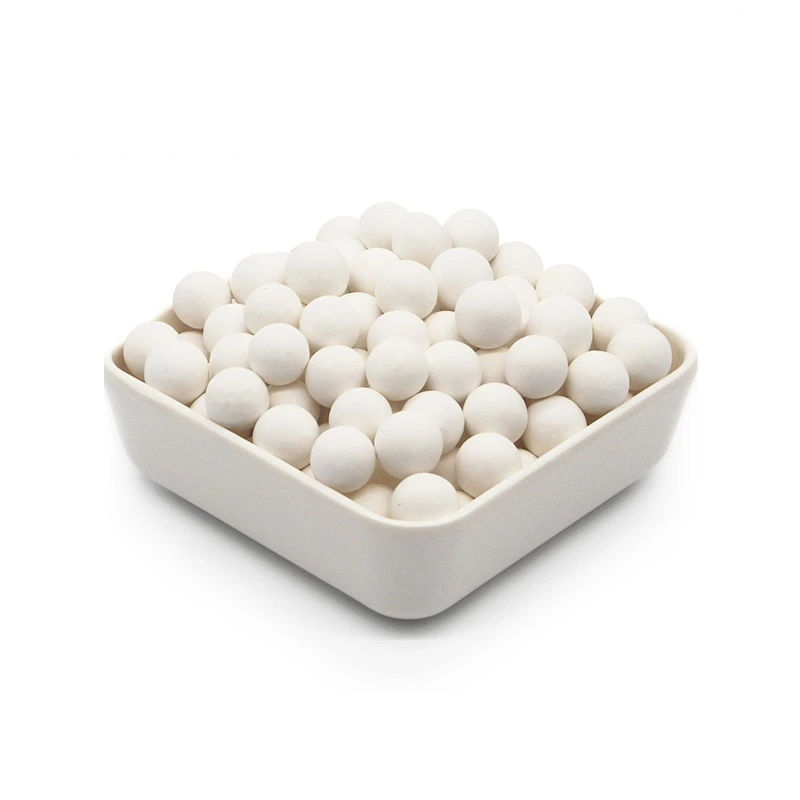
1. The Decision First: Where Activated Alumina Belongs—and Where It Does Not
A buyer searching for “activated alumina sulfuric acid” can mean four very different services. The first is a conventional compressed-air dryer in a sulfuric-acid plant. The second is a guard bed in a dry utility-gas line. The third is a process-gas purifier exposed to SO2, SO3, moisture, or acid aerosol. The fourth is direct contact with circulating H2SO4 or oleum. Only the first two are normal activated-alumina desiccant questions. The last two are acid-process and materials-of-construction questions, and a generic desiccant recommendation is not an acceptable answer.
| Proposed duty | Default position | Reason | Next action |
|---|---|---|---|
| Instrument-air drying | Potentially suitable | Water adsorption in a physically isolated compressed-air train | Specify ISO 8573 classes, filtration, dew-point alarm, regeneration |
| Plant utility-air drying | Potentially suitable | Same as conventional industrial air drying | Confirm no process backflow or acid aerosol ingress |
| Dry inert-gas polishing | Conditional | Possible only when contaminant envelope is known and compatible | Run lab screening and obtain vendor written acceptance |
| Drying-tower packing | Not suitable | Direct circulating concentrated acid contact; desiccant sulfates | Use licensor-approved acid-resistant packing and internals |
| Oleum or liquid-H2SO4 adsorbent | Not suitable | Chemical reaction, heat, pore blockage, contamination | Use approved process equipment, not a regenerable solid bed |
| Acid-mist eliminator | Not suitable | Mist control is droplet-separation duty, not water adsorption | Use process-engineered fiber bed, mesh, vane, or wet control device |
This “service first” distinction is the core of the article. It prevents the most expensive category error: assuming that because activated alumina dries compressed air and because sulfuric acid also dries gas, the two materials are interchangeable. They are not. Concentrated acid operates as a circulating liquid absorbent; activated alumina operates as a cyclic porous solid. Their equipment, hazards, regeneration, and compatibility logic are different.
2. Process Map: Drying Tower, Converter, Absorption Tower, and Utility Dryers
In a contact-process sulfuric-acid plant, dry sulfur-bearing gas is prepared, catalytically converted from SO2 to SO3, and absorbed into strong acid. A conventional drying tower removes water by counter-current contact with concentrated sulfuric acid. The converter then uses a vanadium-based catalyst system under a controlled temperature profile. In double-contact double-absorption designs, an intermediate absorber removes SO3 before another conversion pass, and a final absorber completes the duty. Oleum is made by dissolving additional SO3 into sulfuric acid.
These units are not packed with activated alumina desiccant. Their packings, distributors, pumps, mist eliminators, acid coolers, seals, and construction materials are selected as a coupled process system. Water balance controls acid concentration. Temperature controls SO3 absorption, acid vapor pressure, mist formation, and corrosion. A solid porous adsorbent placed in the wrong location can become a reactive contaminant rather than a useful dryer.
The separate utility-air train
The instrument-air system is a different plant island. Ambient air enters a compressor; aftercoolers and moisture separators remove condensed liquid; coalescing filters remove oil aerosol and fine liquid; twin adsorption towers dry the gas; after-filters catch desiccant dust; and a receiver supplies control valves, analyzers, and pneumatic instruments. Proper check valves and isolation prevent process gas from backflowing into the air header. Here, activated alumina can be entirely appropriate because its job is to adsorb water from clean air, not to contact process acid.
- Ambient intake and compressor: establish the maximum water load from seasonal temperature and humidity.
- Aftercooler and separator: remove bulk liquid before it reaches the adsorbent.
- Optional refrigerated pre-dryer: lower the pressure dew point and reduce cyclic water loading.
- Coalescing filtration: protect the surface against lubricant and aerosol contamination.
- Twin activated-alumina towers: one adsorbs while the other regenerates and cools.
- After-filter, receiver, and analyzer: deliver stable particle, oil, and water classes to the user header.
3. Surface Chemistry: Why Gamma Alumina Is a Good Desiccant but a Poor Acid Packing
Activated alumina is not simply a miniature piece of dense corundum. It is a high-area transition alumina made by controlled dehydration and calcination of aluminum hydroxide or boehmite precursors. Its useful performance comes from a connected pore network and a surface covered with hydroxyl groups and coordinatively unsaturated aluminum sites. Water attaches strongly to those sites, first by specific interactions and then by multilayer adsorption and capillary filling as relative humidity rises.
The same surface reactivity that helps water adsorption makes direct strong-acid contact problematic. Sulfuric acid protonates surface oxygen and hydroxyl groups. Sulfate and bisulfate coordinate to aluminum sites. With enough acid, water, temperature, and time, aluminum sulfate species form and alumina can dissolve or restructure. Binders are part of the bead and can respond differently from the transition-alumina phase. An apparently intact bead can therefore have severely changed pore volume, adsorption capacity, crush behavior, and leachable aluminum.
Why “ceramic” is not a compatibility certificate
Alumina materials span dense alpha-alumina ceramics, tabular alumina, calcined powders, catalyst supports, pseudo-boehmite, and activated desiccant beads. Their surface area can differ by several orders of magnitude. Their pore volume, phase composition, sodium level, binder, and sintering state differ as well. A corrosion chart for one dense ceramic item does not qualify a 300 m2/g porous desiccant. Conversely, a catalyst-support sulfation study does not automatically quantify the service life of a specific commercial bead.
Compatibility must therefore be stated narrowly: product grade, phase, binder, acid concentration, liquid or vapor state, temperature, exposure duration, flow, pressure, and acceptance criterion. “No visible damage after a short coupon immersion” is not enough for a cyclic adsorbent. The bed also has to retain water capacity, pore structure, mechanical strength, and low leachables after realistic cycles.
4. Concentration, Water Activity, Temperature, and Aerosol: The Four Compatibility Axes
Sulfuric-acid corrosion behavior is non-linear. Dilute acid, concentrated acid, oleum, dry SO3, wet SO3, and acid mist are not interchangeable exposures. Water activity changes dissociation and transport. Temperature changes reaction rate and condensation. Aerosol carries liquid directly into pores even when bulk gas seems “dry.” The safest procurement document describes all four axes.
| Exposure | Primary risk to activated alumina | Engineering interpretation |
|---|---|---|
| Liquid dilute H2SO4 | Acid transport, dissolution, binder attack, heat | Reject as direct desiccant service |
| Liquid 93–98% H2SO4 | Surface sulfation, pore filling, local dilution heat, contamination | Reject unless a qualified product has an explicit, application-specific approval—which normal dryer beads do not |
| Oleum / free SO3 | Highly reactive, fuming liquid; strong heat and moisture sensitivity | Keep away from generic porous adsorbent beds |
| Dry gas with no acid aerosol | Depends on gas species and trace contaminants | Conditional laboratory screening; do not infer from water-drying data |
| Gas containing H2SO4 aerosol | Liquid droplets deposit in pores, sulfate surface, raise pressure drop | Use an engineered mist eliminator; do not rely on activated alumina |
| Instrument air with credible acid backflow | Intermittent contamination may escape normal average sampling | Fix isolation and backflow prevention before selecting desiccant |
Do not use a single “maximum acid ppm” from a generic catalogue
A dry-gas contaminant limit has to state measurement basis. Is “ppm” volume fraction of vapor, mass concentration of aerosol, total acid after heated-probe sampling, or sulfate captured in an impinger? At what temperature? Was the line heated above its acid dew point? Could droplets be lost in tubing? Without those details, a number cannot define an adsorbent warranty.
For a new service, run a staged program: characterize the stream with a suitable heated or isokinetic method; perform a materials screening test using the actual bead and contaminant; measure adsorption capacity, crush, attrition, sulfate, aluminum leachables, BET and pore volume before and after; then complete a small guarded field trial with dew-point, pressure-drop, and corrosion monitoring. The trial is not a substitute for process safety review, but it produces evidence where catalogue language does not.
5. Acid Dew Point: Why a “Dry” Gas Can Still Create Liquid Acid
Water dew point alone is not enough for sulfur-containing gas. Small concentrations of SO3 can combine with water vapor and condense sulfuric acid at temperatures far above the ordinary water dew point. The resulting acid-dew-point temperature depends strongly on water and SO3 partial pressures and on the correlation used. A quoted acid dew point with no gas analysis and no named method is not a design basis.
The failure path is straightforward. Gas leaves a hot process region and enters cooler pipe, valve, sample line, filter housing, or standby vessel. A metal surface drops below the acid dew point. Acid condenses locally even though no bulk liquid was expected. The condensate attacks carbon steel, wets solids, mobilizes corrosion products, and can reach the downstream dryer as aerosol or droplets. Reheating after the event does not return sulfated activated alumina to its original state.
Practical margin philosophy
- Measure or conservatively estimate SO3, water, pressure, and temperature over startup, normal operation, turndown, shutdown, and upset.
- Use a named acid-dew-point correlation or a process-licensor model; record the input basis and uncertainty.
- Maintain the coldest wetted metal surface above the calculated dew point by a documented operating margin.
- Heat-trace sample lines where the analytical method requires vapor preservation; otherwise report that the measurement excludes deposited aerosol.
- Place drains and separators where condensation can occur, then verify they work during low flow and standby.
- Treat any downstream sulfate increase or unexplained pressure-drop rise as a possible condensation event, not merely a “bad desiccant batch.”
6. Acid Mist Control: Why Fiber-Bed Separation Is Not an Adsorbent Job
Acid mist is a population of liquid droplets. Depending on how it forms, the distribution can include coarse entrainment that a mesh or vane device can intercept and submicron aerosol that follows gas streamlines. Sulfuric-acid plants commonly use high-efficiency fiber-bed candle technology for fine aerosol, often together with upstream tower design, distributors, and lower-efficiency devices for larger droplets. Material selection is based on acid concentration, temperature, fluorides, gas velocity, pressure drop, and cleaning strategy.
An activated-alumina bed is the wrong mechanism. It presents a huge reactive internal area. Acid droplets deposit, react, and remain. The bed accumulates sulfate and free acidity. Pores block, pressure drop increases, heat is released, and desiccant dust can combine with acid to form sticky deposits. Attempting thermal regeneration can mobilize corrosive vapor. A device that physically coalesces and drains acid is fundamentally easier to control than a sacrificial reactive bed.
| Technology | Best-fit duty | What determines performance | Key limitation |
|---|---|---|---|
| Mesh pad | Larger entrained droplets | Velocity, wire geometry, liquid loading | Limited capture of very fine aerosol |
| Vane separator | Coarse droplets at suitable velocity | Turning, inertia, drainage | Not a universal submicron solution |
| Fiber-bed candle | Fine sulfuric-acid aerosol | Diffusion, interception, coalescence, media and gas velocity | Pressure drop and fouling require engineered selection |
| Wet scrubber | Selected soluble gas/droplet duties | Liquid chemistry, contact energy, mass transfer | Creates a liquid effluent and may not capture the smallest mist alone |
| Activated-alumina bed | Not recommended for acid mist | Reactive uptake, not controlled droplet separation | Sulfation, heat, pressure drop, hazardous spent solid |
For procurement, ask the mist-control vendor for fractional efficiency by droplet size, pressure drop at clean and loaded conditions, drainage arrangement, material compatibility, entrainment limit, inspection method, and replacement criteria. Do not accept a single “99.9% efficiency” claim without particle-size and test-method context.
7. Legitimate Use Case: Instrument-Air Drying in an Acid Plant
An instrument-air dryer in a sulfuric-acid plant has the same basic thermodynamics as one in a refinery, fertilizer plant, or mineral-processing facility. The plant context changes the contamination risk and reliability consequence. Pneumatic control valves and analyzer systems often sit near acid, and a wet or acid-contaminated header can disable the same controls needed to isolate an upset.
A robust train begins with bulk water removal. An aftercooler condenses compressor discharge moisture. A separator drains it automatically. A high-efficiency coalescing stage protects the adsorbent from oil aerosol and liquid carryover. A refrigerated pre-dryer may reduce the water load if energy and complexity are justified. Two desiccant towers switch so one adsorbs while the other depressurizes, regenerates, repressurizes, and cools. An after-filter prevents desiccant dust entering valve positioners.
Specify the complete air quality—not only pressure dew point
ISO 8573-1 separates particles, water, and oil into classes. A buyer should state all three, plus normal and maximum pressure, flow, temperature, monitoring point, and analyzer method. A -40 degrees C pressure-dew-point target is commonly associated with Class 2 water, but it does not say whether the line contains oil aerosol, rust, acid mist, or desiccant fines. In an acid plant, those omissions can dominate reliability.
- Water: specify pressure dew point and proof-test location at worst operating conditions.
- Oil: include liquid, aerosol, and vapor control appropriate to compressor technology.
- Particles: define upstream and downstream filtration and differential-pressure alarms.
- Acid contamination: define a no-free-liquid and no-acid-aerosol boundary, plus a sampling plan during startup and upset.
- Backflow protection: provide physical non-return and isolation devices; do not depend on normal pressure hierarchy alone.
- Availability: decide whether a single twin-tower train is enough or whether critical instruments need redundant storage or a second train.
8. Worked Calculation 1: Water Load to a 1,000 Nm³/h Dryer
This preliminary example shows why the aftercooler and pre-dryer matter. It is not a vendor sizing sheet. Assume 1,000 Nm3/h of air, an 8 bar(a) line, and a 35 degrees C aftercooler outlet saturated with water. The actual compressed volume is approximately:
At 35 degrees C, saturated water-vapor pressure is about 5.6 kPa. An ideal-gas approximation gives roughly 39 g of water vapor per actual cubic meter at this temperature. The gas therefore carries approximately 5.6 kg/h, or about 135 kg/day, immediately after the aftercooler if the flow basis and separator behavior match the assumptions. The precise answer changes with the definition of “Nm3,” compressor intake humidity, separator performance, and whether the published flow is wet or dry.
Now place a refrigerated pre-dryer ahead of the activated alumina and use a 3 degrees C pressure-dew-point basis. Saturation pressure near 3 degrees C is about 0.76 kPa, so the residual vapor load falls by roughly an order of magnitude. Depending on the flow conversion convention, the activated-alumina duty is approximately 15–20 kg/day rather than more than 100 kg/day.
| Case | Illustrative water to desiccant | Design implication |
|---|---|---|
| 35 °C saturated, no pre-dryer credit | About 4–6 kg/h | Large bed or short cycle; strong separator and regeneration demand |
| 3 °C pressure dew point upstream | About 0.6–0.8 kg/h | Much smaller cyclic load; pre-dryer consumes power and needs drains |
| Target -40 °C PDP | Trace residual at outlet | Requires adequate mass-transfer zone, regeneration, cooling, and switching control |
The key buying lesson is not the last decimal place. It is that the water mass balance must precede the adsorbent quotation. A supplier cannot responsibly size the bed from flow alone. Temperature, pressure, inlet dew point, seasonal maximum, upstream liquid removal, cycle time, and outlet target belong on the inquiry.
9. Worked Calculation 2: Adsorbent Mass from Cyclic Working Capacity
Equilibrium capacity is not cyclic working capacity. A laboratory isotherm may show a high water uptake at favorable humidity, but an industrial tower switches before full equilibrium, retains a mass-transfer zone, regenerates incompletely, ages, and experiences maldistribution. For a deliberately conservative preliminary example, use a cyclic working capacity of 0.04 kg water per kg of dry activated alumina. This is an illustrative value within a broad industrial range; final sizing must use the selected grade's data under the actual cycle.
Those masses are only the equilibrium-style balance. A real design adds an allowance for the unused mass-transfer zone, aging, regeneration variation, and operating margin. Geometry then constrains the answer. At an illustrative loose bulk density of 800 kg/m3, 900 kg occupies about 1.13 m3. In a 0.5 m internal-diameter vessel, that volume would require nearly 5.8 m of bed depth—an awkward slender bed with pressure-drop and distribution concerns. The calculation therefore tells the engineer to revisit vessel diameter, cycle length, parallel trains, or upstream drying rather than merely ordering 900 kg. The next pressure-drop example deliberately uses a slightly larger notional diameter, corresponding to 0.157 m/s superficial velocity; it is a sensitivity case, not the same 0.5 m geometry.
What the supplier must provide
- Water equilibrium or dynamic capacity at stated temperature, humidity, and pressure.
- Recommended cyclic working capacity for the proposed regeneration mode.
- Expected mass-transfer-zone length or breakthrough curves at comparable velocity.
- Loose bulk density tolerance and settling allowance.
- Bead-size distribution, crush and attrition values with named methods.
- Recommended regeneration inlet temperature, bed-outlet endpoint, cooling endpoint, and maximum allowable temperature.
Without these values, a high BET number or a general “20% water adsorption” statement cannot support tower sizing.
10. Worked Calculation 3: Regeneration Heat Duty
Regeneration energy heats the adsorbent, vessel internals, and purge gas; it also supplies the energy needed to desorb water. Consider the conservative 900 kg bed, heated from an average 35 degrees C to 180 degrees C. Use an illustrative activated-alumina heat capacity of 0.92 kJ/(kg·K), 36 kg of water per cycle, and 2.6 MJ/kg water for an illustrative desorption duty. Add 10% for vessel and purge losses.
At three regenerations per day, this simplified duty is about 0.71 GJ/day before heater and heat-recovery details. The calculation also explains why excessive adsorbent inventory costs energy every cycle. A larger “safety” bed is not free: its entire thermal mass must be heated and cooled. Conversely, inadequate heat or incomplete cooling leaves residual water, reduces working capacity, and can cause a high outlet dew point immediately after switchover.
Control points that matter more than heater nameplate
- Confirm the temperature actually reaches the water-loaded region; heater outlet alone is not proof.
- Trend regeneration outlet water or dew point to identify the end of desorption.
- Complete cooling with dry gas before repressurization; a hot bed adsorbs less water.
- Limit pressure and temperature ramp rates to protect beads and vessel internals.
- Interlock the heater against low purge flow and abnormal pressure.
- Never apply this routine to a bed suspected of acid contamination; isolate and investigate first.
11. Worked Calculation 4: Ergun Pressure Drop for 3–5 mm Beads
Pressure drop affects compressor power, tower switching, bead movement, and attrition. The Ergun equation combines viscous and inertial contributions. For an illustrative dry-air case at 8 bar(a), 35 degrees C, gas density 9.2 kg/m3, viscosity 1.89×10⁻⁵ Pa·s, void fraction 0.40, superficial velocity 0.157 m/s, and a 5.6 m bed, the equation is:
| Bead diameter | Illustrative ΔP/L | Illustrative bed ΔP | Interpretation |
|---|---|---|---|
| 3 mm | ≈1.5 kPa/m | ≈8.4 kPa | High for this slender geometry; check attrition and power |
| 4 mm | ≈1.1 kPa/m | ≈6.0 kPa | Still prompts geometry review |
| 5 mm | ≈0.84 kPa/m | ≈4.7 kPa | Lower pressure drop but potentially longer mass transfer |
This is a clean, dry-bed estimate. Real pressure drop includes distributors, screens, filters, piping, water loading, fines, settling, and maldistribution. A design should apply a loaded/fouled margin and test both adsorption and regeneration directions. The table also shows the trade-off: smaller beads improve mass transfer but increase pressure drop and can be more sensitive to fines; larger beads reduce pressure drop but may need more bed depth or cycle margin.
12. Diagnosing Acid Contamination Before Blaming the Desiccant
A poor outlet dew point does not prove that the activated alumina grade is wrong. The root cause can be upstream liquid carryover, oil coating, valve leakage, inadequate regeneration, hot-bed return, analyzer error, channeling, broken support screens, or acid aerosol. Acid plants add failure routes through backflow, shared vents, sample systems, and maintenance connections.
| Symptom | Possible cause | Evidence to collect | Immediate response |
|---|---|---|---|
| Sudden dew-point spike after switchover | Incomplete cooling, wet purge, valve cross-leak | Bed temperatures, purge dew point, valve sequence | Protect users; verify cycle before changing media |
| Rising ΔP with sticky or caked fines | Liquid carryover, oil, acid aerosol, corrosion debris | Differential-pressure trend, drain samples, sulfate/oil analysis | Isolate if acid contamination is plausible |
| Low capacity but normal crush | Surface poisoning or insufficient regeneration | Water capacity, sulfate, oil, BET/pore volume, regeneration profile | Correct contamination source; do not simply raise temperature |
| Aluminum or sulfate in downstream condensate | Acid contact and alumina reaction | Ion chromatography/ICP, pH, conductivity, blank comparison | Stop normal regeneration; involve materials and safety teams |
| Dust after a thermal upset | Thermal shock, fluidization, bead weakening | Temperature/ramp history, attrition and crush distribution | Inspect hold-down and flow distribution |
Sampling protocol
Use representative samples from the inlet zone, mid-bed, and outlet zone where safe and practical. Seal samples immediately to preserve water and volatile contamination. Record bed location, time, operating state, pH of any condensate, color, odor only if assessed through safe instrumentation rather than direct sniffing, and chain of custody. Compare with an unused retain sample from the same batch. Test free acidity or extract pH, sulfate, aluminum leachables, moisture, water adsorption, crush, attrition, bulk density, BET and pore distribution as appropriate.
The pattern across bed depth can locate the source. Acid or oil concentrated at the inlet suggests upstream carryover. A narrow degraded zone may indicate a mass-transfer front or channel. Uniform water retention points toward regeneration. Fines at both ends can implicate flow reversal or bad support internals. This evidence is more useful than arguing over a single CoA number.
13. Regeneration Safety After Suspected Acid Exposure
Normal water regeneration assumes the adsorbate is water and the hardware is compatible with the temperature. Acid contamination invalidates both assumptions. Sulfuric acid and sulfate species can remain in pores. Heating can concentrate residual acid, release corrosive vapor or aerosol, change surface chemistry, and expose downstream piping or a vent system that was designed only for humid air.
A site-specific plan should address chemical identification; residual pressure and temperature; corrosive drains; line and vessel metallurgy; ventilation; acid-resistant PPE; emergency shower and eyewash access; sampling technique; neutralization heat; gas generation; transport classification; waste characterization; and the possibility that the beads have lost strength. The plan should involve process safety, industrial hygiene, environmental compliance, the dryer OEM, and the acid-process licensor.
Spent media is not automatically non-hazardous
Clean spent activated alumina from ordinary air drying may have a straightforward disposal route, subject to local characterization. Acid-contaminated media is different. Free acidity, sulfate, absorbed metals, process organics, and corrosivity can change classification. A purchase order should identify who owns the spent-material decision, what samples are retained, which analyses are required, and what documentation accompanies transport. “It is only alumina” is not an acceptable waste determination.
14. Procurement Specification: 22 Lines That Prevent a Category Error
A defensible request for quotation separates material properties from process suitability. The following fields can be copied into a technical inquiry for an isolated instrument-air or utility-gas dryer.
- Service name and a statement that the bed does not contact liquid sulfuric acid or oleum.
- Normal, minimum, and maximum dry-air flow with the reference condition for Nm3.
- Normal and maximum pressure.
- Normal and maximum inlet temperature.
- Inlet pressure dew point or water concentration at maximum load.
- Required outlet pressure dew point and ISO 8573-1 particle/water/oil classes.
- Adsorption time and complete switching sequence.
- Regeneration type: heatless, heated purge, blower purge, heat of compression, or closed loop.
- Purge-gas composition, pressure, flow, inlet dew point, and contaminants.
- Heater outlet setpoint, required bed endpoint, and maximum bead temperature.
- Cooling endpoint before repressurization.
- Vessel diameter, straight-side bed depth, distributor, support, and hold-down details.
- Maximum allowable clean and fouled pressure drop.
- Compressor lubricant and upstream separator/coalescer performance.
- Credible SO3, H2SO4 aerosol, SO2, oil, and process backflow exposure.
- Required bead-size distribution and tolerance.
- Loose bulk density and settlement allowance.
- Crush-strength method, sample count, distribution, and acceptance criterion.
- Attrition/abrasion method and maximum value.
- Moisture or LOI method and maximum at shipment.
- Water-capacity or breakthrough test conditions and acceptance criterion.
- Packaging, desiccant barrier, drum seal, batch traceability, sampling, and third-party inspection.
Ask the vendor to identify every figure as guaranteed, typical, or informational. A guaranteed number needs a test method, sampling plan, and remedy. “Typical” helps compare grades but is not an acceptance limit. The contract should also say that no compatibility with direct H2SO4/oleum exposure is implied by the desiccant quotation.
15. Certificate of Analysis and Incoming Inspection
A CoA proves the tested batch met named material checks. It does not prove the complete dryer will meet dew point, and it does not approve a new chemical exposure. Incoming inspection should verify identity, packaging, physical condition, and a small set of reproducible properties tied to the purchase order.
| Property | Why it matters | Common reporting mistake |
|---|---|---|
| Particle-size distribution | Pressure drop, mass transfer, screen retention | Nominal “3–5 mm” with no retained percentages |
| Loose bulk density | Loaded mass, bed height, settling | No test funnel/tapping definition |
| Moisture or LOI | As-shipped activation and initial capacity | Temperature/time omitted |
| Crush strength | Handling and cyclic mechanical durability | Only an average, no sample count or distribution |
| Attrition/abrasion | Fines and downstream filter load | Method not comparable between suppliers |
| Water adsorption/dynamic capacity | Core dryer performance | Humidity, temperature, pressure, and endpoint missing |
| BET surface area | Batch consistency and poisoning diagnosis | Used as a substitute for cyclic water capacity |
| Sulfate and leachable aluminum after trial | Detects acid interaction in a new environment | Not tested because visual beads look intact |
Packaging is part of quality
Activated alumina begins adsorbing water as soon as its moisture barrier is opened. Specify sealed drums or bags with a liner suitable for export, pallet protection, batch labels, net mass, production date, and an opening/closing procedure. Store under roof, off the floor, away from acid storage and vents. Open only when the vessel is ready. Minimize drop height and use a loading sock to reduce attrition. Retain a sealed reference sample from each batch.
16. Monitoring Plan: Dew Point, Differential Pressure, Sulfate, and Reliability
A high-reliability dryer is managed by trends, not by a calendar alone. Install a pressure-dew-point analyzer at a location that sees representative flow and pressure, with a sample system designed to avoid ambient moisture ingress. Verify the instrument against a traceable reference. Trend outlet dew point by tower and by time since switchover; a single daily reading can miss a wet spike.
Trend differential pressure across each tower at normalized flow. Compare clean-bed baseline, loaded-bed behavior, and regeneration direction. Monitor inlet separator drains and coalescer differential pressure. Test oil carryover when a compressor or filter changes. In an acid plant, add periodic sulfate or conductivity checks at a defensible sample point if the hazard analysis identifies a contamination route.
Useful condition indicators
- Breakthrough shape: earlier, sharper breakthrough can indicate capacity loss or channeling.
- Switchover spike: often points to incomplete cooling, valve leakage, or wet purge.
- ΔP rise: can indicate fines, oil, liquid water, corrosion debris, or acid deposits.
- Regeneration outlet water profile: confirms whether heat reaches and clears the loaded zone.
- Downstream dust: indicates attrition, fluidization, screen failure, or abnormal switching.
- Sulfate or low-pH evidence: triggers an acid-contamination investigation and stops routine heat-up.
Set alarm and trip philosophy according to the consequence of wet air. A low-consequence workshop header can tolerate a controlled bypass; a safety-instrumented valve network cannot. The plant may need receiver autonomy, redundant trains, or a backup nitrogen source while a tower is isolated.
17. Ten-Year TCO: Adsorbent Price Is Usually a Small Line Item
Total cost includes media, freight, labor, outage coordination, filters, purge energy, heater energy, compressor power from pressure drop, analysis, disposal, and expected failure loss. A low media price cannot compensate for short service life, high attrition, weak packaging, or an unsupported cyclic capacity.
Consider an illustrative 900 kg load at USD 4.50/kg: the adsorbent costs about USD 4,050. Add USD 4,500 for planned labor and handling and USD 350 for ordinary characterized disposal. If the dryer requires eight hours of a full plant outage valued at USD 12,000/h, the production consequence is USD 96,000—more than twenty times the adsorbent. Many sites avoid this by changing the bed during a scheduled turnaround, maintaining receiver capacity, or using redundancy. The example demonstrates sensitivity; it is not a quotation or a claim about any customer.
| Illustrative annualized item | Change every 2 years | Stretch to 5 years plus modeled failure risk |
|---|---|---|
| Media + planned handling + disposal | ≈USD 4,450/year | ≈USD 1,780/year |
| Planned outage allocation | Site-specific; zero if absorbed in turnaround | Site-specific |
| Expected unplanned failure loss | Low if condition monitoring and interval work | Probability × downtime × loss rate + repair |
| Energy | Regeneration + pressure drop every year | Can worsen as fines/contamination raise ΔP |
The correct model uses the site's production-loss value, redundancy, failure probability, condition-monitoring effectiveness, electricity or steam price, disposal classification, and discount rate. It should compare qualified grades on a delivered dry-media basis and include the energy effect of bed mass and bead size. Procurement should not advertise an invented universal saving.
18. Worked Calculation 5: Break-Even Failure Probability and Reliability-Adjusted TCO
The most useful TCO calculation is not a dramatic savings claim. It is a break-even question: how small must the probability of an unplanned wet-air or contamination event become before extending the bed interval is economical? Use transparent, illustrative inputs so the reader can replace every value.
Assume the 900 kg load costs USD 4.50/kg, planned labor and handling cost USD 4,500, and ordinary characterized disposal costs USD 350. A planned change therefore costs USD 8,900 before production loss. If it occurs during an already scheduled turnaround, incremental production loss is zero. A two-year interval annualizes to USD 4,450/year. A five-year interval annualizes the planned event to USD 1,780/year.
Now model an unplanned dryer failure that causes 18 hours of restricted production at USD 5,000/hour plus USD 20,000 for troubleshooting, valves, filters, sampling, and emergency media. The consequence per event is:
Under these assumptions, extending the interval from two to five years is economical only if the incremental annual probability of the modeled failure remains below about 2.4%. That is a low threshold because the adsorbent is inexpensive relative to downtime. If the plant has a fully redundant train and no production loss, the failure consequence might fall to USD 20,000, and the break-even probability rises to about 13.4%/year. Reliability architecture changes the decision more than a small difference in media price.
| Illustrative scenario | Failure consequence | Break-even annual probability | Interpretation |
|---|---|---|---|
| No redundancy; 18 h restriction | USD 110,000 | ≈2.4% | Shorter planned interval is easy to justify |
| Partial redundancy; USD 50,000 event | USD 50,000 | ≈5.3% | Condition monitoring must demonstrate low risk |
| Full redundancy; USD 20,000 repair only | USD 20,000 | ≈13.4% | Longer interval may be reasonable with evidence |
This model does not claim that a five-year interval creates a specific failure probability. That probability must come from site history, survival analysis, inspection evidence, vendor experience, and condition monitoring. Acid aerosol changes the failure mode and can invalidate ordinary service-life statistics. A bed with credible acid ingress should be investigated, not “run to the economic optimum.”
The calculation also highlights a procurement control. Record the date, batch, dry loaded mass, baseline pressure drop, initial dew point, regeneration profile, and contamination indicators. Without that history, the plant cannot estimate a failure distribution or defend a longer interval. Cheap media with poor traceability makes the reliability model weaker even if the first purchase price is lower.
19. Safety, Occupational Exposure, and Management of Change
Sulfuric acid is corrosive to tissue and can cause severe skin and eye injury. Acid aerosol creates an inhalation hazard that requires engineered containment, ventilation, monitoring, and appropriate respiratory protection under a site program. A dryer intervention near acid service is therefore not merely a maintenance task. It can involve line breaking, residual pressure, confined space, corrosive solids, hot surfaces, and unexpected process backflow.
Before changing the adsorbent grade, bead size, bed depth, regeneration temperature, vent destination, filtration, or switching sequence, complete the site's management-of-change process. Review pressure drop, relief and vent capacity, heater controls, materials, fire and corrosion hazards, instrumentation, procedures, training, environmental permits, and spare-parts strategy. A smaller bead can improve mass transfer yet raise pressure drop enough to affect compressor operation or fluidize during regeneration. A hotter cycle can improve water removal yet damage seals, binders, coatings, or a contaminated bed.
Minimum job-planning controls
- Positive isolation from acid and process gas, proven by the site's line-break standard.
- Decontamination and atmospheric testing appropriate to the credible chemicals.
- Corrosion-resistant collection for drains and any unknown liquid.
- Acid-resistant PPE, face and eye protection, and emergency shower/eyewash readiness.
- Dust control selected for alumina particulate without creating an acid-contact hazard.
- Respiratory protection based on measured or conservatively assessed airborne contaminants.
- A lift and confined-space plan that accounts for weakened, caked, or bridged media.
- Waste containers compatible with free acidity and the analytical plan.
- Stop-work criteria for low pH, visible fumes, heat, unexpected odor detected by instruments, or corrosive condensate.
Occupational exposure limits vary by jurisdiction and can change. Use the current local legal limit and the site's industrial-hygiene program rather than copying a number from an old data sheet. NIOSH, OSHA, and comparable national authorities provide hazard information, but the employer remains responsible for task-specific assessment and controls.
20. Commissioning and Change-Out Checklist
A good material can fail during loading or startup. Before opening drums, verify that the vessel is clean and dry, screens are intact, supports are level, no acid residue or cleaning chemical remains, and instruments are calibrated. Confirm that the upstream separator and filters are commissioned. Record baseline pressure drop at defined flow and pressure.
- Review confined-space, chemical, lifting, static-control, and line-breaking permits.
- Verify positive isolation from acid, SO3, process gas, drains, and shared vents.
- Inspect and photograph support screens, distributors, wall condition, and old-media pattern.
- Collect representative spent-media samples before mixing layers.
- Load through a controlled sock at limited drop height; keep packaging sealed until use.
- Level each layer without walking directly on the beads unless the OEM procedure permits it.
- Record drum batch, net mass, layer depth, and retained sample.
- Install hold-down and after-filter; close the vessel with the approved gasket and torque procedure.
- Purge and pressurize gradually with dry compatible gas.
- Run the vendor's initial activation cycle if required; control vent routing.
- Cool to the specified endpoint before putting the tower online.
- Verify dew point, particle carryover, pressure drop, valve sequence, and alarm response.
For an acid-plant air system, commissioning must also test backflow prevention and abnormal pressure cases. Simulate loss of air pressure and verify process gas cannot migrate into the dryer. Confirm sample and analyzer returns cannot create a hidden route. Document the final line-up and lock bypasses according to the management-of-change procedure.
21. Standards and Guidance: What Each Document Does—and Does Not Do
Standards reduce ambiguity, but none of the common documents automatically approves activated alumina for direct sulfuric-acid or oleum contact. Use each within its scope.
| Document family | Useful scope | Does not prove |
|---|---|---|
| ISO 8573 series | Compressed-air contaminants and test methods; specify particles, water, oil | Chemical compatibility with H2SO4/oleum |
| ISO 9277 / ASTM D3663 | BET surface-area measurement by gas adsorption | Cyclic water capacity or acid resistance |
| ASTM D4179 | Single-pellet crush strength for formed catalyst shapes | Full-bed attrition or chemical stability |
| ASTM D4058 | Attrition/abrasion evaluation for granular catalyst-type materials | Performance after acid wetting unless the test protocol includes it |
| ASME BPVC Section VIII / local pressure rules | Pressure-vessel mechanical design and inspection | Adsorbent suitability or process chemistry |
| OSHA/NIOSH sulfuric-acid guidance and local OELs | Worker exposure, hazard communication, controls | A media-selection warranty |
| EPA sulfuric-acid plant methods/rules | Applicable emissions measurement and regulatory limits by jurisdiction | That an activated-alumina bed is an approved mist-control technology |
| Process-licensor manuals | Plant-specific drying/absorption/mist-control envelope | Suitability outside the licensed configuration |
Confirm the current edition and contractual applicability. Do not cite NACE MR0175/ISO 15156 merely because “sulfur” appears in the service; that standard focuses on H2S-containing oil and gas production environments, not generic sulfuric-acid desiccant selection. Likewise, a pressure-vessel code does not qualify the adsorbent.
22. Supplier Evaluation: Questions That Reveal Whether the Vendor Understands the Boundary
- Do you distinguish activated gamma alumina from dense alpha-alumina ceramic in your compatibility statement?
- Will you state in writing that the quoted grade is for isolated air/gas drying and not direct H2SO4/oleum contact?
- Which phase and binder system does the bead use, and what changes after normal thermal cycles?
- What cyclic water capacity do you recommend at our inlet and regeneration conditions?
- Can you provide dynamic breakthrough or mass-transfer-zone data at comparable velocity?
- What are the maximum normal and upset regeneration temperatures?
- Which test methods support crush, attrition, bulk density, moisture, and water capacity?
- How many samples are tested for crush, and will you provide the distribution rather than only an average?
- What packaging preserves activation through sea freight and humid storage?
- Can you provide an unused retain sample and support a third-party incoming test?
- What contaminants void the performance recommendation—oil, acid aerosol, SO3, fluorides, organics?
- What evidence would you require before considering a non-air dry-gas service?
- How should the bed be initially activated, cooled, and placed online?
- What is your procedure if sulfate or free acidity is detected in spent media?
- Can you review our vessel geometry and Ergun pressure-drop calculation?
A vendor who answers only with surface area, bead size, and price is not yet providing a dryer design basis. The best supplier will identify missing process data, refuse the direct-acid application, and help define a small qualification trial for a genuinely isolated dry-gas duty.
23. What This Guide Adds Beyond Our Existing Activated-Alumina Articles
This article deliberately avoids repeating complete treatments that already exist elsewhere in the Aluminaworld library. It uses them as supporting links while opening a new boundary-management angle.
| Existing guide | Its main scope | What this article adds |
|---|---|---|
| Activated Alumina for H2O2 Production | Working-solution purification and aluminum leaching | Direct H2SO4/oleum exclusion and utility-air isolation |
| Activated Alumina for LNG Pre-Drying | Layered water guard ahead of molecular sieve | Acid dew point, mist separation, backflow, and acid contamination response |
| Activated Alumina Regeneration | Normal water-desorption temperature and flow | Why those recipes must stop after suspected acid wetting |
| Activated Alumina in Catalyst Manufacturing | Surface area, pore volume, and catalyst support behavior | Sulfation as a compatibility failure, not a catalyst feature |
| Activated Alumina vs Molecular Sieve for Compressed Air | Pressure dew point and dryer TCO | Acid-plant contamination routes and licensor boundary |
Readers who need the standard water-dryer comparison should follow the compressed-air article. Readers sizing an LNG layered bed should use the LNG guide. This page is for the buyer who needs to answer a narrower and more safety-critical question: can a normal activated-alumina grade be used anywhere near H2SO4 or oleum, and how is the safe boundary proven?
24. Technical References and Further Reading
The following public sources support the chemistry and safety framing. Plant-specific design must rely on the current process-licensor package, equipment OEM data, applicable law, and paid standards controlled by the buyer.
- PubChem: Sulfuric Acid compound and hazard information.
- NIOSH Pocket Guide: Sulfuric acid—exposure and emergency information.
- OSHA Chemical Data: Sulfuric acid.
- ISO 8573-1 and applicable ISO 8573 test-method parts for compressed-air particle, water, and oil specification.
- ISO 9277 and ASTM D3663 for specific surface area by gas adsorption.
- ASTM D4179 and ASTM D4058 for defined mechanical-strength/attrition test contexts; verify suitability for the exact product shape.
- ASME BPVC Section VIII or applicable local pressure-equipment rules for dryer vessels.
- Current sulfuric-acid process-licensor manuals for drying towers, absorbers, acid concentration, mist control, metallurgy, and operating envelope.
Public encyclopedic process descriptions can explain the contact-process sequence, but they are not design standards. Vendor literature can describe a grade, but it is not an independent compatibility study. Cite each source for what it actually proves, and label preliminary ranges as typical rather than contractual.
25. Next Steps: Qualify the Isolated Dryer, Not the Acid Contact
If you are evaluating activated alumina for a sulfuric-acid or oleum facility, begin by classifying the service. If the solid will touch circulating acid, oleum, SO3-bearing wet gas, or acid aerosol, take the request to the process licensor and materials engineer; do not ask for a generic desiccant quote. If the service is clean, isolated instrument air or utility-gas drying, then an activated-alumina qualification can proceed.
- Send the normal and maximum flow, pressure, temperature, inlet water, outlet pressure-dew-point target, and cycle.
- Provide the upstream separator, coalescer, compressor lubricant, regeneration mode, and vessel dimensions.
- Map acid-backflow and aerosol routes, including startup, shutdown, vents, sample returns, and maintenance bypasses.
- Request a 5 kg sample and a CoA with named methods for particle size, bulk density, moisture, crush, attrition, and water capacity.
- Run incoming tests and, for a new dry-gas contaminant envelope, a guarded compatibility trial.
- Define dew-point, differential-pressure, sulfate, and filter-monitoring limits before startup.
WhatsApp: +86 133 2522 2240 — message “ACID PLANT AIR DRYER” and include your design basis.
Email: barry@aluminaworld.com
Factory and sampling: Zibo, Shandong, China. Free R&D samples are available for qualified dry-air and compatible dry-gas applications; bulk MOQ and delivery depend on grade and packaging.
Frequently Asked Questions
1. Can activated alumina be packed directly into a sulfuric-acid drying tower?
No. A conventional sulfuric-acid drying tower dries process gas by circulating concentrated sulfuric acid over acid-resistant packing. Activated alumina is a porous, reactive transition alumina, not an inert tower packing for liquid acid. Direct contact can sulfate the surface, alter the pore structure, create heat, contaminate the acid with aluminum species, and destroy the water-adsorption function. Use the tower technology and packing selected by the sulfuric-acid process licensor.
2. Is activated alumina resistant to 98 percent sulfuric acid because alumina is a ceramic?
That inference is unsafe. Alpha alumina ceramic and high-surface-area activated alumina are not interchangeable. Activated alumina is usually gamma or related transition alumina with hydroxylated internal surfaces. Those surfaces are deliberately reactive toward polar molecules and can be sulfated by acid. Acid concentration, temperature, water content, residence time, binders, and impurities all matter, so a statement about one dense ceramic component cannot be transferred to porous desiccant beads.
3. Where can activated alumina be used legitimately in a sulfuric-acid or oleum plant?
The defensible uses are physically isolated dry-gas services: instrument-air dryers, plant compressed-air dryers, selected utility-gas dryers, and possibly a guard layer in a vendor-approved dryer where free liquid acid and acid aerosol are prevented from reaching the bed. Each use needs a knockout separator, coalescing filtration, dew-point monitoring, differential-pressure monitoring, and a documented isolation boundary from SO3, oleum, and circulating acid.
4. Can activated alumina remove sulfuric-acid mist from tail gas?
It should not be specified as an acid-mist eliminator. Sulfuric-acid plants use engineered mist-control devices such as fiber-bed candle elements, mesh or vane devices for the appropriate droplet range, and process-specific tower internals. Those devices collect droplets physically and use acid-compatible materials. A reactive activated-alumina bed would load unpredictably, sulfate, generate pressure drop, and create a difficult spent-solid waste stream.
5. What happens chemically when sulfuric acid contacts activated alumina?
The simplified overall reaction is Al2O3 plus 3H2SO4 yielding Al2(SO4)3 plus 3H2O. Actual porous-bead behavior is more complex: surface hydroxyl groups protonate, sulfate or bisulfate species bind to aluminum sites, pores can fill, binders can be attacked, and dissolution or reprecipitation can occur. The net engineering result is loss of predictable desiccant capacity and a change in mechanical strength, not a stable adsorption cycle.
6. Can an acid-contaminated activated-alumina bed be thermally regenerated?
Do not apply the normal dryer regeneration recipe until the contaminant is identified and the OEM, process licensor, and site safety team approve a written procedure. Heating acid-wetted porous solids may release corrosive vapor or mist, redistribute sulfate, create hot spots, and damage the vessel or downstream piping. Isolate the bed, sample it safely, characterize free acidity and extractable sulfate, and plan specialist disposal or treatment rather than assuming ordinary water desorption.
7. What pressure dew point should an instrument-air dryer target?
The target comes from the plant air-quality specification and the coldest credible ambient or process condition. Minus 40 degrees C pressure dew point is a common Class 2 reference point under ISO 8573-1, but the complete requirement must also state particle and oil classes, pressure, flow, analyzer method, alarm setpoint, and the location at which compliance is demonstrated. A numerical dew point alone is not a full dryer specification.
8. How much activated alumina is required for a compressed-air dryer?
Start with the water mass entering each adsorption half-cycle, then divide by a conservative vendor-supported cyclic working capacity and add allowances for the mass-transfer zone, regeneration uncertainty, aging, and maldistribution. Do not size from equilibrium water capacity. The worked example in this article illustrates the method, but a final design needs the selected grade isotherm, actual inlet conditions, cycle timing, and vessel geometry.
9. Which tests should be on the activated-alumina certificate of analysis?
For isolated air-drying duty, a practical CoA includes grade and batch identity, bead-size distribution, loose bulk density, loss on ignition or moisture at a stated method, single-particle crush result with method, attrition or abrasion result with method, and an adsorption-capacity test at stated temperature and humidity. BET surface area can help with consistency, but it does not replace a water-capacity or dynamic-breakthrough test.
10. What data should a buyer send before requesting activated alumina for an acid-plant utility dryer?
Send normal and maximum flow, pressure, inlet temperature, inlet water or pressure dew point, outlet dew-point target, cycle time, regeneration mode, purge composition, vessel diameter and bed depth, compressor lubricant, upstream separation and filtration, expected acid or SO3 carryover, materials of construction, and the site operating philosophy. State explicitly that the proposed bed is isolated from direct sulfuric acid and oleum contact.
Related Products and Engineering Resources
- Activated Alumina vs Molecular Sieve for Compressed-Air Drying
- Activated Alumina Regeneration: Temperature and Flow Optimization
- Why Activated Alumina Disintegrates: Mechanical Strength Standards
- How to Test Activated Alumina Quality: Six Laboratory Methods
- Activated Alumina in H2O2 Production: Aluminum Leaching Prevention
- Adsorbent Bed Pressure Drop and the Ergun Equation
Related Articles
Need Activated Alumina for an Isolated Acid-Plant Air Dryer?
Send flow, pressure, inlet water, outlet pressure-dew-point target, regeneration cycle, vessel dimensions, filtration, and confirmation that liquid H2SO4, oleum, SO3, and acid aerosol are excluded. We can provide a qualification sample and grade-specific CoA. Direct-acid applications will be declined unless supported by a separate written materials review.