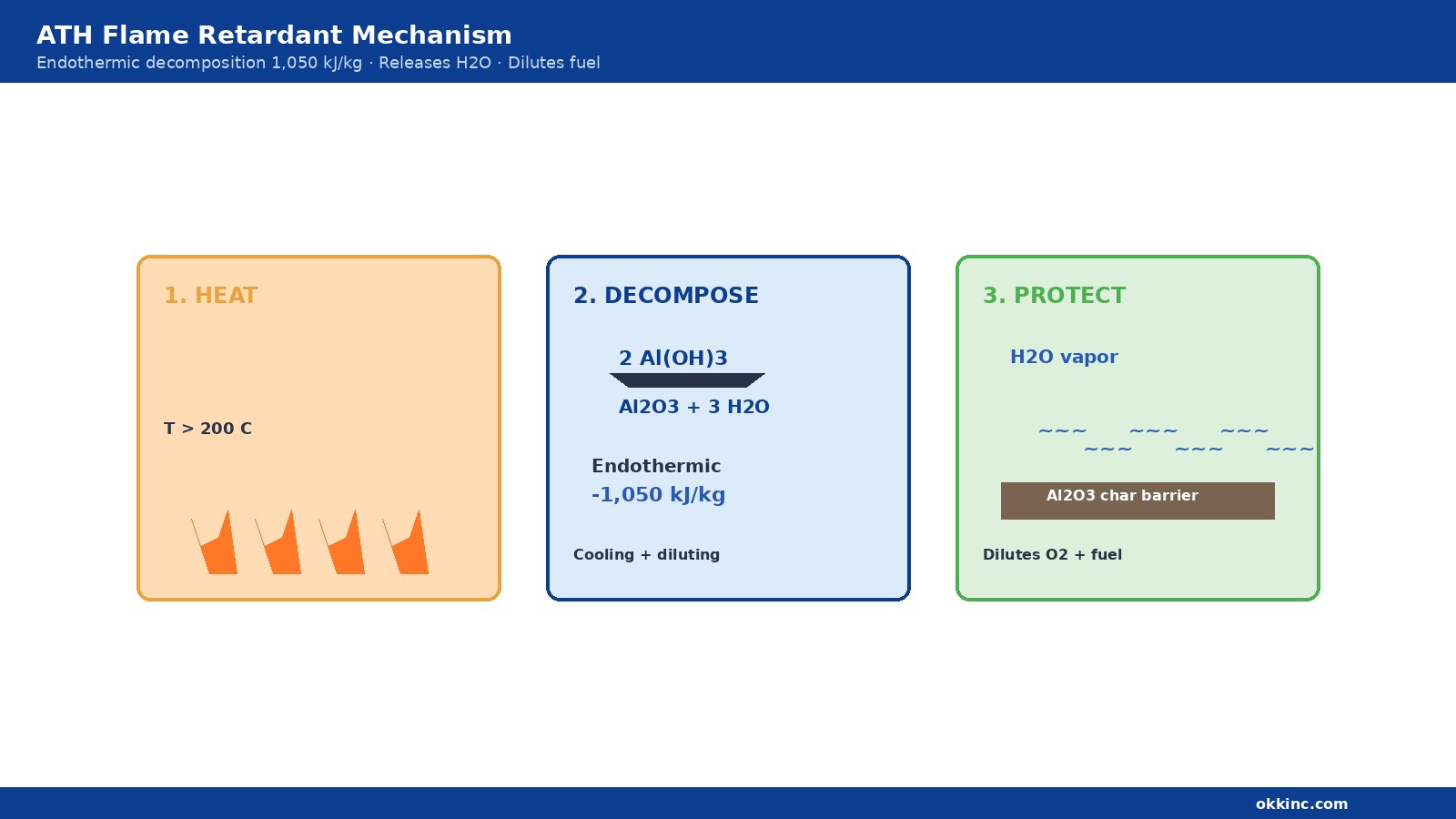
ATH (aluminum hydroxide) and MDH (magnesium hydroxide) are the two dominant metal hydroxide flame retardants, together accounting for over 95% of the non-halogen flame retardant market. While both work by endothermic decomposition and water release, the differences in decomposition temperature, loading efficiency, and processing behavior lead to very different applications.
ATH flame retardant mechanismThe quick rule: ATH for polymers processed below 220°C, MDH for polymers processed above 220°C. Below that threshold, ATH wins on loading efficiency and cost. Above that threshold, only MDH survives the processing temperature.
At Aluminaworld, we manufacture ATH but not MDH. The comparison below is provided to help our customers make informed decisions, including the cases where MDH is the right answer and we will refer you to a qualified supplier.
1. Decomposition Temperature: The Critical Difference
ATH decomposes at 200 to 300°C. MDH decomposes at 300 to 400°C. This 100°C shift drives most of the application differences:
| Property | ATH | MDH |
|---|---|---|
| Decomposition onset | 200°C | 300°C |
| Endothermic energy | 1,300 kJ/kg | 1,450 kJ/kg |
| Water release | 35 wt% | 31 wt% |
| Density | 2.42 g/cm³ | 2.36 g/cm³ |
| Mohs hardness | 3.0 | 2.5 |
| Price (per MT) | $400 to $800 | $700 to $1,400 |
The 100°C shift in decomposition window makes MDH the only choice for high-temperature thermoplastics like polyamides (nylon, processed at 260 to 290°C) and engineering plastics. ATH would decompose during processing if used in these polymers, causing bubbling and porosity in the final part.
2. Loading Efficiency: ATH Wins
For the same flame retardancy performance, ATH requires 5 to 10% lower loading than MDH in equivalent polymer systems. The reasons:
- Higher water release (35% vs 31%)
- Lower density (more particles per kg for the same volume loading)
In practice, the lower density of MDH offsets its higher endothermic energy, resulting in slightly higher loading requirements to achieve the same UL94 rating. For LSZH cable compounds using EVA, the difference is typically 60% ATH vs 65% MDH for the same V-0 rating.
Cone Calorimeter Comparison (EVA + 60% filler)
- ATH: Peak Heat Release Rate (PHRR) 180 kW/m², Total Heat Released 65 MJ/m²
- MDH: PHRR 210 kW/m², Total Heat Released 72 MJ/m²
- ATH performs about 15% better at the same loading
3. When MDH Wins: High-Temperature Polymers
MDH is the right choice in three scenarios:
- Polyamides (nylon 6, nylon 66). Processed at 260 to 290°C. ATH would decompose. MDH at 50 to 60% loading gives UL94 V-0 with acceptable mechanical properties.
- Polypropylene processed above 230°C. Some high-melt-flow PP grades for nonwoven and film applications process at 230 to 250°C. ATH would degrade; MDH at 55 to 65% loading works.
- Engineering plastics (PBT, PET, PC blends). Processed at 260 to 300°C. Only MDH survives.
Hybrid ATH/MDH Systems
For polymers processed at 200 to 240°C, right at the boundary, many formulators use a hybrid system: 70 to 80% ATH + 20 to 30% MDH. This combines the higher loading efficiency of ATH with the higher temperature tolerance of MDH, giving better overall performance than either alone.
If you are unsure which flame retardant is right for your polymer system, our technical team can review your processing conditions and recommend the optimal grade or blend. We supply ATH grades and can refer you to qualified MDH suppliers for the cases where MDH is the right answer.
Frequently Asked Questions
Can I blend ATH and MDH in the same formulation?
Yes. Many LSZH cable compounds use 70:30 or 80:20 ATH:MDH blends to balance cost, loading efficiency, and processing margin.
Which is better for PVC?
ATH is the standard for PVC flame retardancy. MDH is less common because PVC is typically processed at 160 to 200°C, well within ATH's stability window.
Does MDH produce different decomposition products?
MDH decomposes to MgO + H2O, similar to ATH's Al2O3 + H2O. Neither produces toxic gases. Both leave a mineral residue.
Is there a price premium for surface-treated grades?
Yes, 20 to 30% premium for both ATH and MDH. Surface treatment is critical for loadings above 50 wt% in polyolefins.
What is the minimum order quantity?
1 MT for standard grades, 5 MT for custom surface treatments. Trial samples of 1 kg available for lab evaluation.
Related Aluminum Hydroxide Articles
ATH Flame Retardant Mechanism: Why Aluminum Hydroxide Cools and Chars
Surface-Treated ATH: How Silane Coating Improves Polymer Loading and Dispersion
ATH in Artificial Marble: How Aluminum Hydroxide Enables Stone-Look Surfaces
ATH flame retardant mechanism
surface-treated ATH vs unmodified
Alumina Powder Ceramic Glaze Application
Need a Quote or Free Sample?
Tell us your feed conditions and target outlet spec. Our engineers reply within 24 hours with a recommendation and a 1 kg free sample.