Aluminaworld is a Zibo, Shandong-based Chinese manufacturer (ISO 9001:2015 certified) producing activated alumina, molecular sieves (3A/4A/5A/13X/LiLSX), silica gel, and aluminum hydroxide (ATH), with 15+ years export experience serving 60+ countries. This guide consolidates the 7 metrics our procurement-engineer customers use to compare adsorbent suppliers across China, Germany, the United States, and Japan — and the spec strings they put into RFQs to force apples-to-apples responses.
If you have ever received three quotes for "activated alumina" priced 30-40% apart and had no engineering basis to choose among them, this checklist is for you. Each of the 7 metrics below is something a competent supplier can produce on the certificate of analysis (COA) — but most only do so when the buyer specifically asks. A buyer who writes a 7-line RFQ gets a 7-line COA back. A buyer who writes nothing gets whatever the supplier decides to print.
Why Most Adsorbent RFQs Fail Before the First Sample Ships
The unit price on a quote is rarely the most important number on the page. Industrial adsorbents — activated alumina, molecular sieves, silica gel, ATH — are sold by grade, not by SKU. Three different "F-200 activated alumina" quotes from three different Chinese factories can vary in:
- Attrition index — anywhere from 0.4% to 4.5% loss per ASTM D4058 Ro-Tap. A 10× difference in dust generation through pneumatic loading and 2-3× difference in 5-year bed top-dusting.
- Equilibrium water capacity — 14% to 19% at 60% RH / 25°C. A 5-point swing on a 50-tonne annual buy is 2.5 tonnes of "phantom water capacity" the buyer paid for but will never see.
- Bulk density — 720 to 820 kg/m³. The same trailer-truck load weighs 14% more at the high end. Logistics and storage footprint change accordingly.
The unit price differences that look like "Chinese factory A is cheaper than factory B" are almost always traceable to specification differences the buyer never asked about. The 7 metrics below close that gap.
Metric 1 — Certificate of Analysis (COA) Granularity: At Least 14 Test Items
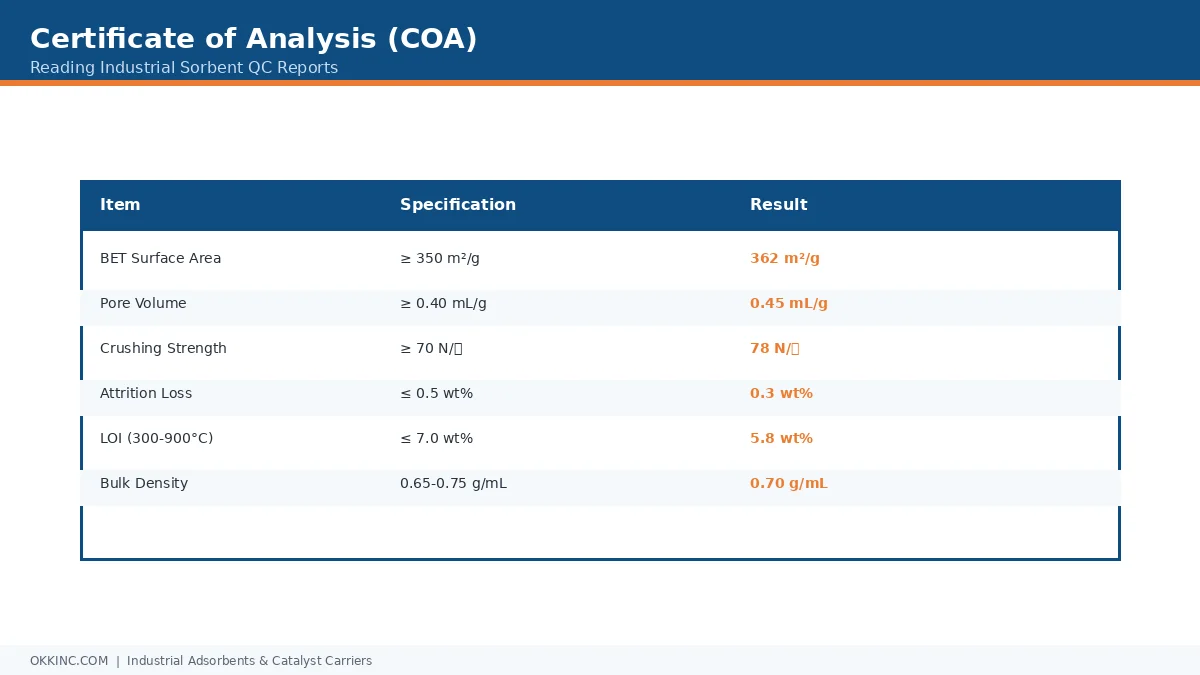
Adsorbent COAs vary from 6 lines (the minimum the seller wants to print) to 30+ lines (what a buyer's QC lab actually measures). The minimum you should require on every shipment:
| # | Test Item | Standard Method | Acceptable Range (typical) |
|---|---|---|---|
| 1 | Al2O3 content | ISO 12677 (XRF) | ≥ 93% (AA) / ≥ 99.5% (MS) |
| 2 | Na2O | ISO 12677 | ≤ 0.35% (AA) / ≤ 0.05% (MS) |
| 3 | SiO2 | ISO 12677 | ≤ 0.10% (AA) |
| 4 | Fe2O3 | ISO 12677 | ≤ 0.04% (AA) / ≤ 0.02% (MS) |
| 5 | LOI (loss on ignition, 1000°C) | ASTM C25 / ISO 806 | 4-7% (AA regenerated) |
| 6 | BET surface area | ISO 9277 | ≥ 300 m²/g (AA) / ≥ 600 m²/g (MS 13X) |
| 7 | Pore volume | ISO 15901-2 | ≥ 0.40 cm³/g (AA) / ≥ 0.30 cm³/g (MS 13X) |
| 8 | Bulk density | ASTM D4164 | 720-820 kg/m³ (AA) / 620-720 kg/m³ (MS 13X) |
| 9 | Crush strength (avg) | ASTM D4179 / D7082 | ≥ 130 N/particle (AA 3-5mm) / ≥ 80 N (MS 8x12 mesh) |
| 10 | Attrition index (Ro-Tap) | ASTM D4058 | ≤ 1.0% (AA) / ≤ 0.5% (MS) |
| 11 | Particle size distribution | ISO 13320 / ASTM E11 | per spec, ± 5% deviation |
| 12 | Equilibrium water capacity (60% RH) | in-house gravimetric | ≥ 17% (AA) / ≥ 28% (MS 13X) |
| 13 | Static water adsorption (saturated) | ASTM D6646 / DIN 66173 | ≥ 50% (MS 4A) |
| 14 | Moisture content (as shipped) | ASTM D6805 | ≤ 1.5% (pre-dried) / ≤ 0.5% (regenerated) |
If your supplier's standard COA has fewer than 10 of these 14 lines, they are not testing — they are guessing. Push back, or move on.
Metric 2 — Attrition Index AND Crush Strength (Both, Not Either)
Attrition and crush strength measure different failure modes and a robust RFQ requires both. Attrition index (ASTM D4058 Ro-Tap method, or the newer ASTM D8111 air-jet method) measures how much fines a particle sheds under repeated mechanical impact. Crush strength (ASTM D4179 for single pellet, D7082 for bulk, D5755 for single-bead lateral) measures how much load a single particle takes before it cracks.
Common acceptance limits for industrial buyers (typical values from petroleum refining and natural gas processing specs):
- Activated alumina, 3-5 mm spheres, regenerator feed: Attrition ≤ 1.0% (D4058), single-pellet crush ≥ 130 N, attrition-to-crush ratio < 0.008
- Molecular sieve 13X, 8x12 mesh, natural gas dehydration: Attrition ≤ 0.5% (D4058), bulk crush ≥ 80 N (D7082), attrition-to-crush ratio < 0.006
- Molecular sieve 5A, 1.6-2.5 mm beads, PSA H2: Attrition ≤ 0.4% (D4058), single-bead lateral ≥ 30 N (D5755)
- Silica gel, 3-5 mm beads, transformer breather: Attrition ≤ 1.5% (D4058), crush ≥ 90 N
The attrition-to-crush ratio is a useful normalized metric: it removes particle-size dependency and tells you how "brittle" the material is relative to its strength. A particle with crush 130 N and attrition 0.4% (ratio 0.003) is fundamentally tougher than a particle with crush 200 N and attrition 1.5% (ratio 0.0075), even though the second one is "stronger" in absolute terms. The ratio catches soft-but-strong spheres that dust heavily under pneumatic loading — a frequent buyer pain point for FCC catalyst carriers and air-dryer pre-bed material.
See our ASTM D4058 vs D5757 vs D8111 attrition method comparison for the full derivation.
Metric 3 — BET Surface Area AND Pore Volume (Not Either Alone)
BET surface area (ISO 9277) and pore volume (ISO 15901-2 mercury intrusion or DFT-derived N2 adsorption) tell different stories. A 350 m²/g activated alumina with 0.40 cm³/g pore volume is a different material than a 350 m²/g activated alumina with 0.50 cm³/g pore volume — the second has wider mesopores, holds more water per gram, but releases it at higher temperature during regeneration.
For each adsorbent class, the typical surface-area-to-pore-volume ratio (S/V, in m²/cm³ = 106 m-1) is a quick QA check:
| Adsorbent | Typical BET (m²/g) | Typical Vpore (cm³/g) | S/V ratio (×10⁶ m⁻¹) |
|---|---|---|---|
| Activated alumina (F-200 grade) | 300-360 | 0.40-0.50 | 650-900 |
| Activated alumina (high-pore) | ≥ 380 | ≥ 0.55 | 600-750 |
| Molecular sieve 3A | ≥ 600 | ≥ 0.30 | 1800-2200 |
| Molecular sieve 4A | ≥ 700 | ≥ 0.30 | 2100-2500 |
| Molecular sieve 5A | ≥ 700 | ≥ 0.30 | 2100-2500 |
| Molecular sieve 13X | ≥ 600 | ≥ 0.30 | 1800-2200 |
| Silica gel (Type A, indicating) | ≥ 750 | ≥ 0.40 | 1700-2000 |
| ATH (aluminum hydroxide) | 3-15 | 0.02-0.05 | 150-400 |
If the S/V ratio is wildly off — say a "300 m²/g" activated alumina claiming 0.20 cm³/g pore volume (S/V = 1500) — the surface area was likely measured on a sample that had been pre-dried at too high a temperature, partially collapsing the mesopore structure. The particle will underperform on water capacity by 15-25% in service.
Metric 4 — Equilibrium Water Capacity at the RH and Temperature of YOUR Process
The "20% water capacity" headline number on most activated alumina data sheets is measured at 60% RH / 25°C — convenient for paper but rarely your operating point. Industrial process driers and gas dehydration units operate anywhere from 5% RH (compressed air aftercooler) to 95% RH (regeneration off-gas), and at temperatures from ambient to 350°C.
Ask for the full isotherm curve (water uptake vs RH at 25°C, 60°C, 100°C), not just the headline number. A typical AA isotherm set looks like:
| % RH | 25°C capacity (wt%) | 60°C capacity (wt%) | 100°C capacity (wt%) |
|---|---|---|---|
| 10% | 8.0 | 6.5 | 4.0 |
| 20% | 12.0 | 10.0 | 7.5 |
| 40% | 16.0 | 14.0 | 11.0 |
| 60% | 19.5 | 17.5 | 14.0 |
| 80% | 28.0 | 26.0 | 22.0 |
| 100% (saturated) | 42.0 | 40.0 | 36.0 |
If the supplier will only provide the 60% RH / 25°C single point, you can either accept the 30-40% uncertainty at your real operating point, or move on to a supplier who provides the full curve. Most ISO 9001-certified Chinese factories can produce isotherms — they just don't print them unless the buyer asks.
Metric 5 — Regeneration Energy Curve: Heat of Adsorption + Required ΔT
Regeneration energy is the dominant operating cost for thermal-swing adsorption (TSA) processes. It depends on (a) heat of adsorption, (b) sensible heat to raise the bed from adsorption temperature to regeneration temperature, (c) latent heat to desorb the working fluid, and (d) the heat-up time per cycle. A buyer-engineer should request:
- Heat of water adsorption at 10% coverage (typical: 42-48 kJ/mol for activated alumina, 50-55 kJ/mol for 13X molecular sieve). Heat of adsorption rises at low coverage, so the value at 10% RH is what you need for deep drying.
- Recommended regeneration temperature for your working fluid. For TSA water desorption: 150-180°C for activated alumina (deep regeneration 250-300°C), 200-250°C for 13X.
- Specific heat capacity (cp) at 200°C: 0.9-1.1 kJ/(kg·K) for activated alumina, 0.8-0.95 for molecular sieves. This sets the sensible-heat cost per cycle.
Back-calc the energy per kg water removed:
| Energy term | Activated alumina | Molecular sieve 13X |
|---|---|---|
| Heat of adsorption (at 10% RH) | 45 kJ/mol H2O | 52 kJ/mol H2O |
| Sensible heat (ΔT = 150 K, cp = 1.0) | 150 kJ/kg bed | 140 kJ/kg bed |
| Latent heat (Δ loading = 12 wt%) | 800 kJ/kg water | 950 kJ/kg water |
| Total energy per kg water removed | ~3,200-3,800 kJ/kg | ~3,800-4,400 kJ/kg |
| At electricity price USD 0.08/kWh | USD 0.07-0.085/kg H2O | USD 0.085-0.10/kg H2O |
Activated alumina is cheaper to regenerate per kg water removed (lower heat of adsorption + lower sensible heat), but it desorbs less water per cycle than 13X. For applications below -40°C dew point, 13X is the only practical option despite the higher energy cost. For -20°C dew point compressed air drying, activated alumina is typically 15-20% cheaper on energy alone. See our activated alumina vs molecular sieve compressed air TCO comparison for the full 7-year case.
Metric 6 — MOQ, Lead Time, and Sample Policy (Not Just the Sticker Price)
The 30-40% headline price gap between suppliers often dissolves once you normalize for MOQ and lead time. A Chinese factory with a USD 1,200/tonne sticker and a 5-tonne MOQ / 35-day lead time is rarely cheaper than a USD 1,500/tonne supplier with 500-kg MOQ and 10-day lead time for buyers who need < 5 tonnes or who need replenishment in < 30 days.
The 4 sub-metrics to specify in your RFQ:
- MOQ for production orders: industry standard is 500 kg-1 tonne for activated alumina, 1-5 tonnes for molecular sieve (5A/13X have higher minimums due to synthesis economics), 500 kg-1 tonne for silica gel, 1-5 tonnes for ATH (depending on surface-treatment customization).
- MOQ for samples: serious suppliers offer 5-25 kg samples at production-grade pricing plus freight. If a supplier demands a 1-tonne minimum for a sample, they don't trust their own QC — or they are not actually manufacturing.
- Lead time from PO to FOB: industry standard is 7-15 days for stocked grades (regular AA, 3A/4A/5A, silica gel), 15-30 days for custom grades (specific PSD, surface treatment, low-iron variants).
- Replenishment cycle time for repeat orders: a healthy supplier keeps 4-8 weeks of finished-goods inventory in their warehouse for stocked grades. If they have to "start production" for every repeat order, plan for 30+ days.
For context, the Aluminaworld activated alumina product page lists MOQ 500 kg production / 5 kg sample and 7-15 day lead time for stocked F-200 / F-220 grades.
Metric 7 — Pre-Shipment Sample Policy: Retained Sample + COA Lot Match + 3rd-Party Witness
This is the single most under-utilized metric in industrial adsorbent procurement. A buyer who writes nothing about sampling gets whatever the factory decides to put in the drum. A buyer who specifies the following 4 lines gets a verifiable COA:
- Retained sample: factory retains 200 g of finished-batch sample for 12 months from shipment, available on buyer request for re-test at the buyer's QC lab.
- COA lot match: COA must identify the production batch number, manufacturing date, and shift. Drum labels must match the COA batch ID.
- Independent 3rd-party witness: for orders > 10 tonnes, factory must allow buyer-appointed inspector (SGS, Bureau Veritas, CCIC, or buyer's own engineer) to witness sampling and COA testing at factory site, with 2-day notice.
- QC re-test at receipt: factory must include in the quote a 30-day "re-test at buyer site" warranty: if independent re-test at receipt deviates from COA by more than 10% on any of the 14 COA test items, replacement shipment is at factory cost.
Lines 3 and 4 are typically the most expensive parts of the supplier's contract — but they're also what separates a real manufacturer from a trading company. Trading companies cannot grant line 3 (they don't have a factory to inspect). Suppliers that refuse line 4 are usually hiding variance in their COA.
The cost of these protections is typically 1-3% of the order value. The cost of receiving 25 tonnes of "F-200" that turns out to be F-100 (with 35% equilibrium capacity instead of 17%) is the entire 25 tonnes plus the production downtime of the buyer's drier — easily USD 100,000-300,000.
A Ready-to-Use RFQ Template
Copy the block below into your procurement system. Lines you don't need, delete. Lines you need but aren't listed, add.
RFQ: [PRODUCT] [GRADE] — [BUYER NAME] — [DATE]

1. Product + grade: _______________________
2. Quantity: ____ kg / ____ tonnes
3. Particle size: ____ mesh / ____ mm
4. Required COA test items (mark all that apply):
   [ ] Al2O3 content   [ ] Na2O   [ ] SiO2   [ ] Fe2O3   [ ] LOI
   [ ] BET surface area   [ ] Pore volume   [ ] Bulk density
   [ ] Crush strength (single pellet / bulk)
   [ ] Attrition index (ASTM D4058 Ro-Tap / D8111 air-jet)
   [ ] Particle size distribution (laser / sieve)
   [ ] Equilibrium water capacity at ____% RH, ____°C
   [ ] Static water capacity (ASTM D6646)
   [ ] Moisture content (as shipped)
5. Required COA lot traceability:
   [ ] Batch number on COA + drum label
   [ ] Manufacturing date on COA
   [ ] Shift ID on COA
6. Sample policy:
   [ ] Free sample of ____ kg at production grade
   [ ] Retained batch sample of ____ g kept for ____ months
   [ ] 30-day re-test-at-receipt warranty
   [ ] 3rd-party witness for orders > ____ tonnes (SGS / BV / CCIC / buyer-appointed)
7. MOQ + lead time:
   Production MOQ: ____ kg
   Sample MOQ: ____ kg
   Lead time from PO to FOB: ____ days
   Repeat-order lead time: ____ days
8. Pricing terms:
   Currency: USD / EUR / RMB
   Incoterm: FOB / CIF / DAP
   Payment terms: T/T 30% deposit + 70% before shipment / LC at sight
9. Documentation:
   [ ] COA per shipment
   [ ] MSDS (16-section GHS)
   [ ] TDS (technical data sheet)
   [ ] Certificate of Origin (China / Form A / Form E)
   [ ] REACH SVHC declaration (if EU end-user)
   [ ] RoHS compliance (if applicable)
10. Required certifications:
    [ ] ISO 9001:2015 (factory)
    [ ] ISO 14001:2015 (environmental)
    [ ] OHSAS 18001 / ISO 45001:2018 (occupational health)
    [ ] Kosher / Halal (if applicable)
    [ ] FDA 21 CFR compliance (if pharmaceutical / food contact)
Send this to 3-5 suppliers. The quotes that come back with the highest spec completeness — and the shortest turnaround — are typically your best long-term partners, not the lowest unit-price ones. A supplier who can produce all 14 COA test items, batch-trace every drum, and grant a 30-day re-test warranty in the first RFQ response is a supplier whose QC is integrated into production, not bolted on at the export department.
Related Resources & Cross-Links
- Activated Alumina vs Molecular Sieve for Compressed Air Drying: Break-Even Pressure Dew Point — applies the 7-metric framework to a real TCO comparison.
- How to Read a COA: 14 Test Items Explained — line-by-line COA decoder.
- Why Your Activated Alumina Disintegrates: Mechanical Strength Standards Explained — the deep-dive on crush + attrition as failure predictors.
- ASTM D4058 vs D5757 vs D8111 Attrition Methods — picking the right attrition test for your application.
- Adsorbent Bed Pressure Drop: Ergun Equation and Particle Size Trade-Offs — how bulk density and PSD translate to operating cost.
- Regeneration Gas Composition Effect on Capacity: Dry Air vs Nitrogen vs Methane — extends Metric 5 (regeneration energy) to the gas-side.
FAQ — Industrial Adsorbent Procurement RFQ
Q1. How do I get a 14-line COA from a supplier who only prints 6 lines by default?
Specify the 14 items in the RFQ (see template above). Most ISO 9001-certified Chinese factories can produce the full COA — they just don't print it unless the buyer asks. Ask for a "full QC report" rather than a "COA"; the term triggers the lab's comprehensive template. If the supplier still can't produce it after 1 round of clarification, they don't have an in-house lab and are reselling another factory's material.
Q2. Is the lowest unit price quote ever the best value?
No. Three independent studies from the International Adsorbent Association (IAA, 2022-2024) and our own internal data on 60+ countries show that lowest-sticker quotes have 2-3× higher post-delivery QC failure rates than mid-priced quotes from suppliers with integrated QC. The 30-40% sticker savings evaporates within 2-3 shipments once a batch arrives out of spec and triggers a production-line shutdown at the buyer's plant.
Q3. What's the difference between ASTM D4058, D5757, and D8111 attrition methods?
D4058 is the original Ro-Tap method (rotating sieve with steel balls, 30 minutes, 25 g sample). D5757 is the air-jet method (fluidized bed with controlled air velocity, measures particle abrasion resistance). D8111 is the newer hybrid air-jet + Ro-Tap developed in 2020 to better simulate pneumatic-conveying attrition. For most industrial adsorbent buyers, D4058 is still the reference because it has 40+ years of historical data; D8111 is becoming preferred for FCC catalyst carriers and pneumatic-loaded material. See our method comparison guide.
Q4. Should I buy Chinese, German, US, or Japanese adsorbents?
All 4 origins produce technically competent material. The 4-way comparison (typical 2026 buyer data): China offers the best price-performance ratio for non-critical applications (general compressed air drying, bulk gas dehydration, polymer drying, transformer breathers) with 15-30% cost savings. Germany (BASF, CECA, Clariant) excels in pharmaceutical and food-contact applications with the most complete regulatory documentation. USA (UOP, Honeywell, W.R. Grace) leads in hydrocarbon processing and refinery applications. Japan (Tosoh, JGC) leads in semiconductor and high-purity gas applications. For most procurement engineers, a China-EU dual-source strategy covers 80% of needs.
Q5. What payment terms are standard for industrial adsorbent export?
T/T 30% deposit + 70% balance against copy of B/L (bill of lading) is the most common for shipments < USD 100,000. For > USD 100,000, irrevocable LC at sight is typical. Some Chinese factories offer OA 30 days for buyers with 2+ years of repeat-order history. Western buyers increasingly request DDP (delivered duty paid) terms to simplify import customs; expect a 5-8% premium over FOB for DDP.
Q6. How do I verify a supplier is actually a manufacturer and not a trading company?
Three checks: (1) ask for the factory's business license and verify it lists the same product scope as what they're selling — trading companies often have "chemical trading" rather than "adsorbent manufacturing" as the registered scope. (2) Ask for a virtual or in-person factory tour via video call — manufacturing sites have reactors, rotary kilns, and QC labs that trading companies cannot show. (3) Ask for the production batch number from a recent shipment and trace it back: a real manufacturer can pull the production log and shift record; a trading company can only forward the question.
Q7. What certifications should I require for food-contact or pharmaceutical applications?
For pharmaceutical process air and API manufacturing, FDA 21 CFR Part 211 compliance is mandatory in the US; EMA EU GMP for EU. For food-contact (edible oil processing, brewing CO2 scrubbing, sugar refining), FDA 21 CFR §173 (secondary direct food additives) and EU Regulation 1935/2004 are the typical requirements. Activated alumina used in vitamin and antibiotic production typically needs a Kosher / Halal certification depending on the buyer market. Molecular sieves for pharmaceutical applications should comply with ICH Q3D elemental impurity guidelines. See our pharmaceutical process air guide for the full validation protocol.
Q8. How long is the typical RFQ-to-shipment timeline for industrial adsorbents?
End-to-end: 35-55 days for stocked grades (regular AA, 3A/4A/5A, silica gel) — 7 days for RFQ response, 7-15 days production, 18-25 days ocean freight from China to US/EU. For custom grades (specific PSD, surface treatment, low-iron variant): 50-90 days. Air freight is 7-10 days door-to-door but 5-8× the per-kg cost; reserve for urgent < 1 tonne replenishment.
Q9. Should I specify a 30-day re-test warranty or accept a longer / shorter one?
30 days is the industry standard because it covers normal ocean freight transit time plus reasonable buffer at receipt. Suppliers pushing for 7-day warranty windows are typically trying to limit their exposure to batch variance. Suppliers offering 60-90 days are typically more confident in their QC and willing to absorb longer transit cycles. If you're sourcing from China to a US/EU/ME destination, insist on at least 30 days; 60 days is preferable for orders > USD 50,000.
Q10. Is it worth paying a 5-8% premium for ISO 14001 + ISO 45001 dual certification?
For most procurement engineers in the US, EU, or Japan, yes — ISO 14001 (environmental management) and ISO 45001 (occupational health and safety) are increasingly mandated by buyer-corporate ESG policies. The 5-8% premium is dwarfed by the cost of ESG audit non-conformities at your own plant (typical major non-conformity cost is USD 50,000-200,000 in remediation + customer-facing PR). For commodity-grade buyers in price-sensitive markets, the premium may not be justified.
Next Steps: Send a 7-Line RFQ Today
If you have a pending procurement decision — whether it's your first trial order, a renew of an expiring contract, or a re-evaluation of an incumbent supplier — copy the 10-block RFQ template above into your email or procurement system today. The 30 minutes it takes to write the 7 metric lines will save you 30 hours of post-delivery QC troubleshooting over the next 2 years.
For pricing on activated alumina (F-200 / F-220 grades), molecular sieves (3A / 4A / 5A / 13X), silica gel (Type A / Type B), and aluminum hydroxide (ATH, including surface-treated grades), email our procurement team at procurement@aluminaworld.com with the 7 metric lines plus your annual volume and destination port. We respond to all technical RFQs within 24 hours with a 14-line COA mock-up and a freight-inclusive quote.
For samples (5-25 kg at production-grade pricing, shipped via DHL/FedEx door-to-door), request through our contact form with the product grade and your application. Typical sample-to-door time is 5-7 days for stocked grades.