Molecular Sieve 3A
Potassium-A zeolite with a 3 Å pore that admits water and almost nothing else — for insulating glass, ethanol dehydration, refrigerants and cracked-gas drying.
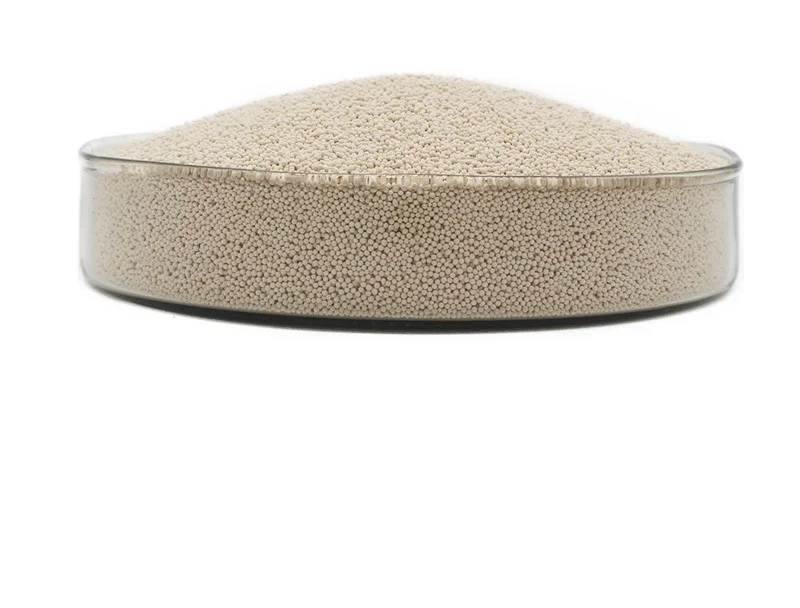
Overview
Type 3A is made by exchanging the sodium ions of a 4A crystal with larger potassium ions, which narrows the effective pore opening to about 3 ångströms. Water (kinetic diameter 2.6 Å) and ammonia still enter freely; ethanol, propylene, butadiene and refrigerant molecules are too large and are excluded.
That selectivity is the whole point of the grade: the sieve dries a stream without co-adsorbing the product itself, so there are no yield losses and no oligomerisation side reactions in reactive olefin service. Where a process must remove water only — and leave everything else untouched — 3A is the standard choice.
Applications
- Insulating-glass units — spacer desiccant that also scavenges sealant volatiles
- Ethanol dehydration to fuel grade (vapour-phase, two-bed systems)
- Refrigerant drying in filter-driers (CFC, HFC, HCFC circuits)
- Cracked gas and olefin drying — ethylene, propylene, butadiene
- Polar liquid drying — methanol, ethanol, isopropanol
- Jet fuel and hydrocarbon stream drying
Specifications
| Property | Molecular Sieve 3A |
|---|---|
| Chemical formula | 0.4K₂O · 0.6Na₂O · Al₂O₃ · 2.0SiO₂ · 4.5H₂O |
| Bead sizes | 1.5–3.0 · 3.0–5.0 mm (pellets on request) |
| Equilibrium water capacity | ≥ 21.0 wt% (25 °C, 50% RH) |
| Crush strength | ≥ 60 N (1.5–3.0 mm) · ≥ 120 N (3.0–5.0 mm) |
| Bulk density | 0.68–0.75 g/cm³ |
| Attrition loss | ≤ 0.10 wt% |
| Package moisture | ≤ 1.5 wt% |
Insulating-glass grade
| Property | IG Grade 3A |
|---|---|
| Bead sizes | 1.0–2.0 · 1.5–2.5 mm |
| Equilibrium water capacity | ≥ 22.0 wt% (25 °C, 50% RH) |
| Attrition loss | ≤ 0.05 wt% (ultra-low dusting, for automated filling lines) |
| Bulk density | 0.70–0.75 g/cm³ |
| Package moisture | ≤ 1.5 wt% |
| Nitrogen adsorption | Near zero — suitable for argon-filled units |
Typical values for orientation. The grade-specific datasheet governs any quotation — request it with your inquiry.
Packing, documents & delivery
Packing
25 kg bags, steel drums or bulk bags — the format is confirmed in the quotation and matched to your unloading and storage.
Documents
Datasheet before order, batch COA with shipment, packing list and commercial invoice with every consignment.
Delivery terms
Prices are quoted EXW Zibo. Ocean freight is calculated for your order and destination port at the time of quotation.
Frequently asked
3A or 4A — which does my dryer need?
If only water may be removed and the product molecules must not be adsorbed (ethanol, insulating glass, refrigerants, olefins), choose 3A. If the stream is a plain gas or air and capacity per volume matters most, 4A is usually the better-value starting point.
Which bead size for insulating glass?
1.0–2.0 mm for narrow spacers and 1.5–2.5 mm for standard aluminium or warm-edge spacers. The IG grade is specified at ≤ 0.05 wt% attrition so automated filling lines run without dust or bridging.
Can 3A dry ethanol to fuel grade?
Yes — vapour-phase 3A beds are the standard route from ~95% to fuel-grade ethanol, because the 3 Å pore admits water but excludes ethanol. Send your feed concentration and target water content and we will confirm bead size and bed loading.
Technical articles
- Molecular Sieve 3A: Ethanol Dehydration and Insulating Glass Applications
- Molecular Sieve 3A for Jet Fuel (Jet A-1 / JP-8) Drying: Why 3 Angstrom Pore Beats 13X, 4A, and Silica Gel
- Molecular Sieve 3a Refrigerant Drying
Request a quotation
To confirm the right grade, it helps to send: your application (IG, ethanol, refrigerant, gas drying), bead size in use today, target dew point or outlet water content, and the replacement window.
Tell us your process.
Get a reply from an engineer.
Send your application, current media and quantity. We will confirm the right grade, share the datasheet, and quote a clear EXW price — no obligation.