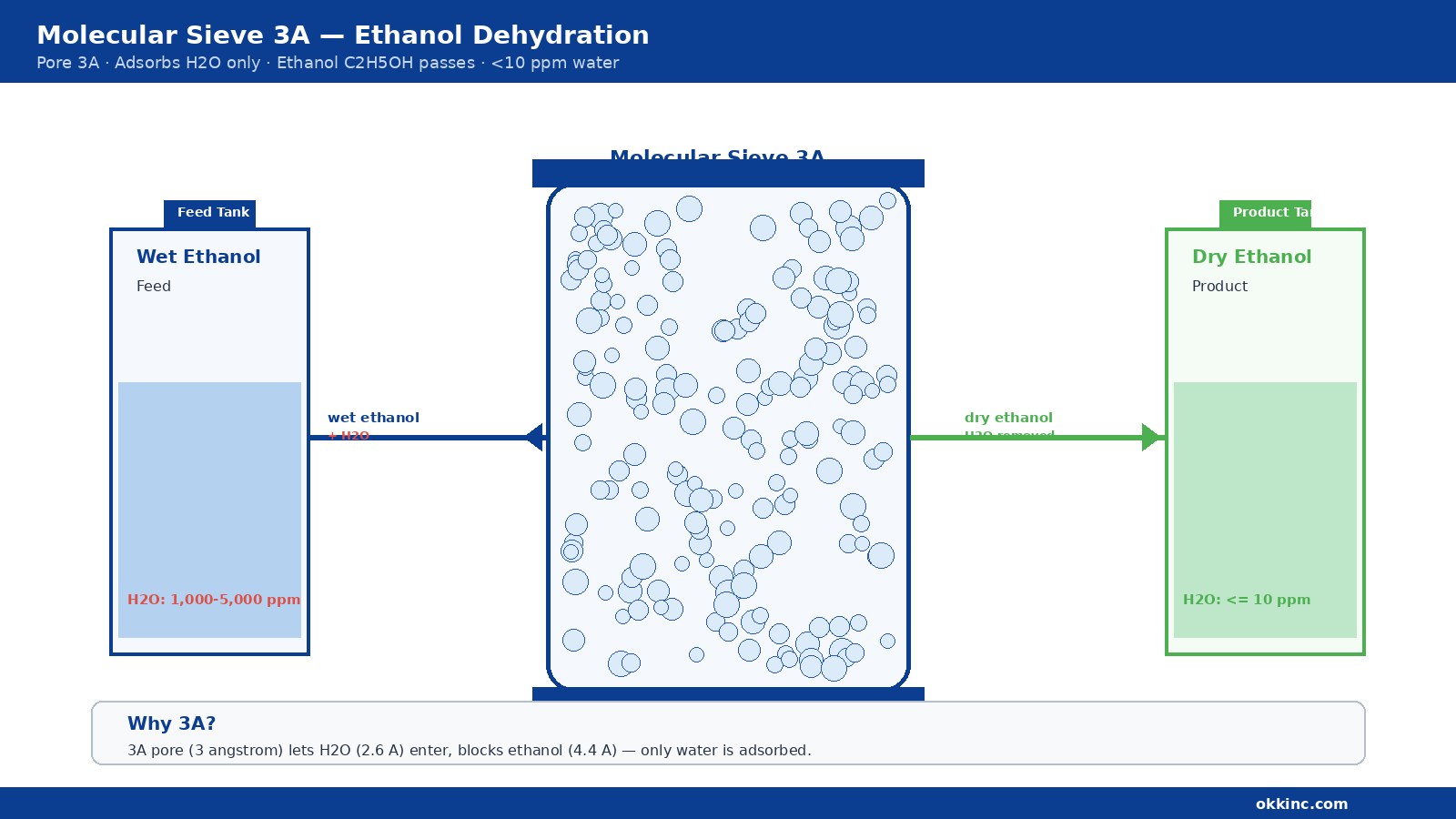
Molecular sieve 3A is the potassium-exchanged form of type A zeolite with an effective pore opening of 3 angstroms (0.3 nm). This narrow aperture is the secret behind its dominance in two specific applications: bioethanol dehydration to fuel-grade purity, and insulating glass unit (IGU) moisture control.
At Aluminaworld, our 3A production line runs 24/7 with monthly output of 600 MT. Approximately 55% goes to fuel ethanol plants in Brazil, India, and the United States; 30% serves IGU manufacturers in Germany, Turkey, and the Gulf states; the remaining 15% covers refrigerant drying and specialty gas applications.
This article walks through both end-uses in detail, with bed sizing numbers, regeneration cycle data, and field case studies. The section on molecular exclusion selectivity will save you weeks of trial-and-error if you are evaluating 3A for the first time.
1. Why 3A is the Only Viable Choice for Ethanol Dehydration
The reason 3A dominates ethanol dehydration is molecular exclusion: ethanol has a kinetic diameter of 4.4 angstroms, larger than 3A's 3-angstrom pore. Water (2.6 angstroms) passes into the crystal structure; ethanol cannot. The result is a physical separation that produces 200-proof (at least 99.5%) ethanol in a single pass through the bed.
For comparison, 4A (3.8 angstrom pore) admits ethanol and would be irreversibly poisoned within hours. 13X (10 angstrom pore) admits ethanol, water, and most C3+ alcohols, and would coke rapidly under regeneration temperatures.
Bed Sizing for a 50,000 L/day Ethanol Plant
A Brazilian corn-to-ethanol facility we supplied in early 2025 runs the following PSA configuration:
- Three adsorption vessels: 2.0 m diameter by 6.0 m straight side, 18.8 m³ bed volume each
- Bed depth 6.0 m using 1.6 to 2.5 mm beads, bulk density 0.75 g/mL
- Feed: 190-proof ethanol at 50°C, 4 bar absolute
- Cycle time: 8 minutes adsorption, 12 minutes regeneration (vacuum + N2 purge)
- Product water content: at most 150 ppm (target 100 ppm)
- 3A lifetime: 3 years before working capacity drops below 12 wt%
The plant produces 50,000 L/day of fuel-grade ethanol with energy consumption of 1.8 kWh per 1,000 L, about 35% lower than azeotropic distillation. The payback on the sieve bed versus the alternative distillation column was 14 months.
2. Insulating Glass Desiccant: 3A Beads vs Silica Gel
For insulating glass units, the desiccant sits inside the spacer bar and adsorbs moisture trapped during manufacture plus vapor that ingresses over the unit's 20-year service life. The target is to keep the internal cavity dew point below minus 60°C, equivalent to less than 5% relative humidity at 20°C.
Silica gel works in the short term but releases adsorbed water back into the cavity as cavity temperature cycles between day and night. Molecular sieve 3A holds water tenaciously; the isotherm shows less than 0.5% water release across a 0 to 60°C temperature swing.
3A Grades for IGU Spacer Bars
| Parameter | IGU Grade | Test Method |
|---|---|---|
| Bead Size | 0.5 to 1.0 mm | Sieve analysis |
| Equilibrium Capacity at 50% RH | at least 21 wt% | ASTM D5028 |
| Dust (After Tumbling) | at most 0.3 wt% | ASTM D4058 |
| Attrition Loss | at most 0.1 wt% | EN 12939 |
| Packaging | 25 kg PE bag or 500 kg drum | - |
A typical German IGU manufacturer we supply runs 80,000 units per month. Each unit uses 35 to 50 g of 3A bead. Our dust-controlled grade keeps the spacer fill line clean; competitor material with dust content over 0.5 wt% causes visible haze on the inner glass surface and customer rejects.
3. Regeneration and Lifetime Extension
Whether in ethanol service or IGU service, 3A eventually needs replacement. Ethanol plant beds last 3 to 4 years under proper regeneration; IGU spacer fill is single-use (life of the window).
Recommended Regeneration Profile for 3A in Ethanol Service
- Bed temperature: 220 to 260°C (avoid above 280°C, which damages the potassium exchange)
- Regeneration gas: N2 or dry CO2 at 0.3 to 0.5 m/s superficial velocity
- Cycle: heat-up 60 min, hold 120 min, cool-down 90 min (total 4.5 hours)
- Vacuum assist (50 mbar absolute) reduces hold time by 30 to 45 min if PSA cycle allows
One common failure mode we see in poorly-maintained plants: the heater is sized for fast cycle time but the bed experiences thermal shock, with temperature ramping at 8°C/min instead of the recommended 4°C/min. After 50 to 80 cycles, fines generation spikes and differential pressure rises. The fix is a heater upgrade plus a top-bed screen to retain fines.
If your 3A bed is showing capacity loss earlier than 24 months, send us the operating data and we will diagnose, typically within 24 hours.
Frequently Asked Questions
What is the working capacity of 3A for ethanol dehydration?
At 150°C regeneration and 1.5 bar absolute desorption pressure, expect 8 to 12 wt% working capacity. Higher regeneration temperature (240°C) pushes capacity to 14 wt% but shortens sieve life.
Can 3A be regenerated in place?
Yes, all molecular sieves including 3A are designed for in-situ regeneration via Temperature Swing Adsorption (TSA) or Pressure Swing Adsorption (PSA). Typical regeneration temperature is 220 to 260°C.
What is the difference between 3A and 4A?
3A has pore openings of 3 angstroms; 4A has 3.8 angstroms. 3A excludes ethanol, propene, and other molecules greater than 3 angstroms. 4A admits them, making 3A essential for ethanol drying.
Is 3A food-grade safe?
Yes, our 3A meets FDA 21 CFR 173.21 requirements for indirect food contact. We supply food-grade COA with every batch.
What is the minimum order quantity for 3A?
100 kg for standard grades; 25 kg samples available for evaluation. Production orders typically 5 to 25 MT per shipment.
Related Molecular Sieve Articles
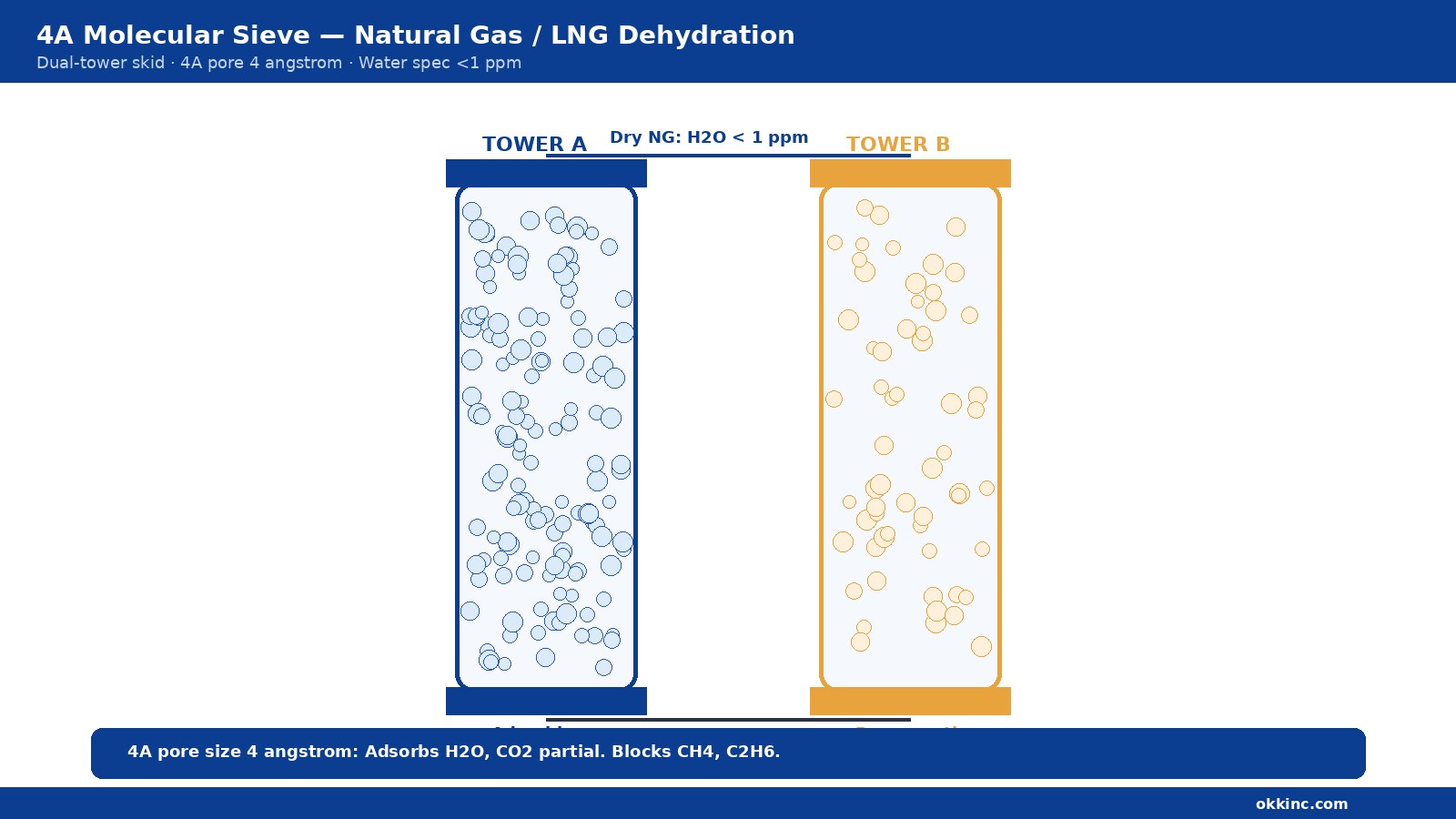
Molecular Sieve 4A for Natural Gas and LNG Dehydration: Capacity and Cycle Design
Molecular Sieve 5A vs 13X in PSA Hydrogen Purification: Which Grade Wins?
How to Regenerate Molecular Sieve: Temperature, Pressure and Cycle Best Practices
calculate the right 3A bed size
3A regeneration temperature profile
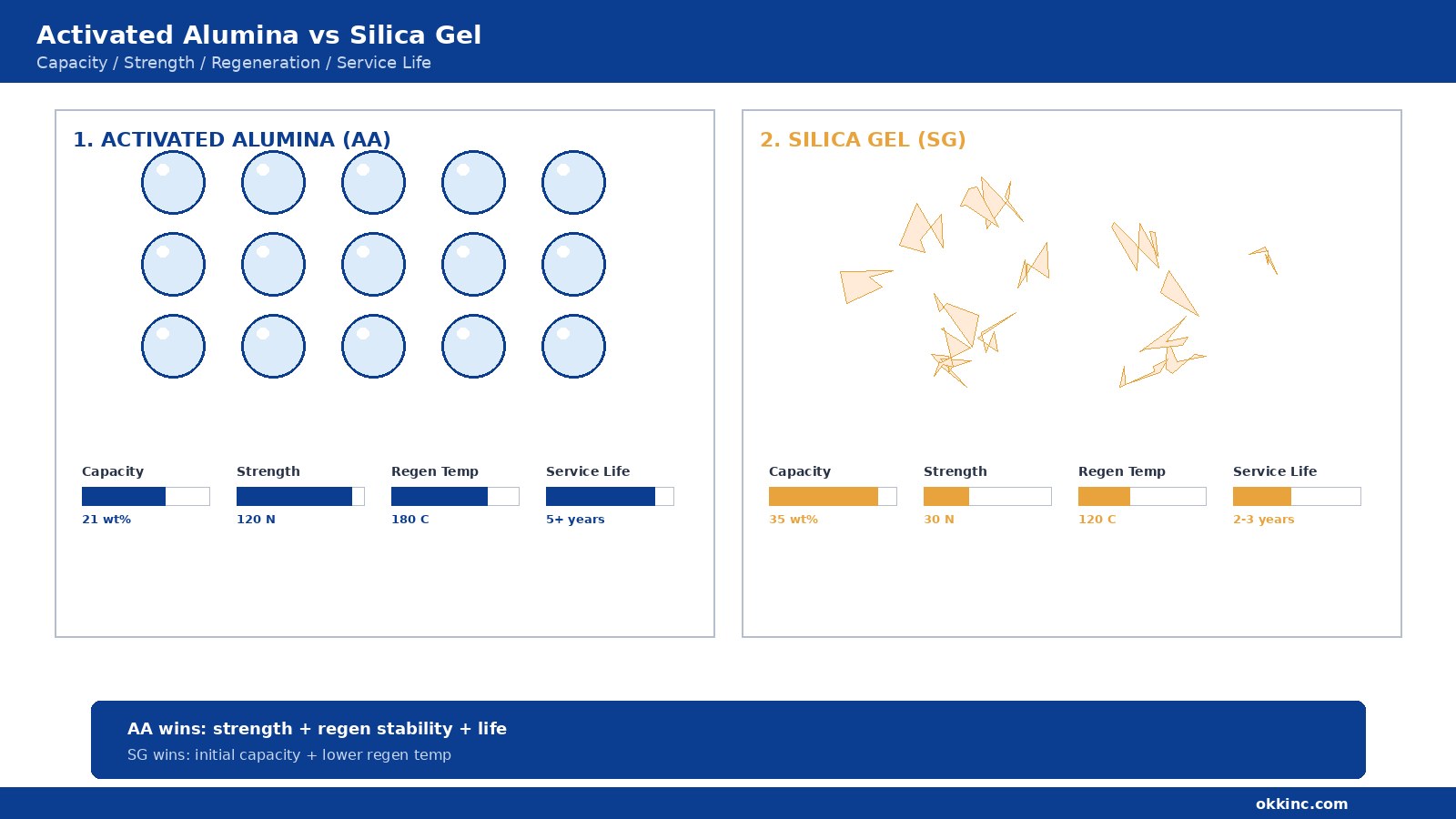
Activated Alumina Vs Silica Gel Desiccant
Need a Quote or Free Sample?
Tell us your feed conditions and target outlet spec. Our engineers reply within 24 hours with a recommendation and a 1 kg free sample.