Molecular Sieve 5A
Calcium-A zeolite with a 5 Å pore that separates by molecular shape — the PSA hydrogen and oxygen sieve, and the classic n-paraffin separation adsorbent.
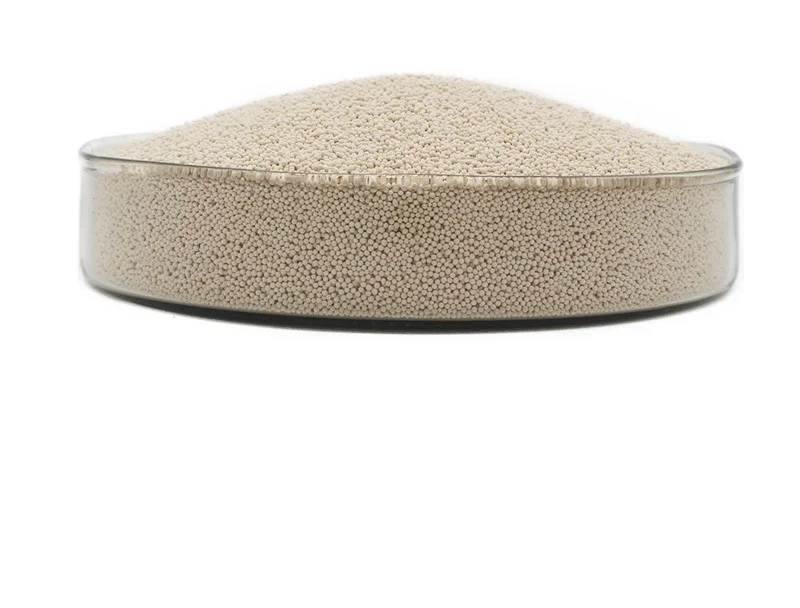
Overview
Type 5A is the calcium-exchanged form of the A zeolite. Opening the pore to about 5 ångströms lets straight-chain (normal) paraffins enter while branched iso-paraffins and aromatics are rejected — a separation by molecular shape that distillation cannot do economically.
The same pore system gives 5A its two other major duties: in PSA hydrogen units it strips CO, CO₂, CH₄ and N₂ from the hydrogen stream, and in PSA oxygen generators it adsorbs nitrogen preferentially from air. Beads are the standard form for PSA vessels; extruded pellets serve fixed-bed separation units.
Applications
- PSA hydrogen purification (refinery and ammonia-plant off-gas)
- PSA / VPSA oxygen generation from air
- Normal-paraffin separation from kerosene-range feeds (Molex-type units)
- Natural-gas sweetening — H₂S, CO₂ and mercaptan removal
- Inert-gas polishing (argon, helium, hydrogen)
- Liquid petroleum gas (LPG) drying and sweetening
Specifications
| Parameter | Unit | Sphere 1.6–2.5 mm | Sphere 3.0–5.0 mm | Pellet 1.6 / 3.2 mm |
|---|---|---|---|---|
| Chemical formula | — | 0.7CaO · 0.3Na₂O · Al₂O₃ · 2.0SiO₂ · 4.5H₂O | 0.7CaO · 0.3Na₂O · Al₂O₃ · 2.0SiO₂ · 4.5H₂O | 0.7CaO · 0.3Na₂O · Al₂O₃ · 2.0SiO₂ · 4.5H₂O |
| Bulk density | g/ml | ≥ 0.68 | ≥ 0.68 | ≥ 0.66 |
| Crush strength | N/piece | ≥ 35 | ≥ 85 | ≥ 40 / ≥ 65 |
| Static water uptake | wt% | ≥ 21.5 | ≥ 21.5 | ≥ 21.5 |
| n-Hexane uptake | wt% | ≥ 14.0 | ≥ 14.0 | ≥ 13.5 |
| Attrition loss | wt% | ≤ 0.20 | ≤ 0.20 | ≤ 0.25 |
Typical values for orientation. The grade-specific datasheet governs any quotation — request it with your inquiry.
Packing, documents & delivery
Packing
25 kg bags, steel drums or bulk bags — the format is confirmed in the quotation and matched to your unloading and storage.
Documents
Datasheet before order, batch COA with shipment, packing list and commercial invoice with every consignment.
Delivery terms
Prices are quoted EXW Zibo. Ocean freight is calculated for your order and destination port at the time of quotation.
Frequently asked
5A or 13X for a PSA hydrogen unit?
Both are used. 5A is the classic choice where CO and N₂ loadings dominate; 13X offers higher CO₂ and water capacity and is often placed as the front layer. Send your feed analysis and target purity (e.g. 99.99% H₂) and we will recommend the layering.
What does the n-hexane uptake figure mean?
It is the practical proxy for n-paraffin working capacity — the number that sizes a paraffin-separation bed. Our 5A is specified at ≥ 14.0 wt% on beads; if your current adsorbent is specified differently, send its datasheet and we will map the equivalence.
Beads or pellets for PSA service?
Beads (1.6–2.5 mm) pack uniformly and keep pressure drop predictable in fast-cycling PSA vessels, which is why they are the default. Pellets are preferred in slower fixed-bed separation duties. When in doubt, match the form you are replacing.
Technical articles
- Molecular Sieve 5A for Hydrogen PSA: 99.99% Purity, Tail Gas Recycle, and Bed Design
- Molecular Sieve 5A for n-Paraffin / iso-Paraffin Separation (MOLSIV): UOP Molex Process Engineering Data
- Molecular Sieve 5A vs 13X in PSA Hydrogen Purification: Which Grade Wins?
Request a quotation
To confirm the right grade, it helps to send: process type (PSA H₂, PSA O₂, paraffin separation), feed composition, cycle times, vessel dimensions and the form and size in use today.
Tell us your process.
Get a reply from an engineer.
Send your application, current media and quantity. We will confirm the right grade, share the datasheet, and quote a clear EXW price — no obligation.