An SiC epitaxial reactor HCl scrubber is a wet or dry alkaline neutralisation stage that removes hydrogen chloride from the process exhaust before it reaches the abatement stack, and it is filled with activated alumina — not molecular sieve — because the acid gas load is present at low partial pressure and the contaminant is chemically reactive rather than physically adsorbed. The distinction matters because a 13X or 4A molecular sieve that performs superbly in compressed-air or hydrogen service will release the very HCl it is supposed to remove once the gas stream is saturated with water vapour at scrubber temperatures.
The failure mode is unusually well understood in the SiC epitaxy industry, yet it persists because the two adsorbent families are frequently specified as if they were interchangeable. A buyer who accepts a supplier statement of "we supply molecular sieve for HCl service" without qualification is buying a product that will pass laboratory breakthrough tests on dry nitrogen and then fail in the reactor exhaust duct within weeks. Conversely, a buyer who over-specifies to a polymeric amine or a proprietary scrubber liquid pays a 3–6× media cost premium for a duty that bulk activated alumina handles routinely at a fraction of the operating cost.
The Process Context: Where HCl Actually Comes From in SiC Epitaxy
Silicon carbide epitaxial growth in a modified CVD (MCVD) or vapor-phase epitaxy (VPE) reactor proceeds by reacting a silane-based or chlorosilane-based precursor — typically trichlorosilane (TCS, SiHCl3) or silane (SiH4) with propane or hydrogen in a hydrogen carrier gas — at 1,500–1,750 °C. Because the process runs hot and chlorine-bearing, or silane-bearing, species are frequently present, the exhaust leaving the reactor bell jar carries a measurable HCl fraction along with unreacted precursor, hydrogen, and trace water.
Those HCl molecules must be removed for three separate reasons, and it is worth separating them because the removal specification differs for each:
- Corrosion of the abatement train. HCl in a wet duct creates an aqueous hydrochloric acid film on carbon steel ducting. Even at 200–400 mg/Nm3, the condensate pH can fall below 2 within hours, and pitting corrosion of 316L stainless in wet HCl service is rapid once the film becomes locally oxygen-starved.
- Environmental limit compliance. Continuous emissions monitoring (CEM) systems on SiC fabs commonly specify an HCl limit expressed as HCl equivalent on a dry basis, and the scrubber is the designated control technology in the air permit. A scrubber that is undersized or loaded with the wrong media puts the permit at risk.
- Back-diffusion into the tool bay. An exhausted scrubber with a breakthrough front produces an HCl plume at the exhaust stack, which under certain wind conditions draws back toward the fab air intakes and corrodes Cu interconnect and precision optics in neighbouring process tools.
The distinction that drives media selection is the partial pressure of HCl in the gas. In an epitaxial reactor exhaust, HCl is typically present in the range of 0.1–2.0 vol% with a corresponding dew point that is frequently in the 40–80 °C range after the gas cools past the scrubber inlet temperature. That combination — low concentration, moderate-to-high humidity, reactive contaminant — is the exact regime in which a physical adsorbent underperforms and a chemisorptive surface treatment wins.
Why Molecular Sieve Fails Here: The Four Mechanisms
Molecular sieves (3A, 4A, 5A, 13X) are crystalline aluminosilicate zeolites whose separation mechanism is size exclusion and physisorption — water and other small polar molecules are admitted into a rigid pore network of effective diameter 3–10 &angstrom; and held by van der Waals and electrostatic forces, not by chemical bonding. That mechanism is superb for drying and for separating N2 from CO2 or CH4. It fails for HCl for four distinct reasons.
1. Pore-mouth blockage and irreversible acid attack
HCl is not a large molecule — its kinetic diameter is roughly 3.6 &angstrom; — so it can physically enter a 5A or 13X pore. But the interaction at the aluminium-oxygen framework is strongly acidic. Zeolite frameworks carry exchangeable cations (Na+ in 4A, K+ and Na+ in 13X) which are readily displaced or neutralised by strong acids. Over a service cycle, this manifests as:
- Progressive loss of cation exchange capacity, so the material stops behaving like a molecular sieve at all.
- Amorphous aluminosilicate gel formation, which blocks pores and cuts the diffusion coefficient that the entire size-exclusion mechanism depends on.
- Loss of crystal structure (XRD amorphous halo replacing the characteristic zeolite pattern), with a measurable drop in BET surface area and a rise in bulk density as the binder system also degrades.
2. Co-adsorption of water driving an exothermic, self-accelerating deactivation
Because the exhaust is humid, the zeolite also loads water — which is exactly its intended function. But water loading is exothermic, and the heat release in a near-adiabatic bed raises the local temperature, which in turn accelerates the acid attack on the framework. The result is a compounding failure: more acid attack ∗ less capacity → the breakthrough front deepens → untreated HCl advances toward the bed outlet → more acid loads the downstream sections. A zeolite bed in this duty does not fail gracefully; it fails in a runaway.
3. Inability to be regenerated in service
A molecular sieve can be regenerated thermally — purge with hot dry gas to drive off adsorbed species. But the acid attack described above is a chemical degradation of the framework, not a reversible physisorption. Once the zeolite is acid-damaged, thermal regeneration restores neither the cation exchange capacity nor the pore structure. In HCl service there is no meaningful “regenerate in place” cycle; the material is a consumable with a finite life, exactly like a scrubbing liquid or a filter cartridge, but sold with the misleading implication that it is a durable adsorbent that can be cycled indefinitely.
4. Inappropriate regeneration exhaust handling
Even if the framework survives, the conventional regeneration step — heating to 200–350 °C to strip water — would drive the adsorbed HCl back out as a concentrated acid stream. Routing that offgas back to the header or to a wet scrubber that was not designed for it creates a new corrosion and permit problem. For low-concentration HCl abatement the economics simply do not support a thermal swing (TSA) cycle at all: the heat duty to regenerate a low-loading bed exceeds the value of the removed contaminant by a wide margin.
What Activated Alumina Actually Does: Chemisorption and Neutralisation
Activated alumina is a porous, high-surface-area form of aluminium oxide (Al2O3) produced from alumina hydrate by controlled calcination. Unlike a zeolite, its "pores" are an amorphous, non-crystalline capillary network rather than a rigid crystalline cage. The functionally important surface chemistry is a population of Lewis-acid and Brønsted-acid surface sites — coordinatively unsaturated aluminium atoms and surface hydroxyl groups — that chemisorb HCl.
The mechanism is straightforward neutralisation chemistry at the surface:
Surface Al–OH + HCl → Al–Cl + H2O
Because the chloride is chemically bound to the alumina surface rather than physically adsorbed, the bed does not experience the water-driven, exothermic, self-accelerating degradation that destroys a zeolite. The water in the stream is simply a co-adsorbate that the alumina tolerates well, and the HCl capacity is governed by available neutralisable surface area rather than by a narrow micropore volume. This is why activated alumina is the classic acid-gas dry scrubber medium — it is the standard reference material for HCl, and the reason is precisely this chemisorptive mechanism, not an accident of supply.
The trade-offs of this chemisorption are important to state plainly, because they define the operating envelope and they are the reason a wet scrubber still has a place in some designs:
- The reaction is effectively irreversible in service. Once bound as Al–Cl, the chloride is not released at normal operating temperature. The bed is a consumable; you change it out when it is spent, you do not regenerate it. Total HCl capacity per kg of media, not cyclic working capacity, is the figure that matters for sizing.
- Water loading competes for capacity. Activated alumina does adsorb water, and in a very humid stream a meaningful fraction of surface area is tied up as surface hydroxyl/water layers. Designs for high-humidity HCl service therefore over-provision bed mass relative to the stoichiometric requirement.
- Limited physical capacity compared to zeolite for water. If the primary goal were water removal rather than acid removal, zeolite (BET and pore volume) would still be the better medium. Activated alumina wins specifically because the contaminant is acid, not water.
| Property | Molecular sieve (4A/13X) | Activated alumina | Why it matters for HCl duty |
|---|---|---|---|
| Binding mechanism for HCl | Physisorption + acid attack on framework | Chemisorption (Al–OH + HCl → Al–Cl + H2O) | Chemisorption is stable; physisorption is not in a humid acid stream |
| Reversibility in service | Partially, but framework damage is irreversible | Effectively irreversible (consumable) | Both are consumables in acid duty; alumina at least fails predictably |
| Behaviour in humid gas | Exothermic water load → accelerated acid degradation | Tolerates humidity well; some capacity tied up as water | Humidity is the norm in SiC exhaust — this is decisive |
| Typical HCl capacity (industry range) | Low and rapidly declining in acid service | Substantial; sizing by stoichiometry + safety factor | Media mass and change-out interval follow directly from this |
| Thermal regeneration | 200–350 °C, does not restore damaged framework | Not applicable — spent media is disposed | Neither medium justifies a TSA cycle at low HCl loading |
| Chemical durability | Poor in strong acid; cations exchanged, amorphisation | Good; surface Cl is the intended end state | Alumina’s “failure” is the reaction completing, not collapse |
Sizing the Bed: Stoichiometry, Not Breakthrough Curve
Because the chemisorption is effectively one-way, the sizing method for an HCl scrubber is stoichiometric mass balance with a safety factor, not the dynamic breakthrough-curve method used for molecular-sieve drying towers. The logic is: compute the total mass of HCl that will be loaded over the intended service interval, convert to the stoichiometric requirement of the media, add a design margin, and that gives the charge mass.
The governing calculation is straightforward. Let MHCl be the total kilograms of HCl to be removed over a full charge cycle, and let the media have a rated capacity of C (kg HCl removed per kg of fresh media, on an industry-typical basis). Then the minimum charge is:
Charge mass (kg) = MHCl / C × Design safety factor (typically 1.5–2.5)
Industry-typical HCl capacities for high-surface-area activated alumina in the BET 300-360 m²/g range vary widely with HCl partial pressure, humidity, and whether the media is a bulk granule or an extrudate, and are typically quoted by suppliers in the region of roughly 20–35 wt% HCl uptake at elevated test conditions. In real low-concentration, high-humidity SiC exhaust the usable working figure is lower than such a headline number, which is exactly why the 1.5–2.5× design safety factor is applied and why field verification of the exhaust concentration is the final arbiter of the change-out interval. Treat any single supplier capacity figure as a test-condition maximum, not an in-service guarantee.
Two sizing refinements are specific to epitaxial exhaust and are routinely missed:
- Condensation carryover. If the exhaust is cooled toward or below its acid dew point before the bed, liquid acid droplets carry a disproportionate share of the HCl mass and can flood the bed. A demister or knockout pot upstream is not optional — it protects the media and improves the accuracy of the inlet measurement.
- Water co-loading. In high-humidity service the mass of water held by the bed can rival or exceed the mass of HCl held. Size on HCl stoich, but expect the bed to become a dehumidifier as a side effect — which is sometimes undesirable if the exhaust must leave at a defined moisture level for downstream abatement.
Wet Scrubber vs Dry Adsorptive Bed: Choosing the Control Technology
It would be a mistake to treat activated alumina as the universal answer. In many SiC fabs the HCl exhaust is handled by a conventional packed-bed wet scrubber using caustic or sodium hydroxide solution, and for some emission ranges and duty cycles a wet scrubber remains the more economical and more robust choice. The honest engineering position is that these are two complementary technologies with distinct envelopes.
| Criterion | Dry activated alumina bed | Wet caustic scrubber |
|---|---|---|
| HCl removal at very low inlet concentration | Excellent — chemisorption drives very low outlet | Good but depends on pH, L/G, and solution reserve |
| Handles condensate / liquid acid | Poor — needs a knockout upstream | Natural — liquids are the working medium |
| Downstream wet corrosion risk | Lower — exhaust leaves dry | Higher — saturated acid mist |
| Consumable / operating cost profile | Bulk media change-out; no liquid make-up | Continuous caustic make-up + sludge/blowdown handling |
| Turnkey footprint | Compact vessel, simple change-out | Pumper, tank, blower, and effluent treatment |
| Best fit | Low-to-moderate HCl, dry-tolerant exhaust, space-constrained retrofits | High HCl load, condensing exhaust, sites with effluent infrastructure |
A number of mature SiC fabs run a hybrid arrangement — a dry activated alumina polish stage downstream of a primary wet scrubber — so that the expensive solution chemistry handles the bulk of the acid load and the dry bed delivers the low-concentration polish that keeps the stack emissions comfortably below the permit limit. This is often the most cost-effective retrofit when a permit is tightened on an existing tool.
Media Quality: What to Specify and What to Reject
Because activated alumina is the correct answer for this duty, the next question for a procurement engineer is how to specify it so that what arrives is actually fit for a low-concentration HCl scrubber. A small number of specification clauses distinguish a fit-for-purpose charge from a bag of porous pellets that will underperform.
Specify a high surface area with a stated particle form
For HCl chemisorption the surface area is the capacity driver, so specify BET in the 300–360 m²/g range (consistent with the media this article’s featured product supplies) and state whether the form is granule (spheres, effective for drop-out beds and lower pressure drop) or extrudate (higher mechanical strength, better attrition resistance, suited to higher gas velocity and cyclic service). Match the form to the vessel — a granule charge in a high-velocity bed will generate fines and blinding.
Specify bulk density and size distribution to the vessel, not to a generic range
State the particle diameter band explicitly (for example, 2.5–5 mm or 4–6 mm) and the bulk density range. The particle size relative to bed height and vessel diameter governs the pressure drop and the risk of channelling; an undersized media in a tall bed raises pressure drop sharply, while an oversized media risks channelling and poor wall-flow distribution. A supplier that cannot state the size band and bulk density on the COA is telling you the media is not characterised for your service.
Reject media with high free moisture or high sodium
Free moisture above roughly 5 wt% is a red flag — it indicates poor activation or storage damage and will add an unplanned water load to a humid stream. Excess sodium (from a sodium-based precursor) is undesirable in acid service because it contributes leachable Na+ to the effluent. Ask for a COA that reports bulk density, BET, particle size, and loss on ignition, and reject any shipment where these are missing rather than “typical.”
Reject any claim of regenerative service life in HCl duty
This is the specification clause that catches the most common mis-specification. If a supplier’s datasheet claims a regenerable working capacity for HCl — implying a thermal or pressure swing cycle — the datasheet is either describing a physisorption test in dry gas (not representative of your duty) or is simply wrong for the application. Hold the line: in low-concentration HCl abatement the media is a consumable and should be quoted on a single-pass capacity basis.
Installation, Commissioning, and Monitoring Discipline
Fit-for-purpose media still underperforms if it is installed badly. A few commissioning practices separate a scrubber that hits its permit limit from one that struggles in the first quarter.
- Screen the charge. Remove fines before filling. Loading dusty media both leaves residual fines in the plenum and creates a high initial pressure drop that tempts operators to open a bypass “just to get back to rate,” quietly defeating the control.
- Tamp and settle properly. A loosely packed bed channels. Over-tamping can crush granules and raise pressure drop. Settle to the manufacturer’s stated bulk density and verify the settled bed height against the design.
- Baseline the inlet and outlet on day one. Measure HCl concentration at inlet and outlet with a properly calibrated analyser (e.g. FTIR or a wet-chemical scrubber capture method) before the tool is qualified. Without a baseline you cannot compute the media’s real loading and you will over- or under-estimate the change-out date.
- Trend outlet concentration, not just inlet. The outlet reading is the compliance number. A rising outlet trend at steady inlet is the early warning that the bed is loading — it should trigger a planned change-out, not a permit excursion.
- Log media mass in and out. Record the charge mass at fill and the removed mass at change-out. Over time this gives you the actual in-service capacity of your specific media in your specific duty — the single most valuable number for refining future sizing and re-tendering.
Cost and Availability for the Buyer
For a procurement engineer the honest economic picture is that activated alumina is a low-cost consumable with a predictable, modest unit price and a change-out interval driven by real mass loading. Because HCl is a low-concentration contaminant, the media is inexpensive per unit mass compared to specialty sorbents, and the total cost of ownership is dominated by media mass, freight, and the labour of the change-out rather than by the media price per kilogram. This is why the buy decision for these duties is typically a freight-and-availability decision as much as a technical one.
Aluminaworld supplies high-surface-area activated alumina (BET 300-360 m²/g) in granule and extrudate forms for acid-gas and general drying service, with a minimum order quantity of 1 MT, ISO 9001 certification, and typical lead time of 15–25 days. Free samples are available so you can run a coupon test or a small trial charge in your actual exhaust before committing to a full vessel. For related media depending on your duty you may also wish to review our molecular sieve range — for genuinely dry duties without an acid component — or our silica gel for moderate-duty moisture pickup, and to compare with our overview of activated alumina vs molecular sieve for compressed-air drying to confirm the material choice fits your non-acid drying service as well.
Related Reading on Acid-Gas and Media Selection
If you are building a broader media-selection or failure-diagnosis capability, these existing posts go deeper on adjacent questions:
- Activated alumina in sulfuric acid and oleum service — the same chemisorptive mechanism under a much higher acid loading, useful for understanding capacity limits.
- Acid-gas breakthrough on 13X with H2S/SO2 poisoning and thermal-swing reversibility — what “reversible” does and does not mean for acid-contaminated zeolite.
- Activated alumina vs silica gel as a desiccant — capacity and stability comparison for non-acid moisture duties.
- Activated alumina vs silica gel in transformer breather service — a low-temperature, low-concentration analogue of the same media choice.
- Acid-spill recovery: when to rebed vs acid-wash activated alumina — practical field response to an accidental acid excursion.
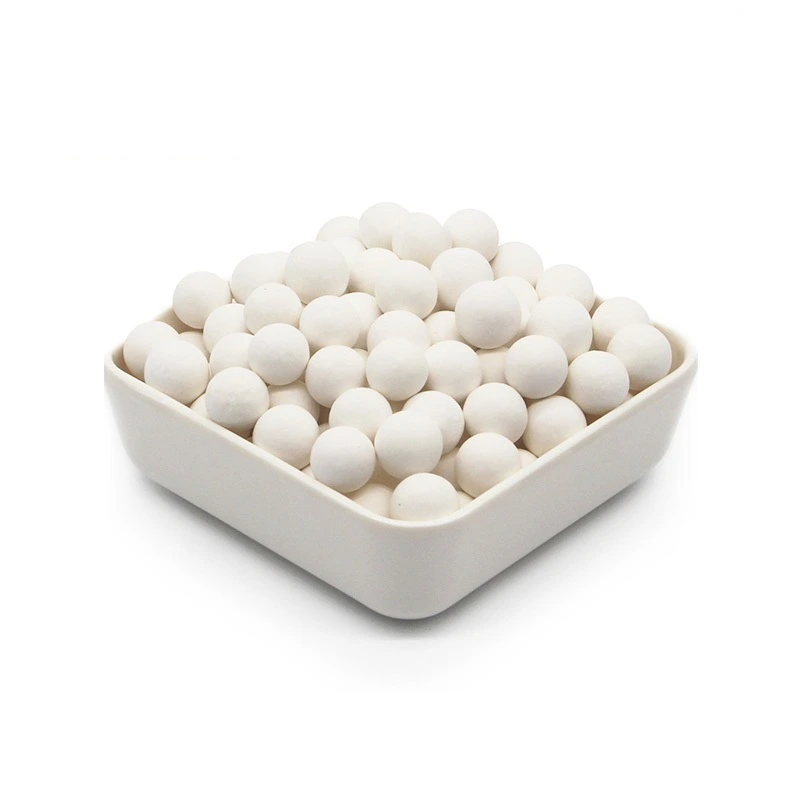
Activated Alumina (BET 300–360 m²/g)
High-surface-area chemisorptive media for HCl and acid-gas scrubbers, in granule and extrudate forms. MOQ 1 MT, ISO 9001, lead time 15–25 days, free sample for coupon testing.
View Product Details →Frequently Asked Questions
Why is activated alumina preferred over molecular sieve for HCl scrubbing in SiC epitaxial reactors?
Because HCl is removed by chemisorption on activated alumina (Al–OH + HCl → Al–Cl + H2O) rather than by physisorption in zeolite pores. Molecular sieve removes HCl only by physical adsorption that is rapidly displaced and accompanied by irreversible acid attack on the zeolite framework, which in a humid stream is accelerated by exothermic water loading. Activated alumina tolerates the humidity and binds the acid chemically, giving predictable service life.
Is molecular sieve completely useless for HCl service, or are there exceptions?
Molecular sieve is a poor and generally unsuitable choice for low-concentration, humid HCl abatement because of the mechanisms above. It is not literally “never used” — trace HCl polishing on a very dry gas, or specialty high-temperature regeneration regimes with exotic binder systems, can involve zeolite — but these are exceptional and are not the duty of an epitaxial exhaust scrubber. For the ordinary epitaxy HCl duty, activated alumina is the correct default.
Can activated alumina in an HCl scrubber be regenerated in place, or is it a consumable?
It is a consumable. The chloride binds chemically to the alumina surface and is not released at normal operating temperature, so there is no practical in-place regeneration cycle for spent media. Size the bed on single-pass HCl capacity with a safety factor, plan a change-out, and dispose of or recycle the spent material. Do not size it like a regenerable molecular-sieve tower.
How much activated alumina is needed to remove a given mass of HCl?
Compute the total HCl mass to be removed over the service interval, divide by the media’s rated HCl capacity (kg HCl per kg of fresh media) to get the minimum charge, then apply a design safety factor of roughly 1.5–2.5×. Because real in-service capacity in humid, low-concentration exhaust is lower than headline test values, the safety factor and field verification of the outlet concentration are both important. Over-provisioning modestly is far cheaper than a permit excursion.
Does the high humidity of epitaxial exhaust reduce activated alumina’s HCl capacity?
Yes, to a degree. The alumina also adsorbs water, and in a very humid stream some neutralisable surface area is tied up as adsorbed water or surface hydroxyl layers. This is why designs for high-humidity HCl service size the bed mass above the pure stoichiometric requirement and apply a safety factor. The key point is that the reduction is a sizing correction, not a disqualification — alumina still greatly outperforms zeolite in the same humid acid stream.
Should a wet caustic scrubber or a dry activated alumina bed be preferred for SiC exhaust HCl?
It depends on the load and the exhaust condition. Wet caustic scrubbers handle high HCl loads and condensing (liquid-carrying) exhaust naturally and are robust where effluent infrastructure exists. Dry activated alumina beds excel at low-to-moderate HCl, dry-tolerant exhaust, and space-constrained retrofits, and deliver lower downstream wet-corrosion risk. Many fabs run a hybrid — wet scrubber for bulk load plus a dry alumina polish stage for the low-concentration tail.
What specifications should a buyer put on the activated alumina COA for HCl scrubber service?
At minimum: BET surface area (300–360 m²/g typical), bulk density, particle size band stated explicitly (e.g. 2.5–5 or 4–6 mm), the physical form (granule vs extrudate), free moisture (reject above ~5 wt%), and loss on ignition. Reject any shipment missing these, and reject any claim of “regenerable” HCl capacity — in this duty the media is a single-pass consumable.
Why does a molecular-sieve HCl bed fail in a runaway rather than gradually?
Because the failure compounds. Water loading on the zeolite is exothermic, which raises local temperature, which accelerates the acid attack on the framework, which cuts capacity, which pushes the breakthrough front deeper, which exposes more downstream media to the acid. Each step amplifies the previous one, so the bed transitions from near-full breakthrough to serious HCl release in a short period rather than degrading smoothly over months.
How often should the HCl scrubber media be changed, and how is the interval determined?
The interval is set by real mass loading: total HCl removed divided by media charge mass and by in-service capacity. Determine it empirically by baselining inlet and outlet HCl at commissioning, tracking the outlet trend, and recording media mass in and out at each change. The measured in-service capacity of your specific media in your specific duty is the most valuable number for refining future sizing and re-tendering.
Does particle size or bed height matter for an activated alumina HCl bed?
Yes. Particle size relative to bed height and vessel diameter governs pressure drop and channelling risk: undersized media in a tall bed raises pressure drop sharply, while oversized media risks channelling and poor distribution. Match the size band to the vessel, settle the bed to the stated bulk density, and screen out fines at fill. A loosely packed or fines-laden bed will underperform regardless of media quality.
Can a dry activated alumina HCl bed handle condensate carryover from the exhaust?
Not well. Liquid acid droplets carry a disproportionate share of the HCl mass and can flood and glaze the bed. Install a demister or knockout pot upstream of the adsorber and ensure the gas temperature stays above the acid dew point across the bed. Handling condensate is one of the main reasons wet scrubbers remain in service for condensing exhaust.
What is the typical lead time, MOQ, and sample policy for activated alumina from Aluminaworld?
MOQ is 1 MT, lead time is typically 15–25 days, production is ISO 9001 certified, and free samples are available so you can run a coupon or trial charge in your actual exhaust before committing a full vessel. Contact us via WhatsApp at +86 133 2522 2240 or email barry@aluminaworld.com to discuss your HCl duty and receive a COA-backed quotation.
Next Steps
If you are specifying or replacing HCl scrubber media for a SiC epitaxial exhaust, the practical path is: (1) confirm your inlet HCl concentration and humidity, and whether the exhaust is condensing; (2) if the exhaust carries condensate or the load is high, evaluate a wet scrubber or a wet–dry hybrid rather than a pure dry bed; (3) request a COA-backed sample of BET 300–360 m²/g activated alumina in the particle form and size band matched to your vessel; (4) run a trial charge, baseline inlet and outlet HCl, and log media mass to measure real in-service capacity; (5) set the change-out interval from that measured loading. Our application engineers can support steps 3–5 with a media selection and sizing calculation for your specific exhaust.
Discuss your HCl scrubber duty with our application engineers
Free sample, COA-backed specification, MOQ 1 MT, lead time 15–25 days.