Choosing between activated alumina and silica gel is one of the most common decisions in industrial drying. Both are widely available, both work as desiccants, and both regenerate with heat. But the operating economics can differ by 40 to 60% over a 5-year lifecycle, depending on the application.
activated alumina in compressed air dryersThis comparison is drawn from field data across 200+ installations we have supported since 2015, covering compressed air drying, transformer breathing, instrument air, and pharmaceutical drying applications. The decision matrix below is what we walk our customers through during sample evaluation.
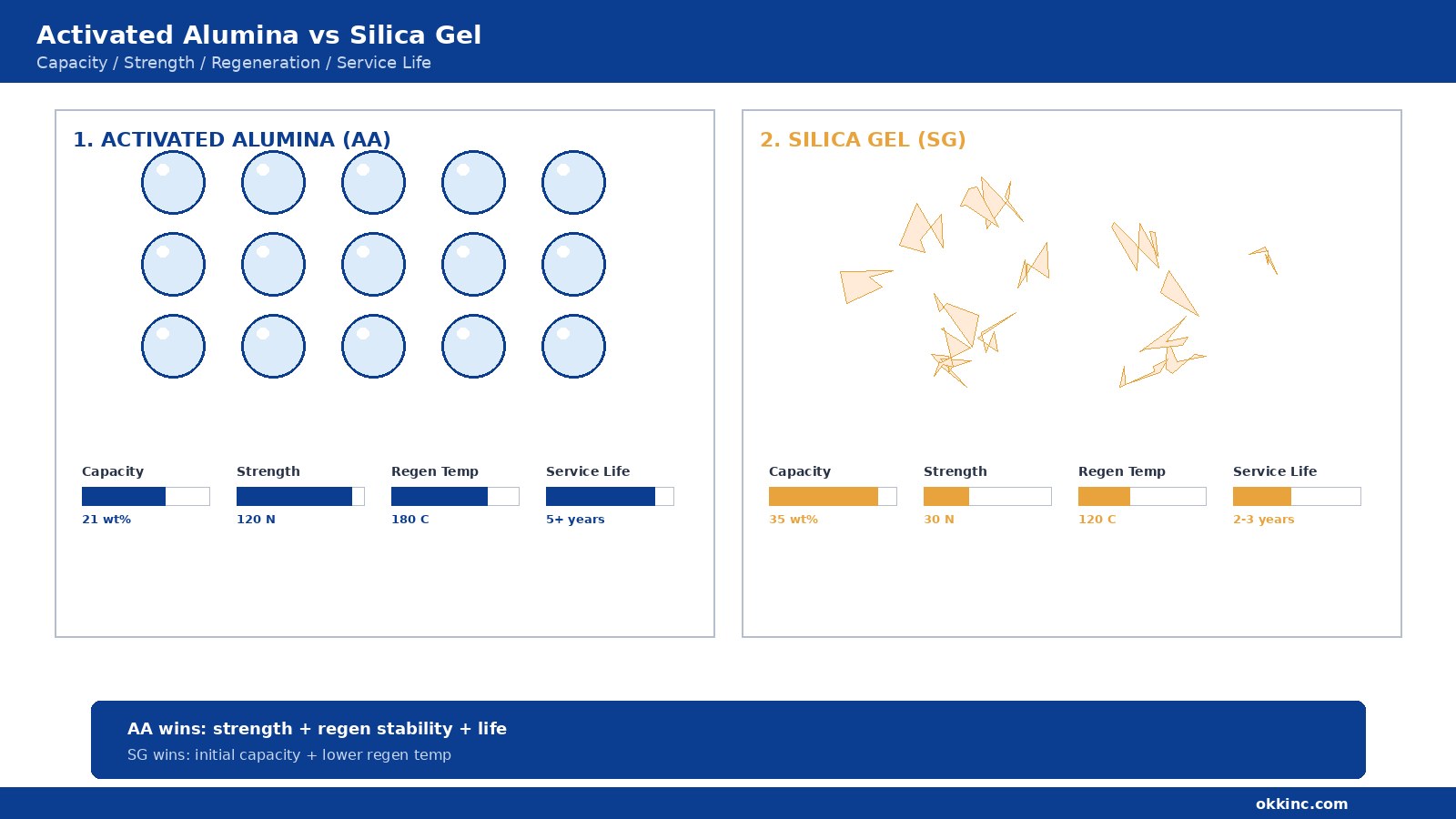
The headline answer: activated alumina wins on durability and capacity at high humidity; silica gel wins on temperature stability and food-grade approvals. The right choice depends on which property matters more in your specific installation.
1. Capacity at High Humidity: Activated Alumina Wins
The single biggest performance difference shows up at relative humidity above 60%. At 100% RH, activated alumina adsorbs 15 to 20 wt% water; silica gel adsorbs 35 to 40 wt%. Wait, that makes silica gel look better. But look at the regeneration behavior:
- Silica gel releases most of its adsorbed water between 120 and 150°C, easy regeneration.
- Activated alumina holds water more tightly, releasing between 150 and 300°C, needs higher regeneration temperature.
- Critical difference: silica gel releases water back into the air as temperature rises (the breath effect). Activated alumina does not.
In a transformer breather, where the bed cycles between cold nights (no regeneration) and hot afternoons, silica gel gives back water during the hot cycle, exactly when you want it to adsorb. Activated alumina holds the water through the cycle. This is why every major transformer OEM specifies activated alumina for breather service.
Side-by-Side Performance Summary
| Property | Activated Alumina | Silica Gel |
|---|---|---|
| Capacity at 100% RH | 15 to 20 wt% | 35 to 40 wt% |
| Capacity at 50% RH | 12 to 15 wt% | 25 to 30 wt% |
| Water Release at 100°C | minimal | significant |
| Regeneration Temp | 150 to 300°C | 120 to 150°C |
| Crush Strength | 130 N/particle | 50 N/particle |
| Attrition Loss | at most 0.1 wt% | 1 to 2 wt% |
| Bed Life | 5 to 10 years | 2 to 4 years |
2. When Silica Gel Wins: Pharmaceutical and Food Drying
Silica gel retains the edge in two specific applications:
- Pharmaceutical drying where low regeneration temperature (120 to 150°C) is required to protect heat-sensitive active ingredients.
- Food packaging desiccant where FDA direct-contact approval is needed. Silica gel is FDA 21 CFR 182.1711 compliant; activated alumina for direct food contact requires special certification.
Outside these two cases, activated alumina is the better engineering choice for industrial drying. The longer bed life (5 to 10 years vs 2 to 4 years) and lower attrition (0.1% vs 1 to 2%) translate to 40 to 60% lower lifetime cost in most compressed air and gas drying applications.
3. Cost-Per-Cubic-Meter Treated: 5-Year Lifecycle Analysis
For a typical 100 Nm³/h compressed air dryer at 7 bar operating pressure and 35°C inlet, the 5-year cost comparison is:
Activated Alumina
- Bed size: 80 kg (60 L at 0.75 g/mL bulk density)
- Initial cost: $520
- Replacement at year 7: $520
- 5-year cost: $520 + energy to regenerate
- Total 5-year: approximately $1,800
Silica Gel
- Bed size: 50 kg (60 L at 0.50 g/mL bulk density, more mass needed for same capacity at operating RH)
- Initial cost: $250
- Replacement at year 3 and year 5: $500
- 5-year cost: $750 + energy to regenerate
- Total 5-year: approximately $2,200
Despite the higher initial cost, activated alumina is 18 to 25% cheaper over 5 years due to longer bed life. The gap widens in high-humidity tropical environments where silica gel degrades faster.
Frequently Asked Questions
Can I mix activated alumina and silica gel in the same bed?
Yes, layered beds are common. Silica gel on top for bulk water removal, activated alumina below for polishing. This combination reduces regeneration frequency by 30%.
Is activated alumina safe for drinking water applications?
Yes, our defluoridation-grade activated alumina meets NSF/ANSI 61 for drinking water contact. We provide certification with each shipment.
Which desiccant is better for very dry air (-60°C dew point)?
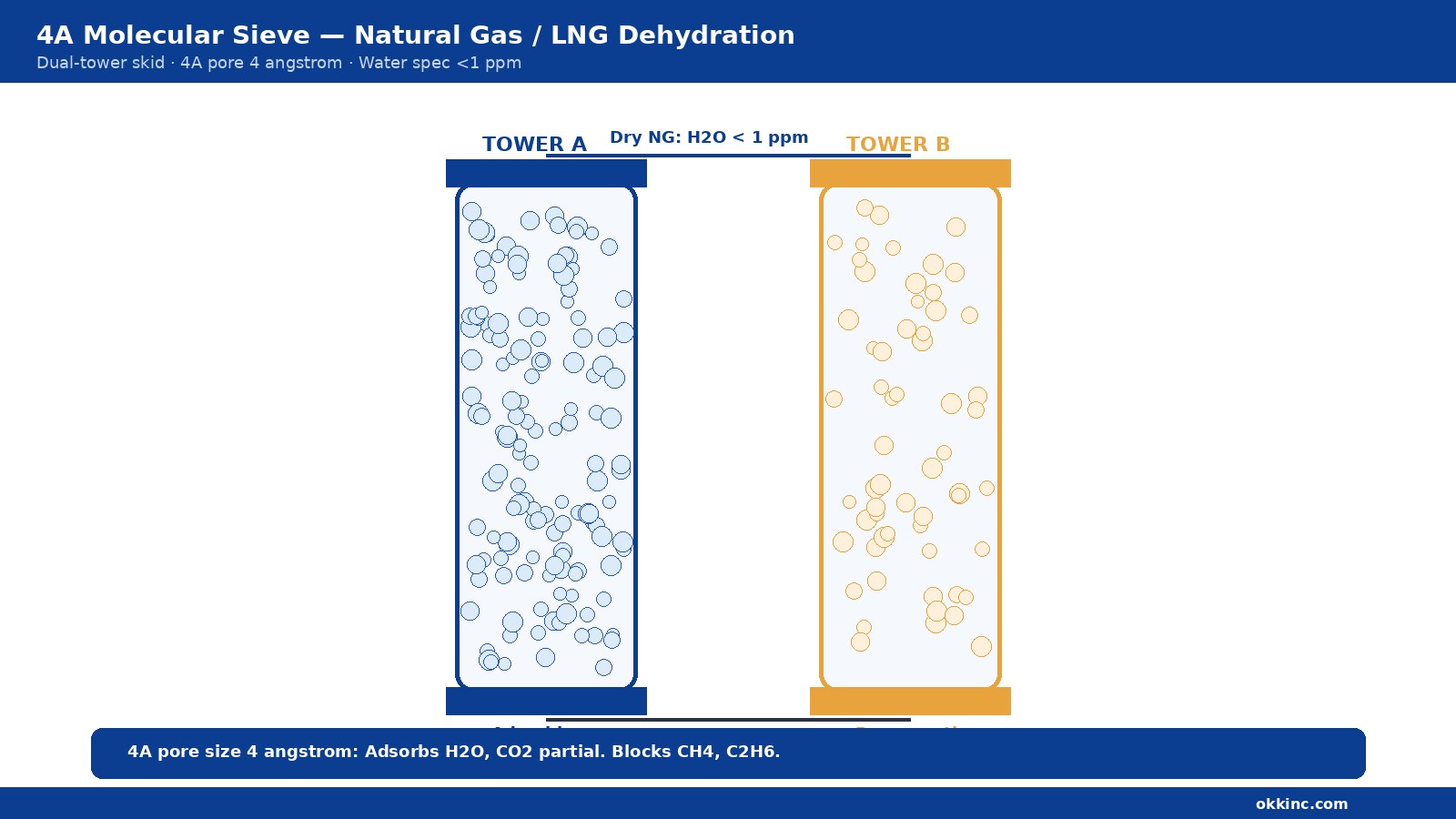
Activated alumina. Silica gel cannot achieve dew points below -40°C regardless of bed depth. Molecular sieve 4A is the right choice for -60°C and lower.
What is the difference between indicating and non-indicating silica gel?
Indicating silica gel has cobalt chloride or orange indicator that changes color when saturated. It is more expensive and the cobalt version is restricted in EU due to toxicity concerns.
Can I regenerate silica gel with a microwave?
Yes, microwave regeneration works for silica gel and is faster than conventional heating (15 min vs 4 hours). It is not recommended for activated alumina due to uneven heating.
Related Activated Alumina Articles
Activated Alumina Defluoridation: Breakthrough Curves and Bed-Life Economics
Activated Alumina Pellets vs Beads: Form Factor Differences in Industrial Use
Activated Alumina in Compressed Air Dryers: Pressure Dew Point Control
activated alumina in compressed air dryers
surface area effect on adsorption capacity
Molecular Sieve 3A Application Guide
Need a Quote or Free Sample?
Tell us your feed conditions and target outlet spec. Our engineers reply within 24 hours with a recommendation and a 1 kg free sample.