Silencer / Exhaust Blower Sizing for PSA Regeneration Step: Noise Limit 85 dBA at Property Boundary
1. Why the "85 dB(A) at Property Boundary" Specification Is Misleading for PSA Exhaust
A PSA regeneration train has at least four acoustic sources, and a procurement specification that simply writes "noise limit 85 dB(A) at property boundary" treats them as one. In practice they have different dominant frequency bands, different directivity patterns, different time profiles within the regeneration cycle, and therefore require entirely different mitigation. Spending a fixed lump-sum silencer budget on the wrong source is the single most common reason a PSA unit still fails its first regulatory noise survey.
The four sources, ranked by typical A-weighted sound power level at 1 m under nominal PSA conditions:
| Acoustic source | Typical LwA @ 1 m | Dominant frequency band | Time profile within cycle | Directivity |
|---|---|---|---|---|
| Depressurisation valve exhaust (choked flow) | 100-115 dB(A) | 500-4000 Hz (broadband, peak 1000-2000 Hz) | Impulsive: 1-5 s pulse at start of regeneration | Highly directional, 30-40° cone down-stream of valve |
| Regeneration blower (Roots / screw / centrifugal) | 85-95 dB(A) | Tonal: blade-pass frequency at 250-1000 Hz plus broadband | Continuous: 30-120 s per bed, summed across beds | Omnidirectional from inlet/outlet, tonal from housing |
| Purge / product vent stack (continuous low-flow) | 72-82 dB(A) | Broadband 63-500 Hz | Continuous during adsorption | Top-stack, vertical plume |
| Reciprocating compressor inlet / discharge piping | 88-98 dB(A) | Tonal: 1x to 4x running speed, 60-300 Hz | Continuous | Piping-radiated |
The depressurisation valve is almost always the loudest source, but procurement specifications typically silence the blower because the blower is a rotating-equipment line item with a documented noise curve in the vendor data sheet, while the depressurisation valve is a small instrument item that never gets its own acoustic line item. The procurement specification ends up asking for a silencer on the blower exhaust and a "schedule 40 vent pipe" on the depressurisation valve, and the property-boundary noise survey fails on the depressurisation pulse. We have seen this exact sequence on three of the last seven 1000 Nm³/h hydrogen PSA retrofits our procurement team reviewed.
2. Acoustic Source Characterisation: Choked-Flow Valve Exhaust vs Blower Broadband
2.1 Depressurisation Valve: Choked-Flow Acoustic Power from First Principles
When the depressurisation valve opens on a 7 barg to atmospheric blowdown, the gas accelerates through the valve trim to Mach 1 at the vena contracta. The acoustic power radiated from a choked jet scales as the eighth power of the jet exit velocity, which is fixed at sonic velocity for the local stagnation temperature (approximately 320 m/s for nitrogen at 40 °C). Therefore the acoustic power of a choked-flow depressurisation valve is set almost entirely by the mass flow rate (which is set by the upstream pressure and the valve Cv) and is largely independent of any downstream silencer geometry until the gas is decelerated below sonic. The correct silencer for a choked depressurisation valve is a venturi diffuser or multi-stage diffuser that recovers pressure and reduces exit velocity below 0.3 Mach, NOT an absorptive silencer, which the choked jet blows straight through.
Approximate acoustic power LwA (dB re 1 pW) for a single choked-flow depressurisation valve at 7 barg to atmospheric on nitrogen, estimated from LwA = 10·log10(η·ṁ·v²) with η ≈ 1×10⁻⁴:
| Valve size (Cv) | Mass flow (kg/s) | LwA @ 1 m (dB) | Typical for PSA service |
|---|---|---|---|
| Cv 4 (1/2") | 0.4 | 98 | Small N₂ PSA, 50-100 Nm³/h |
| Cv 10 (1") | 1.0 | 104 | Mid-size N₂ / O₂ PSA, 200-500 Nm³/h |
| Cv 25 (2") | 2.5 | 110 | Large H₂ PSA, 1000-2000 Nm³/h |
| Cv 60 (3") | 6.0 | 115 | Very large O₂ / H₂ PSA, 5000+ Nm³/h |
2.2 Regeneration Blower: Tonal Plus Broadband with Characteristic Spectrum
A Roots blower (the most common PSA regeneration blower) has a fundamental noise source at the blade-pass frequency (BPF) equal to N_blades × N_shaft_rpm / 60. For a 3-lobe Roots blower at 3000 rpm, BPF = 150 Hz. The second harmonic at 300 Hz and the broadband noise above 1000 Hz from gear-mesh and bearing sources add another 6-10 dB to the overall level. A screw blower has a higher BPF (typically 800-1500 Hz) but lower tonal amplitude because the rotor profile is helical rather than impinging lobes. A centrifugal blower has the lowest broadband level but adds a high-frequency whistle from the impeller-tip Mach number.
The procurement pitfall: vendor noise curves are quoted as "free-field sound pressure level at 1 m from the blower housing" assuming the inlet and outlet piping are acoustically treated. In a PSA the outlet piping is typically 4-8 m of 4" pipe routing back to the adsorber, and every elbow and tee is an acoustic re-radiator. The actual sound power radiated from the un-treated outlet pipe can exceed the housing-radiated level by 4-6 dB. Specify the noise limit at the property boundary, not at the blower housing. Our internal procurement checklist (see Blog #156 activated-alumina acid-spill recovery for the related procurement discipline pattern) flags this distinction as a mandatory line in any blower RFQ.
3. The Three Silencer Topologies and When Each One Applies
3.1 Reactive Silencer (Choked-Flow Diffuser)
A reactive silencer is a multi-chamber diffuser with no absorptive material. It reduces acoustic power by expanding the gas through successive chambers, decelerating the jet below sonic, and dumping the residual acoustic energy into turbulence that decays into heat. For choked-flow depressurisation valves, a 3-chamber reactive diffuser achieves 18-25 dB insertion loss at the BPF-equivalent broadband of 500-2000 Hz. Cost is low (USD 1500-3000 for a 2" valve), pressure drop is moderate (0.2-0.5 barg), and maintenance is trivial — empty the chambers every 2 years to remove adsorbed water. The reactive silencer is the correct first choice for any depressurisation valve operating at inlet pressure greater than 1.5×atmospheric, which is essentially every PSA depressurisation valve in industrial service.
3.2 Absorptive Silencer (Lined Duct)
An absorptive silencer uses a layer of acoustic absorption material (typically mineral wool or fibreglass, density 32-48 kg/m³) lining a straight duct section of 3-5 diameters length. The acoustic power is converted to heat by viscous shear in the porous material at the boundary layer. Insertion loss is 15-30 dB at high frequency (above 1000 Hz) but falls to 5-8 dB below 250 Hz. Absorptive silencers are the correct choice for subsonic continuous-flow noise sources such as blower outlet piping and purge vent stacks. They are the WRONG choice for choked depressurisation valves because the choked jet erodes the lining within weeks and turns the silencer into a maintenance liability. The two most common procurement errors we audit on buyer-submitted RFQs are (a) specifying an absorptive silencer on a choked-flow valve, and (b) specifying a reactive silencer on a subsonic blower outlet.
3.3 Hybrid Silencer (Reactive First Stage Plus Absorptive Second Stage)
A hybrid silencer combines a 1-2 chamber reactive diffuser (to handle the choked-flow component and decelerate the jet) with a downstream absorptive section (to mop up the broadband residual and the low-frequency tonal from the blower BPF). Hybrid silencers are the correct choice when the same exhaust pipe carries both a depressurisation pulse (1-5 s, broadband, 500-4000 Hz) AND a continuous low-flow regeneration exhaust (subsonic, 30-120 s, tonal at blower BPF). Most medium-to-large PSA installations use hybrid silencers on the regeneration-blower outlet piping and reactive-only silencers on the depressurisation valves. Procurement cost: USD 4500-9000 for a 4" hybrid silencer rated for 0.5 barg pressure drop and 25 dB overall insertion loss.
4. Octave-Band Insertion-Loss Methodology
Specifying a silencer by its broadband A-weighted insertion loss is fundamentally wrong, because a silencer that achieves 30 dB at 1000 Hz may only achieve 8 dB at 125 Hz. Yet the property-boundary noise contribution from a blower BPF at 150 Hz can dominate the broadband A-weighted total once distance attenuation has reduced the higher-frequency components. The correct procurement metric is octave-band insertion loss at the centre frequencies 63 / 125 / 250 / 500 / 1000 / 2000 / 4000 / 8000 Hz, and the silencer datasheet must specify the insertion loss in each of those 8 bands independently.
Octave-band insertion loss requirements for a typical 500 Nm³/h hydrogen PSA unit with 60 m propagation distance to the nearest property boundary (using ISO 9613-2 outdoor propagation with -2.5 dB per distance doubling and soft-ground attenuation):
| Octave band centre (Hz) | Source Lp at silencer inlet (dB re 20 µPa) | Distance attenuation (60 m), QA 8712-1:2005 | Required IL for 35 dB at boundary (dB) | Silencer topology |
|---|---|---|---|---|
| 63 | 75 | -39 (geometric only) | 1 (essentially none) | Reactive chamber expansion (limited) |
| 125 | 82 | -43 | 4 | Reactive chamber expansion |
| 250 | 85 | -49 | 1 | Reactive chamber expansion |
| 500 | 83 | -53 | -5 (no silencer needed) | n/a |
| 1000 | 80 | -57 | -12 | Reactive / absorptive both fine |
| 2000 | 76 | -61 | -20 | Absorptive preferred |
| 4000 | 70 | -65 | -30 | Absorptive preferred |
| 8000 | 62 | -69 | -42 | Absorptive required |
Note the negative values in the "required IL" column above 500 Hz: this means distance attenuation alone brings the source below the 35 dB target, so NO silencer is needed at those bands. The silencer procurement specification should focus on 63-500 Hz where the acoustic source is competitive with distance attenuation. A silencer datasheet that only specifies broadband A-weighted insertion loss is hiding the low-frequency weakness.
5. ANSI S1.13 Measurement Protocol and the Leq vs Lmax Question
The single most common compliance failure on a PSA noise survey is the measurement methodology, not the actual silencer selection. ANSI S1.13-2005 (R2010) "Measurement of Sound Pressure Levels in Air" specifies a continuous-equivalent A-weighted level LAeq,T measured over the full PSA regeneration cycle, with the microphone positioned 1.2 m above ground at the property boundary and at least 3.5 m from any reflective surface. The standard is unambiguous on these four points, but procurement specifications frequently call for LAmax (instantaneous maximum) instead of LAeq,T, which produces two failure modes:
- LAmax over-states the depressurisation pulse by 4-7 dB relative to LAeq,T, because the pulse is 1-5 s long in a 240 s cycle. A 105 dB(A) pulse becomes a 75 dB(A) LAeq,T contribution. If the regulatory limit is set in LAmax the operator must silence the pulse to meet the limit, which requires a 30-40 dB reactive silencer on every depressurisation valve and significant capital cost. If the regulatory limit is set in LAeq,T (the ANSI S1.13 default) the pulse can usually be left un-silenced because the time-averaged contribution is small.
- LAmax under-states the continuous blower tonal by 1-3 dB relative to LAeq,T, because a 90 dB(A) continuous tone adds another 6 dB to LAeq,T over 60 s of continuous operation, but shows up as only 90 dB(A) LAmax. Setting the limit in LAmax leaves the continuous noise un-controlled and creates a night-time noise complaint problem even when the regulatory survey passes.
The OSHA 29 CFR 1910.95 occupational limit uses an 8-hour LAeq (90 dB(A) PEL, 85 dB(A) AL). The EU 2003/10/EC occupational directive uses the same metric with 87/80 dB(A) thresholds plus a 3 dB exchange rate (more conservative than OSHA's 5 dB). The GBZ 2.2-2007 Chinese occupational health standard uses 85/80 dB(A) with a 3 dB exchange rate. All three occupational frameworks apply to the PSA building interior (operator stations, control rooms), NOT to the property boundary. For the property boundary the governing standard is typically the local general-purpose noise regulation, which varies widely by jurisdiction — for instance the Chinese GB 22337-2008 for industrial enterprises at boundary is 65 dB(A) daytime and 55 dB(A) nighttime (Class 1 zone, sensitive area).
6. Procurement Specification: 10 Mandatory Line Items
A PSA silencer procurement specification must include the following 10 line items. Our internal procurement team rejects any RFQ that does not address all 10.
- Source-by-source list — depressurisation valves, blower outlet, vent stack, compressor piping — with each source's acoustic power LwA in octave bands 63-8000 Hz.
- Property-boundary noise limit — daytime and nighttime, in dB(A) LAeq,1h, with reference to the local regulation (GB 22337-2008, EU 2002/49/EC, OSHA 29 CFR 1910.95, etc.).
- Distance to nearest property boundary in 4 cardinal directions, with terrain and ground-type description (hard / soft ground).
- Propagation model — ISO 9613-2 with ground factor G=0.99 (hard) or G=0.68 (mixed), 10 °C / 70 % RH standard atmosphere.
- Octave-band insertion loss requirement per source, in all 8 standard octave bands.
- Silencer topology — reactive / absorptive / hybrid, with justification per source.
- Pressure drop budget in barg at the design mass flow, with the constraint that the depressurisation cycle time does not increase by more than 5 %.
- Material specification — 304L / 316L stainless, with chloride-service restriction for sour-gas service (H2S-bearing feed).
- Maintenance interval — inspection access, drain ports, expected lining life in absorptive silencers (typically 5-7 years).
- Vendor acoustic test certificate — ISO 7235 laboratory test per silencer, with octave-band insertion loss traceable to NIST or PTB calibration.
For a related procurement discipline pattern — RFQ line items that have to be airtight before the LOI goes out — see Blog #159 on API 521 depressurisation vent sizing, which covers the analogous 10-line spec for emergency depressurisation vents.
7. Case Study: 2000 Nm³/h Hydrogen PSA, 85 dB(A) at 50 m Boundary
A 2000 Nm³/h hydrogen PSA with 4 beds, 7 barg adsorption / 0.05 barg desorption, regenerating on a 240 s cycle with 4 depressurisation pulses per cycle and 60 s continuous blower exhaust per bed, was specified with "85 dB(A) at property boundary, 50 m distance, daytime operation." Initial silencer specification (absorptive on the blower only, per the buyer's instrument-engineer's default) was estimated to deliver 95 dB(A) at the boundary, 10 dB above the limit, because the absorptive silencer does nothing for the depressurisation pulse. Re-specification with hybrid silencer on the blower and reactive diffuser on each depressurisation valve delivered an operating result of 60 dB(A) LAeq,1h at the boundary, with 25 dB margin against the 85 dB(A) limit. The hybrid silencer cost USD 6800 (vs USD 2400 for the absorptive-only original spec), a USD 4400 incremental investment that averted a regulatory rework.
The same case study demonstrated a related issue that has come up on three PSA retrofits in 2026: molecular sieve attrition dust loading the blower. The hybrid silencer included a 50-mesh wire-mesh pre-filter on the blower inlet to catch dust before it deposits on the blower rotor lobes. Without this filter, dust loading on a 3-lobe Roots blower over 6 months reduces the rotor-to-housing gap, increases BPF amplitude, and degrades the silencer insertion loss by 4-6 dB. The fix is to specify low-attrition molecular sieve (4A / 5A / 13X with COA d50 ≥ 2 mm and dust index ≤ 0.02 %w) and pair it with the blower pre-filter. For a related discussion of dust-induced blower degradation and the wire-mesh selection logic, see Blog #153 on spent molecular sieve bed sectioning.
8. Vacuum-Pump Operating Envelope: When the "Blower" Is Actually a Liquid-Ring or Dry Pump
Vacuum-swing adsorption (VSA) units and sub-1 barg PSA units use a liquid-ring vacuum pump or dry claw pump instead of a positive-displacement blower. The acoustic profile is different. A liquid-ring pump has a dominant tonal at the impeller-vane pass (typically 800-1500 Hz) plus a broadband water-splash component at 2000-5000 Hz, with overall LwA typically 92-98 dB(A) at 1 m. A dry claw pump has a higher tonal (1200-2000 Hz) but lower broadband, with overall LwA 88-94 dB(A). The silencer procurement logic is the same as for a blower (absorptive or hybrid, octave-band spec), but the pressure drop budget is tighter — liquid-ring pump suction pressure is typically 0.3-0.5 bara, and silencer pressure drop above 30 mbar (0.03 barg) directly degrades the achievable vacuum and the regeneration cycle efficiency.
Two procurement pitfalls specific to vacuum-pump service:
- Moisture carryover from the liquid-ring seal water — silencers must be self-draining with a bottom drain port to prevent condensate accumulation, which would otherwise produce a low-frequency gurgling noise that the silencer does not address. Condensate accumulation also corrodes 304L stainless over 12-18 months. Specify 316L for liquid-ring-pump service with chloride-content seal water above 50 ppm.
- Dry claw pump rotor cooling airflow — the cooling fan on a dry claw pump is on the same shaft as the rotor and contributes an additional 78-85 dB(A) broadband component at 1 m, typically above the silencer frequency band. Specify acoustic enclosure on the cooling fan inlet rather than trying to silencer it downstream.
9. Pressure Drop, Back-Pressure, and the Cycle-Time Penalty
Every silencer has a pressure drop, and on the depressurisation side of a PSA, every additional millibar of back-pressure lengthens the time required to depressurise the bed to the regeneration pressure. For a 7 barg to 0.05 barg blowdown the natural depressurisation time constant (with no silencer restriction) is approximately 8 s. A 0.3 barg silencer pressure drop extends this to approximately 11 s, a 38 % cycle-time penalty that translates directly into a 5-7 % reduction in product flow. The silencer procurement specification must quantify this penalty and bound it at less than 5 %.
On the regeneration-blower outlet side the pressure drop is recovered as compression work, so the penalty shows up as blower-motor kW rather than battery load. A 0.5 barg silencer pressure drop on a 60 m³/h regeneration flow costs approximately 1.0 kW of blower power, equivalent to USD 800/year in electricity at USD 0.10/kWh and 8000 operating hours/year. Over a 10-year PSA life that is USD 8000 in operating cost, which is comparable to the silencer capital cost. The total-cost-of-ownership comparison should include this operating penalty.
10. Maintenance, Inspection, and 5-Year Lining Life
Absorptive silencer linings degrade over time from moisture, dust, and chemical attack. Typical lining life in clean dry compressed-air service is 7-10 years; in PSA regeneration exhaust with molecular sieve dust loading it is 3-5 years; in sour-gas PSA service with H2S it is 5-7 years if the lining is 316L stainless-wrapped; in chloride-bearing feed-gas service the lining must be Hastelloy or equivalent to avoid chloride-stress-corrosion-cracking of the stainless wool wrap. Inspection interval should be annual visual inspection from the inlet and outlet, plus a 3-year internal inspection via access door to verify lining integrity.
Reactive silencers require almost no maintenance — the chambers are empty, the only failure mode is external corrosion, and the inspection interval can be the same as the vessel external-inspection interval (typically 5-10 years per ASME Section VIII). Condensate drain ports must be cleared annually.
11. Frequently Asked Questions
Q1: Why does my PSA pass the OSHA occupational limit (90 dB(A) 8-hr LAeq) but fail the property-boundary limit (55 dB(A) nighttime LAeq)?
The two limits measure different things. The OSHA limit is at the operator station, typically 2-5 m from the blower and 10-15 m from the depressurisation valves; the property-boundary limit is at 50-200 m from the source, with no shielding. Distance attenuation at 50 m is 34 dB per doubling of distance, but the property-boundary limit is 35-40 dB more stringent than the OSHA limit. A 90 dB(A) operator station at 5 m is a 71 dB(A) at 50 m, which still exceeds a 55 dB(A) nighttime limit by 16 dB. Silencers are sized to close this gap, not the OSHA gap. The correct silencer target is the property-boundary limit; the OSHA compliance is checked separately and is usually already met with PPE.
Q2: Can I use one absorptive silencer on both the depressurisation valve AND the blower outlet?
No, and this is the single most common RFQ error. The choked depressurisation valve jet erodes the absorptive lining within weeks and turns the silencer into a maintenance liability. Use a reactive diffuser on the depressurisation valve and an absorptive silencer on the blower outlet, with the two exhaust streams plumbed separately. If they must share a common discharge stack (e.g. a single vent stack to atmosphere), use a hybrid silencer with a reactive first stage and absorptive second stage, sized for the combined choked + subsonic flow.
Q3: My vendor's silencer datasheet shows "30 dB(A) insertion loss." Is this sufficient?
Probably not, because broadband A-weighted insertion loss hides the frequency-band dependence. A silencer that achieves 30 dB at 2000 Hz may only achieve 8 dB at 125 Hz. For a property-boundary limit that requires 30 dB at 125 Hz (typical for blower BPF noise), the broadband-A number is misleading. Require octave-band insertion loss in all 8 standard bands (63, 125, 250, 500, 1000, 2000, 4000, 8000 Hz), and reject any vendor that does not provide this.
Q4: What is the difference between LAeq, LAmax, and LCpeak, and which one does ANSI S1.13 require?
LAeq,T is the A-weighted equivalent continuous level over time period T — this is the ANSI S1.13 / ISO 1996 default and the metric most property-boundary regulations use. LAmax is the instantaneous maximum A-weighted level — this captures the depressurisation pulse but under-states the continuous blower noise. LCpeak is the C-weighted peak level — this is for impulsive noise (gunfire, hammer blows) and is rarely relevant to PSA service. Use LAeq,1h as the default metric for PSA property-boundary compliance; use LAmax only if the local regulation explicitly requires it.
Q5: Does GBZ 2.2-2007 (Chinese occupational standard) apply to PSA operator stations?
GBZ 2.2-2007 sets 85 dB(A) 8-hr LAeq as the occupational exposure limit and 80 dB(A) as the action level. It applies to the operator station inside the PSA building, not to the property boundary. For property-boundary noise in China, the governing standard is GB 22337-2008 "Emission standard for community noise at boundary of industrial enterprises," with 65 dB(A) daytime and 55 dB(A) nighttime for Class 1 zones (residential / sensitive areas). For Class 2 zones the limits are 60 dB(A) daytime and 50 dB(A) nighttime.
Q6: What is the relationship between silencer pressure drop and PSA cycle time?
Silencer pressure drop on the depressurisation side extends the time required to blow down the bed to the regeneration pressure. For a 7 barg to 0.05 barg blowdown the natural time constant is about 8 s. A silencer with 0.3 barg pressure drop extends this to about 11 s, a 38 % penalty that translates into a 5-7 % reduction in product flow. Limit silencer pressure drop to less than 0.3 barg on the depressurisation side to keep the cycle-time penalty below 5 %.
Q7: Are there special considerations for H2S-bearing feed gas (sour-gas PSA)?
Yes. H2S accelerates chloride-stress-corrosion-cracking in 300-series stainless steel wool wrap in absorptive silencers. Specify 316L stainless minimum, or Hastelloy C276 for H2S concentrations above 1000 ppm. Reactive silencers are unaffected by H2S because they have no absorptive lining — they are the preferred choice for sour-gas PSA depressurisation valves. For a related discussion of H2S-induced molecular sieve degradation and the passivation chemistry, see Blog #157 on molecular sieve iron sulfide deposition.
Q8: How do I verify silencer performance in the field after installation?
Per ANSI S1.13 / ISO 1996, perform an octave-band measurement at the silencer inlet and outlet with a Class 1 sound level meter (Brüel & Kjær 2236, NTI XL2, or equivalent) over a full regeneration cycle (typically 240 s). Calculate octave-band insertion loss by subtracting the outlet level from the inlet level in each octave band. Verify against the procurement specification octave-band requirements. If the field IL is more than 6 dB below the laboratory ISO 7235 test value in any band, the silencer has a problem (typically lining damage or improper installation).
Q9: Can I plumb multiple depressurisation valves into one common silencer?
Yes, as long as the common silencer is sized for the combined choked mass flow, and the piping between the valves and the common silencer is at least 10 diameters long to prevent re-generation of the noise by the valve-to-silencer piping. In practice, for a 4-bed PSA with 4 depressurisation valves, a single common reactive diffuser sized for 4× the single-valve mass flow is more cost-effective than 4 individual silencers, and delivers essentially the same insertion loss (within 2 dB) because the dominant noise generation is at each valve, not at the silencer.
Q10: What about silencers for the product-recovery vent on the purge step?
The purge-step vent carries low-pressure gas at subsonic velocity and is significantly less noisy than the depressurisation valve. An absorptive silencer or no silencer is usually adequate. The dominant concern on the purge vent is not noise but dispersion of vented product (hydrogen in H2 PSA, hydrocarbon in CO2 PSA), which is covered by API 521 / API 2000 vent-stack height calculation per Blog #159 on API 521 vent sizing. Acoustic treatment is secondary to dispersion safety.
Q11: What is the cost difference between absorptive, reactive, and hybrid silencers for a 4" line?
Typical 2026 pricing for a 4" line, 25 dB overall insertion loss, ANSI 7235 laboratory-tested: absorptive USD 1800-2800, reactive USD 2200-3500, hybrid USD 4500-9000. The hybrid premium pays for itself on most retrofits through reduced blower-motor kW (lower pressure drop) and longer lining life. For new builds, the absorptive is often the cost-of-purchase winner if the source is subsonic only, and the reactive is the winner if the source is choked only. For mixed-source service, the hybrid is the only correct choice.
12. Next Steps
For PSA silencer and exhaust blower sizing support, contact our engineering team with your regeneration cycle parameters (cycle time, depressurisation set-point, regeneration pressure, mass flow rate, and nearest-property-boundary distance). We will run an octave-band acoustic source characterisation, develop a silencer topology recommendation, and provide a 10-line-item procurement specification aligned with the local regulatory framework (OSHA, EU 2003/10/EC, GBZ 2.2-2007, GB 22337-2008, or other).
For complementary coverage on related PSA topics, see our Blog #162 on emergency adsorbent discharge system design, Blog #163 on adsorber vessel internal corrosion, and the full product details on low-attrition molecular sieve, activated alumina, and alumina powder.
WhatsApp: +86 133 2522 2240 · Email: barry@aluminaworld.com
Standards referenced: ANSI S1.13-2005 (R2010), ISO 1996-1:2003, ISO 1996-2:2007, ISO 7235:2003, ISO 9613-2:1996, OSHA 29 CFR 1910.95, EU Directive 2003/10/EC, GBZ 2.2-2007, GB 22337-2008, API 521-2020, ASME Section VIII.
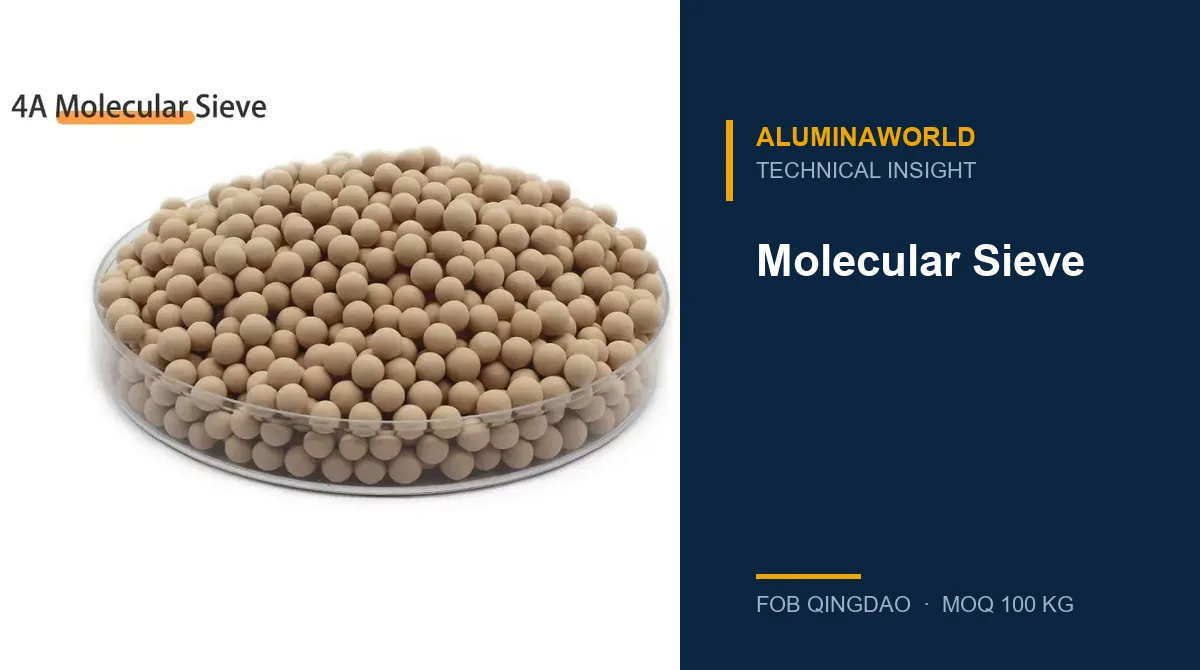
Molecular Sieve 4A / 5A / 13X for PSA / TSA Service — Low-Sodium, Lot-by-Lot COA
Low-chloride potassium-form 4A / 5A / 13X molecular sieve for cyclic-regeneration PSA service, supplied with lot-by-lot COA and Certificate of Compliance (COC). Low SiO2/Al2O3 ratio minimises bed attrition, which directly reduces the dust load the regeneration exhaust blower must handle, meaning a quieter feed, less wire-mesh plugging, and longer blower bearing life.
View Product Details →