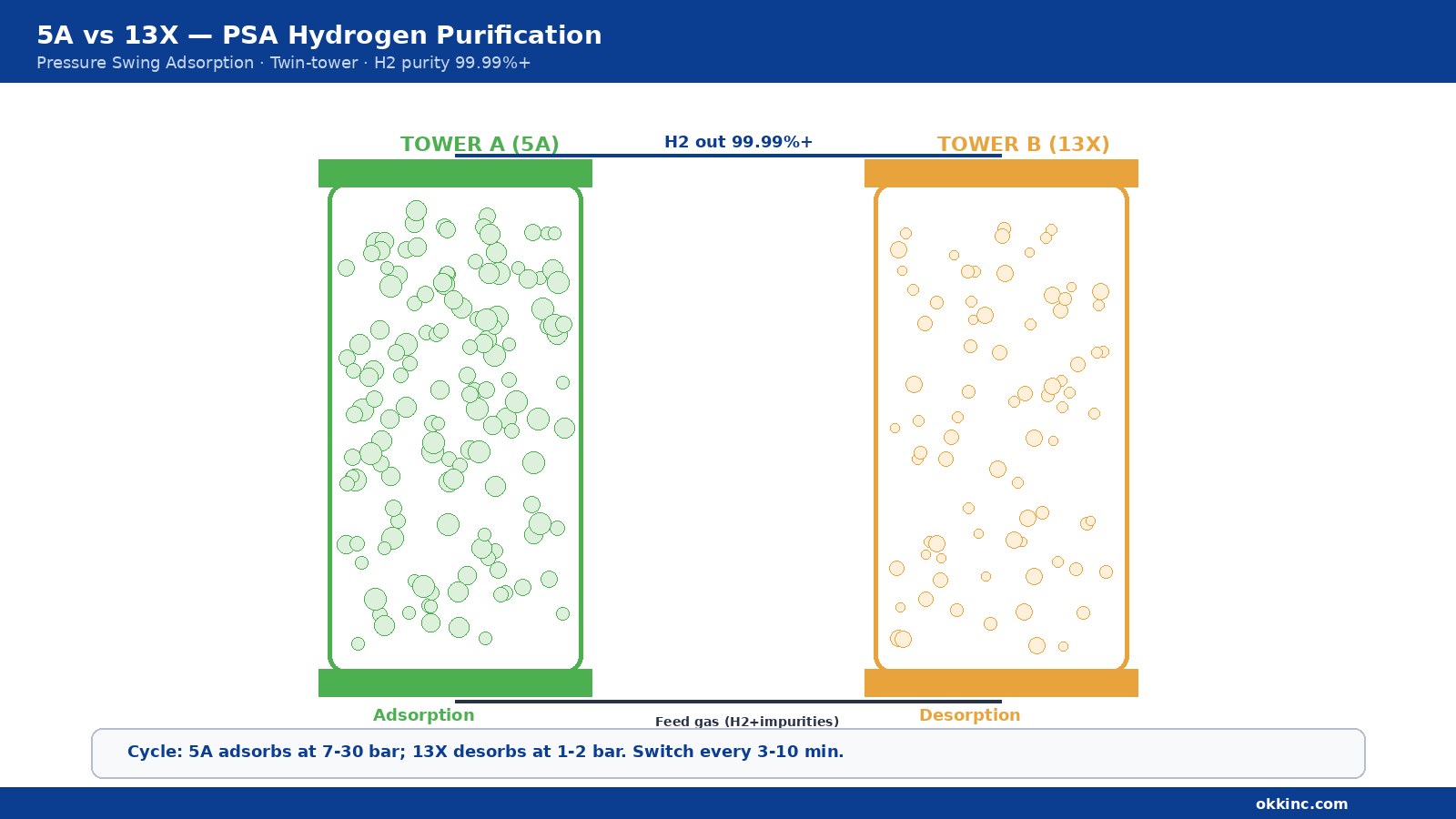
PSA (Pressure Swing Adsorption) hydrogen purification is one of the few applications where two molecular sieve grades, 5A and 13X, are routinely considered as alternatives. The right choice depends on feed gas composition, target purity, and the relative cost of compression versus adsorbent replacement.
At Aluminaworld, we ship both grades to refinery hydrogen plants, methanol reformers, and chlor-alkali operators. The decision matrix below reflects data from over 80 PSA units we have supported since 2018, including one flagship installation where switching from 13X to 5A doubled sieve life.
Both sieves have 5-angstrom effective pore size (5A = calcium-exchanged type A; 13X = sodium type X with 10-angstrom pore that discriminates by molecule size). The key difference is selectivity: 5A excludes all branched and cyclic C6+ hydrocarbons, while 13X admits normal paraffins up to about C12.
1. Pore Structure and Selectivity: The Fundamental Difference
The 5A zeolite has a pore aperture of about 4.9 angstroms (0.49 nm), just large enough to admit normal paraffins up to C5 (n-pentane kinetic diameter ~4.3 angstroms) but excluding all branched and cyclic hydrocarbons. The 13X has 9 to 10 angstrom pore aperture and a different cation arrangement, admitting normal paraffins up to C12 plus most aromatics.
For hydrogen purification from a steam-methane reformer (SMR) or partial oxidation (POX) unit, the feed gas typically contains:
- H2: 70 to 75 mol%
- CO2: 20 to 25 mol%
- CH4: 2 to 5 mol%
- CO: 1 to 3 mol%
- N2: 0.5 to 2 mol%
- Higher hydrocarbons (C2+): 50 to 500 ppm
- H2S: 0 to 5 ppm
Both 5A and 13X adsorb CO2, CH4, CO, and N2 while letting H2 pass. The divergence comes with the heavier hydrocarbons and trace contaminants.
2. When 5A Wins: Refinery Hydrogen with Light Feed
In SMR hydrogen plants where the feed is methane-only (no LPG co-feed) and the reformer operates cleanly, 5A delivers:
- Working capacity for CO2: 4.5 to 5.5 wt% at typical PSA conditions
- Working capacity for CH4: 1.8 to 2.2 wt%
- Cycle time: 10 to 15 minutes per bed
- Sieve life: 5 to 8 years
- Power consumption: 0.32 to 0.38 kWh per Nm3 H2
Case Study: Gulf Coast Refinery 2023
A US Gulf Coast refinery had been running 13X for 7 years in their 90,000 Nm3/h hydrogen plant, replacing the bed every 2.5 years due to C6+ hydrocarbon buildup. We sampled the spent bed and confirmed heavy hydrocarbon saturation at 11 wt%; the 13X was holding C7 to C12 paraffins that 5A would have rejected entirely.
Switching to 5A in early 2024 produced three measurable outcomes: sieve life extended from 30 to 78 months at last inspection, H2 recovery improved from 86% to 89% due to lower co-adsorption losses, and feed-side heating duty dropped 8% because the regeneration cycle needed less aggressive thermal swing.
3. When 13X Wins: Feed with Heavy Hydrocarbons or CO2-Heavy Streams
13X retains the edge in two specific scenarios:
- High CO2 partial pressure (above 8 bar in feed). 13X has 30% higher equilibrium capacity for CO2 at high partial pressures, translating to smaller bed size for the same throughput.
- Feed containing LPG, naphtha, or reformer streams with C6+ aromatics. 13X can handle intermittent excursions where 5A would quickly saturate.
If your feed has CO2 partial pressure below 6 bar and C6+ content below 50 ppm, 5A is the more economical choice over a 10-year horizon. Above those thresholds, 13X retains higher working capacity and shorter bed depth.
The Hybrid Configuration
For high-pressure syngas (60 to 80 bar) with 30 mol% CO2, some plants use a layered bed: 13X on top for bulk CO2 removal, 5A below for final polishing. The 13X handles the bulk; 5A ensures trace CH4 and CO slip stays below 100 ppm in the H2 product. We have supplied layered beds for three Chinese coal-to-hydrogen plants since 2022, all reporting 92 to 95% H2 recovery with product purity at 99.99%.
Frequently Asked Questions
Which is cheaper per kg, 5A or 13X?
5A typically runs 8 to 12% lower than 13X due to simpler calcium exchange chemistry and lower raw material cost. The price gap widens at larger volumes.
Can I retrofit an existing 13X bed with 5A?
Yes, as long as vessel geometry and regeneration heater capacity are unchanged. 5A has slightly lower bulk density, so you may need to add 5 to 8% more mass for the same bed volume.
What purity does PSA typically achieve?
99.9 to 99.999% H2 with single-stage PSA. Higher purity requires a deoxygenator (Pd catalyst) downstream.
How do I know when to change the sieve bed?
Track H2 recovery, product purity, and regeneration heater duty monthly. When H2 recovery drops by 3 percentage points or heater duty rises 15%, plan a bed replacement within 6 months.
Do 5A and 13X require different regeneration profiles?
Yes. 5A regenerates well at 220 to 260°C; 13X prefers 240 to 280°C. Using the wrong profile causes incomplete regeneration and premature capacity loss.
Related Molecular Sieve Articles
Molecular Sieve 3A: Ethanol Dehydration and Insulating Glass Applications
Molecular Sieve 4A for Natural Gas and LNG Dehydration: Capacity and Cycle Design
How to Regenerate Molecular Sieve: Temperature, Pressure and Cycle Best Practices
PSA molecular sieve bed sizing
5A molecular sieve regeneration cycle
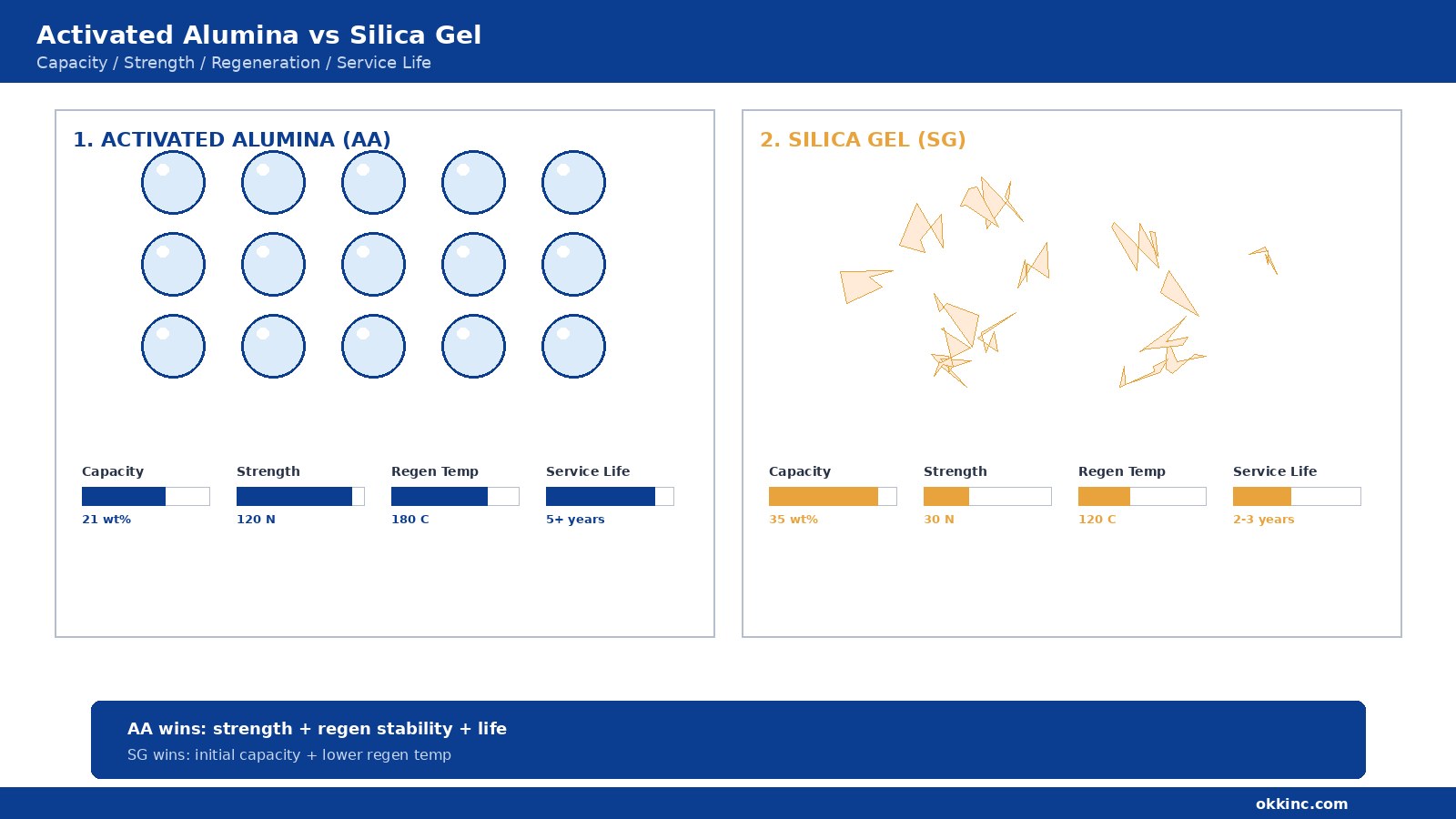
Activated Alumina Vs Silica Gel Desiccant
Need a Quote or Free Sample?
Tell us your feed conditions and target outlet spec. Our engineers reply within 24 hours with a recommendation and a 1 kg free sample.