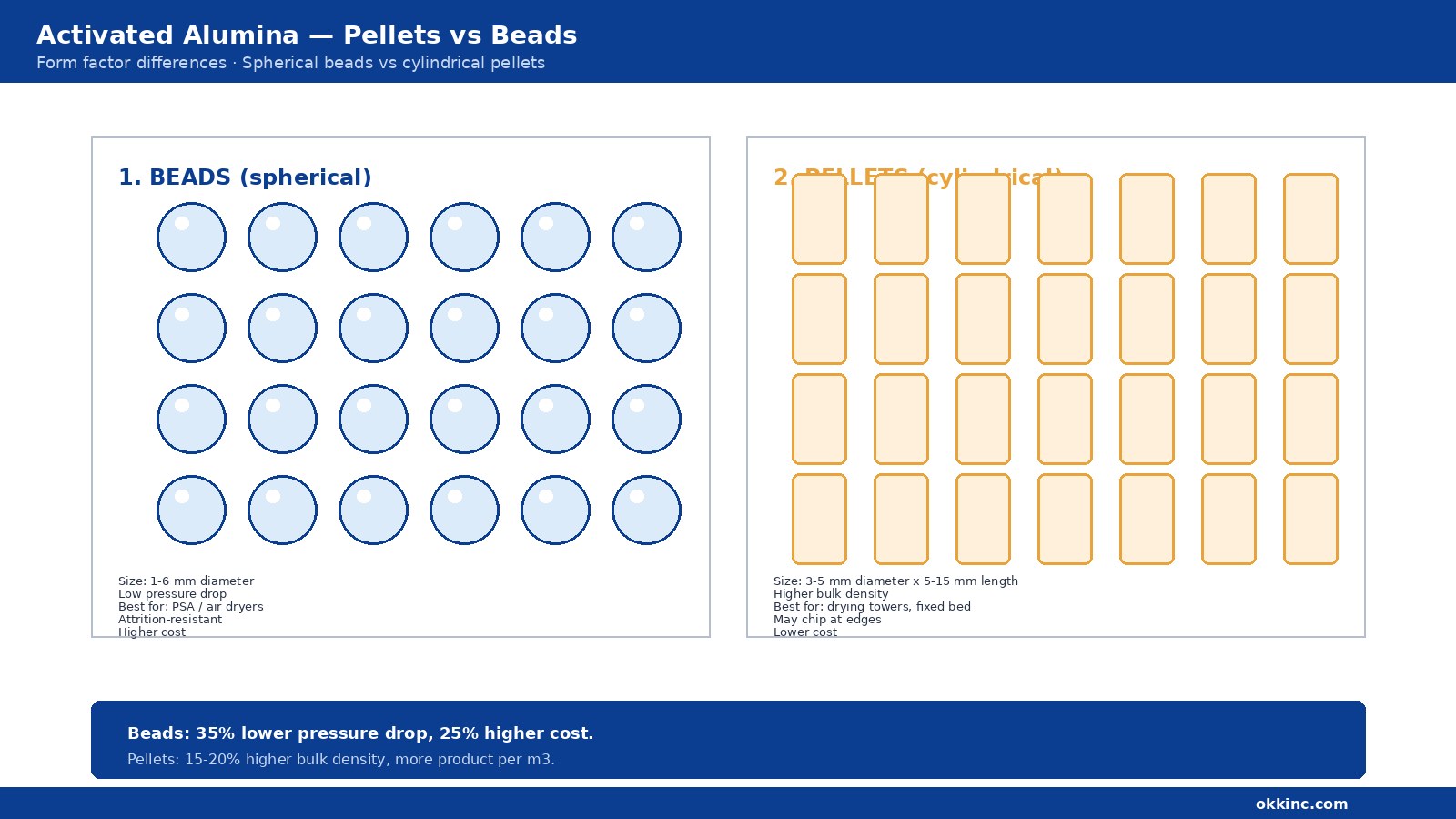
Activated alumina comes in two physical forms: spherical beads (1 to 5 mm diameter) and extruded pellets (1.5 to 4 mm diameter cylinders, typically 3 to 8 mm long). Both deliver the same surface chemistry (300 to 360 m²/g, gamma-alumina phase), but their mechanical and hydraulic properties differ significantly.
activated alumina surface area differences pellet vs beadThe choice between beads and pellets usually comes down to three factors: pressure drop sensitivity, mechanical stress on the bed, and regeneration gas flow direction. Below we walk through each.
At Aluminaworld, we manufacture both forms in dedicated production lines. Approximately 70% of our activated alumina shipments are beads (the more common form), but pellets have specific advantages in catalyst support and certain drying applications.
1. Beads: The Default Choice for Most Drying Applications
Activated alumina beads are made by oil-drop or spray-dry agglomeration, producing highly spherical particles with smooth surfaces. The shape gives:
- Lower pressure drop per bed volume. Spheres pack with consistent void fraction (about 40%); pellets can pack to 35% or higher depending on orientation.
- Higher crush strength per particle. A 3 mm bead typically withstands 130 N; a 3 mm pellet withstands 80 to 100 N depending on aspect ratio.
- Better fluidization. In fluidized-bed applications (rare for alumina), beads fluidize uniformly.
- Less dust generation. Smooth bead surface means less attrition in packed beds.
Standard Bead Grades
| Grade | Size | Typical Use |
|---|---|---|
| AA-1.6 | 1.6 to 2.5 mm | General compressed air drying |
| AA-3.0 | 3.0 to 5.0 mm | Deep-bed PSA, high flow |
| AA-0.5 | 0.5 to 1.0 mm | Defluoridation, IGU |
| AA-5.0 | 5.0 to 8.0 mm | Very deep beds, low delta-P |
2. Pellets: When Cylinder Shape Wins
Extruded pellets are formed by pushing alumina paste through a die and cutting to length. The cylinder shape creates:
- Higher bulk density (10 to 15% more mass per bed volume). Pellets pack more tightly, useful when vessel volume is fixed.
- More surface area per gram (typically 350+ m²/g vs 300 for beads). The extrusion process creates more microporosity.
- Higher attrition (1 to 2% vs 0.1% for beads). Edges and corners wear faster than sphere surfaces.
Pellets are preferred in:
- Catalyst support applications: the cylindrical shape handles thermal cycling better in fixed-bed reactors.
- Compressed air dryers with horizontal flow: pellets do not roll to the outlet as beads can under high gas velocity.
- Applications with extreme regeneration cycles: pellets tolerate more thermal stress without cracking.
3. Decision Matrix: Beads or Pellets?
The table below summarizes when to choose which form. If you have any doubt, start with beads; they are the more forgiving choice for most drying applications.
| Criterion | Choose Beads | Choose Pellets |
|---|---|---|
| Pressure drop sensitive | Yes | - |
| Dust-free requirement | Yes | - |
| Catalyst support | - | Yes |
| Vessel volume limited | - | Yes |
| Vibration or motion | Yes | - |
| Frequent regeneration | - | Yes |
| Maximum surface area | - | Yes |
If you are still unsure, our engineering team can review your application data and recommend the optimal form. We supply free 1 kg samples of both forms so you can run a side-by-side pilot test in your own facility.
Frequently Asked Questions
Can I switch from beads to pellets in an existing bed?
Generally no, because bulk density and bed volume differ. A pellet bed will have 10 to 15% more mass; the change in pressure drop may require fan or blower adjustment.
Are pellets more expensive than beads?
Typically 10 to 15% higher per kg due to more complex manufacturing. The premium is justified when the application requires the specific pellet advantages.
Which form is better for outdoor installations?
Beads, because their smoother surface sheds rain and dust better. Pellets can trap debris in the interstitial spaces between cylinders.
Do you supply custom sizes?
Yes. Common custom sizes include 2.0 to 3.0 mm beads and 1.5 mm diameter pellets. Minimum order: 500 kg for custom sizes.
What is the shelf life?
60 months in sealed packaging. Activated alumina is hygroscopic; opened drums should be used within 3 months or re-sealed with desiccant.
Related Activated Alumina Articles
Activated Alumina Defluoridation: Breakthrough Curves and Bed-Life Economics
Activated Alumina vs Silica Gel: Which Desiccant Is Better for Industrial Drying?
Activated Alumina in Compressed Air Dryers: Pressure Dew Point Control
activated alumina surface area differences pellet vs bead
activated alumina bed-life in defluoridation
Molecular Sieve 3A Application Guide
Need a Quote or Free Sample?
Tell us your feed conditions and target outlet spec. Our engineers reply within 24 hours with a recommendation and a 1 kg free sample.