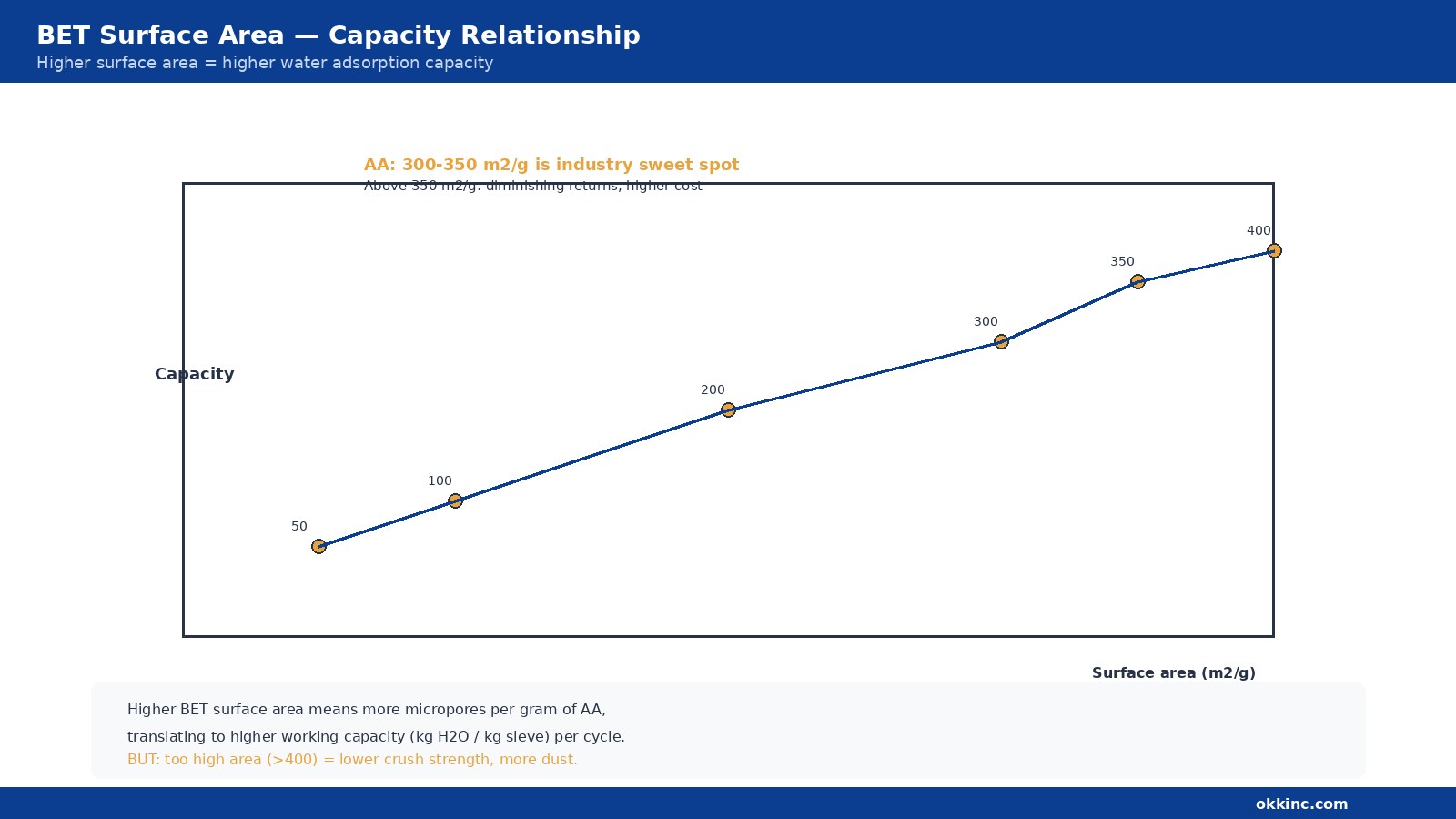
Surface area is the headline specification on every activated alumina datasheet, and the gap between "standard" (300 m²/g) and "premium" (350 m²/g) grades often comes with a 15 to 25% price premium. The question every buyer should ask: does the higher surface area actually translate to better adsorption performance in my application?
defluoridation breakthrough curve impactThe honest answer: usually yes, but the magnitude depends on the specific application. For most compressed air drying, the difference is small (5 to 10%). For defluoridation and certain catalyst support applications, the difference can be 15 to 25%. For Claus catalyst carriers and H2O2 applications, surface area is the dominant performance variable.
This article breaks down where higher surface area matters, where it does not, and how to specify the right grade for your specific application.
1. What Surface Area Actually Measures
BET surface area (named after Brunauer, Emmett, and Teller) measures the total accessible surface including micropores (under 2 nm), mesopores (2 to 50 nm), and the external geometric surface. For activated alumina, the relevant surface is mostly mesopores in the 5 to 15 nm range, the size range where water, fluoride, and most organic molecules adsorb.
Higher BET does not automatically mean more adsorption capacity for a specific molecule. The pore size distribution matters as much as the total area. A 300 m²/g alumina with most pores at 8 to 12 nm may outperform a 350 m²/g alumina with most pores at 4 to 6 nm for adsorbing larger molecules.
Why Higher Surface Area Costs More
The production process to achieve 350+ m²/g requires:
- Lower calcination temperature (450 vs 550°C) to preserve more pore structure
- More precise control of the gelation step (aluminum hydroxide to alumina hydrogel)
- More aging time (24 to 48 hours vs 12 hours) to develop pore structure
- Higher rejection rate (15 to 20% of production fails to meet 350 m²/g spec)
The combination of these factors explains the 15 to 25% price premium.
2. Applications Where Higher Surface Area Matters Most
1. Defluoridation (20 to 25% capacity lift)
Water molecules adsorb in the 5 to 8 nm pore range. Higher surface area means more of these pores, which directly translates to higher fluoride capacity. For a 50 m³/day defluoridation plant, switching from 300 to 350 m²/g extends regeneration cycles by 5 to 7 days per cycle.
2. Catalyst Carrier (Claus, H2O2, FCC) - 15 to 20% activity lift
Catalyst performance correlates strongly with surface area because the active metal (Ni, Mo, Pd, etc.) disperses across the surface. Higher area = better dispersion = higher activity. The 15 to 25% premium pays back within 6 to 12 months in catalyst lifetime.
3. Trace Contaminant Removal - 10 to 15% capacity lift
Applications like removing trace moisture from refrigerants or breaking peroxides in solvents depend on high surface area because the working capacity is small (often 1 to 3 wt%). A 10 to 15% capacity lift significantly extends bed life.
3. Applications Where Higher Surface Area Does Not Matter
1. Compressed Air Drying (5 to 8% capacity lift)
Compressed air drying is dominated by bulk water removal, not surface-dependent adsorption. The 300 m²/g grade performs within 5 to 8% of the 350 m²/g grade. Pay the premium only if your PDP target is below -40°C.
2. Transformer Breathing (5% lift or less)
Breathers operate at low load (only the moisture that ingresses during temperature cycling). Both grades handle the load easily. Choose the standard grade and pocket the savings.
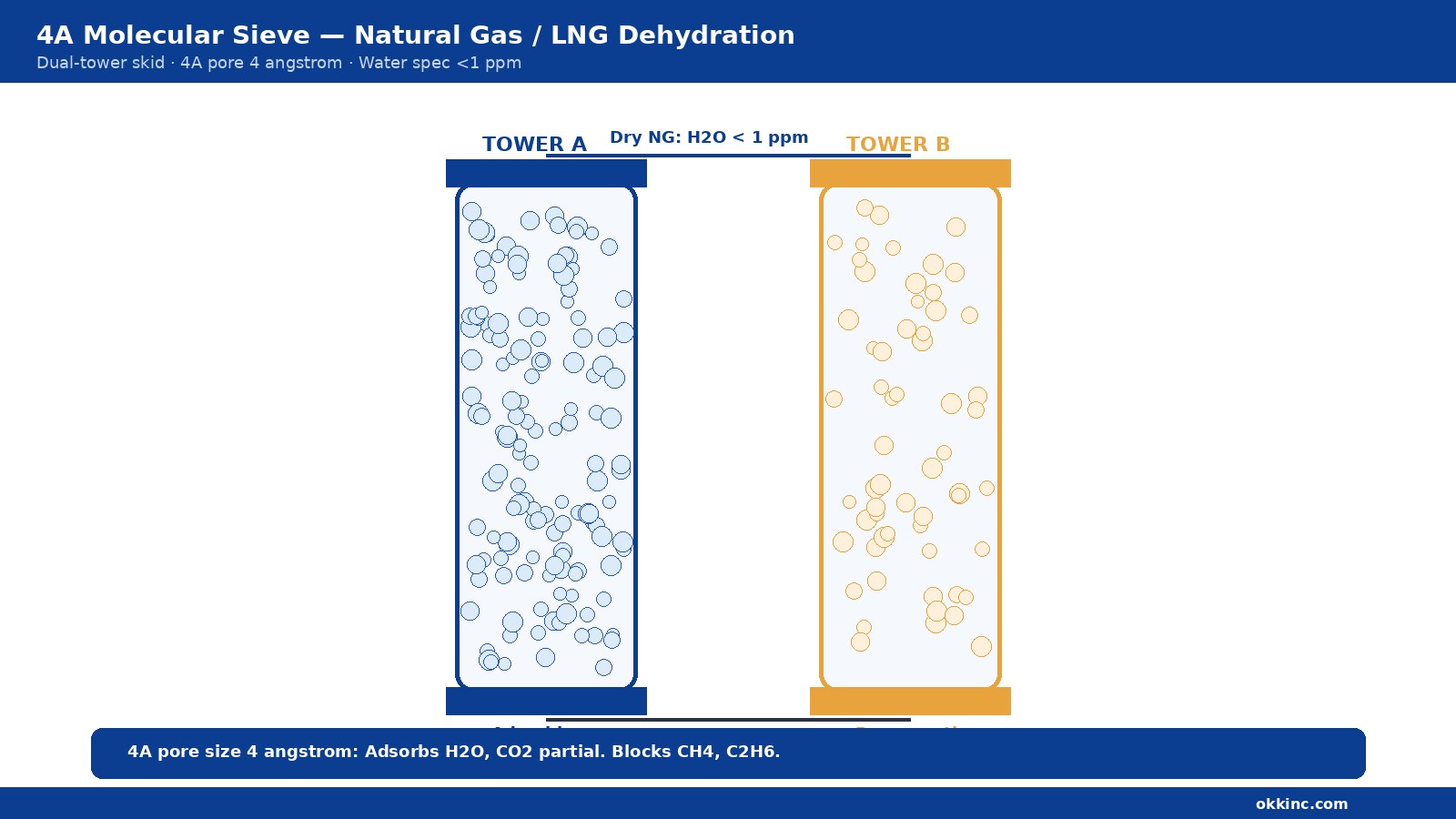
3. Natural Gas Dehydration at High Pressure (5 to 8% lift)
At pressures above 30 bar, water adsorption is more dependent on pressure and temperature than on surface area. Choose based on crush strength and attrition resistance, not surface area.
If you are unsure which grade to specify, our engineers can model your specific application and recommend the most cost-effective grade. Send us your operating conditions and we will reply within 24 hours with a recommendation and a 1 kg sample for evaluation.
Frequently Asked Questions
What is the difference between BET surface area and Langmuir surface area?
BET uses multilayer adsorption theory; Langmuir assumes monolayer coverage. BET is the industry standard for activated alumina. Langmuir values are typically 20 to 30% higher than BET for the same material.
Does higher surface area mean lower crush strength?
Not necessarily, but there is a trade-off. Higher surface area usually means more microporosity, which can reduce mechanical strength. Our 350 m²/g grade maintains at least 130 N/particle crush strength through careful pore engineering.
How is surface area measured?
BET method using nitrogen adsorption at 77 K (liquid nitrogen temperature). The test takes 2 to 4 hours per sample and costs $80 to $150 per sample at commercial labs.
Does surface area change with use?
It decreases over time as pores become blocked by adsorbed species and structural sintering. A typical activated alumina loses 15 to 25% of its initial surface area over 5 years of service.
What is the maximum surface area achievable for activated alumina?
About 400 m²/g for transition alumina (gamma, eta, chi phases). Above this, the structure becomes mechanically unstable. Some specialty aluminas claim higher values using templating methods, but they are not yet commercial.
Related Activated Alumina Articles
Activated Alumina Defluoridation: Breakthrough Curves and Bed-Life Economics
Activated Alumina vs Silica Gel: Which Desiccant Is Better for Industrial Drying?
Activated Alumina Pellets vs Beads: Form Factor Differences in Industrial Use
defluoridation breakthrough curve impact
compressed air drying with surface area 300 vs 350
Molecular Sieve 3A Application Guide
Need a Quote or Free Sample?
Tell us your feed conditions and target outlet spec. Our engineers reply within 24 hours with a recommendation and a 1 kg free sample.