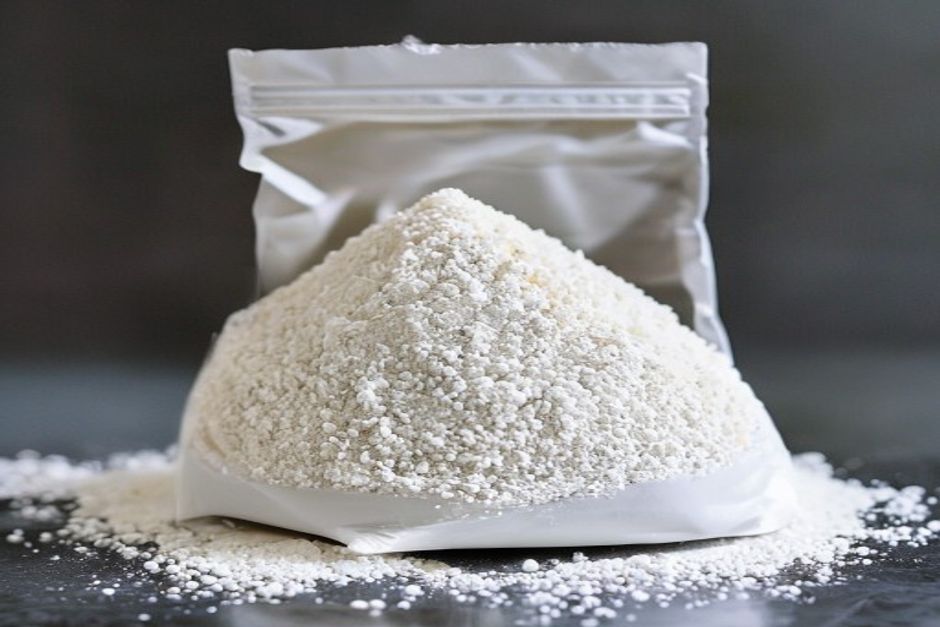
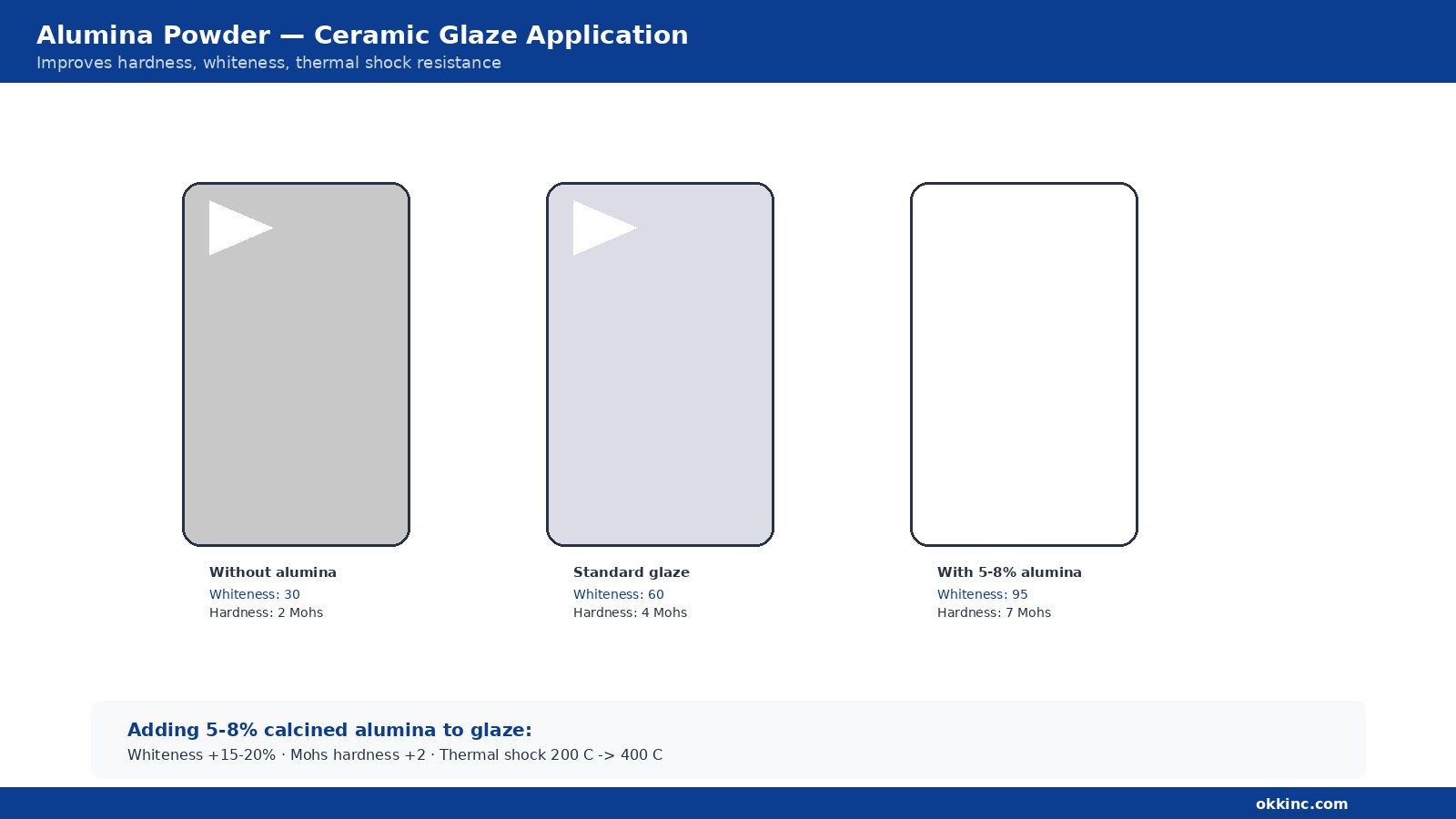
Alumina powder is the single most effective additive for improving ceramic glaze hardness, scratch resistance, and thermal shock tolerance. A glaze formulation with 8 to 15% alumina hydrate (or 6 to 12% calcined alumina) delivers a Mohs hardness increase from 5 to 7+, transforms scratch resistance, and dramatically reduces crazing from thermal cycling.
calcined vs tabular alumina for ceramicsAt Aluminaworld, we supply approximately 1,500 MT/year of calcined alumina specifically for ceramic glaze applications, supporting tile manufacturers in India, Italy, Spain, Turkey, and Brazil. The data below reflects customer feedback across hundreds of glaze formulations.
Whether you are formulating a new glaze or troubleshooting an existing one, this guide covers the grade selection, dosing strategy, and processing tips that deliver consistent results.
1. How Alumina Strengthens Glaze: The Chemistry
Alumina in a glaze functions primarily as a glass former and stabilizer. In the silicate melt, Al3+ ions coordinate with oxygen to form AlO4 tetrahedra that strengthen the glass network. The result is a glaze that:
- Resists scratching (Mohs 6 to 8 vs 5 to 6 for silica-only glazes)
- Tolerates thermal cycling (coefficient of expansion can be tuned)
- Resists chemical attack (acids, alkalis, food stains)
- Holds color stability under UV exposure
Alumina as Al(OH)3 vs Calcined Al2O3
Aluminum hydroxide (Al(OH)3) releases water during firing, creating a more porous initial glaze that densifies as the firing continues. Calcined alumina starts dense and contributes directly to the glass network. The choice depends on firing temperature and desired surface texture.
For firing temperatures below 1,200 degrees C, aluminum hydroxide is preferred; it provides better melt homogeneity. For firing above 1,200 degrees C, calcined alumina is preferred; it avoids the bubbles and pinholes that water release can create.
2. Dosing Strategy by Application
Floor and Wall Tiles (Firing 1,100 to 1,200 degrees C)
Use aluminum hydroxide at 8 to 12% of the dry batch. Particle size: D50 around 10 to 15 micrometer for fast dissolution in the melt. Excessive fines (below 5 micrometer) can cause crawling on the tile surface.
Tableware and Sanitaryware (Firing 1,200 to 1,280 degrees C)
Use calcined alumina at 10 to 15% of the dry batch. Particle size: D50 around 5 to 8 micrometer for fast dissolution without surface defects. The denser particles also help resist the thermal shock of dishwashing and autoclaving.
High-Performance Technical Ceramics (Firing 1,400 to 1,600 degrees C)
Use reactive calcined alumina (D50 below 1 micrometer, surface area 50+ m2/g) at 15 to 25% of the dry batch. The high reactivity enables full densification at the upper end of the firing range, achieving 95%+ density and exceptional hardness.
3. Common Problems and How to Fix Them
Problem 1: Glaze Crawling
The glaze pulls away from the tile edge during firing, leaving bare patches. Cause: too-fine alumina particles, or excessive binder shrinkage. Fix: switch to D50 of 8 to 12 micrometer, reduce alumina content by 2 to 3%, and ensure the binder (CMC) is properly hydrated.
Problem 2: Crazing (Fine Cracks in Cooled Glaze)
Crazing happens when the glaze coefficient of expansion is higher than the body. Adding alumina lowers the glaze expansion coefficient. Fix: increase alumina content by 2 to 4% incrementally until crazing stops.
Problem 3: Pinholes and Bubbles
Gas evolution during firing leaves small holes in the glaze surface. Cause: water release from aluminum hydroxide or organic contamination. Fix: switch to calcined alumina, ensure proper bisque firing temperature to burn off organics, and extend the firing hold time at peak temperature by 10 to 15 minutes.
For complex glaze issues, our ceramic engineers can review your full formulation and recommend adjustments. We supply free 1 kg samples of multiple grades so you can run side-by-side trials.
Frequently Asked Questions
Which mesh size is best for tile glaze?
D50 between 5 and 15 micrometer works for most tile applications. Below 5 micrometer causes crawling; above 20 micrometer gives slower dissolution and visible grain.
Does alumina affect glaze color?
Indirectly yes. Alumina stabilizes the glass network, which makes colorants (iron, cobalt, copper) more consistent and reproducible. It does not add color itself.
Can I use tabular alumina in glazes?
Not recommended. Tabular alumina does not dissolve in the melt at typical glaze firing temperatures. Use calcined or reactive grades.
Is there a food-safe grade?
Yes. Our calcined alumina for tableware glaze meets FDA 21 CFR and EU REACH food contact requirements. We provide certification with each shipment.
What is the typical price for ceramic-grade alumina?
Calcined alumina for ceramic glaze runs $1,200 to $2,000 per MT depending on mesh size and soda content. Reactive grades are 30 to 50% higher.
Related Alumina Powder Articles
Calcined Alumina vs Tabular Alumina: Choosing the Right Alpha-Al2O3 Grade
Alumina Powder as Paint Filler: Abrasion Resistance and Anti-Slip Coatings
High Purity Alumina (HPA) for Lithium Battery Separator Coating: 4N vs 5N
calcined vs tabular alumina for ceramics
alumina powder for precision polishing
Molecular Sieve 3A Application Guide
Need a Quote or Free Sample?
Tell us your feed conditions and target outlet spec. Our engineers reply within 24 hours with a recommendation and a 1 kg free sample.